Planning & Strategy
Committee MEETING
11 May 2022
Order of Business
1. Apologies
2. Notification
of Additional Items
Pursuant to Sections 46A(7) and 46A(7A)
of the Local Government Official Information and Meetings Act 1987, to receive
the Chairperson’s explanation that specified item(s), which do not appear
on the Agenda of this meeting and/or the meeting to be held with the public
excluded, will be discussed.
Any additions in accordance with
Section 46A(7) must be approved by resolution with an explanation as to why
they cannot be delayed until a future meeting.
Any additions in accordance with
Section 46A(7A) may be received or referred to a subsequent meeting for further
discussion. No resolution, decision or recommendation can be made in
respect of a minor item.
3. Declarations
of Interest (if any)
Members are reminded of their duty
to give a general notice of any interest of items to be considered on this
agenda and the need to declare these interests.
4. Public
Comment
To receive comments from members of
the public on matters specified on this Agenda or, if time permits, on other
Committee matters.
(NOTE: If
the Committee wishes to consider or discuss any issue raised that is not
specified on the Agenda, other than to receive the comment made or refer it to
the Chief Executive, then a resolution will need to be made in accordance with
clause 2 above.)
5. Confirmation
of Minutes Page 7
“That the minutes of the
Planning & Strategy Committee meeting of 13 April 2022 Part I Public be
confirmed as a true and correct record.”
6. Options
for Road Closure Page 13
Memorandum, presented by Julie
Macdonald, Strategy & Policy Manager and Chris Lai, Senior Transportation
Engineer.
7. Committee
Work Schedule Page 23
8. Wastewater
Discharge Consent Project - Progress Update Page 25
Memorandum, presented by Mike
Monaghan, Group Manager - 3 Waters.
9. Exclusion
of Public
|
|
To be moved:
“That the
public be excluded from the following parts of the proceedings of this
meeting listed in the table below.
The general
subject of each matter to be considered while the public is excluded, the
reason for passing this resolution in relation to each matter, and the
specific grounds under Section 48(1) of the Local Government Official
Information and Meetings Act 1987 for the passing of this resolution are as
follows:
|
General subject of each matter to be
considered
|
Reason for passing this resolution in
relation to each matter
|
Ground(s) under Section 48(1) for
passing this resolution
|
|
10.
|
Wastewater Discharge Consent Project - Progress
Update (Attachment 2)
|
Legal Privilege -s7(2)(g)
|
Legal Privilege -s7(2)(g)
|
|
|
|
|
This
resolution is made in reliance on Section 48(1)(a) of the Local Government
Official Information and Meetings Act 1987 and the particular interest or
interests protected by Section 6 or Section 7 of that Act which would be
prejudiced by the holding of the whole or the relevant part of the
proceedings of the meeting in public as stated in the above table.
Also that the
persons listed below be permitted to remain after the public has been
excluded for the reasons stated.
[Add Third
Parties], because of their knowledge and ability to assist the
meeting in speaking to their report/s [or other matters as specified] and
answering questions, noting that such person/s will be present at the meeting
only for the items that relate to their respective report/s [or matters as
specified].
|
Memorandum
TO: Planning
& Strategy Committee
MEETING DATE: 11
May 2022
TITLE: Options
for Road Closure
Presented By: Julie
Macdonald, Strategy & Policy Manager and Chris Lai, Senior Transportation
Engineer
APPROVED BY: David
Murphy, Chief Planning Officer
Sarah Sinclair, Chief
Infrastructure Officer
RECOMMENDATION TO Planning & Strategy Committee
1. That the
Committee receive the memorandum titled ‘Options for Road Closure’
dated 11 May 2022.
1. ISSUE
In March 2022 the Planning and
Strategy Committee considered the report titled ‘Options to address
’street racer’ issues. Among other decisions, the Committee
resolved:
That the Chief Executive
provide an update on engineering and legal solutions to the Planning and
Strategy Committee in May 2022.
That option 4 is explored
fully, engaging a specific piece of work, asking the Chief Executive and
officers to explore how a ‘temporary gate structure’ can work on
Longburn and North East Industrial Parks.
This memorandum is in response
to these resolutions.
2. BACKGROUND
In March 2022 officers provided
a report to the Planning and Strategy Committee in response to a resolution in
October 2021:
That
the Chief Executive investigate the anti-social and ‘street racer’
activity occurring at various locations on the outskirts of Palmerston North
and provide advice on the various options Council could pursue to address this
problem.
The report provided an analysis
against criteria of each of the identified options and made recommendations to
Committee and Council about future actions to help address the problem. The
options were:
Option 1: Limit access to Works Road through a bylaw
Option 2: Develop a ‘Cruising Bylaw’
Option 3: Make Works Road a ‘No Parking’
area
Option 4: Temporarily close Works Road
Option 5: Permanently close Works Road
Option 6a: Physical deterrent (installation of speed
humps)
Option 6b: Physical deterrent (surface treatment)
Council adopted the
recommendations of the report, to proceed with options 1 and 3, and 6a. Work is
underway to implement those options.
At the Planning and Strategy
Committee there was discussion about the report recommendation that temporary
road closure (option 4) would not be an effective response to the identified
problem. Following this discussion, the Committee resolved to further
investigate option 4, the temporary closure of Works Road and North East
Industrial Parks, and, to consider the viability of gates at those locations.
The Committee also resolved to receive an update on engineering and legal
solutions.
3. discussion
Engineering update
Staff continue to monitor
emerging roading treatments. Speed humps have been installed at both Works Road
and El Prado Drive and staff are in the process of implementing the parking
restrictions described in the earlier report. Staff continue to liaise with
other councils to share ideas and information about effective responses to
street racers.
Temporary road closure using
gates
The Committee has requested
further information about the use of ‘temporary gate structures’ to
close Works Road and/or the North East Industrial Park. In the March report to
Committee the various options were evaluated against these criteria:
a. Legal -whether the option can be implemented
under law
b. Viable
– whether the option can be practicably implemented
c. Effective
– whether the option will work
d. Enduring
– how long the option will last
e. Applicable
to other locations
f. Timely
– how quickly the option can be implemented
g. Avoids
other adverse effects
This report expands on the
advice already received to consider the legal and practical issues of achieving
temporary road closure through the use of gates.
Legal advice
This section of the report considers the legal issues
involved in installing gates to control access to Works Road and El Prado
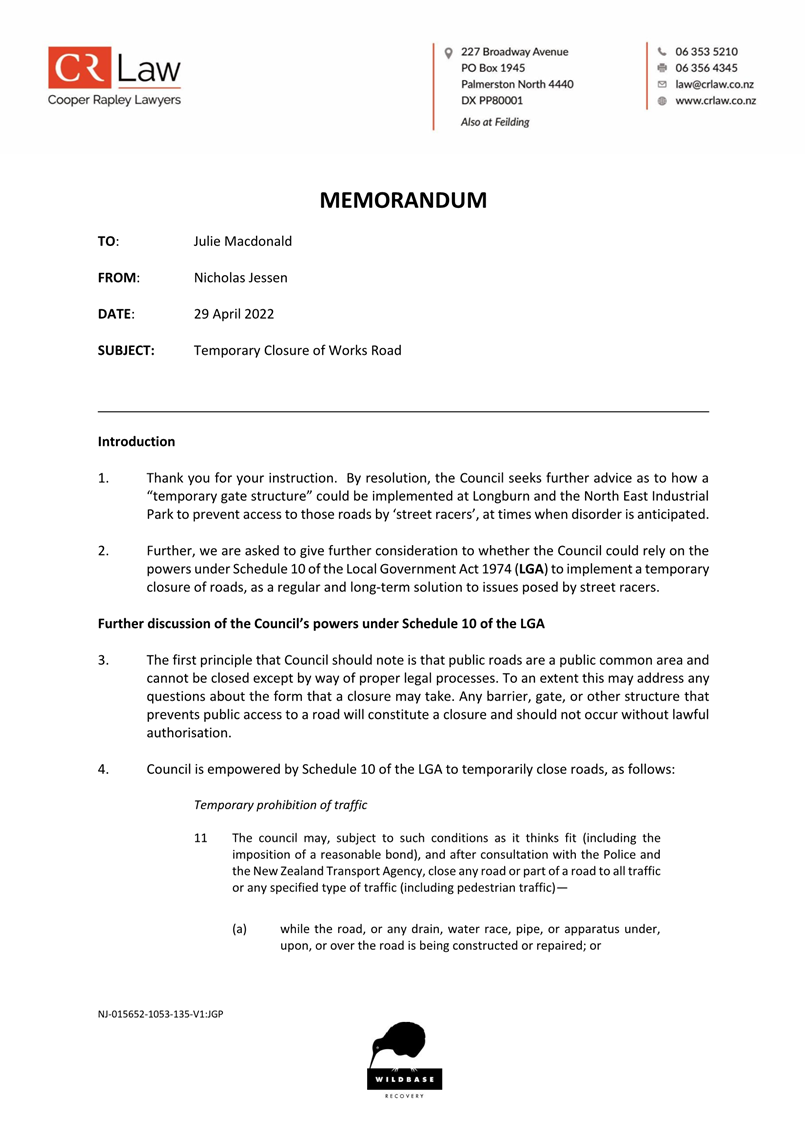
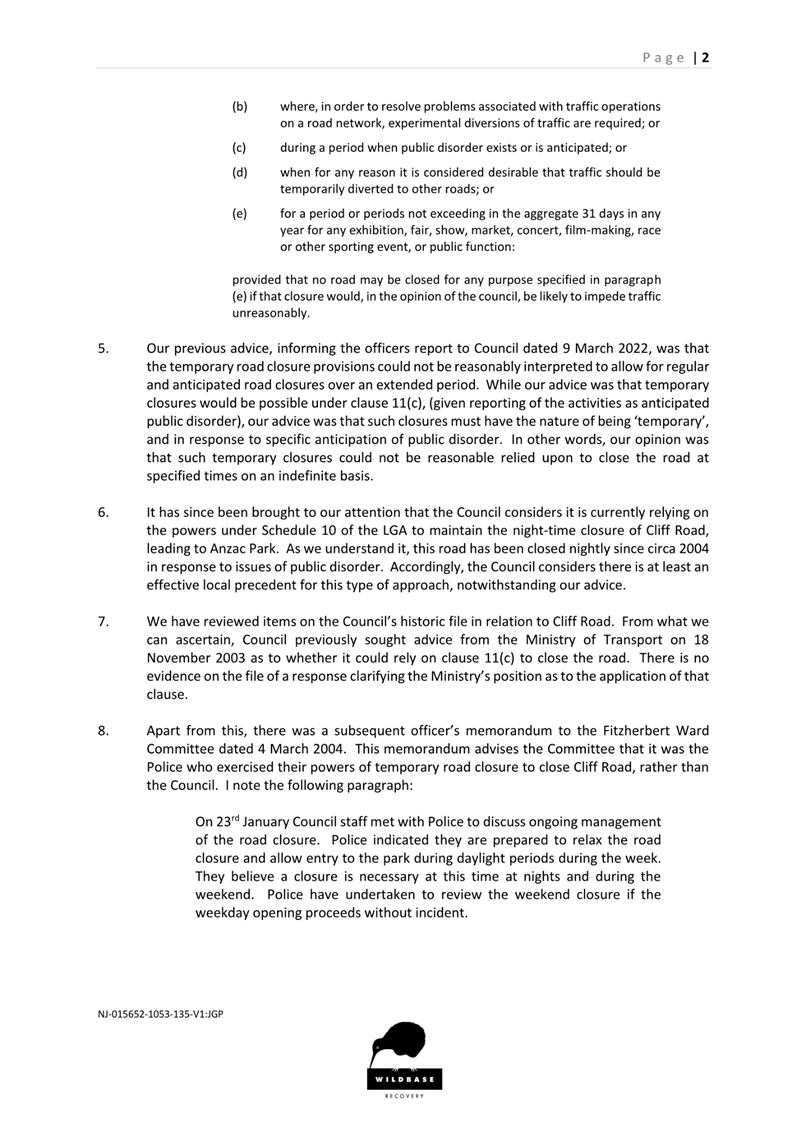
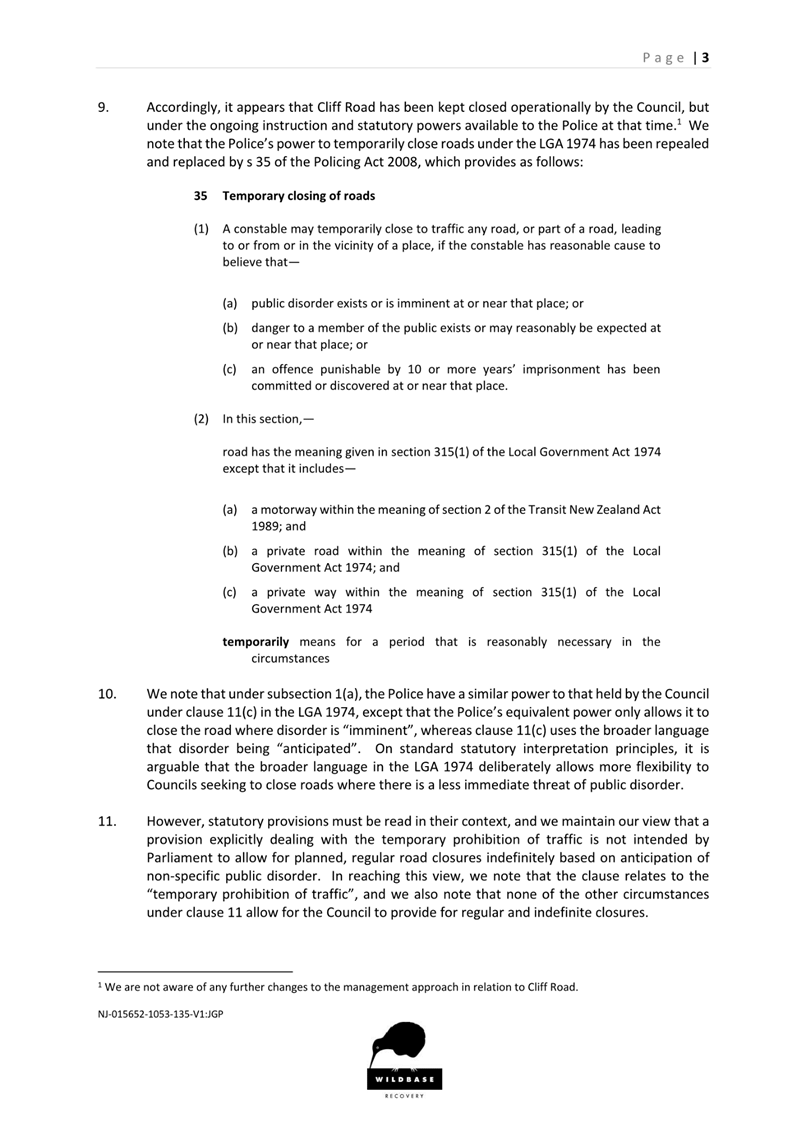
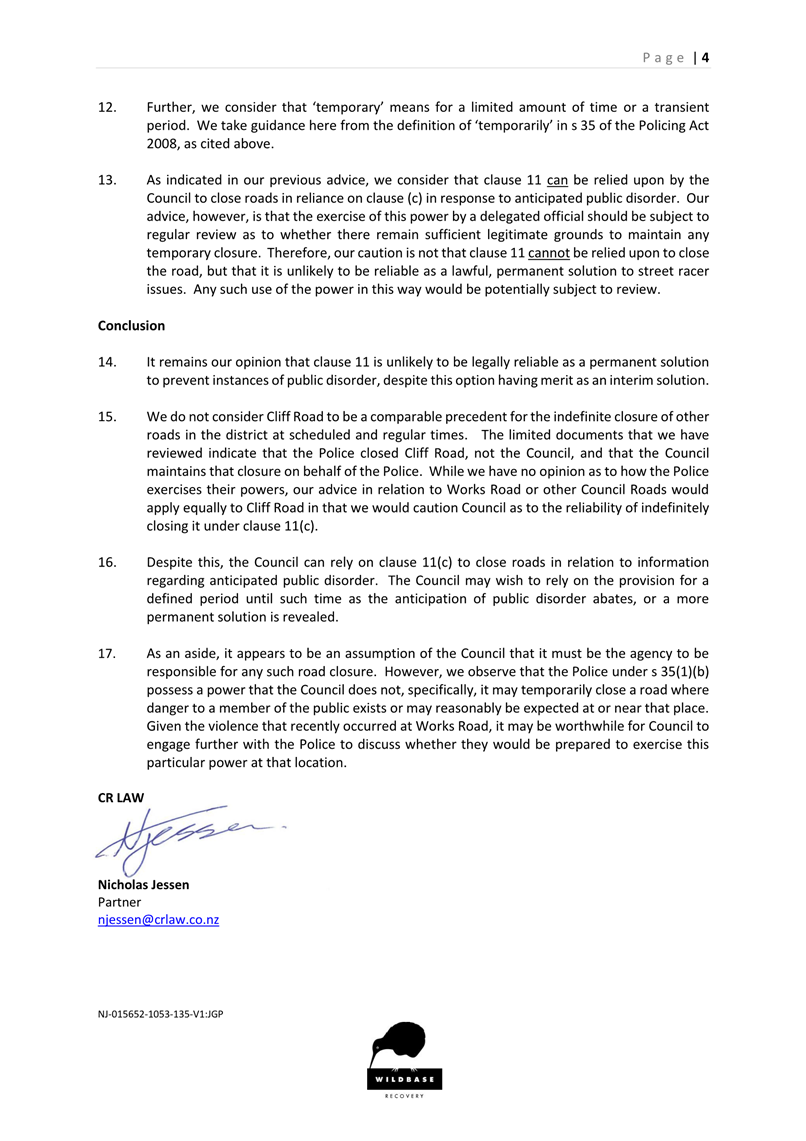
Drive. CRLaw has provided advice on this matter, which is appended as
attachment 1. The legal advice notes that temporary road closure has merit it
is unlikely to be legally reliable as a permanent solution to the identified
problem. The advice suggests that if any temporary road closure is made, that
this should be for a defined period until such time as the anticipation of
public disorder abates.
Viability
This section of the report considers the practical issues
involved in installing gates to control access to either site. This would be
achieved through some type of pin-entry mechanism (for example, through an app
or a key-pad, or with a swipe card or fob at the entry point). The installation
of gates at either location poses several challenges:
- Whatever
mechanism was installed would require ongoing Council support to manage access,
including on-call response for fire and emergency and contact from legitimate
users unable to gain access. Unlike some locations (such as Otene Road in
Hastings) with a limited number of residential properties on a closed road,
each of the industrial park sites has many vehicle movements by multiple
parties. Maintenance of a secure pin system or the provision of cards/ fobs
would require ongoing Council support. In general, the greater the number of
people with access to the gate, the less secure the gate will be, due to the
increasing likelihood of access codes being shared.
- The
cost of installing gates would likely be in excess of $50,000 per location plus
the cost of the technology to enable access and ongoing operational costs.
Staff note that other mechanisms, such as bollards, would be a much greater
cost.
- Because
these sites are public roads, the control of any gate mechanism cannot be
handed over to private parties. Some instances which have been cited as
analogous to the Palmerston North sites (such as Tidal Road in Auckland) are
private roads, where the property owners can manage their own access. As the
road controlling authority, the Council cannot delegate responsibility and so
would need to remain responsible for managing access. This would potentially be
a 24-hour availability response, and so would incur staffing and out-of-hours
costs.
- Any
gate structure would need an appropriate turning area which would cost in
excess of $100,000 per site and may require additional land to be purchased
from adjacent properties. There may also be a requirement for fencing of
adjacent properties. This provision would be to enable the safe exit for any
vehicles failing to gain access to the closed road.
- Similarly,
consideration would need to be given to managing any queued traffic waiting to
gain access through a gate, which may require changes in road layout.
- While
the objective may be for temporary road closure (see the legal issues, above)
the mechanisms required to achieve road closure are essentially of a permanent
nature.
Summary
The Committee requested advice about how a temporary gate
structure could work at the two locations under discussion. Staff consider that
the installation of gates is not a viable solution to the problem due to the
significant cost, resourcing implications and other challenges to achieving
safe and effective access to the site/s while gates are in place.
Officers also note that the scheduled regular closures on an
indefinite basis is not likely to be legally reliable as a permanent solution
to the problem identified. In addition to the considerable logistic issues in
achieving road closure through the installation of gates, the other problems
identified in the March report remain. For example, street racer activity may
be diverted to other, potentially residential, locations.
4. NEXT STEPS
This memo is for information
only. If the recommendation is received then there will be no further actions,
other than those previously agreed as outcomes of the earlier report (in March
2022).
5. Compliance and administration
|
Does the Committee have delegated
authority to decide?
If Yes quote relevant clause(s)
from Delegations Manual
|
Yes
|
|
Are the decisions significant?
|
No
|
|
If they are significant do they
affect land or a body of water?
|
No
|
|
Can this decision only be made
through a 10 Year Plan?
|
No
|
|
Does this decision require
consultation through the Special Consultative procedure?
|
No
|
|
Is there funding in the current
Annual Plan for these actions?
|
Yes
|
|
Are the recommendations
inconsistent with any of Council’s policies or plans?
|
No
|
|
The recommendations contribute
to Goal 1: An Innovative and Growing City
|
|
The recommendations contribute
to the achievement of action/actions in Transport
The action is: Develop,
maintain, operate and renew the transport network to deliver on the Council goals,
the purpose of this plan, and the Government Policy Statement on Transport.
|
|
Contribution to strategic
direction and to social, economic, environmental and cultural well-being
|
Council’s continued
attention to street racing and may contribute to the effective and safe
operation of the city’s transport network.
|
|
|
|
Attachments
|
1.
|
Legal advice ⇩ 
|
|
Memorandum
TO: Planning
& Strategy Committee
MEETING DATE: 11
May 2022
TITLE: Wastewater
Discharge Consent Project - Progress Update
Presented By: Mike
Monaghan, Group Manager - 3 Waters
APPROVED BY: Sarah
Sinclair, Chief Infrastructure Officer
RECOMMENDATION TO Planning & Strategy Committee
1. That the
Committee note the progress update on the Wastewater Discharge Consent project.
1. Background
1.1 Council
formally adopted the preferred Best Practicable Option (BPO) for the future
management of the city’s wastewater at the Extraordinary Meeting of
Council held on 15 September 2021. An Adaptive Management approach was adopted
as part of this resolution which enables an enduring focus on limiting the
amount of highly treated wastewater that is discharged to both land and river,
by finding beneficial other uses and by reducing the amount of wastewater
generated by the City.
1.2 Following
the endorsement of the BPO the Project Team are progressing a
‘consentable solution’. The PNCC Wastewater Treatment Plant
(WWTP) discharge remains authorised by the current discharge consent until
2028. This provides time to seek a new discharge consent and construct
the consented solution.
1.3 This
phase of the project is now known as the ‘Wastewater Discharge Consent
Programme’ (WDCP).
The WDCP will develop and determine -
· Concept
Design of the wastewater treatment plant sufficient to satisfy the information
requirements of the resource consent application
· Assess
the effects of the BPO for land and river discharges
· Specific
mitigation to be included in the application for new consents.
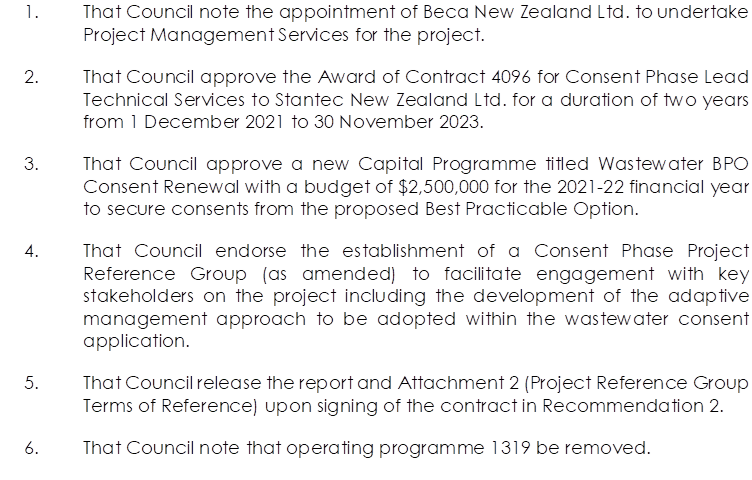
1.4 In
December 2021 Council endorsed the recommendations for the Consenting Phase
Implementation. These included:
2. Update on Project Progress
Technical Workstreams
2.1 Following
the engagement of the lead designer Stantec (supported by PDP consultancy),
supporting specialists have been engaged including Aqualink (reviewers for the
irrigation workstream), Aquanet (river monitoring and modelling), Simpson
Grierson (legal advisor), The Property Group and others including iwi and hapu
advisors.
2.2 The
workstreams that are being undertaken for this stage of consenting are:
|
Task
|
What are
we trying to determine
|
|
Land
application areas investigation
|
To
demonstrate that there are suitable sites for the irrigation of the highly
treated wastewater
|
|
Wastewater
flows and loads
|
To develop
future projections of the amount of wastewater and the contaminant loads for
the next 50 years, to ensure that the design of the treatment is suitable for
future changes in population and water usage.
|
|
River
modelling
|
Modelling of
the river water quality and ecology, as a baseline of current day, and with
future projections of the highly treated in-river discharges to confirm
wastewater treatment levels to meet regulatory requirements
|
|
Wastewater
treatment plant concept design
|
Further
development of the treatment concept, including changes to layout of the
existing plant to add new processes to meet required treatment standards
|
|
Treated
wastewater pipeline concepts
|
Work to
determine options for the location of the wastewater pipelines required to
convey the treated wastewater from the plant to the land application areas
|
|
Effects
investigations – River discharge
|
Investigations
required for the assessment of effects for the resource consent applications.
These include
· Public health risk assessment
· Water quality and ecology
· Recreation
· Water supply protection
|
|
Effects
investigations - Land
|
Investigations
required for the assessment of effects for the resource consent applications.
These include
· Public health risk assessment
· Terrestrial ecology
· Water supply protection
· Groundwater quality
· Sensitives land uses
· Social and economic
· Archaeological
|
|
Cultural
values assessment
|
This
assessment is prepared by tangata whenua and assesses the effects of the
wastewater scheme on such matters as the river, mauri, sites of significance,
mahinga kai, kaitiakitanga
|
2.3 These
workstreams will lead to the development of the consent application documents,
and the assessment of effects on which the consents are based.
Technical Workstreams
Updates
Land Application workstream
2.4 Identification
of land for testing its suitability for irrigation is a high priority. An
advisory group has been established with PDP, The Property Group, Federated
Farmers and Food and Fibre.
2.5 The
Project Team have identified a larger land area to focus further investigations
within. This area has been identified through an assessment process, with
larger land parcels being preferred to maximise the available area to discharge
wastewater per property.
2.6 The
Project Team are aware of concern in the farming community about identification
of land for the irrigation. Discussions with Food & Fibre and
Federated Farmers have highlighted this matter on several occasions.
2.8 At
the end of April contact has been made with several landowners to seek
permission to undertake soil investigations. The soil investigations are
required to inform the Land Application workstream.
2.9 A
media release and a letter drop to properties with the spatial area identified
for investigations occurred in early May. The letter drop included
approximately 600 properties and the letter provided a project update to these
property owners.
2.10 Communications
regarding the soil investigation elaborate that the testing proposed does not
pre-determine those land parcels are being required for the discharge of
wastewater for the project. These investigations are required to collect
information within a geographical area.
Data Gathering and
Monitoring workstream
2.11 Data
continues to be collected for the monitoring regime required as baseline
information to inform the consent application. Ecological information is
being collected from the Manawatū River to provide baseline data to be
used for the freshwater assessments of impact of the discharge.
2.12 Officers
continue to seek advice from iwi partners and other experts on the monitoring
required at this consent stage.
Design Workstreams
2.13 The Flows
and Loads Workstream has been progressed near to completion. This comprises
assessments of inputs into the plant over the next 50 years, including trade
waste, and is assumption based. There have been some discussions with
significant trade waste producers, which will continue through the consenting
process, to ensure any planned future changes in trade waste at this stage are
included in our assumptions.
2.14 The Flows
and Loads workstream also includes assumptions about discharges from the plant.
Work continues on adaptive management, utilising the skills and experience of
the project reference group – at this stage broad assumptions have been
made about the levels of flow to be discharged, to enable the remaining design
work to progress.
2.15 The
Concept Design workstream for the Wastewater Treatment Plant has been scoped
and agreed with Stantec.
2.16 The BPO
process selected Treatment Level 4 (TL4) for the Project. However, at
that time design concepts had not resolved whether there would be a different
level of treatment for the land discharge, to preserve more nutrient in the
treated water. At current concept design stage, consideration has been given by
the design team to what this would entail in practice – likely two
different treatment trains for at least part of the treatment process. This has
cost and operational implications.
2.17 Consideration
is also being given to the consequential operating costs of cut and carry farm
management potentially requiring added nutrient if the water is treated to a
TL4 level, whilst noting that adaptive uses of treated water will be
significantly greater if the water is produced without nutrient.
2.18 Treatment
scenarios have been integral in discussions with Rangitāne in recent
months, with Rangitāne indicating a preference for TL4 100% of the time.
2.19 Work on a
strategy for biosolids has commenced – at present biosolids from the
treatment plant are composted and used at the closed landfill at Awapuni.
Future scenarios indicate that more biosolid will be produced with the new
treatment regime, and the use of biosolids to create the closed landfill
capping layer will not be required for the whole consent period. Therefore,
other disposal options have to be identified and costed.
Consent Preparation
2.20 A Draft
Consent Strategy has also been prepared by Stantec and is being worked through
with the wider project team. The Consent Strategy is an important
milestone to outline the statutory approvals and consenting pathway for the
Project, and strongly influences the workstreams and the programme for completion
of the consent application.
Project Partner, Iwi and
Stakeholder Engagement
2.21 The
complexity of the work has necessitated a flexible approach, to ensure we work
with project partners in a way that works for them, and brings best advice to
the project team. Whilst a variety of forums and advice groups have been
established, one-to-one engagement is also undertaken with project partners and
stakeholders.
Separately to the advice elements, some iwi partners are
involved in co-design within specific workstreams. This is separate to tangata
whenua inputs on the cultural values assessment, and strives to bring
mātauranga Māori advice into the design process.
Project Reference Group
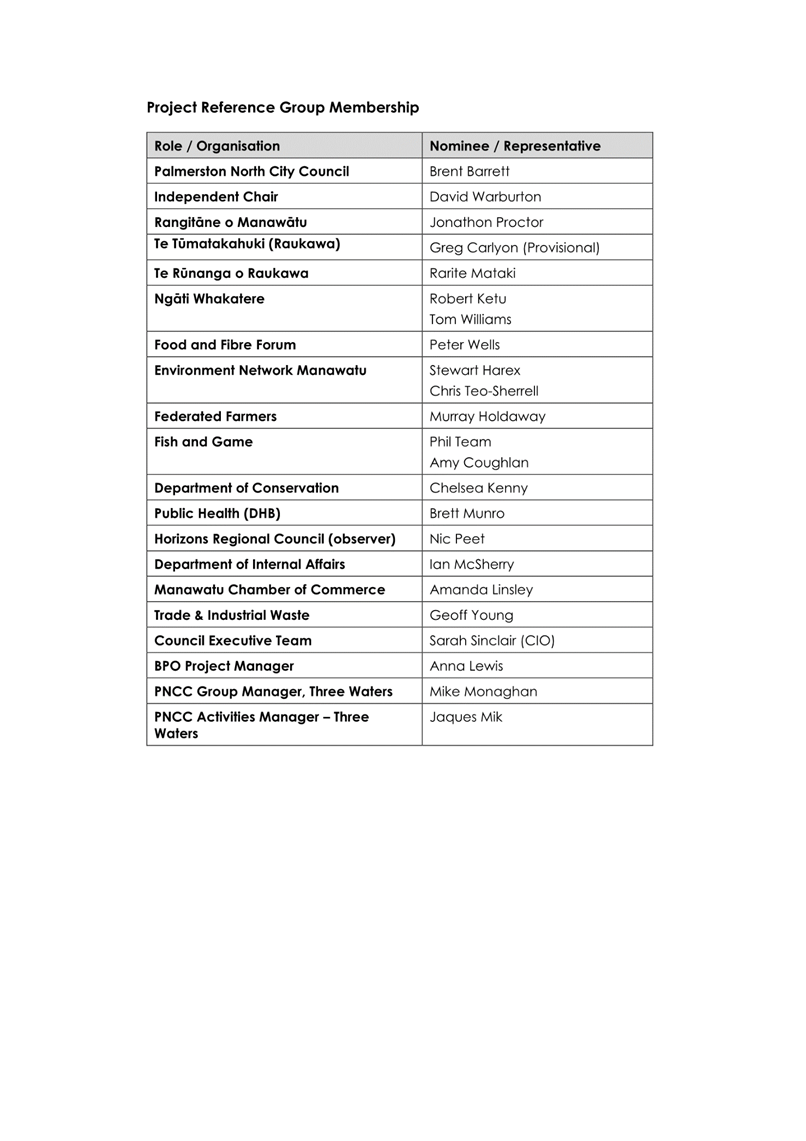
2.22 Further to
resolution 4 in section 1.4 above, a Project Reference Group (PRG) has been
established. Councillor Brent Barrett joined the PRG as an Elected Member
representative in 2022. The membership of the group is included in
Attachment 1. The group meets monthly, and Councillors now receive a
monthly update approximately one week after the PRG, to reflect the PRG
briefing from Councillor Barrett.
2.23 To
facilitate the development of Adaptive Management options for the project Jim
Bradley (Stantec) and Mike Monaghan (PNCC) have presented on existing Adaptive
Management carried out at the PNCC Wastewater Treatment Plant and other
techniques used around New Zealand. The PRG attendees have been invited
to submit their ideas to the Project Team for investigation.
Ngāti Whakatere
2.24 A
Memorandum of Agreement has been developed with Ngāti Whakatere, a hapu of
Ngāti Raukawa, which recognises the ongoing effects of waterwater
discharges into the river on their hapū. Technical specialists from
Ngāti Whakatere will join the Project Technical team to advise on specific
interest areas. Ngāti Whakatere have extended an invitation to councillors
to visit their marae in Shannon and build relationships now the COVID
‘red settings’ are relaxed to amber. The Project Team is
working with the governance team to facilitate this.
Te Tūmatakahuki
2.25 The
Project Team have recently met with representatives from Te Tūmatakahuki,
a group which represents the coastal hapu of Ngāti Raukawa.
Discussions are ongoing to develop an ongoing working arrangement, and work
scopes.
Farming Community
2.26 A farm
advisor has been appointed to support engagement with the farming community,
and to advise on farm management options and costs as the consent development
progresses. Regular meetings have been held with Federated Farmers and Food and
Fibre representatives from the Project Reference Group, working alongside the
Property Group to develop approaches to landowner engagement.
Other Stakeholders
2.27 The
project team presented to the Foxton Community Board on 29 January 2022. The
team presented on the BPO resolutions, and on the workstreams for this consent
stage. The Community Board were pleased that PNCC had selected such a high
treatment level for the plant.
2.28 Discussions
have commenced with Fonterra, both as a trade waste customer and as
representing some elements of the dairy industry locally.
2.29 Horizons
Regional Council has invited PNCC to present on the Project in June.
Public information
2.30 Although
the consent application development does not have a high level of public
engagement required for decision-making, the website has been updated to
coincide with the commencement of landowner engagement. The “Nature
Calls” branding continues for this consenting stage.
Project Programme
2.31 The
draft programme included in the December 2021 Council paper highlighted that
the significant amount of work which is required to prepare an application of
the required standard cannot be completed in the period prior to 1 June 2022
which is the existing consent target date.
2.32 The
inability to meet this deadline is a flow-on effect resulting from COVID-19
delays during the BPO Phase. Condition 23C required that the BPO was
lodged in June 2021 and this was delivered to Horizons in September 2021. At
the time of development of the consent conditions, there was a 1 year timespan
allocated between the BPO decision and the lodgement of consent, presumably to
allow sufficient time to develop a good quality consent application. The
overall consent to discharge is valid until 2028, presumably to also reflect
the significant work required to design and build a new treatment facility after
consent is granted.
2.33 The
December 2021 paper highlighted the significant work required particularly in
respect of the refinement of the land areas, identification of the land areas
for assessment as well as the significant engagement with iwi and affected
parties. At the time, it was assumed that a lodgement in September, to reflect
a 1-year work programme for the consent application was more realistic. The
ongoing effects of Covid-19 have impacted the team, both in terms of illness
across the supply chain slowing down work, and added difficulties in engagement
and face-to-face meetings, including site meetings, through different levels.
2.34 The
project team have determined that more time is needed to develop the consent in
this context and have estimated a likely project completion of 31 December.
2.35 The issue
of the lodgement date was discussed with Rangitāne representatives and
they reluctantly agreed to the extension of the programme of works to the 31
December 2022. With their support, contact was made with Horizons
Regional Council to advise them of the delay.
2.36 A letter
was sent to Horizons on 21 March 2022 to outline the challenges associated with
meeting the consent condition 23C relating to the June 2022 lodgement
date. This letter detailed the work underway, to demonstrate that work
continues to progress on the project in earnest, despite the many challenges
associated with the pandemic. Horizons Regional Council has acknowledged
the letter and the likely programme delay and is aware of the significant and
complex work that Council have done to develop the BPO and progress the consent
application.
2.37 Officers
sought legal advice from Simpson Grierson. Based on their advice,
officers are comfortable that this is a practicable approach to expedite the
delivery of the consent application documents.
3. Project Budget
3.1 A
consequence of the later lodgement of the resource consent application is the
required carry over of capital spend.
3.2 The
December Council paper estimated a spend of $2.5M for the FY2021/2022.
Spend to date of $754,329 is behind estimated spend for this period, based on
the idea that the application will take 6 months longer than originally
anticipated.
3.3 The
cost analysis is being updated to bring information into the Annual Plan
process
4. Project risks
4.1 High
priority risks to the Project include are outlined in Table 2 below– the
table reflects the unmitigated risks and consequences, and the revised risk
after identification and mitigation by the project team
Table 2 – Key Project
Risks
|
Risk
|
Unmitigated Likelihood
|
Unmitigated Consequence
|
Mitigated Risk Level
|
|
Insufficient
Budget
|
Likely
|
Major
|
Moderate
Budget
requires careful management for a project of this size and scale. An external
PM has been appointed
|
|
Ability
to develop ‘robust’ consent application for December 2022
lodgement
|
Likely
|
Major
|
Moderate
Delay
from June to December will require careful management due to Land Discharge
Area workstream. An external PM has been appointed, plus a land
advisor.
Project
control group meets weekly to review programme and address issues.
|
|
External
influences resulting in delays (i.e. COVID-19)
|
Likely
|
Moderate
|
Moderate
Lessening
of alert levels and BAU working resulting is reduced/no further lockdowns.
However, the future risks related to Covid 19 cannot be predicted.
|
|
Ability
to access land for land discharge area testing
|
Likely
|
Major
|
Moderate
Lack
of land access has ability to impact technical assessment development for
consent lodgement. Mitigations include identifications of alternate
landowners, and an assumptions-based approach if required
|
|
Effects
on the mauri of the river and Cultural Effects
|
Likely
|
Major
|
Moderate
Being
addressed through the various Project forums, requires careful consideration
to mitigate cultural effects throughout Project development. High treatment
levels are a mitigation
|
|
Iwi
Relationships
|
Likely
|
Major
|
Moderate
Working
relationships and agreements being developed. Requires ongoing
consideration and management. Project sponsors and senior managers heavily
involved in relationship development
|
4.2 Project
risks will be closely monitored through the Project Control Group and will be
reported to Council periodically.
5. Next Steps
5.1 The
Project Team will provide quarterly updates to the Council on the development
of the consent application.
5.2 Monthly
updates will be provided to Council via the Project Reference Group.
Attachments
|
1.
|
Project Reference Group Membership ⇩
|
|
|
2.
|
Legal Advice- deferral of lodgement - Confidential
|
|