|
Vaughan Dennison (Chairperson)
|
|
Susan Baty (Deputy Chairperson)
|
|
Grant Smith (The Mayor)
|
|
Brent Barrett
|
Karen Naylor
|
|
Rachel Bowen
|
Bruno Petrenas
|
|
Zulfiqar Butt
|
Aleisha Rutherford
|
|
Lew Findlay QSM
|
Orphée Mickalad
|
|
Billy Meehan
|
|
Infrastructure Committee
MEETING
17 August 2022
Order of Business
1. Apologies
2. Notification
of Additional Items
Pursuant to Sections 46A(7) and
46A(7A) of the Local Government Official Information and Meetings Act 1987, to
receive the Chairperson’s explanation that specified item(s), which do
not appear on the Agenda of this meeting and/or the meeting to be held with the
public excluded, will be discussed.
Any additions in accordance with
Section 46A(7) must be approved by resolution with an explanation as to why
they cannot be delayed until a future meeting.
Any additions in accordance with
Section 46A(7A) may be received or referred to a subsequent meeting for further
discussion. No resolution, decision or recommendation can be made in
respect of a minor item.
3. Declarations
of Interest (if any)
Members are reminded of their duty
to give a general notice of any interest of items to be considered on this
agenda and the need to declare these interests.
4. Public
Comment
To receive comments from members of
the public on matters specified on this Agenda or, if time permits, on other
Committee matters.
(NOTE: If
the Committee wishes to consider or discuss any issue raised that is not
specified on the Agenda, other than to receive the comment made or refer it to
the Chief Executive, then a resolution will need to be made in accordance with
clause 2 above.)
5. Presentation
- Geosynthetic Partners International (GPIL) Page 7
6. Confirmation
of Minutes Page 9
“That the minutes of the
Infrastructure Committee meeting of 18 May 2022 Part I Public be confirmed as a
true and correct record.”
7. College
Street / Botanical Road Intersection Safety Investigation Plan Page 11
Memorandum, presented by Hamish
Featonby, Group Manager - Transport and Development.
8. Road
Maintenance Contract - Six Monthly Report Page 17
Memorandum, presented by Hamish
Featonby, Group Manager - Transport and Development.
9. Tamakuku
Terrace Six Monthly Update Page 39
Memorandum, presented by Bryce
Hosking, Group Manager - Property.
10. Papaioea Place
Redevelopment Six Monthly Update Page 45
Memorandum, presented by Bryce
Hosking, Group Manager - Property.
11. Central Business District
Streets for People Programme - Six Monthly Update Page 49
Memorandum, presented by Geoffrey
Snedden, Senior Project Manager.
12. Memorial Park
Development Plan - Update Report Page 55
Memorandum, presented by Kathy
Dever-Tod, Group Manager – Parks and Logistics.
13. Committee Work
Schedule Page 67
14. Exclusion of Public
|
|
To be moved:
“That the
public be excluded from the following parts of the proceedings of this
meeting listed in the table below.
The general
subject of each matter to be considered while the public is excluded, the
reason for passing this resolution in relation to each matter, and the
specific grounds under Section 48(1) of the Local Government Official
Information and Meetings Act 1987 for the passing of this resolution are as
follows:
|
General subject of each matter to be
considered
|
Reason for passing this resolution in
relation to each matter
|
Ground(s) under Section 48(1) for
passing this resolution
|
|
|
|
|
|
|
|
|
|
This resolution
is made in reliance on Section 48(1)(a) of the Local Government Official
Information and Meetings Act 1987 and the particular interest or interests
protected by Section 6 or Section 7 of that Act which would be prejudiced by
the holding of the whole or the relevant part of the proceedings of the
meeting in public as stated in the above table.
Also that the
persons listed below be permitted to remain after the public has been
excluded for the reasons stated.
[Add Third
Parties], because of their knowledge and ability to assist the
meeting in speaking to their report/s [or other matters as specified] and
answering questions, noting that such person/s will be present at the meeting
only for the items that relate to their respective report/s [or matters as
specified].
|
Presentation
TO: Infrastructure
Committee
MEETING DATE: 17
August 2022
TITLE: Presentation
- Geosynthetic Partners International (GPIL)
RECOMMENDATION(S)
TO Infrastructure Committee
1. That the
Infrastructure Committee receive the presentation from Geosynthetic Partners
International for information.
Mr Laurie Verco, Business Development Executive, GPIL will
provide an overview on supplier issues and share insights from a wealth of
knowledge within the civil construction industry.
GPIL is a Major Associate Member of Civil Construction NZ
and an active member within the central region branch.
Attachments
Nil
Palmerston North City Council
Minutes of
the Infrastructure Committee Meeting Part I Public, held in the Council
Chamber, First Floor, Civic Administration Building, 32 The Square, Palmerston
North on 18 May 2022, commencing at 1.01pm
|
Members
Present:
|
Councillor Vaughan Dennison (in the
Chair), The Mayor (Grant Smith) and Councillors Brent Barrett, Susan Baty,
Rachel Bowen, Zulfiqar Butt, Lew Findlay QSM, Billy Meehan, Karen Naylor,
Bruno Petrenas, Aleisha Rutherford and Orphée Mickalad.
|
|
Non Members:
|
Councillors Renee Dingwall, Patrick
Handcock ONZM, Leonie Hapeta and Lorna Johnson.
|
Councillor Aleisha
Rutherford left the meeting at 1.14pm and entered the meeting again at 1.30pm during consideration of
clause 8. She was present for all clauses.
|
7-22
|
Confirmation of Minutes
|
|
|
Moved Vaughan Dennison, seconded Karen Naylor.
The
COMMITTEE RESOLVED
1. That the
minutes of the Infrastructure Committee meeting of 16 March 2022 Part I
Public be confirmed as a true and correct record.
|
|
|
Clause 7-22 above was carried.
|
|
8-22
|
Annual Footpath and Pathway Report
Memorandum, presented by
Hamish Featonby, Group Manager - Transport and Development.
Councillor
Aleisha Rutherford left the meeting at 1.14pm.
Councillor
Aleisha Rutherford entered the meeting again at 1.30pm.
|
|
|
Moved
Vaughan Dennison, seconded Leonie Hapeta.
The COMMITTEE RESOLVED
1. That the annual footpath and pathway report is
included as part of the Road Maintenance Contract Update for future reports.
|
|
|
Clause 8-22 above was
carried.
|
|
9-22
|
Infrastructure Capital Works Dashboard - March 2022
Memorandum, presented by Sue
Kelly, Manager - Project Management Office.
|
|
|
Moved
Vaughan Dennison, seconded Susan Baty.
The COMMITTEE RESOLVED
1. That the Committee receive the
memorandum titled ‘Infrastructure Capital Works Dashboard - March
2022’, presented to the Infrastructure Committee on 18 May 2022.
|
|
|
Clause 9-22 above was
carried.
|
|
10-22
|
Committee Work Schedule
|
|
|
Moved
Vaughan Dennison, seconded Susan Baty.
The COMMITTEE RESOLVED
1. That the Infrastructure Committee receive its Work
Schedule dated May 2022.
|
|
|
Clause 10-22 above was
carried.
|
The meeting finished at 2.20pm
Confirmed 17 August 2022
Chairperson
MEMORANDUM
TO: Infrastructure
Committee
MEETING DATE: 17
August 2022
TITLE: College
Street / Botanical Road Intersection Safety Investigation Plan
PRESENTED BY: Hamish
Featonby, Group Manager - Transport and Development
APPROVED BY: Sarah
Sinclair, Chief Infrastructure Officer
RECOMMENDATION(S)
TO Infrastructure Committee
1. That the
Committee note that Officers will report back to the Committee in November 2022
on recommended options to improve safety at College Street and Botanical Road.
1. Overview of the problem or opportunity
1.1 On
26 May 2022 Committee of Council resolved:
1.1.1 ‘That
the Chief Executive report to Council with a plan to improve safety at College
Street and Botanical Road, including right hand turn lanes and provision for
active transport.’
1.1.2 ‘That a
budget of $15k be established to support design work for a Botanical
Road/College Street safety improvement plan.’
1.2 The
resolutions came about in response to public submissions to the Annual Plan for
‘Right turning arrows in the signal phases at Botanical Road / College
Street’. The submissions included:
1.2.1 197 –
“We would like to join other voices asking for right turning arrow in the
signal phases at Botanical Road / College Street. At the moment vehicles turn
at Ferguson Street roundabout and then along Kingston Street to enter College
Street at a non-controlled intersection creating congestion in a narrow
residential street.”
1.2.2 324 –
“Support a right-hand turn arrow from Botanical Road to College Street
which is dangerous and in peak hours a time onerous intersection that means
cars turn down Kingston Street which would not be necessary if there was free
traffic flow.”
1.3 Currently
right turning traffic must give way to straight and left turning traffic during
a green light and can turn only when there is a suitable gap. As traffic
volumes increase, the ability to find a gap in the traffic to make a right turn
becomes more difficult. This increases the probability of drivers
performing risky manoeuvres to get through the green light without a long wait.
2. Background and previous council decisions
2.1 The
intersection of Botanical Road and College Street has two lanes on each
approach, one for left and straight through movements while the other is for
right turns only.
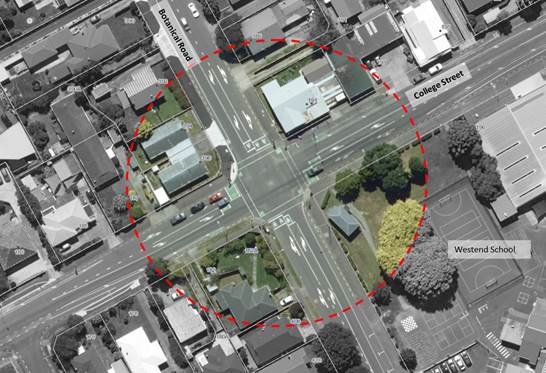
Figure 1:
Intersection of Botanical Road/College Street
2.2 Botanical
Road is a Minor Arterial road that carries approximately 9,000 vehicles per day
north of intersection and approximately 7,700 to the south.
2.3 College
Street west of Botanical Road is a Minor Arterial road which carries
approximately 9,200 vehicles per day. To the east of Botanical Road, College
Street is a Collector road which carries approximately 6,600 vehicles per day.
2.4 West
End Primary School is located on the east corner of the intersection, while on
the northern corner there is a dairy, bakery and laundry. The intersection is
close to Awatapu College, further south on Botanical Road. During school peak
times, a 40km/h variable speed limit applies to College Street and Botanical
Road near this intersection.
2.5 According
to Waka Kotahi NZTA’s Crash Analysis System, eight recorded crashes have
occurred, comprising of one Serious Crash and seven non-injury. Of these crashes
the serious injury was associated with a collision with a pedestrian, one
non-injury crash is associated with right turning traffic and one non-injury
associated with a cyclist and left turning vehicle.
2.6 In
2020, the cycle lanes on College Street were upgraded as part of the College
Street Transport Improvement project. This project implemented buffered cycle
lanes from Maxwells Line through to Victoria Avenue. Cycle
lanes at the intersection of Botanical Road and College Street were considered,
but not installed, due to assumptions regarding the loss of intersection
capacity and concerns around increased traffic delays and queuing.
As traffic speeds are generally lower on approach to
signalised intersections it was considered appropriate at the time for the lead
in cycle lane to be omitted and have cyclists and traffic merge safely on
approach.
2.7 The
intersection currently runs two main traffic phases, one phase for all traffic
on Botanical Road, with the other for College Street traffic. For pedestrians,
the pedestrian phase runs in time with the corresponding traffic phase, with
pedestrians having several seconds head start over traffic to mitigate conflict
with turning traffic.
2.8 Concerns
were raised by the public during consultation on the College Street cycle lanes
about the efficiency of the College Street/Botanical Road intersection,
including long delays during peak times. A dedicated right turn phase of the
traffic light sequence was suggested. This issue was also the subject of
submissions to the 2022/23 Draft Annual Plan.
2.9 Council
has requested that Officers report back with a plan to improve safety at
College Street and Botanical Road, including right hand turn lanes and
provision for active transport.
3. options
3.1 There
are several options available that can be considered to improve the
intersection in terms of safety, whether it is for traffic or active traffic
modes. Each option has advantages and disadvantages. The following section describes
the general options available. Combinations of options have not been listed but
would be investigated as part of the modelling.
3.2 Right
Turn Phase
3.2.1 A right turn
phase can be added to the existing traffic signals for each approach giving a dedicated
movement whilst other traffic is halted. The upgrade would require new lights,
signal software, additional detector loops and civil works associated with the
underground ducting and signal poles.
3.2.2 The advantages
of right turn phases are:
- Increase of
priority and safety of right turn movements;
- alleviation
of right turn queuing from blocking straight through and left turning traffic
(should this occur).
3.2.3 Adding right
turn phases may have implications to other movements and transport modes such
as pedestrians and cyclists. As the number of signal phases increase, it can
result in lesser proportional time for other movements thus potentially
increasing the overall time for other users at the intersection. It can also
lead to longer queues in some lanes which may block off the adjacent right turn
lane from being utilised.
3.3 Lead
in cycle lanes
3.3.1 Currently the
combined through and left lane is marked as one lane, however it is possible
for two lanes of traffic to operate in this space should drivers choose to make
space.
3.3.2 A lead in
cycle lane could be created by reducing the width of the through and left turn
lane to the size of a standard traffic lane. This would enable cyclists to
traverse to the front of the intersection unimpeded by traffic, whilst traffic
travelling through and left will be reduced to one combined lane. Right
turning cyclists will still be required to merge with traffic and enter into
the right turn lane.
3.4 Cycle
phases and head start
3.4.1 Similar to
right turn phases, an additional phase could be added for cyclists to give
greater priority and protection at the intersection. According to NZTA, cycle
signals at intersections are approved for use in certain situations. This
includes:
- providing an
exclusive cycle phase where cyclists can only move at a different time to
traffic;
- providing a
head start for cyclists where the green light is displayed in advance of the
green light for general traffic.
3.4.2 The exclusive
cycle phase or head start will give cyclists higher priority at the
intersection. This will either eliminate or reduce the potential conflict with
traffic and can assist with cyclists making right turns.
3.4.3 Similar to
right turn phases, cycle phases will reduce the time allocated to other
movements. The impact of installing cycle phases is currently unknown.
3.4.4 Introducing
such phases would also require similar infrastructure as indicated for right
turns phases. Dedicated road space would also be needed so that the cycle phase
is not accidentally triggered by vehicles.
3.5 The
options will all have impacts on the performance of the intersection, which are
currently not well understood.
3.6 Several
pieces of work will be undertaken to understand the impacts before determining
the best option, or combination of options including:
- traffic
turning surveys to collect data on intersection turning movements throughout
the day. The data will provide information on the peak traffic periods and
provide information necessary to model the intersection. Surveys are planned
for late July 2022.
- intersection
traffic models of various scenarios using the traffic turning surveys to
understand the potential traffic impacts of the intersection (anticipated to
occur August/September 2022).
3.7 Options
and/or combination of options will be evaluated and Officers will present findings
to Council, with recommendations.
4. FINANCIAL
4.1 As
part of the Annual Plan process, Council approved new funding of $15k in
2022/23 to investigate improvements to this intersection. This funding will be
used to undertake traffic turning surveys and intersection modelling of
potential improvement (or combination of) options.
4.2 There
is currently no budget within the capital programme for the implementation of
changes at the Botanical Road/College Street intersection. An indicative estimate
of the right-hand turning phase option outlined in 3.2 is between $50-100K, and
the lead in cycle lanes described in 3.3 would indicatively cost $10k.
There was no estimate of the cost of the cycle phases and head start described
in 3.3 at the time of writing.
5. Next Steps / Plan
5.1 Traffic
surveys and modelling – July to September 2022.
5.2 Option
analysis – October 2022.
5.3 Report
to Council on recommended option/s in November 2022.
|
Does the Committee have
delegated authority to decide?
|
Yes
|
|
Are the decisions significant?
|
No
|
|
If they are significant do they
affect land or a body of water?
|
No
|
|
Can this decision only be made
through a 10 Year Plan?
|
Yes
|
|
Does this decision require
consultation through the Special Consultative procedure?
|
No
|
|
Is there funding in the current
Annual Plan for these actions?
|
No
|
|
Are the recommendations
inconsistent with any of Council’s policies or plans?
|
No
|
|
The recommendations contribute
to Goal 1: An Innovative and Growing City
|
|
The recommendations contribute
to the achievement of action/actions in Transport
The action is: There is timely
provision of transport infrastructure to support city growth and economic
development opportunities.
Street design is responsive to
land-use, place and movement.
|
|
Contribution to strategic
direction and to social, economic, environmental and cultural well-being
|
The upgrade to the signals could
provide a higher level of service for traffic and cyclists, thus supporting
city growth.
|
|
|
|
Attachments
Nil
Memorandum
TO: Infrastructure
Committee
MEETING DATE: 17
August 2022
TITLE: Road
Maintenance Contract - Six Monthly Report
Presented By: Hamish
Featonby, Group Manager - Transport and Development
APPROVED BY: Sarah
Sinclair, Chief Infrastructure Officer
RECOMMENDATION(S)
TO Infrastructure Committee
1. That the
Committee receive the memorandum titled ‘Road Maintenance Contract
– Six Monthly Report’, presented to the Infrastructure Committee on
17 August 2022.
1. ISSUE
1.1 To
provide a six-monthly update on the road maintenance contract – work
programme and performance.
2. BACKGROUND
2.1 Our
contractor, Fulton Hogan, have completed their first financial year looking
after Palmerston North’s roading and footpath networks. The initial set
up of a contractor into a new area comes with challenges such as resourcing up,
learning about the road network and understanding the demands and priorities of
the city.
2.2 Fulton
Hogan have focused heavily on responding to these challenges and go into the
second year of the contract with greater understanding of Palmerston North City
Council (PNCC) drivers and Palmerston North road user and resident concerns to
better meet roading maintenance expectations in the coming year.
2.3 A
paper was presented to Council committee in March 2022 detailing the data that
the new contract had been collecting and analysing, as well as providing an
update on contract progress.
2.4 In
the past six months Council Officers have focussed on setting expectations in
terms of contract performance, quality management, communication and
responsiveness.
3. ROAD surface – Reactive maintenance
3.1 KBase
– Request for Service
3.1.1 The primary
mechanism for public requests for service from PNCC, KBase, has been modified
for the roading maintenance contract. The contractor receives the request
information directly into their operational management tool (RAMM) –
along with a phone call/email advice from the Council, depending on the
criticality of the problem, to enable the contractor to plan and prioritise
responses.
3.1.2 Palmerston
North residents have been lodging requests as they encounter issues, such that
the contractor has received over 6,100 Kbase requests over the course of the
year. This is an average of 24 requests each working day.
If the resident has specified they would like a call back
as part of the KBase lodging process they will be advised once the appropriate
remedial action is determined. In most cases a response to a reactive
maintenance issue is done within set contract timeframes. In certain
circumstances a more extensive repair is required and so once approved by
Council Officers the contractor will advise when the larger repair is expected
to occur.
3.1.3 The spread of
Kbase requests throughout the year is shown in Figure 1.
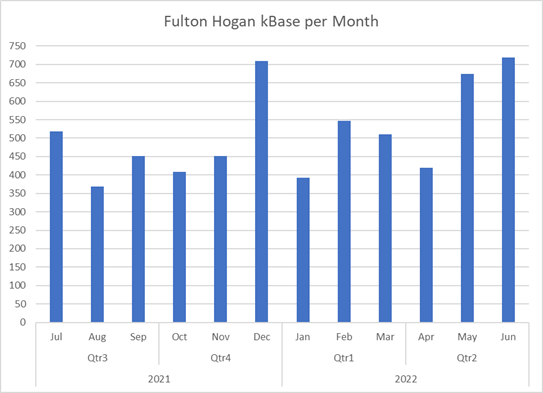
Figure 1: Kbase requests received by Contractor
1 July 2021- 30 June 2022
3.2 Potholes
3.2.1 Potholes are
formed by water seeping into small cracks in the road surface and/or traffic
‘impacting’ or loading the road, especially heavy vehicles.
Potholes are often a symptom of a road surface which is no longer-waterproof
and beginning to deteriorate or deteriorating more quickly than expected based
on asset life. Once the surface is performing less optimally, the combination
of water and heavy traffic at the same time can cause potholes to appear very
quickly, sometimes within just a few hours of a rain event.
3.2.2 The rapid
appearance of potholes means that the maintenance regime for individual
potholes is reactive and is based on the pothole being documented either
directly by the contractor as part of their inspection regime or notification
via KBase. Either way they are logged into RAMM to capture the location and
severity of the defect and aid in operational and tactical decision making.
3.2.3 Throughout the
year the contractor has completed pothole repair works at just over 1,060
different locations with over 2,500 individual potholes repaired across the
sealed, unsealed and footpath networks. This is an average of 10 potholes each
working day, with more potholes repaired per day in wetter months than dry
months.
3.2.4 The
contractors’ methods of data compilation and presentation have allowed
PNCC to identify locations where groupings of potholes occur, and in such cases
a more extensive asphalt ‘holding’ repair has been performed to
waterproof a larger area of failing road and remedy multiple potholes at once.
3.2.5 The budgets
for road repairs are spread across maintenance and renewals for Pavement and
Surfacing. Allocation of funds across the different activities is not
prescriptive, eg. pothole repair vs a more extensive maintenance mill and fill
repair. It is up to Officers to determine the best way to prioritise the
investment to maintain the roads to a suitable standard. At present $1.5M is
allocated to resolving these types of defects.
3.2.6 Repairs to the
road pavement overall are shown in the graphic on the following page. This
shows how the $1.5M spent on pavement and surface urgent defect repairs during
21/22 was allocated in terms of types of repairs.
This $1.5M is funded from two different budgets. The
remainder of the budgets is spent on pre-resurfacing repairs which is
preparation work before resealing, such as raising and fixing service covers
and trench levelling.
10 Year Plan Sealed Pavement
Renewal & Maintenance Budgets
|
|
21/22
|
22/23
|
23/24
|
24/25
|
25/26
|
26/27
|
27/28
|
28/29
|
29/30
|
30/31
|
|
Sealed Pavement Renewals
|
$1.65M
|
$1.80M
|
$1.97M
|
$2.40M
|
$2.81M
|
$3.47M
|
$3.57M
|
$3.68M
|
$3.78M
|
$3.89M
|
|
Sealed Pavement Maintenance
|
$1.54M
|
$1.65M
|
$1.72M
|
$1.79M
|
$1.97M
|
$2.39M
|
$2.48M
|
$2.57M
|
$2.65M
|
$2.93M
|
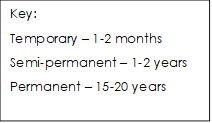
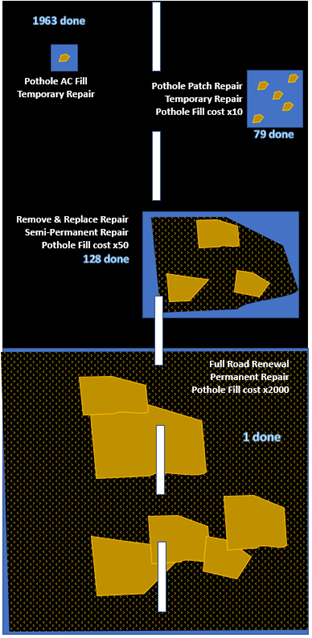
Figure 2: Road pavement repair cost split
2021-22
3.3 Heavy
Leaf Fall
3.3.1 At the start
of the maintenance contract the inspection and cleaning regime cleared many
sumps and drains which had not been cleaned for years. A routine sweeping route
was implemented and key drainage assets cleared to help minimise impacts of
heavy rainfall and subsequent surface flooding.
3.3.2 The weather
patterns this year meant that the Autumn leaf fall occurred a month later than
usual and over a condensed timeframe. Most leaves fell over a two week period.
Unfortunately, this period of high leaf fall coincided with a Covid outbreak
within the Fulton Hogan team and the breakdown of a cleaning vehicle. The
leaf clean-up response within the city was stretched thinly, and the rapid
ongoing leaf drop meant many streets needed multiple visits in very short
timeframes.
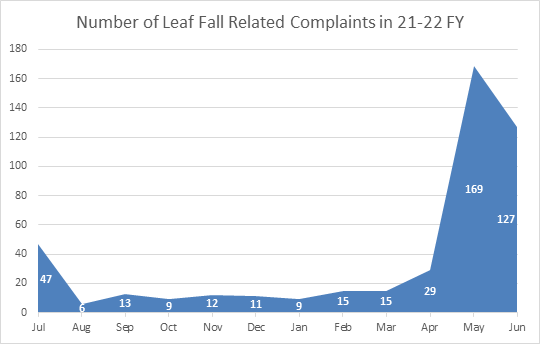
3.3.3 Public
complaints regarding leaf fall were high at 296 over the May - June period of
heavy leaf fall. The requests for service were used to help prioritise areas
within the network that needed the most attention. The combination of the
contractor reallocating workers from other activities and bringing in more
sweeper truck resource and assistance from Council’s Parks team meant
that after the initial slow start leaves were cleared up more effectively. In
one instance Fulton Hogan had 10 different teams on the network clearing leaves
at the same time.
3.3.4 Learning from
Autumn 2022 has resulted in the identification of heavy leaf fall hot spots and
high response need areas. The following map shows an example of sweeper
planning for next year. It shows a weekly sweeping plan during high leaf fall,
which is a combination of heavy leaf fall sweeping and regular street cleaning.
Before next Autumn this information will be shared more broadly, including on
our website, to ensure the public are aware of when and where the sweeper drivers
are focusing their activity.
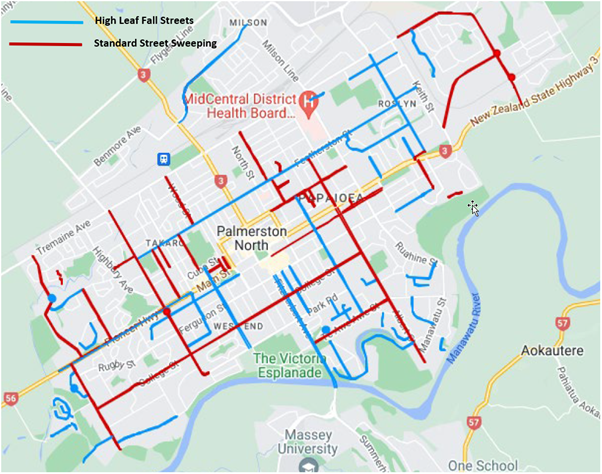
Figure 3: Example Autumn road sweeping weekly schedule
3.4 Boy
Racer Response
3.4.1 Boy racer
issues continue to impact the city and are creating high demand for cleaning up
of debris and street sweeping as well as urgent out-of-hours responses to road
safety and environmental issues, including deliberate diesel spills. This
has been funded through the year using the road maintenance emergency incident
response budget because there was no specific fund. The 22/23 budget has $150k
allocated to boy racers response, although it is hoped that deterrent work will
lessen the demand for post-incident response.
3.4.2 Asphaltic
concrete speed humps were installed at the turning area on Works Road and Valor
Drive to help deter racing activity and further speed humps are being designed
for Works Road. These and other locations continue to be monitored and swept as
needed currently at MakoMako Road, Richardsons/Roberts Line intersection,
Bennett Street and Bounty Place.
3.4.3 In support of
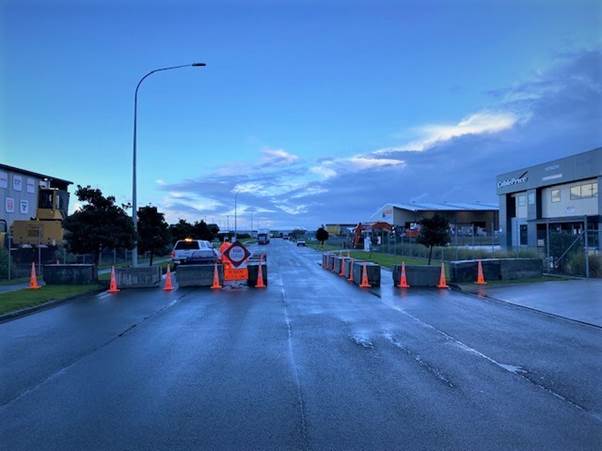
a planned NZ Police operation the Fulton Hogan team volunteered their time to
provide traffic control at two locations. Public access to two roads commonly
used by street racers was closed over a weekend that heavy street racer
activity was predicted.
During daylight hours Fulton Hogan traffic controllers
staffed the cordon and the police took over the duty late afternoon. This was a
great example of collaboration between Fulton Hogan, NZ Police and PNCC to
address antisocial behaviour.
4. Road surface – planned works
4.1 Renewal
& Minor Safety Works
4.1.1 Several
factors caused delays during the 2021/22 construction season. Investigation,
planning and design work was delayed by lockdowns, lack of funding clarity and
staff resourcing due to Covid sickness. By the time Waka Kotahi funding was
confirmed in November, a proportion of the timeframe for design or construction
for the year had already lapsed. This has resulted in the construction of some
projects not being complete by the end of the financial year and the
consequential moving of other projects into the next financial year.
4.1.2 The wet
weather experienced over the summer, along with Covid impacts on staff
resources also delayed the resurfacing programme, such that the contractor was
unable to complete the chipseal reseal programmed works before the Autumn
period when cooler weather makes this work no longer viable. Outstanding chip
sealing sites across the city at Birmingham Street, Roberts Line and Te Awe Awe
Street are scheduled for completion early in the next financial year over the
summer period. The asphaltic concrete resurfacing programme was not affected by
weather and progressed well.
4.1.3 A late start
to construction due to Waka Kotahi funding, Covid impacts and weather meant the
planned footpath works were not fully achieved. This has meant footpath
extensions at Worcester Street in Ashhurst as well as footpath renewals at
Oxford Avenue, Railway Road, Gillespies Line and Reserve Road are now planned
to be completed early in the new financial year.
4.1.4 The Minor
Safety programme was also impacted by the delays described above. The Minor
Safety programme is a Waka Kotahi co-funded 3-year safety focused programme
which is very prescriptive about how funds are allocated. As such, scoping and
design on the projects could not begin until final confirmation of the funding
and programme late in 2021. This has had consequential effects on the
construction programme, and part of the 2021/22 programme was not constructed,
with budgets carried forward into 2022/23.
4.1.5 With 22/23
being the middle year of the Long Term Plan (LTP), security of funding from
Council and Waka Kotahi enables an early start to the season in a number of
activities to ensure a catch up on planned work is achieved without impacting
on delivery of this year’s programme. An example of this is the low cost
low risk projects which were approved by Waka Kotahi in December and hence
under delivered in 21/22 but, now the planning work has been completed, can be
delivered across the full 22/23 year to catch up on carry forwards as well as
the current year’s projects.
4.1.6 Investment
across the network for 2021/22 has achieved the following:
- Resealed
21km of roading (4% of the sealed network), 60% of expenditure spent on urban
applied asphaltic concrete and 40% expenditure spent on chip sealing rural and
urban streets;
- Replaced
272m of kerb and channel mostly associated in combination with urban reseal
sites;
- Undertook
$1.5M worth of road surface repairs to alleviate the worst of the
network’s pavement deformation faults, eg. potholes;
- Structural
renewal work to address the Fitzherbert bridge joints, repair retaining wall
barriers on Atawhai Road, replace vehicle-damaged guardrails on a bridge on
Kahuterawa Road and reinforce and stabilise waterway approaches to a bridge on
Turitea Road after storm damage;
- Smaller
and less complex Minor Safety projects have been completed such as raised
platforms and crossings on Havelock Avenue, Brighton Crescent, Churchill Avenue
and Highbury Avenue;
- Fulton Hogan
private development project to construct signalised intersection improvement
works at Amberley Avenue and Pioneer Highway for the new Countdown supermarket
was completed, for which Council contributed to pavement strengthening works.
5. FOOTPATHs
5.1 A
paper was presented to Infrastructure Committee in May 2022 which summarised
footpath condition work to date.
5.2 Formal
rating of the condition of sections of footpath was undertaken in August 2018.
The process rated footpaths from Excellent through to Very Poor and provided a
tool to prioritise maintenance and renewals activity. The overall results are
shown in Figure 4.
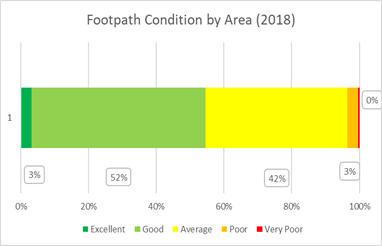
Figure 4: Poor and
Very Poor condition footpaths based on 2018 assessment
5.3 In
2020 condition assessment was undertaken using a different methodology. This
identified individual defects on the footpaths rather than giving an overall
score per section of footpath. The two data sets are not directly
comparable although there is some correlation in terms of where the faults are
compared to the areas identified as poor condition.
5.4 Since
the 2018 condition surveys, remedial work has been completed on some of the
worst sections, eg. Nottingham Avenue has had a full renewal performed.
5.5 Some
sections have been investigated and determined to not be as bad as expected.
The Hodgens Place example shown in Figure 5 below shows a section of footpath
as Very Poor condition (in red) but it only has three minor defects, none of
which affect the usage of the footpath.
5.6 The
footpath work undertaken in 2021/22 was prioritised through a focus on usage
– outside schools, parks, CBD, etc. alongside the condition datasets, to
balance planned investment between poor condition and heavy usage sites.
5.7 During
2021/22 Fulton Hogan undertook 1,552m of concrete grinds to remove 1,030 trip
hazards and completed 2,070m2 of new or replacement concrete
footpaths, 428m2 of new vehicle crossings and nearly 1,200m2
of asphalt footpath resurfacing.
5.8 For
the 2022/23 Footpath Maintenance and Renewals Programme Fulton Hogan used the
2018 Condition Survey results as a first basis for programming future works.
This has involved interrogating the condition survey results, estimating work
required to renew the section rated as Very Poor, a desktop analysis to
correlate the number of complaints against those sections and onsite validation
to determine whether work is required at the most urgent priority level. This
analysis and work planning was completed in 2021/22 to develop the 2022/23 work
programme.
5.9 Based
on the Fulton Hogan analysis, the estimated cost to repair all remaining
footpath sections rated in as poor or very poor in the 2018 survey is $3.07M
using current unit rates. This is made up of $340k to repair all footpath
sections rated as ‘very poor’ and $2.73M to repair all footpath
sections rated as ‘poor’.
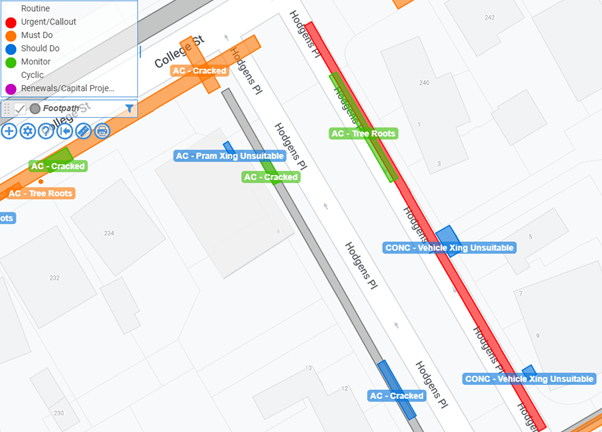
Figure 5: Correlation
of ‘Very Poor’ condition ratings minimal defects observed
5.10 The budget
for Footpath Renewal work for 2022/23 is $997K which includes an additional
$150K approved at Committee of Council as part of the Annual Budget process for
2022/23. At this level of funding per annum, it would take three years to
fully remediate these sections.
|
Forecast
footpath maintenance and renewal expenditure in the 2021-31 10 Year Plan
|
|
FY
|
2022/23
|
2023/24
|
2024/25
|
2025/26
|
2026/27
|
2027/28
|
2028/29
|
2029/30
|
2030/31
|
Total
|
|
Maintenance & Operations Expenses (000's) (excludes
depreciation and interest)
|
|
Budget
|
$516
|
$595
|
$611
|
$626
|
$672
|
$702
|
$723
|
$743
|
$784
|
$6,474
|
|
Renewal (000's)
|
|
Budget
|
$997k
(22/23 Annual Budget)
|
$1,090
|
$1,366
|
$1,406
|
$1,446
|
$1,488
|
$1,531
|
$1,576
|
$1,946
|
$13,924
|
Note:
Operation expenses incorporates environmental maintenance from operating
programmes and CBD cleaning which is
currently not specifically funded through NZTA co-funding rules. This has not
been separately itemised from maintenance expenses.
5.11 As
reported in the Footpath Report in May 2022, Renewal budgets are proposed at
similar rates for years 1, 2 and 3. The budgets for these years (highlighted in
the table above) is higher than the confirmed LTP Council budget 21-24.
Originally Waka Kotahi reduced the funding towards footpath renewals in the
National Land Transport Programme (NLTP) and Council kept their full share in
the budget. So, some of the LTP budgets for footpath renewals did not include
Waka Kotahi subsidy amounts. However later in 2021, Waka Kotahi increased their
total subsidy for footpath renewals to previous levels. The number shown above
reflects the true subsidised budget, reflecting the ongoing renewal investment
not changing for this LTP cycle.
5.12 The number
of streets which have received more than 10 Kbase footpath related complaints
during the year is considered in planning works for 22/23.
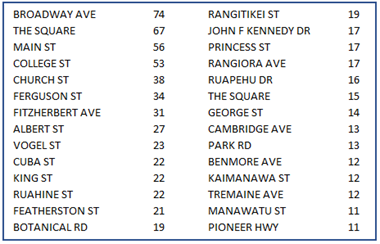
Figure 6: Streets in
the City receiving more than 10 Kbase complaints during the year
5.13 Defects
are loaded into the asset database, prioritised and compared to the Condition
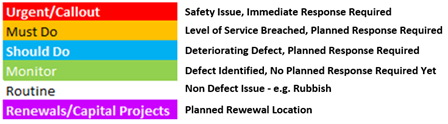
Assessment and KBase records. Figure 7 provides a sample of the map of the
current recorded defects across the city.
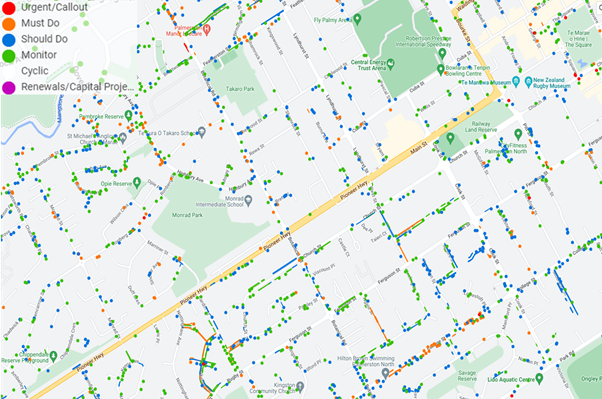
Figure 7: Footpath
defects
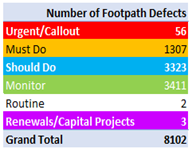 Key:
Key:
5.14 Other
factors considered includes the community served by the footpath by considering
proximity to schools, health care facilities, rest homes, the CBD, parks and
any other factors that increase the usage and reliance on footpaths.
5.15 At present
the programme is being validated prior to final review by Officers. Once
approved it will be shared with the community within the next few months
through the Council website and social media.
5.16 The
footpath renewals programme for 2022/23 is likely to be similar in scope but
the higher level of funding will enable more improvements than 2021/22.
6. Utilisation of Sub-Contractors
6.1 Fulton
Hogan have utilised 20 subcontractors to supplement their own team and provide
specialist expertise. Local market engagement was a requirement of the contract
tender to help support a healthy local contractor market. Fulton Hogan have
employed more subcontractors than they originally indicated in their tender, up
slightly from the last report to 49% of the workforce. 15% of those
subcontractors are small local suppliers.
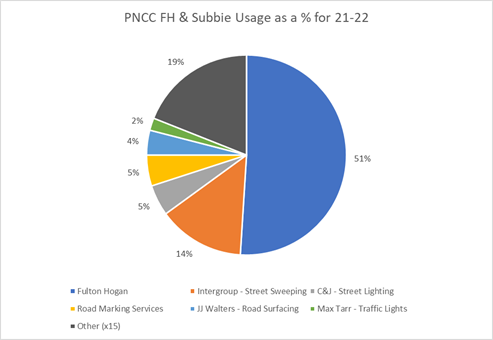
Figure
8: Breakdown of works undertaken by subcontractors
7. asset challenges
7.1 Road
Pavement Faults
7.1.1 Part of the
road maintenance contract is embedding routine inspections, data collection and
analytics into business as usual. This allows decisions and prioritisation to
be made at a ‘whole of network’ level based on current defect data.
The inspections cover all aspects of the roading corridor from pavement and
surface of the road, through to signs, sumps, culvert pipes and bridges. The
inspections capture the severity of the defect as well as the size, to enable a
more realistic assessment of the repair needed.
7.1.2 These captured
defects are then used to create monthly maintenance plans and to prioritise and
justify larger interventions where multiple defects occur. As these defects are
remedied, our data systems are updated as part of the monthly payment claim
process.
7.1.3 The database
for defects identified in the Palmerston North transport network shows a large
number of pavement and surfacing defects and suggested repairs. They include
faults such as potholes, cracking, depressions, failing surfaces and trenches.
7.1.4 This
information indicates a deterioration process at a much higher pace than our
planned and funded repairs and renewals programme. Work is underway in
preparation for the next 10 Year Plan, to use the information to identify works
and investment options to improve or rectify the situation.
7.1.5 One input into
the 2024-34 10 Year Plan and 2024-27 NLTP bid will be an adjusted Sealed
Pavement Renewal project list. This will further highlight that we have a
growing number of road sections that need major intervention and not enough
budget to reduce the requirement in a timely manner.
Updated Pavement
Renewal Locations
|
Indicative Timeframe
|
Validated Locations
|
|
2022/23
|
· Ferguson-Pitt Street (Part of Pitt/Ferg Upgrade
($1.4m)
· James Line (Kelvin Grove Road to Schnell Drive)
($1.5m) (Capital New funded)
· Custom Street, Ashhurst ($2.7m) (Capital New funded)
|
|
2023/24 onwards
(currently temporary holding treatments are being used to hold these
renewals off until funds are available)
|
· Tremaine Avenue (Konni-Wood) – Postponed due
to funding constraints in 22/23
· Vogel Street (Tremaine to Featherston) – heavy
maintenance to defer for 3 – 5 years in 22/23
· Railway Road (west of rail crossing at Bunnythorpe)
· Campbell Road (roundabout to Stoney Creek Road)
· Kelvin Grove Road (Ashhurst Road to Henaghans Road,
including seal widening and isolated vertical improvements)
· Stoney Creek Road (rail crossing to Kelvin Grove)
· Tremaine/Milson intersection
· Railway Road (Tremaine to rail overbridge)
· Tremaine Avenue (Milson to Thames Street)
· Pioneer Highway (2x sections between Botanical and
Amberley)
· Summerhill Drive (Mountain View Road to Tennent
Drive)
· Turitea Road (SH57 to Valley Views, seal widening)
· Kairanga-Bunnythorpe Road (rail line to Te Ngaio,
dependent on 2x bridge upgrades)
· Tremaine (Thames Street to Vogel), Francis Way
|
7.1.6 Figure 9 shows
the spread of road and top surface faults across the network and Figure 10 is a
summary of the network map showing the number of road and top road surface
faults there currently are on the network.
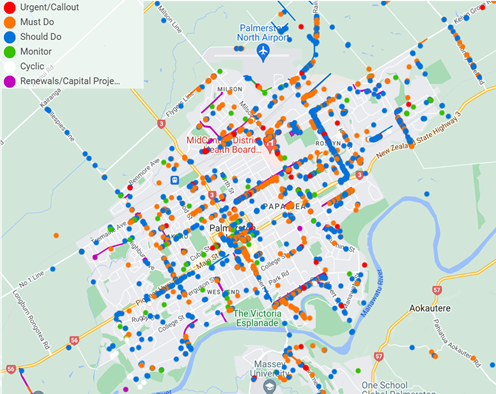
Figure 9: Identified road and top road surface
faults
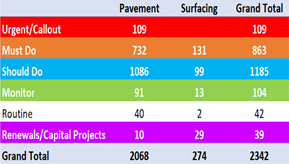
Figure 10: Number of identified faults across
the network
7.1.7 Similar to the
previous key, the 872 Urgent and Must Do defects have breached our assumed
Level of Service, whereas the 1185 Should Do defects are signals that the asset
is soon to fail. The 104 sites which are being Monitored is the first signal of
a defect without visible sign of increasing severity.
7.2 Drainage
Faults
7.2.1 Fulton Hogan
has applied considerable focus to ensure critical stormwater sump
infrastructure has been cleaned of all detritus ahead of forecast storm events.
In some cases, this increased attention has identified infrastructure in poor condition
and requiring programmed maintenance upgrades. These repairs will assist
significantly in the mitigation of adverse effects from rainstorm
blockages.
7.2.2 Culvert
inspections across the rural network have been undertaken identifying some
substandard culverts requiring future programmed remedial replacement. Kerb and
channel repairs have also been carried out on reseal sites across the city.
7.2.3 Large diameter
galvanised steel culverts on Greens and Kahuterawa Roads have recently been
identified as needing replacement due to condition as the base of the culverts
have failed. These are planned for replacement once resource consents have been
obtained.
8. road performance
8.1 Smooth
Travel Exposure
8.1.1 Smooth Travel
Exposure is the percentage measure of how much of the distance travelled across
the road network is smooth – higher being better. A standard measure of
road roughness is determined for each section of road through automated data
capture and then multiplied by the number of vehicles that would have travelled
across that road during that time and aggregated to a metric of the single
percentage travelled on smooth roads.
8.1.2 The red line
in Figure 11 below shows how Palmerston North compares to its peers of similar
networks (urban/rural mix), other mostly urban networks and within the region
and nationally. In general, the results show fairly smooth travel for most road
categories. This is a good reflection of the superficial treatment types
utilised over the past few years to remedy poor riding sections of road.
8.1.3 The measure
unfortunately does not signal the underlying condition of the road, only the
surface ‘top coat’, which means it is not a good measure of
underlying road lifespan or risk of failure.
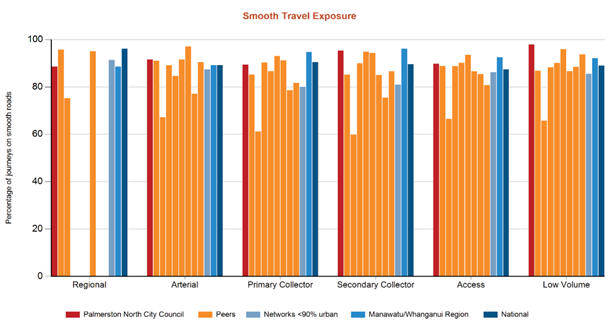
Figure 11: Performance of PNCC roads (smooth
road exposure) compared to peers
8.2 Condition
vs Investment
8.2.1 With the
inspection regime in place Officers now have an accurate understanding of the
quantum of defects on our roads. The multitude of defects in Section 7.1, Road
Pavement Faults, highlights the volume of issues compared to the current level
of funding, based on prior understanding of the network and prior performance.
At the surface level, superficial repairs have improved journey smoothness
however the data indicates costly underlying issues which will require
significant investment.
8.2.2 Figures 12 is
a graph produced by the Road Efficiency Group (REG) Insights tool, which shows
how our level of investment in maintenance and renewals compares to our peer
group of similar road networks and across the region. Our peer group consists
of medium sized cities with limited lengths of rural roads.
8.2.3 Palmerston
North consistently sits towards the bottom end of the scale within our peer
group in terms of investment, which may be explained by the compact nature of
our city. The peer group comparison however doesn’t consider the large
influx of freight traffic impacting on our urban roads. This is more likely to
help explain the substantive deterioration in road lifespan over the past few
years in particular, which means in turn that previous investment levels are
unlikely to be adequate in the future. The implications of this are discussed
in ‘Next Steps, below.
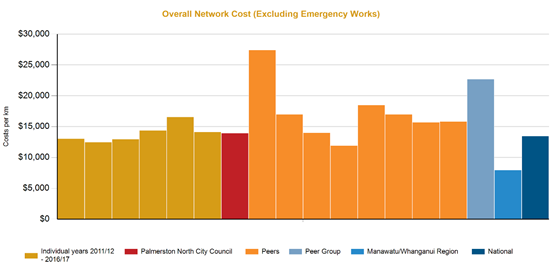
Figure 12: Level of investment in PNCC road network
compared to other networks
9. Other reflections
9.1 Officers
met with Fulton Hogan staff to reflect on the successes and challenges of the
first year of the project. Both parties acknowledged that the contract was slow
to resource to required levels, which was exacerbated by Covid impacts on
resource availability across New Zealand.
9.2 Officers
acknowledge that the data arising from the contract is excellent and has
significantly increased our understanding of the network and its challenges.
Work is underway to respond to our improved network understanding. This
includes the following:
· Assessing
the distribution of road maintenance and renewal budgets and making
recommendations of changes which would improve our responsiveness to priority
issues or resolve issues earlier.
· Innovating
new maintenance approaches to address specific problems.
· Developing
strategies to identify and secure targeted and prioritised funding in the next
LTP.
9.3 Officers
and Fulton Hogan have reviewed responsiveness and prioritisation decision
making on the contract. A weekly prioritisation meeting has been initiated
between the two contract managers to ensure decisions reflect wider Council
priorities as well as asset priorities.
9.4 Officers
and Fulton Hogan recognise that a lack of public information about planned
works, and reactive responses, has exacerbated public frustration about road
condition issues and responsiveness. A web page is currently being trialled to
make planned work schedules available to the public in a map-based format. This
will be searchable to enable users to identify planned works on individual
streets. In addition, FAQs will be prepared on reactive maintenance and
inspection schedules will be put online in map form.
9.5 PNCC
Communications staff and Asset Managers have also provided a briefing to local
media about potholes, how they form and how they are repaired to help build
shared understanding of reactive issues and underlying road issues, and to
promote the snap-send-solve app.
10. NEXT STEPS
10.1 As
specific programmes are confirmed for the 2022/23 year, they will be shared
with the public through the Council website and social media as appropriate.
10.2 With the
next National Land Transport Fund applications due in August 2023, the next 12
months will be focused on preparation of the business case.
10.3 Decisions
are needed on the level of investment in maintenance, operations and renewals
we will seek Waka Kotahi co-funding for. A clear understanding of how the
network is currently performing both in terms of smoothness and lifecyle
(defects and underlying issues) compared to required level of service and the
difference between the two will be key to right-sizing the funding request to
achieve the outcomes required.
10.4 The
business case development process will involve engagement with Elected Members,
Iwi and consultation with other key stakeholders early in 2023.
10.5 Further
six-monthly reports covering progress on the work programme and performance of
the road maintenance contract will be provided to the Infrastructure Committee
over the term of the contract.
11. Compliance and administration
|
Does the Committee have
delegated authority to decide?
|
Yes
|
|
Are the decisions significant?
|
No
|
|
If they are significant do they
affect land or a body of water?
|
No
|
|
Can this decision only be made
through a 10 Year Plan?
|
Yes
|
|
Does this decision require
consultation through the Special Consultative procedure?
|
Yes
|
|
Is there funding in the current
Annual Plan for these actions?
|
Yes
|
|
Are the recommendations
inconsistent with any of Council’s policies or plans?
|
No
|
|
The recommendations contribute
to Goal 1: An Innovative and Growing City
|
|
The recommendations contribute
to the achievement of action/actions in Transport
The action is: Develop,
maintain, operate and renew the transport network to deliver on the Council
goals, the purpose of this plan, and the Government Policy Statement on
Transport.
|
|
Contribution to strategic
direction and to social, economic, environmental and cultural well-being
|
An efficient and effective
transport network enables social, economic, environmental and cultural
wellbeing by supporting people, goods and services to move throughout the
city.
|
|
|
|
Attachments
Nil
Memorandum
TO: Infrastructure
Committee
MEETING DATE: 17
August 2022
TITLE: Tamakuku
Terrace Six Monthly Update
Presented By: Bryce
Hosking, Group Manager - Property
APPROVED BY: Sarah
Sinclair, Chief Infrastructure Officer
RECOMMENDATION(S)
TO Infrastructure Committee
1. That the
Committee receive the memorandum titled ‘Tamakuku Terrace Six-Monthly
Update’, presented to the Infrastructure Committee on 17 August 2022.
1. ISSUE
1.1 The
Infrastructure Committee requested six-monthly updates be provided throughout
the duration of the project.
2. BACKGROUND
2.1 The
District Plan includes a specific Structure Plan and suite of planning
provisions for the Whakarongo Residential Area that will direct the subdivision
design and development. This includes guidance for providing different section
sizes.
2.2 Tamakuku
Terrace provides an opportunity to deliver a subdivision consistent with the
requirements of the District Plan.
2.3 Once
developed the subdivision will create 114 new residential sections. Sections
will be of a variety of sizes to appeal to a wide variety of purchasers by
giving options regarding design, build type and purchase price.
2.4 Section
sizes will range from 275m2 (a couple) through to 810m2,
with the average section size being 463m2.
2.5 The
development of the site will be split into two stages:
· Stage
1 – 79 sections; and
· Stage 2 –
The balance of 35 sections.
2.6 Stage
2 is subject to the approval of the comprehensive discharge consent (CDC) for
the entire Whakarongo Growth Area from Horizons Regional Council and is
anticipated to closely follow, but remain distinct from, Stage 1.
3. Development update – up to july 2022
3.1 Below
is the project update from the July 2022 project steering group meeting:
Health and Safety
3.2 The
health and safety incident report for Stage 1 of the project is summarised
below:
|
|
Near Misses
|
Incidents
|
Notifiable Events or Loss-Time Injuries
|
Total
|
|
Accumulative
to date
|
3
|
12
|
0
|
15
|
|
This
period
|
0
|
1
|
0
|
1
|
|
Total
|
3
|
12
|
0
|
16
|
Regulatory
3.3 All
consents have been obtained for the project from both Palmerston North City
Council and Horizons Regional Council for Stage 1.
3.4 Horizons
Regional Council have continued to commend the contractor for the environmental
controls onsite which have been working well in the recent rain events.
3.5 The
KiwiRail Authority Grant and Permit have been issued to allow the Stage 1 works
that are within the KiwiRail corridor to proceed, noting this is different from
the consent required for Stage 2 to construct the stormwater pipe under the
rail corridor.
Progress Update
3.6 Overall,
the contractor is progressing well, and the site is being well managed.
3.7 The
revised practical completion date for Stage 1 is now mid-August 2022. This has
been delayed from the original expected completion date of November 2021.
3.8 Most
of this delay is due to wet weather especially as the project nears completion
with rain throughout large parts of July.
3.9 In
addition, there were also delays caused from Covid-19 Alert Levels 3 and 4 in
August 2021, and a small number of minor delays relating to additional
environmental controls required by Horizons.
3.10 The
section titles for Stage 1 are now expected in October 2022.
Key Programme
Milestones
3.11 Below
is a summary of the revised development milestones:
|
Key
Project Milestones
|
Programmed Date
|
Current Status
|
|
Stage
1 Construction Completion
|
November
2021
|
August
2022
|
|
Stage
1 Presales
|
Ongoing
|
Ongoing
|
|
Stage
1 Titles Issued
|
February
2022
|
October
2022
|
|
Stage
2 Resource Consent Application Lodged
|
April
2022
|
June
2022
|
3.12 Please
note the Consent application for Stage 2 is subject to Council achieving the
greater Resource Consent for the Whakarongo Growth Area. This includes
acquiring the Downstream Oxbow from a neighbouring party.
Sales
3.13 The sales
as at 31 July 2022 are summarised below:
|
Stage
|
Presales
|
|
Stage 1 Unconditional Sales
|
20
|
|
Stage 1 Conditional Sales
|
16
|
|
Stage 2 Conditional Sales
|
4
|
|
Total
Presales
|
40
|
3.14 Council
launched the second sales release comprising of 16 sections on 15 February
2022. We have not sold any of these sections to the market.
3.15 The market
has continued to soften in the first seven months of the year, which is
illustrated by the average house price index in Palmerston North City reducing
by 5.9% over the last three months. In addition to this several agencies have
reported a considerable decrease in open home numbers and enquiries.
3.16 There are
multiple factors that are causing this downward pressure including increasing
interest rates, lending serviceability and building cost escalation.
3.17 Bayleys
were engaged on 18 March 2022 to assist with converting the enquiries into
sales. Amongst the continued marketing campaign Bayleys have also held a
targeted information evening in May 2022 which has created further interest in
the project.
3.18 Despite
the overall softening of the market, there has continued to be strong interest
in the project with over 860 visitors to the website in June and 760 visitors
in July 2022 which is almost double what it was in May.
3.19 Moving
forward the focus will be on the build partners, supporting them to sell House
and Land Packages so that they can purchase more sections. Council is
proactively exploring opportunities around terms to make it easier for build
partners to pre-purchase sections and make purchasing overall within the
development even more attractive.
3.20 The first
of the house and land packages being offered from one of the build partners is
now being advertised online. This is on one of the smaller sections in the
development to demonstrate a positive outcome that can be achieved on one of
these sections.
3.21 The recent
government budget increased the Kāinga Ora First Home Cap on new builds to
$700,000 in Palmerston North City and the Kiwibuild cap has increased to
$715,000. Officers are working with build partners on how they could reach
these levels.
3.22 Council
Officers continue to assess the pricing within the current market, and we will
respond to market corrections accordingly, however we do not recommend making
reactionary decisions or leading price corrections. Whilst Council do not want
to be leading price corrections in the market, equally it is important the
section prices remain aligned to the market.
Marketing
3.23 A
marketing refresh is planned to coincide with construction completion and
increase in marketing to drive enquiry. We will be able to move from image
renders to actual photos which will assist with this. A new campaign has been
approved with NZME with features in local, regional and national publications.
This is still within the overall planned marketing budget for the project.
3.24 Bayleys
have also signalled that once construction is finished and potential purchasers
can walk around the site, this will help with the overall marketing and
engagement strategies as potential purchasers will be able to physically visit
the sections and get a feel for the live environment.
3.25 The design
guidelines and section covenants for the development have also been reviewed to
ensure these were not going to be a barrier to entry. This process was
completed in consultation with the build partners. The design guidelines are
aligned with the District Plan with most elements being considered as part of
the consenting process.
3.26 The
guidelines ensure the quality of outcomes within the development and assist
with the overall consenting process. Feedback from the group builders is the
guidelines have not materially added cost to their house and land packages.
Financial
3.27 Stage 1 of
the project continues to track within the programme budget and all variations
have been accommodated within the project contingency.
3.28 Revised
sales projections have been factored into the 2022/23 budget.
4. wider whakarongo growth area
4.1 Advanced
negotiations continue with the private landowners in the lower terrace of the
Whakarongo growth area to acquire the natural oxbow. This is the key component
in achieving the wider Whakarongo growth area consent with Horizons.
4.2 Council
Officers are expecting a draft set of consent conditions from Horizons in early
August 2022 for review.
5. NEXT STEPS
5.1 Continue
to deliver the project in accordance with programme.
5.2 Achieve
all consents for Stage 2 of the project, with earthworks commencing around
October 2023 in the summer construction window.
6. Compliance and administration
|
Does the Committee have
delegated authority to decide?
|
Yes
|
|
Are the decisions significant?
|
No
|
|
If they are significant do, they
affect land or a body of water?
|
No
|
|
Can this decision only be made
through a 10 Year Plan?
|
No
|
|
Does this decision require
consultation through the Special Consultative procedure?
|
No
|
|
Is there funding in the current
Annual Plan for these actions?
|
Yes
|
|
Are the recommendations
inconsistent with any of Council’s policies or plans?
|
No
|
|
The recommendations contribute
to Goal 1: An Innovative and Growing City
|
|
The recommendations contribute
to the achievement of action/actions in City Growth
The action is: Housing
development is initiated at Whakarongo
|
|
Contribution to strategic
direction and to social, economic, environmental and cultural well-being
|
Progressing with the Tamakuku
Terrace subdivision development within the Whakarongo Growth Area will:
· Provide
additional sections to the marketplace to help reduce the supply vs. demand shortfall;
· Provide choice
to purchasers through a variety of section sizes and provide them the freedom
to choose their preferred house builder;
· Provide a best
practice example to the private development community showcasing the
opportunities and benefits of working closely with local iwi, urban
designers, territorial authorities and local experts to achieve excellent
outcomes.
· Support local
contractors and the employment market.
|
|
|
|
Attachments
Nil
Memorandum
TO: Infrastructure
Committee
MEETING DATE: 17
August 2022
TITLE: Papaioea
Place Redevelopment Six Monthly Update
Presented By: Bryce
Hosking, Group Manager - Property
APPROVED BY: Sarah
Sinclair, Chief Infrastructure Officer
RECOMMENDATION(S)
TO Infrastructure Committee
1. That the
Committee receive the memorandum titled ‘Papaioea Place Redevelopment Six
Monthly Update’, presented to the Infrastructure Committee on 17 August
2022.
1. ISSUE
1.1 Stage
3 of the Papaioea Place Housing Redevelopment is funded through Programme 1743
– Social Housing – Papaioea Stage 3.
1.2 The
Infrastructure Committee requested six-monthly updates be provided throughout
the duration of the project.
2. BACKGROUND
2.1 The
Papaioea Place project Form of Contract is a design and build contract between
Palmerston North City Council (Principal) and Latitude Homes (Contractor) of
New Plymouth.
2.2 Papaioea
Place Stages 1 and 2 have already been delivered on the site. This saw the
demolition of the old 48 units which were no longer fit for purpose and
replaced with 78 new units along with supporting infrastructure.
2.3 Stage
3 of the project will see a further seven units and a tenant lounge being
constructed in the centre of the site.
2.4 Site
meetings and Project Control Group meetings are held each month and this report
is a summary from the June 2022 meeting.
3. Project update – up to june 2022
Health and Safety
3.1 There
were no new health and safety incidents reported since the last report.
3.2 There
have been three H&S ‘near misses’ to date for the life of the
project over all three stages of the development.
Programme Update
3.3 Construction
has commenced on the final seven units. These are scheduled for completion in
late April 2023.
3.4 Construction
of the tenant lounge will commence in the coming months and is scheduled for
completion in August 2023.
Financial
3.5 There
is an approved Programme Budget for Stage 3 of $4,204,446 including GST.
3.6 Stage
3 is currently tracking within budget and to programme.
4. NEXT STEPS
4.1 Continue
the construction of Stage 3 of Papaioea Place as per construction programme.
5. Compliance and administration
|
Does the Committee have
delegated authority to decide?
|
Yes
|
|
Are the decisions significant?
|
No
|
|
If they are significant do, they
affect land or a body of water?
|
No
|
|
Can this decision only be made
through a 10 Year Plan?
|
No
|
|
Does this decision require
consultation through the Special Consultative procedure?
|
No
|
|
Is there funding in the current
Annual Plan for these actions?
|
Yes
|
|
Are the recommendations
inconsistent with any of Council’s policies or plans?
|
No
|
|
The recommendations contribute
to Goal 3: A Connected and Safe Community
|
|
The recommendations contribute
to the achievement of action/actions in Connected
Communities
The action is: Upgrade
the Papaioea housing complex.
|
|
Contribution to strategic
direction and to social, economic, environmental and cultural well-being
|
The Papaioea Place
Redevelopment will:
· Increase
Council’s social housing to help meet the demand for this type of
housing and reduce the housing waiting list;
· Improve
the housing condition of the complex by replacing the old units; and
· Provide
a complex that delivers on the Social Housing Plan.
|
|
|
|
Attachments
Nil
Memorandum
TO: Infrastructure
Committee
MEETING DATE: 17
August 2022
TITLE: Central
Business District Streets for People Programme - Six Monthly Update
Presented By: Geoffrey
Snedden, Senior Project Manager
APPROVED BY: Sarah
Sinclair, Chief Infrastructure Officer
RECOMMENDATION(S)
TO Infrastructure Committee
1. That
the Committee receive the memorandum titled `Central Business District Streets
for People Programme – Six Monthly Update’, presented to the
Infrastructure Committee on 17 August 2022.
1. ISSUE
1.1 The
Streets for People Programme for improvements to the Central Business District
streets is funded through Programme 2122 – CBD Streets for People.
1.2 The
terms of reference for the Infrastructure Committee include oversight of the
progress of the design and build for the Streets for People Programme. The
Infrastructure Committee requested six-monthly updates be provided throughout
the duration of the project.
2. BACKGROUND
2.1 In
2010 Palmerston North City Council (PNCC) commenced a new urban design journey
for the City, including the city centre. This resulted in the development of
both the City Centre Framework 2013 (CCFW) and City Centre Streetscape Plan
2016 (CCSP) to inform and guide future city centre urban and streetscape
development. The CCFW and the CCSP outline the steps for making the city centre
a vibrant place that locals are proud of and that leaves a lasting positive
impression on visitors.
2.2 The
Streets for People Programme was put in place to implement the CCSP and was
incorporated into Council’s 2018-28 10 Year Plan. The objective of the programme
is to invest into the public realm resulting in the following benefits:
· Improved
vitality in the city centre, more people, more often, more interaction with the
streetscape;
· Slowed
traffic speeds and decreased through traffic volumes – with pedestrians
prioritised;
· A
range of population demographics actively using the streets;
· Improved
multi-mode share for getting to and moving around the streets.
2.3 A
map of CBD Streets for People Programme (2122) is outlined below.
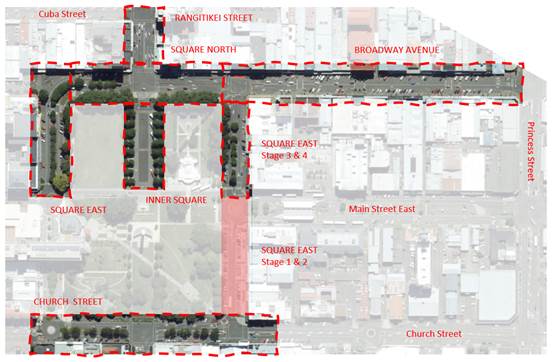
2.4 The
first stages of the programme, Square East (Stages 1 and 2) between Church
Street and Main Street, were completed in June 2020. This resulted in new wider
footpaths, reduction of on street parking and improved street amenity,
including trees and seating. These stages were tendered publicly with Higgins
Construction Limited being awarded both contracts.
2.5 In
June 2020 Council approved the procurement process to engage a design
consultant to undertake all design services for all the streets in the programmes.
This was because bundling the remaining streets into one design contract would
enable price efficiencies and result in development of a comprehensive and
connected streetscape plan. A complete set of detail design drawings would also
allow PNCC to undertake Early Contractor Engagement to explore delivery options
such as contract bundling, decrease construction costs and enable efficiencies
in construction programming to reduce the overall length of disruption to the
public, retailers and other stakeholders.
2.6 At
the 20 December 2021 meeting Council endorsed sole source negotiations with a
contractor for construction for Square East Stages 3 and 4. The Contractor was
subsequently engaged under an Early Contractor Engagement contract to provide
buildability and risk input through the design phase prior to delivery of the
work, which is described below.
3. PROJECT SUMMARY – up to July 2022
3.1 Status
of Project: Detail Design
3.2 Work
completed to date:
3.2.1 BECA has
completed the preliminary design stage for all the streets in the programme.
The detail design for Square East Stages 3 and 4 has also been completed, which
included:
· Rangitāne
co-design;
· Value
engineering material selection, whilst retaining aesthetic and functional
requirements;
· Engagement
and stakeholder design with affected parties.
3.2.2 The detail
design for Square East Stages 3 and 4 was issued to a contractor through an
Early Contractor Involvement (ECI) agreement. The intent was to involve the
contractor early to resolve buildability issues, improve value engineering and
mitigate supply chain delays caused by Covid.
3.2.3 The contractor
developed a construction price along with two construction programme
methodologies for Square East Stages 3 and 4. This was submitted to PNCC in
mid-May 2022, and a paper for Council approval was drafted.
3.2.4 As part of the
Annual Plan deliberations the construction budget for Square East Stages 3 and
4 was deferred to the 2023/24 financial year.
3.2.5 Due to the
deferral of the budget, the procurement methodology, including any need for
sole sourcing, will be reviewed in early 2023, to reflect current known market
conditions, and to enable procurement and delivery of the project in the
revised timeframe.
3.2.6 Detail design
of the other streets in the programme was not completed in the 21/22 financial
year – the delaying effects of COVID on the supply chain meant that the
project team prioritised the design of Square East Stages 3 and 4 to best meet
planned construction deadlines. Funding is proposed to be carried forward into
this financial year (22/23) to complete the detail designs for Broadway, Square
North, Rangitikei Street, Church Street, Square West and the Inner Square, to a
stage where Officers have confident post-Covid cost assessments to inform
discussions on delivery.
3.2.7 Learnings from
the Value Engineering process for Square East Stages 3 and 4 will be
incorporated into the designs underway.
3.2.8 Whilst some
engagement with stakeholders is underway and will continue through the design
stage, it is proposed to bring the design to a pre-consultation basis, to
understand the delivery programme prior to undertaking any further engagement
with those affected by specific project stages.
4. Financial
4.1.1 The Streets
for People Programme has the following budget, including a proposed carry
forward of $600k from 21/22 to 22/23 to complete the design contract underway.
|
Programme
ID:
|
2122 – CBD Streets for People
|
|
|
|
|
|
|
|
|
|
|
|
|
22/23
(000s)
|
23/24
(000s)
|
24/25
(000s)
|
25/26
(000s)
|
26/27
(000s)
|
27/28
(000s)
|
28/29
(000s)
|
Total
(000s)
|
|
Capital
costs
|
|
5,288
|
925
|
6,276
|
6,766
|
3,726
|
661
|
24,244
|
|
Marcomms/Engagement
|
|
41
|
20
|
20
|
20
|
20
|
20
|
144
|
|
CCSP
- Square North
|
|
|
|
264
|
2,441
|
|
|
2,705
|
|
CCSP
- Square East
|
600
|
2,903
|
|
|
|
|
|
3,503
|
|
CCSP
- Church Street
|
|
|
|
|
394
|
3,643
|
|
4,038
|
|
CCSP
Broadway Ave
|
|
|
439
|
2,931
|
2,640
|
|
|
6,011
|
|
CCSP
Rangitikei St
|
|
2,343
|
|
|
|
|
|
2,343
|
|
CCSP-
Square West
|
|
|
465
|
3,060
|
1,269
|
|
|
4,795
|
|
CCSP
- inner Square
|
|
|
|
|
|
62
|
641
|
703
|
|
Inflation
|
|
126
|
45
|
482
|
717
|
506
|
110
|
1,989
|
|
Total Capital Cost
|
600
|
5,414
|
971
|
6,758
|
7,483
|
4,232
|
772
|
26,234
|
4.2 The
programme has the following contracts in place:
|
Vendor
|
Description
|
Value
|
Spend to date
|
|
BECA
|
Services provided:
· Concept through
to detail design for all the streets
· Co-design with
Rangitāne
· Localised
traffic modelling
· Lighting design
|
$1,066,243
|
$632,508
|
|
WT Partnership
|
Services provided:
· PM services
· Stakeholder
liaison
· ECI contract and
price negotiations – SE 3 & 4
· Quantity
Surveyor reviews SE 3 and 4
|
$223,150
|
$209,338
|
5. next steps
5.1 The
key milestones for the delivery of the detail design for the programme are as
follows:
|
Date
|
Activity
|
|
End August 2022
|
· Finalise
detail design and costings delivery programme for the streets in the
programme.
· Review of
Stages 3 and 4 value engineering and implications on design stage.
· Review
implications of tender price across the programme (noting that the intent of
completing the pre-consultation design is to develop robust post-Covid
costings).
· Review of
the ECI process to identify advantages/benefits that were achieved. These can
then be incorporated in future procurement strategies for similar works.
|
|
February 2023
|
Six Monthly Project
Update Report to the Infrastructure Committee (if required).
|
|
End May 2023
|
Paper to Council on options for delivery of the
construction stage of the programme, and associated engagement planning for
each option, plus costs and opportunities for external funding.
|
6. Compliance and administration
|
Does the Committee have
delegated authority to decide?
|
Yes
|
|
Are the decisions significant?
|
No
|
|
If they are significant do they
affect land or a body of water?
|
No
|
|
Can this decision only be made through
a 10 Year Plan?
|
No
|
|
Does this decision require
consultation through the Special Consultative procedure?
|
No
|
|
Is there funding in the current
Annual Plan for these actions?
|
Yes
|
|
Are the recommendations
inconsistent with any of Council’s policies or plans?
|
No
|
|
The recommendations contribute
to Goal 2: A Creative and Exciting City
|
|
The recommendations contribute
to the achievement of action/actions in City Shaping
The action is:
· The city centre contributes positively to the perception of
Palmerston North;
· Visible public life and pedestrian counts increase;
· There is increased demand for floor space;
· The city centre has a series of places with a strong place
identity;
· The City Centre Streetscape Plan is delivered, with Square East
the initial priority.
|
|
Contribution to strategic
direction and to social, economic, environmental and cultural well-being
|
A vibrant city
centre will make Palmerston North even more attractive for work and play,
provide more opportunities for locals and visitors to connect with the city
and the people who live here, and bring significant benefits for the local
economy. The Streets for People programme provides for investment in the
public space to ensure our roads are places for people, not just vehicles. It
emphasises pedestrian friendly public spaces, cultivating a lively economy
after 5pm, and attracting more private investment in the city centre.
|
|
|
|
Attachments
Nil
Memorandum
TO: Infrastructure
Committee
MEETING DATE: 17
August 2022
TITLE: Memorial
Park Development Plan - Update Report
Presented By: Kathy
Dever-Tod, Group Manager - Parks and Logistics
APPROVED BY: Sarah
Sinclair, Chief Infrastructure Officer
RECOMMENDATION(S)
TO Infrastructure Committee
1. That
the Committee receive the memorandum titled ‘Memorial Park Development
Plan – Update Report’, presented to the Infrastructure Committee on
17 August 2022.
1. ISSUE
1.1 The
Memorial Park Development Plan 2017 (the Development Plan) provides the
strategy for the preservation and enhancement of the existing values and unique
characteristics of Memorial Park. The Development Plan site plan shows
enhancements and replacements of existing features, and the addition of new
features planned for the park. A copy of the plan is shown in Attachment One.
1.2 Implementation
of the Development Plan was funded in Ten-Year Plan 2018-28, with significant
investment planned for years 1 through 5 (2019 to 2024).
1.3 This
report provides the committee with an update on the redevelopment of Memorial
Park, and the completion of two significant anchor projects – the
installation of a splashpad and redevelopment of the children’s
playground.
2. BACKGROUND and history
2.1 Memorial Park is one of the six City Reserves. A City Reserve is
intended to be a destination for the wider community and visitors to the city.
Each City Reserve has its own special character and facilities.
2.2 Memorial Park was originally a gravel extraction pit and rail siding
yard. The park provided rail ballast for the Palmerston North to Foxton rail
network. Once this work ceased, the pit that remained after heavy gravel
extraction was considered an “eyesore” by the community. The community
lobbied Council to develop a park on the site, and it was named Fitzroy Park.
2.3 The park was dedicated as ‘Memorial Park’ in 1954 by
Major General Kippenberger, in recognition of lives lost and the general war
effort achieved during WWII. Significant investment occurred in the original
development of the site including landscaping and the addition of play
features, a cycling track, sportsfield, skating rink, paddling pool and public
amenities.
2.4 Over time the original features at the park lost their shine and, in
the absence of a coordinated development plan, additions to the park occurred
in an uncoordinated and untargeted manner. As a result, the park began to lose
its special character.
2.5 In August 2017 Council began extensive engagement with the community
regarding development plans for Memorial Park. The engagement process
helped identify the park’s special character and the values the community
and stakeholders held as important.
2.6 The
themes that came through strongly in the consultation were:
· 1950’s optimism and family fun;
· Water play; and
· Playground, family areas, and lazy, long summer fun days at the
park.
2.7 In addition to these themes it was identified that Memorial Park
could provide a high level of physical accessibility, making the park more
inclusive.
2.8 The Development Plan was adopted in 2017. It takes a coordinated
approach to the park’s development over time.
2.9 The Ten-Year Plan 2018-28 provides the budgets for the delivery of a
series of projects over time.
2.10 As well as the Memorial Park Development Plan Implementation
programme (new capital):
· Provision was made
in the Ten-Year plan for approximately 60% of the developments at Memorial Park
to be funded through renewals to replace existing assets such as hard surfaces,
playground and general building renewals.
· Funds within the
programme for Improving Accessibility and Safety in Parks were prioritised to
Memorial Park.
2.11 The community aspiration of a high-quality splash pad was approved
by Council as part-subject to securing external funding of $250,000 towards the
total cost of $500,000.
2.12 In 2019,
Officers reviewed the overall development programme and project planning. It
was determined it would be beneficial to align and combine the playground
renewal planned for 2027/28 with the new developments planned. The
advantages were:
· More ability to
deliver on accessibility improvements by undertaking all site works at once;
· An economy of scale
to carrying out all earthworks at once;
· A reduction in disruption
to the park users with one larger worksite and some works carried out in
parallel vs the alternative of staging;
· Some future
renewals, such as the deteriorating playground safety surface, would be
achieved more efficiently;
· Greater impact for
the community, with many of the benefits of the upgrades and renewals combined.
2.13 An
amendment was made to the 2020/21 Annual Plan to bring forward budgets, from
2027/28 to 2020/21. The overall funding provision in the Ten-Year Plan 2018-28
was not altered, just the timing.
3. Project Management
3.1 A
series of projects associated with the implementation of the Memorial Park
Development Plan over the 2019/20, 2020/21 and 2021/22 financial years were
managed by the Parks and Logistics Division of Council. The projects included:
· A new and fully
accessible splash pad, including an underground tank, water reticulation system
and pump house;
· A new and fully
accessible playground which meets all playground and accessibility audit
standards;
· A new and accessible
family and BBQ area;
· A new
caretaker’s shed;
· Conversion of the
old caretaker’s shed into a skate rental shed for the Memorial Park
Sports Trust;
· New concrete around
the new caretaker’s shed, the skate rental shed and the paddling pool;
· New pool fencing;
· A new War Memorial
entrance that houses the restored original 1954 flagpole that was dedicated by
Major General Kippenberger.
3.2 There
were several aspects to the management of this programme of works that made it
particularly challenging to manage, including:
· The impacts of
Covid-19 in the early construction and fund-raising stage for the splashpad and
playground;
· Contractor and
materials availability;
· Timelines for
completion to have the playground and existing paddling pool available for
summer.
3.3 Covid-19
produced significant uncertainties – particularly regarding the
availability of specialised equipment for the splash pad and play equipment -
which was sourced from overseas.
3.3.1 When the
Covid-19 pandemic began to escalate across the world, $15,000 of the targeted
$250,000 of external funding had been secured.
3.3.2 In the early
stages of the pandemic, securing specialist equipment from overseas was
identified as an emerging risk, due to disruptions to supply chains and price
escalations as a result of the pandemic. The mitigation actions and
associated risks were assessed. The decision was made to immediately
place on order for the equipment, with very high confidence at that time that
funding would be secured in a timely manner.
3.3.3 Once the
equipment was purchased and in New Zealand the pandemic was well underway and
the funders changed focus to help respond to issues arising from the pandemic.
This pushed the splash pad play equipment out of the short-term timeframe to
receive funding, and reduced confidence the external funding needed to complete
the project would be secured in a timely manner.
3.3.4 The splash pad
project was put on hold until the external funds had been secured.
3.3.5 The programme
of works was revised to focus on making the playground and existing paddling
pool available for use by the community as soon as possible. This posed
additional risks and programming complexity, including additional work site
fencing and separation of the civil works previously coordinated between the
playground and splashpad projects. The playground opened on 2 July 2021.
3.3.6 With the
splash pad on hold, the contractors moved off site to meet their commitments to
other work. When full funding for the splash pad was finally secured, Council
was only able to secure the contractors intermittently on the project, due to
their other commitments. The project delivery timeline required further
revision.
3.3.7 The splashpad
project was ultimately delayed by 7-8 months, and eventually opened on 12
December 2021.
4. Project Outcomes
4.1 The
project outcomes sought, as articulated in pages 17 to 25 of the Development
Plan, are:
· Play equipment
– use and repurpose as much of the existing playground equipment as
possible;
· Splash pads and
water play – expand and develop water play at the park;
· Entrance and feature
wall – create a new ‘memorial’ arrival area with a curved
retaining wall that is welcoming;
· Work with the
existing themed buildings and rejuvenate with colour and local history;
· Poppies play space
– the new water play area and playground should have the poppy theme and
war memorial remembrance built into the design;
· Paddling pool
surrounds and fence – create a subtle, black accessible fence and
concrete the paved area;
· Picnic and BBQ
– develop a new family area and BBQ area – that is larger with more
BBQ – and under trees.
4.2 The
two projects achieved the following outcomes:
· An estimated
300-400% increase in user numbers;
· Extremely positive
community feedback – as viewed through social media – a sample of
comments is provided in Attachment Two;
· One of New
Zealand’s best outdoor free water play features, including New
Zealand’s largest splash pad;
· A doubling of the
area of water-play space at the park;
· Subtle and
appropriate recognition of the park as a war memorial using built-in design
features and murals;
· A fully accessible
and poppy-themed playground, family area and splash pad. It is noteworthy that
there have been enquiries from other councils and schools about the playground
design and its accessibility aspects;
· High re-use - All
swings, shade sails and climbers were repainted and reused. Only the wooden
playground was in too poor of a condition to be re-used;
· A nearly complete
restoration of the park, buildings and surrounds – including new curved
entrance, new caretaker’s shed, upgraded skate rental shed, new pool
fence, new hard-stand concrete surfaces and new safety surfaces.
4.3 The
park is being managed by Council staff in partnership with CLM and is
continuing to be popular. CLM is training Council staff in the operation of the
splash pad as well as providing pool side supervision during busy periods.
4.4 There
remains a small drainage issue at the splash pad. The levels are out by up to
20mm in places, causing water to pond on the path leading to the
playground. The discrepancy in the levels would have almost certainly not
occurred if the hard surfaces for both splash pad and playground were able to
be completed at the same time as had originally been planned.
Rectification of this issue will be a relatively small cost that can be
accommodated within existing budgets.
5. Financial
5.1 Over
the past three financial years, approximately 85% of the Memorial Park
Development Plan implementation has occurred.
5.2 The
total cost to date is $2,116,307 against a budget of $2,100,000, of which
$250,000 was raised externally.
5.3 Costs
by year were:
· 2019/20
$749,899
· 2020/21 $923,523
· 2021/22 $442,885
5.4 The
components of the overall project were:
· Splashpad
Budget $500,000
of which $250,000 was raised externally
Spend $580,000[1]
· Playground
Budget $600,000
Spend $620,000
· Earthworks,
landscaping and amenities
Budget $1,000,000
Spend $916,307[2]
6. Lessons learned
6.1 A
project lessons learned debrief has been conducted with an independent
facilitator.
6.2 The
key project management lessons learned were:
· Having a Development
Plan produced on sound and comprehensive community engagement was key to
ensuring final built facilities were aligned with community values and
aspirations. The project scope was well defined.
· The passion and
creativity of the Project Team, in both design and project management stages,
was a key factor in producing the quality final product.
· The unforeseen and
rapidly developing risks Covid-19 presented were managed well. Excellent
adaptation while the project was in-flight was evident.
· There could have
been better communication with Elected Members on actions and delivery
timelines as the project evolved.
· These projects would
have benefited with more detailed construction plans and project management
documentation, including procurement plans (the Project Management Office has
developed training and mentoring).
· A critical
assessment of contractor capacity to manage multiple projects at once when
constructing a large and complex job like Memorial Park might have helped make
some improvements to timeframes.
· The aspirations for
the park expressed in the Development Plan were met.
7. NEXT STEPS
7.1 The
lessons learned from this project have been captured by the Project Management
Office and will be used in planning of other Council projects.
7.2 Planning
for the next projects in the development of Memorial Park is well
underway. Projects in 2022/23 include:
· Removal of the old
caretaker’s shed;
· Installation of a
new toilet/change room to replace the existing change room;
· Design and
installation of the Heroes Walk Memorial.
· Installation of the
sensory garden;
· Continue replacement
of the closed board wooden road boundary fence with pool style fencing
(renewals).
8. Compliance and administration
|
Does the Committee have
delegated authority to decide?
|
Yes
|
|
Are the decisions significant?
|
No
|
|
If they are significant do they
affect land or a body of water?
|
No
|
|
Can this decision only be made
through a 10 Year Plan?
|
No
|
|
Does this decision require
consultation through the Special Consultative procedure?
|
No
|
|
Is there funding in the current
Annual Plan for these actions?
|
Yes
|
|
Are the recommendations
inconsistent with any of Council’s policies or plans?
|
No
|
|
The recommendations contribute
to Goal 2: A Creative and Exciting City
|
|
The recommendations contribute
to the achievement of action/actions in Active Communities
The action is: The
recommendations contribute to the outcomes of the Creative and Liveable Strategy
Create a city
that has great places for all people, particularly families
Have the most
active community in New Zealand
Implement
projects from approved Master Plans, Reserve Management Plans and Development
Plans
|
|
Contribution to strategic
direction and to social, economic, environmental and cultural well-being
|
The implementation of the
Memorial Park Development Plan enhances recreation opportunities and
activities available in the City.
The park is a popular gathering place for families and groups and adds to the
vibrancy and pride in Palmerston North.
|
|
|
|
Attachments
|
1.
|
Memorial Park Development Plan 2017 ⇩ 
|
|
|
2.
|
Sample of Social Media comments - Memorial Park upgrade ⇩ 
|
|
COMMITTEE WORK SCHEDULE
TO: Infrastructure
Committee
MEETING DATE: 17
August 2022
TITLE: Committee
Work Schedule
RECOMMENDATION TO Infrastructure Committee
1. That the
Infrastructure Committee receive its Work Schedule dated August 2022.
|
COMMITTEE WORK SCHEDULE – AUGUST 2022
|
|
Item No.
|
Estimated Report Date
|
Subject
|
Officer Responsible
|
Current Position
|
Date of Instruction/
Clause number
|
|
1.
|
August 2022
|
Memorial Park – Final Implementation Report
|
Chief Infrastructure Officer
|
|
Play, Recreation & Sport
24 February 2021
Clause 8-21
|
|
2.
|
August 2022
|
Streets for People Update (six monthly)
|
Chief Infrastructure Officer
|
|
|
|
3.
|
August 2022
|
Road Maintenance Contract (six-monthly report on work
programme and performance)
|
Chief Infrastructure Officer
|
|
16 March 2022
Clause 4-22
|
|
4.
|
August 2022
|
Asset
Management Improvement Plan update
|
Chief Infrastructure
Officer
|
To be included in ‘Asset Management Review’
report going to Finance & Audit Committee on 24 August 2022
|
16 March 2022
Clause 5-22
|
|
5.
|
August 2022
|
Ferguson/Pitt
Street Intersection Upgrade - additional safety management options and
timings
|
Chief Infrastructure
Officer
|
Included
in reports to Council on 3 August 2022
|
Council
2 March 2022
Clause 4.3-22
|
|
6.
|
March 2023
|
Update on infill
lighting required to achieve compliance in P and V categories (update for
Programme 1367)
|
Chief Infrastructure
Officer
|
|
16 March 2022
Clause 3-22
|
|
7.
|
2023
|
Feasibility of siting a
Chinese Garden within the Victoria Esplanade
|
Chief Infrastructure
Officer
|
|
Committee of Council
9 June 2021
Clause 28.29-21
|
Attachments
Nil