Culture & Sport Committee
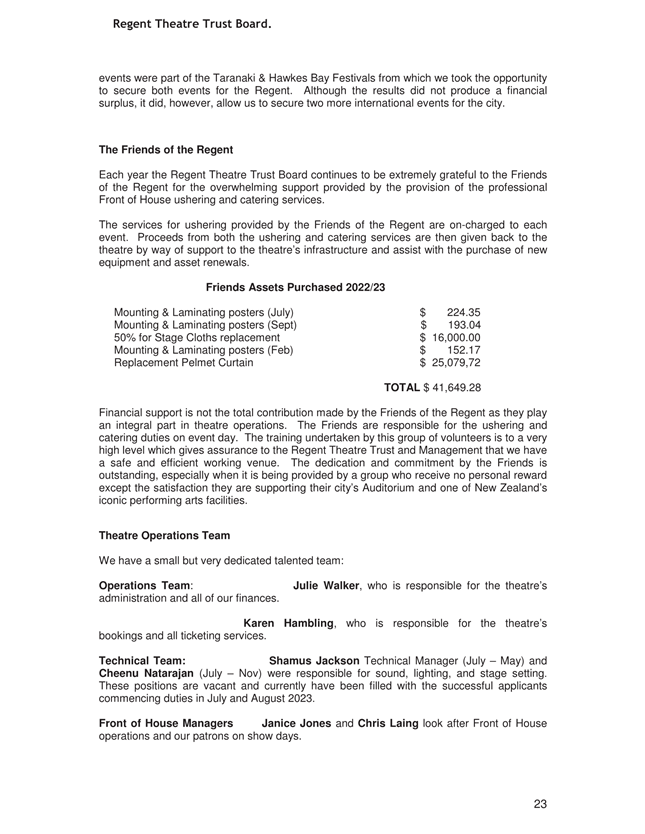
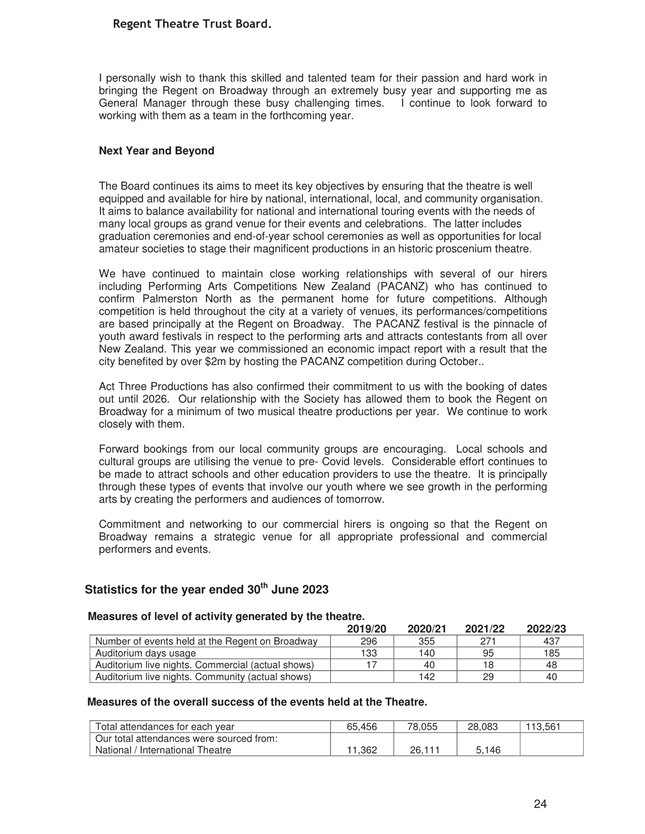
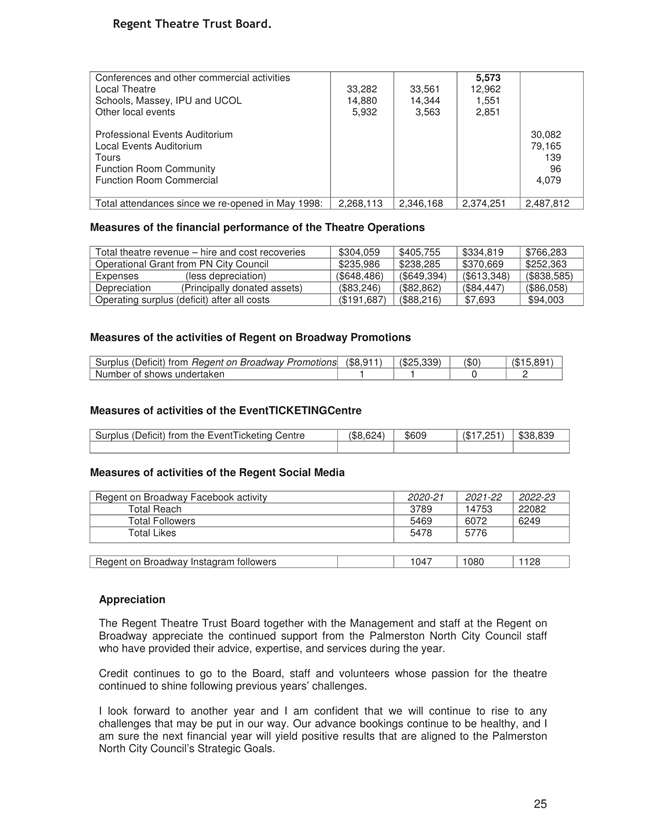
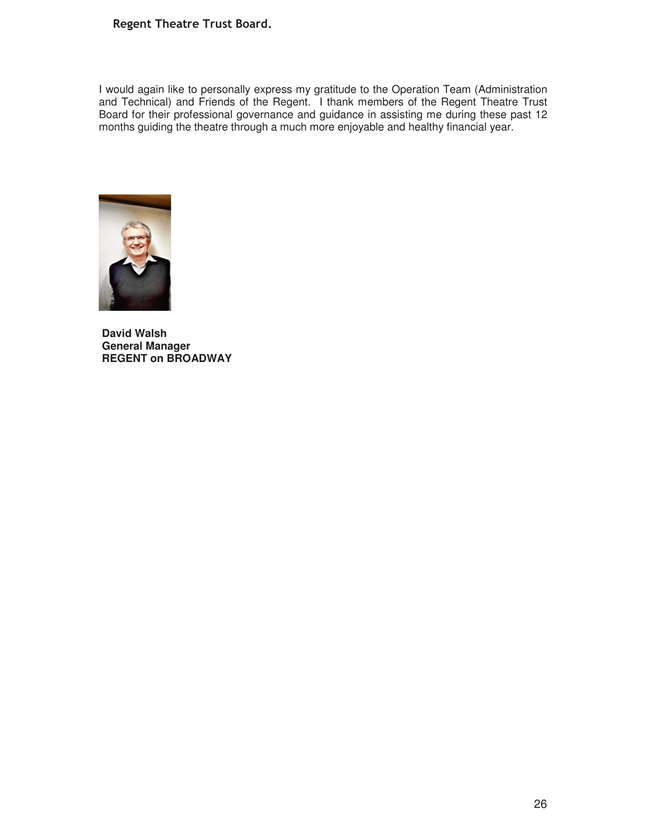
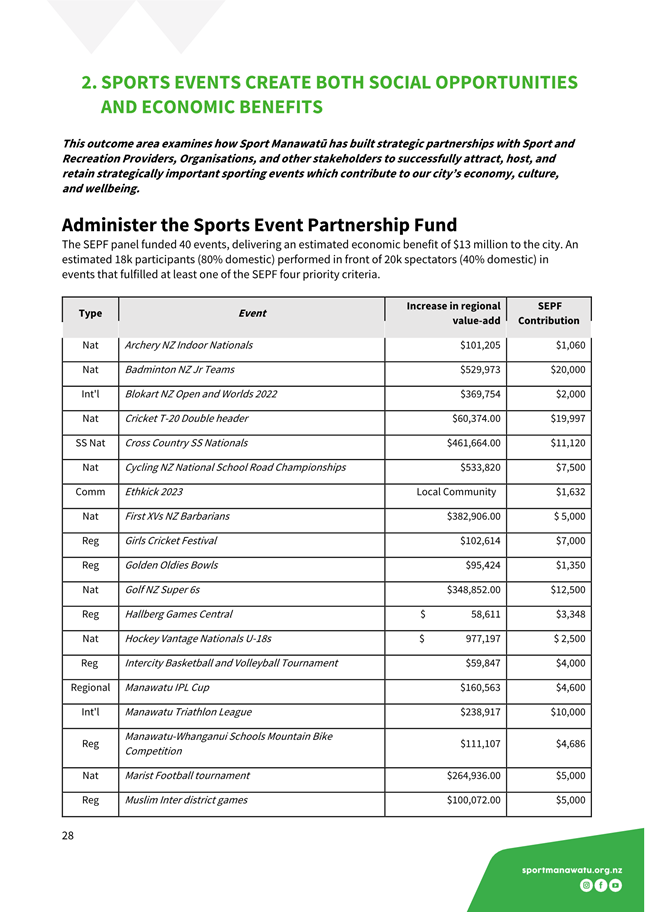
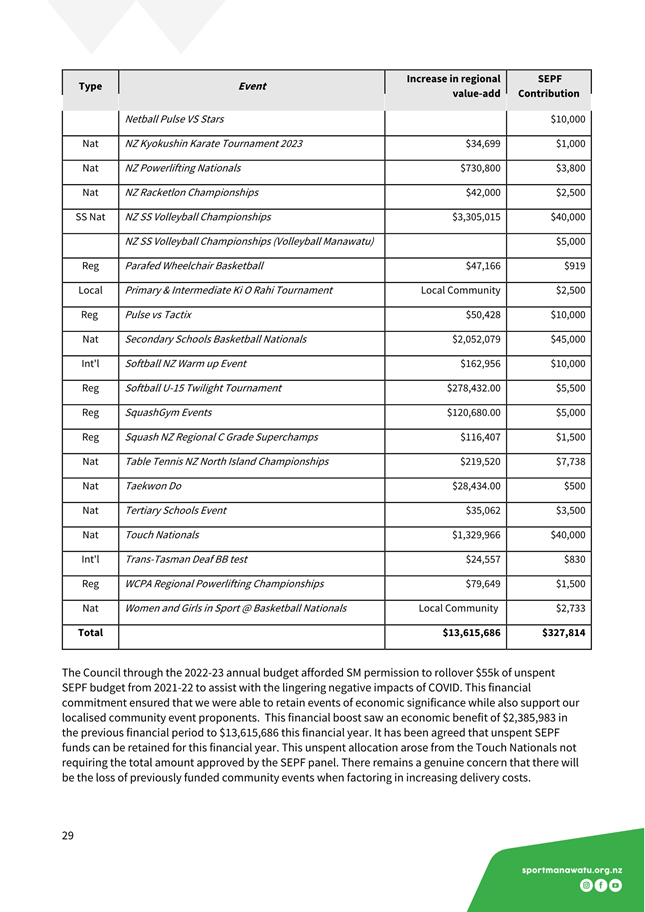
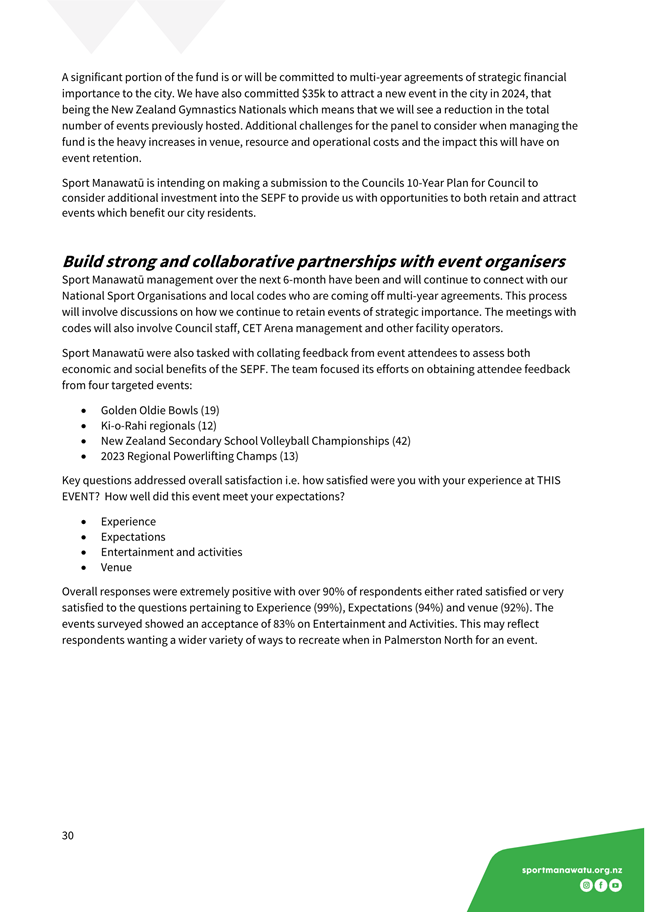
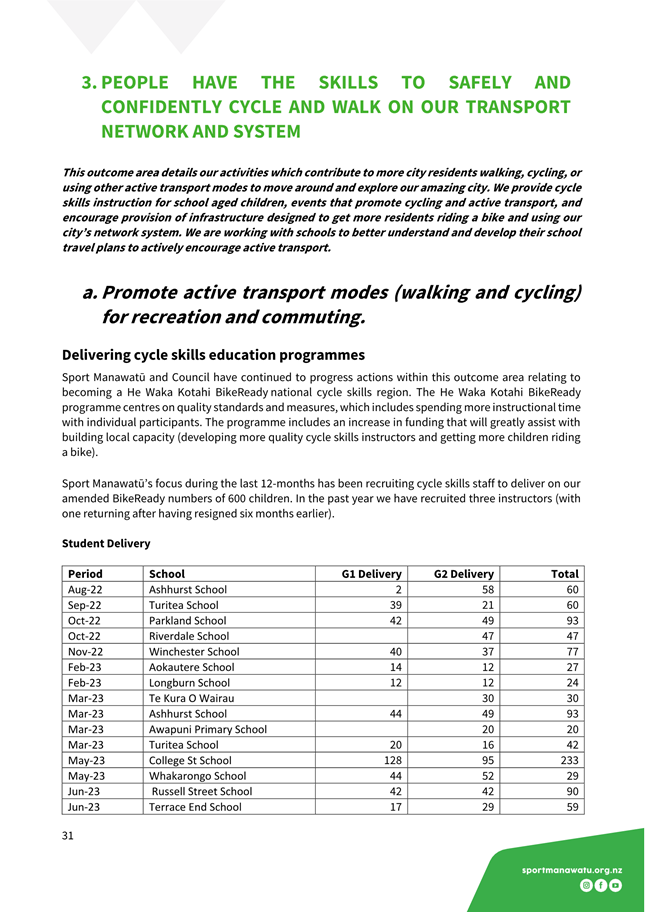
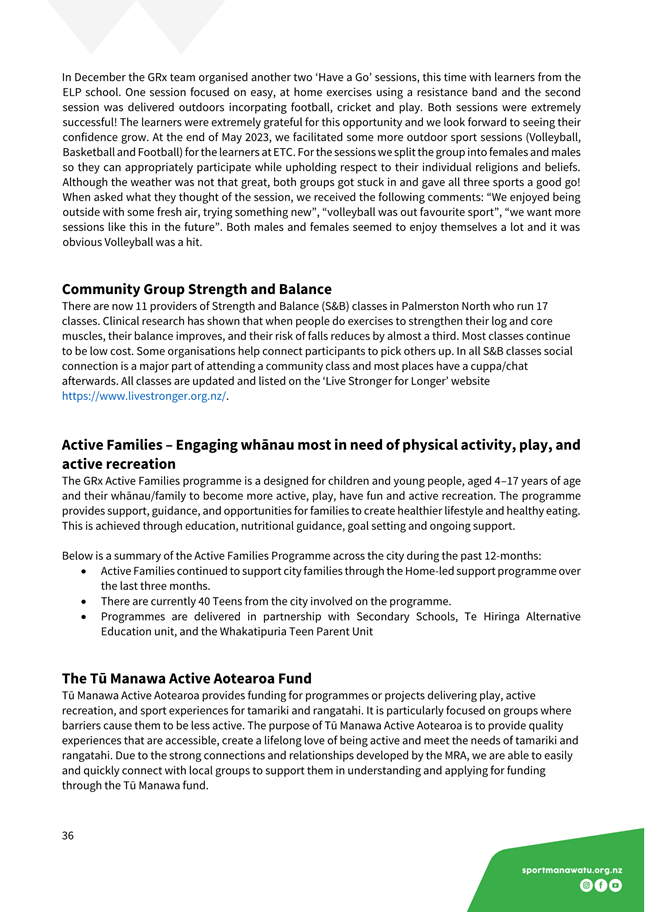
|
Rachel
Bowen (Chair)
|
|
Billy
Meehan (Deputy Chair)
|
|
Grant
Smith (The Mayor)
|
|
Mark
Arnott
|
Leonie
Hapeta
|
|
Vaughan
Dennison
|
Debi
Marshall-Lobb
|
|
Lew
Findlay (QSM)
|
William
Wood
|
|
Roly
Fitzgerald
|
Kaydee
Zabelin
|
|
Patrick
Handcock (ONZM)
|
|
Culture & Sport Committee
MEETING
8 November 2023
Order of Business
1. Karakia
Timatanga
2. Apologies
3. Notification
of Additional Items
Pursuant to Sections 46A(7) and
46A(7A) of the Local Government Official Information and Meetings Act 1987, to
receive the Chairperson’s explanation that specified item(s), which do
not appear on the Agenda of this meeting and/or the meeting to be held with the
public excluded, will be discussed.
Any additions in accordance with
Section 46A(7) must be approved by resolution with an explanation as to why
they cannot be delayed until a future meeting.
Any additions in accordance with
Section 46A(7A) may be received or referred to a subsequent meeting for further
discussion. No resolution, decision or recommendation can be made in
respect of a minor item.
4. Declarations
of Interest (if any)
Members are reminded of their duty
to give a general notice of any interest of items to be considered on this
agenda and the need to declare these interests.
5. Public
Comment
To receive comments from members of
the public on matters specified on this Agenda or, if time permits, on other
Committee matters.
(NOTE: If
the Committee wishes to consider or discuss any issue raised that is not
specified on the Agenda, other than to receive the comment made or refer it to
the Chief Executive, then a resolution will need to be made.)
6. Presentation
- Manawatū GymSports Page 7
7. Presentation
- Palmerston North Performing Arts Trust Page 15
8. Confirmation
of Minutes Page 17
“That the minutes of the Culture & Sport
Committee meeting of 13 September 2023 Part I Public be confirmed as a true and
correct record.”
9. The
Regent Theatre Trust - Annual Report 2022-23 Page 25
Memorandum, presented by Sarah Claridge, Democracy
& Governance Advisor.
10. The Globe Theatre
Trust - Annual Report 2022-23 Page 97
Memorandum, presented by Sarah Claridge, Democracy
& Governance Advisor.
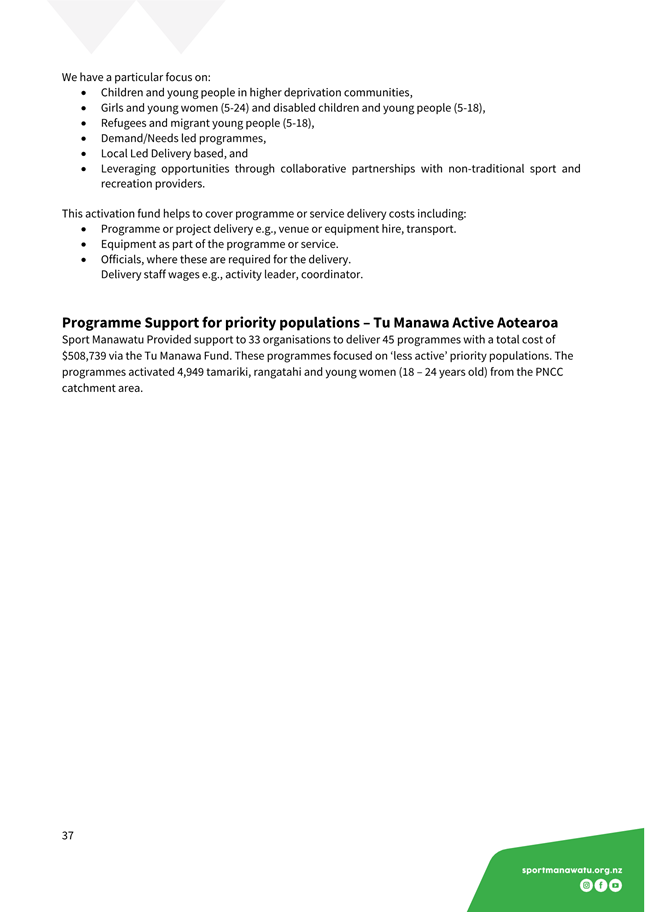
11. Sport Manawatū
- Annual Report 2022-23 Page 139
Memorandum, presented by Ann-Marie Mori, Policy
Analyst.
12. Central Energy
Trust Arena Masterplan 2023 Page 185
Memorandum, presented by Dave Charnley, Senior Urban
Designer; Ann-Marie Mori, Policy Analyst and John Lynch, Venues Manager.
13. Response to the
'Aquatic Facilities and Water-based Recreation Needs Assessment' Page 193
Report, presented by Ann-Marie Mori, Policy Analyst and
Kathy Dever-Tod, Group Manager - Parks and Logistics.
14. Reserve Management
and Development Planning Update Page 207
Memorandum, presented by Jason Pilkington, Parks
Planner and Kathy Dever-Tod, Group Manager - Parks and Logistics.
15. Committee Work
Schedule Page 217
16. Karakia
Whakamutunga
17. Exclusion of Public
|
|
To be moved:
“That the public be excluded from the
following parts of the proceedings of this meeting listed in the table below.
The general subject of each matter to be considered
while the public is excluded, the reason for passing this resolution in
relation to each matter, and the specific grounds under Section 48(1) of the
Local Government Official Information and Meetings Act 1987 for the passing
of this resolution are as follows:
|
General subject of each matter to be
considered
|
Reason for passing this resolution in
relation to each matter
|
Ground(s) under Section 48(1) for
passing this resolution
|
|
|
|
|
|
|
|
|
|
This resolution is made in reliance on Section
48(1)(a) of the Local Government Official Information and Meetings Act 1987
and the particular interest or interests protected by Section 6 or Section 7
of that Act which would be prejudiced by the holding of the whole or the
relevant part of the proceedings of the meeting in public as stated in the
above table.
Also that the persons listed below be permitted to
remain after the public has been excluded for the reasons stated.
[Add Third Parties], because of their knowledge and ability to assist the
meeting in speaking to their report/s [or other matters as specified] and
answering questions, noting that such person/s will be present at the meeting
only for the items that relate to their respective report/s [or matters as
specified].
|
Presentation
TO: Culture
& Sport Committee
MEETING DATE: 8
November 2023
TITLE: Presentation
- Manawatū GymSports
RECOMMENDATION TO Culture & Sport Committee
1. That the
Culture & Sport Committee receive the presentation for information.
Kylan Taylor, Head of Men’s Artistic Gymnastics and
Alanah McLeod, Lead Activate Coach will provide an update on Manawatū
GymSport’s youth development programme and their activate programme for
inclusion of all children.
Attachments
|
1.
|
Manawatū
GymSports update ⇩ 
|
|
Presentation
TO: Culture
& Sport Committee
MEETING DATE: 8
November 2023
TITLE: Presentation
- Palmerston North Performing Arts Trust
RECOMMENDATION TO Culture & Sport Committee
1. That the
Culture & Sport Committee receive the presentation for information.
Margaret May and Sheridan Hickey, Trustees, Palmerston North
Performing Arts Trust will update the Committee on the history and activities
of the Trust.
Attachments
Nil
Palmerston North City Council
Minutes of
the Culture & Sport Committee Meeting Part I Public, held in the Council
Chamber, First Floor, Civic Administration Building, 32 The Square, Palmerston
North on 13 September 2023, commencing at 9.00am
|
Members
Present:
|
Councillors Rachel Bowen (in the Chair),
Billy Meehan, Mark Arnott, Vaughan Dennison, Lew Findlay, Roly Fitzgerald,
Patrick Handcock, Leonie Hapeta, Debi Marshall-Lobb, William Wood and Kaydee
Zabelin.
|
|
Non Members:
|
Councillors Brent Barrett, Lorna Johnson
and Orphée Mickalad.
|
|
Apologies:
|
The Mayor (Grant Smith) (for late arrival
and early departure).
|
The Mayor (Grant Smith) entered the
meeting at 9.18am during consideration of clause 30. He was not present when the meeting resumed at
11.12am. He entered the meeting again at 12.23pm during consideration of
clause 38. He was not present for clauses 28, 29 and 35-37 inclusive.
Councillor Lew Findlay left the
meeting at 12.03pm during consideration of clause 37. He was not present for clauses 37 to
39 inclusive.
|
Karakia
Timatanga
|
|
|
Councillor Rachel Bowen opened the
meeting with karakia.
|
|
|
Acknowledgement
of Te Wiki o Te Reo Māori
|
|
|
In
acknowledgement of Te Wiki o Te Reo Māori, Councillor Debi Marshall-Lobb
spoke about the ways Te Reo is upheld by Palmerston North City Council.
|
|
28-23
|
Apologies
|
|
|
Moved Rachel Bowen, seconded Billy Meehan.
The
COMMITTEE RESOLVED
1. That
the Committee receive the apologies.
|
|
|
Clause 28-23 above was carried 14 votes to 0, the voting being as
follows:
For:
Councillors Rachel Bowen,
Billy Meehan, Mark Arnott, Vaughan Dennison, Lew Findlay, Roly Fitzgerald,
Patrick Handcock, Leonie Hapeta, Debi Marshall-Lobb, William Wood, Kaydee
Zabelin, Brent Barrett, Lorna Johnson and Orphée Mickalad.
|
|
29-23
|
Public
Comment
Warren Warbrick made public comment in relation to Item
10: Options to change the Palmerston North City Coat of Arms (clause
34).
Warren is also representing his cousin Wiremu Kingi Te Awe
Awe, as head of the Te Awe Awe family, and the traditional leaders of
Ngāti Hineaute hapū and Rangitepaia hapū of Rangitāne.
In clause 2.9 of the report John Bevan Ford is referenced
as being Senior Lecturer at Massey; at the time he was also designated as the
Tohunga whakairo for Rangitāne, and Warren was assigned to be his
apprentice. As such he was privy to a lot of the discussions that John
had with his people at the time, especially relating to the symbolism of this
piece of work.
The Māori chief in the crest was originally modelled
on Te Peeti Te Awe Awe and then later his people wished it to be a more
generic form of rangatira. In his hand he has a mere pounamu, which was
very significant to them because it is a symbol of one of three mere pounamu
that recognised the peace making that happened at a place called Tūwhakatupua,
and the mere that they held was called Tane-nui-a-Rangi. The one in the
crest represents Tane-nui-a-Rangi.
Rangitāne o
Manawatū see the crest as being a strong symbol of their relationships
with Council and their bicultural way of being. After discussions with
his cousin Wiremu Te Awe Awe they would like to see the crest stay as it is
and no change to happen.
|
|
|
Moved
Lorna Johnson, seconded Billy Meehan.
The COMMITTEE RESOLVED
1. That the
Culture & Sport Committee receive the public comment for information.
|
|
|
Clause 29-23 above was
carried 14 votes to 0, the voting being as follows:
For:
Councillors Rachel Bowen,
Billy Meehan, Mark Arnott, Vaughan Dennison, Lew Findlay, Roly Fitzgerald,
Patrick Handcock, Leonie Hapeta, Debi Marshall-Lobb, William Wood, Kaydee
Zabelin, Brent Barrett, Lorna Johnson and Orphée Mickalad.
|
|
30-23
|
Presentation
- Special Olympics Team
Presentation, by Olwyn
Humphreys and Carla L’huillier, Special Olympics Team Coaches, along
with athletes.
The
Mayor (Grant Smith) entered the meeting at 9.18am.
Olwyn and Carla spoke about the Special Olympics
Team’s trip to Berlin in July to participate in the Special Olympics
World Summer Games 2023 - the biggest sporting event of 2023 with more than
170 countries competing: 7,000 athletes, 3,000 coaches and 20,000
volunteers. The New Zealand team consisted of 39 athletes and 22 coaches and
support staff.
Highlights included the following:
· The athletes
received a range of medals for athletics, ten pin, swimming and 3x3 unified
basketball – the largest medal haul to date (5 gold, 17 silver and 12
bronze) – and smashed many personal bests.
· The host town
programme in Munich was hosted by three municipalities. Events included
being hosted at civic receptions, visits to schools, a beer garden, palace,
and planetarium, and joint training sessions with locals. The team had
the opportunity to perform their new haka and waiata several times at
functions.
· Opening ceremony
held at the Olympiastadion, Berlin which has not hosted an Olympic event
since 1936.
· Each evening the
team met to discuss the highs and lows of the day and to prepare for the next
day, and a taonga made in the image of the manaia on their uniforms was
presented to someone each day who had done something special.
· All the athletes
embodied the Special Olympics oath, which is ‘let me win, but if I
cannot win, let me be brave in the attempt’. As a country we can
be proud of them!
· Community
support and fundraising supported the $18,000 per athlete required and raised
awareness of the games.
|
|
|
Moved
Rachel Bowen, seconded Billy Meehan.
The COMMITTEE RESOLVED
1. That the
Culture & Sport Committee receive the presentation for information.
|
|
|
Clause 30-23 above was
carried 15 votes to 0, the voting being as follows:
For:
The Mayor (Grant Smith) and
Councillors Rachel Bowen, Billy Meehan, Mark Arnott, Vaughan Dennison, Lew
Findlay, Roly Fitzgerald, Patrick Handcock, Leonie Hapeta, Debi
Marshall-Lobb, William Wood, Kaydee Zabelin, Brent Barrett, Lorna Johnson and
Orphée Mickalad.
|
|
31-23
|
Presentation
- Palmerston North Heritage Trust
Presentation, by Margaret
Tennant, Chair, Palmerston North Heritage Trust Committee.
Margaret presented an update on the activities of the
Trust and current heritage issues, as attached to these minutes. In
addition, she made the following comments:
· Relationship
between Council and the Heritage Trust is going well – individual
Councillors are always open to conversation and the library staff have been
wonderful.
· Challenges
around archive space – Palmerston North is wise not to go along with
the Archive Central model.
· Signage boards
across the city relating to heritage is important.
· While noting
that smaller towns utilise trained volunteers, which may be helpful depending
on the task, there are good models of systems to manage archives in other
cities/councils. Staff having a working knowledge of archives would be
helpful.
The Chief Executive advised the Trust had written to him,
along with the NZ Society of Genealogy, and that work is underway regarding
recruitment of a City Archivist. The Chief Executive encouraged both
groups to make submissions to the Long Term Plan.
Regarding the Heritage
Planner role, Officers advised there is not a specialist heritage planner in
Council and has not been for at least 20 years, however heritage is involved
in a wide variety of planning projects, the expectation being that all
planners have a good understanding of heritage and that this is incorporated
into their everyday work.
|
|
|
Moved
Rachel Bowen, seconded Billy Meehan.
The COMMITTEE RESOLVED
1. That the
Culture & Sport Committee receive the presentation for information.
|
|
|
Clause 31-23 above was
carried 15 votes to 0, the voting being as follows:
For:
The Mayor (Grant Smith) and
Councillors Rachel Bowen, Billy Meehan, Mark Arnott, Vaughan Dennison, Lew
Findlay, Roly Fitzgerald, Patrick Handcock, Leonie Hapeta, Debi Marshall-Lobb,
William Wood, Kaydee Zabelin, Brent Barrett, Lorna Johnson and Orphée
Mickalad.
|
|
32-23
|
Presentation
- Volleyball Manawatū
Presentation, by Kelsey
Higgins, Community Engagement Officer, Volleyball Manawatū.
Kelsey outlined Volleyball Manawatū’s annual
plan and highlighted major projects, as attached to these minutes. In
addition she made the following comments:
· 2024 is the
final year of the contract for the New Zealand Secondary Schools Volleyball
Championships, the largest indoor sporting event in New Zealand. The three
year contract negotiations will begin next month. Volleyball NZ is
looking for the association to be able to lead the operations of that
tournament; in which case they will need to increase the Manawatū staff
to accommodate this and heighten the professionalism and ensure sufficient
funding in Year 3 to cover costs.
· It is important
to Volleyball Manawatū that the space at Takaro Sports Club remains a
community space, maintained by the Club. They are looking to expand community
provision and tie in to the competitive and elite sport pathway in beach
volleyball for New Zealand. Previously the only beach volleyball court
was at Massey University and the only other city court is a grass court at
one of our community parks.
· The Mana Beach
2023/24 season will be the first season the association has run leagues as
well as a tournament series.
· An economic
impact study on the previous year’s tournament identified a 2,000%
return on investment of $180,000.
· Kelsey
stated she understood Council worked with Sport Manawatū and not the
sports directly but wanted to represent the potential impact of the sport
partnership fund for our community, and in particular the national
championship.
|
|
|
Moved
Lorna Johnson, seconded Billy Meehan.
The COMMITTEE RESOLVED
1. That the
Culture & Sport Committee receive the presentation for information.
|
|
|
Clause 32-23 above was
carried 15 votes to 0, the voting being as follows:
For:
The Mayor (Grant Smith) and
Councillors Rachel Bowen, Billy Meehan, Mark Arnott, Vaughan Dennison, Lew
Findlay, Roly Fitzgerald, Patrick Handcock, Leonie Hapeta, Debi
Marshall-Lobb, William Wood, Kaydee Zabelin, Brent Barrett, Lorna Johnson and
Orphée Mickalad.
|
|
33-23
|
Confirmation
of Minutes
|
|
|
Moved Rachel Bowen, seconded Billy Meehan.
The
COMMITTEE RESOLVED
1. That the
minutes of the Culture & Sport Committee meeting of 28 June 2023 Part
I Public be confirmed as a true and correct record.
|
|
|
Clause 33-23 above was carried 13 votes to 0, with 2 abstentions, the
voting being as follows:
For:
The Mayor (Grant Smith) and
Councillors Rachel Bowen, Billy Meehan, Mark Arnott, Vaughan Dennison, Lew
Findlay, Roly Fitzgerald, Patrick Handcock, Debi Marshall-Lobb, William Wood,
Kaydee Zabelin, Brent Barrett and Orphée Mickalad.
Abstained:
Councillors Leonie Hapeta and Lorna Johnson.
|
|
34-23
|
Options
to change the Palmerston North City Coat of Arms
Memorandum, presented by
Desiree Harvey, Legal Counsel and Donna Baker, Acting Chief Executive Unit
Manager.
|
|
|
Moved
Grant Smith, seconded Debi Marshall-Lobb.
The COMMITTEE RECOMMENDS
1. That Council
retain the current Coat of Arms.
|
|
|
Clause 34-23 above was
carried 15 votes to 0, the voting being as follows:
For:
The Mayor (Grant Smith) and
Councillors Rachel Bowen, Billy Meehan, Mark Arnott, Vaughan Dennison, Lew
Findlay, Roly Fitzgerald, Patrick Handcock, Leonie Hapeta, Debi
Marshall-Lobb, William Wood, Kaydee Zabelin, Brent Barrett, Lorna Johnson and
Orphée Mickalad.
|
The meeting adjourned at 10.52am.
The meeting resumed at 11.12am.
The Mayor (Grant Smith) was not present when the
meeting resumed.
|
35-23
|
Te
Manawa Museums Trust - Statement of Intent 2023-26: revised finances
Memorandum, presented by
Sarah Claridge, Democracy & Governance Advisor.
|
|
|
Moved
Rachel Bowen, seconded Billy Meehan.
The COMMITTEE RESOLVED
1. That the
Committee agree the revised Statement of Intent 2023-26 from Te Manawa
Museums Trust.
|
|
|
Clause 35-23 above was
carried 14 votes to 0, the voting being as follows:
For:
Councillors Rachel Bowen,
Billy Meehan, Mark Arnott, Vaughan Dennison, Lew Findlay, Roly Fitzgerald,
Patrick Handcock, Leonie Hapeta, Debi Marshall-Lobb, William Wood, Kaydee
Zabelin, Brent Barrett, Lorna Johnson and Orphée Mickalad.
|
|
36-23
|
Te
Manawa Museums Trust - Annual Report 2022-23
Memorandum, presented by Susana
Shadbolt, Te Manawa Chief Executive Officer, Catherine Parsons, Te Manawa
Finance & Commercial Manager and Caroline Tate, Te Manawa Museums Trust
Board Chair.
Te Manawa representatives noted
the following corrections to their report:
· Page 77 of
Agenda, all the notes in the ‘Comments’ column should read 21/22,
not 22/23.
· The
Property, Plant and Equipment note on pages 105 and 106 of the Agenda is a
duplication.
|
|
|
Moved
Rachel Bowen, seconded Billy Meehan.
The COMMITTEE RESOLVED
1. That the
Committee receive Te Manawa Museums Trust Board’s Annual Report 2022-23
(Attachment 1).
|
|
|
Clause 36-23 above was
carried 14 votes to 0, the voting being as follows:
For:
Councillors Rachel Bowen,
Billy Meehan, Mark Arnott, Vaughan Dennison, Lew Findlay, Roly Fitzgerald,
Patrick Handcock, Leonie Hapeta, Debi Marshall-Lobb, William Wood, Kaydee
Zabelin, Brent Barrett, Lorna Johnson and Orphée Mickalad.
|
|
37-23
|
Play
Policy - Annual Implementation and Monitoring Report 2023
Memorandum, presented by
Manumea Durie, Play Advisor and Anton Carter, Group Manager – Community
Services.
Councillor
Lew Findlay left the meeting at 12.03pm.
|
|
|
Moved
Rachel Bowen, seconded Billy Meehan.
The COMMITTEE RESOLVED
1. That the Committee receive the memorandum
titled ‘Play Policy - Annual Implementation and Monitoring Report
2023’ presented to the Culture & Sport Committee on 13 September
2023.
|
|
|
Clause 37-23 above was
carried 13 votes to 0, the voting being as follows:
For:
Councillors Rachel Bowen,
Billy Meehan, Mark Arnott, Vaughan Dennison, Roly Fitzgerald, Patrick
Handcock, Leonie Hapeta, Debi Marshall-Lobb, William Wood, Kaydee Zabelin,
Brent Barrett, Lorna Johnson and Orphée Mickalad.
|
|
38-23
|
2023/24
Maintenance and Renewal Plans and Budgets for Cultural Facilities
Memorandum, presented by
Bryce Hosking, Group Manager - Property and Resource Recovery.
The
Mayor (Grant Smith) entered the meeting again at 12.23pm.
|
|
|
Moved
Rachel Bowen, seconded Billy Meehan.
The COMMITTEE RESOLVED
1. That the
Committee receive the memorandum titled ‘2023/24 Maintenance and
Renewal Plans and Budgets for Cultural Facilities’, presented to the
Culture & Sport Committee on 13 September 2023.
|
|
|
Clause 38-23 above was
carried 14 votes to 0, the voting being as follows:
For:
The
Mayor (Grant Smith) and Councillors Rachel Bowen, Billy Meehan, Mark Arnott,
Vaughan Dennison, Roly Fitzgerald, Patrick Handcock, Leonie Hapeta, Debi
Marshall-Lobb, William Wood, Kaydee Zabelin, Brent Barrett, Lorna Johnson and
Orphée Mickalad.
Note:
Moved Billy Meehan, seconded William Wood.
The motion:
‘That the Chief Executive be instructed to present an annual
maintenance and renewal plans and budgets report for Council owned sports
facilities, excluding the arena, to the Culture & Sport Committee’,
was withdrawn.
|
|
39-23
|
Committee Work Schedule
|
|
|
Moved
Rachel Bowen, seconded Billy Meehan.
The COMMITTEE RESOLVED
1. That the
Culture & Sport Committee receive its Work Schedule dated September 2023.
|
|
|
Clause 39-23 above was
carried 14 votes to 0, the voting being as follows:
For:
The Mayor (Grant Smith) and
Councillors Rachel Bowen, Billy Meehan, Mark Arnott, Vaughan Dennison, Roly
Fitzgerald, Patrick Handcock, Leonie Hapeta, Debi Marshall-Lobb, William
Wood, Kaydee Zabelin, Brent Barrett, Lorna Johnson and Orphée
Mickalad.
|
|
|
Karakia
Whakamutunga
|
|
|
Councillor Rachel Bowen closed the
meeting with karakia.
|
The meeting
finished at 12.43pm.
Confirmed 8 November 2023
Chair
Memorandum
TO: Culture
& Sport Committee
MEETING DATE: 8
November 2023
TITLE: The
Regent Theatre Trust - Annual Report 2022-23
Presented
By: Sarah
Claridge, Democracy & Governance Advisor
APPROVED BY: Donna
Baker, Acting Chief Executive Unit Manager
RECOMMENDATION TO
CULTURE & SPORT COMMITTEE
1. That the
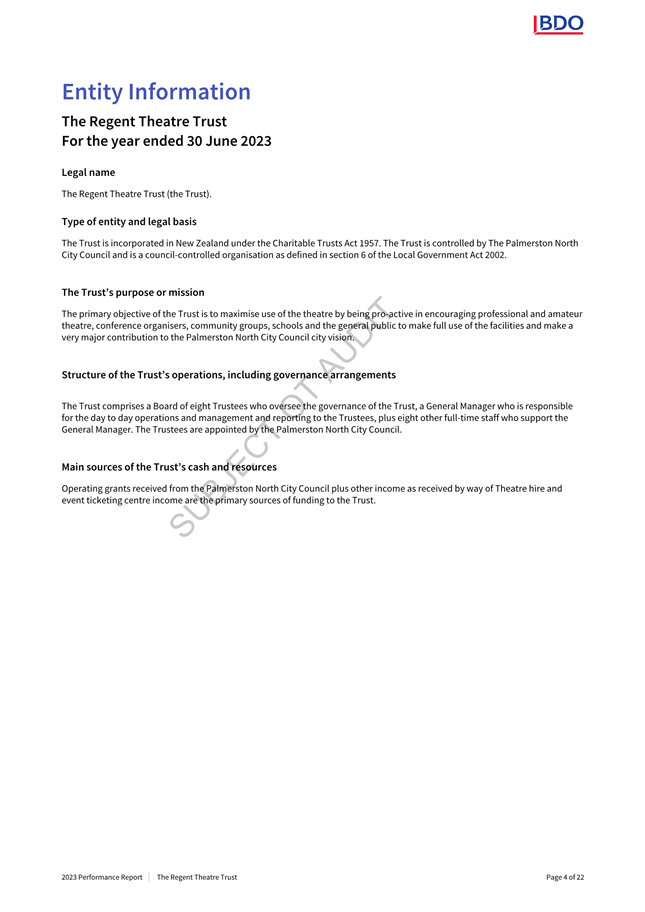
Committee receive the Regent Theatre Trust Board’s Annual Report 2022-23
(Attachment 2).
1. ISSUE
1.1 The
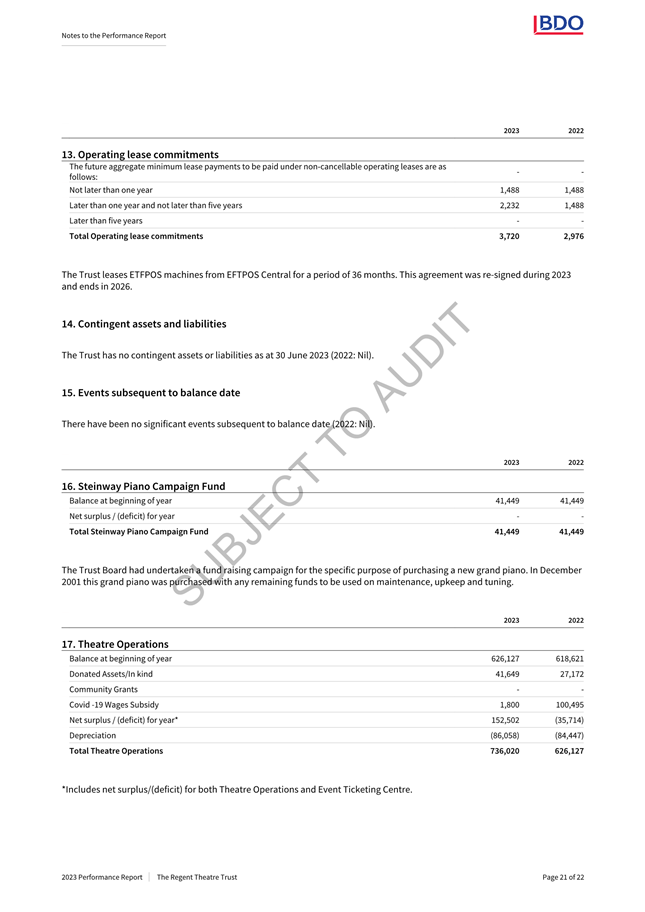
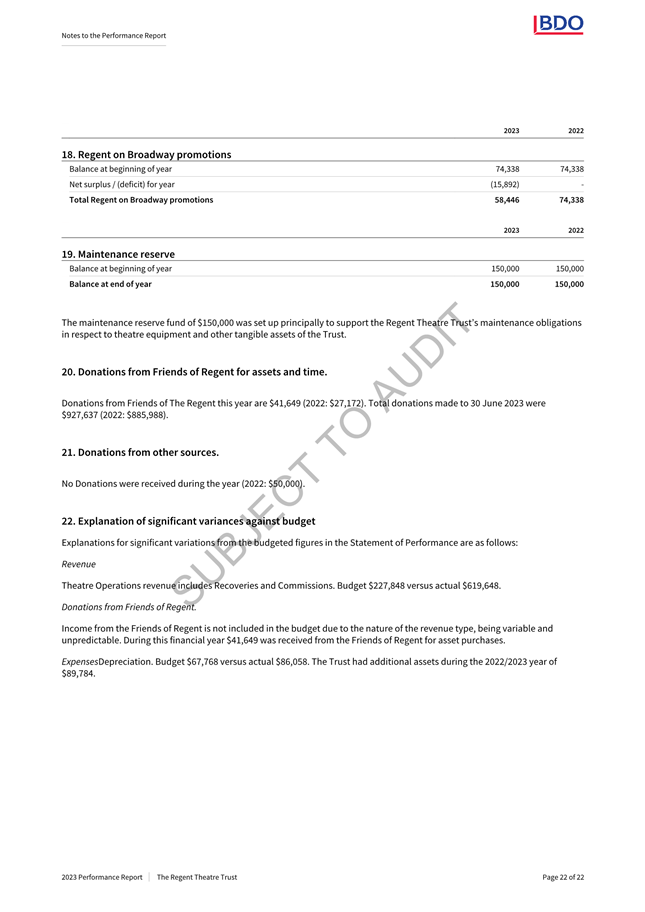
Regent Theatre Trust Board (the Regent) has submitted its Annual Report 2022-23
(Attachment 2). This memorandum provides an opportunity for Elected
Members to review the progress the Regent Theatre has made against its
Statement of Intent during the period 1 July 2022 to 30 June 2023.
1.2 Representatives
of the Regent are in attendance to present.
2. BACKGROUND
2.1 The
Regent is a Council Controlled Organisation (CCO) which was set up to
independently manage and promote the Regent Theatre as the preferred local
venue of choice for international, national and local performing arts
experiences.
2.2 A
CCO is an organisation in which Council has the right to appoint at least fifty
percent of the members on the Board and must work towards Council’s
objectives on its behalf.
2.3 For
the 2022-23 year, Council expected the Regent to focus on the delivery of four
core functions:
· Be
Palmerston North’s premier theatre attracting regional and national
audiences to visit Palmerston North.
· Host a good
quality range of events attracting diverse audiences.
· Deliver an
increase in audience size and performance nights.
· Protect and
futureproof this heritage building.
2.4 In
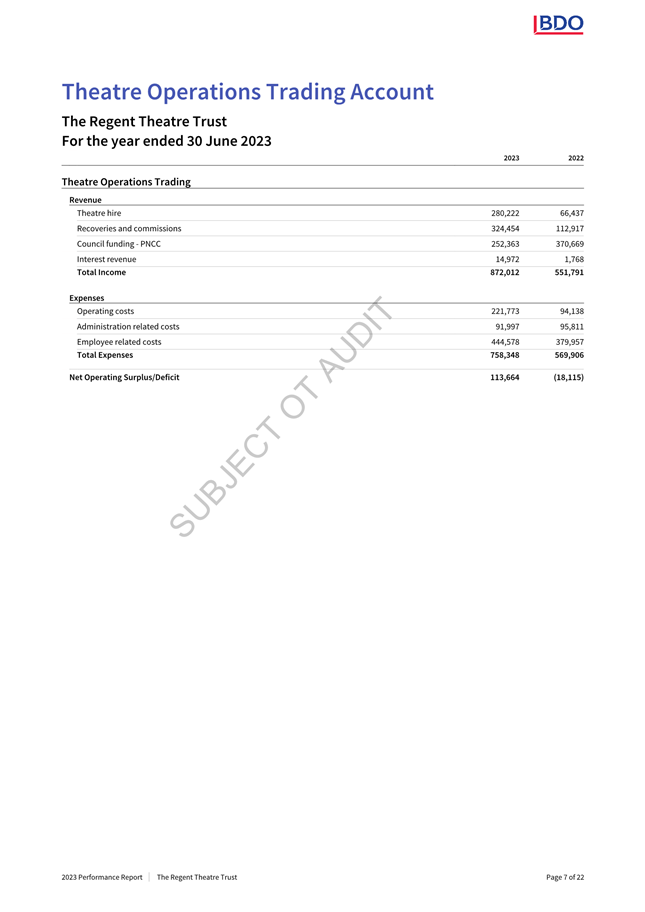
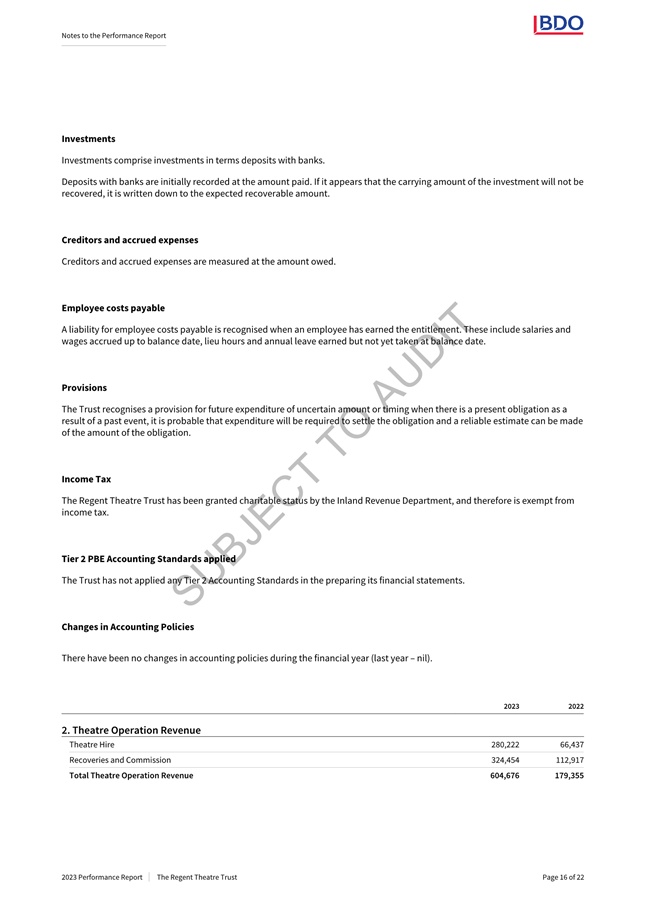
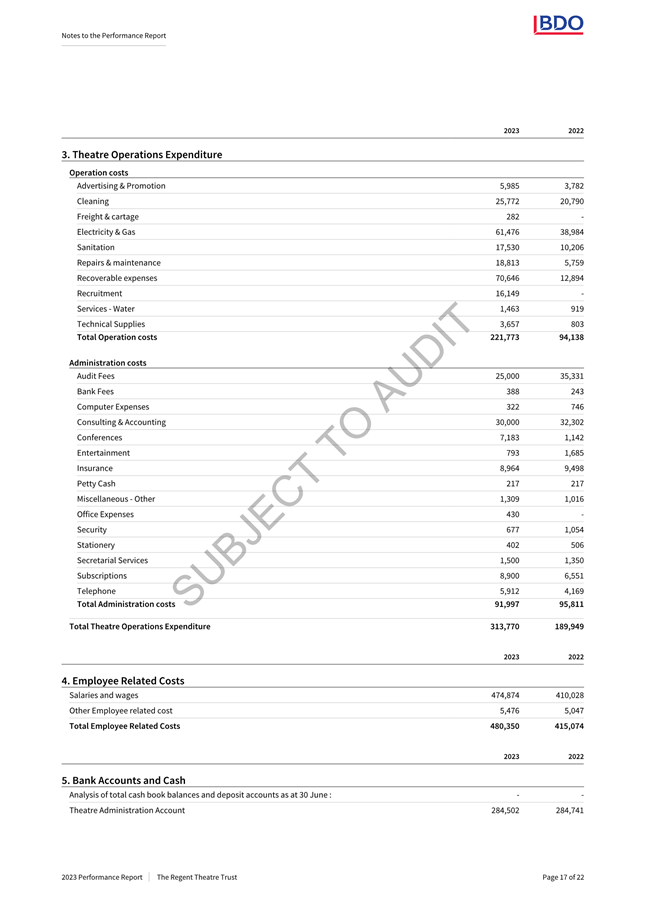
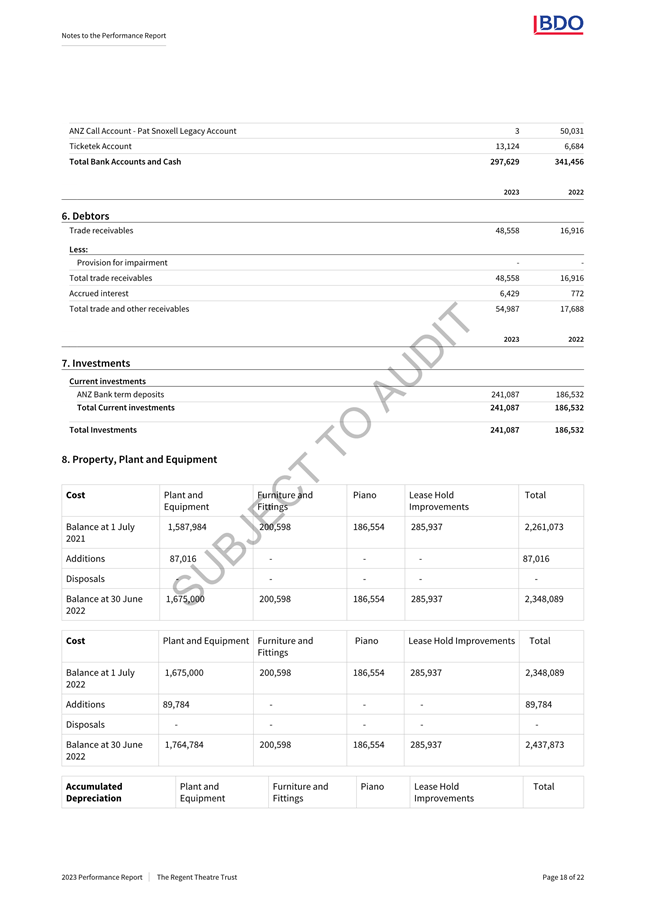
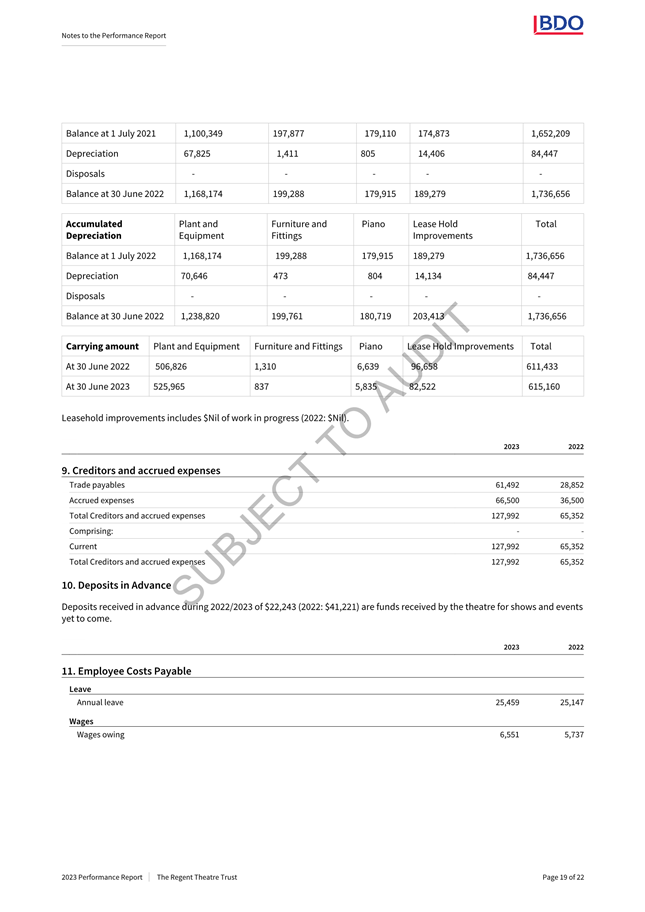
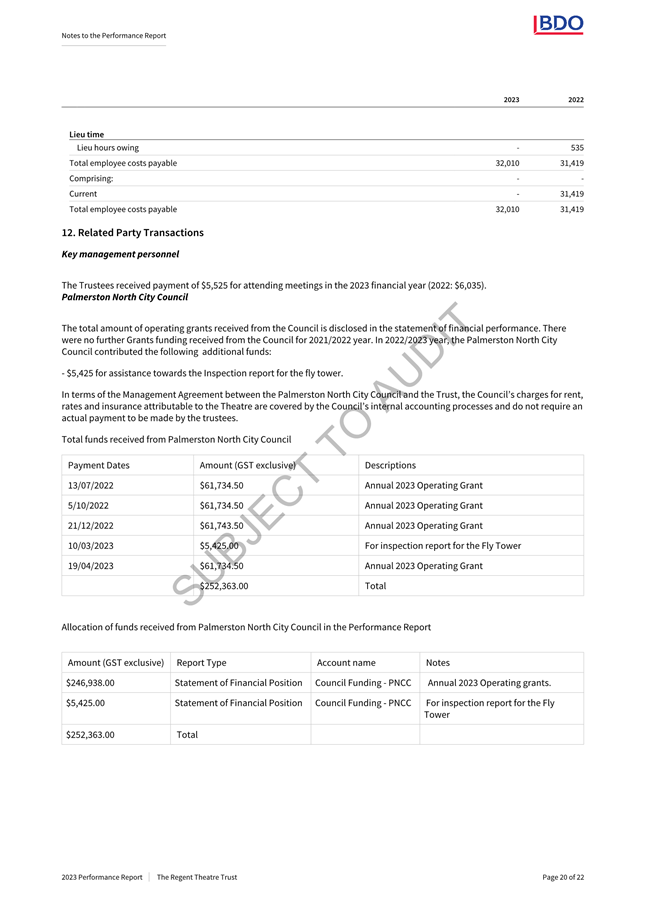
2022/23, the Council granted the Regent Theatre Trust Board $252,363[1] to deliver
the core functions listed in 2.3 above. This included an additional
$5,425 for the inspection report for the fly tower (used for the movement of
scenery and lighting).
2.5 The
Council owns the building and maintains it and the Trust uses it rent free.
2.6 The
Local Government Act (LGA) requires CCOs to produce an annual report which
compares its actual and intended performance (as set out in the Statement of
Intent) and audited financial statements.
2.7 Audit
New Zealand has not yet audited the Regent’s Annual Report. Therefore,
the attached annual report is still in draft form. An updated report will be
presented to the Committee in the event there are any material changes
following audit.
3. PERFORMANCE FOR THE Year July 2022 - June 2023
3.1 Highlights
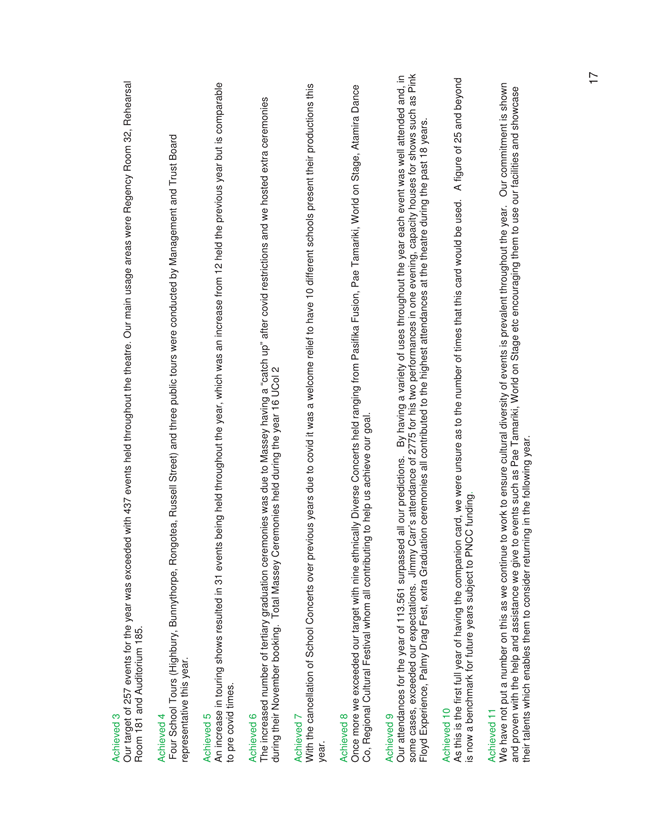
from the Regent’s Annual Report include the following:
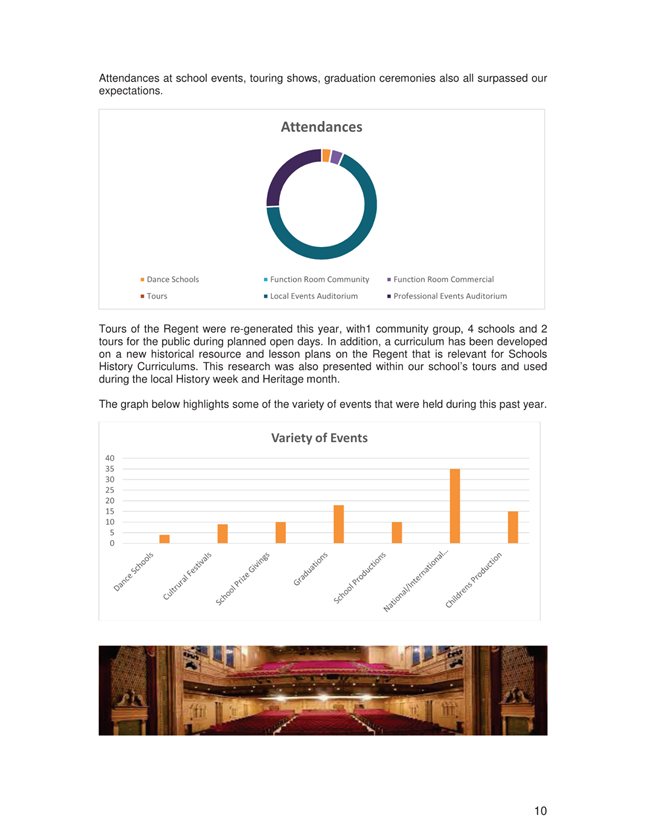
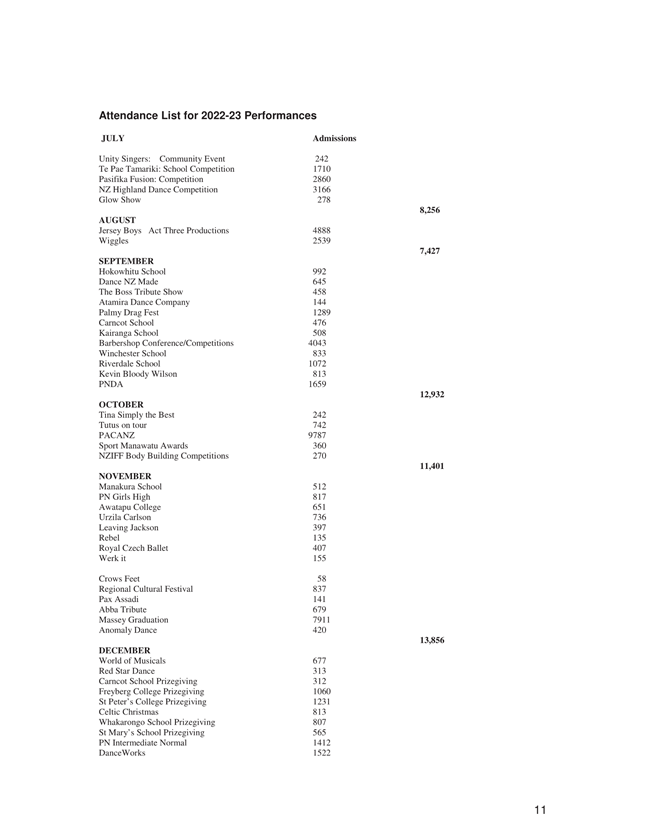
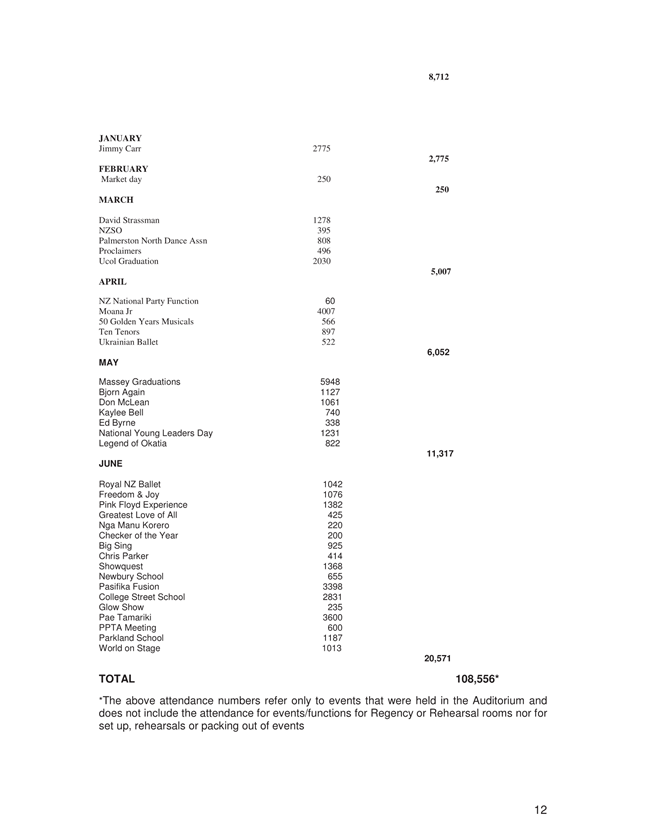
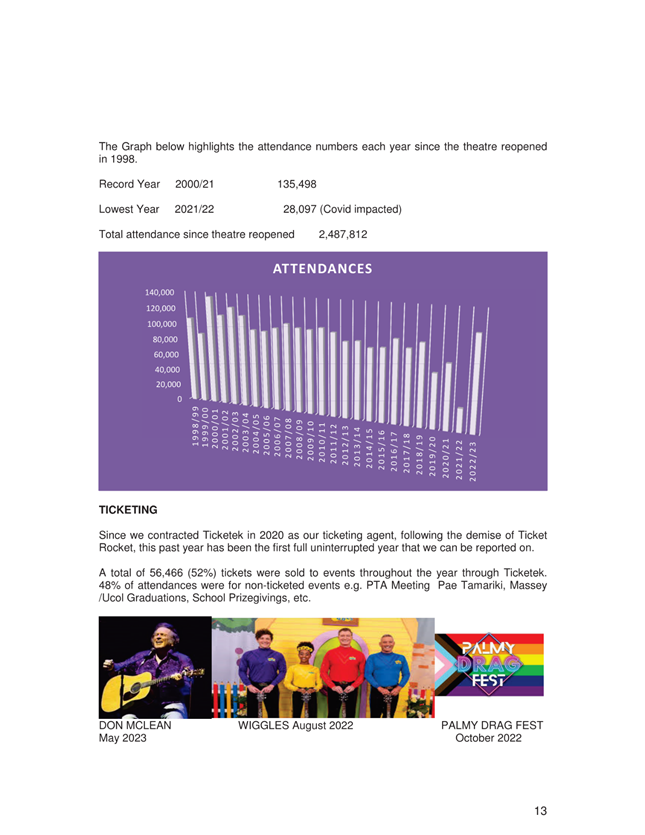
· Secured highest
patronage figures in the last 18 years - 113,561
people attended shows at the Regent during this reporting period.
· Hosted several
sell-out international and national touring events including Jimmy
Carr, The Wiggles, Kevin Bloody Wilson, Tina Simply the Best, Leaving Jackson
World of Musicals, 10 Tenors, Royal Czech Ballet, New Zealand Symphony
Orchestra and the Royal New Zealand Ballet.
· Hosted nine ethnically diverse concerts including Pasifika Fusion, Pae Tamariki,
World on Stage, Atamira Dance Co. and the Regional Cultural Festival.
· Locally
produced Legend of Okatia was the key event for the Regent’s 25-year
celebrations.
· The
Manawatū Youth Theatre
performed Moana Jr, attracting 4,007 people to the theatre and a chance for
young people to perform on a big stage.
3.2 Attachment
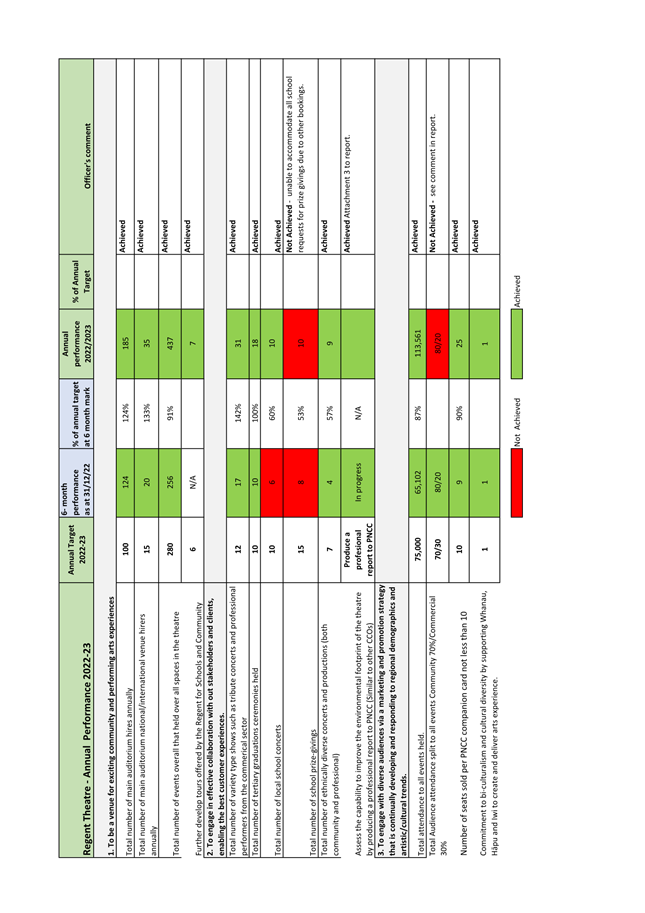
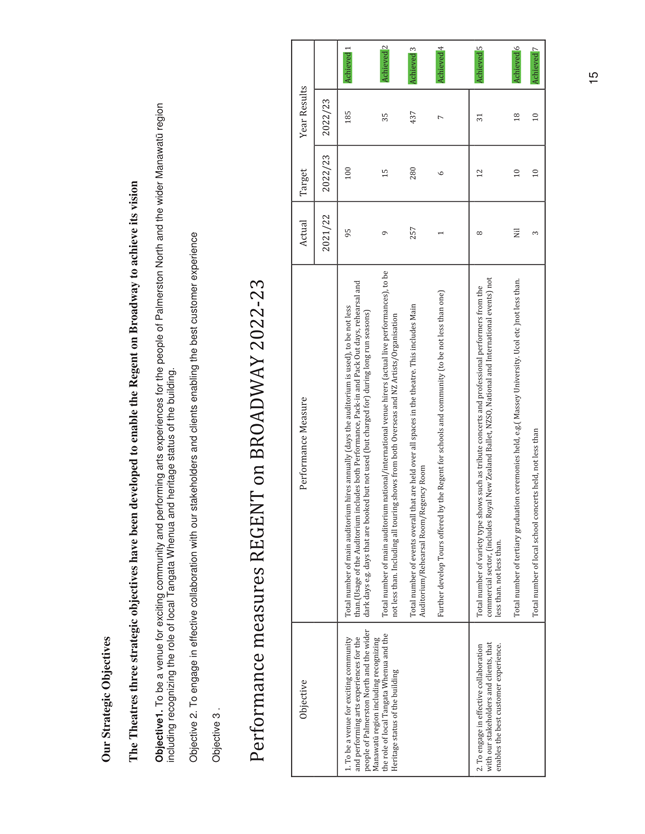
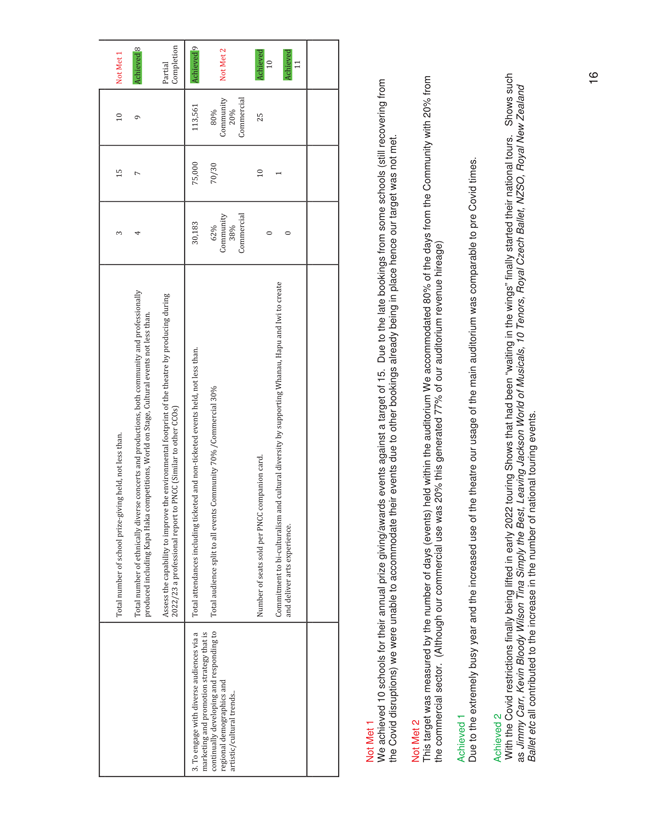
1 shows the Regent’s performance against the agreed Statement of Intent
targets. All but two of the Regent’s performance measures were
achieved.
3.3 The
number of ‘school prizegivings’ was not achieved because the Regent
was unable to accommodate the requests, due to other bookings.
3.4 The
total attendance split between community and commercial events also missed its
target. The ratio of attendance of community vs commercial events measures the
ratio of events (community/ commercial) held within the auditorium.
Increasing the ratio of commercial events to 30% will increase the financial
security of the theatre and reduce the Regent’s reliance on Council grant
support. As the Board encourages greater commercial use of the theatre, Council
will need to closely observe how the Board manages this objective against
continuing to offer community use of the theatre.
3.5 The
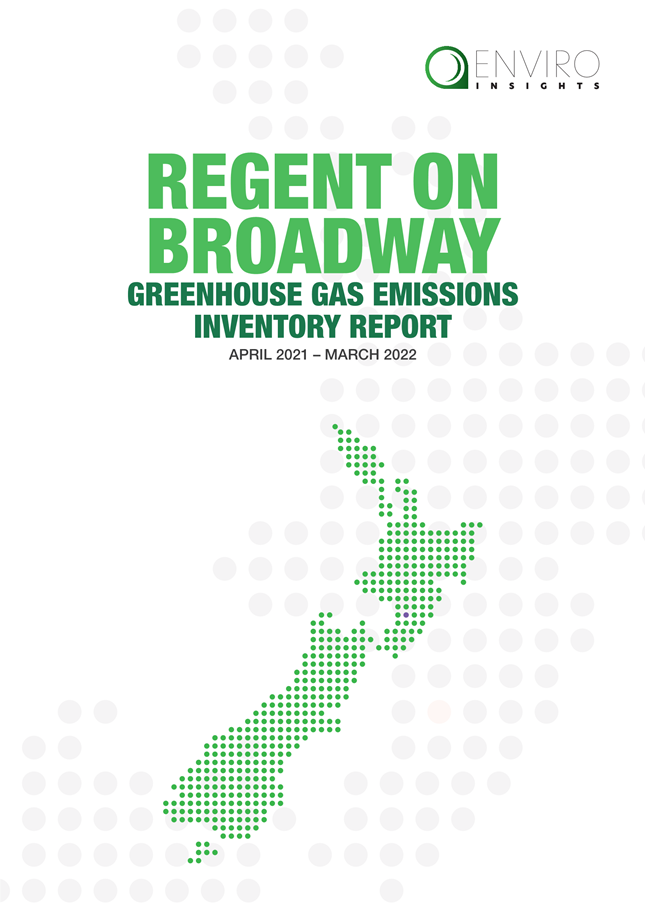
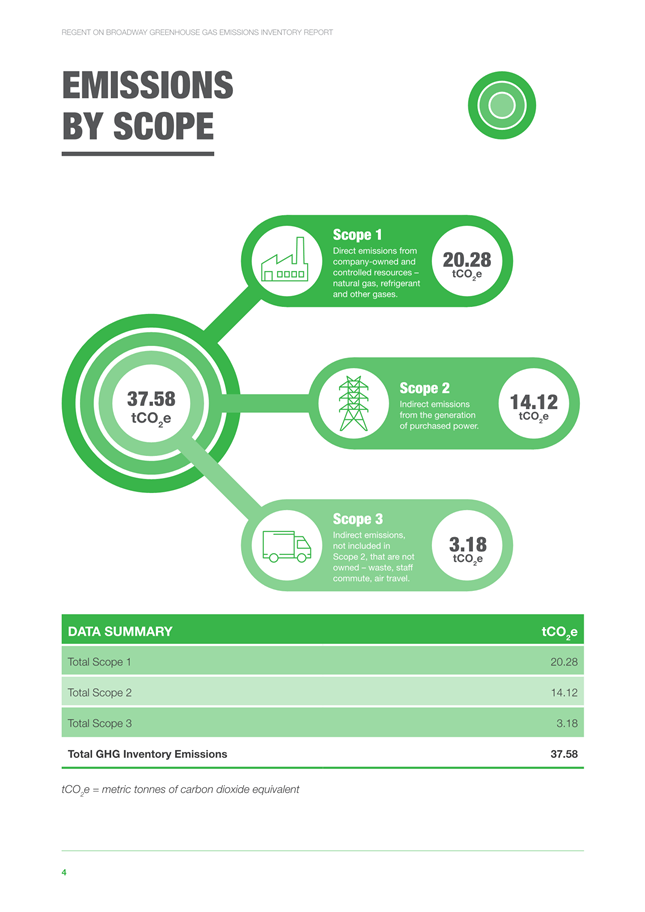
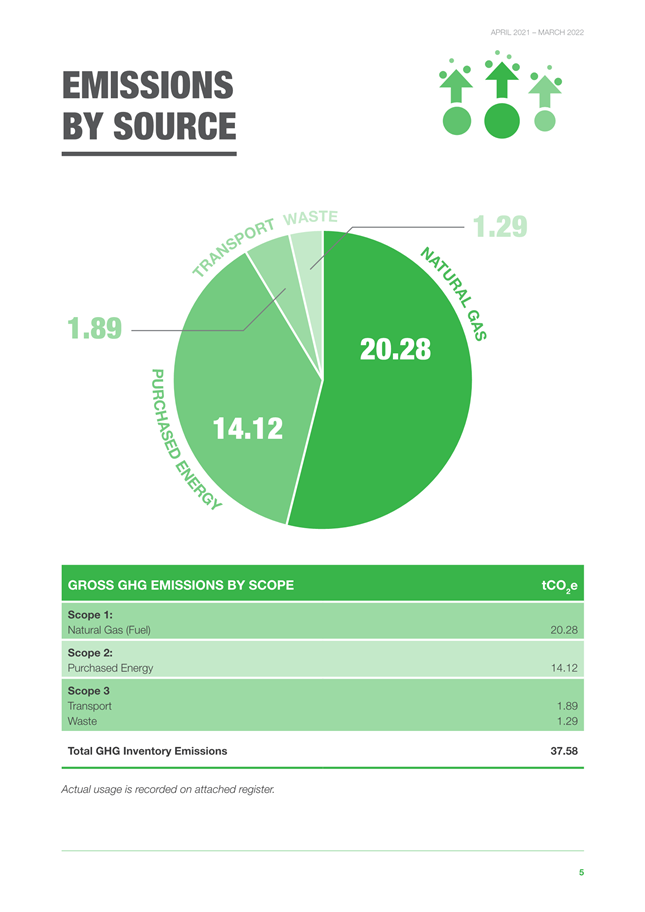
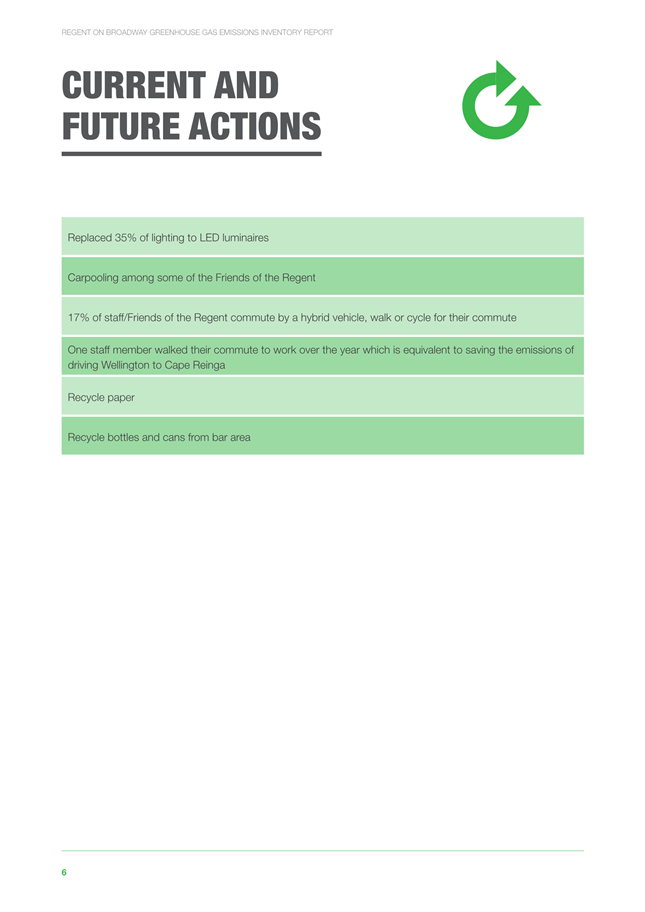
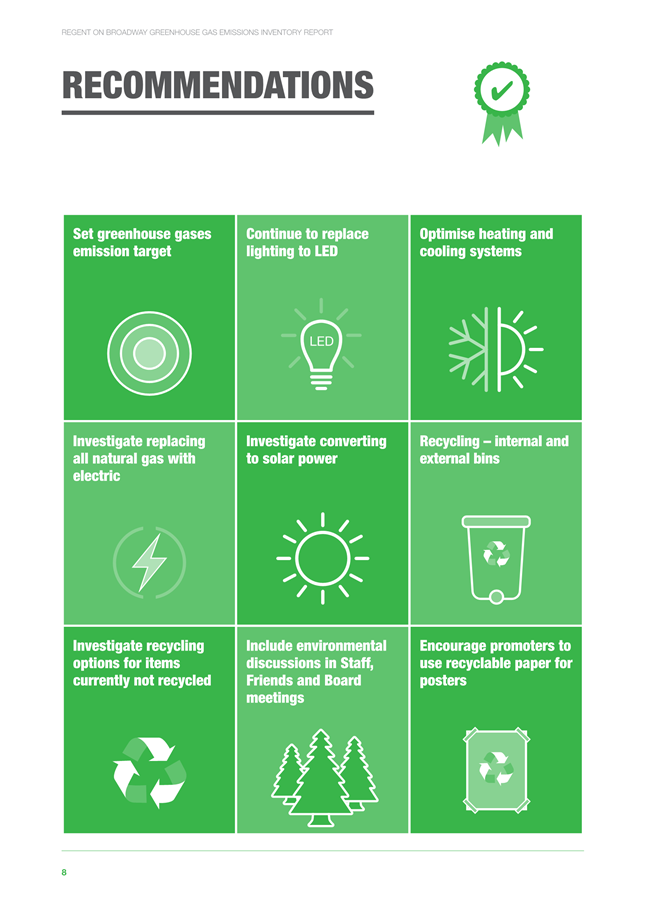
Regent’s Greenhouse Gas Emissions report (Attachment 3) provides a
baseline of the Regent’s carbon emissions for the 2021-22 year. It offers
recommendations and future actions for how the Regent could reduce its carbon
emissions in the future, and could be used to set future performance targets.
3.6 The
Regent has not recorded its result for the measure ‘Commitment to
bi-culturalism and cultural diversity’ in the second part of the year,
stating that work being done to encourage bicultural shows to perform is
ongoing. Officers note the annual target was met in the first half of the year.
3.7 Officers
see no merit in comparing 2022 with the COVID years of 2020 and 2021; instead
Table 1 compares 2022 results with pre-COVID years 2018 and 2019.
Table 1: The Regent – Annual Performance Results for
the financial years 2018, 2019 and 2022 (Covid-free years)
|
Measure
|
|
2017-18
30 June 2018
|
2018-19
30 June 2019
|
2022-23
30 June 2023
|
3 Year Trend
|
|
Live
nights – performances in the
auditorium at night commercial + community
|
Actual
|
139
(36 commercial)
|
153
(37 commercial)
|
88
(48 commercial)
|
↓
|
|
Auditorium days usage
|
Actual
|
158
|
181
|
185
|
↑
|
|
Summary of events – Total number of events held at the Regent
|
Actual
|
365
|
385
|
437
|
↑
|
|
Patronage – Total attendance for all events
|
Actual
|
91,065
|
98,781
|
113,561
|
↑
|
|
Average size of
audience per event
|
Actual
|
249
|
257
|
260
|
↑
|
4. fINANCIAL pERFORMANCE
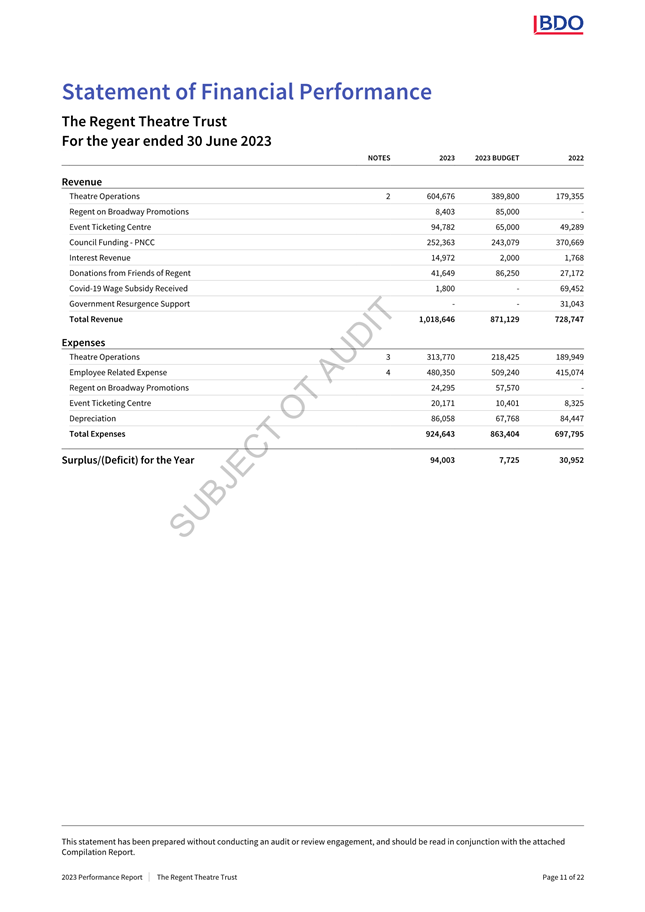
4.1 Financially
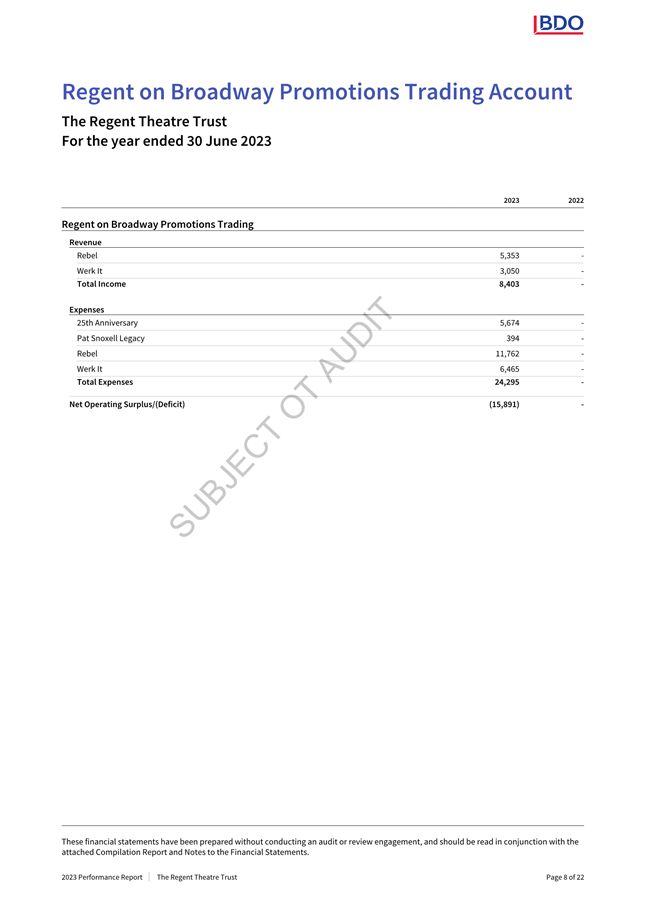
the Regent has done well compared to last year. It has achieved an
operating net surplus of $94,000, which is $86k better off than forecasted.
This is due to the theatre’s operations being much stronger than
expected.
4.2 The
Trust's current assets are more than twice its liabilities indicating that the
Trust can satisfy its obligations.
Table
2: Financial Information for Annual Report 2022-23
|
2023
|
2022
|
|
Summary Financials
($000)
|
Actual
|
Budget
|
Var.
|
Actual
|
Var.*
|
|
Financial
Performance
|
|
|
|
|
|
|
PNCC Grant
|
252,363
|
243,079
|
9,284
|
370,669[2]
|
(118,306)
|
|
Total Revenue
|
1,018,646
|
871,129
|
147,517
|
728,747
|
289,899
|
|
Total Expenses
|
924,643
|
863,404
|
(61,239)
|
697,795
|
226,848
|
|
Net Surplus (Deficit)
|
94,003
|
7,725
|
86,278
|
30,952
|
63,051
|
|
Financial
Position
|
|
|
|
|
|
|
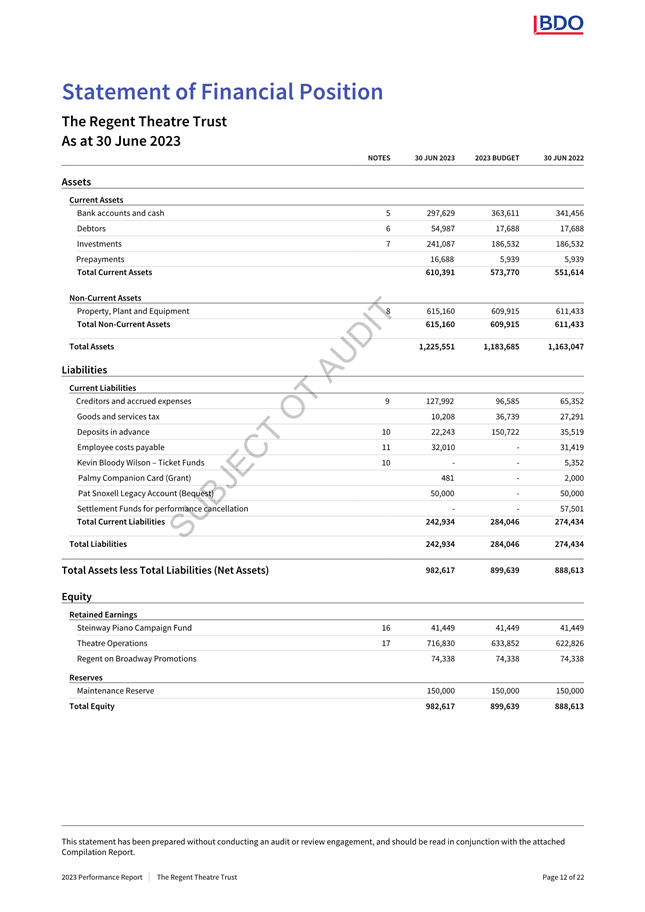
Current Assets
|
610,391
|
573,770
|
36.621
|
551,614
|
58,777
|
|
Total Assets
|
1,225,551
|
573,770
|
41,866
|
1,163,047
|
58,777
|
|
Current Liabilities
|
242,934
|
284,046
|
41,112
|
274,434
|
(31,500)
|
|
Total Liabilities
|
242,934
|
284,046
|
41,112
|
274,434
|
(31,500)
|
|
Equity
|
982,617
|
899,639
|
82,978
|
888,613
|
94,004
|
|
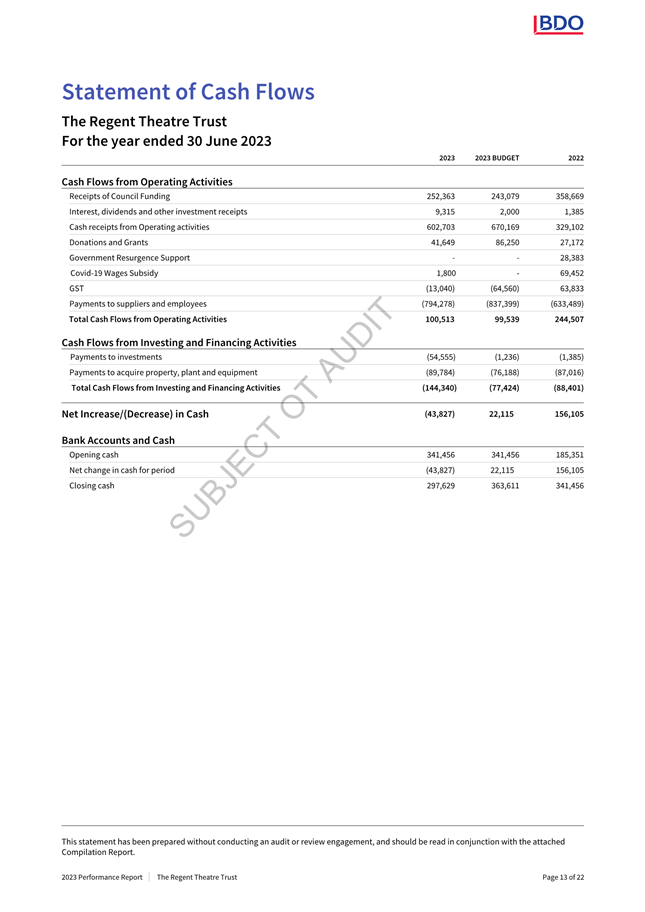
Cash
Flows
|
|
|
|
|
|
|
Total Net Cash Flows
|
(43,827)
|
22,115
|
(21,712)
|
156,105
|
(199,932)
|
|
Opening Cash
|
341,456
|
341,456
|
0
|
185,351
|
156,105
|
|
Closing Cash
|
297,629
|
363,611
|
(65,982)
|
341,456
|
(43,827)
|
*when compared to the same period 12
months ago
5. NEXT STEPS
At the end of February 2024, the Regent
Theatre Trust Board will submit:
• draft
Statements of Intent for 2024–27; and
• six-month
reports on the current Statement of Intent 2023–26.
These will be presented to the
next available Culture & Sport Committee meeting.
6. Compliance and administration
|
Does the Committee have
delegated authority to decide?
|
Yes
|
|
Are the decisions significant?
|
No
|
|
If they are significant do they
affect land or a body of water?
|
No
|
|
Can this decision only be made
through a 10 Year Plan?
|
No
|
|
Does this decision require
consultation through the Special Consultative procedure?
|
No
|
|
Is there funding in the current Annual
Plan for these actions?
|
Yes
|
|
Are the recommendations
inconsistent with any of Council’s policies or plans?
|
No
|
|
The recommendations contribute
to Goal 2: A Creative and Exciting City
|
|
The recommendations contribute
to the achievement of action/actions in the Arts and Heritage Plan.
The action is: to support CCOs
to achieve the objectives of the Arts and Heritage plan.
|
|
Contribution to strategic
direction and to social, economic, environmental and cultural well-being
|
Receiving the Annual Report is a
mechanism for Council to provide guidance and direction to the cultural CCOs
and meets Council’s responsibility to monitor the CCOs under the LGA.
|
|
|
|
Attachments
|
1.
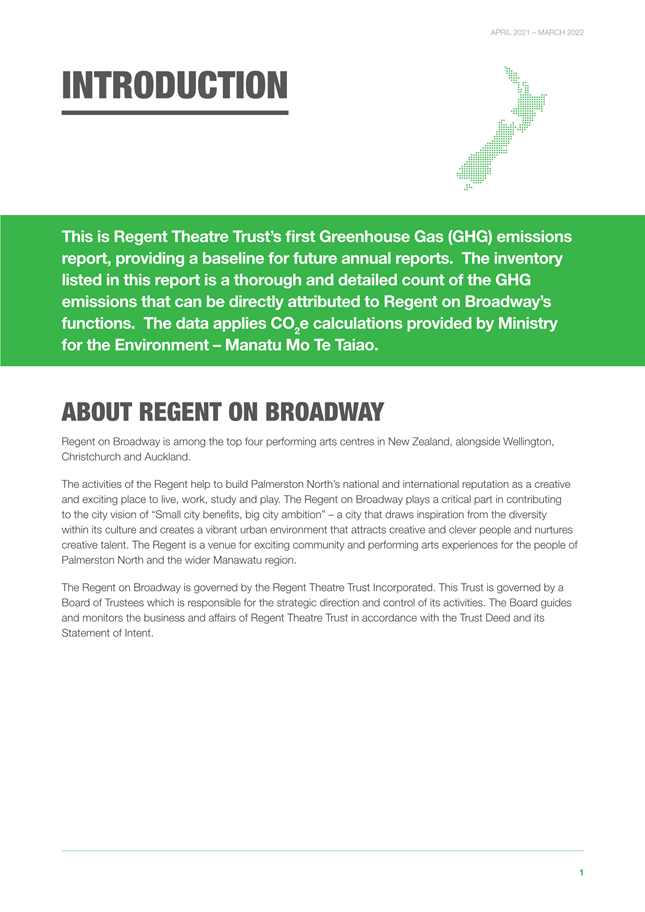
|
The
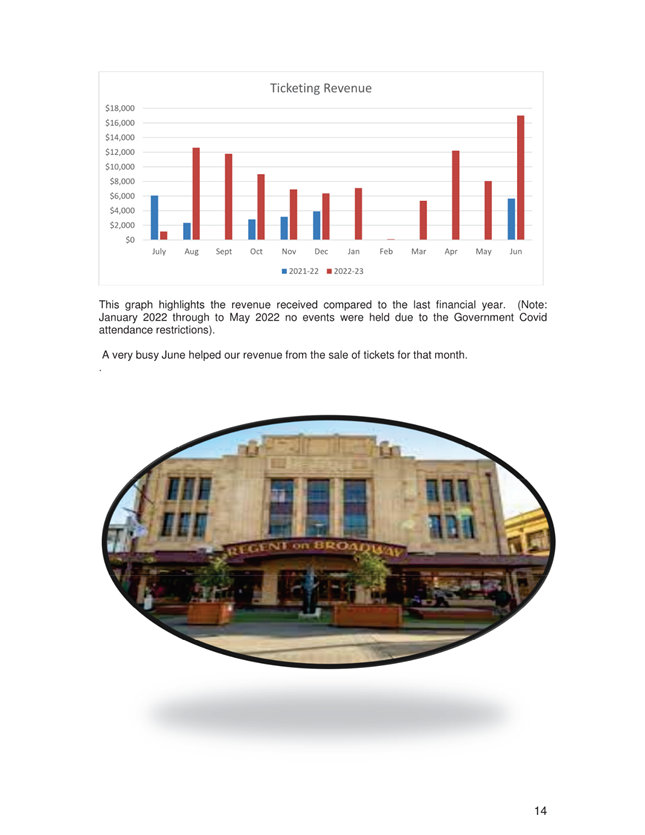
Regent Theatre Trust_Performance Measures 2022-2023 ⇩ 
|
|
|
2.
|
The
Regent Theatre Trust_Annual Report 2022-2023 ⇩
|
|
|
3.
|
Greenhouse
Gas Emissions Inventory Report 2021-22 ⇩ 
|
|
Memorandum
TO: Culture
& Sport Committee
MEETING DATE: 8
November 2023
TITLE: The
Globe Theatre Trust - Annual Report 2022-23
Presented
By: Sarah
Claridge, Democracy & Governance Advisor
APPROVED BY: Donna
Baker, Acting Chief Executive Unit Manager
RECOMMENDATION TO culture & sport COMMITTEE
1. That the
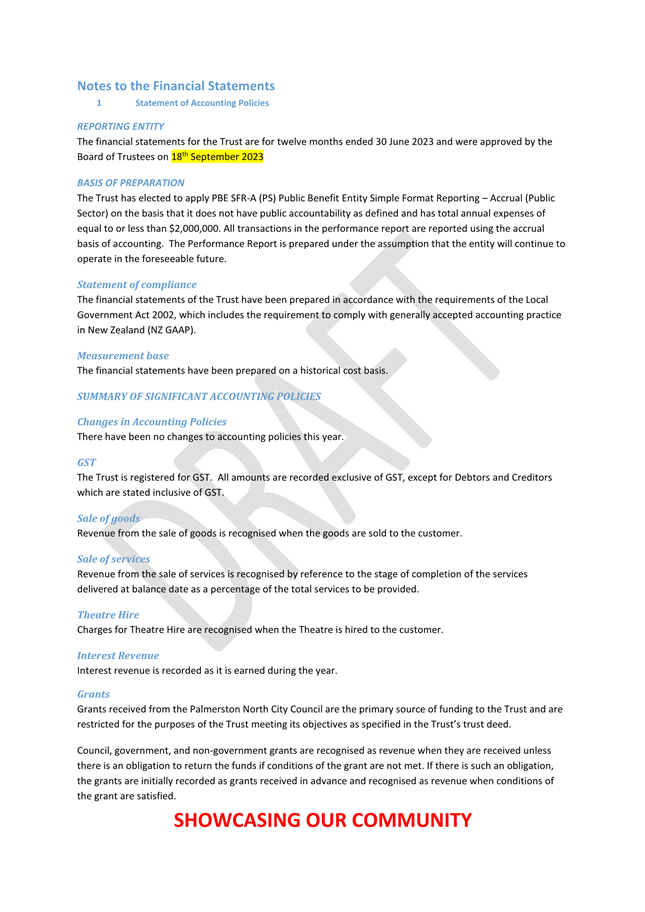
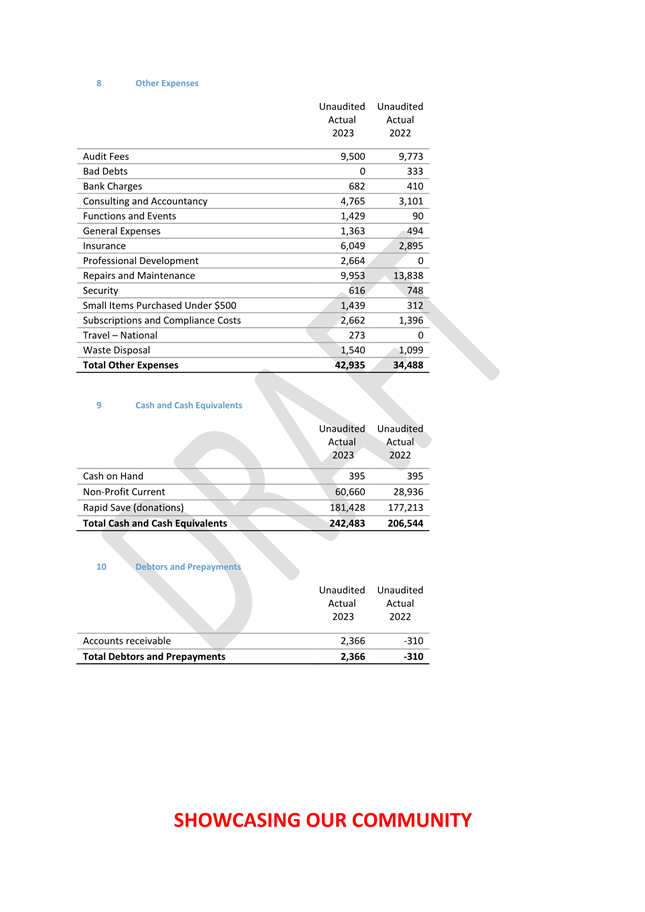
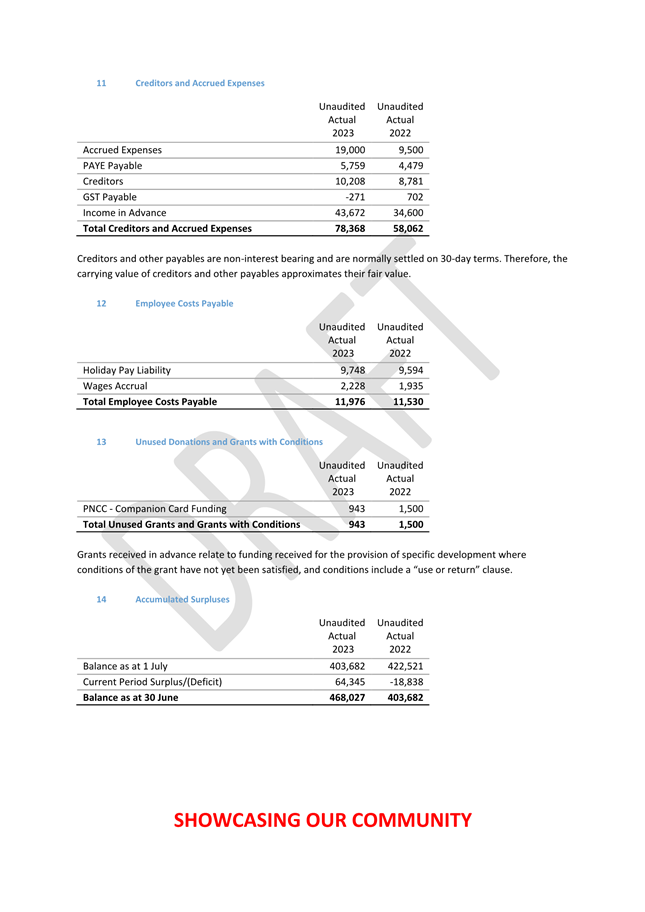
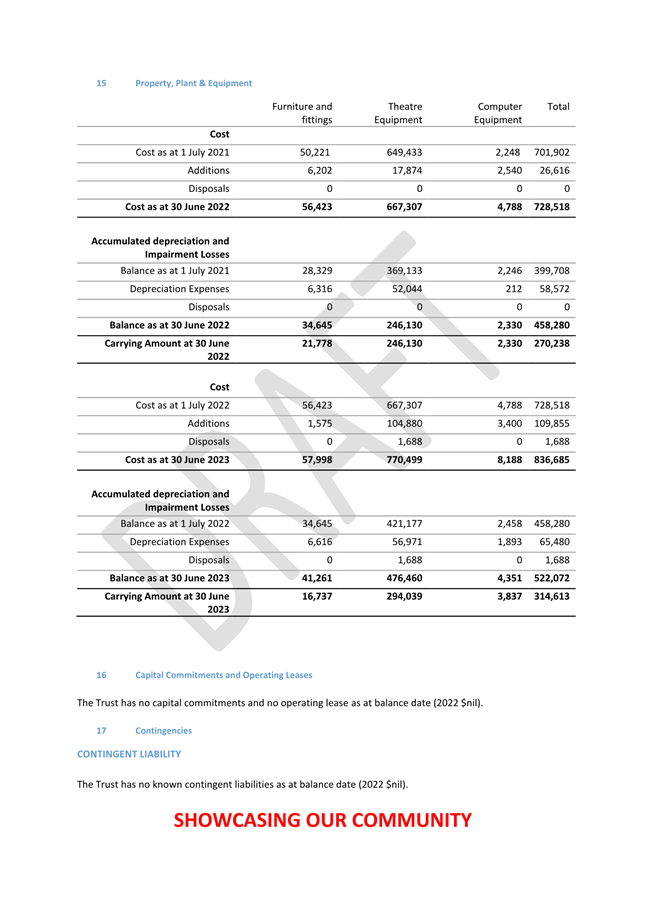
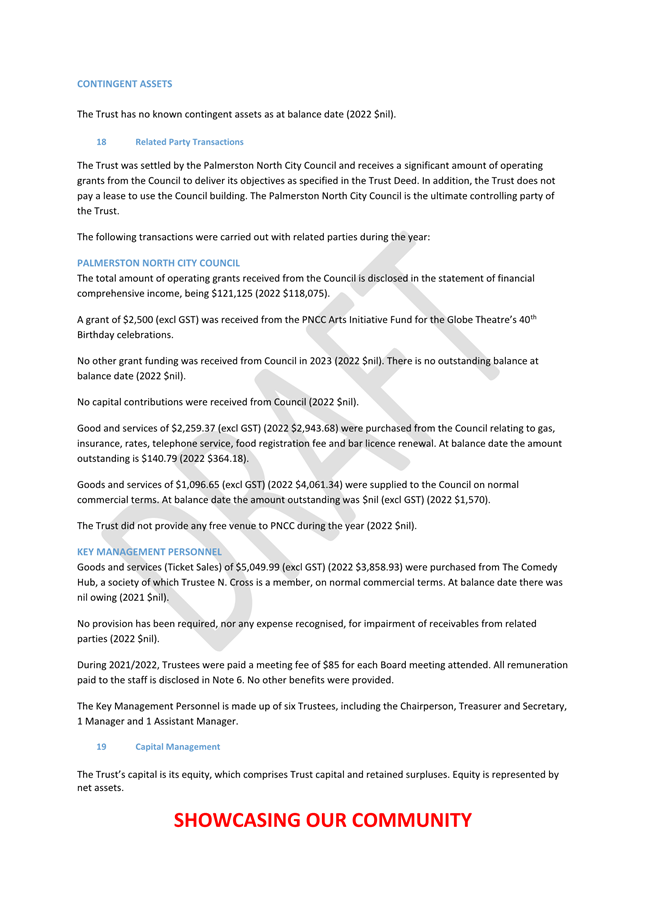
Committee receive the Globe Theatre Trust Board’s draft Annual Report
2022/23 (Attachment 2).
1. ISSUE
1.1 The
Globe Theatre Trust Board (the Globe) has submitted its draft Annual Report
2022-23 (Attachment 2). This memorandum provides an opportunity for
Elected Members to review the progress the Globe Theatre has made against its
Statement of Intent during the period 1 July 2022 to 30 June 2023.
1.2 Representatives
of the Globe are in attendance to present.
2. BACKGROUND
2.1 The
Globe is a Council Controlled Organisation (CCO),
which was set up to independently manage and promote the Globe Theatre as a
venue for hire. A CCO is an organisation in which Council has the right to
appoint at least fifty percent of the trustees and must work towards
Council’s objectives on its behalf.
2.2 For
the 2022/23 year, Council expected the Globe to focus on the delivery of three
core functions:
· Remain an
affordable venue for hire
· Support
theatre talent development – onstage and off
· Encourage
diversity and the celebration of diverse communities.
2.3 In
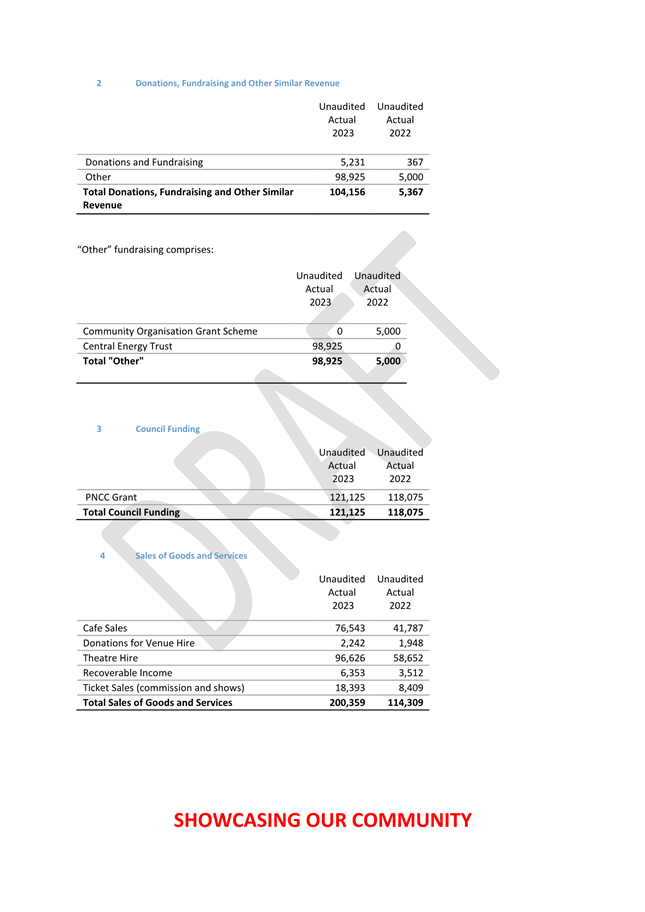
2022/23, the Council granted the Globe Trust Board $121,125[3] to deliver the core
functions listed in 2.3 above. Council expected the Board to supplement this
grant by seeking external revenue.
2.4 The
Local Government Act (LGA) requires CCOs to produce an annual report which
compares its actual and intended performance (as set out in the Statement of
Intent) and audited financial statements.
2.5 The
attached Annual Report has not yet been audited by Audit NZ. An updated report
will be brought to Committee in the event there are any material changes
following audit.
3. PERFORMANCE FOR THE Year July 2022 - June 2023
3.1 Highlights
from the Globe’s Annual Report include the following:
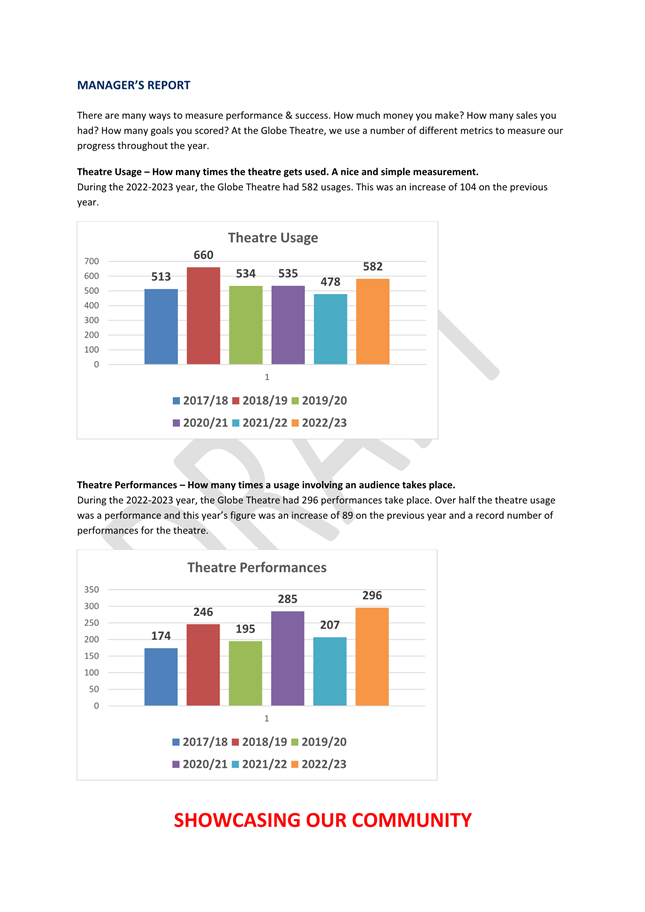
· Hosted a
wide range of shows and events – such as: Manawatū Youth Theatre,
French film festivals, Powerlifting National Championships, comedy nights,
Manawatū Jazz Festivals and the Aotearoa Country Music Awards.
· Continued to
build strong working relationships with a variety of community groups including
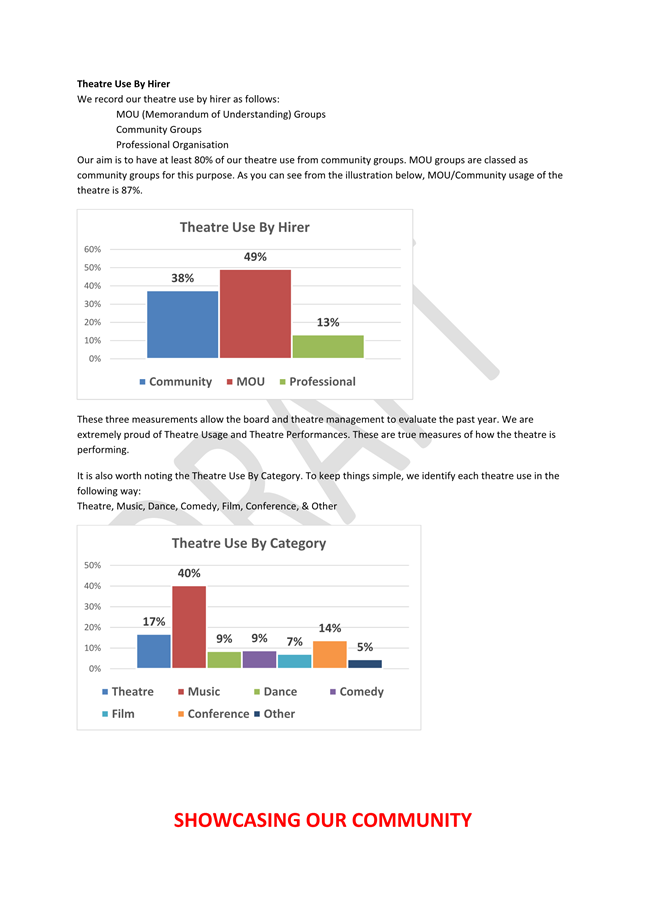
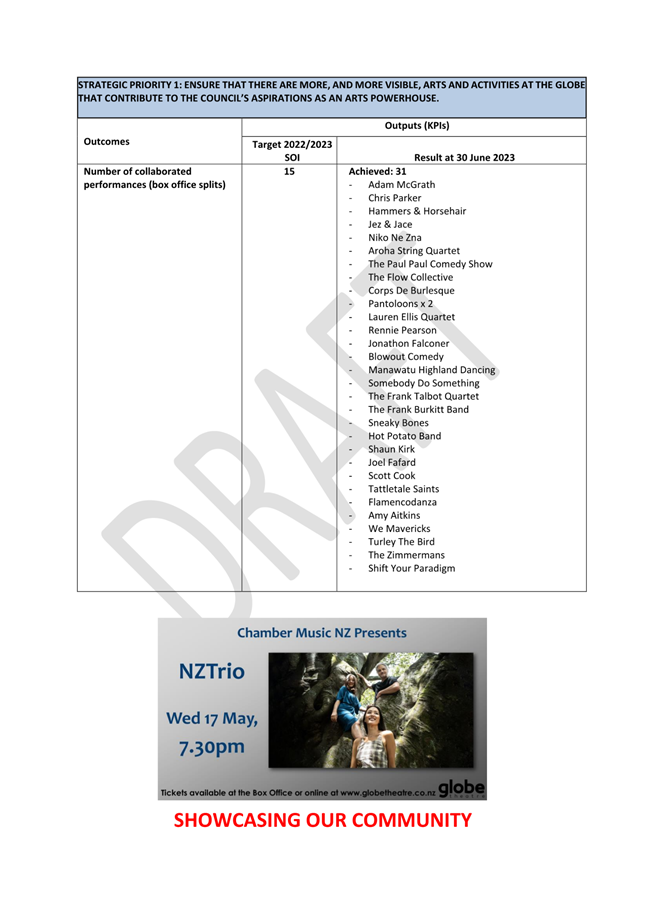
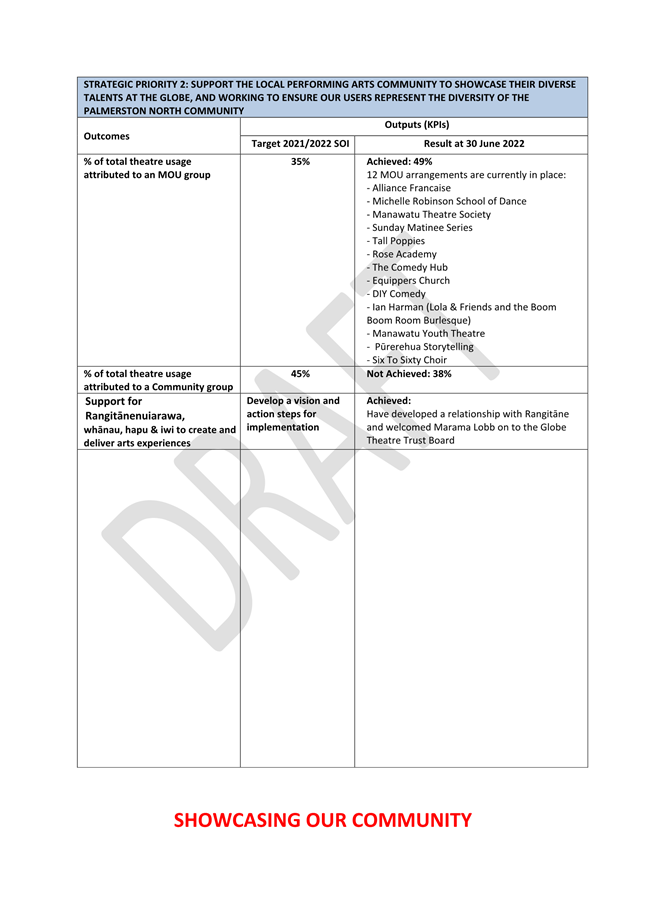
12 Memorandum of Understanding (MOU) groups. MOU groups used the theatre 49% of
the time in 2022/23.
· Continued to
attract touring acts for many musical/ theatre performances. By offering acts
different options for paying the hireage fee, 31 groups took up the offer of
the 70/30 hire option – which increases the variety of acts performed in
the city.
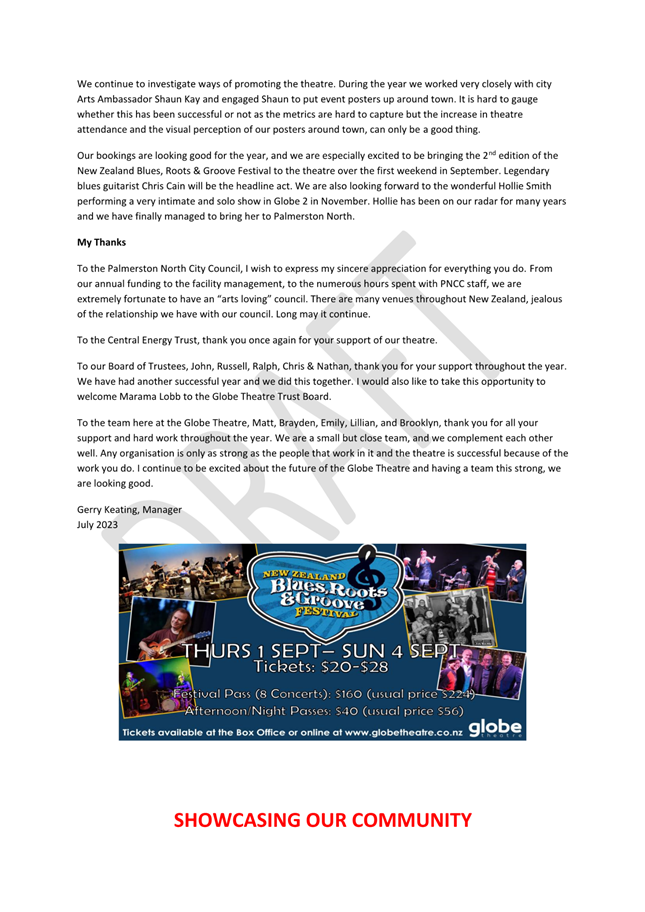
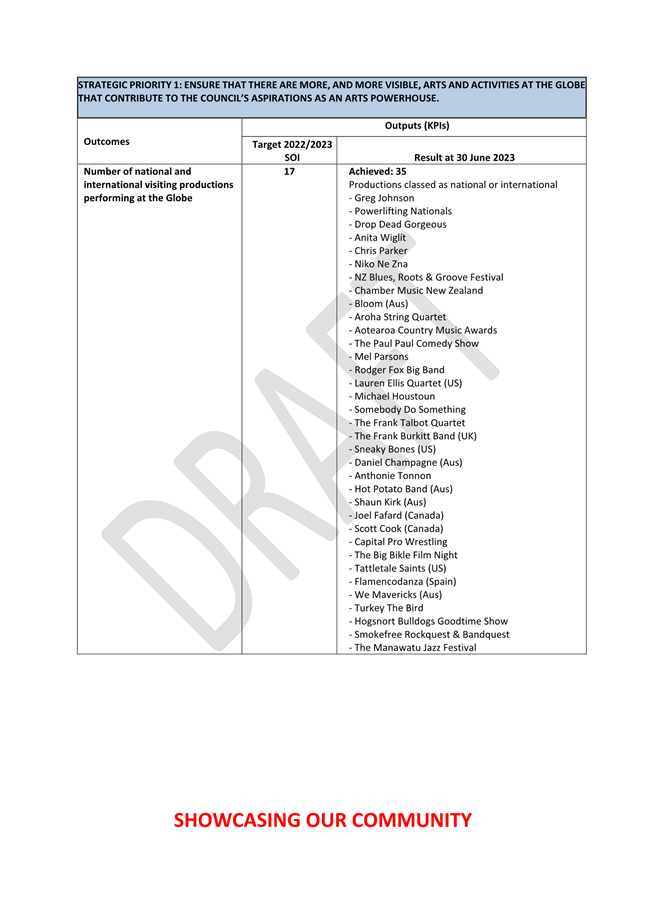
· Attracted 35
national/ international touring groups to Palmerston North, which increases the
variety of acts performed in the city.
· Received a Highly
Commended award in the Manawatū Business Awards 2022 ‘Not for
Profit’ category.
3.2 The
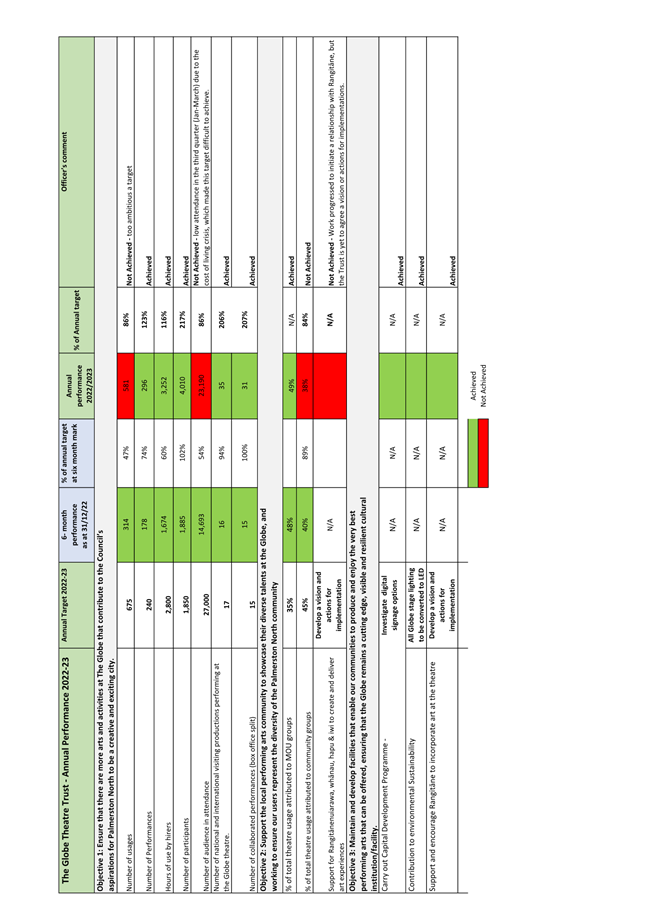
Globe has achieved most of its targets, except for three: number of usages;
number of audience members and the percentage of total theatre usages by a
community group. Attachment 1 shows the Globe’s performance against
the agreed Statement of Intent targets and includes Officer comments.
3.3 Objective
1: Increasing usage and audience attendance
The Globe managed to increase usage compared to 2022,
however, admits its target was too ambitious.
The measure ‘Number of audience members’ did
not meet the target. The Globe was very successful at encouraging new
acts to tour Palmerston North, however despite there being more performances at
the Globe than expected, fewer people attended the shows. Part of this could be
due to the cost of living crisis, and people having less disposable income to
attend ‘new’ or unfamiliar shows. Generally, returning or familiar
shows were well attended, but some of the first-time performances (to
Palmerston North) struggled.
3.4 Objective 2:
Supporting and encouraging local community use
The percentage of theatre usage attributed to community
groups (excluding MOUs) did not meet its target of 45%. This measures the
community groups which use the theatre for one-off performances or irregularly
rather than the MOUs who use the theatre on a regular basis. Despite this
measure not meeting its target, Officers are not concerned, as when combined
with the MOU result, community use of the theatre reached 87% against a
combined target of 80%.
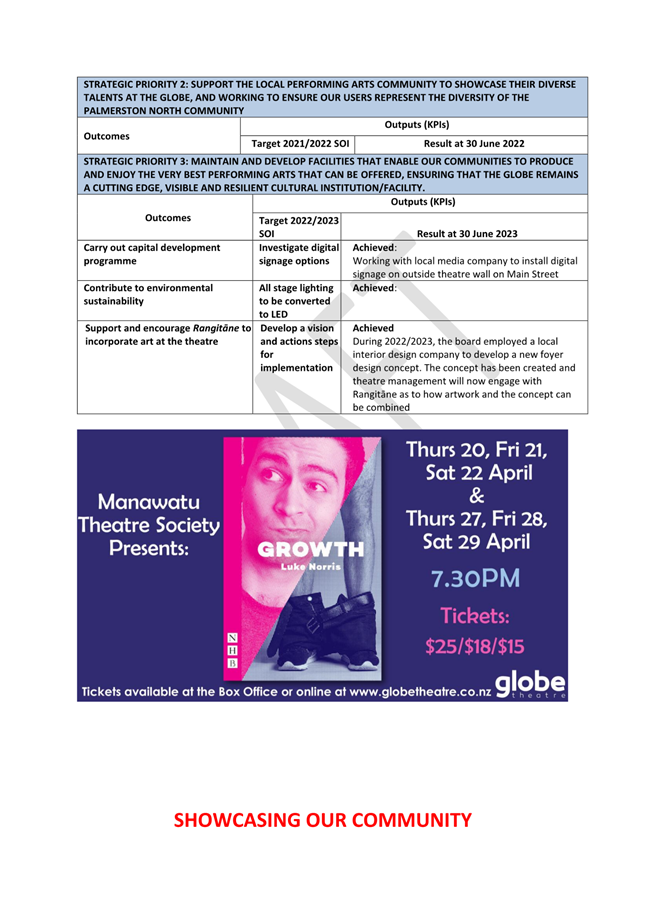
3.5 Work
to provide ‘Support for Rangitānenuiarawa,
whanau hapū and iwi to create and deliver art experiences’, has
started progressing towards the target, which was to develop a vision and
actions for implementation. The Trust Board has initiated a relationship
with Rangitāne and has commissioned Rangitāne artists to design and
create artwork for the new Theatre Foyer. The
Board also recently appointed Marama Lobb onto the Board. The development of a
vision and additional actions are the next steps.
3.6 Officers
see no merit in comparing 2022 with the COVID years of 2020 and 2021; instead
Table 1 compares 2022 results with pre-COVID years 2018 and 2019.
3.7 Despite
the Globe Trust not meeting its 22/23 target for Patronage (audience
attendance), it still achieved greater audience numbers than in the pre-COVID
years.
Table 1: The Globe – Annual Performance Results for
the financial years 2018, 2019 and 2023 (Covid-free years)
|
Measure
|
|
2017-18
30 June 2018
|
2018-19
30 June 2019
|
2022-23
30 June 2023
|
3 Year Trend
|
|
Number of Usages
|
Actual
|
514
|
680
|
581
|
↓
|
|
Number of Performances
|
Actual
|
175
|
253
|
296
|
↑
|
|
Patronage –
Total attendance for all events
|
Actual
|
Not
recorded
|
21,409
|
23,190
|
↑
|
|
% Community Usage
% of total usage attributed to community groups
(including MOUs)
|
Actual
|
83%
|
83%
|
87%
|
↑
|
|
Average size of audience per event
|
Actual
|
Not
available
|
85
|
78
|
↓
|
4. Financial Performance for the year July 2022-
June 2023
4.1 The
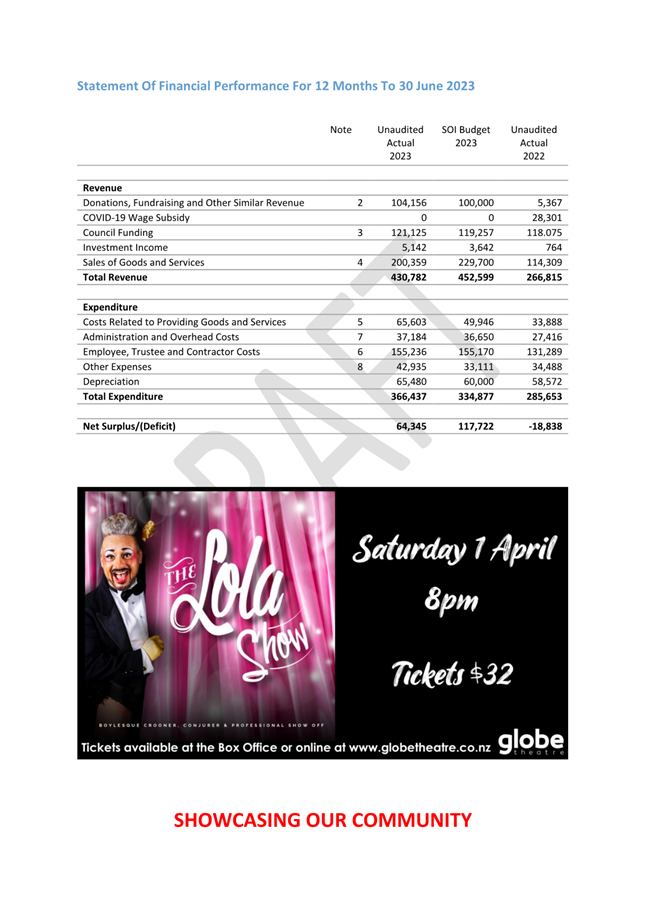
Trust had an operating net surplus $64K, which was less than the budgeted net
surplus of $117K in the Statement of Intent. The Globe sets out in their
report that this was due to an ambitious revenue target for sales of goods and
services.
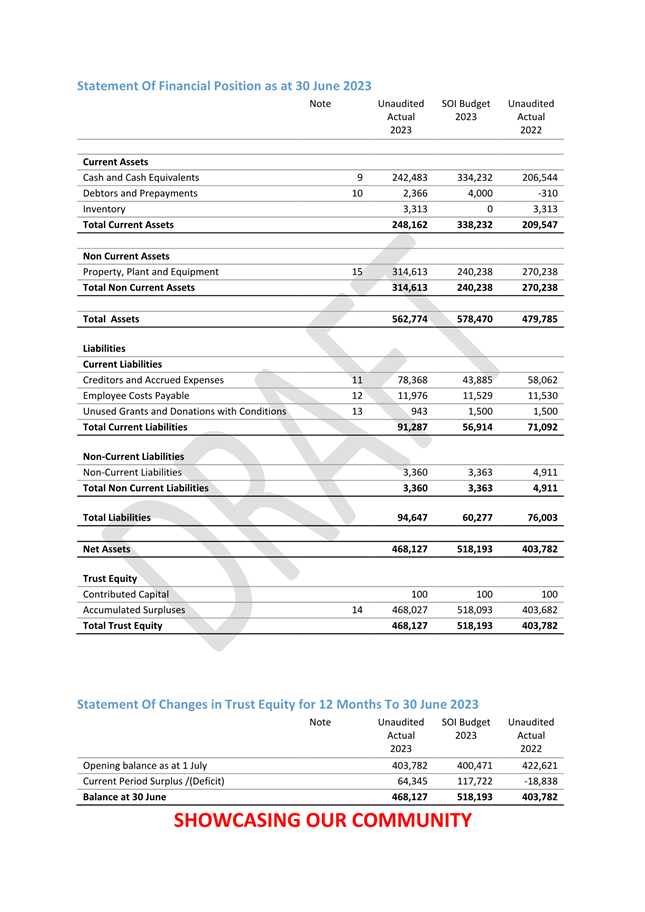
4.1 The
Trust's current assets are more than 2.7 times its liabilities indicating that
the Trust can satisfy its obligations.
Table 2: Financial
Information for the draft Annual Report 2022-23
|
|
2023
|
2022
|
|
|
Summary Financials ($000)
|
Actual
|
Budget
|
Var.
|
Actual
|
Var.*
|
|
Financial Performance
|
|
|
|
|
|
|
PNCC
Grant
|
121,125
|
119,257
|
1,868
|
118,075
|
3,050
|
|
Total
Revenue
|
430,782
|
452,599
|
(21,817)
|
266,815
|
163,967
|
|
Total
Expenses
|
366,437
|
334,877
|
31,560
|
285,653
|
(80,784)
|
|
Net
Surplus (Deficit)
|
64,345
|
117,722
|
(53,377)
|
(18,838)
|
83,183
|
|
Financial Position
|
|
|
|
|
|
|
Current
Assets
|
248,162
|
338,232
|
(90,070)
|
209,547
|
38,615
|
|
Total
Assets
|
562,774
|
578,470
|
(15,696)
|
479,785
|
82,989
|
|
Current
Liabilities
|
91,287
|
56,914
|
(34,373)
|
71,092
|
20,195
|
|
Total
Liabilities
|
94,647
|
60,277
|
(34,370)
|
76,003
|
18,644
|
|
Equity
|
468,127
|
518,193
|
(50,066)
|
403,783
|
64,344
|
|
Cash Flows
|
|
|
|
|
|
|
Total
Net Cash Flows
|
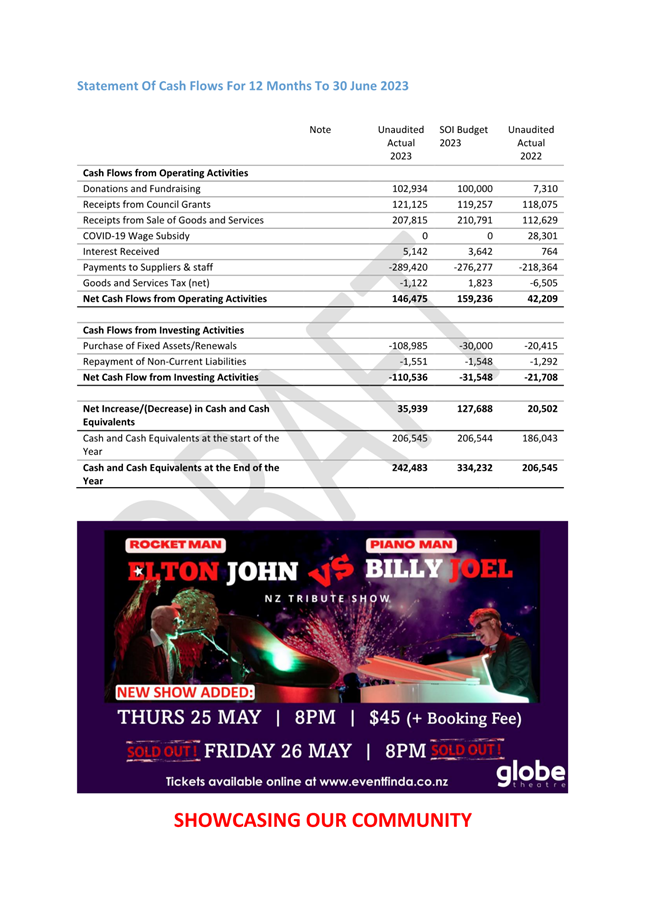
35,939
|
127,688
|
(91,749)
|
20,502
|
15,437
|
|
Opening
Cash
|
206,545
|
206,544
|
1
|
186,043
|
20,502
|
|
Closing
Cash
|
242,484
|
334,232
|
(91,748)
|
206,545
|
35,939
|
*when compared to the
same period 12 months ago
5. NEXT STEPS
5.1 Council
Officers will communicate any Council comments on the draft Annual Report to
the Globe Theatre.
5.2 At
the end of February 2024, the Globe Theatre Trust Board will submit:
· their draft
Statements of Intent for 2024–27; and
· six-month report on the current
Statement of Intent 2023–26.
These will be presented to Committee in April 2024.
6. Compliance and administration
|
Does the Committee have
delegated authority to decide?
If Yes quote relevant clause(s)
from Delegations Manual
|
Yes
|
|
Are the decisions significant?
|
No
|
|
If they are significant do they
affect land or a body of water?
|
No
|
|
Can this decision only be made
through a 10 Year Plan?
|
No
|
|
Does this decision require
consultation through the Special Consultative procedure?
|
No
|
|
Is there funding in the current
Annual Plan for these actions?
|
Yes
|
|
Are the recommendations
inconsistent with any of Council’s policies or plans?
|
No
|
|
The recommendations contribute
to Goal 2: A Creative and Exciting City
|
|
The recommendations contribute
to the achievement of action/actions in Arts and Heritage
Plan.
The action is: to support CCOs
to achieve the objectives of the Arts and Heritage plan.
|
|
Contribution to strategic
direction and to social, economic, environmental and cultural well-being
|
Receiving the Annual Report is a
mechanism for Council to provide guidance and direction to the cultural CCOs
and meets Council’s responsibility to monitor the CCOs under the Local
Government Act.
|
|
|
|
Attachments
|
1.
|
The
Globe Theatre Trust Board_Non-financial Performance Results ⇩ 
|
|
|
2.
|
The
Globe Theatre Trust_Draft Annual Report 2022-23 ⇩ 
|
|
Memorandum
TO: Culture
& Sport Committee
MEETING DATE: 8
November 2023
TITLE: Sport
Manawatū - Annual Report 2022-23
Presented
By: Ann-Marie
Mori, Policy Analyst
APPROVED BY: David
Murphy, Chief Planning Officer
RECOMMENDATION TO
CULTURE & SPORT COMMITTEE
1. That the
Committee receive Sport Manawatū’s 2022-23 Annual Report (Attachment
1) presented on 8 November 2023.
1. ISSUE
1.1 In
July 2022 Sport Manawatū and the Council entered a three-year funding
agreement and strategic partnership plan. Under the 2022-25 agreement there is
a requirement to submit an Annual Report.
1.2 A
six-month
progress update was presented to the Culture & Sport Committee in March
2023.
1.3 Staff
have evaluated Sport Manawatū’s performance against the
agreement’s accountability requirements and performance measures to
assess progress towards three outcome areas.
1.4 Attachment
1 is Sport Manawatū’s Annual Report to the Council for the period
from 1 July 2022 to 30 June 2023. Representatives of Sport Manawatū
are in attendance to present the report.
1.5 Sport
Manawatū’s audited accounts for 2022-23 will be presented once they
are available.
2. BACKGROUND
2.1 Sport
Manawatū is an independent charitable trust and receives multiple and
diverse sources of funding, including from Ihi Aotearoa - Sport New Zealand,
the Palmerston North City Council, other councils in the region, the Te Whatu
Ora Health NZ – MidCentral, and community trusts. Sport Manawatū
works towards meeting several different investment outcomes through its
activities and, therefore, its report includes some activities that are not
solely funded through Council’s funding agreement.
2.2 Council
has funded Sport Manawatū since the early 1990s. Over time the grant
amount has varied as services were added, including strategic plan
implementation, event support, and active transport promotion. These changes
have reflected organisational changes by Council (such as fluctuations of
in-house versus outsourced delivery models) as well as Council policy changes
(including changes to community outcomes and the Support and Funding Policy).
2.3 The
2022-25 funding agreement outcomes, based on Council’s 2021 strategic
direction, are:
1. Palmerston North is
one of the most active communities in NZ.
2. Sports events create
both social opportunities and economic benefits.
3. People have the
skills to safely and confidently cycle, and walk, on our transport network.
These outcomes guide Sport
Manawatū’s reporting.
3. SPORT MANAWATŪ IS MAKING GOOD PROGRESS TOWARDS THE AGREEd OUTCOMES
3.1 An
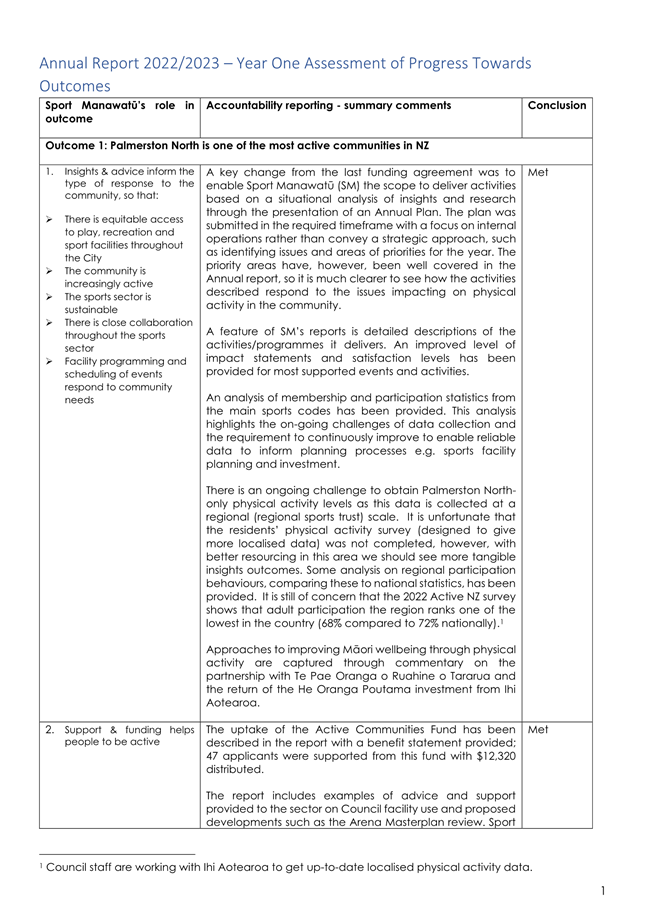
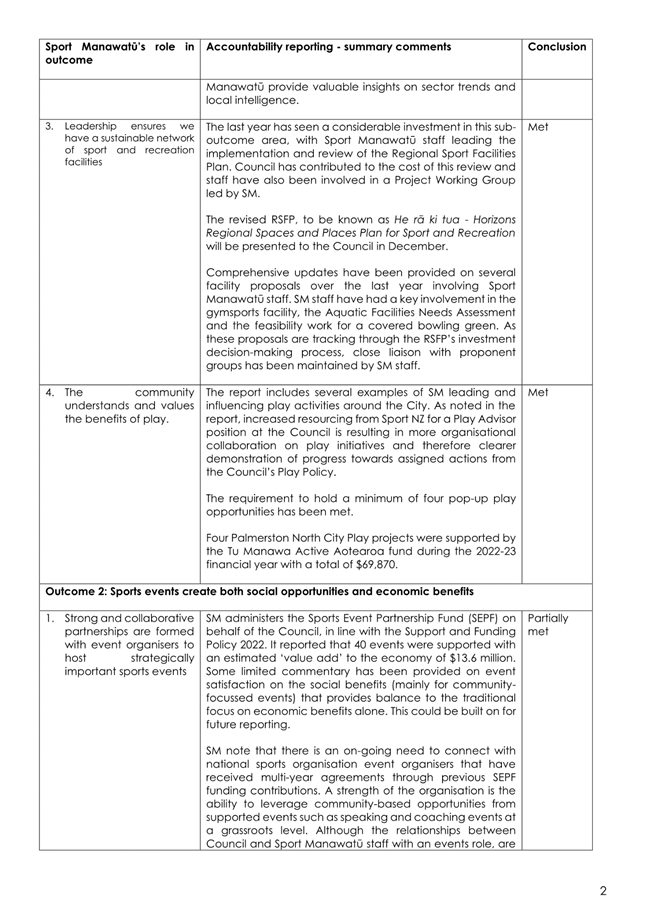
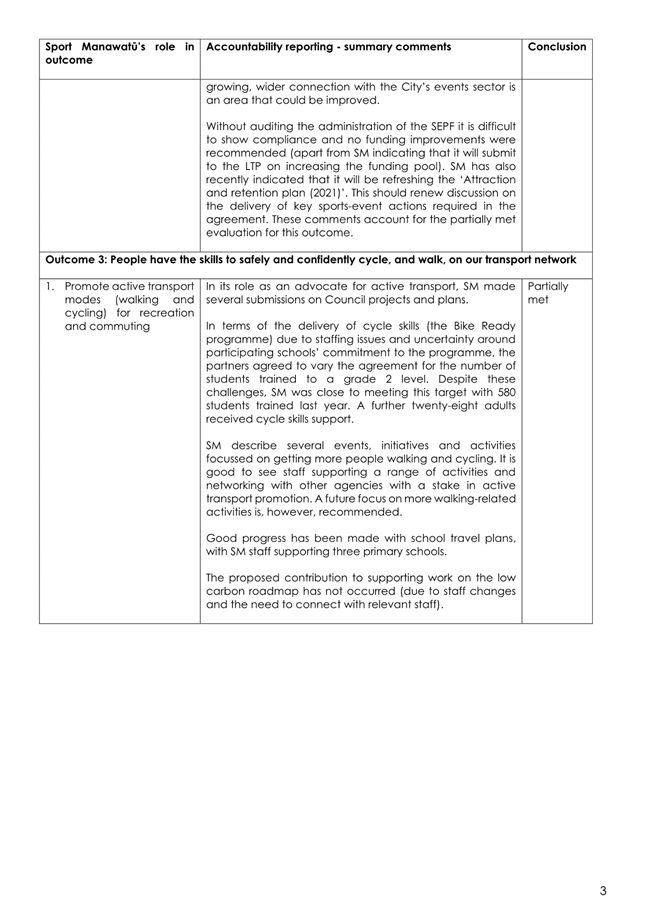
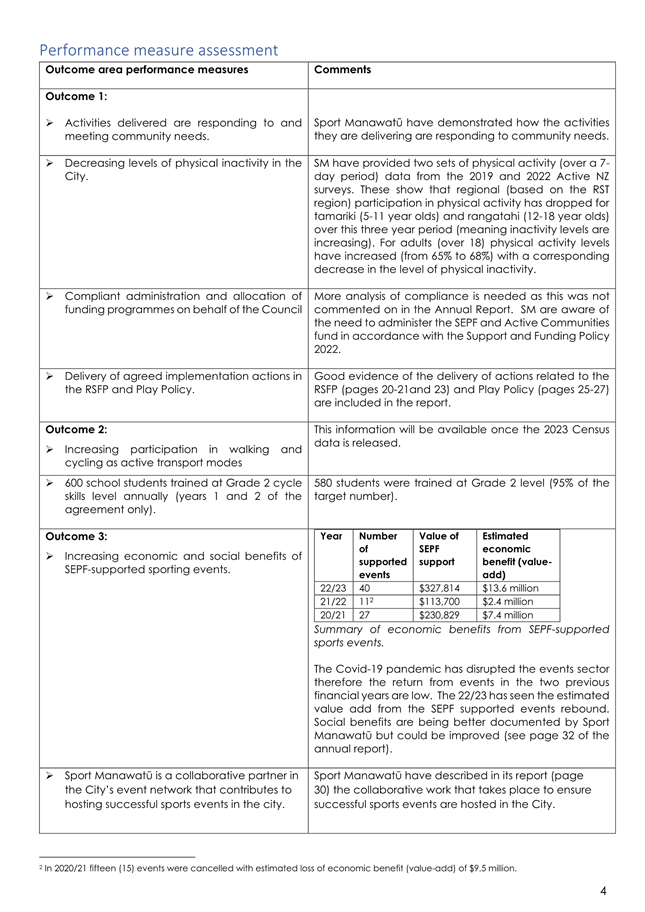
evaluation of Sport Manawatū’s accountability reporting requirements
and performance measures is summarised in Attachment 2. This assessment is part
of ongoing discussions with Sport Manawatū staff.
3.2 In
summary, Sport Manawatū has demonstrated good progress towards meeting the
performance measures in the first year of the 2022-25 funding agreement. The
performance measures guide monitoring for the key outcome areas. In many cases,
Sport Manawatū has provided useful narrative alongside quantitative data
to help measure progress towards the agreed outcomes. Areas to improve relate
to its role in the outcomes relating to sports events (outcome 2) and active
transport (outcome 3).
3.3 In
terms of a wider assessment of the combined contribution of both the Council
and Sport Manawatū towards the outcomes, the relevant high-level measures
in Council’s strategies and plans are still being collated for reporting.
Staff will report on an analysis of these measures once all this data has been
received.
4. tHE NEXT STEP IN REPORTING SPORT
MANAWATŪ’S PROGRESS WILL BE A SIX-MONTH UPDATE
4.1 Council
and Sport Manawatū staff will continue to work closely together on the
wide-ranging activities and initiatives covered by the funding agreement for
the 2022-23 year.
4.2 Under
the new agreement, Sport Manawatū will provide a six-month update to the
Council for the period ending December 2023, in early 2024. Staff may be able
to report on the high-level measures at this point.
5. Compliance and administration
|
Does the Committee have
delegated authority to decide?
|
Yes
|
|
Are the decisions significant?
|
No
|
|
If they are significant do they
affect land or a body of water?
|
No
|
|
Can this decision only be made
through a 10 Year Plan?
|
No
|
|
Does this decision require
consultation through the Special Consultative procedure?
|
No
|
|
Is there funding in the current
Annual Plan for these actions?
|
Yes
|
|
Are the recommendations
inconsistent with any of Council’s policies or plans?
|
No
|
|
The recommendations contribute
to Goal 2: A Creative and Exciting City
|
|
The recommendations contribute
to the achievement of action/actions in Active
Communities
The action is: Carry out regular
monitoring and reporting with Sport Manawatū.
|
|
Contribution to strategic
direction and to social, economic, environmental and cultural well-being
|
The 2022-25 funding agreement
and strategic partnership plan guides the delivery of services and activities
to the community that contribute to social well-being. As a regional sports
trust, Sport Manawatū are well-positioned to deliver these activities
and services to the community with support and funding from Council.
|
|
|
|
Attachments
|
1.
|
Sport
Manawatū - Annual Report 2022-23 to Palmerston North City Council ⇩
|
|
|
2.
|
Annual
Report 2022-23 - Year One Assessment of Progress Towards Outcomes ⇩ 
|
|
Memorandum
TO: Culture
& Sport Committee
MEETING DATE: 8
November 2023
TITLE: Central
Energy Trust Arena Masterplan 2023
Presented
By: Dave
Charnley, Senior Urban Designer; Ann-Marie Mori, Policy Analyst and John Lynch,
Venues Manager
APPROVED BY: David
Murphy, Chief Planning Officer
RECOMMENDATIONS TO COUNCIL
1. That Council adopt the Central Energy Trust Arena Masterplan 2023 to inform
future decision making, including the 2024-2034 Long Term Plan process.
2. That Council receive the Central Energy Trust Arena Masterplan 2023: Delivery Scenarios (Attachment 2) to inform
prioritisation of the 2024-2034 Long Term Plan.
1. ISSUE
1.1 On
4
May 2022 Council resolved that direction on the Arena Masterplan review be
provided by Council via the Planning & Strategy Committee, that a workshop
with Elected Members be planned to assist the preparation of the work and that
final approval of the Arena Masterplan Review be a Council decision.
1.2 The
Central Energy Trust Arena Masterplan Study 2017 has been reviewed and updated.
This memorandum requests Council’s approval of the Masterplan review.
1.3 A
copy of the Central Energy Trust Arena Masterplan 2023 is included as
Attachment 1.
1.4 It
is recommended that the Central Energy Trust Arena Masterplan 2023 be adopted
to inform future decision making, including the 2024-2034 Long Term Plan
process. Adoption of the Masterplan does not commit the Council to funding and
delivering the individual components of the Masterplan. Funding and delivery of
any Council projects is directed by the content of the Long Term Plan, not the
content of the Masterplan.
1.5 Projects
identified within the Central Energy Trust Arena Masterplan 2023 are
anticipated to be delivered over a long time period through a variety of
funding mechanisms and will need to be carefully weighed up against competing
priorities.
1.6 The
updated Central Energy Trust Arena Masterplan 2023 builds on previous master
planning vision and now reflects all recently completed projects while further
embedding strategic fit, contextual and site analysis, utilisation and
location. It also included key moves to continue to guide the co-ordinated
long-term development and function of the site and its facilities.
1.7 The
Plan will now guide all future decision making for the long-term development of
the site, including prioritisation, funding and delivery through the Long Term
Plan process. All potential projects identified on page 33 of the updated
Masterplan have preliminary costs based on their gross floor area and
identified dependencies.
1.8 A
peer review of preliminary Masterplan costs has been undertaken and there is
variability. These costings are currently being further assessed against
project scope along with investigation of supporting infrastructure to further
determine and confirm master plan project costs. These preliminary costings
will be completed and provided to Council ready for prioritisation of the
2023-2024 Long Term Plan.
1.9 That
said, delivery scenarios and preliminary cost envelopes have been prepared for
consideration. These are provided as a separate document alongside the updated
Masterplan to inform project prioritisation and funding into the 2024-2034 Long
Term Plan.
1.10 The
Central Energy Trust Arena Masterplan 2023: Delivery Scenarios and preliminary
cost envelopes are included as Attachment 2.
1.11 Final
preliminary Masterplan costings when received will be in line with the delivery
scenarios as laid out in Attachment 2. Further detailed costings of all key
projects will be better understood through developed design and feasibility
processes as determined through Long Term Plan prioritisation.
2. BACKGROUND
2.1 In
2014, Council undertook a high-level study of Arena Manawatū,
now Central Energy Trust Arena to produce a spatial framework for the site and
immediate surrounding streets. Significant improvement of the facility’s
relationship and connection to adjoining streets was identified as a key issue.
A range of projects aimed to deliver a high-quality site and sports destination
with improved street presence, legibility and sporting visibility. This
included a new open plaza entrance to Cuba Street and a potential Sports House.
2.2 In
2015, Updates to Section 15 Recreation of the Operative District Plan were made
resulting in a specific Arena Zone (Section 15.2.5) and embedding the Arena
spatial framework as a Planning Map (Map 15.2). Funding of priority streams of
work was allocated into the 2015 - 2025 Long Term Plan including
Council agreeing to provide a $1.5M funding grant for a Sports House on the
site.
2.3 In
2017, a more detailed Masterplan study was then prepared to further test and
develop previous work undertaken. Key outcomes underpinning the Masterplan to
create a higher quality sporting destination with improved street presence,
legibility and sporting visibility remained. Further contextual analysis of the
planning framework, site conditions, built form, open space patterns and
general assessment of facilities were undertaken. Specific briefs for Arenas
1-6 were prepared and a range of concept options including a new Sports House
tested to best address site-wide requirements. Options were costed and assessed,
and a preferred Masterplan option emerged (Option 3). Funding for Option 3
priority projects were then allocated into the 2018-2028 Long Term Plan.
2.4 Land
was acquired at the corner of Cuba and Waldegrave Street and the site made good
in preparation for construction works for a new entrance plaza. From 2018, with
oversight from the Arena Steering Group, detailed design of priority projects
commenced with the first artificial turf at Arena 6 completed late 2019.
2.5 During
this time the proposal for a Sports House to be located at Central Energy Trust
Arena was withdrawn by Sport Manawatū. Attention then shifted to
construction delivery with the Cuba Street entrance plaza and overbridge,
reconfigured speedway pits and south stand base plinth and ablutions completed
in August 2021.
2.6 This
significant change has resulted in a more welcoming public entrance from Cuba
Street, an enhanced visitor and fan experience for users of Arena 1 and
improved operations management for larger events such as speedway, rugby,
concerts and community events. These changes have drawn positive national
design attention with Central Energy Trust Arena receiving a handful of
prestigious Toitanga and public space design awards.
2.7 With
this tranche of work now complete, updating the Masterplan to reflect progress
made, understand any new or emerging needs and confirm all future projects are
the next logical steps in continuing to provide long term vision and guidance
for co-ordinated and integrated development of Central Energy Trust Arena.
2.8 Sport
and recreation facility planning processes are occurring in parallel. Needs
assessments guided by the Regional Sports Facilities Plan 2018 and the
Palmerston North ‘City Specific’ sections updated in 2022 have
informed the Masterplan review. Central Energy Trust Arena is recognised
as having a unique role in the region for meeting demand for further sports
facilities. Needs have been canvassed for additional indoor court and sports
field facilities identified for the site. A regional GymSports feasibility
study is underway and Central Energy Trust Arena is a potential location being
considered.
2.9 The
Arena site does not sit in isolation to its immediate surrounds. Other projects
– the Cuba Street link and Featherston Street cycleway directly relate to
the immediate street network that surrounds the Arena site and these have been
highlighted within the updated Masterplan. It is essential to ensure these
projects are considered in relationship to the ongoing development of the Arena
and that wider City Centre transformation and active transport outcomes to
better connect and access the site are achieved.
3. REVIEW METHODOLOGY
3.1 The
Central Energy Trust Arena Masterplan 2023 has been prepared by an experienced
multi-disciplinary team comprising Council Officers and consultants. The
methodology follows best practice for the development of a masterplan and
includes increased information and analysis on understanding the place before
developing a spatial response.
3.2 The
review process consisted of the following:
· Engagement
utilising a range of techniques including surveys, focus groups, workshops,
drop-in sessions and meetings to understand all existing or emerging issues,
opportunities and priorities.
· Assessment
of Vision and Goals and project strategic role and fit.
· Contextual
analysis including surrounding urban structure and form, relation to city
centre, river and key transport networks, district plan and regional sports
facility planning, cultural and historical. Includes identifying key projects
that physically relate or connect to the site, e.g. Cuba Street link.
· Site
visits to understand function and use, recent changes and operational issues.
Includes inspection and assessment of facility condition. Includes access
to all seismic assessments undertaken.
· Access
to latest as-built drawings to compile and update existing site plan and
seismic assessments.
· Preparation
of a preliminary spatial response to test thinking around key moves and future
development.
· Assess
and understand dependencies to determine and coordinate most logical way
forward for future development.
· Seeking
feedback from all engaged parties.
· Preparation
of high-level preliminary costings based on understood spatial need, functional
purpose and gross floor area. Includes undertaking a peer review and
reconciling of any cost differences in regard to scope and investigation of
supporting infrastructure.
· Prepare
a finalised updated Masterplan and supplementary guidance to inform approach to
prioritisation and delivery.
3.3 As
directed by Council’s Active Communities Plan, the Regional Sports
Facility Plan has informed the Masterplan review. Formal needs
assessments and feasibility studies establish the boundaries by which to test
spatial capacity and flexibility in the Arena site to accommodate any potential
or established community sports. Spatial testing has been carried out to
confirm and demonstrate within the updated Masterplan that all current needs
identified on the site could be accommodated (see Attachment 3 for more
detail).
4. REVIEW ENGAGEMENT
4.1 Direct
engagement has occurred with Elected Members via a Council workshop and drop-in
sessions, through hui with Rangitāne o Manawatū; and surveys, focused
interviews and workshop with key stakeholders, user groups and Council
Officers. Engagement has canvassed a wide Arena user group audience to gain
perspective from a local, regional and national level (refer to engagement
diagram on page 7 of The Masterplan for further detail).
4.2 Engagement
has informed understanding of all current site and facility issues and
confirmed a proposed programme of future projects for development.
4.3 As
Council embarks on each of the projects identified, there will be several
opportunities for public consultation and engagement with key stakeholders.
5. REVIEW key highlights AND RESPONSE
5.1 The
revised Plan retains many existing projects and proposes new projects that will
meet current identified needs while ensuring spatial flexibility for other
future needs.
5.2 It also signals an interest from city partners and key
stakeholders to further enhance identity and heritage, as well as explore
future potential of a facility to establish a public facing ‘hub of
sport’ adjacent to the new entrance plaza at the corner of Cuba Street
and Waldegrave Street.
5.3 The
review pointed to key challenges, which are responded to in the revised
Masterplan:
· Sufficient
community indoor court space – there is a tension between the Arena
being a financially sustainable venue and destination attractor while also
providing for community needs. We also know that indoor court space is limited
in the region; the Masterplan thus investigates an additional indoor court
facility on the Arena site.
· All-weather
sports fields – increased capacity for winter training. The
Masterplan proposes an additional artificial turf on the site and
reconfiguration of current surfaces.
· Gymsports
needs – Elected Members are also aware of the work Gymsports is doing
with Sport Manawatū to look to future-proof their facilities. Should the
Arena be the best location for Gymsports, the Masterplan seeks to provide
sufficient space for that option.
· Site
identity – stakeholders have varying perspectives. The Masterplan
responds by further balancing heritage and considers the role of naming spaces
and facilities. Expanding ‘He Aho tangata’ and improving wayfinding
across the site and facilities will assist and support this.
· Improved
movement and safety – providing clear and intuitive pathways for all
users, particularly east-west and north-south movements, will
‘stitch’ facilities together. Addressing safety concerns throughout
particularly at carparks and entries including after dark. Provide well lit,
welcoming and overlooked pathways.
· City
centre connection – attraction of events and audiences and improving
the public frontage and access between the city and the site. The Masterplan
highlights the relationship between the surrounding and wider urban structure
and highlights key projects immediately related to the Arena including
connection to wider transport network.
· Earthquake
prone building at Arena 5 – a seismic rating of 30% NBS. Whilst in a
‘good’ working condition, Arena 5 is acknowledged as having passed
its ‘use-by-date’ and is no longer fit for purpose. This presents a
spatial opportunity for a future multi-purpose or indoor court facility though
it is dependent on further land acquisitions to be complete and current users
being decamped to alternative facilities before decommissioning and
redeveloping.
· Land
acquisition is required – the vast majority of the land affected by
the Central Energy Trust Arena Masterplan 2023 is Council owned. There are
still small remaining parcels of private land adjacent to the Entrance Plaza to
acquire. Acquisition for these sites has been
considered in the overall costings.
6. DELIVERY SCENARIOS & PRELIMINARY COSTINGS
6.1 Officers
have prepared delivery scenarios to inform prioritisation in the 2024-2034 Long
Term Plan process. These consider dependencies to offer ways forward in
implementing further physical change at the Arena, particularly in delivering
immediate and short-term priorities.
6.2 A
peer review of preliminary Masterplan costs has been undertaken and there is
variability, particularly with larger new facilities proposed. These costings
are now being further assessed against project scope including proposed bulk
and location gross floor area and supporting infrastructure investigations to
determine and confirm final Masterplan preliminary costings. These final
costings will still remain high-level in nature and be provided to Council
ready for prioritisation of the 2023-2024 Long Term Plan.
6.3 It
should be noted that projects identified within the Central Energy Trust Arena
Masterplan 2023 are anticipated to be delivered over a long time period through
a variety of funding mechanisms and will need to be carefully weighed up
against competing priorities.
6.4 Detailed
costs for each project identified are expected to be better understood through
feasibility as each project moves through indicative business case processes to
better determine a preferred developed design option for delivery.
6.5 Delivery
scenarios including the preliminary cost envelopes for each scenario are
included as Attachment 2.
7. NEXT STEPS
7.1 Officers will provide final Masterplan costings prior to
commencing 2024-2034 Long Term Prioritisation process.
7.2 Council will consider development priorities and funding
for Central Energy Trust Arena through the 2024 -2034 Long Term Plan.
7.3 Officers will prepare an Implementation Plan to determine
strategy, process and action in regard to the next tranche of development
priorities including:
· aligning strategic objectives,
· determining roles and responsibilities for operational
delivery (including Arena Steering Group),
· stakeholder, team and process management,
· tasks and deliverables,
· risk assessment.
7.4 As projects are prioritised, feasibility studies/businesses
cases will be prepared to:
· confirm strategic
fit and the case for change
· appraise and
determine best option to maximise public value
· be commercially
viable and attractive to supply
· confirm
affordability and funding over time
· be
successful in delivery by Council and its partners.
8. Compliance and administration
|
Does the Committee have
delegated authority to decide?
|
No
|
|
Are the decisions significant?
|
No
|
|
If they are significant do they
affect land or a body of water?
|
No
|
|
Can this decision only be made
through a 10 Year Plan?
|
No
|
|
Does this decision require
consultation through the Special Consultative procedure?
|
No
|
|
Is there funding in the current Annual
Plan for these actions?
|
No
|
|
Are the recommendations
inconsistent with any of Council’s policies or plans?
|
No
|
|
The recommendations contribute to all Goals, in particular
Goal 2: A Creative and Exciting City
|
|
The recommendations contribute
to the achievement of action/actions in the Active Communities Plan, Arts
& Heritage Plan, City Shaping Plan, City Growth Plan, Transport Plan,
Economic Development Plan, Connected Communities Plan, Climate Change Plan
and Environmental Sustainability Plan.
The actions are:
· Deliver the
Central Energy Trust Arena Masterplan
· Provide sport
and recreation opportunities in all of the City’s parks and reserves,
that are responsive to the needs and views of communities of interest
· Implement a
wayfinding strategy to increase legibility in public spaces in the city
centre
· Support projects
that promote the visibility of, and participation in, Māori creative
practices
· Include
Rangitāne o Manawatū art and design in the city centre
· Acknowledge and
express Te Ao Māori in citywide urban design principles and practice
· Apply urban
design best practice to greenfield structure planning and public space master
planning
· Prioritise
active transport programmes that deliver on Council goals, the purpose of
this plan, and the Government Policy Statement on Transport
· Attract, fund
and manage events which bring significant economic benefit to the city
(through the Major Events Fund, Art Event Fund and Sports Event Partnership
Fund)
· Provide
gender-neutral and accessible public toilets throughout the city
· Implement
sustainable practices throughout the Council
|
|
Contribution to strategic
direction and to social, economic, environmental and cultural well-being
|
The revised Arena Masterplan is best practice master
planning and therefore is expected to deliver across all four wellbeings.
|
|
|
|
Attachments
|
1.
|
Central
Energy Trust Arena Masterplan 2023 (attached separately) 
|
|
|
2.
|
Central
Energy Trust Arena Masterplan 2023: Delivery Scenarios & Cost Envelopes
(attached separately) 
|
|
|
3.
|
Establishing
needs for CET Arena Masterplan Projects 2023 (attached separately)
|
|
REPORT
TO: Culture
& Sport Committee
MEETING DATE: 8
November 2023
TITLE: Response to the 'Aquatic Facilities and Water-based
Recreation Needs Assessment'
PRESENTED BY: Ann-Marie
Mori, Policy Analyst and Kathy Dever-Tod, Group Manager - Parks and Logistics
APPROVED BY: David
Murphy, Chief Planning Officer
RECOMMENDATION TO COMMITTEE
1. That the
Culture & Sport Committee receive the ‘Aquatic Facilities and
Water-based Recreation Needs Assessment’ (the Needs Assessment) prepared
by RSL Consultants and smartz (Attachment 1).
RECOMMENDATIONS TO COUNCIL
2. That Council
endorse Option 2 in the report titled ‘Response to the ‘Aquatic
Facilities and Water-based Recreation Needs Assessment’’.
3. That Council
note the outcomes of the investigation into the low investment opportunities
described in this report will be reported back to Council to inform future
decision-making.
SUMMARY OF OPTIONS
ANALYSIS FOR THE AQUATIC FACILITIES AND WATER-BASED RECREATION NEEDS ASSESSMENT
(LTP PROGRAMME 1899)
|
Problem
or Opportunity
|
To consider how the recommended
opportunities presented in the ‘Aquatic facilities and water-based
recreation needs assessment’ (the Needs Assessment) should be included
in Council’s planning.
These
opportunities range from making immediate operating changes to pool
scheduling, considering low investment opportunities (e.g. school
partnerships), to making significant investment in redeveloped or new
facilities.
|
|
OPTION 1:
|
Continue
current levels of service for the swimming pool activity, outdoor paddling pools
and splash pads, and the canoe polo facilities at Hokowhitu Lagoon.
Initiate work, as appropriate,
on recommended immediate opportunities in the Needs Assessment.
|
|
Community
Views
|
The Needs Assessment included
views from a wide range of stakeholders and sector groups. This option
will involve more liaison with stakeholders.
|
|
Benefits
|
Operational improvements will
benefit some users immediately. Low cost option compared to
implementing the low or high investment opportunities.
|
|
Risks
|
May not be a popular option or be
easily implemented. There may be frustration from some sectors of the
community (formal sports pool users) that all opportunities aren’t
being explored.
|
|
Financial
|
May have minor revenue
implications.
|
|
OPTION 2:
(recommended)
|
Option 1 (as above) AND
explore the low investment opportunities (see Attachment 2) through
LTP programme 1899 this year (2023-24) to inform future decisions.
|
|
Community
Views
|
The Needs Assessment included
views from a wide range of stakeholders and sector groups. This option
will involve more liaison with stakeholders, particularly the education
sector, to respond to the issues.
|
|
Benefits
|
Exploration into this opportunity
aims to create long-term pool network resilience across the City (and
therefore less reliance on Council’s provision alone).
Places the Council in a better
position to inform future LTP cycles given the low investment opportunities
may have an ongoing operational impact.
Provides an opportunity for
organisational relationships to be formed and for the aquatics sector to have
a more ‘joined-up’ / network approach to resolving issues.
|
|
Risks
|
Uncertain internal and external funding
environments for our potential partners.
May raise expectations from the
community that the Council is in a position to make funding provision to
pursue the low investment opportunities.
|
|
Financial
|
Operational changes to pool
scheduling may have minor revenue implications.
No immediate impacts as this work
can be funded through LTP programme 1899.
|
|
OPTION 3:
|
Options 1 AND 2 AND make funding provision within the
draft 2024-34 LTP process to plan for capital and operational implications of
the recommended high investment opportunities (see Attachment 2).
|
|
Community
Views
|
The Needs Assessment included
views from a wide range of stakeholders and sector groups. This option
will involve more liaison with stakeholders, particularly the education sector,
to respond to the issues.
|
|
Benefits
|
Would signal the level of
commitment from the Council to the community to investing in solutions to
meet the wide-ranging needs served by aquatic facilities/swimming pools.
Would allow for costs associated
with these opportunities to be refined through feasibility assessment.
|
|
Risks
|
Unrealistic and unaffordable to
progress planning and capital projects in the current funding environment.
Feasibility not established for
all investment opportunities – particularly the high investment
opportunities.
Requires additional
programmes/budgets due to the broad scope of the opportunities that need to
be explored.
|
|
Financial
|
This option would require the
preparation of indicative budgets and timelines for each item as part of the
draft 2024-34 LTP process.
Currently Council has not made
provision within the 2021-31 LTP for capital investment or operational grants
for new or partnered swimming pool facilities.
|
Rationale for the recommendations
1. Overview of the problem or opportunity
1.1 The
purpose of this report is to provide Elected Members with an opportunity to
respond to the recommended opportunities presented in the ‘Aquatic
Facilities and Water-based Recreation Needs Assessment’ (the Needs
Assessment, see Attachment 1).
1.2 These
opportunities range from making immediate operating changes to pool scheduling,
considering low investment opportunities (e.g. school partnerships), to making
significant investment in redeveloped or new facilities.
1.3 The
opportunities aim to meet the City’s wide-ranging
water-recreation needs, including catering for participation/leisure and
competitive swimming, in a balanced way.
1.4 The
Needs Assessment was completed in August 2023 by RSL Consultants and
smartz. This work was funded through LTP programme 1899 with a $51,000
budget.
1.5 Council
now has an opportunity to decide which opportunities should be progressed to
respond to identified needs and to inform further decision-making.
2. Background and previous council decisions
Background
2.1 The
network of water-based facilities in Palmerston North includes a range of
Council, education, and private pools along with natural bodies of water.
The Council operates three aquatic facilities (see Section 6.2.1 of the Needs
Assessment) – the Lido Aquatic Centre, the Freyberg Community Pool and
Splashhurst.
2.2 The
strategic direction for the swimming pool activity sits in Whāinga 2: He
tāone whakaihiihi, tapatapahi Goal 2: A creative and exciting city and Te
mahere hapori hohe Active communities plan. Swimming pools are also
covered by the Parks and Reserves Asset Management Plan.
2.3 Consultation
on the 2021-31 LTP generated over 700 submissions, with approximately half of
these in the ‘active communities’ activity area. Submissions
on aquatic facilities dominated this topic.
Manawatū-Whanganui Regional Sport Facility Plan
– review of the Palmerston North section
2.4 The
Needs Assessment forms part of a wider planning process expressed in the Manawatū-Whanganui Regional Sport Facility Plan 2018
(RSFP). The Palmerston North section of the RSFP was reviewed in October
2022 by consultants RSL.
2.5 The
revised ‘Aquatics’ section recommended the following planning
approaches for further exploration:
a) Gain more access to school
pools (although this only increases the capacity of the pool network during
summer months, when it is least needed).
b) Cover the existing 50m
pool at the Lido Aquatic Centre (this would add sufficient year-round access to
lane space to the sports pool network up until approximately 2041. This
would allow Council to consider longer-term options to protect the network).
c) Develop new pool space,
including:
- Deepwater
pool space for sport and recreation activities that require greater depth such
as water polo.
- Warmwater
pool space which is often developed for therapy and rehabilitation purposes.
- Leisure
water for tamariki (particularly targeting the 4-8 year old age group)
These approaches were reported to Council
in November 2022 and guided the scope for the Needs Assessment.
The Needs Assessment
2.6 The
research was carried out in response to several factors, including numerous
community requests through the 2021-31 LTP for the Council to build new
water-based sport and recreation facilities.
2.7 The
key objectives of the Needs Assessment were to understand:
a) If
the Council needs to make changes to its current operating policies to increase
the use of current facilities and/or invest in current or new indoor and
outdoor aquatic facilities to serve the City’s water-recreation needs.
b) The
types of facilities that would best meet the water-recreation needs of the
community and provide value for money for users and residents.
c) When
any additional capacity is required and provide a timetable and cost estimates
for future capital works programming.
2.8 Specialist
sport and recreation consultants, RSL Consultants and smartz were commissioned
to carry out the work early in 2023.
2.9 A
Councillor workshop was held on 24 May 2023 with the consultant team. In
preparation for the workshop the consultants surveyed Elected Members asking
them what the community values about aquatic and water-based recreation
facilities in Palmerston North.
National Aquatic Facilities Strategy (2013) review
2.10 Alongside
the Needs Assessment, Ihi Aotearoa Sport New Zealand has been reviewing the 2013 National Aquatic Facilities Strategy (the
Strategy). Key insights from this review have informed the Needs
Assessment. The strong guidance from the Strategy is that the facility
focus should be on local level facilities. The Strategy is due for
completion by the end of the year.
Annual Plan 2023-24 and Long-Term Plan 2024-2034 process
2.11 Thirty-seven
submitters commented on aquatic facilities through the Annual Plan 2023-24
process. All supported an increased Council investment, larger pool
and/or new facilities, as well as proceeding with LTP programme 1899 (Aquatic
Facilities and Water Recreation Preliminary Feasibility Study/Needs
Assessment).
2.12 There is
provision in this year’s Annual Plan, through LTP programme #1899, to
investigate the feasibility of the recommended opportunities in the Needs
Assessment.
2.13 The
Council referred an aquatic facilities business case to the Long-Term Plan
2024-2034 process. At this stage, no programmes have been included for
consideration.
3. NeEDS ASSESSMENT FINDINGS AND RECOMMENDED
OPPORTUNITIES
3.1 The
Needs Assessment was guided by a key goal:
To provide opportunities for everyone to enjoy aquatic
activities safely and equitably.
Key findings
3.2 The
main findings are set out in the Executive Summary (in pages 2 – 4 of
Attachment 1) and in the main body of the Needs Assessment with the following
highlights:
Ø Comparing
the City’s supply with the national demand profile, more pool water
should be allocated for leisure and hydrotherapy and less for fitness/lane
sports water sports and learning/education activities (e.g. learn-to-swim).
Ø The
City is growing, meaning our facilities need to cater for both
participation/casual (11.4% of the city’s population) and competitive
(1.2% of the city’s population) water-based activities.
Ø The
analysis of pool space scheduling demonstrates there is peak time (i.e.,
mornings and evenings) availability in the three Council-operated pools.
Ø The
(draft) National Aquatics Facility Strategy 2023 states swimming and diving
sports do not require additional international or national level event
facilities, as there are enough to serve event needs now and into the
future. Any event-focused facility development should be district or
possibly regional-level facility.
Ø To
meet the range of community demands, all operational and upgrade/repurpose
options are recommended for exploration before developing new facilities.
Recommended opportunities
3.3 Section
9 of the Needs Assessment covers a range of opportunities to address the
imbalance of pool water type ahead of other demands. While these
opportunities support addressing the imbalance of pool space (to accommodate
leisure swimming and hydrotherapy needs), they also provide for competitive
swimming activities to grow.
3.4 The
recommended opportunities (see Section 9 of the Needs Assessment), with
indicative timeframes are:
Ø A:
Immediate opportunities – operational pool scheduling
adjustments, user liaison
Ø B:
Partnership low investment opportunities (2023-2026) – predominantly
exploring school partnership options
Ø C:
Significant investment opportunities (2027 beyond) – upgrade and new
facility proposals
3.5 Staff
note that the costs for recommended low and high investment opportunities (i.e.
opportunities B and C) are estimates and have not been assessed for feasibility
or taken to a business case stage. A brief description of the
opportunities and costs for each are in Attachment 2.
3.6 To
help understand how the opportunities address the need for more leisure pool
space and hydrotherapy provision, further explanation is provided in section 9
of the Needs Assessment below:
Ø Opportunity
B aims to address leisure swimming demand by making school pool water
space available for casual, out-of-school hours access over the summer months.
Ø Opportunity
C includes an option to enclose the Lido’s 50m pool to provide a
sport-focused pool facility, therefore freeing up other pools for leisure and
recreational activities. To a lesser degree, the potential upgrade of the
25m pool to a 50m pool would do the same, although an upgrade would absorb pool
space that could be used more for leisure and recreational activity.
Ø During
the summer months and outside of the peak lane swimming times, any new 50m pool
would be used for leisure swimming. Any new multi-pool facility in the
growth area would have a leisure and hydrotherapy focus (see the Albany Stadium
Pool case study).
3.7 The
opportunities are inter-linked, i.e. they should be approached sequentially.
This is because one group of actions may resolve issues and change the nature
or scope of the potential low and high investment opportunities.
3.8 The
sequential relationship between the Needs
Assessment’s proposed opportunities is illustrated in the diagram
below:
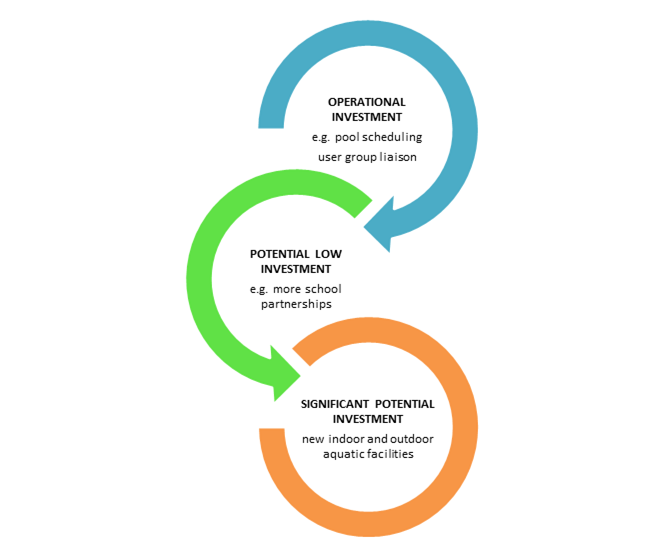
Figure
1: Relationship between the Needs Assessment’s proposed
opportunities
3.9 Recommendations
from the Needs Assessment aim to balance the type of pools we have to meet
leisure swimming and hydrotherapy needs. The purpose is also to achieve
resilience across the City’s network of facilities for water-based
activities.
4. DESCRIPTION OF OPTIONS
4.1 Option
1:
· Continue
current levels of service for the swimming pool activity, outdoor paddling
pools and splash pads, and the canoe polo facilities at Hokowhitu Lagoon.
· Initiate
work on the recommended immediate opportunities (A) in the Needs Assessment
where possible:
|
Ø Council policy
setting options for scheduling of casual swimming lane space in public pools
Ø Morning pool space optimised for sports groups
|
Comment
· Sport
Manawatū and CLM are well-positioned to work with
Council and sports user groups to seek better optimisation of pool use in the
mornings.
· Allows time to
monitor impacts of operational adjustments.
4.2 Option
2:
· Option
1 (as above) AND explore the low investment opportunities (B) through
LTP programme 1899 this year (2023-24) to inform future decisions:
|
Ø Summer school
pool access is encouraged and, where appropriate, resourced in partnership,
e.g. pool network resilience funding scheme
Ø Network resilience support for the current indoor school
pools available for community use, e.g. capital grant or loan
Ø Network resilience through strategic investment in
upgrades selected to school pool facilities
Ø Leveraging Council’s pool management contract to
improve technical capability and capacity across the network
Ø Leveraging resources to develop an asset upgrade and
renewals programme across the pools network
Ø Hokowhitu Lagoon water quality, weed management and
improvement to stormwater inflow
|
Comment
· Report
back to Council on the outcomes of the investigation into the low investment opportunities
to inform future decision-making.
4.3 Option
3:
· Option
1 AND 2 AND make funding provision within the draft 2024-34 LTP process to plan
for capital and operational implications of the recommended high investment
opportunities (C):
|
Ø Lido 50m pool
enclosure with a roof structure
Ø Demolish the current Lido 25m indoor pool and replace
with a 50m indoor pool facility OR a new 50m pool at Lido
Ø New local level, multi-purpose pool facility as the city
grows (e.g. in the Kākātangiata urban growth area)
|
|
Ø Lake opportunities
– access to or purchase of privately owned ex-quarry lake/s
Ø Explore the development of an artificial Canoe Polo
outdoor courts facility
|
Comment
· This
option requires the preparation of indicative budgets and timelines for each opportunity
(likely to be place-holder budgets as depend on the outcomes of exploration
into the low investment opportunities and would be developed without
information from feasibility/business cases).
4.4 Figure
2 shows a summary of each of the options, and how they potentially align with
Council’s long-term planning.
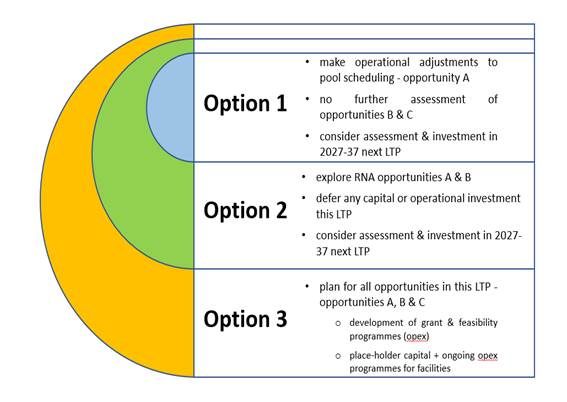
Figure 2: Summary of options in response to the
opportunities presented in the Needs Assessment
5. Analysis of options
5.1 Option
1: Make immediate operational adjustments (opportunity A) and
consider the low and high investment opportunities later.
|
Pros
|
Cons
|
|
Focuses
effort on better use of existing infrastructure including maximising use of
lane space and pools
|
Pushes
out timeframes for further research, including feasibility and building
timeframes
|
|
Provides
the potential for better delivery to address immediate demand pressures and
user needs
|
Unsatisfactory
outcome for parts of the aquatic community, such as organised sports groups
wanting facilities to be built sooner
|
|
Low
cost option compared to investment opportunities
|
|
5.2 Option
2: Option 1 (opportunity A) AND explore the low investment opportunities
(opportunity B) through LTP programme 1899 this year (2023-24) to inform future
decisions.
|
Pros
|
Cons
|
|
Would
result in more definite costs associated with this opportunity to be
determined (e.g. refine estimated costs, and quantify grants to schools)
|
May
cause frustration to stakeholders as the focus is on more research rather
than building facilities
|
|
Places
the Council in a better position to inform future LTP cycles given the impact
this opportunity may have on high investment items and ongoing operational costs
|
Uncertain
internal and external funding environments for our potential partners
|
|
Provides
an opportunity for organisational relationships to be built and for a more
‘joined-up’ / network approach
|
|
|
Exploration
of this option could create long-term resilience across the City (and
therefore less reliance on Council’s provision alone)
|
|
|
Aligns
with the RSFP investment decision-making process that is best practice for
sports facility planning; explores other solutions to problems that
don’t involve new facilities
|
|
|
Gives
some breathing space when Council is faced with juggling multiple community
facility projects requiring investment decisions
|
|
|
Can
use programme 1899 to explore this opportunity
|
|
5.3 Option
3: Option 1 and 2 (opportunities A AND B) AND make funding provision
within the draft 2024-34 LTP process to plan for capital and operational
implications of the recommended high investment opportunities (opportunity C).
|
Pros
|
Cons
|
|
Would
signal the level of commitment from the Council to the community to planning
and investing in solutions to meet the wide-ranging needs served by these
facilities
|
Challenging
to progress planning and capital projects in current funding environment
|
|
|
Feasibility
not established for investment items – particularly the high investment
opportunities
|
|
|
Requires
extra budget or a new programme due to the broad scope of the opportunities
that need to be explored
|
5.4 In
response to the Needs Assessment, staff recommend Council should implement the
immediate opportunities (A) AND explore the feasibility of low investment
opportunities (B) to inform future decisions (Option 2). The community
benefits of Option 2 enable some ‘quick wins’ and also provide
opportunities to consider the most effective solutions to the identified needs.
6. Conclusion
6.1 The
Needs Assessment recommends that Council consider several opportunities to
better balance the type of pools to meet the forecast demand for participation
and competitive swimming, and other water-based activities.
6.2 The
low investment opportunities can be explored in 2023/2024 through LTP programme
1899 and will enable decisions on future LTP cycles.
7. Next actions
7.1 Depending
on the decisions of Council, work on the immediate opportunities can begin
under delegated authority.
7.2 LTP
programme 1889 could be used to initiate work on exploring the low investment
opportunities.
8. Outline of community engagement process
8.1 The
Needs Assessment has involved a considerable level of community engagement but
not public consultation. Section 8 and Appendix 5 of the Needs Assessment
outline the stakeholder engagement process.
Compliance and administration
|
Does the Committee have
delegated authority to decide?
If Yes quote relevant clause(s)
from Delegations Manual
|
No
|
|
Are the decisions significant?
|
No
|
|
If they are significant do they
affect land or a body of water?
|
No
|
|
Can this decision only be made
through a 10 Year Plan?
|
Yes
|
|
Does this decision require
consultation through the Special Consultative procedure?
|
No
|
|
Is there funding in the current
Annual Plan for these actions?
|
Yes
|
|
Are the recommendations
inconsistent with any of Council’s policies or plans?
|
No
|
|
The recommendations contribute
to Goal 2: A Creative and Exciting City
|
|
The recommendations contribute
to the achievement of action/actions in Active Communities
The action is: Carry out a
needs-assessment for swimming and other water-based recreation
|
|
Contribution
to strategic direction and to social, economic, environmental and cultural
well-being
|
Water-based recreation
facility provision plays an important role in the safety, health, and
wellbeing of the Palmerston North community. The City has a network of
water-based recreation facilities that are used by the community for
developing aquatic safety skills, improving health, and for water recreation
and sport activities. The community need and demand for future aquatic
facilities and water-based recreation provisions have been determined through
this research. The Aquatic Facilities and Water-based Recreation Needs
Assessment provides a basis for Council’s aquatic facility planning.
|
|
|
|
Attachments
|
1.
|
Aquatic
Facilities and Water-based Recreation Needs Assessment (August 2023) by
smartz and RSL Consultants (attached separately)
|
|
|
2.
|
Summary
of opportunities and estimated costs from 'Aquatic Facilities and Water-based
Recreation Needs Assessment (August 2023) (attached separately)
|
|
Memorandum
TO: Culture
& Sport Committee
MEETING DATE: 8
November 2023
TITLE: Reserve
Management and Development Planning Update
Presented
By: Jason
Pilkington, Parks Planner and Kathy Dever-Tod, Group Manager - Parks and
Logistics
APPROVED BY: Chris
Dyhrberg, Chief Infrastructure Officer
RECOMMENDATIONS TO
Culture & Sport Committee
1. That the
Committee note the progress on reserve management and reserve
development planning.
2. That the
Committee publicly notifies its intention to review the Ashhurst Domain
Development and Management Plan under the provisions of the Reserves Act 1977.
1. ISSUE
1.1 The
Reserves Act 1977 (The Act) provides the legislative framework for how Council
manages, develops and disposes of its reserves.
1.2 The
Act requires the Administering Body, in this case the Council, to have Reserve
Management Plans (RMPs) in place for reserves and stipulates how the plans are
developed and adopted.
1.3 This
report provides an update on reserve management planning since the last report
to Council in 2018.
1.4 The
report also outlines the future work programme and seeks Council approval to
publicly notify its intention to commence the review of the Ashhurst Domain
Development and Management Plan.
2. BACKGROUND
2.1 In
June 2015 Council received a memo titled Sport and Recreation Planning
Framework. The memo described the requirements for reserve management
planning under the provisions of the Act.
2.2 The
memo described a process and priority order for managing the large body of work
required to comply with the reserve planning provisions of the Act.
2.3 In
August 2018, the Sport and Recreation Committee received an update on the
reserve planning process. The report outlined that a significant phase of
the work programme, the reserves auditing exercise, was nearing completion.
2.4 It
was also noted that since the 2015 report, a few RDPs had been completed
(Memorial Park RDP and Ahimate Reserve RDP). In addition, work on Victoria
Esplanade and Te Motu O Poutoa was underway.
2.5 The
Committee adopted a revised work programme. The 2018 programme is
presented in Table 1.
|
Timeframe
|
Reserve
|
Type
of Plan
|
Who
|
|
2018/19
|
Victoria
Esplanade
Te
Motu o Poutoa
Reserve
Status and Classification
|
RMP
Co-manage
n/a
|
External
Internal/external
External
|
|
2019/20
|
Te
Motu o Poutoa
Manawatu
Linear River Park
|
RDP
RMP
|
Co-management
body and City Networks
City
Networks & City Future
|
|
2020/21
|
Te
Motu o Poutoa
Ashhurst
Domain
|
RMP
RDP
& RMP
|
Co-management
body and City Networks
City
Future & City Networks
|
|
2021/22
|
Manawatu
Linear River Park
Sport
and Recreation Reserves
|
RDP
– Review
RMP
|
City
Future/external
External
|
|
2022/23
|
Kahuterawa
Outdoor Recreation Plan
Recreation
and Ecological Linkages (including shared paths and walkways)
|
RMP
& RDP
RMP
|
External
External
|
|
2023/24
|
Aquatic
Facilities
|
RDP
|
TBA
|
|
2024/25
|
The
Square
|
RMP
& RDP
|
TBA
|
Table 1: Reserve Management Planning programme
adopted by Council in 2018
2.6 Note:
The review of the Turitea Reserve Management Plan was not included in the 2018
programme and is not included in this report. Whilst the Turitea Reserve
is subject to the Act, the primary purpose of the reserve is quite different to
the reserves covered in this report. The Turitea Reserve is mixed
purpose, including water supply. At the meeting of Council on 4 October
2023, Officers advised Council that the review of the Turitea Reserve
Management Plan has been delayed, pending the outcomes of water reform.
3. CONTEXT FOR Reserve management planning
3.1 Section
41 of the Act sets out the provisions for reserve management plans.
Section 41(3) states: ‘The management plan shall provide for and
ensure the use, enjoyment, maintenance, protection, and preservation, as the
case may require, and, to the extent that the administering body’s
resources permit, the development, as appropriate, of the reserve for the
purposes for which it is classified, and shall incorporate and ensure
compliance with the principles set out in section 17, section 18, section 19, section 20, section 21, section 22, or section 23, as
the case may be, for a reserve of that classification’.
3.2 The
Local Government Act 2002 makes provision for the development of a Long Term
Plan (LTP). In relation to reserves, the LTP is informed by several
documents, including the Parks Asset Management Plan (AMP). The AMP sets
out the investment in parks and reserves and related activities over a 30-year
period to ensure the delivery of agreed levels of service to the community in
the most cost-effective manner. In this regard, the AMP is the primary
document informing the development of reserves.
3.3 The
function of a reserve management plan in the context of local government therefore,
is primarily use, enjoyment, maintenance, protection, and preservation of
reserves Council administers.
3.4 The
Palmerston North District Plan sets out the rules and objectives for the use
and development of land in the city. The District Plan seeks to mitigate
adverse effects, and therefore limits activities permitted on reserves.
Reserve management plans need to consider the impact of reserve activities on
the surrounding environment.
3.5 The
development of reserve management plans is a very large and time-consuming body
of work. Before preparing a reserve management plan, the Council is
required to:
a. give public notice of
its intention to do so; and
b. in that notice, invite
interested persons and organisations to send to the administering body at its
office written suggestions on the proposed plan within a time specified in the
notice; and
c. in preparing that
management plan, give full consideration to any such comments received.
3.6 Once
the draft plan has been prepared, Council is then required to publicly notify
that the draft plan is available for inspection, inviting written objections
and suggestions over a two-month period. Council is then required to
provide a reasonable opportunity for anyone who wishes to speak to their
submission before considering submissions and adopting the reserve management
plan.
3.7 Despite
the work involved, there are advantages to Council adopting management plans
for the reserves which extent beyond compliance. These are:
a. Providing the community
with opportunity for input into the way reserves are managed and preserved.
b. Setting objectives and
policies for matters that are not covered by a bylaw or Council policy, for
example - no golf on sports fields, no open fires, etc.
c. Simplifies re-leasing
of reserve land. If leasing of land is anticipated in the RMP, then
Council is no longer required to a pass a resolution and publicly notify its
intention to renew a lease and hear submissions under the provisions of the
Act.
d. Simplifies issuing new
leases. Council could determine how it will engage with the community,
and potentially speed up and simplify the leasing process. For example,
as part of the reserve planning process, Council could identify reserve areas
in the city for community gardens.
e. If a Reserve Management
Plan makes provision for the issue of licences for certain complementary
activities within reserves, such as coffee carts, then these licences could be
issued simply and cost effectively in line with the fees and charges set by
Council.
3.8 Ultimately,
the adoption of RMPs will provide more certainty to the community and reduce
the time and cost involved with activities consistent with strategies, plans
and policies of Council and the District Plan.
4. Reserve Management planning PROGRESS
4.1 Table
2 summarises progress with reserve management and development planning since
the 2018 report.
4.2 As
part of the 2021 Long Term Plan, Council adopted two new reserve development
areas: Marae Tarata and the Hokowhitu Lagoon. These have been added
to Table 2 for completeness.
4.3 The
table shows that reserve management planning has not progressed as quickly as
planned for a few reasons. The development of reserves management plans
is managed by staff, with external expertise engaged when needed, through
Programme 1073 of the Long Term Plan.
4.4 The
Parks and Logistics Division have been recruiting for a Parks Planner for the
past nine months, with no success to date. The large volume of work
associated with District Plan changes for growth and medium density housing
have diverted the limited staff resources away from reserve management
planning.
|
Park or Reserve
|
Plan Type
|
2018 Timeframe
|
Progress
|
|
Manawatu
River Park (River Framework)
|
RDP
|
|
Complete
- 2016
|
|
Linklater
Reserve
|
RDP
|
|
Complete
- 2016
|
|
Ahimate
Reserve
|
RDP
|
|
Complete
- 2017
|
|
Memorial
Park
|
RDP
|
|
Complete
- 2017
|
|
Victoria
Esplanade
|
RMP
& RDP
|
2017/18
|
Complete
- 2018
|
|
Te
Apiti Masterplan
|
External
|
|
Complete
- 2022
(PNCC
partner)
|
|
Sport
and Recreation Reserves
|
RMP
|
2018/19
|
Not
started
|
|
Recreation
and Ecological Reserves
|
RMP
|
2018/19
|
Not
started
|
|
Te
Motu O Poutoa
|
RMP
& RDP
|
2019/20
|
In
progress – concept design complete, Business Case under development
|
|
Ashhurst
Domain
|
RMP
& RDP
|
2018/19
|
Preliminary
background work underway. Delayed pending outcomes of Te Apiti Masterplan and
Te Ahu a Turanga
|
|
Kahuterawa
Outdoor Recreation Plan (review)
|
RMP
(review) & RDP
|
2020/21
|
Stakeholder
engagement complete. Increased support for urban growth work and a
staff vacancy have hampered progress
|
|
Aquatic
Facilities
|
|
2019/20
|
Needs
assessment in progress[4]
|
|
Te
Marae o Hine/ The Square
|
|
2020/21
|
Not started
|
|
Marae
Tarata (part of River Framework)
|
RDP
|
2022/23
|
Stakeholder engagement complete
|
|
Hokowhitu
Lagoon (part of Manawatu River Park)
|
RDP
|
2022/23
|
On hold – pending completion of adjoining
Centennial Park residential area
|
Table 2: Reserve
Planning programme and progress
4.5 While
initial preparatory work was undertaken for the revision of Ashhurst Domain
Development and Management Plan, Officers did not initiate a full revision
process while a few related planning works in the wider related environment
progressed. These included Te Apiti Masterplan work, Te Ahu a Turanga
(Gorge Road replacement), the Ashhurst to Palmerston North shared path, and the
Ashhurst Urban Growth planning.
4.6 In
May 2022 the Te Apiti Masterplan was formally adopted by the Te Apiti
Partners. In the Officer report to Council on 10 August 2022, it was
noted:
‘In the delivery phase it is noted that only one
project (the ‘Ashhurst Three Bridges Loop Track’ identified as
‘P1’ in the masterplan) has Council as the specific lead. In
two other cases, and potentially some others, Council is identified as a
support partner. As such, the expectation is an Officer will continue to
perform an active role as part of the Secretariat group, from existing budgets,
for such a significant area.[5]’
5. FORWARD work programme
5.1 With
a reduced capital works programme in 2023/24, and the reserve component of the
District Plan changes largely complete, the reserve management planning
programme and plan approach has been reviewed.
5.2 To
ensure that the limited resources of Council can be used to get the best
coverage of reserves, in the shortest timeframe, Officers propose the following
plan structure:
a. Each City Reserve[6] would have
its own reserve management and development plan.
b. Te Motu o Poutoa will
continue to progress as a separate reserve development and management programme
under the provisions of the Kawenata and the Rangitāne o Manawatū
Committee.
c. The Kahuterawa Outdoor
Recreation Plan would have its separate plan as a unique blend of recreation,
commercial forestry and ecological areas. Its review is in progress.
d. All other reserves will
be covered in a single Omnibus Reserve Management Plan with chapters addressing
the different reserve types. This is the approach taken by most other
councils in New Zealand.
5.3 The
omnibus plan sections/chapters would be based around the reserve categories
contained within the Parks Asset Management Plan.
5.4 This
would enable the management of similar reserves across the City to be aligned,
avoiding undue repetition, whilst maintaining the uniqueness of reserve
categories.
5.5 The
omnibus chapters would not have associated ‘Development
Plans’. The Parks Asset Management Plan is the more appropriate
place for the programme of works associated with the development of categories
of reserves, where demand and levels of service for these park areas are
reviewed and programmes of work to address any identified gaps identified, and
forwarded to the Long Term Planning process for consideration.
5.6 There
is nothing preventing Council from developing a separate reserve management
plan in the future for any reserve covered by the omnibus plan, should
circumstances arise.
5.7 Table
3 describes the proposed reserves plan workplan. The programme is based on full
staffing levels and ongoing funding of programme 1073.
|
Reserve
Type
|
Plan Type – individual or omnibus
|
Plan Type
|
Year
|
|
City
Reserve
|
Ashhurst
Domain
(review - underway)
|
RMP
and RDP (review)
|
2023/24
– 2024/25
|
|
Outdoor
recreation
|
Kahuterawa
Outdoor Recreation Plan
(review - underway)
|
RMP
and RDP (review)
|
2023/24
|
|
Part
of City Reserve
|
Marae
Tarata
(former quarry – end of Tip Road)
|
RDP
|
2023/24
|
|
City
Reserve
|
The
Manawatu River Park
|
RDP
(review River Framework)
|
2024/25
– 2025/26
|
|
Omnibus
RMP
|
Chapters on:
1. Generic policy and
management that applies to all reserve types
2. Neighbourhood Reserves
3. Suburb Reserves
4. Special Character Reserves
5. Cultural Reserves
6. Ecological Reserves
(including walkways, gullies and linkages)
7. Sports fields
|
RMP (new)
|
2024/25
– 2026/27
|
|
City
Reserve
|
Te
Marae o Hine (The Square)
|
RMP (new)
|
2026/27
|
|
City
Reserve
|
The
Victoria Esplanade
|
RMP
and RDP (review)
|
2027/28
|
|
City
Reserve
|
The
Linklater Reserve
|
RMP (new) and RDP (review)
|
2027/28
|
|
City
Reserve
|
Memorial
Park
|
RMP (new) and
RDP (review)
|
2028/29
|
Table 3: Reserve
Planning Proposed Programme
5.8 The
timing is right for Council to resume work on the review of the Ashhurst Domain
Reserve Development and Masterplan.
5.9 Council
adopted the Manawatū River Framework in February 2016. It is
recommended that the River Framework be reviewed in 2024/25.
6. NEXT STEPS
6.1 Publicly
notify the Council’s intention to review the Ashhurst Domain Reserve
Development and Management Plan as per requirements of the Reserves Act.
6.2 Begin
the public consultation process for the review Ashhurst Domain Reserve Development
and Management Plan.
6.3 Report
back to Council with a draft Kahuterawa Outdoor
Recreation Plan for consultation.
6.4 Report
back to Council with a draft Marae Tarata Development Plan, to be incorporated
into the Manawatu River Framework review.
7. Compliance and administration
|
Does the Committee have
delegated authority to decide?
|
Yes
|
|
Are the decisions significant?
|
No
|
|
If they are significant do they
affect land or a body of water?
|
No
|
|
Can this decision only be made
through a 10 Year Plan?
|
No
|
|
Does this decision require
consultation through the Special Consultative procedure?
|
No
|
|
Is there funding in the current
Annual Plan for these actions?
|
Yes
|
|
Are the recommendations
inconsistent with any of Council’s policies or plans?
|
No
|
|
The recommendations contribute
to Goal 2: A Creative and Exciting City
|
|
The recommendations contribute
to the achievement of action/actions in Active
Communities
The action is:
Reserve Management and
Development Plans and Masterplans (prepared under the Reserves Act 1977)
– Te Āpiti/Manawatu Gorge, Victoria Esplanade, Memorial Park,
Ahimate Park, Manawatū River, Kahuterawa (Arapuke), Ashhurst
|
|
Contribution to strategic
direction and to social, economic, environmental and cultural well-being
|
Ensure the strategic
direction of Council is implemented through the development of Reserve
Development and Management plans.
|
|
|
|
Attachments
Nil
Committee Work Schedule
TO: Culture
& Sport Committee
MEETING DATE: 8
November 2023
TITLE: Committee
Work Schedule
RECOMMENDATION TO Culture & Sport Committee
1. That the
Culture & Sport Committee receive its Work Schedule dated November 2023.
|
COMMITTEE WORK SCHEDULE – NOVEMBER 2023
|
|
Item No.
|
Estimated Report Date
|
Subject
|
Officer Responsible
|
Current Position
|
Date of Instruction/
Clause number
|
|
1.
|
November 2023
|
Annual Report 2022-2023 - The Regent
|
Acting CE Unit Manager
|
|
Terms of Reference
|
|
2.
|
November 2023
|
Annual Report 2022-2023 - The Globe
|
Acting CE Unit Manager
|
|
Terms of Reference
|
|
3.
|
November 2023
|
Annual Report: Sport Manawatū
2022/2023 to Palmerston North City Council
|
Chief Planning Officer
|
|
Terms of Reference
|
|
4.
|
November 2023
|
Aquatic Facilities – Feasibility
Study
|
Chief Planning Officer
|
|
17 August 2022
Clause 23-22
|
|
5.
|
|
Scope and cost of a needs assessment for performance spaces
|
Chief Planning Officer /
Chief Customer Officer
|
To
be addressed via LTP
|
Council
31 May 2023
Clause 88.16-23
|
|
6.
|
Early 2024
|
Rural Games – annual presentation
|
Acting CE Unit Manager
|
|
Council
31 May 2023
Clause 88.11-23
|
|
7.
|
April
2024
|
Six Month Performance Report - Te Manawa, The Globe and The
Regent
|
Acting
CE Unit Manager
|
|
Terms
of Reference
|
|
8.
|
April
2024
|
Draft Statement of Intent 2024-2027 - Te Manawa, The Globe
and The Regent
|
Acting
CE Unit Manager
|
|
Terms
of Reference
|
|
9.
|
June
2024
|
Final Statement of Intent 2024-2027 - Te Manawa, The Globe
and The Regent
|
Acting
CE Unit Manager
|
|
Terms
of Reference
|
|
10.
|
June 2024
|
Development of conservation plan for Caccia Birch House and
property, costed and included in the CBH Masterplan programme of work for
2023/24
|
Chief Infrastructure
Officer
|
|
Council 2 June 2021
Clause 50.5-21
|
|
11.
|
June 2025
|
Review of in-house service delivery of Caccia Birch House
|
Chief Customer Officer
|
|
Council
2 June 2021
Clause 50.7-21
|
Attachments
NIL