|
Lorna
Johnson (Chair)
|
|
Patrick
Handcock (Deputy Chair)
|
|
Grant
Smith (The Mayor)
|
|
Brent
Barrett
|
Orphée
Mickalad
|
|
Rachel
Bowen
|
Karen
Naylor
|
|
Lew
Findlay (QSM)
|
William
Wood
|
|
Billy
Meehan
|
Kaydee
Zabelin
|
Community Committee MEETING
28 August 2024
Order of Business
1. Karakia Timatanga
2. Apologies
3. Notification
of Additional Items
Pursuant to Sections 46A(7) and
46A(7A) of the Local Government Official Information and Meetings Act 1987, to
receive the Chairperson’s explanation that specified item(s), which do
not appear on the Agenda of this meeting and/or the meeting to be held with the
public excluded, will be discussed.
Any additions in accordance with
Section 46A(7) must be approved by resolution with an explanation as to why
they cannot be delayed until a future meeting.
Any additions in accordance with
Section 46A(7A) may be received or referred to a subsequent meeting for further
discussion. No resolution, decision or recommendation can be made in
respect of a minor item.
4. Declarations
of Interest (if any)
Members are reminded of their duty
to give a general notice of any interest of items to be considered on this
agenda and the need to declare these interests.
5. Public
Comment
To receive comments from members of
the public on matters specified on this Agenda or, if time permits, on other
Committee matters.
(NOTE: If
the Committee wishes to consider or discuss any issue raised that is not
specified on the Agenda, other than to receive the comment made or refer it to
the Chief Executive, then a resolution will need to be made.)
Reports
6. New
Public Toilet - End of Albert Street Page 7
Report, presented by Bryce Hosking,
Group Manager - Property and Resource Recovery and Bill Carswell, Activities
Manager – Property Services.
7. Approval
to consult on the draft Health Promotion Policy (Healthy Beverages, Smoke-free
and Vape-free, and Sun Protection). Page 21
Report, presented by Lili Kato, Policy
Analyst.
8. Confirmation
of Minutes Page 45
That the minutes of the Community
Committee meeting of 20 March 2024 Part I Public be confirmed as a
true and correct record.
9. Papaioea
Place Social Housing Redevelopment - Close-out Report Page 53
Memorandum, presented by Bryce Hosking, Group Manager -
Property and Resource Recovery and Bill Carswell, Activities Manager - Property
Services.
10. Te Whare Kouru -
New Animal Shelter - Close-Out Report Page 61
Memorandum, presented by Bryce Hosking, Manager -
Property and Resource Recovery and Bill Carswell, Activities Manager - Property
Services.
PRESENTATIONS
11. Presentation: Youth
Council Page 71
12. Presentation:
Neighbourhood Support Page 73
13. Presentation:
Pasifika Reference Group Page 75
14. Presentation:
Seniors' Reference Group Page 77
15. Committee Work
Schedule - August 2024 Page 79
16. Karakia
Whakamutunga
17. Exclusion of Public
|
|
To be
moved:
“That the public be excluded from the
following parts of the proceedings of this meeting listed in the table below.
The general subject of each matter to be considered
while the public is excluded, the reason for passing this resolution in
relation to each matter, and the specific grounds under Section 48(1) of the
Local Government Official Information and Meetings Act 1987 for the passing
of this resolution are as follows:
|
General subject of each matter to be
considered
|
Reason for passing this resolution in
relation to each matter
|
Ground(s) under Section 48(1) for
passing this resolution
|
|
|
|
|
|
|
|
|
|
This resolution is made in reliance on Section
48(1)(a) of the Local Government Official Information and Meetings Act 1987
and the particular interest or interests protected by Section 6 or Section 7
of that Act which would be prejudiced by the holding of the whole or the
relevant part of the proceedings of the meeting in public as stated in the
above table.
Also that the persons listed below be permitted to
remain after the public has been excluded for the reasons stated.
|
Report
TO: Community
Committee
MEETING DATE: 28
August 2024
TITLE: New
Public Toilet - End of Albert Street
PRESENTED BY: Bryce
Hosking, Group Manager - Property and Resource Recovery
APPROVED BY: Chris
Dyhrberg, General Manager Infrastructure
RECOMMENDATION TO Community Committee
1. That Council
proceed with the construction of a new single-pan toilet at the end of Albert
Street within the road reserve (Option 1).
Summary of options analysis for
|
Problem
or Opportunity
|
To
meet public demand for a toilet option at the Albert Street River entrance, a
single pan public toilet is proposed for the end of Albert Street within the
road reserve.
The
residents at the end of Albert Street strongly oppose a toilet being built in
this location as it will be visible from their respective properties.
Whilst
determining public toilet locations is within officer’s delegated
authority, given the strong opposition, officers wanted to bring a report to
the Community Committee for a decision as to whether to proceed with the
proposed toilet, before lodging for consent.
|
|
OPTION 1:
|
That
Council proceed with the construction of a new single-pan public toilet at
the end of Albert Street within the road reserve
|
|
Community Views
|
· Given
the increasing popularity of the Albert Street entrance to the river pathway,
a toilet in this location is anticipated to be positively received by the
wider public.
· The
residents at the end of Albert Street strongly oppose a new public toilet being
built in the proposed location as it will be visible from their respective
properties.
|
|
Benefits
|
· There
are many benefits of providing access to public toilets across the city
including achieving health, economic development, and tourism outcomes.
The provision of toilets is essential for people exercising and walking dogs
in public spaces and in this case along the river pathway.
· Building
a new toilet in the road reserve area at the end of Albert Street will help
meet the current and future demands of the users of the pathway.
· The
preferred location of the toilet is very likely to achieve a resource
consent. It is also preferred from an asset management point of view as
it can be easily accessed maintenance perspective and is less likely to incur
after hours damage due to its visibility. Also, being on the city side
of the stop bank means it is unlikely to be damaged during a flood event.
· There
has been a focus on the aesthetics of the toilet and its surrounds to ensure
it is as visually appealing as possible, similar in style to the toilets at
He Ara Kotahi.
· The
toilet is being constructed off-site and transported to the installation
site, which will minimise disruption to the neighbouring residents. The
design and build nature of the toilet also ensures best value for money for
ratepayers.
|
|
Risks
|
· There
is a reputational risk that Council may be criticised for proceeding with the
toilet in a location where the residents at the end of the street can see the
toilet despite their opposition. This risk can be slightly mitigated
through minimising the visual impacts of the toilet through the design;
however, it cannot be completed mitigated.
· There
is a strategic risk that the toilets may increase the likelihood of freedom
camping at the end of Albert Street. This risk can be mitigated through
the toilets being locked each night and not opened again until the morning by
our cleaners, which will be a deterrent as the facilities will not be
available afterhours. Furthermore, should freedom camping still occur,
a further mitigation could be to consider making it a ‘no
camping’ area.
· There
is a safety risk that the toilets may attract antisocial behaviour in the
area. Whilst this is a risk, officers have not seen any increase in
antisocial behaviour as a direct cause to building toilets along the pathway
in any other locations. This risk can be mitigated through adequate
lighting and visibility, overnight security checks, and directly working with
the police to address specific incidents.
· There
is a health and safety risk that the toilets may not be fit for purpose and
visually detract from the area. This risk is mitigated through robust
maintenance, cleaning, and renewal plans, along with the focus on the design
to meet modern standards and accessibility needs.
|
|
Financial
|
· New
public toilets are delivered through the capital new Programme 161 (City-wide
– New Public Toilets).
· The
total project cost for the Albert Street toilet is $282K, which includes all
consenting, connections, and a 25% project contingency. This is within
the current budget provision for the programme in year 1.
|
|
OPTION 2:
|
That
Council does not proceed with the construction of a new public toilet at the
end of Albert Street
|
|
Community Views
|
· The
residents at the end of Albert Street will view this positively and consider
it listening to their concerns.
· General
users of the river pathway may view this negatively as it does not meet for
their needs.
|
|
Benefits
|
· Given
their opposition to the toilet, the residents at the end of Albert Street
will consider their concerns have been listened to.
· There
are no other benefits identified with this option.
|
|
Risks
|
· There
is a strategic risk that Council will not be following its strategic
direction to build public toilets in the areas of need leading to not
achieving goals and objectives. This risk cannot be mitigated through
this option.
· There
is a reputational risk that Council may be criticised by the wider public for
not responding to the increased use of the entrance to the river pathway from
Albert Street by constructing supporting infrastructure. This risk
cannot be mitigated.
· There
is a health and safety risk that not providing a toilet may create
undesirable behaviour due to an absence of access to a public toilet leading
to unsanitary conditions and public health risks. This risk is somewhat
mitigated by there being other toilets in the wider area along the river
pathway.
|
|
Financial
|
· Budget
permitting, the allocated funding through Programme 161 will be redirected to
bring forward building a new public toilet in another location. The
exact cost of the toilet will be determined by the size of the toilet block
and location of the toilet in respect to services.
|
|
OPTION 3:
|
That
Council re-explores the construction location options to find a viable
alternative location
|
|
Community Views
|
· The
residents at the end of Albert Street will view this positively and consider
it listening to their concerns.
· Depending
on whether a suitable alternative location is found, this may not meet the
needs of the river pathway users.
|
|
Benefits
|
· Given
their opposition to the toilet, the residents at the end of Albert Street may
still consider their concerns have been listened to.
· There
are no other benefits identified with this option as other location options
have already been explored.
|
|
Risks
|
· There
is a reputational risk that Council may be criticised for delaying the
decision unnecessarily given other location options have already been considered
and either discarded or not progressed for various reasons, and it is likely
that the location in Option 1 of this report would eventually be progressed
anyway. This risk cannot be mitigated.
· There
is a health and safety risk that not providing a toilet may create
undesirable behaviour in the meantime due to an absence of access to a public
toilet leading to unsanitary conditions and public health risks. This
risk is somewhat mitigated by there being other toilets in the wider area
along the river pathway.
· There
is a compliance risk that at least two of the alternative location options
will not achieve a resource consent, and even if they do, the conditions of
the consent would be unpalatable. This risk cannot be mitigated.
· There
is a financial risk that there will be an increase in both the initial
capital and the ongoing costs for the project depending on the location
chosen including, but not limited to, extended service connections being
required, increased maintenance or even land lease costs in the golf Club
land option. This risk is mitigated through the 25% project
contingency.
· Depending
on the final location, there is a strategic risk that the toilets may
increase the likelihood of freedom camping at the end of Albert Street.
This risk can be mitigated through the toilets being locked each night and
not opened again until the morning by our cleaners which will be a deterrent
as the facilities will not be available afterhours. Furthermore, should
freedom camping still occur, a further mitigation could be to consider making
it a ‘no camping’ area.
· There
is a safety risk that the toilets may attract antisocial behaviour in the
area. Whilst this is a risk, Officers have not seen any increase in
antisocial behaviour as a direct cause to building toilets along the pathway
in any other locations. This risk can be mitigated through adequate
lighting and visibility, overnight security checks, and directly working with
the police to address specific incidents.
· There
is a health and safety risk that the toilets may not be fit for purpose and
visually detract from the area. This risk is mitigated through robust
maintenance, cleaning, and renewal plans, along with the focus on the design
to meet modern standards and accessibility needs.
|
|
Financial
|
· There
is adequate budget provision in Programme 161 for a toilet in the Albert
Street location even if the scope were to increase. That said,
depending on the increase in project cost, this may result in other public
toilet work needing to be deferred to stay within budget parameters.
· The
exact cost of a toilet in an alternative location will be determined by the
size of the toilet block and the location of the toilet in respect to
services.
|
Rationale for the recommendations
1. Overview of the problem or opportunity
1.1 To
meet public demand for a toilet option at the Albert Street River entrance, a
single pan public toilet is proposed for the end of Albert Street within the
road reserve.
1.2 In
November 2023, the residents at the end of Albert Street expressed strong
opposition to a toilet being constructed in the area in a location that would
be visible from their respective properties. Officers met the residents
on-site to discuss the proposal and to understand their concerns on 28 November
2023.
1.3 Several
actions were agreed to in the meeting including, but not limited to, providing
more information on the proposal, exploring alternative locations, and
providing feedback on their specific concerns.
1.4 Whilst
these actions were completed by officers, the residents have made clear they
are still strongly opposed to a public toilet being built in the proposed
location.
1.5 Whilst
determining public toilet locations is within officer’s delegated
authority, given the strong opposition, officers wanted to bring a report to
the Community Committee for a decision as to whether to proceed with the
proposed toilet, before lodging for consent.
2. Background and previous council decisions
Manawatu River Use
2.1 In
2023, officers monitored the coming and going from each river entrance to
understand their usage. The process counted people for a period of one
hour. This was repeated at different times of the day (between 9am and
5pm) at each site; and was done three times for each site. We then took
the average of the three counts at each entrance over that one-hour period.
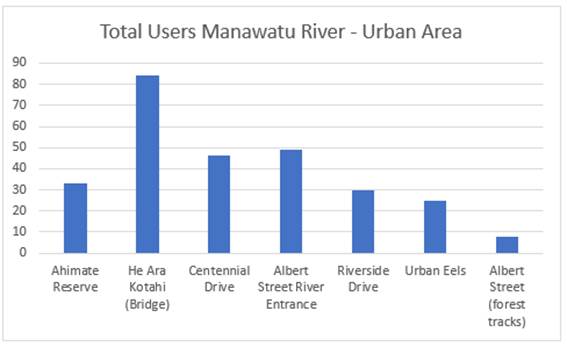
2.2 The
graph below shows the average of the counts. Albert Street came in second
overall on the average at 50 people per hour. If you assume there is an
average of 6 useable hours per day (obviously different between summer and
winter), this determines there is circa 110,000 people per year using the river
pathway past the Albert Street entrance (50 ppl x 6 hrs x 7 days x 52 weeks).
Responding to this use is a key driver behind the location choice for a new
toilet.
End of Albert Street Location
2.3 In
2016, a five-year work programme for public toilets was presented to Council to
inform the 2017 Recreation and Community Facilities Asset Management
Plan. This included the end of Albert Street as a proposed location.
2.4 The
2023 Asset Management Plan has now been revised and used to inform Programme
161 (City-wide – New Public Toilets) in the 2024/34 Long Term Plan.
2.5 The
locations for the new toilets was supported through information from our Parks
and Reserves Division.
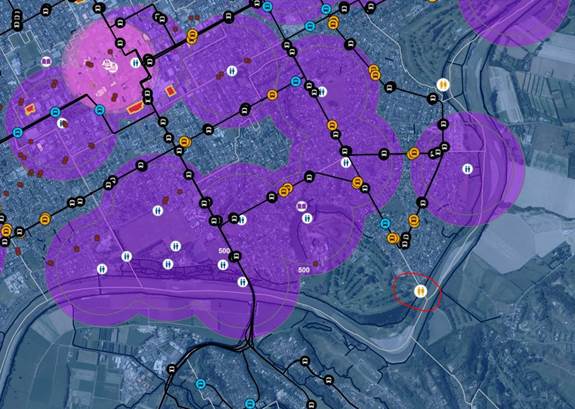
2.6 The
desirability of the end of Albert Street as a location is promoted by the below
graphic which shows the new location in between two existing facilities 500m in
either direction (the purple circles). The Albert Street location is
circled in red.
2.7 The
location at the end of Albert Street is also seen as desirable because it is:
· A popular
start-finish for walkers.
· It is close to the
adventure area which is well patronised; and
· Parking
is available during the day.
3. Description and anaylysis of options
3.1 Several
potential locations were explored and subsequently able to be discarded as
appropriate or viable options, with a preferred construction location now
determined by officers.
3.2 Given
the opposition of the residents, Council now need to consider whether to
proceed or not.
Construction Locations
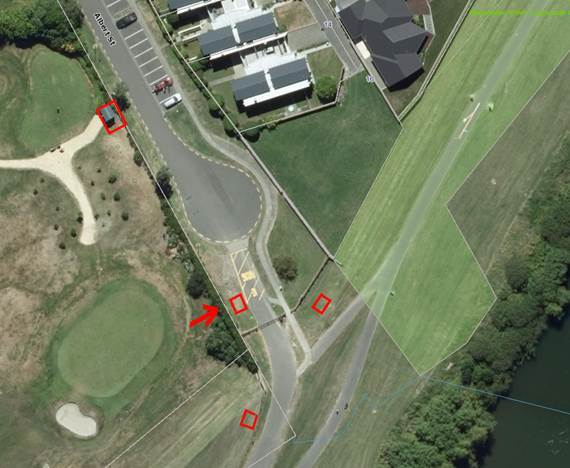
3.3 Officers
explored several locations for the proposed toilet to be built:
· Adding to the
existing private toilets within the Manawatu Golf Club
· End of Albert
Street within the road reserve at the foot of the stop bank
· On top of the stop
bank
· On the river side
of the stop bank
· Within
Waterloo park, avoiding erecting a new toilet at the end of Albert Street
altogether.
3.4 The
below aerial shows these locations in more detail with the arrow showing the
preferred location:
3.5 Resource
consenting and asset management considerations were used to determine a
preferred location. The following is a summary of the assessment of the
options in the aerial above.
· The
preferred location shown with the arrow is located within the road reserve and
is very likely to achieve a resource consent. It is also preferred from
an asset management point of view as it can be easily accessed maintenance
perspective and is less likely to incur after hours damage due to its
visibility. Also being on the city side of the stop bank means it is
unlikely to be damaged during a flood event.
· The
option located on top of the stop bank will not get a resource consent, meaning
it was discarded.
· The
option on the riverside of the stop bank could be technically possible,
although unlikely to be consented, from a resource consent perspective.
Additionally, as it is on the riverside, there is an unacceptable risk of flood
damage should the river levels rise in a weather event, and has an increased
risk of afterhours damage and antisocial behaviour occurring as it is not
immediately visible being on the other side of the stop bank. This option
was subsequently not progressed further.
· The
option to come to an arrangement and expand and alter the existing facility
within the golf club land was explored. The option required Council
investing heavily into a building it did not own and required a lot of work to
create a connection to the road whilst maintaining the security to the golf
club. This option also required terms to be reached with the golf club
around a lease adding to Council’s on-going operational costs. This
option was subsequently not progressed further.
3.6 Officers
also explored the nearby Waterloo Park as this was requested in the on-site
meeting with the residents as an alternative. There are already public
toilets within Waterloo Park, although admittedly set back some distance from
the pathway, making them unobvious to the users of the river pathway.
Officers believe more toilets within the park would over-prescribe the need of
toilets at both the Park and at that entrance to the river pathway, and would
not achieve the desired outcomes around providing facilities consistently along
the pathway, especially given the distance between toilets as shown in the
graphic in 2.6.
Design
3.7 The
toilet will be a turn-key building constructed off site and transported to the
location for installation. The project will include:
· Design, consent,
construction, transportation and install of a single block of accessible public
toilet.
· A concrete pad and
landscaping to make the location suitable for construction.
· Water,
sewer, and power connections.
3.8 Please
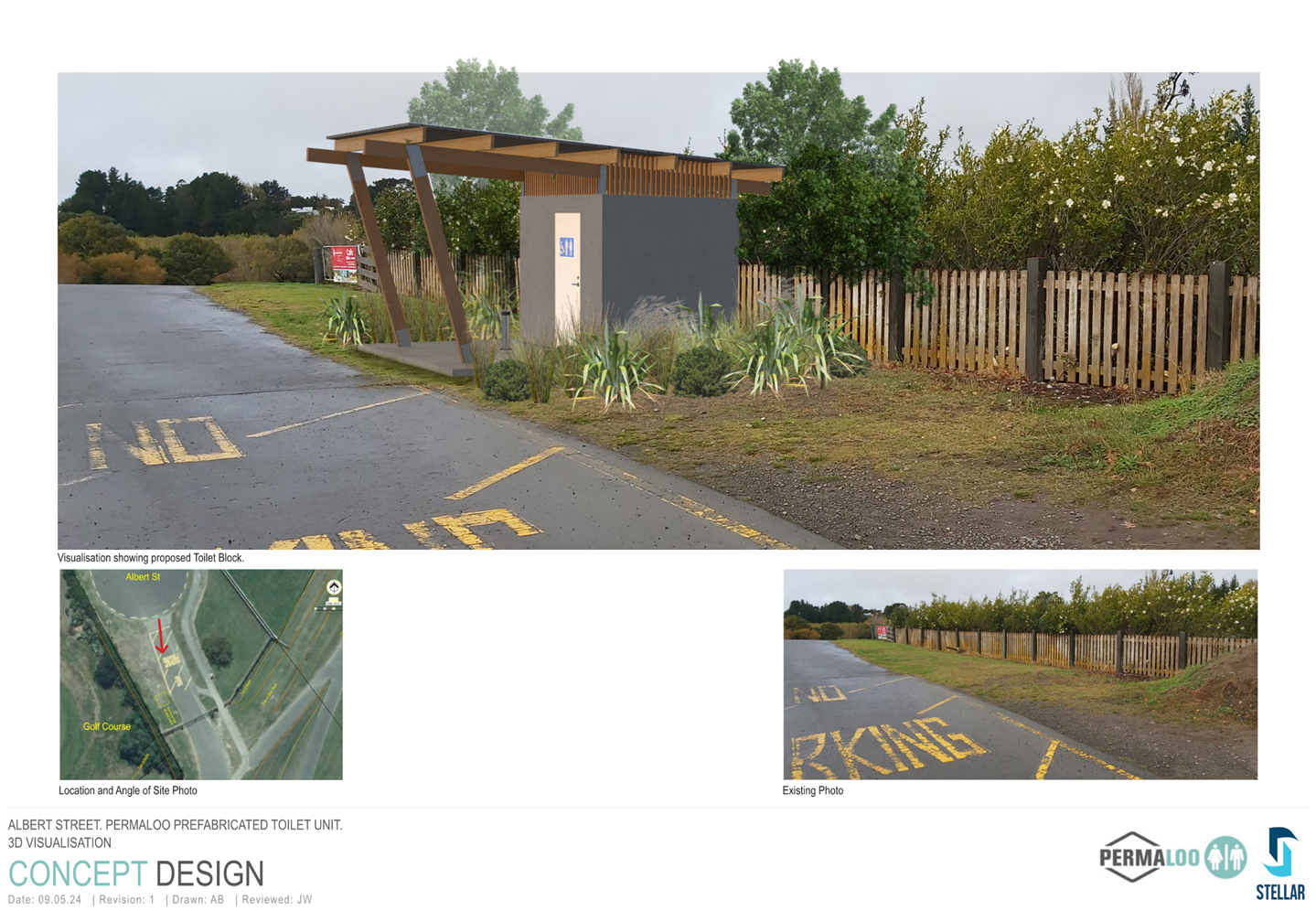
refer to Appendix 1 for a visual concept of the toilet when it is in place.
Financial
3.9 There
are two main suppliers for turn-key public toilets in the region. Costs
were obtained by both suppliers and the construction cost of the preferred
supplier for this project was $215K.
3.10 A
breakdown of the total project cost is as follows:
|
Item
|
Cost
(excl. GST)
|
|
Construction and Installation
|
$165K
|
|
Design, Consenting, and
Connections
|
$50K
|
|
Total
Construction Costs
|
$215K
|
|
Project Management Costs
|
$26K
|
|
Contingency (25%)
|
$41K
|
|
Total
Project Cost
|
$282K
|
4. Conclusion
4.1 To
meet public demand for a toilet option at the Albert Street River entrance, a
single pan public toilet is proposed for the end of Albert Street within the
road reserve as it will be visible from their respective properties.
4.2 Whilst
officers have sought to alleviate the residents’ concerns, there remains
strong opposition to the toilet being constructed in a location where it can be
seen from their houses.
4.3 Given
this strong opposition, officers wanted to bring a report to the Committee for
a decision as to whether to proceed with the proposed toilet, before lodging
for consent.
5. Next actions
5.1 If
Council decide to proceed with the toilet in the preferred location, designs
will be advanced and lodged for consent before eventual construction towards
the end of 2024.
6. Outline of community engagement process
6.1 Initial
contact was received from the group of residents at the end of Albert Street on
15 November 2023. An on-site meeting was then held between the residents
and officers on 28 November to hear the concerns in more detail.
6.2 A
response to the questions and concerns was provided on 21 December 2023 which
provided the residents with most of the information contained within this
report. The action from this correspondence was for officers to work the
different location options and report back to the residents. This
occurred on 10 April 2024, along with providing the concept designs in Appendix
1 of this report.
6.3 Subsequently
the project was deferred to allow this report to be brought to the Community
Committee for a decision.
7.
Compliance and administration
|
Does the Committee have
delegated authority to decide?
|
No
|
|
Are the decisions significant?
|
No
|
|
If they are significant do, they
affect land or a body of water?
|
No
|
|
Can this decision only be made
through a 10 Year Plan?
|
No
|
|
Does this decision require
consultation through the Special Consultative procedure?
|
No
|
|
Is there funding in the current
Annual Plan for these actions?
|
Yes
|
|
Are the recommendations inconsistent
with any of Council’s policies or plans?
|
No
|
|
|
|
|
The recommendations contribute
to:
Whāinga 3: He hapori
tūhonohono, he hapori haumaru
Goal 3: A connected and safe
community
|
|
The
recommendations contribute to the achievement of the objective
in:
7.
Mahere tautāwhi hapori
7. Community Support Plan
The objective is: Provide
gender-neutral and accessible public toilets throughout the city.
|
|
Contribution to strategic direction
and to social, economic, environmental, and cultural well-being.
|
Constructing new public
toilets at the end of Albert Street will ensure there are clean, accessible
and gender-neutral public toilets provided throughout the city.
New toilets are developed in
the most popular locations to meet demand of the public.
|
|
|
|
Attachments
|
1.
|
Albert
Street Toilet Visual Concept ⇩ 
|
|
Report
TO: Community
Committee
MEETING DATE: 28
August 2024
TITLE: Approval
to consult on the draft Health Promotion Policy (Healthy Beverages, Smoke-free
and Vape-free, and Sun Protection).
PRESENTED BY: Lili
Kato Policy Analyst
APPROVED BY: David
Murphy, General Manager Strategic Planning
RECOMMENDATION TO
COMMUNITY COMMITTEE
1. That the
Committee approve the draft Health Promotion Policy (Healthy Beverages,
Smoke-free and Vape-free, and Sun Protection) for consultation.
Summary of options analysis for the
draft health promotion policy (healthy beverages, smoke-free and vape-free, and
sun protection).
|
Problem
or Opportunity
|
The
Sun Protection Policy is due for review. As part of the review staff looked
at the possibility of combining the Sun Protection Policy with the Healthy
Beverages Policy and the Smoke-free and Vape-free Outdoor Areas Policy. All
three policies seek to promote the health of the community by encouraging
behaviour change in settings that Council has influence or control over, for
example Council-controlled public places or facilities. The policy review
offers an opportunity to combine the approach.
|
|
OPTION 1:
|
Approve
the draft Health Promotion Policy (Healthy Beverages, Smoke-free and
Vape-free, and Sun Protection), for consultation.
|
|
Community Views
|
Wider community views
are yet to be sought but engagement with Council partner Rangitāne o
Manawatū and stakeholders including Cancer Society, Te Tihi, and Te
Whatu Ora have been incorporated in the draft Policy.
|
|
Benefits
|
Another step towards
completing the policy review in line with the policy framework requirements.
Improvements to the
Policy are proposed and the community will have the opportunity to provide
feedback on these.
|
|
Risks
|
None identified.
|
|
Financial
|
None identified.
|
|
OPTION 2:
|
Don’t approve the draft Health
Promotion Policy (Healthy Beverages, Smoke-free and Vape-free, and Sun Protection),
for consultation.
|
|
Community Views
|
Wider community views
are yet to be sought but engagement with Council partner Rangitāne o
Manawatū and stakeholders including Cancer Society, Te Tihi, and Te
Whatu Ora have been incorporated in the draft Policy.
|
|
Benefits
|
None identified.
|
|
Risks
|
Lost opportunity to
improve the current policies. The Sun Protection Policy has yet to undergo a
review since it was adopted in 2010. This is also the case for the Healthy
Beverages Policy which was adopted in 2017. The Smoke-free and Vape-free
Outdoor Areas Policy had its last review in 2020 and is due for another one.
|
|
Financial
|
None identified.
|
Rationale for the recommendations
1. Overview of the problem or opportunity
1.1 The
Sun Protection Policy is due for review. It was first adopted in 2010 and this
is the first review of the Policy. Staff also took the opportunity to review
the Healthy Beverages (adopted in 2017) and the Auahi Kore Smoke-free and
Vape-free Outdoor Areas (first adopted in 2013) Policies. The Healthy Beverages
Policy has yet to be reviewed since it was adopted and the Auahi Kore
Smoke-free and Vape-free Outdoor Areas Policy was last reviewed in 2020 and is
due for review.
1.2 All
three current policies seek to promote the health of the community by
encouraging behaviour change in settings where the Council has influence or
control, such as in Council-controlled public places, facilities, and events.
1.3 All
three current policies contribute to improving health issues that are prevalent
within the community. These include:
· Melanoma
and skin cancers caused by sun exposure.
· Premature
and preventable death and morbidity from tobacco smoking.
· Diabetes,
unwanted weight gain, and tooth decay in children, from a high sugar diet.
1.4 The
‘social determinants of health’ weave a complex web around
individuals and communities, therefore better health outcomes are a complex
system-wide concern that requires systemic, multi-level solutions that are not
limited to the health sector[1].
Council has no formal role in health service delivery; however it does have an
important role in creating and encouraging conditions that help build healthy
communities.
1.5 Council
owns and/or administers land and facilities that are available for public use
and enjoyment. Council is also an event provider in the City, and therefore, it
has direct control on how these places and events are managed in a way that
reflects community values and expectations.
1.6 Staff
propose to combine the Sun Protection, Healthy Beverages and Smoke-free and
Vape-free Policies together because of their similarities in policy objectives,
outcomes, and guidelines.
1.7 Elected
members participated in a workshop to discuss the three policies in March 2024.
2. Background and previous council decisions
2.1 The
following is an outline of the purpose, year of adoption and review of
Council’s health promotion policies:
|
Name of policy
|
Purpose
|
Year of initial adoption
|
Year/s reviewed
|
|
Auahi
Kore Smoke-free and Vape-free Outdoor Areas
|
To encourage residents and
visitors to Palmerston North to be smoke-free and vape-free in public spaces.
|
2013
|
2015
2020
|
|
Healthy
Beverages
|
To encourage healthy beverage
choices to contribute to improved health and model good health behaviours for
the wider community.
|
2017
|
None
|
|
Sun
Protection
|
To contribute to a reduction
in the incidence of skin cancer by improving shade and other sun protection
measures throughout the City.
|
2010
|
None
|
2.2 The
Oranga Papaioea City Strategy, recently adopted as part of the Long-Term Plan
2024-34, provides the strategic direction for this Policy.
This proposed Policy will contribute in particular to these
community wellbeing goals and outcomes:
Whāinga 2: He tāone whakaihiihi, tapatapahi ana
Goal 2: A creative and exciting city;
We want our communities to have:
o a
vibrant city that connects people, and where creativity is built into our
cityscape; and
o access
to exciting well-managed events and activities throughout the city and our
neighbourhoods.
Whāinga 3:
He hapori tūhonohono, he hapori haumaru
Goal 3: A connected and safe community
We want our communities to have:
o access
to services and facilities that are inclusive and appropriate for their needs;
o the
support they want to live healthy lives; and
o access
to safe and accessible community places.
2.3 The
purpose statement in the following plans are most relevant to this Policy
review:
|
Arts plan
|
Urban design plan
|
Community safety and
health plan
|
Community support plan
|
|
To
achieve our purpose we will:
1. Provide,
fund and support city and community events.
|
To
achieve our purpose we will:
1. Maintain
and promote a well-connected and well-designed urban environment.
2. Provide
and promote connected sustainable, accessible, safe, interesting, and playful
public spaces.
|
To
achieve our purpose we will:
1. Promote
community health.
2. Co-ordinate
and support community safety and harm reduction initiatives.
|
To
achieve our purpose we will:
1. Provide
and support community centres, Youth Space and Hancock Community House.
|
Auahi Kore Smoke-free and
Vape-free Outdoor Areas Policy
2.4 This
policy takes an educative non-punitive approach to raising awareness about the
harm of smoking and vaping. Council uses signs as the main mechanism to raise
awareness of the smoke-free and vape-free environment. In 2020 the Policy
was widened to include vape-free which meant that the outdoor areas Council
designated as smoke-free became vape-free also.
2.5 Awareness
is also raised through an annual campaign which is led by the smoke-free and
vape-free reference group and timed around World Smoke-free Day on 31 May.
Social media platforms are used to remind the community about the commitment to
a smoke-free and vape-free environment. The annual campaigns are well received,
and most of the engagement is positive. However, Council also receives feedback
from the public that there are people who continue to smoke and vape at parks,
playgrounds, and other outdoor public places.
2.6 Tobacco
smoking is the most significant cause of premature and preventable death and
morbidity in Aotearoa NZ. It is the key driver of inequities in health outcomes
for Māori and Pacific people[2].
2.7 The
latest prevalence data in the New
Zealand Health Survey 2022/2023 shows that daily smoking rates is
continuing to track downwards. The percentage of daily adult smokers (age 15
years and older) is 6.8%, down from 8.6% in the 2021/2022 year. There has been
a decline over time in daily smoking for all ethnic groups, however inequities
remain. Smoking rates among Māori are higher than rates
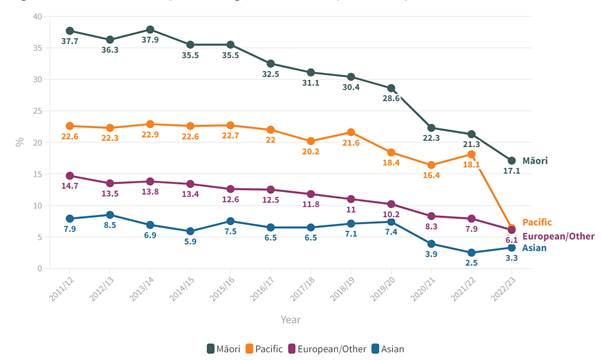
in other ethnicities as shown in Figure 1 below. Daily smoking rates for
Māori adults in 2022/2023 are 17.1%, down from 21.3% in 2021/2022[3].
Figure 1: Trends in daily smoking
prevalence by ethnicity from the New Zealand Health Survey 2022/23[4]
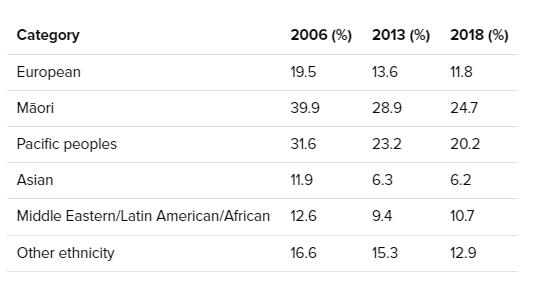
2.8 Table
1 below shows census data from 2006 to 2018 for Palmerston North, indicating
the percentage of those who reported being regular smokers by ethnicity.
Māori and Pacific Peoples continue to have the highest percentage of
regular smokers in the city[5].
Table 1: Regular smokers, by ethnic group,
for people in Palmerston North City, 2006-2018 Censuses[6]
2.9 The
latest prevalence data in the New Zealand Health Survey 2022/2023 shows that
more New Zealanders than ever are vaping. The increase in recent years was
particularly marked among younger age groups, Māori and Pacific peoples,
and people living in the most deprived neighbourhoods. The percentage of daily
adult (age 15 years and older) vapers is 9.7%, up from 8.4% in 2021/2022. Daily
vaping prevalence among 15-17 year olds almost doubled between 2021/2022 and
2022/23 from 8.3% to 15.4%.
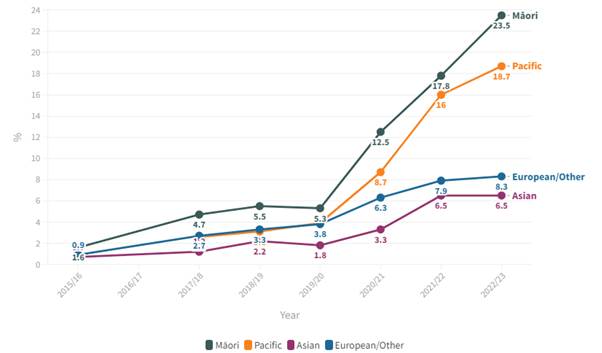
2.10 The
increase in daily vaping has been much greater among Māori and Pacific
people as shown in Figure 2[7].
Figure 2: Trends in daily vaping by
ethnicity from the New Zealand Health Survey 2022/23[8]
2.11 In May
this year Council, in collaboration with Te Whatu Ora, Cancer Society and
Whaiora Trust, ran a vaping awareness programme targeting youth. It was held at
Youth Space and was well attended by young people. At this event feedback about
youth vaping was sought from youth. Participating youth were asked “why
do you think vaping is appealing to some young people?”. Most of the
responses was in relation to peer pressure and trying to fit in and “be
cool”. Others said the different flavours/ taste/ and the effect the vape
had on the individual, for example “head spins”. Several young
people also said it gives relief and helps with stress, and “to get
through stuff that nobody knows about”. Others said it was because young
people think it is not harmful or better than cigarettes.
2.12 When asked
what they thought the Council could do to support young people in becoming
vape-free, many identified educational methods, such as talking with youth
about what vapes contain and the effects they have on the body. One person
suggested cracking down on dairies that sell to underage kids, while another recommended
that youth should be required to show identification (we assume this meant when
purchasing vapes). A couple of respondents mentioned that counselling should be
provided and that safe spaces, like Youth Space, should be available. Some
suggested a complete ban on vapes, while others suggested alternative methods
to help quit, such as offering lollies or Hā Habit tools (a breathing
device). One person was convinced that the Council could not do anything, while
another believed that any solution should be youth-centred and led, for
example, through the Youth Council. Another person thought the focus should be
on the vaper’s choice, not on Council intervention.
2.13 Staff also
sought feedback from the Smoke-free and Vape-free reference group members (Cancer
Society and Te Whatu Ora) about their thoughts of combining Council’s
Smoke-free and Vape-free Outdoor Areas Policy with the Healthy Beverages Policy
and Sun Protection Policy. Both organisations expressed support for this and
felt it was a natural fit.
Healthy Beverage Policy
2.14 This
Policy sets controls by restricting the sale of sugar-sweetened beverages
(SSBs), where possible, in some Council controlled facilities and events. The
Policy promotes alternatives to SSBs which include water, 100% fruit juice,
unsweetened milk, artificially sweetened carbonated drinks; and zero sugar
carbonated drinks.
2.15 The
implementation of this Policy has been heavily reliant on its socialisation
throughout the organisation. The Policy considers instances where Council’s
control in facilities or events has been limited by terms of a current
contract. In those instances, the Policy provides a voluntary option, with a
view to gradually phasing out the sale of SSBs across Council facilities and
events.
2.16 Since the
Policy has been in place the Central Energy Trust Arena, Palmerston North
Conference and Function Centre, and Civil Administration Building have phased
out the sale of SSBs and replaced them with the Policy’s recommended
beverages. Staff have reported that they do receive some negative feedback from
the public, about not having the choice to purchase SSBs particularly at the
Central Energy Trust Arena. Some people also question the restriction on SSBs
when alcohol and other items with maybe a higher level of sugar are available
for purchase.
2.17 In terms
of implementing the Policy at Council funded events and functions, the Policy
takes a lenient approach requiring “reasonable steps to prevent the sale
of SSBs”. This perhaps has contributed to less consistency in
implementation particularly for those events that are delivered by third
parties who have received funding from Council. Staff have requested that
the definition of ‘events’ needs further clarification and have
pointed out that the current definition cover a broad range of events, many of
which Council has no direct control over.
2.18 Staff also
sought feedback from Council Controlled Organisations (CCO) including Globe
Theatre, Te Manawa and The Regent Theatre. The Regent Theatre was the only CCO
to respond and was supportive of the Healthy Beverages Policy, and the
possibility of combining Council’s health policies. They could see the
Regent progressing towards phasing out SSBs as they have full control of the
drinks that are sold at the Regent. However, they did want some time to
consider the full impact as the proceeds from sales currently go towards the
maintenance of the building.
2.19 Currently
there are no educational or awareness activities by Council to raise awareness
of the Policy and its objectives. There are no resources allocated to
this activity at present.
2.20 On
average, people in Aotearoa consume 37 teaspoons of sugar per day in food they
eat and in what they drink. Toi Te Ora – Public Health advise adults
should consume no more than 6 teaspoons of sugar per day, and children no more
than 3 to 4 teaspoons per day[9].
2.21 A 2019
study by Auckland University found that compared to sugar in solid food, sugar
in drinks carries a greater risk of causing harmful metabolic changes that lead
to chronic illnesses such as obesity diabetes. This is due to concentration
with which sugar is metabolised when consumed in liquid rather than solid form[10].
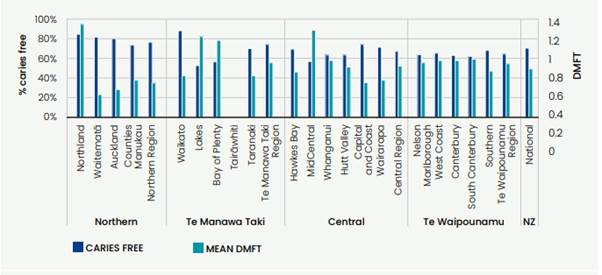
2.22 Figure 3
is taken from the New Zealand Health Status Report 2023, it shows the oral
health status for year 8 children by district in 2021. The Midcentral district
(which includes Palmerston North) had the highest mean of children with
decayed, missing or filled teeth (DMFT) in the central region. Midcentral also
had the second highest mean for DMFT compared to all other districts nationally[11].
Figure 3: Oral health status, year 8 by
district, 2021[12]
Sun Protection Policy
2.23 The
current Policy seeks to influence key functions and roles held by Council to
increase the provision of shade and other sun protection measures within the
city. This is mainly through Council’s function as a consent authority
and provider of parks, recreational facilities, and events.
2.24 Like the
Healthy Beverages Policy, the Sun Protection Policy has been heavily reliant on
being consistently socialised throughout the organisation. The Policy has been
more embedded in the delivery of parks and reserves compared to its influence
in the District Plan and planning processes. Which means the potential for
Council to extend its reach in terms of influence to those designing and
implementing the built environment beyond Council has been limited. Council has
been intentional about increasing shade in parks and reserves and has provided
resourcing for a tree planting programme and providing shade structures. The
shade audit which the implementing staff complete every three years or so helps
to inform the forward planning for tree planting.
2.25 Staff
report that it has been difficult to provide consistent sun protection measures
for events as the delivery of these measures at events has not been properly
considered in resourcing. They have also found that it is difficult to
implement the policy guideline to plan community events to occur outside the
hours of 11am – 4pm.
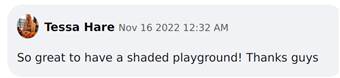
2.26 Staff also
report that the adequacy of shade is often highlighted by the community when
new community facilities are finished and open for public enjoyment. Some
comments on Council’s social media platforms have been included below:
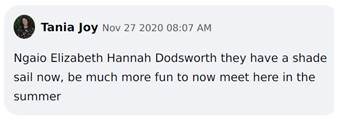
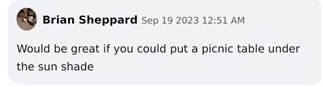
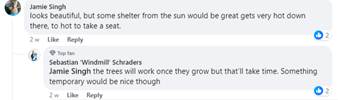
2.27 Over
exposure to UV rays can increase a person’s likelihood of developing
melanoma or other skin cancers[13].
2.28 In
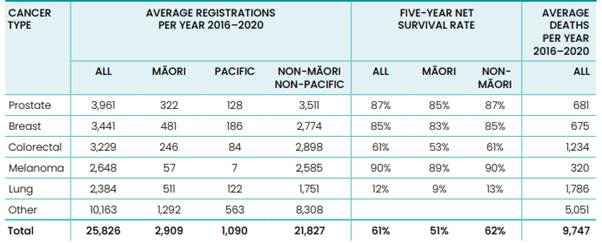
Aotearoa New Zealand 47% of cancer deaths are caused by lung, colorectal,
breast, prostate cancer and melanoma. Under the New Zealand Cancer registry,
the most commonly registered cancers were breast, prostate, colorectal,
melanoma and lung as shown in the table below (which was published in the New
Zealand Health Status Report 2023.
Table 2: Most common causes of cancer registrations by
ethnicity, five years 2016-2020 and five-year net survival rates for 2013/14
registrations[14]
Workshop with Elected
Members
2.29 On 27
March 2024 a workshop with elected members was held to seek their feedback on
Council’s health policies, particularly in regard to combining all three
policies into one.
2.30 Following
the workshop, officers’ understanding was that there was general support
for each of the health promotion policies; however, there was a variance in
views regarding the extent and focus of the Council's role in contributing to
health promotion objectives. For example, some elected members believed that education
is key to helping the community make informed choices, while others thought
this was not the Council's role. Opinions differed on finding the right balance
in terms of the Council's leverage. Some felt that removing options (e.g., not
selling sugary soft drinks in Council facilities) was an appropriate use of the
Council's leverage, while others believed that restricting options (e.g.,
limiting the sale of sugary soft drinks at events) was outside the Council's
mandate. They strongly felt that the Council should not dictate choices but
rather allow people to decide for themselves.
2.31 Feedback
was also sought regarding combining all three health promotion policies. Views
on this were divided, some were supportive of having a combined policy as a package,
others thought that a combined policy may open the debate on other things that
could or should be included.
2.32 Elected
members views, and the views of those we engaged with, were taken into account
when drafting the draft Health Promotion Policy (Healthy Beverages, Smoke-free
and Vape-free, and Sun Protection).
2.33 This
report and options analysis provides an opportunity for elected members to
formally consider the policy issues in each of these areas.
3. Description of options
3.1 The
primary purpose of this report is to present the Committee with a draft Health
Promotion Policy (Healthy Beverages, Smoke-free and Vape-free, and Sun
Protection), and to seek approval to publicly consult on this draft. The
options are approving the draft Policy for public consultation, or not to
approve the draft for public consultation.
4. Analysis of options
Option 1: Approve the
draft Health Promotion Policy (Healthy Beverages, Smoke-free and Vape-free, and
Sun Protection) (recommended).
4.1 Option
1 is the next step in this policy review process. It will give the public the
opportunity to provide feedback on the suggested changes to the Policy which
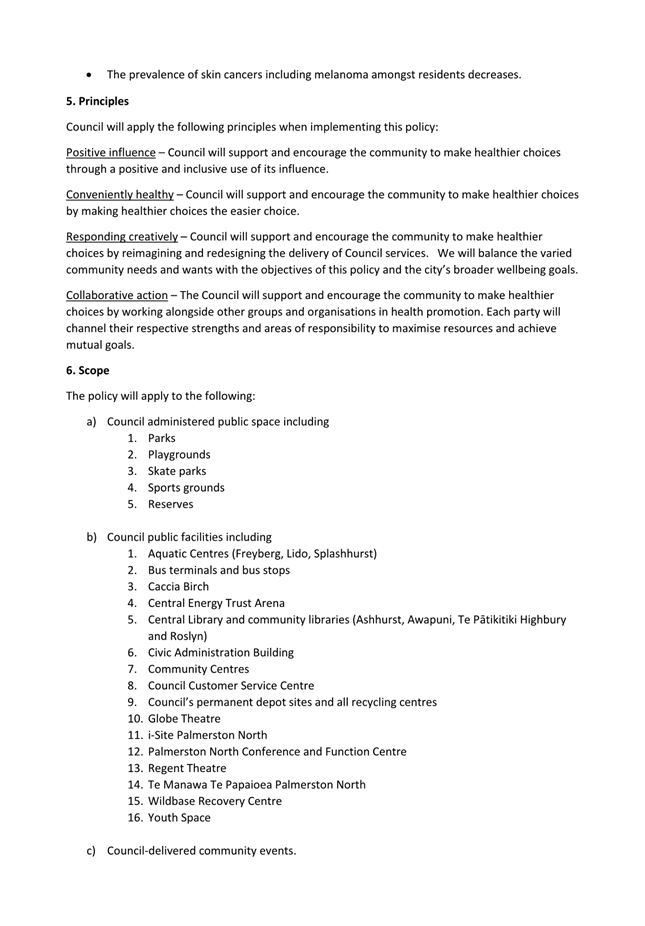
are outlined as follows:
One combined Health
Promotion Policy:
4.2 We
propose that the Healthy Beverages, Smoke-free and Vape-free Outdoor Areas and
Sun Protection Policies be combined into one policy titled the Health Promotion
Policy (Healthy Beverages, Smoke-free and Vape-free, and Sun Protection). The
proposed Policy retains the same elements of each current policy. The
advantages of combining these policies are as follows:
o Provides
a neat package that describes all the elements of Council’s approach to
health promotion.
o More
consistent oversight across all three health promotion areas, in terms of
implementation. There will be fewer opportunity for policies to get lost or
overlooked amongst implementation areas and staff changes.
o More
opportunity for consistent review of the Policy to ensure responsiveness to
community needs and expectations.
Definition of events:
4.3 There
has been some confusion in the past in terms of which events the current
policies apply to. The proposed Policy attempts to bring more clarity by using
terms that are familiar to the operational staff and targeting those events
that are intended to be captured by the proposed Policy. ‘Council
delivered community events’, are those events that are directly delivered
by Council for the community. This means that Council has direct control over
the delivery from planning to implementation.
Smoke-free and Vape-free
signs in te reo Māori:
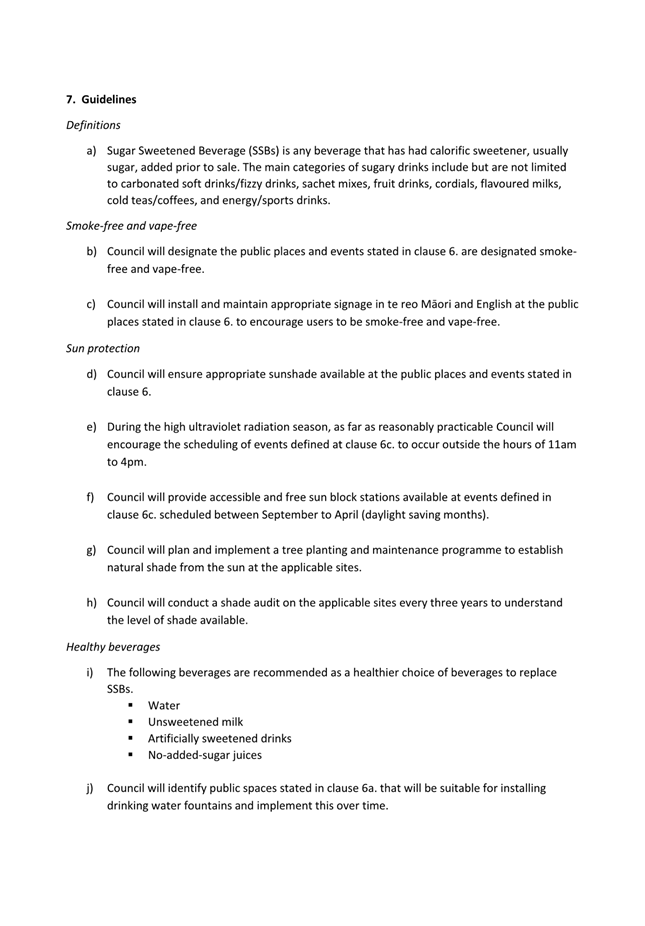
4.4 The
proposed Policy makes it compulsory for smoke-free and vape-free signage to be
in Te Reo Māori and English. This currently happens in practice, and the
proposed Policy will be updated to reflect this practice.
Requirement for sun block
stations at events:
4.5 The
proposed Policy makes it a requirement for sun block stations to be available
at Council delivered community events, scheduled between September to April
(daylight saving months). This currently happens at some Council delivered
community events, but the provision is not consistent due to a lack of
resourcing. Given that the definition of events has been tightened in the
proposed Policy this gives staff greater clarity and the ability to plan
resourcing to meet this requirement.
Extend list of Council
facilities where SSB is not to be sold:
4.6 The
current Healthy Beverages Policy mostly encourages voluntary compliance in
stopping the sale of SSBs at some Council facilities. This was in recognition
of the existing contracts Council had in place at the time of adoption.
However, the intention to phase out the sale of SSBs is clear in the current
Policy and will be actioned when contracts come up for review. Central Energy
Trust Arena, Palmerston North Conference and Function Centre and the Civil
Administration Building have all ceased the sale of SSBs and have replaced
these with the recommended beverages in the Policy. Therefore, we propose to
extend the list of Council facilities where SSBs will not be sold to include
the following:
· Bus
terminals and bus stops
· Caccia
Birch
· Central
Energy Trust Arena
· Civic
Administration Building
· Council
Customer Service Centre
· I-Site
Palmerston North
· Palmerston
North Conference and Function Centre
· Wildbase
Recovery Centre
· Youth
Space
Most
of these facilities do not have SSBs for sale, and therefore there will be very
little operational impact in implementing this Policy. I-Site currently sells
SSBs along with some of the recommended beverages in the Healthy Beverages
Policy. Staff report that of all the drinks they supply SSBs sell the most,
however because their supply stock is small the impact on removing them will be
minimal.
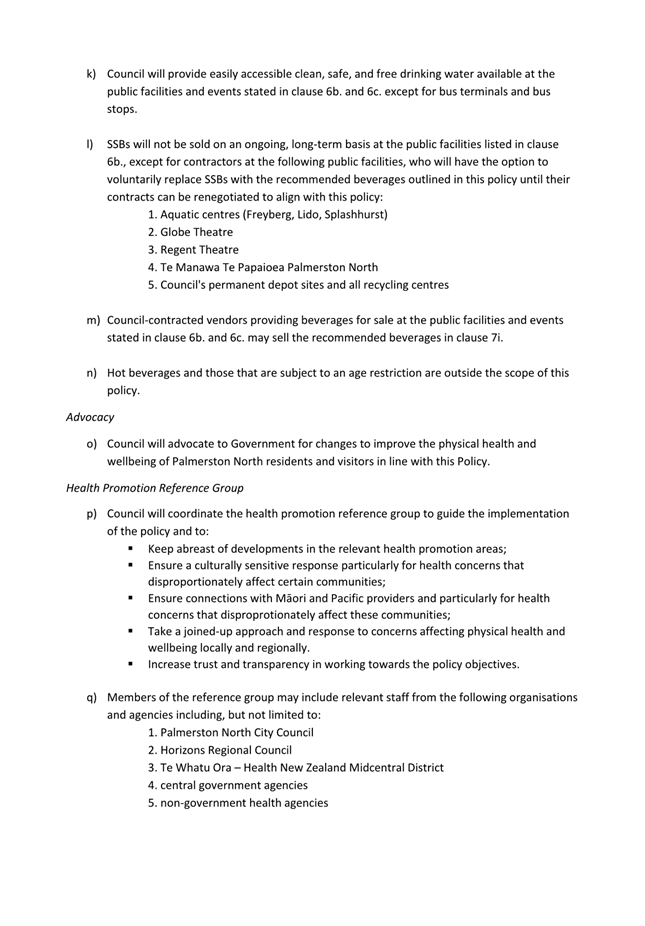
4.7 The
proposed Policy continues voluntary compliance in selling SSBs for the
following facilities – Aquatic centres (Freyberg, Lido, Splashhurt),
Globe Theatre, Regent Theatre, Te Manawa Te Papaioea Palmerston North and
Council’s permanent depot sites and recycling centres. This is due
to existing contracts and arrangements that prevent these facilities from restricting
the sale of SSBs at this time. The proposed Policy does make it clear that when
contracts come up for renewal that restricting the sale of SSBs is considered
in contract negotiations.
Requirement for free
drinking water
4.8 One
of the objectives of the Healthy Beverages Policy is to make water the
preferred beverage of choice at public places and events. Providing free
drinking water is another step toward achieving this objective. The proposed
Policy requires the installation of drinking fountains in suitable public
spaces, as well as the provision of free, accessible, and safe drinking water
in Council facilities. There is currently an operational programme to install
water fountains in some parks, playgrounds, and sports fields, so this requirement
aligns with what is already being practiced. Many of the public facilities
listed in the proposed Policy already provide free, accessible, and safe
drinking water. Therefore the impact on operations should be minimal.
Health promotion reference
group
4.9 There
is currently a Smoke-free and Vape-free Reference Group established under the
Smoke-free and Vape-free Outdoors Areas Policy. The proposed Policy seeks to
extend this to a Health Promotion Reference Group, to incorporate the focus on
healthy beverages and sun protection. Currently the organisations (outside of
Council) that are part of the smoke-free and vape-free reference group have
wider health promotion interests than just Smoke-free and Vape-free, and
therefore a widening of the mandate will be welcomed by members (as they
indicated in our engagement with them).
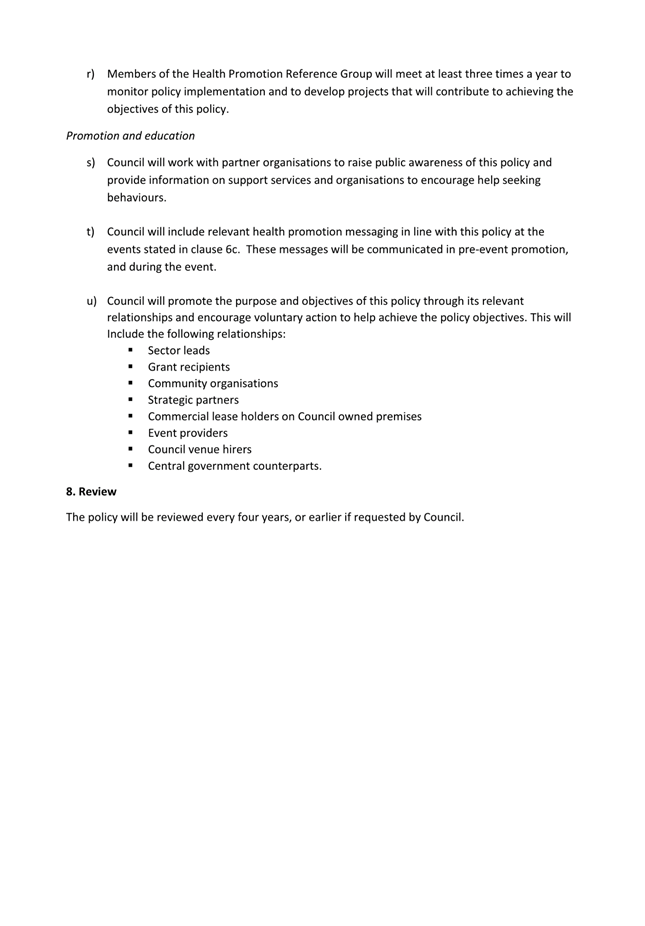
Awareness campaigns
4.10 The
proposed Policy introduces a requirement to raise public awareness of the
Policy. This is something that is currently done regularly with the Smoke-free and
Vape-free Outdoor Areas Policy, which has been made possible because $5,000 per
year is allocated towards achieving the objectives of the Policy. The Healthy
Beverages Policy and Sun Protection Policy, on the other hand, does not enjoy
the same kind of exposure because there is no resourcing dedicated to this.
Therefore, we propose that raising awareness of the Policy is a requirement to
bring some consistency and awareness to all of Council’s health promotion
focus areas. In terms of operational impact, there may need to be future
consideration of resourcing for this element of the proposed Policy.
Option 2: Don’t
approve the draft Health Promotion Policy (Healthy Beverages, Smoke-free and
Vape-free, and Sun Protection, for consultation.
4.11 Choosing this
option will mean that work on this policy review will come to an end. The
existing policies will continue to be in effect. The proposed improvements to
these policies will be lost and the community will not have the chance to
provide feedback on them. This option is not recommended.
5. Conclusion
5.1 We
recommend approving the draft Health Promotion Policy (Healthy Beverages,
Smoke-free and Vape-free, and Sun Protection, for consultation (option 1). This
will allow the process of reviewing the Policy to proceed and be adopted by
February 2025. Formal consultation will provide the opportunity to
receive submissions on the proposal.
6. Next actions
6.1 If
Council approves the draft Policy for public consultation, then the
consultation material will be finalised for publication and the consultation
process will begin.
6.2 A
consultation plan will be developed and implemented providing opportunities for
feedback on the proposal.
6.3 The
proposed consultation period will run from a month over September and October
2024. The hearing of submissions is planned for December 2024. A
final report, with staff advice on the issues raised by submitters and
recommendations on proposed changes to the draft Policy, will be presented to
Committee in February 2025.
7. Outline of community engagement process
7.1 Initial
engagement has been carried out with the Council’s partner Rangitāne
o Manawatū and the following external stakeholders:
· Cancer
Society
· Te
Tihi
· Te
Whatu Ora
· The
Regent Theatre
7.2 Consultation
will seek to engage the following stakeholders:
· Community
Organisations
· Event
organisers
· Representative
bodies for health and nutrition
· Users
of public spaces and facilities
7.3 Consultation
will consist of the following means:
· Workshops
· One
to one interview
· Drop
in sessions
· Survey
· Social
media collateral
· Website
collateral
· Print
media notices
· Network
newsletter notices
8. Compliance and administration
|
Does the Committee have
delegated authority to decide?
|
Yes
|
|
Are the decisions significant?
|
No
|
|
If they are significant do they
affect land or a body of water?
|
No
|
|
Can this decision only be made
through a 10 Year Plan?
|
No
|
|
Does this decision require
consultation through the Special Consultative procedure?
|
No
|
|
Is there funding in the current Annual
Plan for these actions?
|
Yes
|
|
Are the recommendations
inconsistent with any of Council’s policies or plans?
|
No
|
|
The recommendations contribute
to:
Whāinga 2: He tāone
whakaihiihi, tapatapahi ana
Goal 2: A creative and
exciting cityWhāinga 3: He hapori tūhonohono, he hapori haumaru
Goal 3: A connected and safe
community
|
|
The
recommendations contribute to the achievement of objectives
in:
1.
Mahere hoahoa tāone
1. Urban Design Plan
- Apply urban design best
practice to all city planning and development
- Provide best-practice urban
design guidance to resource consent applicants, developers and designers
- Urban design plan objectives
are included and planned for in all city development
Provide and facilitate a
co-ordinated calendar of accessible and sustainably managed city and
community events
|
|
Contribution to strategic
direction and to social, economic, environmental and cultural well-being
|
The recommendation will
contribute to the public providing feedback on how well Council has been
promoting Auahi Kore Smokefree and Vapefree City. It will also contribute to
increasing sun protection at events and public spaces. Lastly it will
contribute to widening the mandate to work with public health partners to
promote community health initiatives and programmes.
|
|
|
|
Attachments
|
1.
|
Draft
Health Promotion Policy (Healthy Beverages, Smoke-free and Vape-free, and Sun
Protection). ⇩
|
|
Palmerston North City Council
Minutes of
the Community Committee Meeting Part I Public, held in the Council Chamber,
First Floor, Civic Administration Building, 32 The Square, Palmerston North on 20 March 2024,
commencing at 9.02am
|
Members
Present:
|
Councillors Lorna Johnson (in the Chair),
and Councillors Patrick Handcock, Brent Barrett, Rachel Bowen, Lew Findlay,
Billy Meehan, Orphée Mickalad, Karen Naylor, William Wood and Kaydee
Zabelin.
|
|
Non Members:
|
Councillors Vaughan Dennison, Roly
Fitzgerald and Leonie Hapeta.
|
|
Apologies:
|
The Mayor (Grant Smith) (on Council business), Councillors
Rachel Bowen and Patrick Handcock (early departure on Council business).
|
Councillor Vaughan Dennison left the
meeting at 9.05am during consideration of clause 1. He entered the meeting again at 10.17am when it resumed. He was not present when the meeting resumed
at 1.00pm. He entered the meeting again at 2.07pm during consideration of
clause 12. He was not present for clauses 2, 3, 9, 10 and 11.
Councillors Rachel
Bowen, Patrick Handcock and Roly Fitzgerald left the meeting at 10.53am during
consideration of clause 5. They were not present for
clauses 5 to 12 inclusive.
Councillor
Leonie Hapeta left the meeting at 11.33am during consideration of
clause 7. She was not present for clauses 7 to 12 inclusive.
|
|
Karakia
Timatanga
|
|
|
Councillor
Lorna Johnson opened the meeting with karakia.
|
|
1-24
|
Apologies
|
|
|
Moved Lorna Johnson, seconded Karen Naylor.
The
COMMITTEE RESOLVED
1. That
the Committee receive the apologies.
|
|
|
Clause 1-24 above was carried 13 votes to 0, the voting being as
follows:
For:
Councillors Lorna Johnson,
Patrick Handcock, Brent Barrett, Rachel Bowen, Lew Findlay, Billy Meehan,
Orphée Mickalad, Karen Naylor, William Wood, Kaydee Zabelin, Vaughan
Dennison, Roly Fitzgerald and Leonie Hapeta.
|
Councillor
Vaughan Dennison left the meeting at 9.05am.
|
2-24
|
Presentation:
Youthline
Shane Casey, CEO
Youthline Central North Island Inc. spoke about the organisation and
operational coverage including funding opportunities, major challenges and
impacts they are making with youth. He tabled further information that
was presented to Elected Members (PowerPoint), as appended to these Minutes,
and made the following additional comments:
· To
seek further corporate sponsorship they are required to gain permission from
their principle sponsor first.
· The
issues the youth are dealing with can be traumatic hence they need to deal
with these sensitively when communicating the work they do with stakeholders
and the public.
· Currently
working with outside education providers in order to get placement for
students in the Manawatū.
· There
are no resources to spare for them to strategize across the sector and work
on how to overcome their challenges.
· Encourages
the work around Youth Development Strategy from other stakeholders to keep
moving.
|
|
|
Moved
Lorna Johnson, seconded Brent Barrett.
The COMMITTEE RESOLVED
1. That the Community Committee receive the
presentation for information.
|
|
|
Clause 2-24 above was
carried 12 votes to 0, the voting being as follows:
For:
Councillors Lorna Johnson,
Patrick Handcock, Brent Barrett, Rachel Bowen, Lew Findlay, Billy Meehan, Orphée
Mickalad, Karen Naylor, William Wood, Kaydee Zabelin, Roly Fitzgerald and
Leonie Hapeta.
|
|
3-24
|
Presentation:
Launch Youth Nu'u
Davis Sione, Vision Holder
for Launch Youth Nu’u spoke about the story behind the initiative, its
operational model, challenges and outcomes. He tabled further
information that was presented to Elected Members (PowerPoint), as appended
to these Minutes, and made the following additional comments:
· They
are partnering with City Mission and utilising them as a mentor.
· They
have been successful in supporting young people in getting qualifications or
working towards a trade.
· They
would like to further establish a partnership with Council.
Officers note they have
supported and will continue to support this initiative with information and
advice.
|
|
|
Moved
Lorna Johnson, seconded William Wood.
The COMMITTEE RESOLVED
1. That the Community Committee receive the
presentation for information.
|
|
|
Clause 3-24 above was
carried 12 votes to 0, the voting being as follows:
For:
Councillors Lorna Johnson,
Patrick Handcock, Brent Barrett, Rachel Bowen, Lew Findlay, Billy Meehan,
Orphée Mickalad, Karen Naylor, William Wood, Kaydee Zabelin, Roly
Fitzgerald and Leonie Hapeta.
|
The
meeting adjourned at 10.00am.
The
meeting resumed at 10.17am.
Councillor
Vaughan Dennison was present when the meeting resumed.
|
4-24
|
Annual
Sector Lead Report: Housing Advice Centre
Memorandum, presented by
Ahmed Obaid, Community Development Advisor and Housing Advice Centres’
Peter Grey, Committee Chair, Lynne Clough, Service Coordinator and Susan
Baty, Committee Member. They tabled further information that was
presented to Elected Members (PowerPoint and updated statistical
information), as appended to these Minutes.
Elected Members sought an additional recommendation to
refer the request for increased funding to the Long-Term Plan deliberations
and effectively treat this as a submission. It was also noted the amount suggested
is not fixed.
|
|
|
Moved
Lorna Johnson, seconded Brent Barrett.
The COMMITTEE RESOLVED
1. That the
Committee receive the Annual Sector Lead Report 2023 (Attachments 1-3)
submitted by Housing Advice Centre.
|
|
|
The COMMITTEE RECOMMENDS
2. That Council refer
the increase Housing Advice Centre’s Sector Lead grant funding by
$21,131 to the Long-Term Plan 2024-2034 deliberations for the 2024/25
financial year, and adjusted for inflation in future years.
|
|
|
Clause 4-24 above was
carried 13 votes to 0, the voting being as follows:
For:
Councillors Lorna Johnson,
Patrick Handcock, Brent Barrett, Rachel Bowen, Lew Findlay, Billy Meehan,
Orphée Mickalad, Karen Naylor, William Wood, Kaydee Zabelin, Vaughan
Dennison, Roly Fitzgerald and Leonie Hapeta.
|
|
5-24
|
Annual
Sector Lead Report: Te Pū Harakeke - Community Collective Manawatū
Memorandum, presented by
Ahmed Obaid, Community Development Advisor and Te Pū Harakekes’
Tim Kendrew, Manager and Kim Penny, Chair.
Councillor Leonie Hapeta
requested Council provide to the tenants of Handcock House an annual report
on the property’s maintenance programme. Officers have agreed to
include this in their process moving forward.
Councillors
Pat Handcock, Roly Fitzgerald and Rachel Bowen left the meeting at 10.53am.
|
|
|
Moved
Lorna Johnson, seconded Kaydee Zabelin.
The COMMITTEE RESOLVED
1. That the Committee receive the Annual Sector Lead Report 2023
(Attachment 1 - 3) submitted by Te Pū Harakeke – Community Collective
Manawatū.
|
|
|
Clause 5-24 above was
carried 10 votes to 0, the voting being as follows:
For:
Councillors Lorna Johnson,
Brent Barrett, Lew Findlay, Billy Meehan, Orphée Mickalad, Karen
Naylor, William Wood, Kaydee Zabelin, Vaughan Dennison and Leonie Hapeta.
|
|
6-24
|
Annual
Sector Lead Report: Manawatū Multicultural Council
Memorandum, presented by
Ahmed Obaid, Community Development Advisor and The Manawatū
Multicultural Councils’ Kanchana Seneviratne, Service Manager, and Yuanindya
Inggita, Events & Programme Coordinator.
|
|
|
Moved
Lorna Johnson, seconded Brent Barrett.
The COMMITTEE RESOLVED
1. That the
Committee receive the Annual Sector Lead Report 2023 (attachments 1-3)
submitted by the Manawatū Multicultural Council.
|
|
|
Clause 6-24 above was
carried 10 votes to 0, the voting being as follows:
For:
Councillors Lorna Johnson,
Brent Barrett, Lew Findlay, Billy Meehan, Orphée Mickalad, Karen
Naylor, William Wood, Kaydee Zabelin, Vaughan Dennison and Leonie Hapeta.
|
|
7-24
|
Annual
Sector Lead Report: Te Tihi o Ruahine Whānau Ora Alliance
Memorandum, presented by Amy
Viles, Community Development Advisor and Te Tihi o Ruahine Whānau Ora
Alliances’ Materoa Mar, Upoko Whakarae, (Chief Executive), Pikihuia
Hillman, Pou Herenga (Project Development), and Mahalia Polson,
Kaiwhakamarohi, (Project Support). They tabled further information that
was presented to Elected Members (PowerPoint), as appended to these Minutes.
Councillor
Leonie Hapeta left the meeting at 11.33am.
|
|
|
Moved
Lorna Johnson, seconded Vaughan Dennison.
The COMMITTEE RESOLVED
1. That the Committee receive
the Annual Sector Lead Report 2023 (Attachments 1-3) submitted by Te Tihi o
Ruahine Whānau Ora Alliance.
|
|
|
Clause 7-24 above was
carried 9 votes to 0, the voting being as follows:
For:
Councillors Lorna Johnson,
Brent Barrett, Lew Findlay, Billy Meehan, Orphée Mickalad, Karen
Naylor, William Wood, Kaydee Zabelin and Vaughan Dennison.
|
|
8-24
|
Confirmation
of Minutes
|
|
|
Moved Lorna Johnson, seconded Karen Naylor.
The
COMMITTEE RESOLVED
1. That the
minutes of the Community Committee meeting of 22 November 2023 Part I
Public be confirmed as a true and correct record.
|
|
|
Clause 8-24 above was carried 9 votes to 0, the voting being as
follows:
For:
Councillors Lorna Johnson,
Brent Barrett, Lew Findlay, Billy Meehan, Orphée Mickalad, Karen
Naylor, William Wood, Kaydee Zabelin and Vaughan Dennison.
|
The
meeting adjourned at 11.52am.
The
meeting resumed at 1.00pm.
Councillor
Vaughan Dennison was not present when the meeting resumed.
|
9-24
|
Welcoming
Communities Annual Update
Memorandum, presented by
Somayyeh Ghaffari, Community Development Advisor and Amy Viles, Acting
Community Development Manager.
|
|
|
Moved Lorna Johnson, seconded Brent Barrett.
The COMMITTEE
RESOLVED
1. That the Committee receive the memorandum
titled ‘Welcoming Communities Annual Update’ presented to the
Community Committee on 20 March 2024.
|
|
|
Clause 9-24
above was carried 8 votes to 0, the voting being as follows:
For:
Councillors
Lorna Johnson, Brent Barrett, Lew Findlay, Billy Meehan, Orphée
Mickalad, Karen Naylor, William Wood and Kaydee Zabelin.
|
|
10-24
|
Community
Housing Partnership Fund Update
Memorandum, presented by
Julie Macdonald, Strategy and Policy Manager.
|
|
|
Moved
Lorna Johnson, seconded Karen Naylor.
The COMMITTEE RESOLVED
1. That the Committee receive the memorandum titled
‘Community Housing Partnership Fund Update’ presented to the Community
Committee on 20 March 2024.
|
|
|
Clause 10-24 above was
carried 8 votes to 0, the voting being as follows:
For:
Councillors Lorna Johnson,
Brent Barrett, Lew Findlay, Billy Meehan, Orphée Mickalad, Karen
Naylor, William Wood and Kaydee Zabelin.
|
|
11-24
|
Accessibility
Review - Council-owned Buildings
Memorandum, presented by
Bryce Hosking, Group Manager - Property and Resource Recovery.
Officers noted this review is
part of a wider piece of work. The broader infrastructure work
will commence 2025 and officers confirmed they will engage with the
Disability Reference Group on this, in line with the recommendation from
2022.
Elected Members made an
additional resolution to monitor progress on the implementation of the entire
piece of work.
|
|
|
Moved
Lorna Johnson, seconded Karen Naylor.
The COMMITTEE RESOLVED
1. That the
Committee receive the memorandum titled ‘Accessibility Review –
Council-owned Buildings’ presented to the Community Committee on
20 March 2024.
|
|
|
Moved Brent Barrett, seconded Karen Naylor.
2. That the
Committee receive an annual update report on the accessibility programme implementation.
|
|
|
Clause 11-24 above was carried 8 votes to 0, the
voting being as follows:
For:
Councillors Lorna Johnson, Brent Barrett, Lew
Findlay, Billy Meehan, Orphée Mickalad, Karen Naylor, William Wood and
Kaydee Zabelin.
|
|
12-24
|
Committee
Work Schedule - March 2024
Councillor Vaughan Dennison entered the meeting
again at 2.07pm.
|
|
|
Moved
Lorna Johnson, seconded Kaydee Zabelin.
The COMMITTEE RESOLVED
1. That the Community Committee receive its Work
Schedule dated March 2024.
|
|
|
Clause 12-24 above was
carried 9 votes to 0, the voting being as follows:
For:
Councillors Lorna Johnson,
Brent Barrett, Lew Findlay, Billy Meehan, Orphée Mickalad, Karen
Naylor, William Wood, Kaydee Zabelin and Vaughan Dennison.
|
|
|
Karakia
Whakamutunga
|
|
|
Councillor
Lorna Johnson closed the meeting with karakia.
|
The meeting
finished at 2.09pm
Confirmed 12 June 2024
Chair
Memorandum
TO: Community
Committee
MEETING DATE: 28
August 2024
TITLE: Papaioea
Place Social Housing Redevelopment - Close-out Report
Presented
By: Bill
Carswell, Activities Manager - Property Services, and Bryce Hosking, Group
Manager - Property and Resource Recovery
APPROVED BY: Chris
Dyhrberg, General Manager Infrastructure Services / Deputy CEO
Cameron McKay, General Manager Corporate Services/CFO
RECOMMENDATION TO Community Committee
1. That the
Community Committee receive the report titled ‘Papaioea Place Social
Housing Redevelopment – Close-out Report’ presented on 28 August
2024.
1. ISSUE
1.1 The
final stage of the Papaioea Place Social Housing Redevelopment project was
completed in December 2023.
1.2 As
part of the project completion process, officers have completed a project
close-out and lessons-learned process. This memorandum provides a summary
of this process and findings for the entire project.
2. close-out
review summary
Project Overview
2.1 Redevelopment
started with the decommissioning of the
pre-existing 48 individual social houses which were converted into 85 new
semi-detached units and including 4 fully accessible units completed during 3
separate stages. All units have been certified with Lifemark 4-Star (for
typical units) and 5-Star (for totally accessible units) ratings.
2.2 The
project was delivered in 3 stages:
· Stage 1 –
June 2017 to March 2019
· Stage 2 –
August 2019 to October 2021
· Stage
3 – November 2021 to December 2023
2.3 Stage
1 began with the development of concept and layout plans and included the
delivery of 50 typical units.
2.4 Stage
2 delivered 28 typical units and went through the full lockdown period for
Covid-19 in 2020 and the challenge of nationwide resource shortages.
2.5 The
final Stage 3 delivered 3 typical units, 4 accessible units, a community
lounge, car parking spaces, professional landscaping, road paving, etc.
Planning and Project Objectives
2.6 The
tenants of the original units often complained of draughts, cold conditions,
and high-power costs. Moisture levels generated mould regularly and occupants
were often unwell. High ongoing maintenance costs led to Council recognising
the need for other options to remedy the situation.
2.7 After
eliminating the overall maintenance approach (not cost-effective and did not
guarantee long-term benefits) and the renewal option (limited benefits provided
from the upgrading work), the Council decided to decommission the properties
and redevelop them, which could ensure a better outcome in terms of investment
and deliver healthy homes.
2.8 The
3 main goals established at the start of the project were:
· Healthy Living
Environments – providing standards to provide a healthy living
environment and reduce household running costs.
· Lifemark 4-star
and 5-star ratings – ensuring the design achieved accessibility,
mobility, and future-proofing for the targeted age group for residents.
· Sustainable Design
– double glazing, house orientation, landscaping and plantings, eaves,
highly efficient lighting, shallow and smaller rib raft foundations, a building
shape to optimise materials required and sustainable materials.
· Best
Practice – provide a best practice development which enhances
resident’s quality of life.
2.9 Rangitāne
blessed the work site at a commencement ceremony in June 2017 and again at the
completion in December 2023. Blessings were bestowed on all the
individual units by Rangitāne and the name of “Whakaruruhau”
was gifted for the community lounge. This translates to a place of peaceful
shelter.
Benefits Realisation
2.10 In the
early stage of this redevelopment, different approaches were considered to
improve/enhance the current asset conditions and a benefit analysis has been
conducted to identify the most beneficial way to deliver this project.
This was focused on the aspect of managing an asset, its long-run costs, and
how it would be beneficial to the end users, the community and the
public. Based on the above considerations, redevelopment of the whole
site was then finalised.
2.11 The
redevelopment has achieved the best asset values, based on the asset management
principles as outlined below.
· The life
expectancy of the old units was coming to a near end (few years left).
The life expectancy of these new units is over 50 years.
· Because of the new
assets, reliability will be ensured, and risks can be kept low (with a proper
maintenance strategy) and the maintenance cost can be reduced significantly.
· By incorporating
sustainable design such as double glazing, insulation, highly efficient
heating, and other appliances, the running costs are expected to be much lower
and affordable for residents.
· The recent
construction ensures we are fully compliant with the latest regulatory and
environmental requirements. The units meet Healthy Homes standards and
have achieved Lifemark certification 4-Star and 5-Star.
· The
residents enjoy the sense of community created and appreciate the work put into
the unit’s design with the lounge and with the shared spaces. This
has been reported through various news reports and magazines. The project
has also been fully recognised by Central Government and has attained a
national reputation for providing quality housing.
2.12 Council
offered a systematic approach to managing this asset so it can last longer and
be more sustainable, as outlined below.
· Upon completion of
the construction phase of our social housing units at Papaioea Place.
Project completion documents were prepared, including as–built plans.
· This information
was loaded into our asset information system - SPM with all assets being
assigned a condition of 1 as they are brand new.
· The first
condition inspections of the social housing units within the complex have been
scheduled for two years, in line with our condition assessment schedule.
Future inspections will be times based on the last condition date.
· Over the life of
the social housing units, components will require replacement due as they age,
or their condition deteriorates over time. For reactive maintenance, the
component will be disposed of in SPM and the new assets will be loaded into SPM
keeping our data current.
· For proactive
maintenance, condition data will be used to schedule works such as washdowns,
painting, gutter clearance, and change of smoke alarms. The data will
further be used to inform renewal programmes. With quantity data and unit
cost within SPM informing works required and indicative costings. As
works are completed, asset records were updated to reflect work
undertaken. This information informs both Operational and Capital renewal
budgets to ensure funding is available in the right year to undertake work.
Information gathered will further inform decision-making as poor-performing
components can be identified and alternative options considered.
· The
new social housing units have a life expectancy of 50 years or more.
Proper lifecycle management will ensure that our social housing units can be
homes to residents during their tenure and deliver the agreed level of service.
Delivery Programme
2.13 The
project was delivered in 3 stages:
· Stage 1 –
June 2017 to March 2019
· Stage 2 –
August 2019 to October 2021
· Stage
3 – November 2021 to December 2023
2.14 Aside from
Stage 2, which was impacted slightly by disruption from Covid-19, the project
was successfully delivered within the financial years the respective stages
were planned for.
Health and Safety
2.15 The health
and safety performance of the contractor was exemplary, with just three
‘near misses’ and one minor incident which did not result in injury
registered throughout the entire life of the project.
Change Control
2.16 The scope
change and variation process were well managed, with all scope issues arising
throughout the project assessed and worked through. All variations were
accommodated through the project contingency and managed and sequenced in a way
to limit any delays to the project delivery.
Risk Management
2.17 Risks were
closely managed throughout the project to ensure risks were mitigated where
possible and the consequences and impacts minimised.
2.18 Some of
the key risks throughout the project include, but were not limited to, the
following.
· Health
and safety – site safety, safety of residents whilst sharing access to
the overall site, especially during stage 2, Covid-19 impacts/delays presented
a key risk for the project. These were mitigated through a Site-Specific
Safety Plan and Covid-19 Impact Plan.
· Programme
– construction conditions had a considerable effect with deliverables due
to infections/isolating with consultants, contractor’s workforce,
material delays and labour shortages. This was mitigated through early
contractor engagement for stages 2 and 3, and long lead-in times being factored
into the delivery programme.
· Environmental
– as large amounts of the project were delivered through winter; weather
impacts created a high risk for delays. Strong construction management
focusing on getting the units watertight as soon as practicably possible was a
key mitigation.
· People
– with the development being delivered in stages, this meant residents
were moving into the new units whilst construction moved to the next
stage. This presented several risks around safety and security, but also
in terms of disruption and access. Risks were mitigated through a robust
communications plan, which included regular updates, with residents and
neighbours, including detailing hours and days of work.
· Financial
– the risk of not being able to stay within budget parameters throughout
a 6-year, multi-stage project was a challenge, especially due to the disruption
and inflationary impacts. This was managed through early contractor
engagement and the fixing of costs of materials, allowing the contractor to
secure items with long lead-in times.
· Contractual
– Council entered a design and build contract for the contract.
There is a risk that Council does not secure the best price for the project as
this contract type transfers much of the design risk to the contractor, which
they then priced into the contract. The positive trade off is that a
design and build contract can provide more price certainty and mitigates risks
associated with design.
Contractor and Consultant Performance
2.19 With the
assistance of WT Partnership (project management and cost management), Council
were successfully able to deliver this redevelopment project in 2023. Risk
management, change control, cost management, and stakeholder management were
all features.
2.20 The
contractor’s performance was also excellent with health and safety,
quality, and waste management plans implemented throughout the
construction. The responsiveness and communication also contributed to
the successful delivery.
2.21 This was
evidenced through the direct award to Latitude Homes for each of the 3 stages
of project because of their continued excellent performance.
Financial
2.22 A
financial overview for the total project is outlined in the table below.
|
Stage
|
Budget (incl. GST)
|
Actuals (incl. GST)
|
|
Stage
1
|
$8,710K
|
$8,347K
|
|
Stage
2
|
$5,803K
|
$5,916K
|
|
Stage
3
|
$4,240K
|
$3,949K
|
|
Total
|
$18,754K
|
$18,212K
|
2.23 Please
note:
· In addition to the
above, there was $82K incurred over the period of 2009-2012 for the initial
scoping/feasibility work that predated the budgets and spend above.
Pleasingly, even factoring this work in, the project was still delivered within
the overall budget.
· Stage
2 was delivered within budget. The design and consent work for stage 3
was brought forward into stage 2 to enable the contractor to move seamlessly
into stage 3 construction, hence the slight overspend in stage 2, but larger
underspend in stage 3.
2.24 Additionally,
it is worth noting that stage 2 of the project was also a recipient of Central
Government Shovel-Ready Programme Funding of $4.6M which funded the
construction portion of the stage 2 project.
3. conclusion
3.1 The
whole redevelopment took 6 years to complete in 3 stages, beginning in 2017.
Council has recognised the development achievements through happy residents and
a large amount of positive feedback.
3.2 Early
in the planning stage, Council looked to improve our assets by turning the old,
low-standard housing into high-capacity, high-quality, and high-value units.
The “value” is not only from an investment or asset perspective,
but also about the value of the people Council have. While residents of
the units may be older or have mobility challenges, quality of life was a real
focus.
This project turned 48 existing
Council units into 85 new units. Council made the investment decision
based on a few criteria such as, best use of land, to provide quality homes,
fit for aged group residents, low maintenance and operation cost, durable and
long-lasting. Other considerations were also accounted for such as,
normal regular maintenance, renewal but keeping the quantities of units, and
redeveloping the whole site and increasing the number of units.
3.3 Council
found that the redevelopment will provide the best outcome in terms of cost (at
that current stage, in the long term, and the future) and end-user satisfaction
and reputation when the project is complete.
3.4 Council
provided compassionate housing solutions tailored to the needs of the
city’s aged group residents. Council investigated their needs and
stepped in their shoes to think of their concerns as an aged resident.
Council took it seriously and considered what it would be like for them living
there.
3.5 The
units set a high standard for rental accommodations, featuring front and back
doors in each unit for improved ventilation, skylights in the middle of the
hallway to conserve energy, and superior insulation and good moisture control
for comfort and cost savings.
3.6 Recognising
the challenges of declining mobility, Council have designed our facilities to
fit for requirements of the target residents by earning Lifemark certification
and guaranteeing accessibility and safety. Accessible housing minimises trip
hazards while preserving privacy and community connections through
amenities. Council have allowed private gardening areas in each unit so
residents can enjoy as much independence as they individually prefer.
Outside these colourful houses, communal spaces landscaped with seats, pergolas
with benches, and the community lounge, offer opportunities for socializing and
participating in the community.
3.7 Beyond
meeting basic needs, Council have strived to enhance residents' quality of
life. Vibrant, colourful homes and public planting areas promote joy and
relaxation, with ample outdoor spaces for recreation and social gatherings,
especially during holidays. Venues of larger capacity like a pergola and
community lounge enable a nicer and centralised gathering place for the
community to enjoy.
3.8 Council’s
commitment to inclusivity ensures that mobility challenges do not limit
residents' experiences. Internally, our homes feature barrier-free layouts that
are fully accessible everywhere including kitchen benches, with switches and
storage placed conveniently for accessibility. Externally, designated
parking for each accessible unit and some other disability parking available
for the public, and wheelchair-friendly amenities like overhung planters and a
fully accessible community lounge promote independence and comfort.
3.9 The
Papaioea Place Redevelopment project can be considered a success, delivering an
innovative medium density housing development in the city. Future housing
developments led by Council can reflect elements of Papaioea Place. However, it
is worth acknowledging that they may not follow the same layout and design,
instead seeking to deliver housing solutions through exploring different
layouts and typologies.
4. Compliance
and administration
|
Does the Committee have delegated
authority to decide?
|
Yes
|
|
Are the decisions significant?
|
No
|
|
If they are significant do, they
affect land or a body of water?
|
No
|
|
Can this decision only be made
through a 10 Year Plan?
|
No
|
|
Does this decision require
consultation through the Special Consultative procedure?
|
No
|
|
Is there funding in the current
Annual Plan for these actions?
|
Yes
|
|
Are the recommendations
inconsistent with any of Council’s policies or plans?
|
No
|
|
The recommendations contribute
to:
Whāinga 3: He hapori tūhonohono,
he hapori haumaru
Goal 3: A connected and safe
community
|
|
The
recommendations contribute to the achievement of objective/objectives
in:
7.
Mahere tautāwhi hapori
7. Community Support Plan
The objective is: Upgrade the
Papaioea housing complex.
|
|
Contribution to strategic
direction and to social, economic, environmental, and cultural well-being
|
· Increase
Council’s social housing to help meet the demand for this type of
housing and reduce the housing waiting list.
· Improve the
housing condition of the complex by replacing the old units; and
· Provide a
complex that delivers on the Social Housing Plan.
|
|
|
|
Attachments
Nil
Memorandum
TO: Community
Committee
MEETING DATE: 28
August 2024
TITLE: Te
Whare Kouru - New Animal Shelter - Close-Out Report
Presented
By: Bill
Carswell, Activities Manager - Property Services, and Bryce Hosking, Manager -
Property and Resource Recovery
APPROVED BY: Chris
Dyhrberg, General Manager Infrastructure
Cameron McKay, General Manager Corporate Services
RECOMMENDATION TO Community Committee
1. That the
Community Committee receive the report titled ‘Te Whare Kouru – New
Animal Shelter – Close-Out Report’ presented on 28 August 2024.
1. ISSUE
1.1 The
construction of the new animal shelter facility is now complete.
1.2 As
part of the project completion process, Officers have completed a project
close-out and lessons learned process. This memorandum provides a summary
of this process and findings for the project.
2. close-out review summary
Project Overview
2.1 The
project involved the design and construction of a new Animal Shelter at the end
of Totara Road, Palmerston North. Council required a new facility to
comply with the Health and Safety and Animal Welfare requirements, and the
facility will replace the existing non-compliant dog holding facility next to
the new building.
2.2 Physical
construction of the facility was achieved 23 May 2024, Code of Compliance
issued in July 2024, and Practical Completion achieved on 1 August 2024.
2.3 The
project scope included construction and provision of utilities services for:
· An administration
blocks – This space is consisting of a reception area, meeting room,
staff office, kitchen, changing room and ablution facilities.
· Isolation and
quarantine kennels – Consisting of 8 kennels across 3 rooms, assessment
room, kitchen, general storeroom, chemical store, and dog wash area.
· Dangerous dog
kennels – Consisting of 11 kennels specifically designed for dogs deemed
dangerous, exercise areas, kitchen/food store and a laundry.
· Two general kennel
blocks – Consisting of 13 kennels designed for housing general dogs,
exercise areas, small dog housing and puppy housing, birthing room, and
storeroom.
· Carparking,
landscaping and exterior spaces associated with the new building.
2.4 Separate
contractors were engaged directly by Council to carry out security, data
infrastructure and radio infrastructure scope.
Planning and Project Objectives
2.5 On
the 1 October 2018, a new Code of Welfare amendment, “Temporary Housing
for Companion Animals”, came into effect. A review and condition
grade of Council’s existing facility found that in its current state, it
did not meet the obligations of the new Code. It was deemed that the
current facility would require significant renewal works to gain compliance
with the new Code.
2.6 In
February 2020, four options were presented to Council:
1. Refurbishment
of existing facility – undertake substantial refurbishment works to meet
code requirements.
2. Build
a new facility – build a new purpose-built facility on Council-owned land
next to the existing facility.
3. Share
facility with another Council – relocate to a shared facility with
another Council; and
4. Outsource service to a
private supplier – a private organisation to run the facility on
Council’s behalf from a private facility.
2.7 Council
approved the option to build a new facility.
2.8 The
main objectives established for the animal shelter project were:
· Code
of Welfare for the Temporary Housing of Companion Animals – construct a
facility which complies with the new Code requirements.
· Capacity
Planning and Future Proof – design a facility that has capacity for the
current number of dogs, capacity for immediate and short term growth and surge
capacity in kennel numbers should it be required, but also provide an expansion
provision so the facility could easily be expanded in the future when the city
needs it.
· Health
and Hygiene Standards – create a new facility that will provide
dedicated, fit-for-purpose spaces, located in such a way that isolation and
spread of disease and can be effectively managed by staff.
· Support
Adoption and Rehoming Goals – provide a facility that supports
council’s adoption goals through physical engagement and education spaces
for the public seeking to adopt an animal.
· Staff
and Animal Welfare – provide a facility that minimises the safety and
security risk for council’s staff operating from the facility as well as the
animal’s housed within it.
2.9 Rangitāne
blessed the work site at a commencement ceremony in November 2022 with a Mauri
stone laid on the site. A blessing was then bestowed on the facility upon
completion and the name of “Te Whare Kouru” was gifted for the
facility.
Benefits Realisation
2.10 The new
animal shelter directly delivers on the objectives set out early in the project
as detailed below.
· The new facility
meets the new Code requirements for the Code of Welfare for the Temporary
Housing of Companion Animals. Alongside meeting facility management
requirements, the facility addresses:
o Isolation management.
o Management of contagious
diseases including drainage and surfacing.
o Provides for animal
behavioural needs.
o Safety for assessment and
admittance.
o Temperature
and lighting control.
· Future
growth was considered for both the kennels and staff facilities i.e. office
space. Given the layout of the facility, there was no feasible way to
provide an expansion provision for the staff facilities, so space had to be
allowed for the staffing numbers to increase from 5 to 10 staff in the design.
· The
kennel capacity provides options for future expansion and allowed for a whole
block to essentially be deferred into the future. There is a slight
increase in kennel numbers from the old facility, allowing for surge capacity
and immediate growth.
· The
facility includes an enrichment area which provides a space that supports
engagement when seeking to rehome animals. Attachment 1 provides a floor
plan of the new facility.
2.11 Additionally,
focus was given to managing an asset, its long-run costs, and how it would be
beneficial to the end users, the community, and the public. The asset
management principles used are outlined below.
· The life
expectancy of the old shelter was coming to a near end. The life
expectancy of the new facility is over 50 years.
· Because of the new
assets, reliability will be ensured, and risks can be kept low (with a proper
maintenance strategy) and the maintenance cost can be reduced significantly.
· By incorporating
sustainable design such as double glazing, insulation, highly efficient
heating, and other appliances, the running costs are expected to be as minimal
as possible.
· The
recent construction ensures we are fully compliant with the latest regulatory
and environmental requirements.
2.12 Council
offered a systematic approach to managing this asset so it can last longer and
be more sustainable, as outlined below.
· Project completion
documents are prepared, including as–built plans.
· This information
is loaded into our asset information system – SPM with all assets being
assigned a condition of 1 as they are brand new.
· The first
condition inspection of the facility has been scheduled for two years, in line
with our condition assessment schedule. Future inspections will be times
based on the last condition date.
· Over the life of
the facility, components will require replacement due as they age, or their
condition deteriorates over time. For reactive maintenance, the component
will be disposed of in SPM and the new assets will be loaded into SPM keeping
our data current.
· For proactive
maintenance, condition data will be used to schedule works such as washdowns,
painting, gutter clearance, and change of smoke alarms. The data will
further be used to inform renewal programmes. With quantity data and unit
cost within SPM informing works required and indicative costings. As
works are completed, asset records were updated to reflect work undertaken.
This information informs both Operational and Capital renewal budgets to ensure
funding is available in the right year to undertake work. Information
gathered will further inform decision-making as poor-performing components can
be identified and alternative options considered.
· The
new facility will have a life expectancy of 50 years or more. Proper
lifecycle management will ensure that our facility will remain fit for purpose
and deliver the agreed level of service.
Delivery Programme
2.13 Two developed
design options were presented to Council in 2021: A base build design and
another with the addition of an educational space. Council approved the
first option to design and construct the base build only.
2.14 A detailed
design was subsequently prepared, and a competitive tender process was
undertaken for the construction of the new facility. Through the tender
process, it was identified that the available budget was insufficient to
complete the project.
2.15 In June
2022, a request was put forward to Council to increase the budget and to award
the construction contract to Lee Builders. These requests were approved
by Council.
2.16 For the
construction phase, the anticipated start date of the construction was 16 June
2022 with completion on or around 15 June 2023, or circa a 12-month
construction programme. However, the actual start date was revised to 7
November 2022 due to contractor availability.
2.17 Two
extension of time (EOT) delays have occurred during the project:
· EOT No.1 –
This delay was due to soft ground conditions, Mauri stone relocation,
structural steel shop drawings and inclement weather. This EOT was
approved and formally extended the programme completion date to 14 February
2024.
· EOT
No.2 – This delay was due to operational changes to the kennel gates, and
onset galvanising delays because of missing the originally scheduled
window. The gate installs were completed on 17 May 2024.
2.18 Physical
construction of the facility was achieved 23 May 2024, Code of Compliance issued
in July 2024, and Practical Completion achieved on 1 August 2024.
Health and Safety
2.19 The health
and safety performance of the contractor was good, with frequent fortnightly
Health and Safety inspections undertaken by a third party from Lee Builders and
clearly demonstrated diligence on near miss reporting to mitigate any serious
incidents, loss time injuries and/or serious injury.
2.20 21
incident reports were received over the duration of the project. 12 of
these were near misses, and 1 incident, where a telco cable was hit, and 8
minor incidents that were treated with first aid on site.
Change Control/ Lessons Learnt
2.21 The scope
change and variation process were well managed, with all scope issues arising
throughout the project assessed and worked through utilising the contract
mechanisms.
2.22 Whilst
some scope change resulted in extensions to the programme, the cost aspect of
variations was managed within the project construction contingency and
sequenced in a way to limit as many delays to the project delivery as possible.
2.23 Designing
and building the animal shelter provided valuable lessons in project
management, design considerations, and stakeholder engagement.
2.24 One key
lesson learnt was the importance of early and continuous involvement of all
stakeholders, including animal welfare experts, to ensure the facility meets
the specific needs of its inhabitants and end users. While stakeholders
and experts were regularly consulted with throughout the design phase, this
reduced in frequency through the construction phase, which resulted in several
significant changes to design to assist with functionality and safety when it
came to the kennel gates in particular. These changes came about later in
the project and resulted in delays that perhaps, had mock-ups of the approved
design been carried out earlier, the end user would have been able to identify
the issues and had them resolved within the previous programme.
Risk Management
2.25 Risks were
closely managed throughout the project to ensure risks were mitigated where
possible and the consequences and impacts minimised.
2.26 Some of
the key risks throughout the project include, but were not limited to, the
following:
· Health
and safety – site safety, safety of the public who also used the road
access and works being carried out at the racecourse adjacent to the
site. These were mitigated through a Site-Specific Safety Plan and
monitored frequently via reporting and toolbox talks.
· Programme
– ground conditions and a very specific design for the kennels impacted
the overall programme. Materials with long lead times were identified
early in the tender process and a thorough design query process was put in
place to ensure that clarifications and changes were captured efficiently to
mitigate delays.
· Design
– designing an animal shelter facility involves several design risks that
need careful consideration. A primary risk was ensuring the health and
safety of both animals and staff, which requires proper ventilation, sanitation,
and containment systems to prevent the spread of disease.
Another risk was designing for the specific needs of different animal
classifications, as inadequate spaces or inappropriate materials can lead to
behavioural issues or physical harm. Additionally, the facility must be
fully compliant with the Animal Health, Safety and Welfare legislation.
· Environmental
– as large amounts of the project were delivered through winter; weather
impacts created a high risk for delays. Strong construction management
focusing on getting the building closed in as soon as practicably possible was
a key mitigation.
Contractor and Consultant Performance
2.27 With the
assistance of WT (project management and cost management) and WSP (design
services), Council were successfully able to deliver this project in
2024. The use of risk management, value engineering, change control, cost
management, stakeholder management and adapting the design to meet end user
requirements, while ensure the project remained within the construction budget,
were all strong features.
2.28 Lee
Builders demonstrated exceptional performance through outstanding collaboration
and adaptability. They seamlessly integrated into the project team,
fostering open communication and being a positive member in a cooperative
environment. Their willingness to listen and incorporate feedback ensured
that all stakeholders' needs were met. Moreover, their adaptability was
evident in their ability to pivot and respond to unexpected challenges, quickly
adjusting plans without compromising on quality. This combination of
collaborative spirit and flexibility made them an asset, significantly
contributing to the project's success.
Financial
2.29 A
financial overview for the total project is outlined in the table below:
|
Prog. 1552
|
2020/21
|
2021/22
|
2022/23
|
2023/24
|
Total
|
|
Budget
|
$79K
|
$595K
|
$2,670K
|
$4,109K
|
$7,454K
|
|
Actuals
|
$77K
|
$595K
|
$2,670K
|
$4,172K
|
$7,514K*
|
2.30 Please
note the total actual cost has a slight overspend of circa $60K or close to 1%
of the total project cost. This is a forecasted final cost as Officers
are still working through the close-out process with the contractor and
consultants. Whilst this figure is subject to change, Officers do not
anticipate it changing substantially from the above. The final figure can
be circulated once confirmed.
2.31 It is
worthwhile noting that the construction works delivered through the main
construction contract with Lee Builders stayed within the allocated $5,784K
construction budget ($5,184K contract plus $600K construction
contingency). The forecasted overspend is attributed to other cost areas
associated with the project.
3. conclusion
3.1 Despite
exceeding the delivery programme, the project was an undeniable success,
delivering a state-of-the-art Animal Shelter facility that sets a new standard
for dog shelters in New Zealand.
3.2 The
emphasis on quality throughout the construction process resulted in a highly
functional, safe, and comfortable environment for the animals. The
facility's advanced design features, including compliant and safe kennels,
modern assessment and care areas, and suitable exercise yards to keep dogs and
people safe, reflect a deep commitment to animal welfare. This shelter
not only meets current standards, it showcases best practices in design and
care.
3.3 The
Ministry for Primary Industries has considered the shelter as a benchmark for
future projects, inspiring improvements across the country and ensuring a
better future for dogs in need, with several other territorial authorities
making contact to inform their own respective animal shelter builds.
4. Compliance and administration
|
Does the Committee have delegated authority to decide?
|
Yes
|
|
Are the decisions significant?
|
No
|
|
If they are significant do, they affect land or a body of
water?
|
No
|
|
Can this decision only be made through a 10 Year Plan?
|
No
|
|
Does this decision require consultation through the
Special Consultative procedure?
|
No
|
|
Is there funding in the current Annual Plan for these
actions?
|
Yes
|
|
Are the recommendations inconsistent with any of Council’s
policies or plans?
|
No
|
|
The recommendations contribute to:
Whāinga 3: He hapori tūhonohono, he hapori
haumaru
Goal 3: A connected and safe
community
|
|
The recommendations
contribute to the achievement of objective/objectives in:
9. Mahere haumaru
hapori, hauora hapori
9. Community Safety and Health Plan
The objective is: Build a fit-for-purpose animal shelter
to replace the dog pound.
|
|
Contribution to strategic
direction and to social, economic, environmental, and cultural well-being
|
· The new animal
shelter ensures Council can meet the legislative requirements of the Ministry
of Primary Industries code of welfare temporary housing of companion animals.
· The number of
dogs in the City is continuing to grow with the population growth. The
project ensures Council’s facility is future proofed and able to
respond to this growth when required.
· Helps to
facilitate Council-run educational programmes focused on dogs and delivered
at various community events and ad hoc outreach programmes.
|
|
|
|
Attachments
|
1.
|
Final
Floor Plan ⇩ 
|
|
Presentation
TO: Community
Committee
MEETING DATE: 28
August 2024
TITLE: Presentation:
Youth Council
RECOMMENDATION TO Community Committee
1. That the Community
Committee receive the presentation for information.
Summary
Palmerston North Youth Council will
present an overview of activities they have been involved in, progress and
outcomes achieve along with future aspirations.
Attachments
NIL
Presentation
TO: Community
Committee
MEETING DATE: 28
August 2024
TITLE: Presentation:
Neighbourhood Support
RECOMMENDATION TO Community Committee
1. That the Community
Committee receive the presentation for information.
Neighbourhood Support Palmerston North will share highlights
on how they are supporting and outworking the vision of the council with
regards to building safe, resilient, inclusive and connected communities in our
city.
Attachments
NIL
Presentation
TO: Community
Committee
MEETING DATE: 28
August 2024
TITLE: Presentation:
Pasifika Reference Group
RECOMMENDATION TO Community Committee
1. That the
Community Committee receive the presentation for information.
Attachments
NIL
Presentation
TO: Community
Committee
MEETING DATE: 28
August 2024
TITLE: Presentation:
Seniors' Reference Group
RECOMMENDATION TO Community Committee
1. That the Community
Committee receive the presentation for information.
Summary
Seniors’ Reference Group will
share their annual presentation to update the Committee on their activities of
the past 12 months.
Attachments
NIL
Committee Work
Schedule
TO: Community
Committee
MEETING DATE: 28
August 2024
TITLE: Committee
Work Schedule - August 2024
RECOMMENDATION TO Community Committee
1. That the
Community Committee receive its Work Schedule dated August 2024.
committee
work schedule – August 2024
|
|
Estimated Report Date
|
Subject
|
General Manager Responsible
|
Current Position
|
Date of Instruction
&
Clause number
|
|
|
12 Jun 2024
|
Pasifika Reference Group -
Annual Presentation
|
Customer & Community
|
|
|
|
|
12 Jun 2024
|
Seniors Reference Group -
Annual Presentation
|
Customer & Community
|
|
|
|
1
|
12 Jun 2024
23 Oct 2024
|
Annual Report on Library Services
|
Customer & Community
|
|
24 May 2023
Clause 22-23
|
|
2
|
23 Oct 2024
|
Disability Reference Group – Annual Presentation
|
Customer & Community
|
|
Invitation to present
4 Nov 2020
Clause 41-20
|
|
3
|
23 Oct 2024
|
Develop an Age Friendly Plan
|
Customer & Community / Strategic Planning
|
|
31 May 2023
Clause 88.15-23
|
|
4
|
23 Oct 2024
|
Annual Report - Community Funding Allocation 2023/24
|
Customer & Community
|
|
Rec 1c of the Community Grants
& Events Funding Review - May 2021
|
|
5
|
4 Dec 2024
|
Develop a Community Housing Partnership Plan
|
Strategic Planning
|
|
31 May 2023
Clause 88.9-23
|
|
6
|
Mar 2025
|
Welcoming Communities Annual Report
|
Customer & Community
|
|
4 Nov 2020
Clause 43-20
|
|
7
|
Mar 2025
|
Housing Advice Centre – Annual Sector Lead Report
|
Customer & Community
|
|
Terms of Reference
|
|
8
|
Mar 2025
|
Manawatū Multicultural Centre – Annual Sector
Lead Report
|
Customer & Community
|
|
Terms of Reference
|
|
9
|
Mar 2025
|
Te Pū Harakeke – Annual Sector Lead Report
|
Customer & Community
|
|
Terms of Reference
|
|
10
|
Mar 2025
|
Te Tihī o Ruahine Whānau Ora Alliance –
Annual Sector Lead Report
|
Customer & Community
|
|
Terms of Reference
|
|
11
|
Mar 2025
|
Annual update on the implementation of the accessibility
programme
|
Infrastructure
|
|
20 Mar 2024
Clause 11.2-24
|
|
12
|
May 2025
|
Property options in Roslyn to support the delivery of
community services
|
Customer & Community
|
|
Council
29 May 2024
Clause 95.G47-24
|
|
13
|
May 2025
|
Youth Wellbeing and Youth Development – Annual
Progress Report
|
Customer & Community
|
|
Council
29 May 2024
Clause 95.2F(1) -24
|
|
14
|
TBC 2025
|
Actions and resources required to sign up to the
Accessibility Charter
|
Customer & Community
|
|
22
Nov 2023
Clause
38-23
|
|
15
|
TBC 2025
|
Progress report on social housing development at
Summerhays St
|
Strategic Planning / Infrastructure
|
|
Council
1 May 2024
Clause 66-24
|
|
16
|
TBC 2025
|
Options to deliver social housing within the current
Revenue and Finance Policy limit
|
Strategic Planning / Infrastructure
|
|
20 March 2024
Clause 10-24
|
|
17
|
2024/2025
|
Expressions of Interest for a partnership-based approach
to providing a natural burial site in PN
|
Infrastructure
|
|
22
Nov 2023
Clause
47
Council
1 Jun
2022
Clause
60-22
|