|
Lorna
Johnson (Chair)
|
|
Patrick
Handcock (Deputy Chair)
|
|
Grant
Smith (The Mayor)
|
|
Brent
Barrett
|
Orphée
Mickalad
|
|
Rachel
Bowen
|
Karen
Naylor
|
|
Lew
Findlay (QSM)
|
William
Wood
|
|
Billy
Meehan
|
Kaydee
Zabelin
|
Community Committee MEETING
23 October 2024
Order of Business
1. Karakia Timatanga
2. Apologies
3. Notification
of Additional Items
Pursuant to
Sections 46A(7) and 46A(7A) of the Local Government Official Information and
Meetings Act 1987, to receive the Chairperson’s explanation that
specified item(s), which do not appear on the Agenda of this meeting and/or the
meeting to be held with the public excluded, will be discussed.
Any
additions in accordance with Section 46A(7) must be approved by resolution with
an explanation as to why they cannot be delayed until a future meeting.
Any
additions in accordance with Section 46A(7A) may be received or referred to a
subsequent meeting for further discussion. No resolution, decision or
recommendation can be made in respect of a minor item.
4. Declarations
of Interest (if any)
Members are
reminded of their duty to give a general notice of any interest of items to be
considered on this agenda and the need to declare these interests.
5. Public
Comment
To receive
comments from members of the public on matters specified on this Agenda or, if
time permits, on other Committee matters.
6. Presentation:
Disability Reference Group - Annual Report Page 7
7. Presentation:
MASH Trust Page 9
8. Presentation:
Manawatū Tenants Union Page 11
9. Confirmation
of Minutes Page 13
That the minutes of the Community Committee meeting of 28
August 2024 Part I Public be confirmed as a true and correct record.
rePorts
10. City Library Annual
Report 2023-2024 Page 19
Memorandum, presented by Linda Moore, Manager, City
Library.
11. Palmerston North
Age Friendly Action Plan Page 89
Report, presented by Amy Viles, Acting Manager
Community Development.
12. Summary of
Community Funding Allocations 01/07/2023 - 30/06/2024 Page 131
Memorandum, presented by Cindy Nguyen, Community
Development Advisor, and Amy Viles, Manager Community Development.
13. Annual Section 10A
Dog Control Report 2023/2024 Page 157
Memorandum, presented by Rebeka Adamson, Manager
Environmental Protection Development and Regulatory.
14. Committee Work
Schedule - October 2024 Page 173
15. Karakia
Whakamutunga
16. Exclusion
of Public
|
|
To be moved:
“That the public be excluded from the
following parts of the proceedings of this meeting listed in the table below.
The general subject of each matter to be considered
while the public is excluded, the reason for passing this resolution in
relation to each matter, and the specific grounds under Section 48(1) of the
Local Government Official Information and Meetings Act 1987 for the passing
of this resolution are as follows:
|
General subject of each matter to be
considered
|
Reason for passing this resolution in
relation to each matter
|
Ground(s) under Section 48(1) for
passing this resolution
|
|
17.
|
Provisional local alcohol policy - progress update
|
PROTECT THE HEALTH AND SAFETY OF THE PUBLIC: - Releasing
this information might harm the health and safety of the public, MAINTAIN LEGAL PRIVILEGE: - This information is covered
by legal privilege because it contains legal advice or could become a
matter before the courts NEGOTIATIONS: -
This information needs to be kept confidential to ensure that Council can
negotiate effectively, especially in business dealings
|
s7(2)(d), s7(2)(g) and s7(2)(i)
|
|
|
|
|
This resolution is made in reliance on Section
48(1)(a) of the Local Government Official Information and Meetings Act 1987 and
the particular interest or interests protected by Section 6 or Section 7 of
that Act which would be prejudiced by the holding of the whole or the
relevant part of the proceedings of the meeting in public as stated in the
above table.
|
Presentation
TO: Community
Committee
MEETING DATE: 23
October 2024
TITLE: Presentation:
Disability Reference Group - Annual Report
RECOMMENDATION
TO Community Committee
1. That the
Community Committee receive the presentation for information.
Hugh O’Connell, Chair of the Disability Reference
Group, will update the Committee on their activies of the past 12 months.
Attachments
Nil
Presentation
TO: Community
Committee
MEETING DATE: 23
October 2024
TITLE: Presentation:
MASH Trust
RECOMMENDATION TO Community Committee
1. That the
Community Committee receive the presentation for information.
Karleen Edwards, Chief Executive, and John Fowke, Chair of MASH
Trust, will present on Te Whare Oranga, a proposal for an integrated, holistic
wrap around service to support the community.
Attachments
NIL
Presentation
TO: Community
Committee
MEETING DATE: 23
October 2024
TITLE: Presentation:
Manawatū Tenants Union
RECOMMENDATION TO Community Committee
1. That the
Community Committee receive the presentation for information.
Summary
Manawatū Tenants Union will
present to the Committee about healthy homes standards.
Attachments
NIL
Palmerston North City Council
Minutes of
the Community Committee Meeting Part I Public, held in the Council Chamber,
First Floor, Civic Administration Building, 32 The Square, Palmerston
North on 28 August 2024, commencing at 9.00am
|
Members
Present:
|
Councillor Lorna Johnson (in the Chair),
The Mayor (Grant Smith) and Councillors Patrick Handcock, Brent Barrett, Rachel
Bowen, Billy Meehan, Orphée Mickalad, Karen Naylor, William Wood and
Kaydee Zabelin.
|
|
Non Members:
|
Councillors Vaughan Dennison and Debi
Marshall-Lobb.
|
|
Apologies:
|
The Mayor (Grant Smith) (early departure
on Council Business), Councillors Billy Meehan and Debi Marshall-Lobb (early
departure on Council Business), Councillor Lew Findlay.
|
The Mayor (Grant Smith) left the meeting at 10.29am during
consideration of clause 16. He was not present when the meeting resumed at
1.06pm. He was not present for clauses 16 - 21 inclusive.
Councillor Debi Marshall-Lobb left the
meeting at 10.33am during consideration of clause 17. She entered the meeting
again at 10.36am when it resumed. She was not present when the meeting resumed
at 1.06pm. She entered the meeting again at 2.42pm during consideration of
clause 20. She was not present for clauses 17 and 19.
Councillor Billy Meehan was not present
when the meeting resumed at 1.06pm. He was not present for clauses 19 - 21
inclusive.
|
|
Karakia
Timatanga
|
|
|
Councillor
Lorna Johnson opened the meeting with karakia.
|
|
13-24
|
Apologies
|
|
|
Moved Lorna Johnson, seconded Patrick Handcock.
The
COMMITTEE RESOLVED
1. That
the Committee receive the apologies.
|
|
|
Clause 13-24 above was carried 12 votes to 0, the voting being as
follows:
For:
The Mayor (Grant Smith) and Councillors Lorna Johnson, Patrick
Handcock, Brent Barrett, Rachel Bowen, Billy Meehan, Orphée Mickalad,
Karen Naylor, William Wood, Kaydee Zabelin, Debi Marshall-Lobb and Vaughan
Dennison.
|
|
14-24
|
Public
Comment
|
|
|
The
following speakers individually made public comment on Item 7: Draft Health
Promotion Policy: Healthy Beverages, Smokefree and Vapefree outdoor Areas and
Sun Protection approval for consultation. They both spoke in support of the
policy going out for consultation. Julie tabled further information
(PowerPoint) that was presented to Elected Members, as appended to these
Minutes.
· Jose Gutry,
Cancer Society of New Zealand
· Julie Beckett,
Te Whatu Ora
The
following speakers collectively made public comment on Item 6: New Public
Toilet – End of Albert Street. They spoke in opposition to the
recommended location for the public toilet. They tabled further information
that was presented to Elected Members, as appended to these Minutes.
· Rob Green
· Nicola Quinn
· Bill Forster
|
|
|
Moved Lorna Johnson, seconded Patrick Handcock.
The
COMMITTEE RESOLVED
1. That the Committee receive the public
comments for information.
|
|
|
Clause 14-24 above was carried 12 votes to 0, the voting being as
follows:
For:
The Mayor (Grant Smith) and Councillors Lorna Johnson, Patrick
Handcock, Brent Barrett, Rachel Bowen, Billy Meehan, Orphée Mickalad,
Karen Naylor, William Wood, Kaydee Zabelin, Debi Marshall-Lobb and Vaughan
Dennison.
Note:
Councillor William Wood declared a conflict of interest for public
comment by Jose Gutry, he withdrew and sat in the gallery when Jose made
comment and then returned to the table.
|
|
15-24
|
New
Public Toilet - End of Albert Street
Report, presented by Bryce
Hosking, Group Manager - Property and Resource Recovery, Bill Carswell,
Activities Manager – Property Services and Aaron Phillips, Activities
Manager – Parks Infrastructure
A motion was put to move
Option 3 for officers to explore further options.
|
|
|
Moved
Lorna Johnson, seconded Billy Meehan.
The COMMITTEE RESOLVED
1. That the Chief Executive re-explores the
construction location options to find a viable alternative location (Option
3).
|
|
|
Clause 15-24 above was carried 12 votes to 0, the voting being as
follows:
For:
The Mayor (Grant Smith) and Councillors Lorna Johnson,
Patrick Handcock, Brent Barrett, Rachel Bowen, Billy Meehan, Orphée
Mickalad, Karen Naylor, William Wood, Kaydee Zabelin, Debi Marshall-Lobb and
Vaughan Dennison.
|
|
|
Note:
On a motion that: That the Chief Executive proceed with the construction
of a new single-pan toilet at the end of Albert Street within the road
reserve (Option 1). The motion was lost 5 votes to 7, the voting being
as follows:
For:
Councillors Patrick
Handcock, Brent Barrett, Orphée Mickalad, William Wood and Kaydee
Zabelin.
Against:
The Mayor (Grant Smith) and
Councillors Lorna Johnson, Rachel Bowen, Billy Meehan, Karen Naylor, Debi
Marshall-Lobb and Vaughan Dennison.
|
|
16-24
|
Approval
to consult on the draft Health Promotion Policy (Healthy Beverages, Smoke-free
and Vape-free, and Sun Protection).
Report, presented by Lili
Kato Policy Analyst.
The
Mayor left the meeting at 10.29am
|
|
|
Moved
Lorna Johnson, seconded Karen Naylor.
The COMMITTEE RESOLVED
1. That the
Committee approve the draft Health Promotion Policy (Healthy Beverages,
Smoke-free and Vape-free, and Sun Protection) for consultation.
|
|
|
Clause 16-24 above was
carried 11 votes to 0, the voting being as follows:
For:
Councillors
Lorna Johnson, Patrick Handcock, Brent Barrett, Rachel Bowen, Billy Meehan,
Orphée Mickalad, Karen Naylor, William Wood, Kaydee Zabelin, Debi
Marshall-Lobb and Vaughan Dennison.
|
|
17-24
|
Confirmation
of Minutes
Councillor Debi Marshall-Lobb left the meeting at
10.33am
|
|
|
Moved
Lorna Johnson, seconded Billy Meehan.
The COMMITTEE RESOLVED
1. That
the minutes of the Community Committee meeting of 20 March 2024
Part I Public be confirmed as a true and correct record.
|
|
|
Clause 17-24 above was
carried 9 votes to 0, with 1 abstention, the voting being as follows:
For:
Councillors Lorna Johnson,
Brent Barrett, Rachel Bowen, Billy Meehan, Orphée Mickalad, Karen
Naylor, William Wood, Kaydee Zabelin and Vaughan Dennison.
Abstained:
Councillor Patrick
Handcock.
|
|
18-24
|
Papaioea
Place Social Housing Redevelopment - Close-out Report
Memorandum, presented by Bill
Carswell, Activities Manager - Property Services, and Bryce Hosking, Group
Manager - Property and Resource Recovery.
|
|
|
Moved
Lorna Johnson, seconded Patrick Handcock.
The COMMITTEE RESOLVED
1. That the
Community Committee receive the report titled ‘Papaioea Place Social
Housing Redevelopment – Close-out Report’ presented on 28 August
2024.
|
|
|
Clause 18-24 above was
carried 11 votes to 0, the voting being as follows:
For:
Councillors Lorna Johnson,
Patrick Handcock, Brent Barrett, Rachel Bowen, Billy Meehan, Orphée
Mickalad, Karen Naylor, William Wood, Kaydee Zabelin, Debi Marshall-Lobb and
Vaughan Dennison.
|
The
meeting adjourned at 10.46am.
The
meeting resumed at 1.06pm.
The
Mayor (Grant Smith), Councillors Billy Meehan and Debi Marshall-Lobb were not
present when the meeting resumed.
|
19-24
|
Presentation: Neighbourhood
Support
Presentation, by Jim Seumanu,
Group Contact Kathriona Benvie, Group Contact, and Alison Jarden, Manager.
They presented on the activities
and experiences in developing communities within their neighbours. They
also tabled further information (PowerPoint) that was presented to Elected
Members, as appended to these Minutes.
|
|
|
Presentation: Palmerston
North Youth Council
Presentation, by Eva, Secretary
and Malia, Co-Chair
They
presented on the current structure of the Youth Council and their activities
and experiences over the past year. They tabled further information
that was presented to Elected Members (PowerPoint), as appended to these
Minutes.
|
|
|
Presentation: Pasifika
Reference Group
Presentation, by Courtney Manu,
Co-Chair, and Maggie Leota, Group Member.
They presented a review of the
past year and what the group will focus on for the 2024/25 year. They tabled
further information that was presented to Elected Members (PowerPoint), as
appended to these Minutes.
|
|
|
Presentation:
Seniors’ Reference Group
Presentation, by Jim Jefferies,
Chair, Joan Spencer, Group Member and Russell Hallam, Group Member.
They presented on their
activities over the past year and what the Group may undertake in future.
They tabled further information that was presented to Elected Members
(PowerPoint), as appended to these Minutes.
|
|
|
Moved
Lorna Johnson, seconded Patrick Handcock.
The COMMITTEE RESOLVED
1. That the Community Committee receive all the
presentations for information.
|
|
|
Clause 19-24 above was
carried 9 votes to 0, the voting being as follows:
For:
Councillors Lorna Johnson,
Patrick Handcock, Brent Barrett, Rachel Bowen, Orphée Mickalad, Karen
Naylor, William Wood, Kaydee Zabelin and Vaughan Dennison.
|
|
20-24
|
Te
Whare Kouru - New Animal Shelter - Close-Out Report
Memorandum, presented by Bill
Carswell, Activities Manager - Property Services, and Bryce Hosking, Manager
- Property and Resource Recovery.
|
|
|
Moved
Lorna Johnson, seconded Patrick Handcock.
The COMMITTEE RESOLVED
1. That the
Community Committee receives the report titled ‘Te Whare Kouru –
New Animal Shelter – Close-Out Report’ presented on 28 August
2024.
|
|
|
Clause 20-24 above was
carried 10 votes to 0, the voting being as follows:
For:
Councillors Lorna Johnson,
Patrick Handcock, Brent Barrett, Rachel Bowen, Orphée Mickalad, Karen
Naylor, William Wood, Kaydee Zabelin, Debi Marshall-Lobb and Vaughan
Dennison.
|
|
21-24
|
Committee
Work Schedule - August 2024
|
|
|
Moved
Lorna Johnson, seconded Patrick Handcock.
The COMMITTEE RESOLVED
1. That the Community Committee receive its Work
Schedule dated August 2024.
|
|
|
Clause 21-24 above was
carried 10 votes to 0, the voting being as follows:
For:
Councillors Lorna Johnson,
Patrick Handcock, Brent Barrett, Rachel Bowen, Orphée Mickalad, Karen
Naylor, William Wood, Kaydee Zabelin, Debi Marshall-Lobb and Vaughan
Dennison.
|
|
|
Karakia
Whakamutunga
|
|
|
Councillor
Lorna Johnson closed the meeting with karakia.
|
The meeting
finished at 3.10pm
Confirmed 23 October 2024
Chair
Memorandum
TO: Community
Committee
MEETING DATE: 23
October 2024
TITLE: City
Library Annual Report 2023-2024
Presented
By: Linda
Moore, Manager, City Library
APPROVED BY: Danelle
Whakatihi, General Manager Customer & Community
RECOMMENDATION TO Community Committee
1. That the
Committee receive the report titled ‘City Library Annual Report
2023-2024’ (Attachment 1) presented on 23 October 2024.
1. ISSUE
1.1 At
the Community Committee on 24 May 2023, the Committee resolved a notice of
motion:
“That the Community Committee receive its work
schedule dated May 2023 including an annual report on Library Services”
1.2 The
attached report details the wide range of library services and programmes
provided by the City Library and gives examples of the positive impacts these
services have for Palmerston North.
1.3 This
memorandum highlights key elements from the annual report and provides an
update from property on library facilities.
1.4 The
report is attached as Attachment 1.
2. BACKGROUND
2.1 The
City Library is made up of the Central Library; four community libraries in
Awapuni, Ashhurst, Highbury (Te Pātikitiki) and Roslyn; the Mobile Library
and Blueprint. For the period that this annual report covers, Youth Space was
also part of the City Library.
2.2 The
City Library will reach the significant milestone of providing library services
to the city for 150 years in 2026. Other milestones in 2026 include celebrating
30 years of being in the Central Library building and 15 years in Youth Space.
2.3 The
City Library has played a vital role in neighbourhoods for many years.
Following on from the Awapuni Library (which celebrated 35 years in 2022), the
Ashhurst Library celebrated 30 years in their current location in December
2023. Two other community libraries reach milestones in 2028 – the Roslyn
Library service will celebrate 75 years and the Te Pātikitiki Library will
celebrate 20 years in their current location.
3. DELIVERing on Council’s goals
3.1 Council
has four strategic goals for achieving the city vision: Small city benefits,
big city ambitions. The work of the City Library sits primarily under
Whāinga Goal Three: He hapori tuhonohono, he hapori haumaru A connected
and safe community and Whāinga Goal Two: He tāone whakaihiihi,
tapatapahi ana A creative and exciting city.
3.2 It
is important to note that City Library activities and services also deliver to
aspects of plans under Goal 1 and Goal 4.
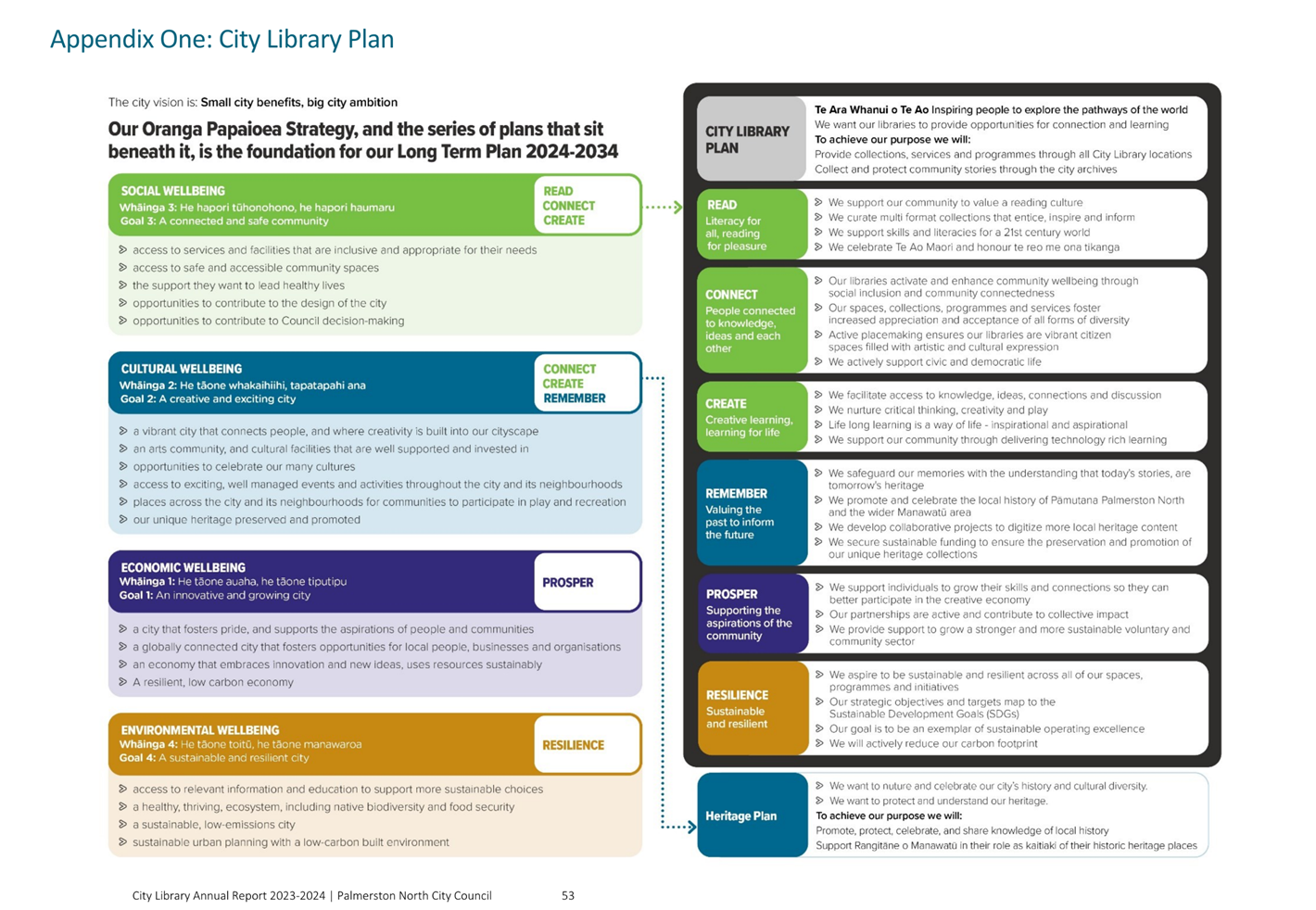
4. THE CITY LIBRARY PLAN
4.1 The
City Library plan states, “we want our libraries to provide opportunities
for connection and learning. To achieve this purpose we will provide
collections, services and programmes through all City Library locations and
collect and protect community stories through the city archives”
4.2 The
City Library kaupapa Te Ara Whānui o Te Ao translates as inspiring people
to explore the pathways of the world. We deliver on the City Library Plan
through our kaupapa and the six pouwhenua, or pillars, below:
READ:
Literacy for all, reading for pleasure
CONNECT:
People are connected with knowledge, ideas and each other
CREATE:
Creative learning, learning for life
REMEMBER:
Valuing the past to inform the future
PROSPER:
Supporting the aspirations of the community
RESILIENCE:
Sustainable and resilient
4.3 Our
goal is to ensure that the City Library makes a difference community-wide under
each of these six pou (see Appendix One of the attached report for details).
4.4 The
City Library delivers a wide range of services and lifelong learning programmes
under each of the pou.
5. CONNECT: People are connected to knowledge,
ideas and each other.
5.1 We
achieve this through providing library collections, programmes, and services
that reflect community needs and interests, feature community voices, and
create meaningful experiences. Examples of this include:
5.2 Play: We actively contribute to the delivery
of the Recreation and Play Mahere Rēhia Plan through the Pop Up Play
School Holiday series, the Library Walls Alive project, the Play Libraries
project, participation in the Palmy Play Festival and the Puanga Passport to
Play edition.
5.3 Outreach Connections: We continually review how
services and programmes
can be more inclusive, tailored to
suit specific needs and taken to where people are. Initiatives have included those for
adult literacy, use of the Nymbl App and
programmes for the
neurodiverse, rainbow, health and disability sectors of the community.
5.4 Home
Service: This year 119 people were supported to receive long-term
deliveries of library materials through Home Service.
5.5 Club
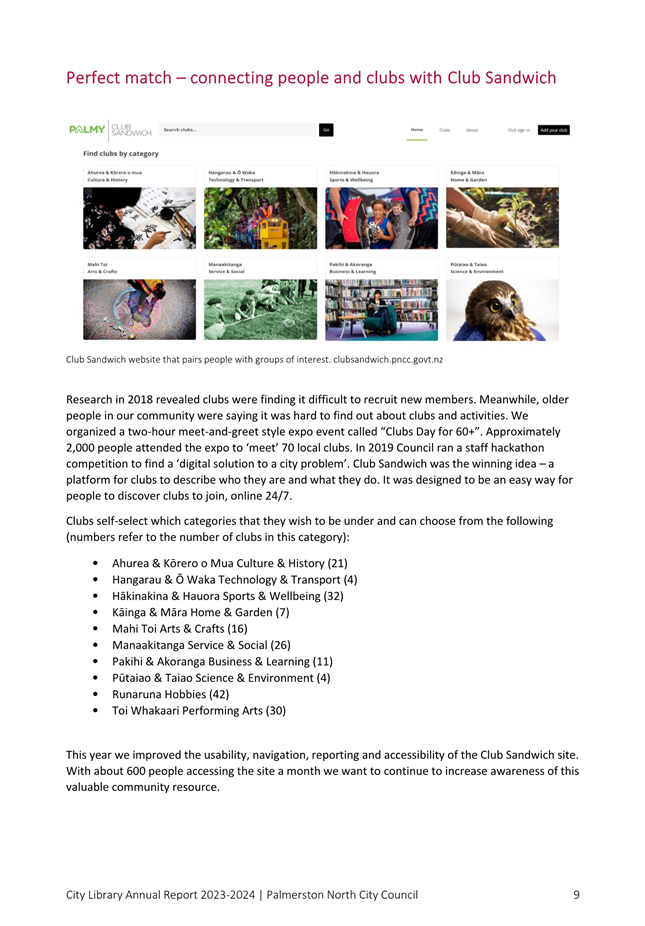
Sandwich: Club Sandwich is a platform for clubs to describe who they are and
what they do and an easy way for people to discover clubs and join 24/7. This
year we improved the usability, navigation, reporting and accessibility of the
site.
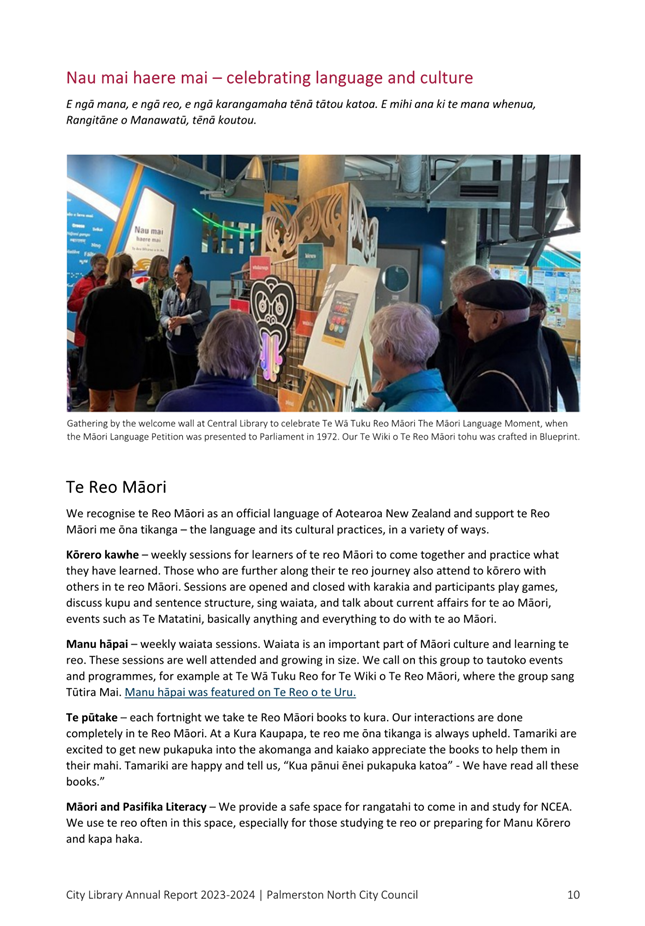
5.6 Te
Reo Māori: The City Library supports te Reo Māori me ōna tikanga
– the language and its cultural practices, in a variety of ways. This
support includes Kōrero kawhe, the Manu hāpai waiata group, Te
pūtake (a fortnighly delivery of te reo Māori books to kura) and
programmes throughout Mahuru Māori - Te Wiki o te Reo.
5.7 Language
Weeks: The City Library celebrates and acknowledges many language weeks,
connecting our diverse community with library programmes and the community
languages collection.
5.8 Youth
Space: A safe, fun, inclusive and welcoming environment, where young people can
spend time and explore opportunities through the provision of library services,
youth mentorship, lifelong learning programmes and community events.
6. PROSPER: Supporting the aspirations of the
community
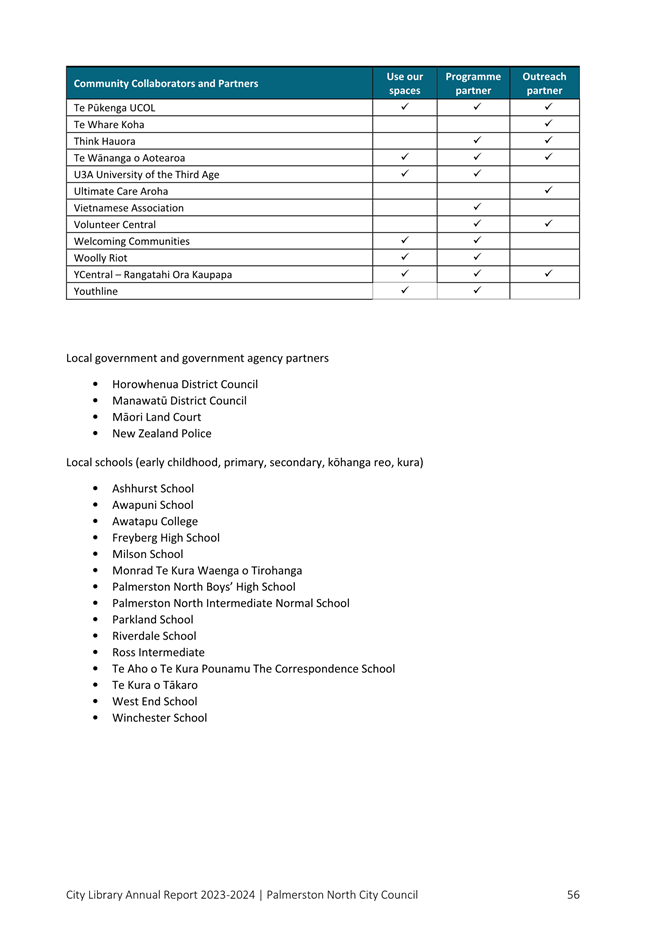
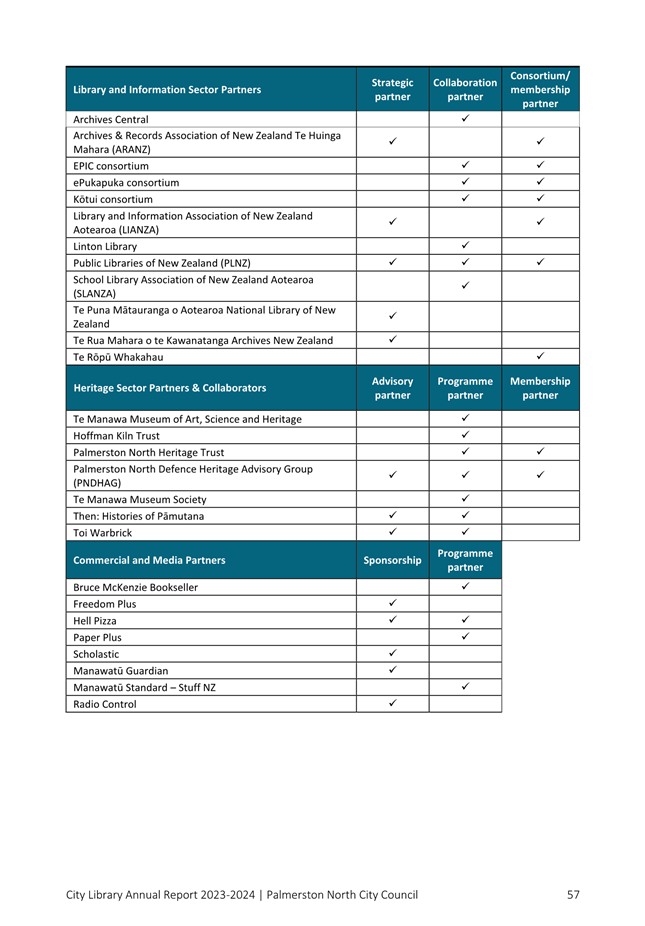
6.1 We
achieve this through supporting individuals to grow their skills, often through
partnerships that contribute to collective impact while helping to grow a
strong and sustainable voluntary and community sector. Examples of these
partnerships include:
6.2 Massey University Te Kunenga ki Pūrehuroa: Off the Page This
annual series is in its 19th year. The programme includes panels,
readings, discussions and creative writing workshops.
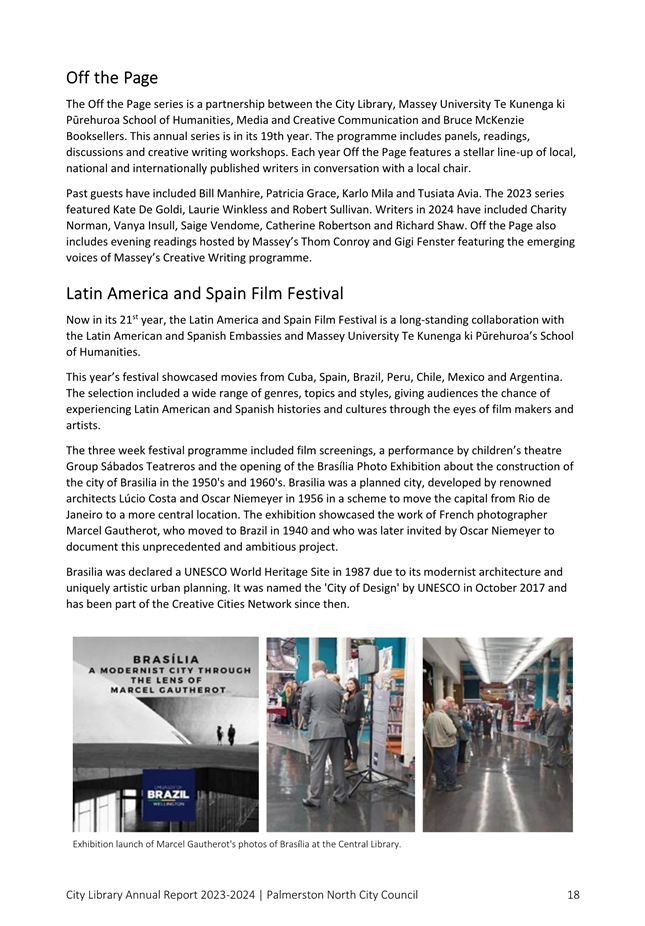
6.3 Massey University Te Kunenga ki Pūrehuroa: Latin America and Spain
Film Festival (LASFF) Now in its 21st year, LASFF is a three
week festival programme which included film screenings, a performance by
children’s theatre Group Sábados
Teatreros and the opening of the Brasília
Photo Exhibition
6.4 Massey
University Te Kunenga ki Pūrehuroa: Children’s University This is a
programme that supports and encourages tamariki to participate in learning
experiences outside of the classroom.
6.5 Palmerston
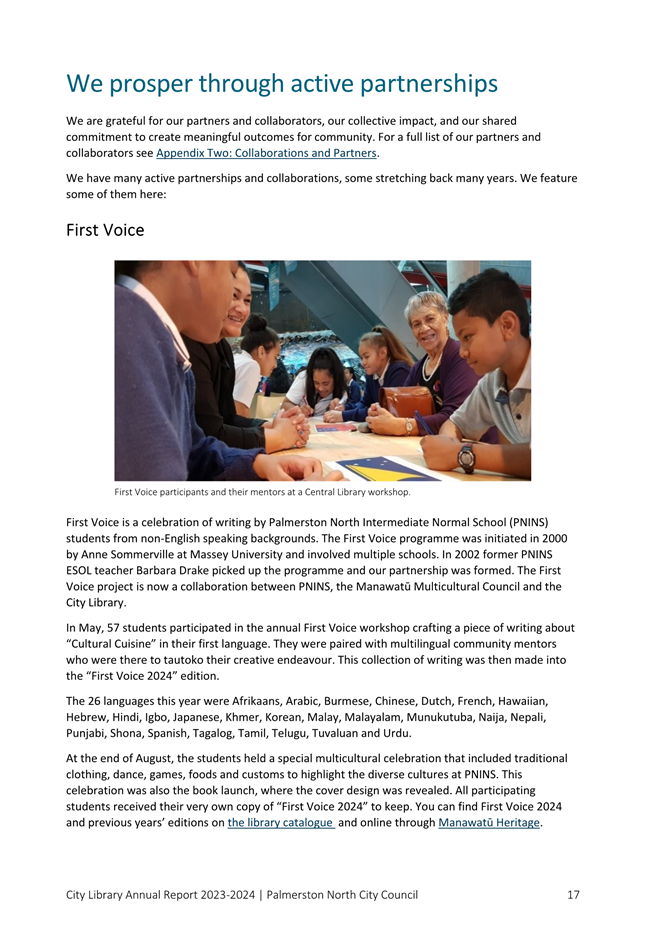
North Intermediate Normal School (PNINS): First Voice A celebration of writing
by PNINS students from non-English speaking backgrounds.
6.6 Digital Futures Aotearoa Recycle-a-Device (RAD) Club:
RAD is a charitable initiative that works to address key digital gaps in an
innovative programme that gives back to the community.
6.7 Dignity: We partnered with Dignity in 2020 to
support their vision of achieving period equity across Aotearoa and provided
over 1,000 free period products for our community.
7. READ: Literacy for all, reading for pleasure
7.1 We
achieve this through providing library collections, programmes and services
(including outreach services) that support children, young people and their
families in learning and educational success, career readiness and in life.
Examples of this include:
7.2 Library Collections: We curate multi-format
collections that support the recreational and learning needs of the many readers of all ages and stages who use the City Library. There are a range of formats
in our collections to suit a variety of reading styles and needs including
standard or large print, CD or MP3, eBooks and audiobooks on the Libby and
Borrow Box apps and books in a range of languages including Te Reo Māori.
These collections will increasingly become
digital. More of our spending
has moved to purchasing access
to online subscriptions and
databases, eBooks, streaming media and downloadable content. We offer a wide
variety of streaming services, apps and eResources that are available
24/7.
7.3 He
Taonga te Pūmahara Memory Matters collection: We connected with Alzheimers
New Zealand to work towards completing the Dementia Friendly Recognition
Programme. Our dementia friendly collection He Taonga te Pūmahara Memory
Matters includes materials specifically curated for people with dementia and
memory loss and their caregivers.
7.4 Writers and Readers Winter Series: This year
we launched our inaugural winter celebration of writers and readers, showcasing
writers both in the Manawatū, and across Aotearoa.
7.5 Children’s
Reading Programmes: our
children’s reading programmes continued to respond to changing
whānau and individual reader needs.
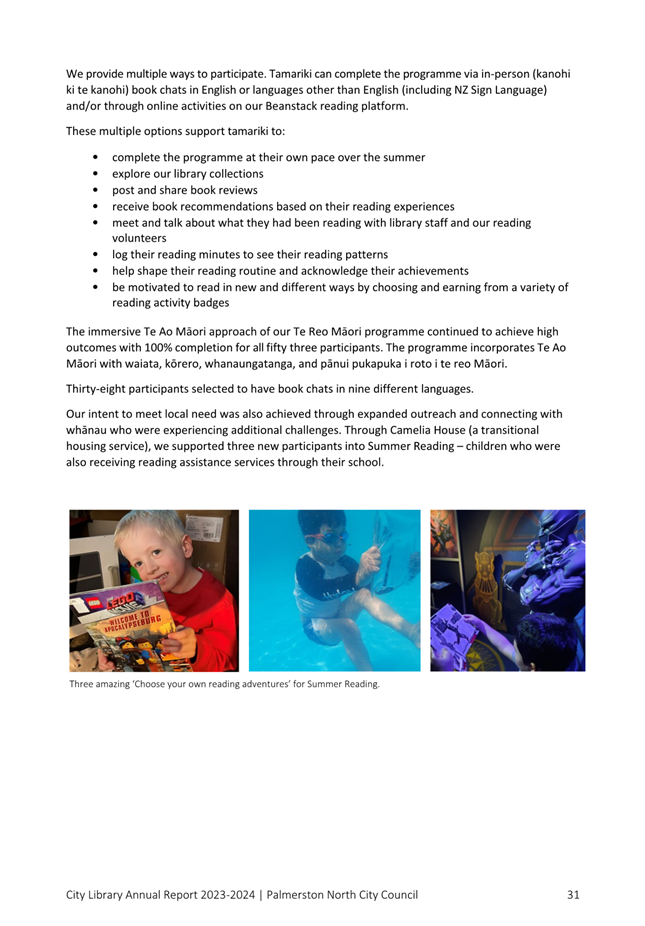
We provide multiple ways to participate. Tamariki can complete the programme via in-person (kanohi ki te kanohi)
book chats in
English or languages other than English
(including NZ Sign Language) and/or through online activities on our Beanstack
reading platform. The immersive Te Ao Māori approach of our Te Reo
Māori programme incorporates Te Ao Māori with waiata, kōrero,
whanaungatanga, and pānui pukapuka i roto i te reo Māori.
8. CREATE: Creative learning, learning for life
8.1 We
achieve this by being a primary point of social access to information, lifelong
learning, and creative expression through the innovative use of technology and
digital resources. Examples of this include:
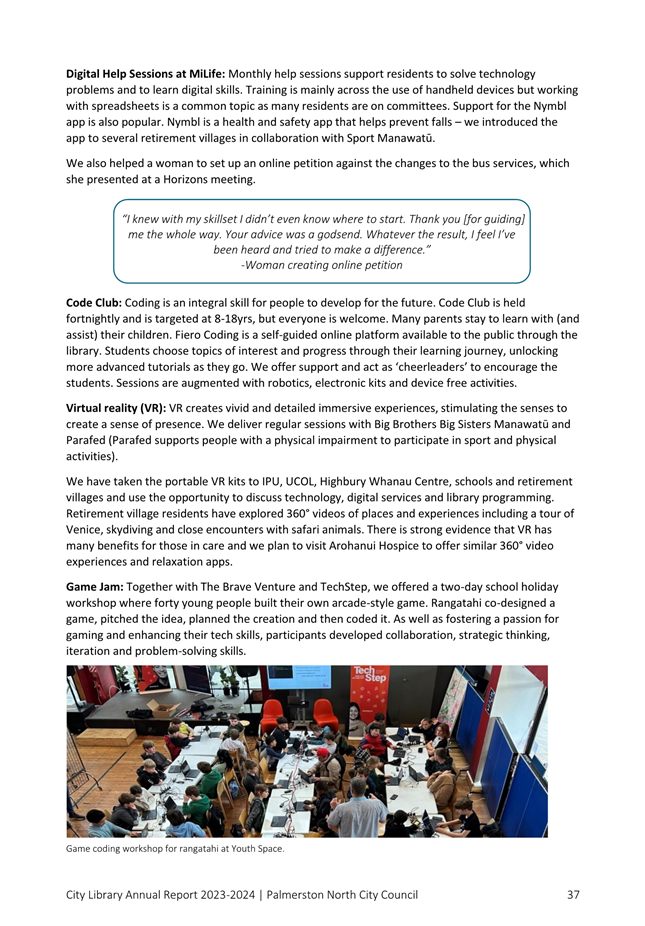
8.2 Technology rich learning: We deliver
technology rich learning, providing access to a wide range of digital resources and tools for our
community. Programmes and activities are designed to support
skill development in Science, Technology, Art, Maths, Innovation and
Entrepreneurship (STEAM-IE). Examples include LibLab; digital sessions at the
Winchester School Innovation Hub and MiLife; Code Club and Game Jam.
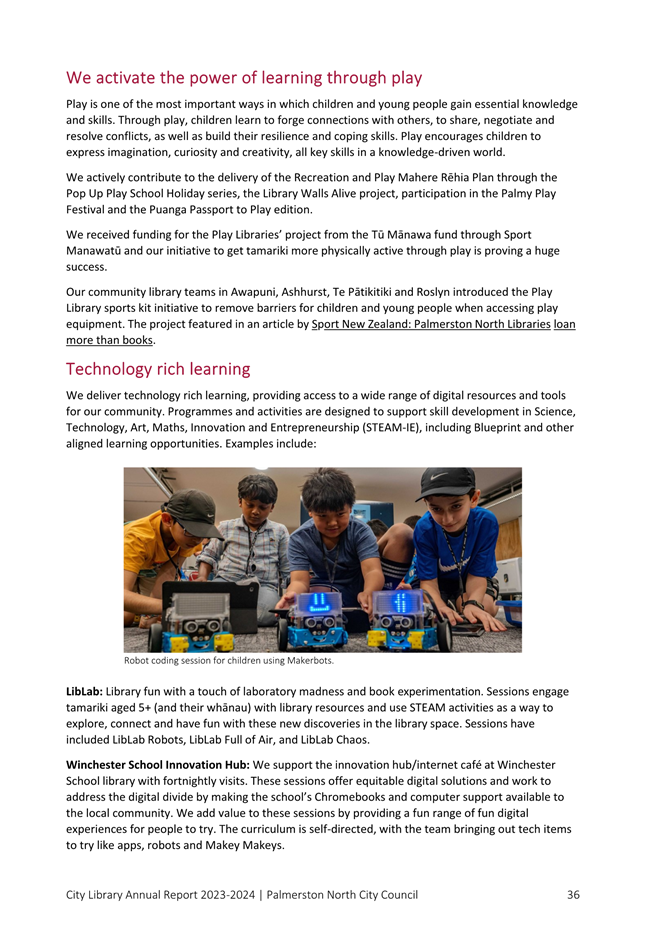
8.3 Virtual Reality (VR): We deliver regular VR sessions
with Big Brothers Big Sisters Manawatū and Parafed. We have also taken the
VR kits to IPU, UCOL, Highbury Whanau Centre, schools and retirement villages,
using the opportunity to discuss technology, digital services and library
programming.
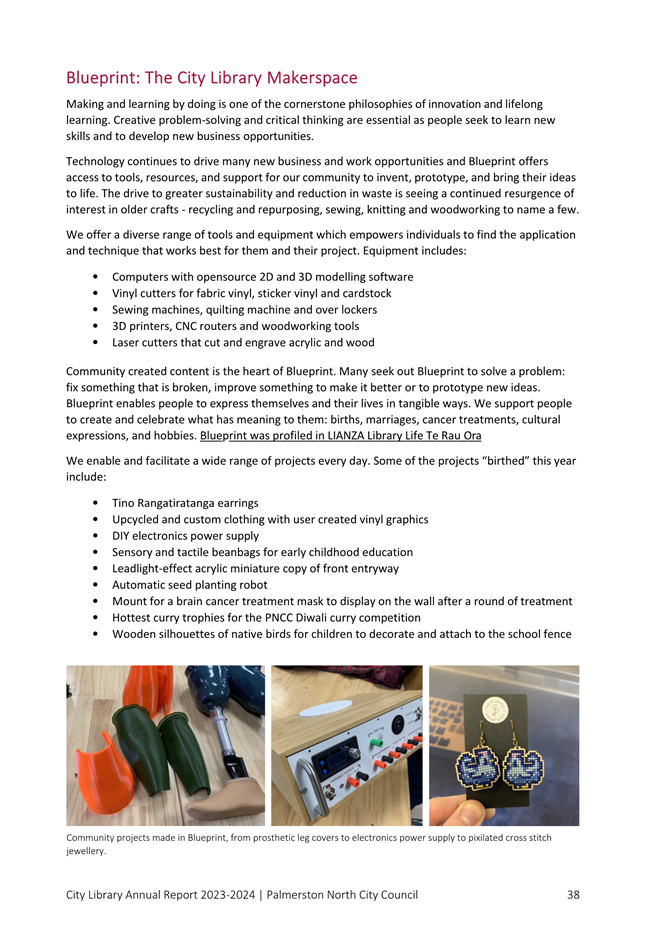
8.4 Blueprint: Technology continues to drive many new business and work
opportunities and Blueprint offers
access to tools,
resources, and support
for the community to invent,
prototype, and bring their ideas to life. Examples
of projects in Blueprint include: a DIY electronics power supply; sensory and
tactile beanbags for early childhood education; an automatic seed planting
robot; and wooden silhouettes of native birds for children to decorate and
attach to the school fence.
9. REMEMBER: Valuing the past to inform the
future
9.1 We
achieve this through connecting the community with mana whenua and the
bicultural foundations of the city; diverse local culture; history through
heritage and archival collections (both physical and digital); and local
history and heritage programmes.
9.2 Archival
and Heritage collections: The collections held in the Ian Matheson City Archive
(IMCA) are a significant part of both our local heritage and the national
documentary heritage of New Zealand. These collections have an important place
alongside the natural, built and cultural heritage which reflects our
Palmerston North identity. The Community Archives were moved to an offsite
storage facility in February 2023 after discovering a leak in their former
storage area. Changes were made to the current archive space in the Central
Library to better utilise the space by relaying the collections for better
space efficiencies and effectiveness.
9.3 Manawatū
Heritage: Development work this year focussed on increasing the capacity
of Manawatū Heritage. This will enable Manawatū Heritage to be a one
stop shop for the archival and heritage collections; making it an invaluable
resource for historians, researchers and students.
9.4 Back
Issues: We have coordinated the ‘Back Issues’ series, a
weekly history feature with strong visual images for the Manawatū Standard
for the past three years and all articles have been uploaded to Manawatū
Heritage.
9.5 Genealogy:
Family history and finding out about our ancestors is a key part of
understanding our own migration stories. Making genealogy databases such as
Ancestry available in our library spaces, running family history programmes and
working with genealogical groups helps us to provide this service.
9.6 Oral
Histories: As new migrants come to Palmerston North it is important that
their stories are collected and become part of our city’s history. Oral
histories are an excellent way of recording these stories and we work with
volunteers and other groups to co-ordinate, record and make these stories
available.
9.7 Local
History Week and Heritage Month: For the second year, Local History Week was
held in March and led into the annual Heritage Month. Heritage Month builds on
the success of the Local History Week with activities delivered by both the
library team and heritage partners across the city. The programme was very successful
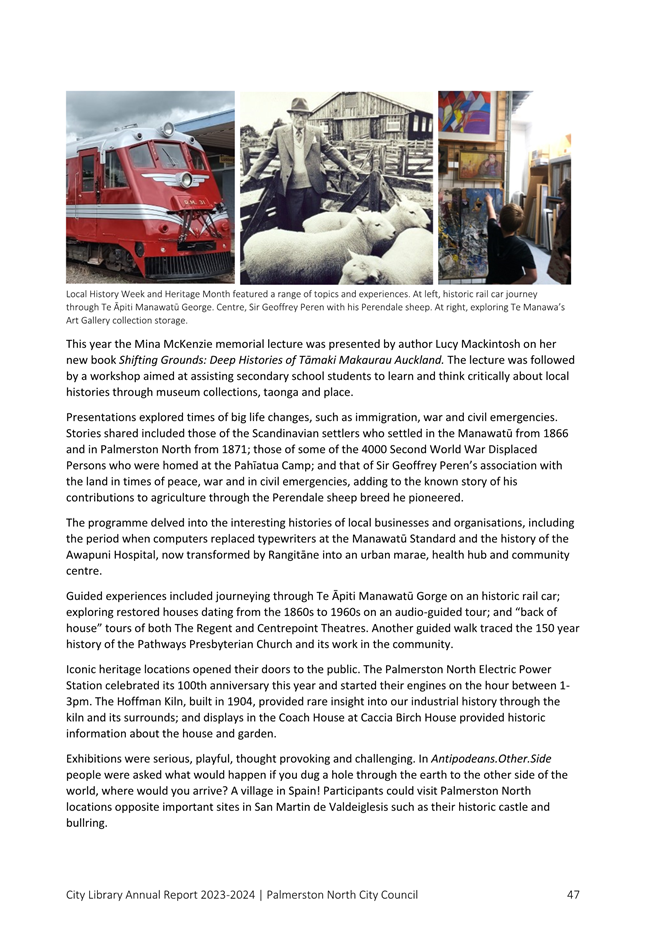
with 2050 attendees across 80 programmes and activities.
10. RESILIENCE: Sustainable and
resilient
10.1 An important characteristic of a resilient
community is social connectedness and having the skills and knowledge to be
sustainable. We support these skills through a number of initiatives including
the Palmy Crop swap, kai resilience and sustainability workshops
delivered by Environment Network Manawatū (ENM).
11. Performance Indicators
11.1 The City
Library captures a wide range of performance metrics which are compared to the
previous year’s data to measure any changes. The majority of indicators
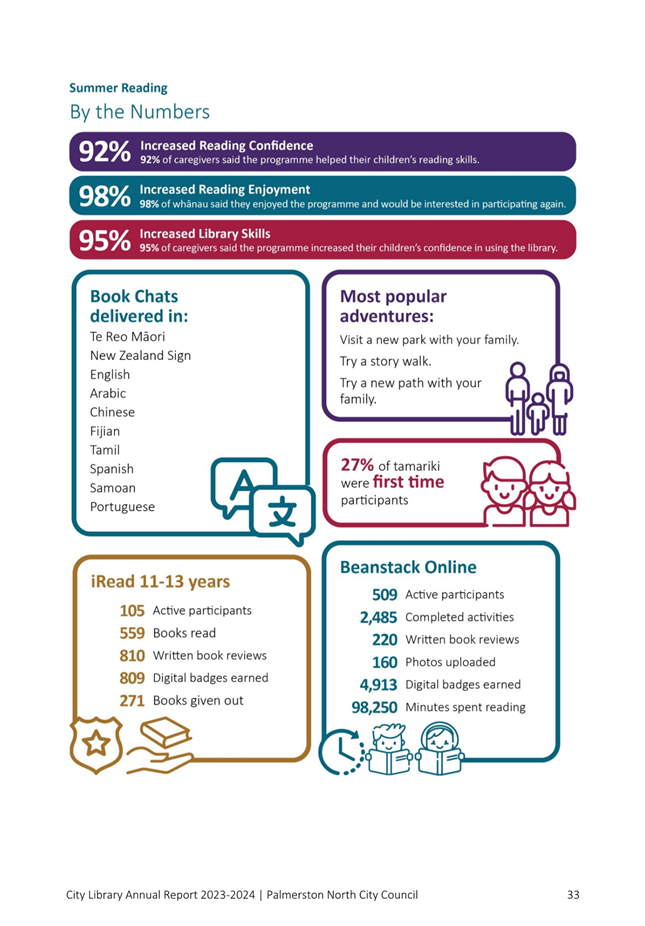
show an increase (see p4 of the City Library Report)
12. Emerging LIbrary trends
Emerging library trends
relevant to the work of the City Library include:
12.1 Societies
are increasingly more diverse making delivering universal services and
achieving equity more complicated
12.2 The
digital divide is persistent and getting more serious, even as connectivity
improves
12.3 Regulation
of digital spaces is accelerating but without consideration of how libraries
support access to information
12.4 An increasingly
uncertain world intensifies challenges and complicates the delivery of services
as libraries are seen more frequently in a crisis response role providing dry,
warm (or cool) spaces, electricity and internet connections for those who no
longer have these at home.
13. CHALlenges
We are facing a number of
challenges:
13.1 Long-Term
Sustainability: Ensuring the City Library has the financial resources to
support its current work and to meet the future growth of the city.
13.2 State of
facilities: The current state of City Library facilities at all locations is
impacting daily operations and services to our public.
13.3 Storage
issues for physical archives: Proper archival storage is needed for
long-term preservation and efficient access and management of the city’s
archives. Current archive facilities, conditions, locations and service
arrangements are not up to archival standards.
13.4 Digital
storage for Manawatū Heritage: Digital archive storage following
digital archive preservation, data sovereignty and accessibility best practices
is needed for the current and future digitised and born-digital city archival
collections.
13.5 Staff
retirements – retaining knowledge and training up new staff: The
City Library is facing a generational shift requiring succession planning for
long-serving, highly-skilled workforce who are retiring. We are working on
growing and developing our current workforce to gain the experience and skills
required to help ease this transition.
13.6 Diversity
of skills: Modern libraries require teams with a range of skillsets and
backgrounds who are people-focussed and grounded in lifelong learning. Our team
needs to be well-versed in professional librarianship, tech-savvy, and have the
soft skills required to navigate a range of social and societal challenges.
13.7 Digital
content divide: A new content divide is emerging for those that do not have
access to either Wi-Fi or a device on which to read. For content that is read
online and not downloadable, we will need to continue to provide both fast and
reliable internet access and Wi-Fi and internet-connected devices in all of our
library spaces.
14. opportunities
We are focusing on the
following areas of opportunity:
14.1 Refreshing
and Re-energising Library Spaces: We have an opportunity to adapt and
energise library spaces for new uses in keeping with changing collections,
services, programmes; the interests and needs of our community; and the
changing ways that they use library spaces.
14.2 Workforce
Capacity and Development: We are tracking emerging trends across the
future work of libraries and using that information to determine the training
staff will need. This includes recruiting skilled people for new workstreams
where additional support is required.
14.3 Equitable
access and inclusion: Ensuring our resourcing model and library services
are designed to eliminate barriers to access, provide public and staff
opportunities for growth, and develop and support equitable access to the collections,
programmes and services we offer.
14.4 Data and
Metrics: Improving our data systems to better collect data and use
statistics to make informed decisions about what the City Library should or
should not do.
14.5 Promotion
and marketing: Strategically promoting library programmes and services
to increase awareness and use of our libraries; and to support the role and
value of the City Library network to our community.
14.6 Improving
sustainability and resilience: As a resource, libraries have a long
history of sustainability. We are at the start
of our journey of being
deliberate and intentional with the impact
of our consumption and the
role we play in supporting social resiliency.
15. Facilities
A current overview of the City Library facilities is as below:
Central Library
15.1 The
renewals and maintenance strategy for the Central Library building has meant
that only essential Health
and Safety or compliance work has been undertaken on the
building between 2013 -2021.
15.2 Since 2021,
through the 2021-31 LTP, there was an increase in both the renewals and
maintenance budgets for the facility. However, significant assets are at end of life and are failing – escalators, lifts (both public and staff) and the building management system (BMS).
15.3 Whilst not
considered a dangerous building, the building was identified as being
earthquake prone in 2018.
15.4 The seismic solution
for the Central Library provides an opportunity to maximise space, flexibility, sustainability and efficiency.
This may include space provision for Youth Space and the physical collections
of the Ian Matheson City Archive.
15.5 The
seismic strengthening solution for the Central Library also provides the
opportunity to consider how the building functions, position it for the future,
and replace failing assets throughout the building. This is one of the key
considerations in a partial rebuild being the preferred option.
15.6 Consideration
will need to be given to decanting the building before the rebuild and finding
temporary homes for the Central Library, the Ian Matheson City Archive, and
Blueprint.
Community Libraries
15.7 Our
community libraries are in better condition than the Central Library and have
also seen an increase in investment since 2021, with more planned preventative
maintenance and renewals.
15.8 Most
recently in 2023 the Awapuni and Roslyn Libraries were closed to address
maintenance issues, noting that we lease these buildings, they are not council
owned. Many of the maintenance issues were the landlord’s responsibility.
16. NEXT STEP
16.1 The next
annual report on library services will be provided for information at the end
of 2024/2025.
17. Compliance and administration
|
Does the Committee have
delegated authority to decide?
|
Yes
|
|
Are the decisions significant?
|
No
|
|
If they are significant do they
affect land or a body of water?
|
No
|
|
Can this decision only be made
through a 10 Year Plan?
|
No
|
|
Does this decision require
consultation through the Special Consultative procedure?
|
No
|
|
Is there funding in the current
Annual Plan for these actions?
|
Yes
|
|
Are the recommendations
inconsistent with any of Council’s policies or plans?
|
No
|
|
The recommendations contribute
to:
Whāinga 3: He hapori
tūhonohono, he hapori haumaru
Goal 3: A connected and safe
community
|
|
The
recommendations contribute to the achievement of action/actions
in:
8.
Mahere Whare Puna Mātauranga
8. City Library Plan
The action is: Provide city
libraries that connect, curate and provide access to knowledge, ideas and
works of the imagination that are primarily focused on meeting the needs of
communities with the greatest needs and changing needs of communities.
Provide library programmes that
support the development of literacy in all forms.
|
|
Contribution to strategic
direction and to social, economic, environmental and cultural well-being
|
By providing library
facilities, services, activities and programmes that nurtures literacy,
lifelong learning and access to knowledge. Fostering vibrant community
interactions and enhances community wellbeing through social connectedness
and community cohesion.
|
|
|
|
Attachments
|
1.
|
City
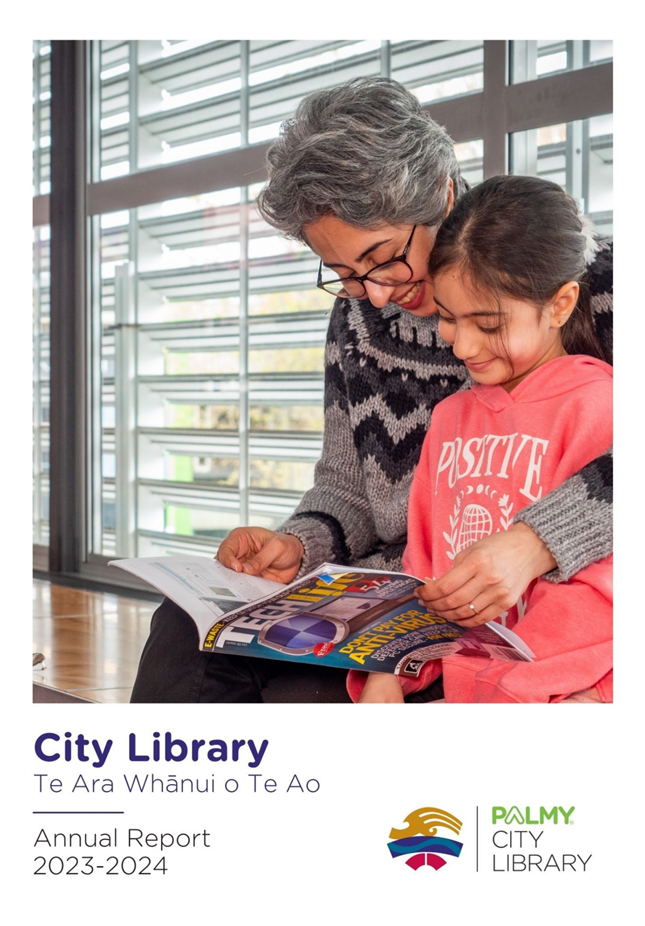
Library Annual Report 2023-2024 ⇩ 
|
|
Report
TO: Community
Committee
MEETING DATE: 23
October 2024
TITLE: Palmerston
North Age Friendly Action Plan
PRESENTED BY: Amy
Viles, Acting Manager Community Development
APPROVED BY: Danelle
Whakatihi, General Manager Customer & Community
RECOMMENDATIONS TO
Council
1. That the
Council endorse the Palmerston North Age Friendly Action Plan and accept the
Options Report; and
2. That the Council
approves the reallocation of the existing $30K of implementation budget towards
.3 FTE, for a Community Development Advisor – Age Friendly to: guide the Council’s
commitment to be an Age Friendly City, develop a Palmerston North Age Friendly
Implementation Plan and to coordinate the internal and external implementation
of actions from that plan.
Summary of options analysis for
|
Problem or Opportunity
|
Council’s 31 May 2023
resolution was to establish an Age Friendly Programme and to develop an Age
Friendly plan.
The draft Palmerston North
Age Friendly Action Plan is now completed and is presented for endorsement
(appended to this report at Attachment 1). This report outlines the options
for the Committee to consider the continuation of the Age Friendly work.
|
|
OPTION 1:
|
The
Council endorse the Palmerston North Age Friendly Action Plan and refer an
additional budget of $50K (.5 FTE) for the development and implementation of
the Palmerston North Age Friendly Implementation Plan to the Annual Budget
deliberations.
NB:
Option 1 would see a total budget allocation of $80K, including $30K of
existing implementation budget (already allocated in the Long-Term Plan) and
an additional $50K per annum (.5 FTE) for a Community Development Advisor -
Age Friendly to:
· guide the Council’s
commitment to be an Age Friendly City;
· develop a
Palmerston North Age Friendly Implementation Plan; and to
· coordinate the
internal and external implementation of actions from that plan.
|
|
Community Views
|
Community engagement
with key partners and stakeholders has been completed throughout the
development of the Palmerston North Age Friendly Action Plan. Feedback demonstrates support for this direction to be
supported by Council.
|
|
Benefits
|
Funding a .5 FTE for the Community Development Advisor -
Age Friendly role will ensure a continuation of the work to date, the
development of a coordinated Palmerton North Age-Friendly Implementation
Plan, ongoing wider community engagement, and will confirm Council’s
previously stated commitment to be an Age-Friendly community.
There will also be additional budget of $30K to support
the implementation of actions.
The Palmerston North Age-Friendly Action Plan delivers on
strategic aspirations within the current Connected Communities
Plan, Transport Plan, Urban Design Plan, Housing Plan and Social Housing
Guidelines.
|
|
Risks
|
Agreeing
to this option has budget implications.
|
|
Financial
|
$30,000 annually has
been budgeted through the LTP for implementation only.
Under
Option 1, additional budget of $50K would be utilised to fund the appointment
of a .5 FTE role to develop an Age Friendly Implementation Plan and to guide
the Council’s commitment to be an Age Friendly City (as outlined
above).
|
|
OPTION 2:
|
The
Palmerston North Age Friendly Action Plan is endorsed by Council, and Council approves the reallocation of the existing $30K
of implementation budget towards .3 FTE for a Community Development Advisor -
Age Friendly to:
· guide the
Council’s commitment to be an Age Friendly City;
· develop a
Palmerston North Age Friendly Implementation Plan; and to
· coordinate the
internal and external implementation of actions from that plan.
|
|
Community Views
|
Community views have
not been sought for this option; however key stakeholders have advocated to
Council for a commitment to be an Age Friendly City and this option allows
for a level of support towards that commitment.
|
|
Benefits
|
This option has no
future budget implications and allows for the continuation of the work.
Funding a .3 FTE for a Community Development Advisor
– Age Friendly role will ensure a continuation of the work to date, the
development of a coordinated Palmerton North Age Friendly Implementation
Plan, a level of ongoing community engagement, and will confirm
Council’s previously stated commitment to be an Age Friendly community.
The Palmerston North
Age Friendly Action Plan delivers on strategic aspirations within the current
Connected Communities Plan, Transport Plan, Urban Design Plan, Housing
Plan and Social Housing Guidelines.
|
|
Risks
|
Option 2 would result
in the implementation of delivery of actions at a slower rate than Option 1.
The community may view
a slower delivery (from the previous .5 fixed term role) as a reduction in
commitment by Council to the commitment to be an Age Friendly City.
|
|
Financial
|
No
additional financial cost, as Option 2 recommends a reallocation of budget
from the age friendly implementation budget to age friendly co-ordination
(via staffing .3 FTE allocation). Additional community aspirations for
community projects, initiatives or events may be eligible for consideration
through the Community-led Initiatives Fund.
|
|
OPTION 3:
|
The
Palmerston North Age Friendly Action Plan is endorsed by Council, and Council
does not approve the reallocation of the existing $30K of
implementation budget towards .3 FTE for an Community Development Advisor -
Age Friendly, in effect, maintaining the status quo of $30K implementation
budget and no FTE towards a role.
|
|
Community Views
|
Feedback
from key community partners and key stakeholders demonstrates support for a
dedicated role within Council to support the implementation of age friendly
actions.
|
|
Benefits
|
This
option has no future budget implications and allows for the continuation of
the work.
Council
will continue to demonstrate a commitment to Age Friendly membership and to
the implementation of the actions in the plan.
|
|
Risks
|
Option
3 could result in a scaled-back delivery of actions.
There
would be no dedicated role towards the development of an Age Friendly
Implementation Plan and to engage with internal and external stakeholders on
the implementation of actions.
|
|
Financial
|
There
are no financial implications for this option as budget is already allocated
for implementation through the Long-Term Plan.
|
|
OPTION 4:
|
The
Palmerston North Age Friendly Action Plan is not endorsed by Council
and the Implementation Plan is not developed to deliver the actions outlined
in the plan.
|
|
Community Views
|
Staff understand that
Option 4 would not be supported by key community partners and stakeholders.
|
|
Benefits
|
There are financial
benefits identified for this option for Council as the $30K allocated for age
friendly implementation could be reallocated to other activities.
|
|
Risks
|
Relationships with
partners and stakeholders could be damaged by the perception that Council has
gone back on the commitment to be an Age-Friendly community.
|
|
Financial
|
There are financial
benefits to not spending the allocated implementation budget, as this could
be reallocated to other activities.
|
Rationale for the recommendations
1. Overview of the problem or opportunity
1.1 This
report presents the Palmerston North Age Friendly Action Plan for Council
endorsement. Four options are presented for consideration to proceed with the
development of the Implementation Plan.
1.2 If
Council is to maintain membership of Age Friendly Aotearoa (AFANZ) and support
the Age Friendly programme and subsequent Action Plan beyond October 2024, then
funding the implementation of the plan is necessary. As a requirement of the
AFANZ membership, Council shall:
a. demonstrate that it is taking
credible and tangible steps towards developing an age friendly strategy or
action plan for their community,
b. be
leading the Age Friendly strategy or plan for their community.
1.3 Requirement
‘a’ is underway and demonstrated. The commitment to
requirement ‘b’ requires ongoing resourcing by Council.
Given these membership requirements, ongoing resourcing is required to drive
the development of any Palmerston North Age Friendly Implementation Plan.
1.4 It
is important to note, that there are no set requirements for Council to
maintain membership status to Age Friendly Aotearoa New Zealand (AFANZ). AFANZ
provides recommendations and guidance to member local authorities. The actions
outlined in the Action Plan are self-identified by Council officers following
the community engagement process.
2. Background and previous council decisions
2.1 On
14 September 2022, the Age Friendly Palmerston North community group made a
presentation to the Community Development Committee to request that Council
agree to commence the process of becoming an Age Friendly City as soon as
possible, by allocating resource either via the next Annual Plan or Long-Term
Plan. As a result, the Committee resolved that the request be referred to the
Long-Term Plan process.
2.2 On
15 March 2023, at the Community Committee meeting, Council's Seniors’
Reference Group highlighted its support for the city pursuing Age Friendly
status during its annual presentation.
2.3 A
report titled ‘Age Friendly Status and Funding’ was
presented to the Community Committee on 24 May 2023, in response to the
Committee’s resolution of 15 March 2023 that the Chief Executive
investigate what is required to apply for Age Friendly status and funding. The
Community Committee on 24 May 2023 resolved:
‘To refer a programme to develop an Age Friendly
strategy/plan to the Annual Budget deliberations.’
2.4 Subsequently,
on 31 May 2023, Council resolved:
‘To establish an Age Friendly Programme to develop
an Age Friendly strategy/plan with a budget of $50K in 2023/24 and refer
ongoing costs of $30K annually to the Long-Term Plan deliberations.’
2.5 A
.5 FTE position for a fixed term of 12 months was established to undertake
community engagement and develop a Palmerston North Age Friendly Action Plan.
Officers presented an Age
Friendly Progress Report in 1 May 2024 to Council, presenting a summary of
the age friendly work to date, including the community engagement plan and
community feedback following the engagement process. The fixed term position to
complete this work ended in August of this year.
2.6 As
described in the earlier
scoping report presented to the Community Committee on 24 May 2023,
becoming an Age Friendly City requires Council to join the membership network
and commit to a process of developing and implementing an Age Friendly Action
Plan in collaboration with community partners. Palmerston North City Council
successfully joined the Age Friendly Aotearoa New Zealand (AFANZ) membership
network in September 2023.
World Health Organisation
(WHO) 8 Age Friendly Domains
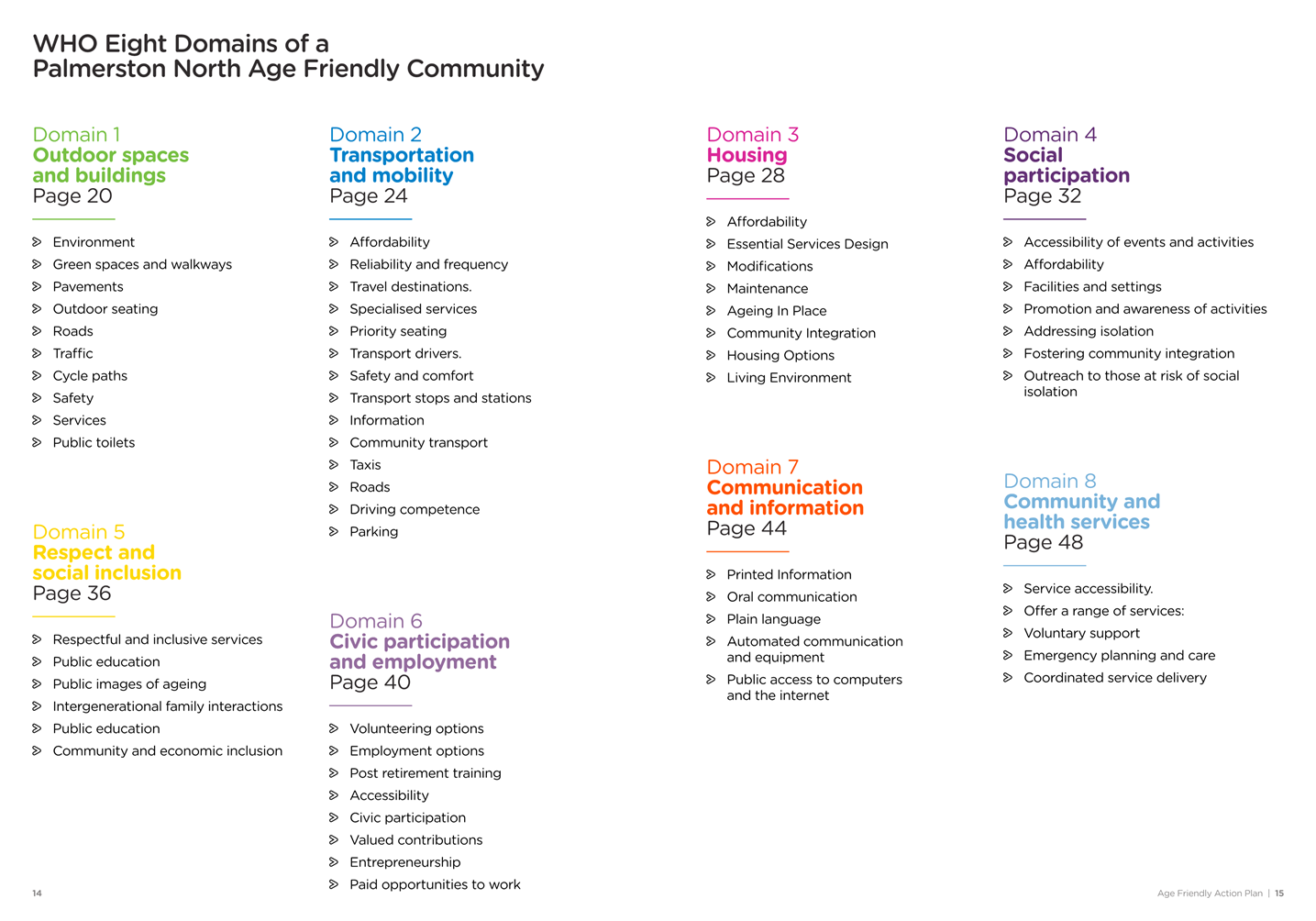
2.7 The
Age Friendly Framework, endorsed by Age Friendly Aotearoa New Zealand (part of
the Office for Seniors through the Ministry of Social Development) includes the
eight domains of the World Health Organisation (WHO) Age Friendly Framework,
which are:
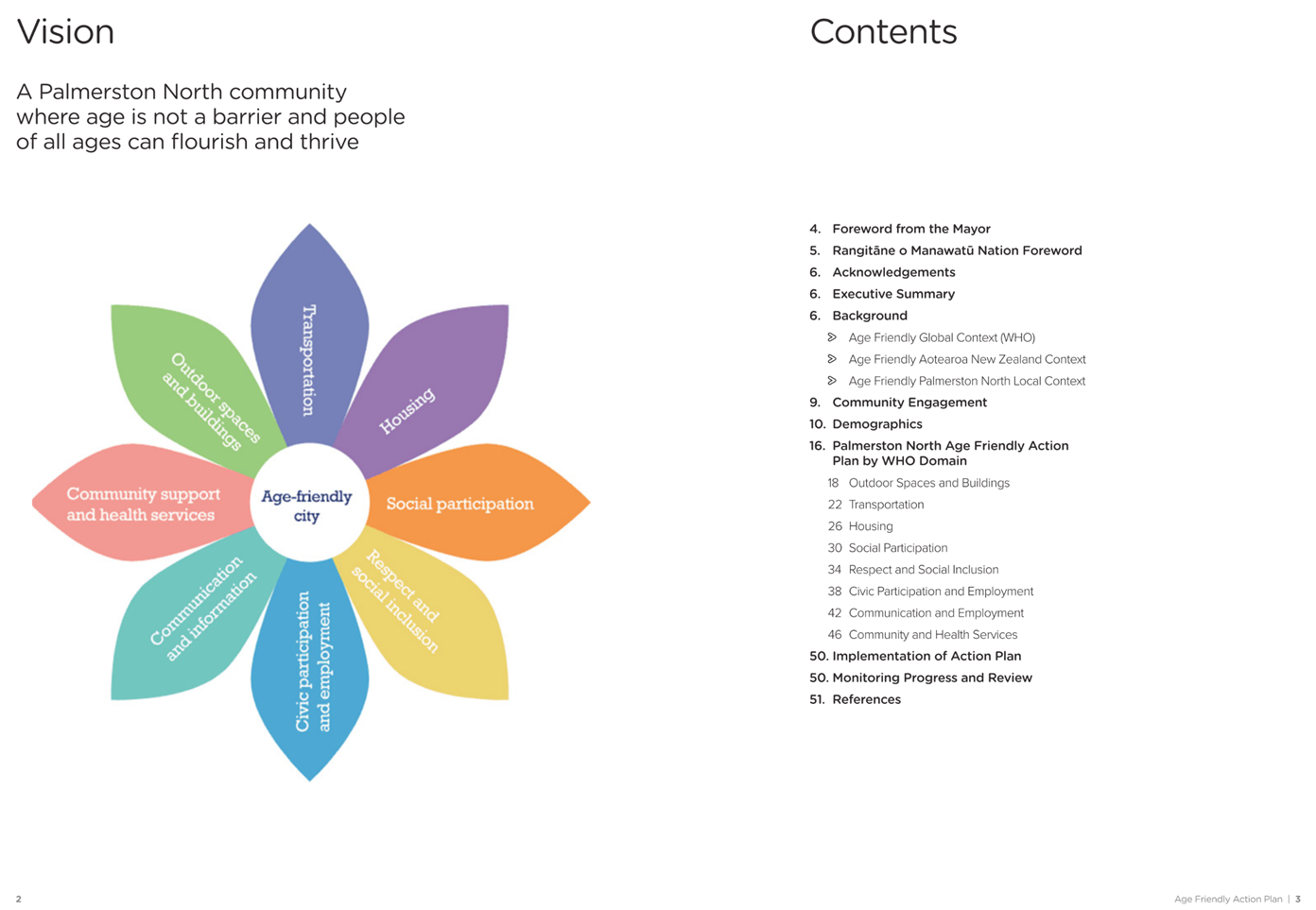
1. Open Spaces & Buildings
2. Housing
3. Transport
4. Civic Participation & Employment
5. Social Participation
6. Respect & Inclusion
7. Communication & Information
8. Health & Community Support Services
World Health Organisation Age
Friendly Principles
2.8 The
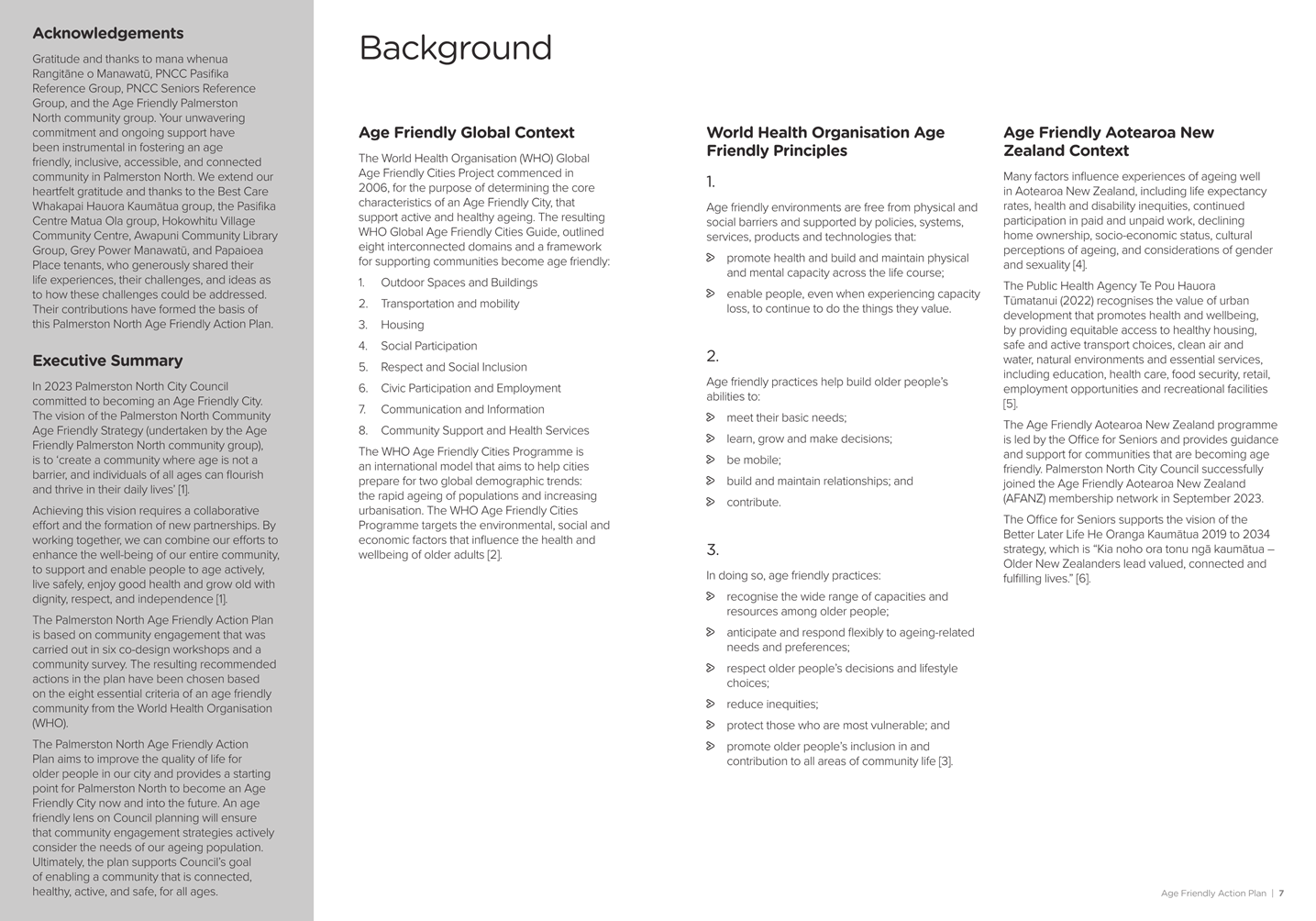
WHO Age Friendly Principles provide the following guidelines:
1. Age friendly environments are free from
physical and social barriers and supported by policies, systems, services,
products and technologies that:
• promote health and build and
maintain physical and mental capacity across the life course;
• enable people, even when
experiencing capacity loss, to continue to do the things they value.
2. Age friendly practices help build older
people’s abilities to:
• meet their basic needs;
• learn, grow and make decisions;
• be mobile;
• build and maintain relationships; and
• contribute.
3. In doing so, age friendly practices:
• recognise the wide range of
capacities and resources among older people;
• anticipate and respond flexibly to
ageing-related needs and preferences;
• respect older people’s decisions and lifestyle choices;
• reduce inequities;
• protect those who are most vulnerable; and
• promote older people’s inclusion in and
contribution to all areas of community life.
2.9 The
Office for Seniors suggest that the development of an Age Friendly Plan is
guided by the following steps (as outlined in the preceding report dated 24 May
2023 ’Age Friendly Status and Funding’ and the ‘Age Friendly
Progress Report’ dated 1 May 2024):
Step 1. Get started. Connect with others, set up a steering
group and check any funding that might be available.
Step 2. Assess how age friendly your community is. Before
you can develop an age friendly plan, you need to understand your
community’s current situation.
Step 3. Develop a plan for communities to work towards
becoming age friendly. The plan should focus on your own specific strengths,
cultures, and needs.
Step 4. Implement the plan. With the assessment and
planning done, you can now start to implement your age friendly actions.
Step 5. Evaluate your age friendly programme. Evaluating
the programme is key to understanding what is working well, what is not, and
what to focus on next.
2.10 Council’s
Age Friendly programme development is currently at the end of Step 3:
· a community
engagement process has been completed and evaluated;
· an internal staff
working group has been established and has considered community engagement
feedback; and
· a
draft Action Plan has been completed for endorsement.
2.11 Officers
are ready to move to Step 4, develop an Implementation Plan, for the
implementation of age friendly actions and to ascertain which areas can be
considered within the scope of existing budgets and/or those that may require
additional resourcing.
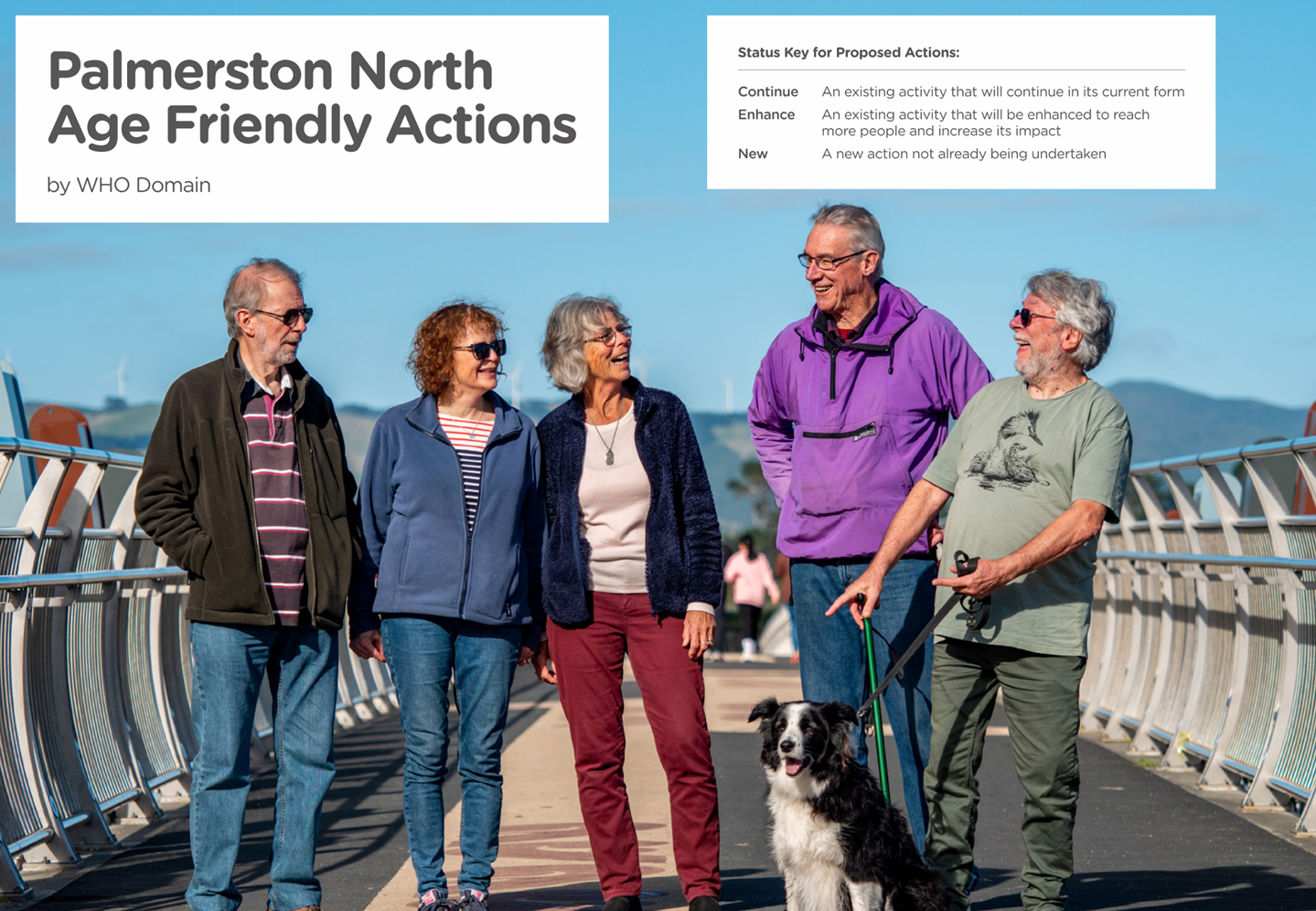
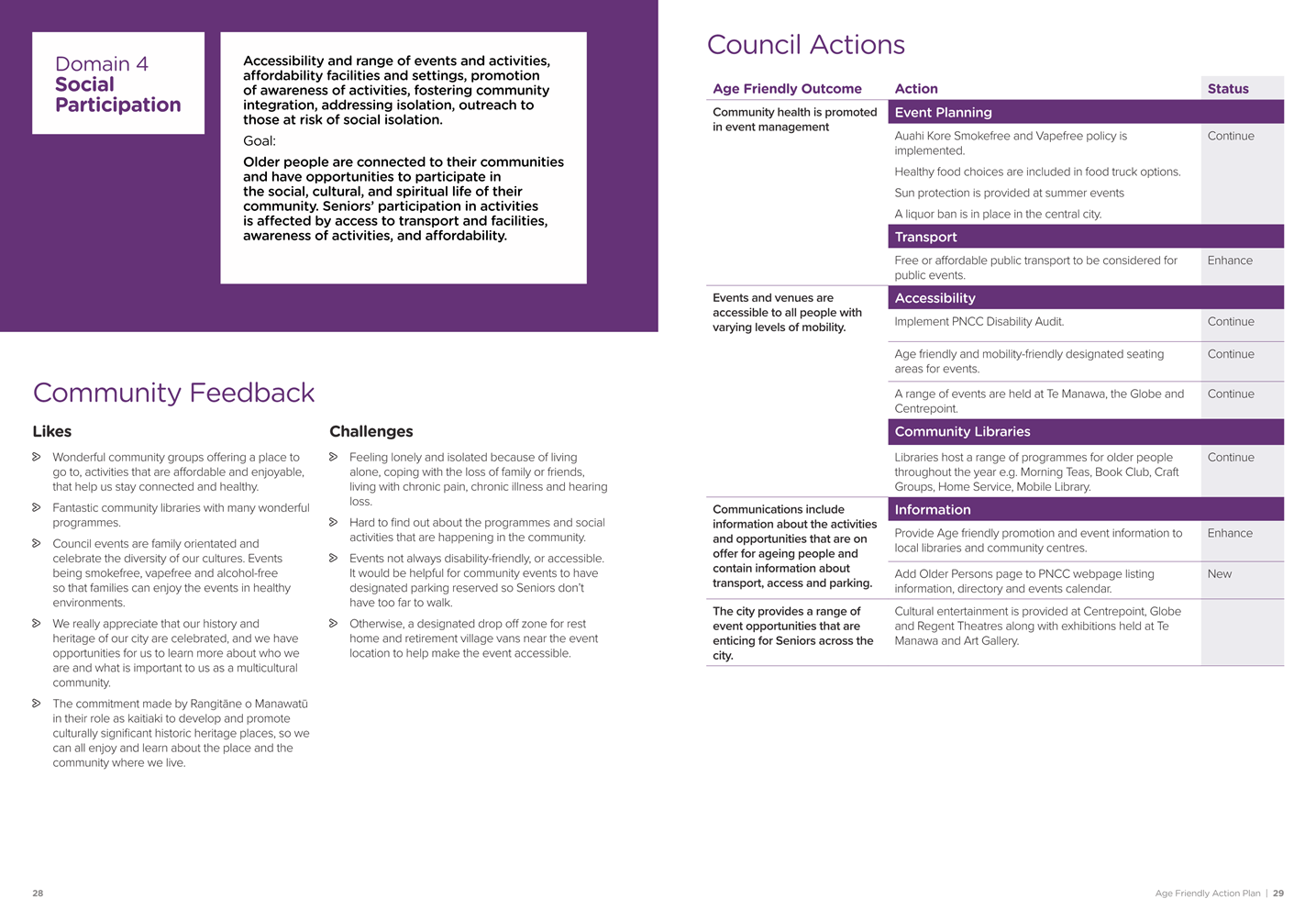
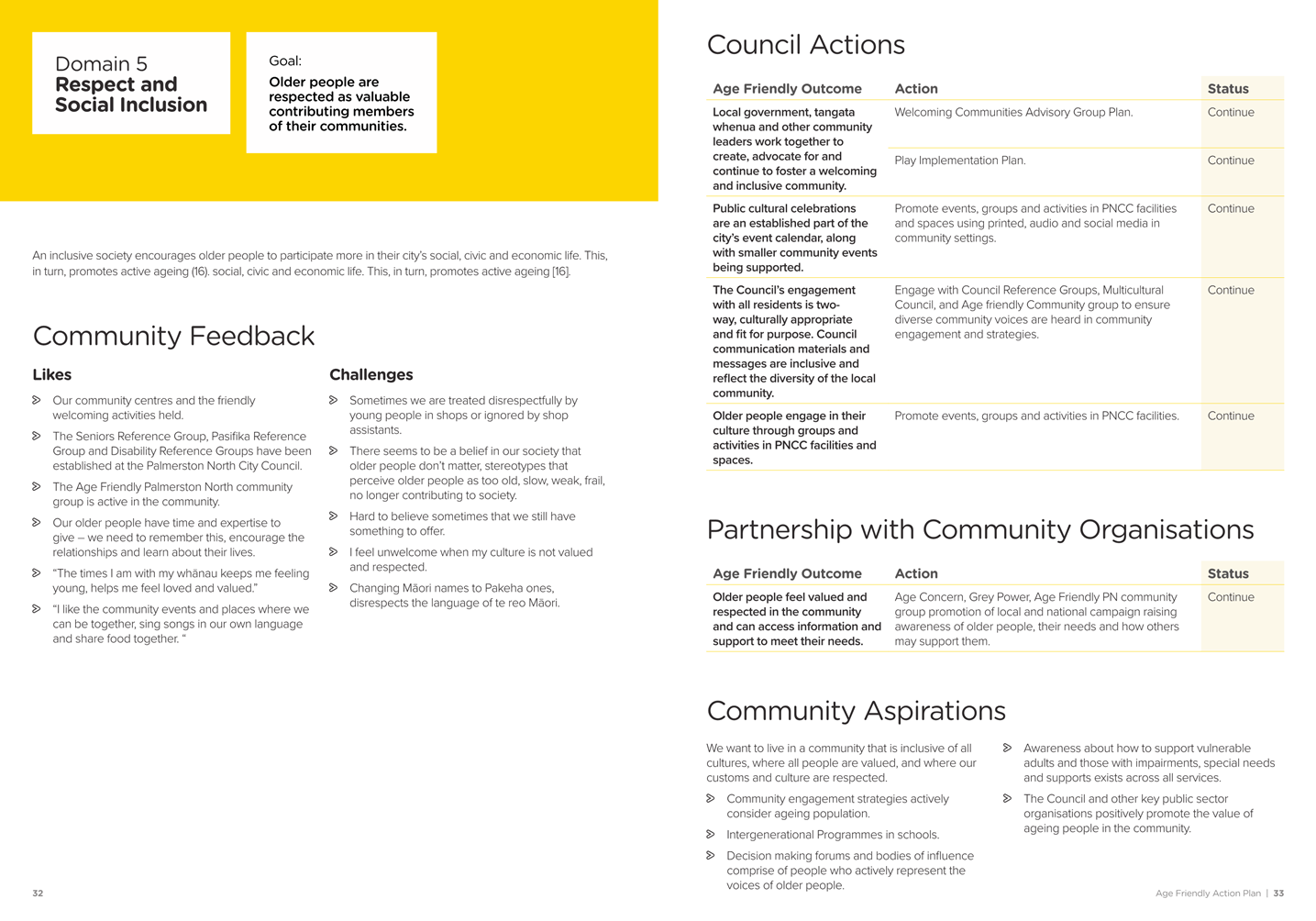
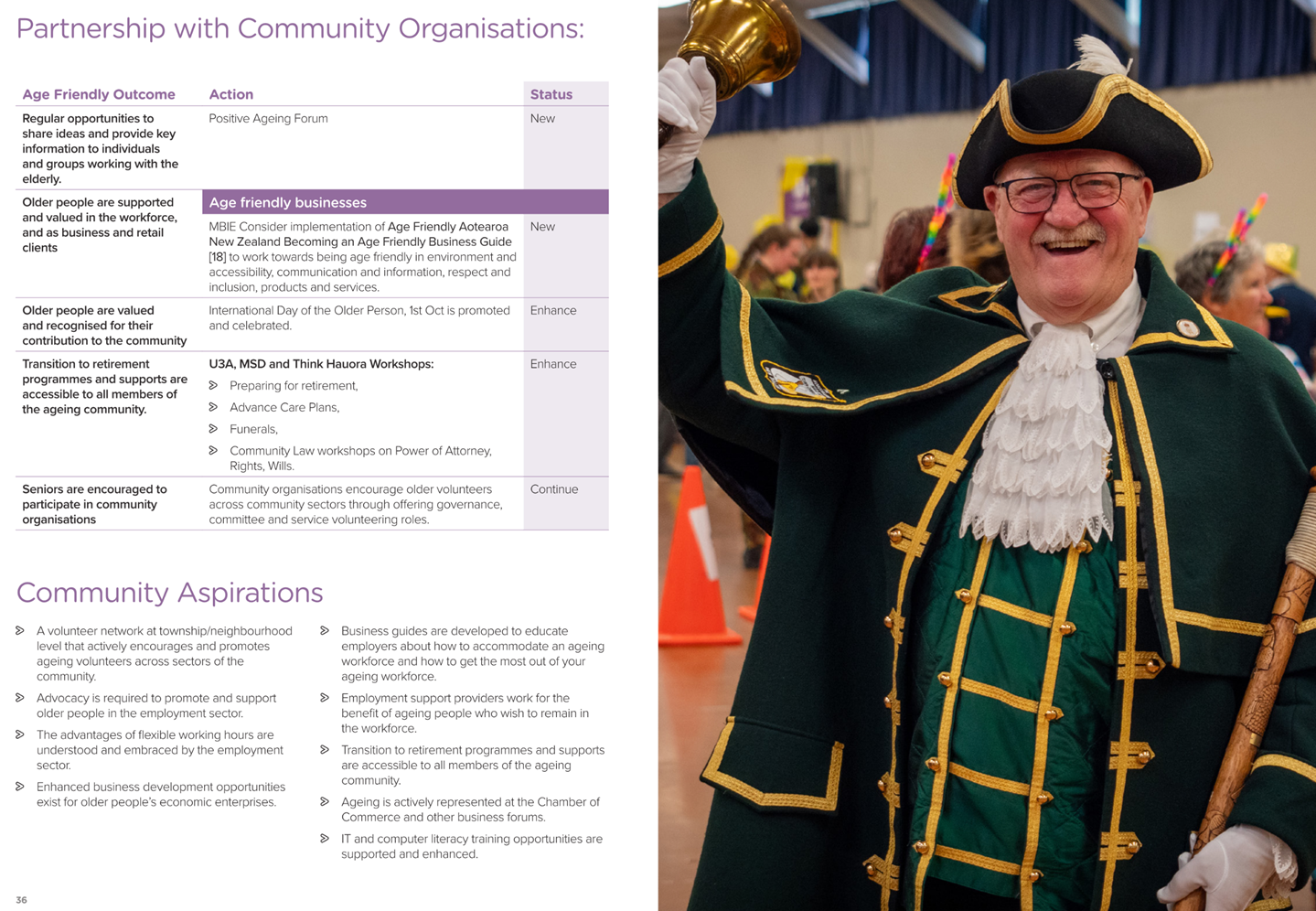
2.12 The Action
Plan has identified age friendly actions that Council could deliver as either
an existing activity that will continue in its current form (Continue), an
existing activity that will be enhanced to reach more people and increase its
impact (Enhance) or a new action that is not already being undertaken (New).
2.13 While some
actions may be achieved by approaching ongoing initiatives with an age friendly
lens, others will require direction from Council.
2.14 The Action
Plan provides a starting point for Palmerston North to become an Age Friendly
City and to respond to current needs. Specifically, it identifies actions
Council could directly deliver, through the Implementation Plan and for the
support of community aspirations outside of Council’s direct remit.
Outline of the community
engagement process
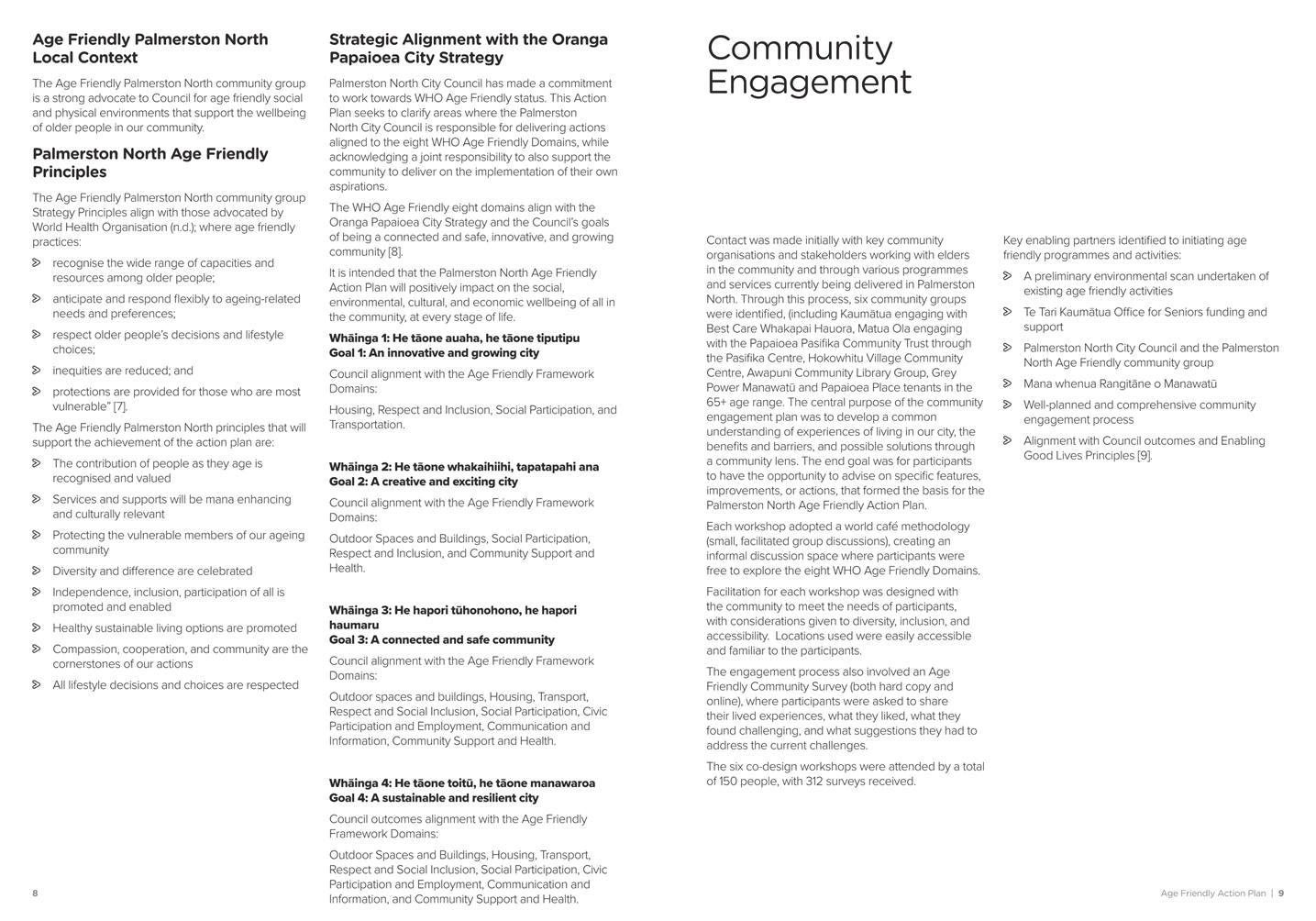
2.15 The basis
of the Palmerston North Age Friendly Action Plan was a community engagement
process over six co-design workshops and a community survey. The six co-design
workshops were attended by a total of 150 people, with 312 surveys received.
2.16 The
engagement followed a community-led development approach and the plan
established meaningful relationships with a wide range of key stakeholders
(mana whenua, community organisations and relevant community groups). Benefits
of the co-design process has meant that stakeholders have been involved in the
development of the Palmerston North Age Friendly Action Plan. Outlined details
of the community engagement methodology can be located in the appendix of the Age
Friendly Progress report to Council on 1 May 2024.
The strengths of the
community engagement process
2.17 Joining
the Age-Friendly Aotearoa Network, an inter-regional Council group consisting
of Ministry of Seniors and Age-Friendly Council staff nationally. This required
an initial stocktake of what was already being done as an age-friendly
community.
2.18 Building
on the successful initial application to join the network, it was important to
take time to learn what other Councils had committed to in becoming an
Age-Friendly Community and the process they followed.
2.19 Having a
pre-workshop period of engagement with community providers, to connect with
organisations, learn about the characteristics and needs of their communities
and their current service provision.
2.20 The
guidance and input from Melissa Hemi, Kaihanga Kaha for Opal Community &
Kaumātua Services Coordinator was invaluable in the development of the
engagement process, and key in ensuring that the PNCC Age-Friendly Co-Design
Kaumātua Workshop honoured the partnership between Palmerston North
City Council and mana whenua Rangitāne o Manawatū.
2.21 Facilitation
for each workshop was designed with the community to meet the needs of
participants, with considerations given to diversity, inclusion, and accessibility.
Locations used were easily accessible and familiar to the participants. Each
workshop adopted a world café methodology (small, facilitated group
discussions), creating an informal discussion space where participants were
free to explore the eight WHO Age Friendly domains.
2.22 The
purpose of the workshops was to develop a common understanding of how people
experience living in our city, the benefits and barriers, and possible
solutions. The end goal was for participants to advise on
specific features, improvements, or actions, that formed the basis for the
Palmerston North Age Friendly Action Plan.
2.23 For the
Matua Ola workshop with the Pasifika community, groups were placed according to
the Pasifika community represented, with a language translator for each
(Tongan, Samoan, Cook Island and Niuean). Key to the Matua Ola engagement, was
the Talanoa process starting with a tatalo (prayer), time to share
ideas and experiences of what was important to them, Matua Ola feeling heard
and listened to, cultures being valued and respected and sharing food together.
Weaknesses of the community
engagement approach
2.24 Limitations
in capacity meant that no workshops were held in rural areas, and there was
limited representation from Retirement Villages and Rest Homes in the survey
undertaken. One rest home and three retirement villages were visited, to offer
an opportunity to participate in the survey.
2.25 Rural
communities engaged through their local community library, where the initial
interest shown in the survey did not result in many surveys being returned.
Key findings
2.26 Key
findings have highlighted areas directly related to the work of Council, areas
Council may have influence to advocate and areas that are outside of the work
of Council. Workshop participants and survey respondents recommended actions
that centred on the need for an age-friendly and disability-friendly lens (that
is mana enhancing and culturally relevant) to be applied to all of
Council’s services and city planning.
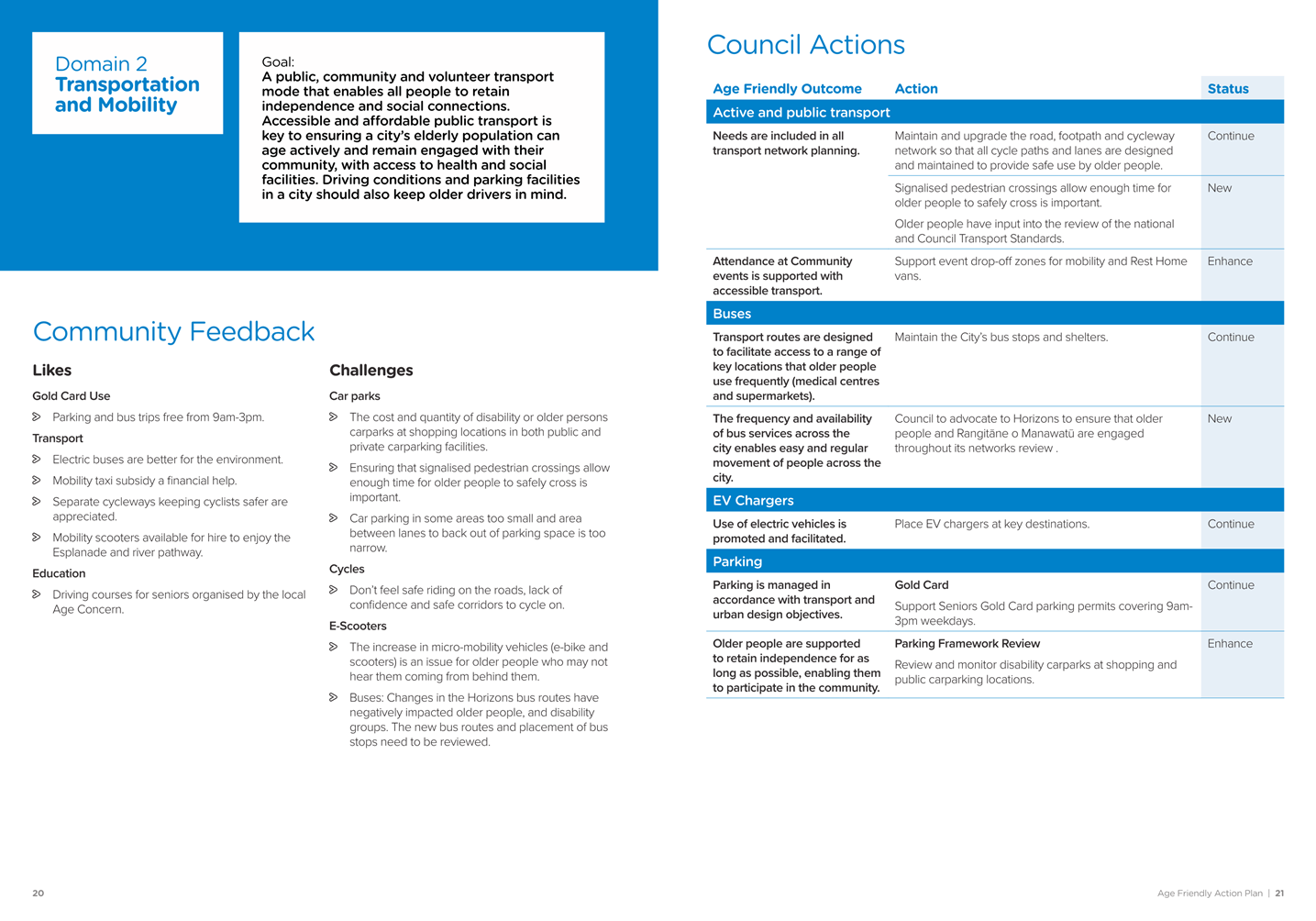
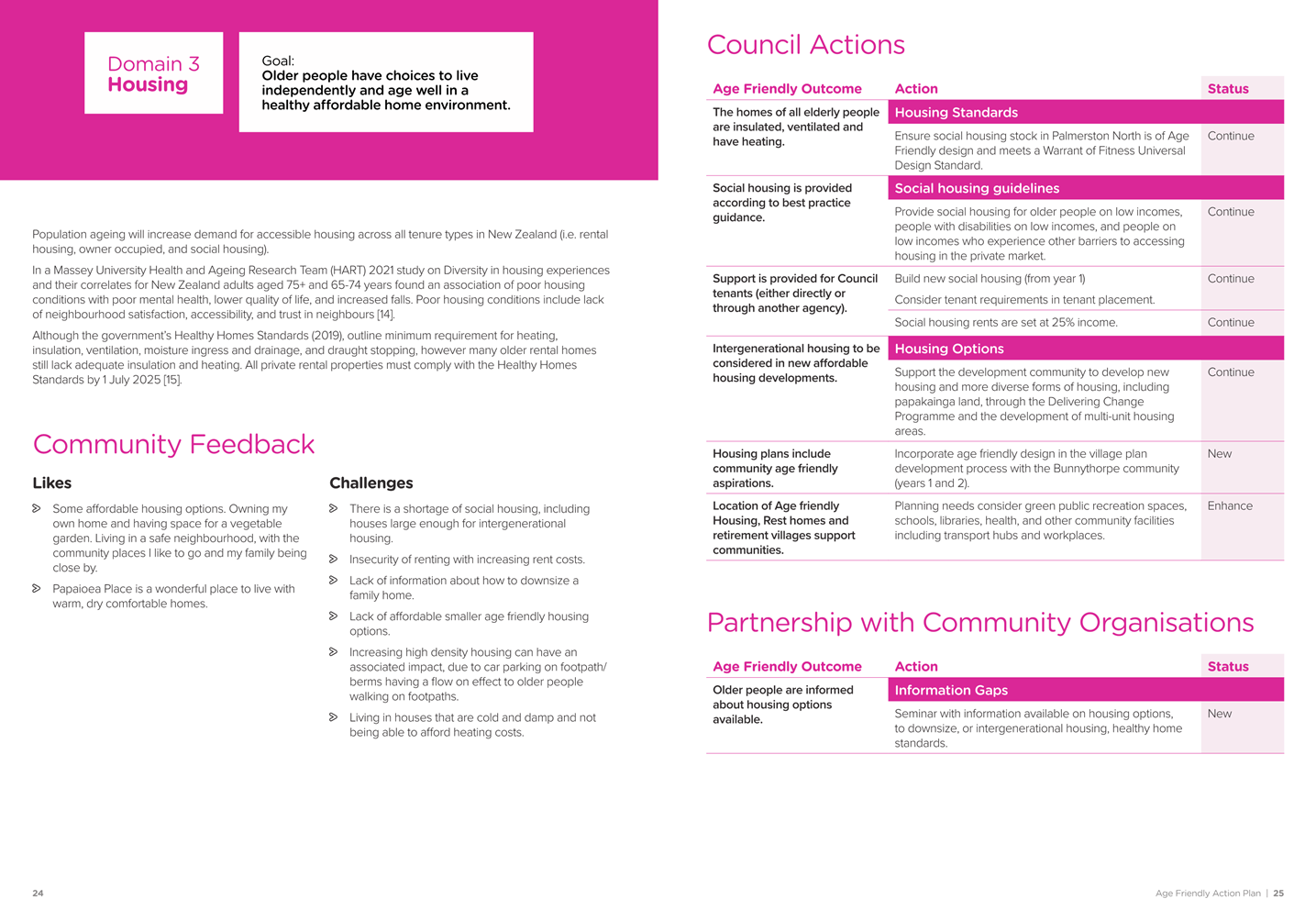
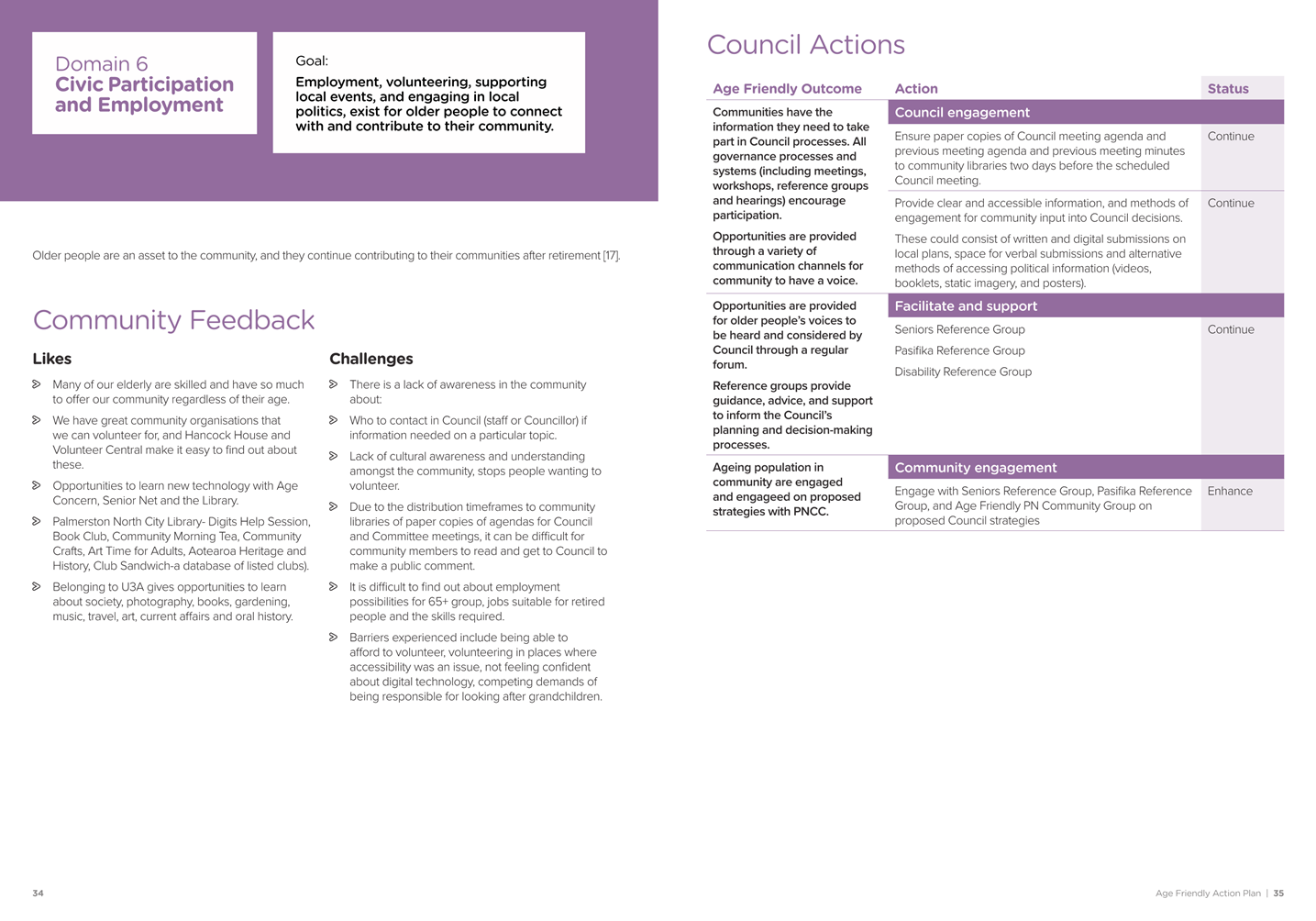
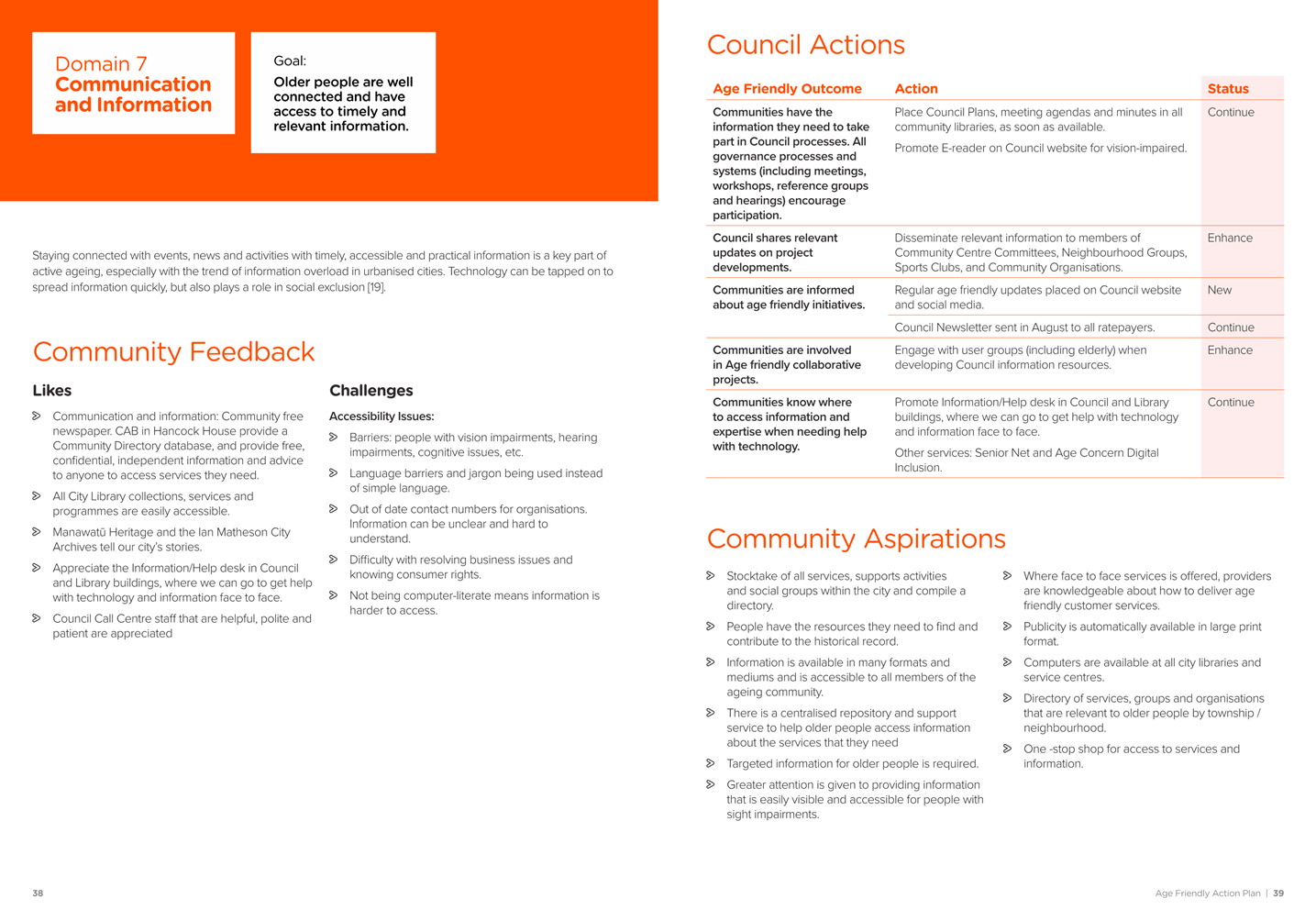
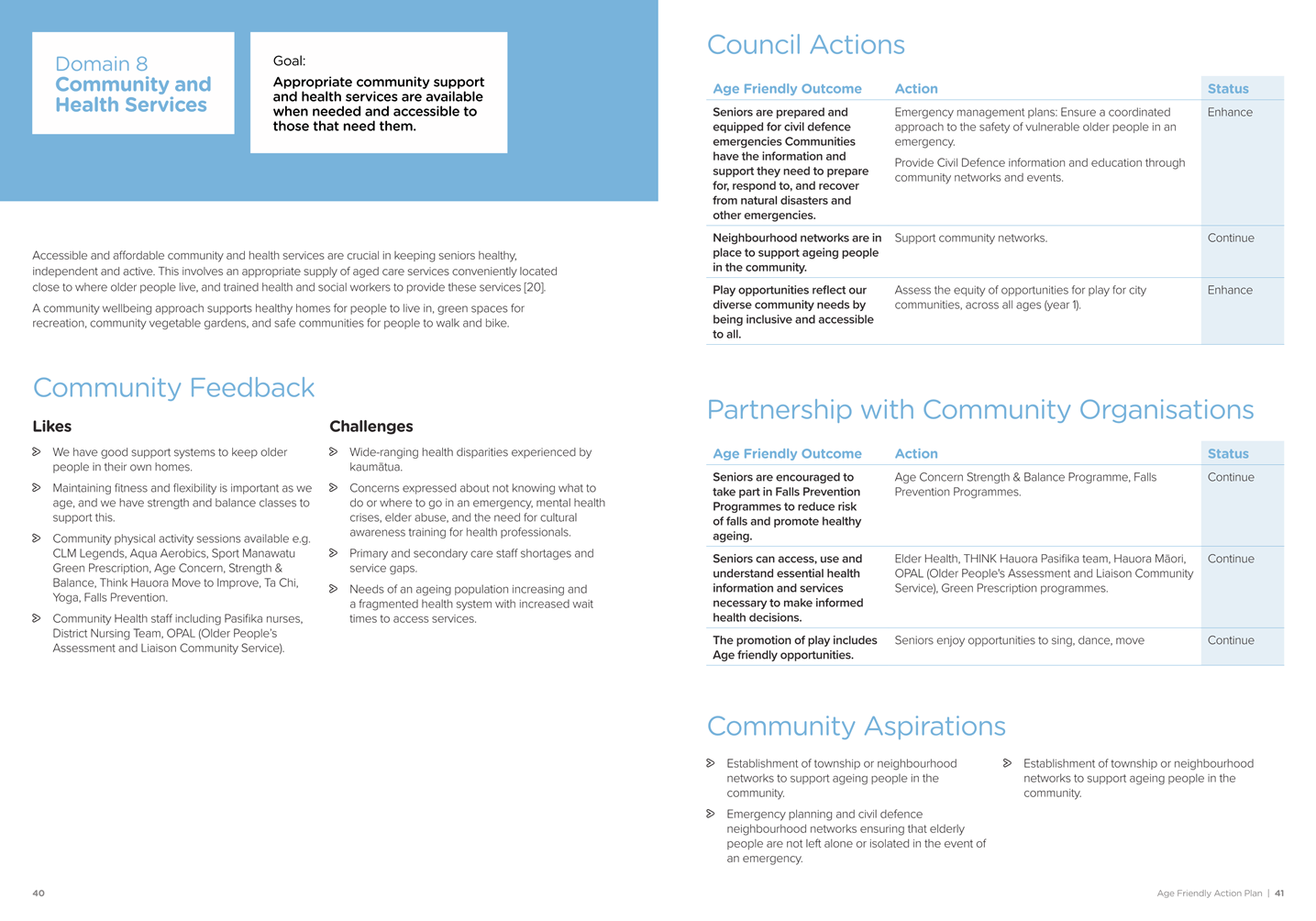
2.27 Key themes
that emerged from all workshops included concerns with transport, housing,
accessibility, social isolation, health, a need for connected, inclusive
communities and clear, accurate, user-friendly and relevant information that
was appropriate to an age-friendly audience.
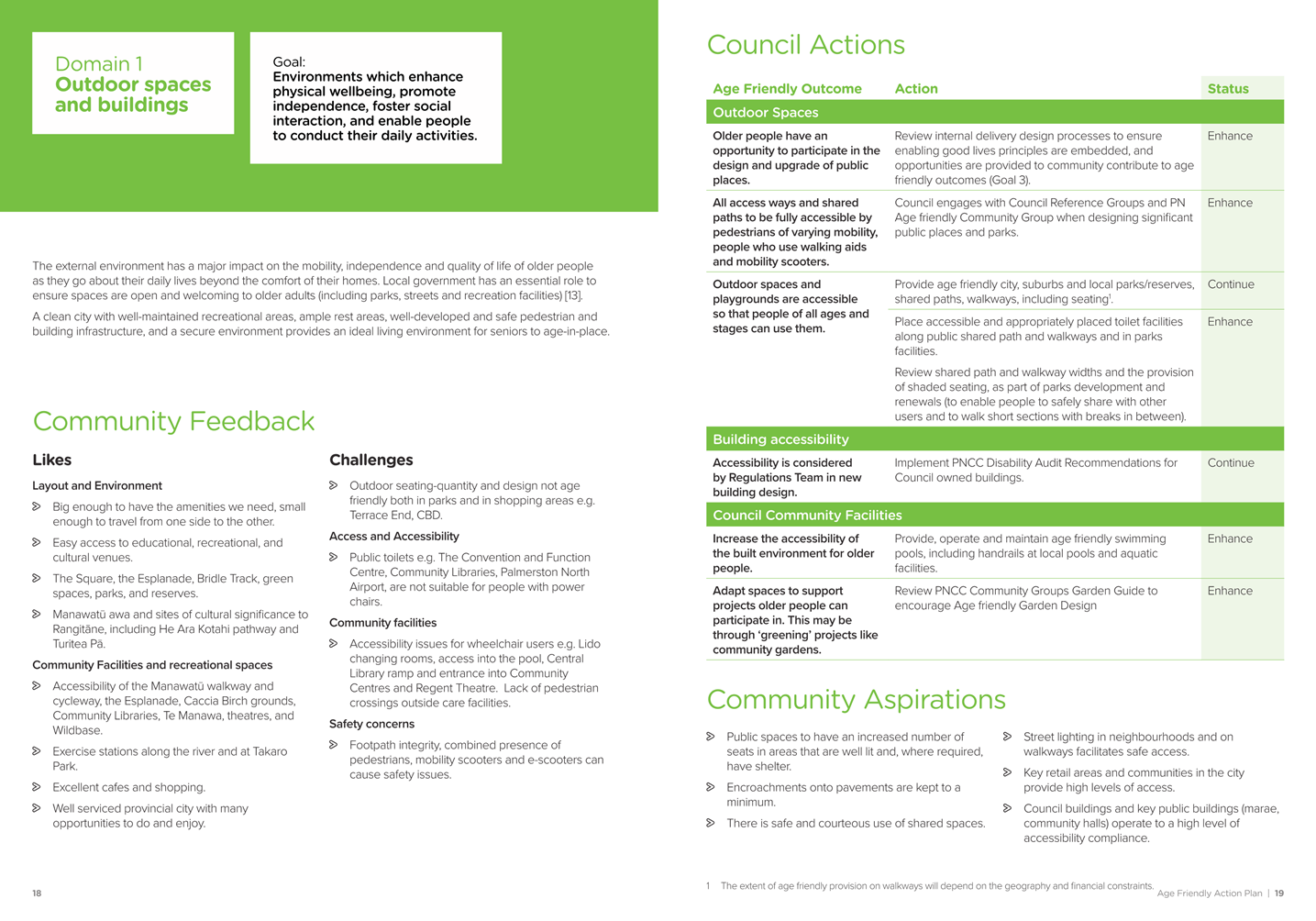
2.28 Concerns
were raised in the Age Friendly community workshops of difficulties accessing
stairs and ramps into public buildings and that outdoor seating was not
suitable for older people when at an inadequate height and clearance space, and
missing backrests. Concerns about footpath safety were also expressed, where
regular Council footpath maintenance was needed to address broken footpaths and
tree roots impacting on the integrity of the footpath. Further feedback from
the workshops can be located in the appendix of the Age
Friendly Progress report to Council on 1 May 2024.
Demographics
2.29 Population
projections detailed within the Palmerston North Age Friendly Action Plan
signal an ageing population in Palmerston North which will have an impact on
citywide planning for this sector. In the next decade there will be more older
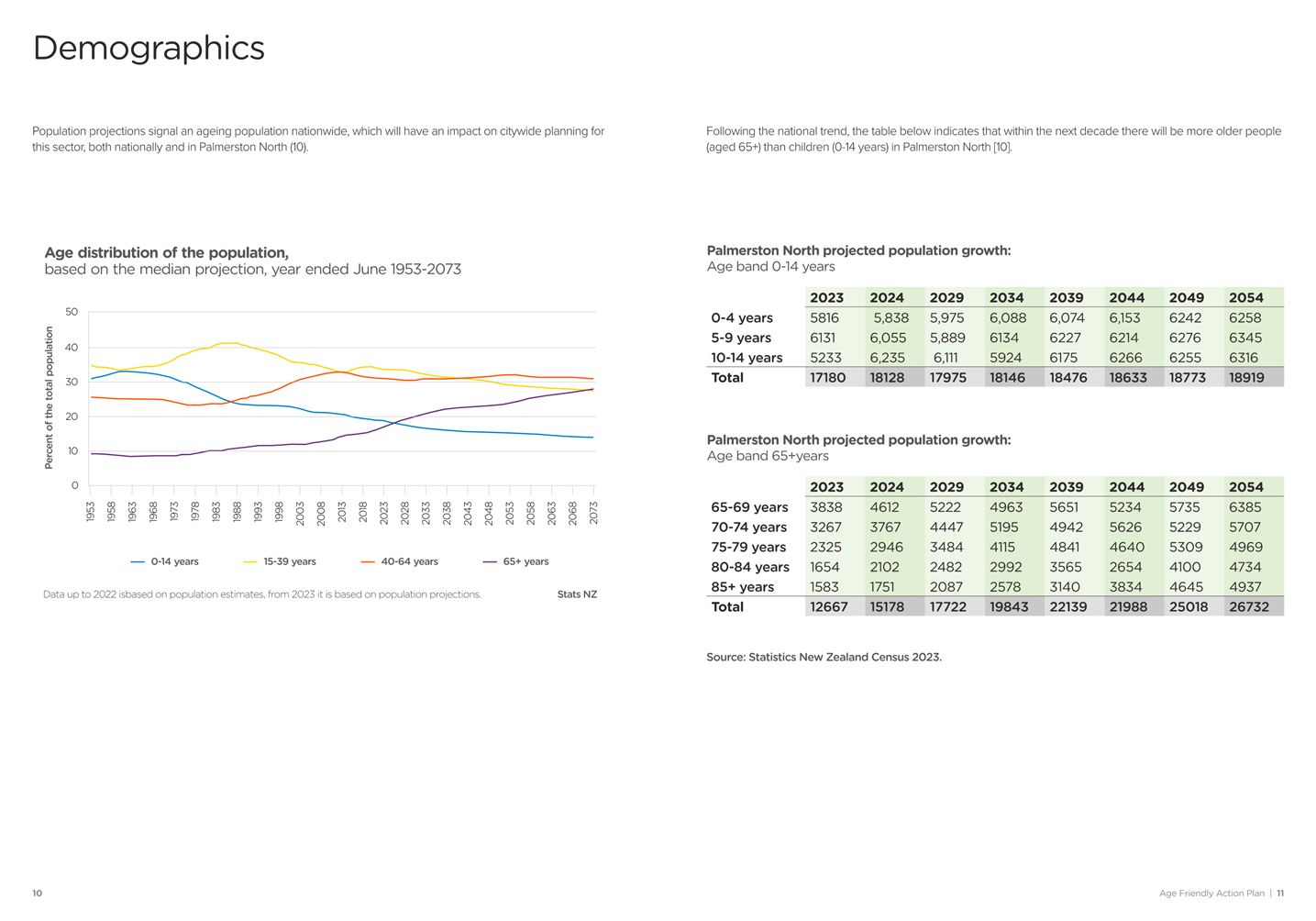
people (aged 65+) than children (aged 1-14) in Palmerston North.
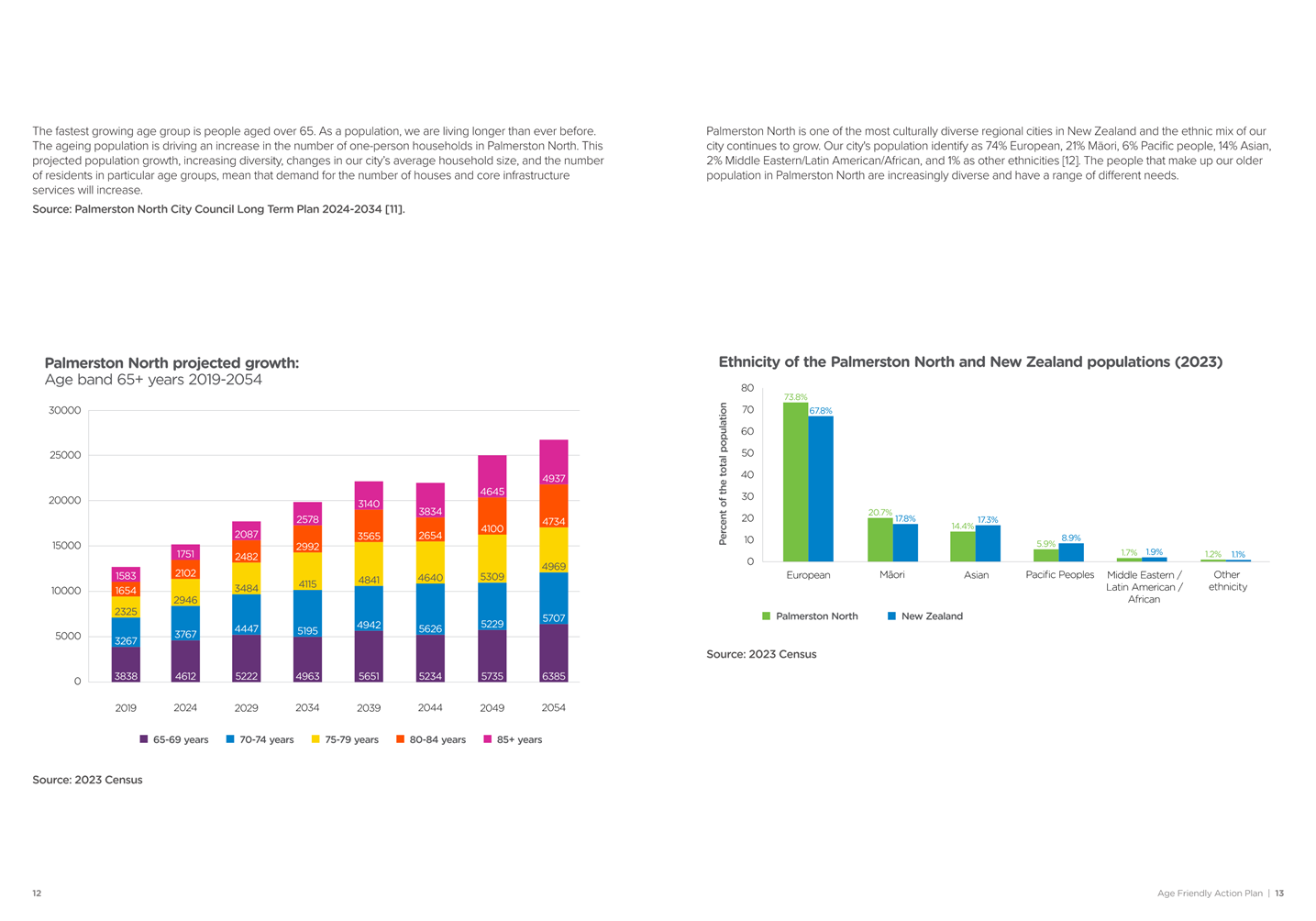
2.30 The
fastest growing group is people aged over sixty-five. The ageing population is
driving an increase in the number of one-person households in Palmerston North.
This projected population growth, increasing diversity, changes in our
city’s average household size, and the number of residents in particular
age groups, mean that demand for the number of houses and core infrastructure
services will increase. More information regarding both Council and Census data
can be accessed through the Action Plan.
Strategic Alignment
2.31 The
Age-Friendly Action Plan delivers on strategic aspirations within the current
Community Support Plan, Transport Plan, Urban Design Plan, Housing Plan
and Social Housing Guidelines. Council goals align with the WHO Age Friendly
Principles and 8 Domains (outlined on page 5 & 6 of this report):
Whāinga
1: He tāone auaha, he tāone tiputipu PNCC Goal 1: An innovative and growing city
· A city that
fosters pride, and supports the aspirations of people and communities
· Safe and
affordable transport options for people.
Goal 1 aligns
with the Age Friendly Framework Domains of Housing, Respect & Inclusion,
Social Participation, and Transportation.
Whāinga
2: He tāone whakaihiihi, tapatapahi ana
PNCC Goal 2: A Creative and Exciting City
· City that connects
people and where creativity is built into our cityscape
· Arts and cultural
facilities that are well supported and invested in
· Our unique heritage
preserved and promoted
· Opportunities to
celebrate our many cultures
· Access to
well-managed events and activities throughout the city and our neighbourhoods
· Places across the
city and its neighbourhoods for communities to participate in play and
recreation.
Goal 2 aligns
with the Age Friendly Framework Domains of Outdoor Spaces and Buildings, Social
Participation, Respect & Inclusion, and Community Support and Health.
Whāinga
3: He hapori tūhonohono, he hapori haumaru
PNCC Goal 3:
A connected and safe community
· Access
to services and facilities that are inclusive and appropriate for needs
· The
support they want to live healthy lives
· Access
to healthy and affordable housing
· Opportunities
to contribute to the design of their city.
Goal 3 aligns
with the Age Friendly Framework Domains of Outdoor space and buildings,
Housing, Transport, Respect and Social Inclusion, Social Participation, Civic
Participation & Employment, Communication & Information, Community
Support and Health
Whāinga 4: He tāone
toitū, he tāone manawaroa
PNCC Goal 4: A
sustainable and resilient city
· A resilient city and communities, prepared for the
impacts of climate change.
Goal 4 aligns
with the Age Friendly Framework Domains of Outdoor Spaces and Buildings, Housing,
Transport, Respect and Social Inclusion, Social Participation, Civic
Participation & Employment, Communication & Information, and Community
Support and Health.
3. Description of options
Option One
3.1 Option
1 would see the endorsement of the Palmerston North Age
Friendly Action Plan and a total budget allocation of $80K, including $30K
of existing implementation budget (already allocated in the Long-Term Plan) and
an additional $50K per annum .5 FTE for an Community Development Advisor
– Age Friendly to:
· guide
the Council’s commitment to be an age friendly city;
· develop
a Palmerston North Age Friendly Implementation Plan; and to
· coordinate
the internal and external implementation of actions from that plan
3.2 Feedback
from community partners and stakeholders demonstrates support for this
direction to be supported by Council.
3.3 Funding
a .5 FTE for the Community Development Advisor Age Friendly role will ensure a
continuation of the work to date and the development of a coordinated Palmerton
North Age Friendly Implementation Plan, ongoing wider community engagement, and
will confirm Council’s commitment to be an Age Friendly City.
3.4 The
Palmerston North Age Friendly Action Plan delivers on strategic aspirations
within the current Community Support Plan, Transport Plan, Urban Design
Plan, Housing Plan and Social Housing Guidelines.
3.5 $30,000
annually has been budgeted through the Long-Term Plan for implementation only.
Option Two
3.6 Option
2 would see the endorsement of the Palmerston North Age Friendly Action Plan
and approval for the reallocation of the existing $30K of implementation budget
towards a .3 FTE Community Development Advisor -Age Friendly, for the
development of an Age Friendly Implementation Plan.
3.7 Similar
to Option 1, by funding a .3 FTE for the Advisor role, Council will ensure a
continuation of the work to date and the development of a coordinated Palmerton
North Age Friendly Implementation Plan, ongoing community engagement, and a
confirmation of Council’s commitment to be an Age Friendly City.
Option Three
3.8 The
Palmerston North Age Friendly Action Plan is endorsed, and Council does not
approve the reallocation of the existing $30K of implementation budget towards
.3 FTE for a Community Development Advisor - Age Friendly.
3.9 In
this option, Council maintains the status quo of the $30K implementation budget
allocated in the Long-Term Plan with no FTE allocation towards a role.
3.10 Option 3
could result in a scaled back delivery of actions as there would be no dedicated
role within Council towards the development of an Age Friendly Implementation
Plan or to engage with internal and external stakeholders on the delivery of
that plan.
3.11 This
option carries no financial risk or benefit as the budget has been allocated.
3.12 Option 3
has potential for reputational risk against expected delivery.
Option Four
3.13 The
Palmerston North Age Friendly Action Plan is not endorsed by Council and
the Implementation Plan is not developed to deliver the actions outlined in the
plan.
3.14 There are
financial benefits identified for this option for Council as the $30K allocated
for age friendly implementation could be reallocated to other activities,
however the budget has already been adopted in the Long-Term Plan.
3.15 The age
friendly work would not continue, which carries reputational risk should this
option be chosen.
4. Analysis of options
Option One
4.1 Option
1 represents the greatest opportunity for community impact and to achieve
Council’s goal to achieve WHO Age Friendly status and to maintain
membership to Age Friendly Aotearoa New Zealand (AFANZ).
4.2 Option
1 also best addresses the predicted needs of the increasing ageing population
of residents aged 65+ years and increasing urbanisation.
4.3 $30,000
has been allocated in the Long-Term Plan budget from Years 1-10 for the
implementation of the Palmerston North Age Friendly Action Plan. There are a
significant number of Actions outlined in the report. While many of the actions
are outlined to continue, many of these actions require an age friendly
advocate to ensure that an age friendly lens is applied. Outlined in the Action
Plan are multiple actions across 8 Age Friendly Domains.
4.4 Option
1 has additional financial cost to Council that are not budgeted for in the
Long-Term Plan. At the time of the Long-Term Plan deliberations, the Action
Plan and associated recommendations were not complete, which meant that the
resource implications were not fully understood in time for inclusion in the
Long-Term Plan.
Option Two
4.5 Under
this option, an Advisor would be able to progress the implementation of the Age
Friendly actions both internally, across divisions of Council and externally,
with community stakeholders.
4.6 Under
this option, budget to implement the actions will have been reallocated to FTE,
so the financial cost of the delivery of all specific Council actions will need
to be considered within each existing budget or be considered in future annual
budgeting planning.
4.7 While
there is no additional financial cost to Council, the development of the Age
Friendly Implementation Plan would be progressed at a slower rate.
4.8 Some
community projects, initiatives or events may be considered for grant funding,
if eligible (for example a Seniors Forum may be eligible for funding through
the Community-led Initiatives Fund should the event be community-led by a
relevant community organisation).
4.9 The
Office for Seniors has a fund available for the initial work of becoming an Age
Friendly City. The fund supports organisations with grants between $5,000 to
$15,000. The funds may be used for operational costs related to the development
of a strategy or plan, and/or the implementation of new projects or initiatives
in support of a strategy or plan.
4.10 Council
was successful in receiving $5,000 of funding in November 2023 from this fund.
Council will be eligible again in 2026 to apply to this fund for implementation
and initiative costs. The fund opens annually in August/September and officers
will apply again when eligible in 2026.
4.11 Community
views have not been sought for this option, however key stakeholders have
advocated to Council for a commitment to be an Age Friendly City and for
Council to maintain a dedicated position to progress this work.
4.12 Option 2 is
the option that is recommended by officers, as it will provide some scope to
implement actions, within existing budgets.
Option Three
4.13 There is
some risk that work across the 8 Age Friendly Domains outlined in the report
will not sustain an age-friendly lens without a role dedicated to the delivery
of the work and that the actions will be difficult to implement.
4.14 If
Option 3 is chosen, then each group or division within Council will need to
consider how they could best develop and implement the recommended age friendly
actions in the plan relevant to the 8 Age Friendly Domains. How this will be
communicated to community will need to be established. Under this option,
Community Development Advisors would continue to provide support for community
organisations to access community funding and develop community-led projects,
initiatives and events.
4.15 There is a
risk that relationships with key community partners and stakeholders could be
impacted by a perceived reduction in commitment by Council.
4.16 However, this
option also has no budget implications and allows for the continuation of the
work and Council will continue to demonstrate a financial commitment to Age
Friendly membership and to the implementation of the actions in the plan.
Option Four
4.17 There is a
financial benefit to Council from budget of $30K that has already been
allocated for Age Friendly implementation in Years 1-10 of the Long-Term Plan
being allocated to another activity.
4.18 With this
option there is a risk that relationships with key community partners,
stakeholders as well as the wider 65+ community could be damaged by the
perception that Council has gone back on the committed already undertaken.
4.19 Community
feedback shows support for an Age-Friendly commitment and action to be provided
by Council and Council has already demonstrated a commitment to be an Age
Friendly City through the Long-Term Plan budget and the Oranga Papaioea City
Strategy.
5. Conclusion
5.1 As
a result of the co-design process, the draft Action Plan has been completed.
The Action Plan is designed to provide a road map for Council and the community
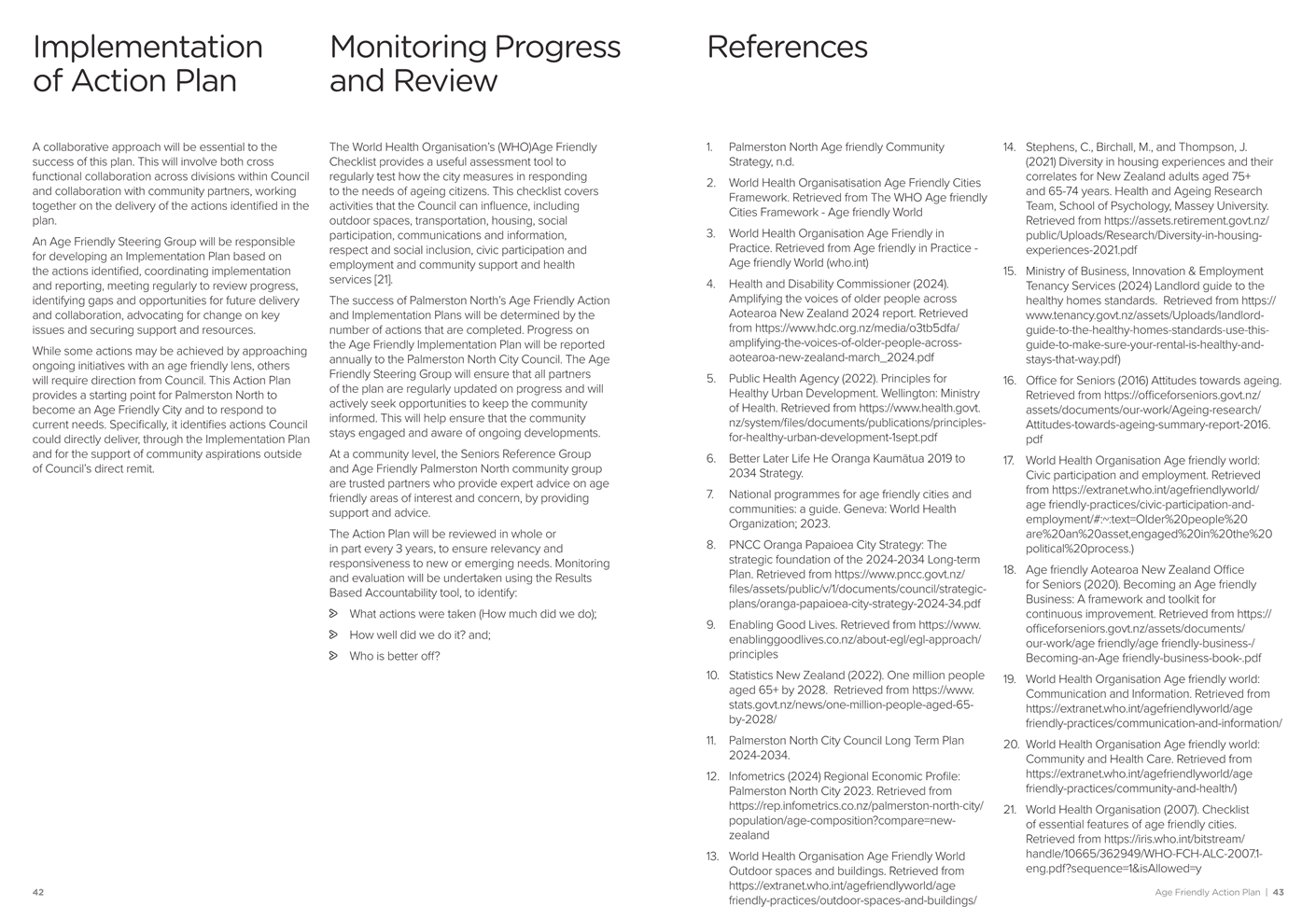
to progress towards becoming an Age Friendly City.
5.2 Palmerston
North City Council has made a commitment to further work towards WHO Age
Friendly status. The ongoing process to become Age Friendly does not involve an
end point achievement of a status or accreditation, rather it includes a
commitment to the ongoing process and membership.
5.3 Therefore,
there are no set requirements for Council to maintain membership status to Age
Friendly Aotearoa New Zealand (AFANZ). AFANZ provides recommendations and
guidance to member local authorities. The actions outlined in the Action Plan
are self-identified by Council officers following the community engagement
process.
5.4 The
Palmerston North Age Friendly Action Plan seeks to clarify areas where the
Palmerston North City Council is responsible for delivering actions aligned to
the eight WHO Age Friendly domains. Specifically, it identifies actions Council
could directly deliver, through the Implementation Plan, while acknowledging a joint responsibility to also support
the community to deliver on the implementation of their own aspirations outside
of Council’s direct remit.
5.5 Success
of the Palmerston North Age Friendly Action Plan will depend on an age-friendly
lens being incorporated into Council services and planned developments. While
some actions may be achieved by approaching ongoing initiatives with an age
friendly lens, others will require direction from Council.
5.6 The
stepped development process outlined above demonstrates that
Council’s Age Friendly programme development is currently sitting at
Stage 3 of 5 stages, where community engagement has been completed and
evaluated, an internal staff working group has been established to consider
community engagement feedback, an Action Plan has been completed for
endorsement and we are ready to move to Step 4, to develop an Implementation
Plan.
5.7 Given
all of the information detailed above, officers recommend proceeding with
Option 2. Although Option 1 represents the greatest opportunity for community
impact and to achieve Council’s goal to achieve WHO Age Friendly status,
it also carries additional financial cost, with a total budget allocation
of $80K. Option 2 still enables Council to continue to progress the age
friendly work towards the implementation of actions and it carries no further
unbudgeted financial cost to Council.
5.8 Option
2 provides adequate resourcing to enable the full development of an Age
Friendly Implementation Plan and the execution of that plan within realistic
timeframes.
6. Next actions
6.1 If
Option 1 or 2 is chosen, then an Age Friendly steering group will be
responsible for developing an Implementation Plan based on the actions
identified, coordinating implementation and reporting, meeting regularly to
review progress, identifying gaps and opportunities for future delivery and
collaboration, advocating for change on key issues and securing support and
resources.
6.2 A
collaborative approach will be essential to the success of this plan. This will
involve both cross functional collaboration across divisions within Council and
collaboration with community partners, working together on the delivery of the
actions identified in the plan. At a community level, the Seniors Reference
Group and Age Friendly Palmerston North community group are trusted partners
who provide expert advice on age friendly areas of interest and concern, by
providing support and advice.
6.3 The
Age Friendly Programme aligns with work currently being undertaken by Council
including the:
a. the Accessibility Audit and the future work of the
Accessibility Charter
b. endorsement of the Enabling Good Lives
principles
c. commitment to the Urban Design
Protocol.
The Accessibility Audit of Council-owned buildings
highlighted that some buildings or part of the building are inaccessible or
limitedly accessible. This is an issue for both the aged community and for
those living with disabilities.
6.4 In
the development of a Palmerston North Age Friendly Implementation Plan,
officers will continue to look at opportunities to align the plan with these
three areas.
6.5 If
Option 3 is chosen, then each group within Council will need to consider how
they could best develop and implement the recommended actions in the plan
relevant to the 8 Age Friendly Domains. How this will be communicated to
community will need to be established.
6.6 If
Option 4 is chosen, then no further actions will be taken, other than to
feedback to community partners and stakeholders.
7. Compliance and administration
|
Does the Committee have
delegated authority to decide?
If Yes quote relevant clause(s)
from Delegations Manual
|
No
|
|
Are the decisions significant?
|
No
|
|
If they are significant do they
affect land or a body of water?
|
No
|
|
Can this decision only be made
through a 10 Year Plan?
|
No
|
|
Does this decision require
consultation through the Special Consultative procedure?
|
No
|
|
Is there funding in the current
Annual Plan for these objectives?
|
Yes
|
|
Are the recommendations
inconsistent with any of Council’s policies or plans?
|
No
|
|
The recommendations contribute
to:
Whāinga 3: He hapori tūhonohono,
he hapori haumaru
Goal 3: A connected and safe
community
|
|
The
recommendations contribute to the achievement of objective/objectives
in:
7.
Mahere tautāwhi hapori
7. Community Support Plan
The objective is: Support
for-purpose organisations and communities of interest and deliver programmes
to promote community wellbeing. Specific action: Participate in the World
Health Organisation’s (WHO) Age-friendly Cities and Communities
programme.
|
|
Contribution to strategic
direction and to social, economic, environmental and cultural well-being
|
The
Age-Friendly Action Plan delivers on strategic aspirations within the current
Community Support Plan, Transport Plan, Urban Design Plan, Housing Plan
and Social Housing Guidelines, and Council Goals 1, 2, 3 and 4.
|
|
|
|
Attachments
|
1.
|
Palmerston
North Age Friendly Action Plan ⇩ 
|
|
Memorandum
TO: Community
Committee
MEETING DATE: 23
October 2024
TITLE: Summary
of Community Funding Allocations 01/07/2023 - 30/06/2024
Presented
By: Cindy
Nguyen, Community Development Advisor, and Amy Viles, Manager Community
Development
APPROVED BY: Danelle
Whakatihi, General Manager Customer & Community
RECOMMENDATION TO Community Committee
1. That the Committee receive the report titled ‘Summary of
Community Funding Allocations from 01/07/2023 - 30/06/2024’ dated
23 October 2024.
1. ISSUE
1.1 Council wishes to see an annual overview of all community
funding.
2. BACKGROUND
1.2 Palmerston North depends on having a capable and
sustainable community and voluntary sector to support a connected, safe and
vibrant community. To this end, the Council funds a wide range of community
groups, organisations and individuals via several contestable
initiative-specific and outcomes-focused grant programmes.
1.3 In May 2021, as a result of the Business Assurance Review
of community grants and events funding, it was determined that a yearly report
on the performance of all grants be presented to the Council with
recommendations for change where applicable.
1.4 This is the fourth yearly report.
1.5 This report has been prepared by Community Development
team, with input from Council’s Events, Marketing, Resource Recovery,
Youth Services, and Strategic Planning teams, as well as Te Pū Harakeke
and Sport Manawatū.
3. DISCUssion
Overview
3.1 This
report will provide information and analysis on the performance of
Council’s community funding programmes delivered in the 2023/2024 financial
year.
3.2 The
funding programmes (also referred to as Grants or Fund) included in this report
are:
a. Strategic Priority
Grants
b. Community-led
Initiatives Fund
c. Community Development
Small Grants Fund
d. Community Training
Fund
e. Creative Communities
Scheme
f. Arts Event
Fund
g. Major Events Fund
h. Sports Event
Partnership Fund
i. Sponsorship
Funds
j. Natural and
Cultural Heritage Incentive Fund
k. Palmerston North Youth
Council Scholarships and Grants Fund
l. Resource Recovery
Fund
m. Active Communities
Fund
Graph 1 below shows the overview
of funding programmes and their budgets in this report.
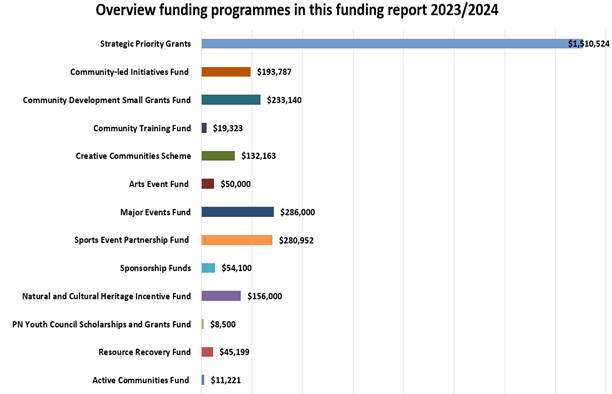
Graph 1
3.3 This
report will provide an overview of each fund for the
2023/2024 financial year, comment on
trends seen over the previous three years of the funding programme where
applicable, and comment on the future of each fund.
3.4 Following the overview by the fund, this report will
provide insight into overall themes across the funding programmes.
Context
3.5 Contestable
community funding is a tool used to support community development, as a
mechanism to devolve resources into the community to support community-led
activity. For the Council, other benefits of grant funding processes include
facilitating interactions between the Council and the community as
opportunities to build relationships, providing the Council with intel via
applications and reporting as to the challenges and opportunities present in
communities, and providing capability-building opportunities for the community
sector. A common challenge of contestable community funding approaches is
oversubscription, with demand outstripping supply, particularly as community
and voluntary sectors grow in size and capability. As the Council cannot afford
to fund all requests, staff draw on guidelines, policy and expertise to
prioritise available funding. Staff also use a range of other tools to support
capacity and capability building in the community and voluntary sector.
3.6 In
2018, Council began moving funding administration to the cloud-based software
SmartyGrants. This saves both Council and grant recipients time and resources,
allowing the Council to focus on getting the best outcomes for the community.
It also ensures staff can easily access application data and preserve
information for the future. There are now 17 active
funding programmes administered on this software.
3.7 The
policy guiding the administration of Council’s funding programmes is the Support and Funding Policy 2022, which was endorsed by
the Council in April 2022.
3.8 It is noted that this report includes a snapshot only of
the Active Communities Fund, and the Sports Event Partnership Fund, as detailed
information on these funds is reported on separately by Sport
Manawatū.
Information by fund
3.9 Strategic Priority Grants
(SPG)
Purpose: To activate the potential of the community sector to deliver
on the Council’s strategic direction, specifically Goals 2, 3 and 4,
through three-year funding agreements.
The Strategic Priority Grants (SPG)
programme is the Council’s largest funding stream available for the
for-purpose sector. With three-year funding agreements, it provides
organisations with a higher level of certainty in their operations than annual
or project-specific funding. It is also one of the few funding programmes
available for back-office costs, and many SPG recipients rely on this funding
to contribute to staff salaries and overheads.
Budget
2023/2024: $1,510,524
Allocation process: Once every
three years, a staff panel assesses SPG applications received via SmartyGrants
according to the criteria and principles in the funding policy. Due to demand
and the relative complexity of the applications, the allocation process
involves multiple steps, including initial individual staff assessments, a
small group assessment and ranking stage, and a full panel moderation
stage.
2023/2024
Year: This was the second year of the 2022/2025 three-year contract period. In
the first year, funding was allocated to 43 groups. However, funding
recipient Manawatū Reuniting Refugee Families Trust (MRRFT) ceased
operation in 2023 and their SPG funding allocation for years 2 and year 3 have
been incorporated into the Manawatū Multicultural Council (MMC)’s
Sector Lead funding allocation, to continue working with multi-ethnic
communities including refugees. MMC was assessed by staff to be best placed to
continue to deliver against the priority for refugee communities. Therefore,
from the second year of the Strategic Priority Grants round 2022/2025, there
are now 42 funded groups who have continued their SPG contracts into the final
year, including 7 sector leads: Community Arts Palmerston North Incorporated,
Creative Sounds Society Incorporated, Environment Network Manawatū,
Manawatū Multicultural Council Incorporated, Ora Konnect, Te Pū
Harakeke Community Collective Manawatū and Housing Advice Centre
(Palmerston North) Incorporated.
Performance data submitted by SPG
recipients this year continuously demonstrates the significant impact and role
the SPG recipient organisations, and their facilities and services, have on the
day-to-day lives of the community.
There were 7,089
‘services’ delivered, including programmes, events, projects,
workshops, engagement hui, and more. This figure is a significant increase on
the services delivered in the previous year (Graph 2). There was also an
increase in the total number of volunteers, from 1,528 volunteers in 2022/23 to
2,073 volunteers reported as supporting the activities delivered by the groups
during this year 2023/24, demonstrating a significant level of civic engagement
and community connectivity underpinned by these groups (Graph 2).
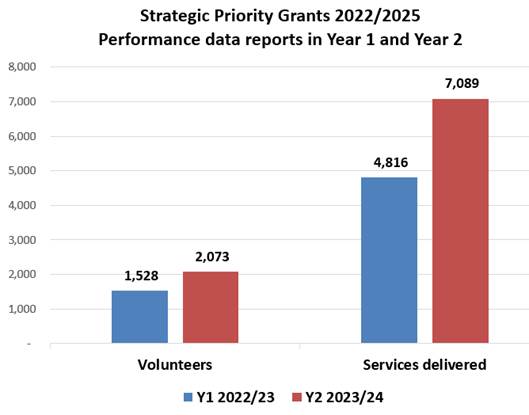
Graph
2
To date, 95% of all clients of
services we funded, reported being highly satisfied or satisfied with the
programme or service they received or participated in.
In terms of outcomes achieved, the
data shows that 92% of clients reported an increased sense of community
connection, 93% of clients reported an increase of confidence and/or that they
had gained new skills, knowledge and experience, and 96% of clients reported
that they had received information and advice to meet their needs (it is
important to note that not all organisations have all outcomes measured,
outcomes are measured relevant to the services delivered).
Sector
Leads: A review of Sector Leads trial was
presented to the Community Committee meeting on 22 November 2023. The
Council approved the continuation of the Sector Leads Partnership model in
principle, as per the Support and Funding Policy 2022, and noted that
appropriate budget would be established for Sector Lead partners within the
draft 2024-2034 Long-Term Plan.
Future
of the fund: As resolved in the 2024-2034
Long-Term Plan strategic outcomes, staff are currently running the new round
Strategic Priority Grants 2025-2028. The round opened 9 September to
4 November 2024. Results will be notified to applicants in March 2025. Sector
Lead organisations have completed performance reviews with staff and contract
negotiations will be undertaken within the same timeframe for the new round SPG
2025-2028.
3.10 Community-led Initiatives Fund
Purpose: To provide communities with the resources to
deliver their own small-scale community-led initiatives, including events and
projects, that will primarily benefit Palmerston North communities of identity,
place, or interest.
This fund is to support initiatives
provided by the community for the community. Open year-round, it gives Council
flexibility to support community-led initiatives as they emerge.
Budget 2023/24: $193,787
Allocation process: Applications are received via SmartyGrants, and assessed by a
panel of two officers, including a first full assessment and a second peer
review assessment.
2023/2024
Year: The Community-led Initiatives Fund
saw 32 eligible applications and 29 of these were successful with total
allocated amount of $183,144.
Epic
Music Foundation received the largest grant of $15,000 for the ‘Equitable
Music Tuition’ project - a community-based initiative which provides
itinerant music lessons at two primary schools in Palmerston North - Te Kura O
Takaro and Terrace End School over a 4-term period. The Palmy PRIDE programme
and City Mission Palmerston North’s parenting programme received grants
of $10,594 and $10,044 respectively, to support their initiatives in support of
rainbow communities and families. $1,350 was the smallest grant allocated to
support the Philippine Central Association to hold their ’Festival of Talents‘ bringing the diversity performances
together.
This year, it was pleasing to see a
continuation of the diverse number of applications seen in previous years
(Graph 3). The amount requested from this fund was over $250,000, doubling the
amount requested in the 2021/22 financial year (Graph 4).
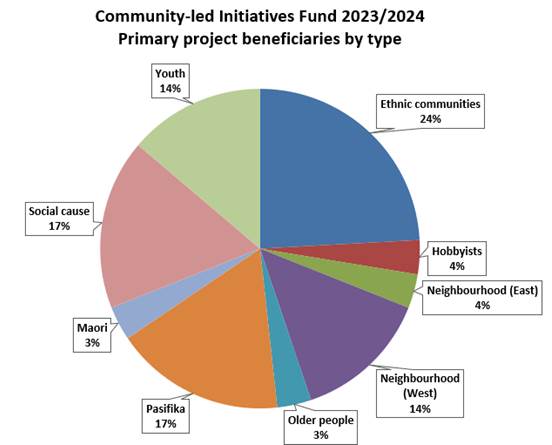
Graph
3
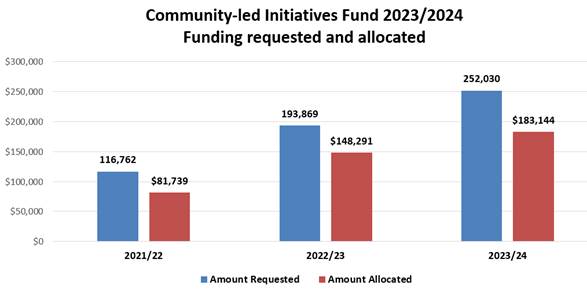
Graph 4
This year, the outcomes engine will
continue to be applied in the Community-led Initiatives Fund application form
and in the acquittal report, to assist in the evaluation of outcome
achievement.
To date, 16 successful recipients
have completed their funded initiatives and their acquittal reporting. The
reports show the initiatives funded made a strong contribution to
Council’s Goals 2 and 3 by: increasing whānau and community
connectedness, celebrating city diversity, providing opportunities for
communities to achieve their aspirations and to celebrate their culture. There
was a total of 6,950 attendees and 553 volunteers involved in the initiatives,
and 95% of attendees were satisfied with the initiative they participated
in.
Future
of the fund: Staff will continue to work
with community groups to develop new initiatives for funding and encourage a
diversity of applications.
3.11 Community
Development Small Grants Fund
Purpose: To provide funding for essential
administration expenses to enable local not-for-profit community groups to
operate.
Groups may apply for grants of up to $5,000 to cover costs related to audit or
financial review, communication, energy, insurance, volunteer expenses, rent or
stationery. Organisations seeking funding must contribute to either Goal 2, 3
or 4.
Budget
2023/2024: $233,140 (excluding
$10,000 for Te Pū Harakeke’s administration costs.)
Allocation
process: Grants are allocated through a contestable
process once a year, administered by Te Pū Harakeke. Te Pū
Harakeke appoints a community panel to meet with applicants and make allocation
decisions.
To
maintain consistent alignment with the Support and Funding Policy 2022, the
Allocation Committee continued to place an emphasis on the support priority
“groups which have a need for administrative funding” again in this
funding period. This meant some groups who had received grants in the past but
had very large operating budgets or had very large reserves were deprioritised,
ensuring that the funds went to the groups that needed it most.
2023/2024 Year:
64 applications were received in total, and 56 of these were successful in
receiving an allocation of funding. Of the 56 approved applications, the
average amount requested was $4,514 and the average amount allocated was
$4,130. Of the 56 approved applications, 20 were also Strategic Priority
Grants 2022-25 recipients.
Feedback
from recipients, via accountability reports from last year, show that 94%
‘strongly agreed’ or ‘agreed’ that the application and
assessment process was efficient, and that they were better able to meet their
essential administration expenses for operation as a result of receiving the
grant.
Future
of the fund: The contract for the
administration of Small Grants has been incorporated in the Sector Lead
partnership agreement with Te Pū Harakeke for 2022/2025. That contract
requires that administration of the fund is undertaken in alignment with the
Support and Funding Policy 2022.
3.12 Community
Training Fund
Purpose: This fund supports
Sector Lead groups to provide affordable training opportunities for staff,
volunteers and board members of community groups to build capacity and
capability in the arts, environment and social sectors.
Budget 2023/2024: $19,323
Allocation process: Funding
is available throughout the financial year or until funds run out. Sector Lead
groups use SmartyGrants to apply for funding prior to offering training to
community groups. Applications are assessed by Council
officers.
2023/2024 Year: 13 training
workshops were delivered, at a total cost of $16,963. There were total of 286
attendees throughout the year. The following table shows the range of training
workshops delivered:
|
Training session
|
Descriptions/Outcomes
|
Number of
attendees
|
|
Introduction
to Te Tiriti o Waitangi
|
To enhance community organisations’ knowledge
of Te Tiriti o Waitangi and how the principles of the Treaty should be
implemented in the workplace.
|
16
|
|
Implementation
of Te Tiriti o Waitangi
|
A collaboration with Rangitāne o Manawatū.
Raising levels of cultural sensitivity for participants which will directly
influence their work relationships.
|
18
|
|
Communities using IRD
|
To support participants how to get an IRD number and
navigating the different forms that are available.
|
12
|
|
Karakia and Whakawhanaungatanga
|
In-depth breakdown on the purpose, intent, and
benefits of karakia; and whakawhanaungatanga in relation to inner peace and
common ground.
|
20
|
|
Positive
Volunteering
|
Fostering a stronger volunteering culture, leading
to a higher number of volunteers, retention rates, and retained knowledge in
the sector.
|
33
|
|
Managing Volunteers
|
Organisations have better personnel management
skills, leading to increased capacity and better outcomes in their area of
work.
|
30
|
|
Te Rangimarie Marae Visit
|
The full and rich history of the marae in Palmerston
North.
|
22
|
|
Grants
Workshop
|
Organisations around the sector are always reliant
on external funding, including grants. However, the range of grants they
apply for is often limited. The applications themselves are also not
necessarily of a high quality. This workshop aimed to improve both outputs.
|
19
|
|
Local Food Resilience
|
A focus on bioregional localities food systems and
strategies.
Identifying community scale food resilience assets
and needs.
Looking at opportunities to rekindle local food
culture.
Creating a bioregional food inventory.
Strengthening local food economy by identifying and
engaging in local food systems and developing partnerships.
|
18
|
|
Project Waitangi – Te Tiriti o Waitangi
|
Two sets of Te Tiriti o Waitangi trainings this
year, each with two workshops (four workshops in total).
|
46
|
|
Addressing Family Harm
with Disabled People
|
Upskilling
front line workers and volunteers who work with vulnerable clients. The
workshop aim is to have better understanding, knowledge and skills when
addressing Family Violence and Sexual Violence against tāngata and
whānau whaikaha Māori, Deaf, disabled people, Adults at Risk
(across the lifespan) and families in the Palmerston North area.
|
40
|
|
Xero and Finance for
Charities
|
Using
Xero, as well as more general topics such as budgets, and preparing for board
reports.
|
12
|
Future of the fund: The fund will continue to support community groups with
opportunities to build their capacity and capability. The community sector is always seeking to learn new and innovative ways to
help do their work.
Moving
forward, Sector Lead organisations will be encouraged to use the Community
Training Fund to support the organisations in their sector.
3.13 Creative Communities Scheme (CCS)
Purpose:
This grants programme is a partnership between Creative New Zealand and the
Council. The fund supports local arts projects that create opportunities for
the local community to engage with and participate in arts activities. While
Creative New Zealand set the priorities for this fund, the local allocation
panel has the option to also consider the outcomes outlined in the
Council’s Strategic direction to achieve Goal 2: A creative and exciting
city and Goal 3: A connected and safe community.
Budget
2023/2024: The total fund pool for 2023/24
was $111,045, made up of a $36,093 Council contribution, $68,220 from Creative
NZ, $6,732 carried forward from 2022/2023.
This
year, Creative New Zealand has also added the ‘CCS Festival Fund
2023/24’ specifically for established art-focused festivals, which
celebrate the experiences, stories, cultures and regional identities of New
Zealanders. The fund is for festivals that have occurred at least once in the
past five years and is intended to help the sector adapt following so much
Covid-19 disruption. The total budget available to be allocated for CCS
Festival Fund 2023/24 is $21,118.39.
Allocation process: This
process is determined by the Creative Communities guidelines set by Creative
NZ. A panel is made up of community representatives and two Elected Members,
with two funding rounds per year (allocation decisions in September and March
of each year).
2023/2024
Year: A total of 46 applications were received across the two
rounds, with 35 projects funded including 2 applications for Festival fund. The
total allocated amount for the Creative Communities Scheme was $100,120.33 and
an additional $21,118.39 for the CCS Festival fund.
The
average grant awarded this year for the Creative Communities Scheme was
approximately $3,000 per application. The unspent amount will be carried over
to the 2024-2025 financial year.
Grants
ranged from $640.75 to support an open mic type concert that gives musical
theatre lovers the chance to perform in front of an audience, to $9,000 for a
project called “Samoan educational song resources”, by Hokozoo
Productions, which includes a recording of Samoan songs for children/adults to
embrace the Samoan language and culture.
The
Festival Fund was fully allocated to two applicants in Round 1: Manawatū
Jazz & Blues Festival 2024 ($10,000.00) and Manawatū Summer
Shakespeare ($11,118.39).
Three-year trend: As
demonstrated in Graph 5 below, there was an increase in Ngā toi
Māori, theatre and visual arts projects this year, with a significant
increase in music and craft/objects projects, following a decline in 2022/23.
There was a decrease in multi-artform, literature, dance and inter-arts
projects. There was also an increase in the number of applications that
included people of multiple ethnicities (Graph 6).
As shown in Graph 7, the amount
allocated funding continues to be roughly half of the amount requested from
applicants. The number of applications received, 46, is more than the last 2
years, which suggests that the sector is developing. It is noted that the gap
between the amount requested and the amount allocated is reducing, suggesting
that applications are becoming more realistic, and indicating more substantial
projects are starting to move to larger funds like the Arts Event Fund and
Creative Arts Grants. The Creative Communities Committee is still able to refer
applicants directly to these funds where appropriate.
Future of the fund: The Creative Communities Scheme remains a popular and
effective funding stream to support small-scale art initiatives and local
artists to grow.
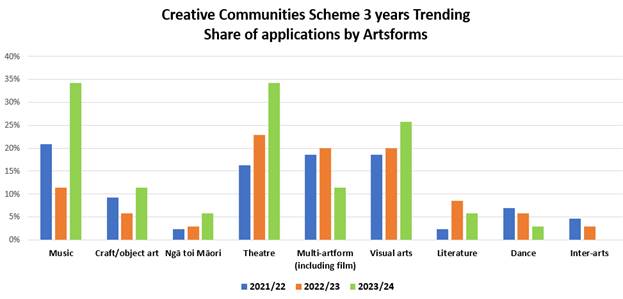
Graph
5
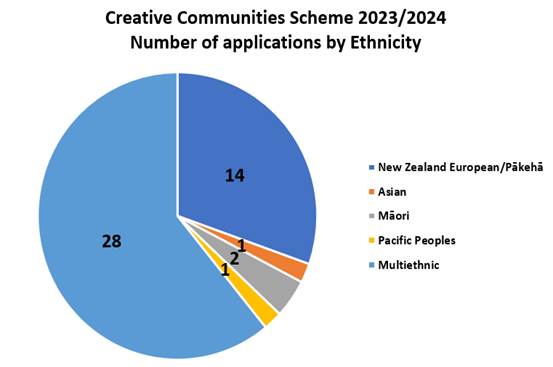
Graph
6
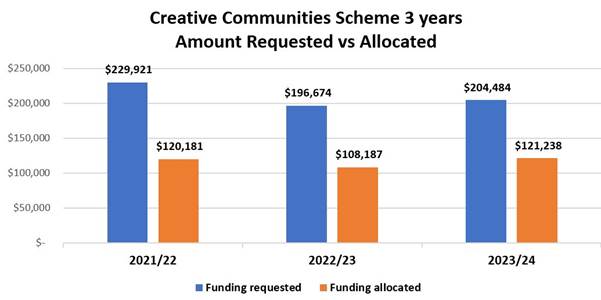
Graph
7
3.14 Arts
Event Fund
Purpose: To invest in events that contribute to Council’s
vision for the City, in particular, Goal 2: A creative and exciting city.
Council recognises the opportunities that arise from hosting significant art
events in Palmerston North, both in terms of economic growth and in developing
the city as a culturally rich city where people have the opportunity to express
their creativity and cultural identity. To be considered for funding the event
must:
· Have the arts as a central focus.
· Be of significant regional, national or international
importance.
· Be accessible to the community.
· Positively profile the city of Palmerston North; and
· Provide an economic benefit for Palmerston North.
Budget
2023/2024: $50,000
Allocation
process: The Arts Event Fund is
open all year until allocated. Applications are received via SmartyGrants, and
assessed by a panel of two officers, including a first full assessment and a
second peer review assessment.
2023/2024
Year: Of the five applications to
the fund, four were successful, and one was declined. The unsuccessful
application was a small-scale concert by Chamber Music New Zealand, and this
was instead supported with Arts Initiative budget. A total of $55,000 was
requested over the five applications assessed. The successful projects
included:
· Manawatū
Horowhenua Pae Taiohi Secondary Schools Kapa Haka Competition (Manawatū
Horowhenua Māori Teachers Incorporated) was supported with $15,000 towards
this biennial regional Kapa Haka competition for Secondary Schools of
Manawatū and Horowhenua held at the Fly Palmy Arena. The sold-out event
featured more than 250 performers entertaining an audience of 2500 with another
1000 watching the performances streamed online. Top place getters Manukura
(1st) and Te Piringa (2nd) went on to represent Manawatū - Horowhenua at
the National competition in Nelson in June 2024.
· PNDA 24th Annual Dance Festival
(Palmerston North Dance Association) was supported with $10,000 to host their
seven-day multi-genre dance championships at the Regent on Broadway. This
year’s event was held in collaboration with Manawatū Performing Arts
Competition Society (MPACS) celebrating their 100th anniversary. Guest artists
from MPACS provided performances in vocal, instrumental, piano, speech &
drama, musical theatre and highland dance. The competition attracted 2000 young
performers and their families from Auckland, Taranaki, Hawkes Bay, Wellington
and the top of the South Island.
· Manawatū Jazz &
Blues Festival 2024 (Manawatū Jazz Club) was granted $15,000 to
support delivery of the 54th annual jazz and blues festival in Palmerston
North, comprising public concerts at the Globe Theatre, workshops and 'Cafe
Scene' artists. This year’s festival was impacted by the loss of music
icon and festival organiser, Roger Fox, immediately prior to the event. A total of 1812 attendees
included performers and audience from Taranaki, Hawke’s Bay, the
Wellington region and Christchurch. An economic impact report on the event
estimated direct expenditure by attendees of $117,701 and added value to the
region of $82,391.
· NZ Blues, Roots & Groove Festival 2024
(Aotearoa Jazz Education and Performance Charitable Trading Trust) was granted
$10,000 to support the national four-day event celebrating blues, roots and
groove music, to be held in the first week of September each year. The loss of Roger Fox also
impacted this event, with an organising committee supported by Gerry Keating,
Globe Theatre Manager, taking over at short notice. An economic impact report is expected but was
not available at the time of this report.
Three-year trend: Funding for the arts remains under pressure with Creative
New Zealand’s funds reduced, and their change in focus away from
event-based funding. This has contributed to organisers of local art events
seeking higher levels of support from the Arts Event Fund. This year the fund was
swiftly allocated and closed in early December 2023. As the table below shows, a modest investment can provide
significant economic return to the community, in addition to the wellbeing
benefits and enhancement of the city’s reputation that comes from hosting
and attending these events.
|
Event
|
Arts Event
Fund
|
Total Attendance
|
Direct Expenditure
|
Value Added
|
|
Manawatū Horowhenua
Pae Taiohi Secondary Schools Kapa Haka Competition
|
$15,000
|
3750
|
Not available
|
Not available
|
|
PNDA 24th Annual Dance Festival
|
$10,000
|
2000
|
Not
available
|
Not
available
|
|
Manawatū Jazz & Blues Festival 2024
|
$15,000
|
1812
|
$117,701
|
$82,391
|
|
NZ Blues, Roots & Groove Festival 2024
|
$10,000
|
787
|
Not available
|
Not available
|
Future
of the fund: In 2024/2025, officers will
continue to maximise the available funds to support the arts community,
including supporting larger events to pathway into the Major Events Fund and
the Creative New Zealand large grants where appropriate. Officers will work
with event organisers on economic impact reports for each event to demonstrate
the return on investment. The Arts Event Fund will also be in the scope of the
review of Events funding alongside the Major Events Fund and Sports Event
Partnership Fund.
3.15 Major Events Fund
Purpose: To support the
attraction, development and growth of events in Palmerston North. The objective
of the Major Events Fund is to support Event Producers to deliver world-class
events that drive sustainable growth in domestic visitation and promote
Palmerston North’s unique identity to a wider audience. A specific focus
on events that increase visitor nights, increase tourism spending and economic
activity is targeted.
Budget 2023/2024:
$286,000
Allocation process: A
cross-section assessment panel consisting of two council officers and a Central
Economic Development Agency (CEDA) representative receives and approves
applications throughout the financial year via SmartyGrants until funds are
fully allocated. Multi-year funding can be approved by the panel if this will
assist in event growth and economic benefit.
2023-2024 Year: All grant
recipients were awarded a single year of funding to re-align to the Long-Term
Plan. This officer decision ensured funding was available throughout the cycle.
2023/24 Funding Allocations:
|
Gravel and Tar Cycling
Classic
|
Greasy Chain Trust
|
$30,000
|
|
NZ Cycling Criterium
|
Performance Advantage
|
$25,500
|
|
Manawatū Art Trail
|
Square Edge Community
Arts
|
$30,000
|
|
Armageddon Expo
|
Beyond Reality
|
$30,000
(final year of 3)
|
|
NZ Young Performer
Awards
|
PACANZ
|
$22,000
|
|
Palmy Drag Fest
|
Palmy Drag Ltd
|
$20,000
|
|
Kiwibots VEX National
Championships
|
NZ Robotics Charitable
Trust
|
$10,000
|
|
Davis Cup – World
Cup of Tennis
|
NZ Tennis
|
$30,000
|
|
Pasifika Fusion 2024
|
Malamalama Moni Aoga
Amata EFKS Palmerston North Inc.
|
$30,000
|
|
Central District Field
Days
|
Stuff Events
|
$30,000
|
Another event was successful in
grant funding based on information received in their application along with
successful prior delivery but cancelled prior to grant funding payment. NZ
Rural Games also receives non-contestable funding of $75,000 cash and $25,000
in kind support and is not included the allocations of the Major Events Fund.
There were an additional five
unsuccessful applications to the fund. Assessors found a number of these
applicants either did not match aims and criteria of the fund or did not assist
in the aspirations of a fully rounded and dispersed calendar of events for the
city.
Three-year trend: Many
applicants do not meet the specific criteria set out in the Support and Funding
Policy to drive additional visitation to Palmerston North and these event
organisers need help to increase visitation to the city with specific marketing
guidance and support to demonstrate economic impact through robust data
collection and analysis. New organisers and events are beginning to emerge
within the major event sector within the city which is a promising sign that
the aims of the fund will continue to be delivered through increased economic
activity and city vibrancy.
Future of the fund: Staff
will maintain a targeted focus on economic benefits and events that help
promote the city to a national audience and drive visitation to the city.
Improved standardised reporting and reporting metrics would enable a clear and
consistent approach for all funding requests which could be extended to other
funding sources within council. The loss of a number of post-Covid funding
streams from Central Government is a concern as organisers will be looking to
all grant funders including Palmerston North City Council to fill in the gaps
created by this reduction.
3.16 Sports
Event Partnership Fund (via Sport Manawatū)
Purpose: To support
operational costs for sports events hosted in Palmerston North that have an
economic benefit and enhance community connectedness and health.
Budget 2023/2024: $280,952
(plus $25,000 funds retained from 2022/2023 as a carryover due to last minute
event cancellations).
Allocation Process: This
fund is fully administered by Sport Manawatū with a cross-sector
assessment panel which includes Sport Manawatū staff, a Council officer
and a CEDA representative.
2023/2024 Year: This fund
has proven a great asset to the city given that it continues to support
community events, raises the profile of the city by hosting national-level
events in world-class facilities, and activates the local economy in ways that
only sporting events can.
28 events received grant funding
totalling $289,421, providing an estimated $11,615,686 of economic benefit to
the city based on economic impact modelling from applicant information,
representing a 4,000% return on investment to the city.
Future of the fund: The
retention aspect of the fund is under threat from other cities with similar
funds and new facilities purposefully built to attract the events Palmerston
North currently hosts. This gives great leverage and bargaining power to some
events currently funded and that Sport Manawatū aims to retain. For this
reason, Sport Manawatū expects to reduce the number of events currently
supported so that they can afford to retain events that maximize the value add
to the city. Furthermore, the city must present a united front so that Sport
Manawatū can present a better offer to the events we support. This may
enhance the city’s worth to event participants, who may influence
organisers’ decision in retaining events in Palmerston North.
3.17 Sponsorship
Fund
Purpose: To associate the
Council with initiatives (including activities, projects or events) which
improve the city’s reputation and national presence.
The fund priorities are to invest
in initiatives that:
· contribute to outcomes
to achieve goal one of the Council's strategic direction
· is innovative,
delivering something new or addressing an issue that affects the people of
Palmerston North in line with the Council’s strategic goals
· is of significant
regional or national importance
· positively profiles the
city of Palmerston North
· provides a quantifiable
economic benefit (e.g., activities, projects or events that attract more than
200 visitors to the city who stay at least one night).
Budget 2023/2024:
$54,100
Allocation process:
Applications are received via SmartyGrants, and assessed by a panel of
officers, including a first full assessment and a second peer review
assessment.
This fund opens at the start of the
financial year and remains open until it is fully allocated. A maximum of
$10,000 is available per application. Staff have discretion to award up to 50%
of the total funding to an eligible proposal.
2023/2024 Year: 13
applications were received, 9 were successful in receiving funding. Across
these 9 successful applications, the whole $54,100 fund was allocated. The fund
was again fully allocated within six months of the financial
year. The majority of applications were event related, ranging from
conference sponsorship to support for economic events.
Future of the fund: This
fund will continue to be used to support initiatives that profile Palmerston
North. Council will use this fund as an incentive in attracting conference,
business and city initiatives.
3.18 Natural and Cultural Heritage Incentive Fund (NCHIF)
Purpose: To fund the
protection, promotion and strengthening of heritage buildings or other objects
listed in the District Plan and the trimming and maintenance of notable trees.
The NCHIF has four categories:
a) Strengthening
Palmy History: to support owners of earthquake-prone heritage buildings and
street character buildings that require strengthening with the costs of
feasibility studies, working drawings and structural works;
b) Protecting
Palmy History: to support owners looking after our most significant heritage
buildings and sites, with funding for conservation, maintenance, repair, and
restoration of scheduled heritage buildings and sites;
c) Promoting
Palmy History: to support community-led heritage education, research or
promotion projects; and
d) Notable
Palmy Trees: to support notable tree owners with the costs of minor maintenance
and trimming.
Given the requirements of the
Building (Earthquake-prone Buildings) Amendment Act 2016, the priority for this
fund is earthquake-strengthening listed heritage buildings.
Budget 2023/2024: $156,000
to support funding categories a-d above.
Allocation process: For fund
categories a-c, applications are assessed by one officer and peer-reviewed by
another officer. All applications are assessed against several criteria set out
in the Heritage Funding Guidelines.
2023/2024 Year: See Graph 8
below. Key insights include:
· There was one
application for Promoting Palmy Heritage, consistent with the low uptake in
previous years
· Applications for
Strengthening Palmy Heritage were relatively low and of lower value than previous
years
· Applications for
Protecting Palmy Heritage have been steadily increasing over the past three
years
· Funding for notable
trees remains consistent with historical trends
· The majority of funding
applications are able to be accepted with further information about the
project’s deliverables.
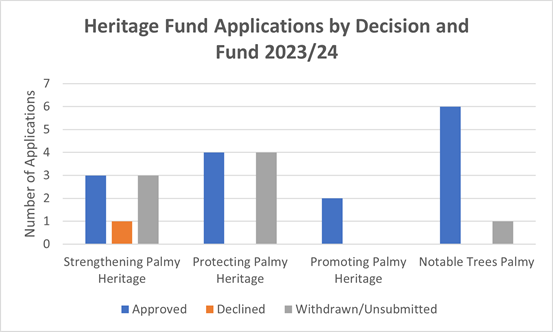
Graph 8
Three-year trend: The
key Annual Plan Performance Measure is an “Increase in investment in
earthquake-prone heritage buildings.” Three-year trends in Graph 9 below
show that:
· Support for maintenance
and repairs on heritage buildings has dipped below the five-year peak in
2021/22
· Notable tree maintenance
is consistent with the three-year average
· Investment in
earthquake-prone buildings is less than in previous years. This is likely due to
the small number and smaller average value of applications compared to previous
years. Whilst there has been a larger average value in applications for
earthquake-prone buildings, the number of applications has been less than
previous years
· Promoting Palmy Heritage
received a couple of larger-value applications compared to previous years.
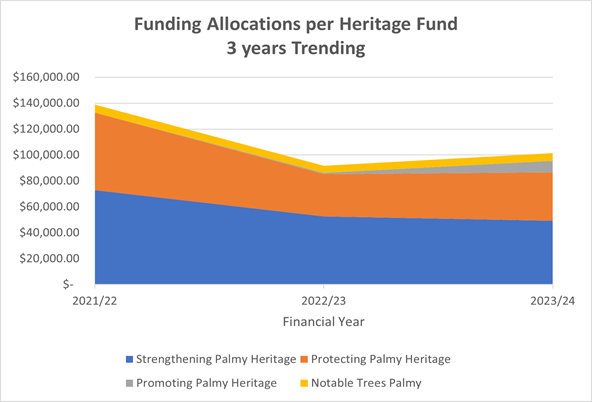
Graph
9
3.19 Palmerston North Youth Council Scholarships and Grants Fund
Purpose: To celebrate the contribution
made by young people in our city through active participation and leadership in
their given field. Inspire young people to take up growth opportunities and
enable access to these opportunities.
Administrating the fund also provides a development
opportunity for the Youth Council who learn about financial transparency and
sound decision-making. Funding categories include sports, arts, academic
excellence, and community contribution. Applicants must be aged 12-24.
Budget 2023/2024: $8,500
Allocation process: Once a year, allocation
decisions are made by a scholarships committee, which consists of 5 to 7 Youth
Councillors (who represent a range of schools, ages, and interests) plus a
council officer who oversees the process and supports the young people to make
transparent and sound decisions.
The amount awarded to successful applications is variable
based on the amount requested but is typically between $500 (minimum) and
$1,150 (maximum) per applicant. The assessment process includes an initial
application review, an interview with shortlisted applicants and a moderation
session through SmartyGrants. Assessment criteria were based on 4
key areas: purpose, access to other forms of funding, visibility, and viability.
Candidates are not eligible to receive funding if they have received the Youth
Council Scholarship and Grants Fund previously or lived outside of Palmerston
North City Bounds.
2023/2024 Year: Applications were open for
three months, there were 81 applications with a total amount requested of
$76,480. There were 8 successful applications, across arts, sports and academic
aspirations. A total of $15,350 was requested and the total fund of
$8,500 was allocated. $1,300 was awarded to Academic endeavours, $2,700 to
young people pursuing Arts endeavours and $4,500 towards Sports
Aspirations.
Fund Allocation:
Successful applications this funding round included
supporting Palmy young people to represent and perform on a world stage;
participating in VEX IQ World Championships in Texas; A Secondary Schools Choir
Tour of China; Being selected as a NZ delegate to the 2024 UK IAgrM Leadership
Development Programme run over two months in the UK, Netherlands and Belgium.
The fund also supported young people to equitably access
and participate in opportunities presented to them; attending NZ Spirit of
adventure leadership journey; having the ability to continue dance mentorship;
attend a recording mentorship with a nationally known recording artist and
develop an EP. The fund continues to fill a gap in support for young people
wanting to pursue opportunities in Sport, including Dance.
Future of the fund: This
fund will continue to be used to celebrate and support the aspirations of young
people of our city.
3.20 Resource Recovery Fund (RRF)
Purpose: To support initiatives that reduce the
amount of waste going to landfill. Local small businesses and not-for profits
are invited to apply for projects that align with the funds key support
priorities: waste diversion, education programs, community events, trials and
pilot programs and research and development. The fund is supported by goals in
the Waste Management and Minimisation Plan 2019, and successful applications
align with this guiding document.
Budget 2023/2024: $45,199 (including
$5,199 that was unspent from a previously awarded project.)
Allocation process: Applications are received once
per year. Applications are assessed by two council officers, an assessor and a
peer reviewer.
2023/2024 Year: For the third round of the Resource
Recovery Fund, $48,835 was allocated to four of the six applicants. The total
amount requested was $75,835. The successful projects were:
· Environment
Network Manawatū’s successful repair cafe was supported for the
third year in a row, being awarded $12,000 towards organisation of this
initiative. As this project has been a success for three consecutive years and
fulfils specific actions in the Waste Management and Minimisation Plan 2024,
future years will be funded outside the resource recovery fund, allowing this
portion to be contestable by projects.
· Just
Zilch’s storage capacity increase was awarded $7,335 to support
expansion of their storage warehouse. This will allow more food to be rescued
and distributed to the community.
· Precycle’s
expansion of Sustainable is Attainable to the Manawatu, an initiative that has
been successful in Timaru and Hawkes Bay. The first phase of this project is to
gather data from local businesses and industry, which will then be used to
develop alternatives for waste and by products, preventing it from going to
landfill. Precycle was awarded $7,500 towards this phase of the project.
· Mason
Brothers Honey successfully requested $15,000 for Project Clean Comb which
is an initiative to wash and reuse plastic honey frames that would normally be
thrown away.
Future of the fund: Goal 2.1 of the 2024 Waste
Management and Minimisation Plan specifies provision of the Resource Recovery
Fund. This is funded through Councils allocation of the Ministry for the
Environments Waste Levy. Councils long-term plan includes budget to continue
this fund annually for the next 10 years.
The Resource Recovery Fund is publicised via a media
release, key stakeholder (Environment Network Manawatū) newsletters, radio
interviews, newspaper advertising, as well as on social media channels.
Applicant numbers and the total amount requested decreased
this round, however the fund remained oversubscribed. Even with the repair cafe
being funded via another budget in the future, applications in this round
suggest that the fund would still be oversubscribed. Over the three years the
fund has been available, the average amount applied for is $11,790 and the
average amount allocated is $10,142.
3.21 Active
Communities Fund (administered via Sport Manawatū)
Purpose: To remove financial barriers to enable Palmerston North
residents to be more active, more often.
Budget
2023/2024: $10,000 per year, plus
$1,221.27 unspent funds carried over from previous financial years.
Allocation
process: Residents apply to the fund via
an application form, which is assessed by a panel composed of Sport
Manawatū, Replay Sport, Best Care Whakapai Hauora and two other advisors
(community members).
2023/2024
Year: There were 32 applications on behalf
of 40 people during the year. 25 applications were approved, benefiting 33
residents. The average amount allocated was $380 per application or $288 per
beneficiary. Figures do not include GST.
Future of the fund: Sport Manawatū advises that the impact this fund
produces is difficult to describe in words. The fund is currently promoted by
the Sport Manawatū website, by some monthly publication (e.g. Fluxx), and
by word of mouth. Sport Manawatū may use other methods of promotion at the
Panel’s discretion.
4. Summary
4.1 Council has a good range of fund types, catering for a wide variety
of community needs and aspirations, at different levels. This report has
demonstrated the significant role grant funding plays in the city, with over
$2.9 million dollars allocated annually to support communities to achieve their
wellbeing aspirations.
4.2 2023/2024 has continuously seen strong demand for funding across the
board. This need could be seen in September at the Palmerston North Community
Funding Expo 2024, with more than 200 community members and 20 funders in
attendance.
4.3 Event funding has been identified as an area of opportunity to
improve processes and outcomes.
5. NEXT STEPS
5.1 Officers will continue to work to ensure Council’s funds are
accessible as possible to the community, including facilitating the Palmerston
North Community Funding Expo in collaboration with other funders, reviewing
application forms and developing information resources for the community.
5.2 The next annual report for the 2024-2025 financial year will be
provided in the third quarter of 2025.
6. Compliance and administration
|
Does the Committee have
delegated authority to decide?
|
Yes
|
|
Are the decisions significant?
|
No
|
|
If they are significant do they
affect land or a body of water?
|
No
|
|
Can this decision only be made
through a 10 Year Plan?
|
No
|
|
Does this decision require
consultation through the Special Consultative procedure?
|
No
|
|
Is there funding in the current
Annual Plan for these objectives?
|
Yes
|
|
Are the recommendations
inconsistent with any of Council’s policies or plans?
|
No
|
|
The recommendations contribute
to:
Whāinga 3: He hapori
tūhonohono, he hapori haumaru
Goal 3: A connected and safe
community
|
|
The
recommendations contribute to the achievement of objective/objectives
in:
7.
Mahere tautāwhi hapori
7. Community Support Plan
The objective is: Administer
grants in line with the community funding policy.
Note due to the range of funds
included this report relates to outcomes and actions under multiple plans
across Goals 2, 3 and 4.
|
|
Contribution to strategic
direction and to social, economic, environmental and cultural well-being
|
Providing
funding to community helps Council deliver its strategic objectives in a
range of areas and provides critical support to the local for-purpose sector.
|
|
|
|
Attachments
Nil
Memorandum
TO: Community
Committee
MEETING DATE: 23
October 2024
TITLE: Annual
Section 10A Dog Control Report 2023/2024
Presented
By: Rebeka
Adamson, Manager Environmental Protection Development and Regulatory
APPROVED BY: Kerry-Lee
Probert, General Manager Development & Regulatory
RECOMMENDATION TO Community Committee
1. That the
Community Committee receive the report titled ‘Annual Section 10A Dog
Control Report 2023/2024’ presented on 28 August 2024.
1. ISSUE
1.1 This
report has been prepared to satisfy the requirements of Section 10A of the Dog
Control Act 1996 (‘the Act’).
1.2 The
report covers the 2023/24 fiscal year.
1.3 The
Act requires the following information to be provided:
a. The number of
registered dogs to the territorial authority district;
b. The number of
probationary owners and disqualified owners in the territorial authority
district;
c. The number of dogs in
the territorial authority district classified as dangerous;
d. The number of dogs in
the territorial authority district classified as menacing;
e. The number of
infringement notices issued by the territorial authority;
f. The number of dog
related complaints received by the territorial authority under this Act.
1.4 The
attached report on the Council’s administration of its Dog Control Policy
and Practices for 2023/24 has the following highlights:
1.5 The
new animal shelter, Te Whare Kouru was blessed by Rangitāne on 23 May,
marking a significant point in the progress of the project.
1.6 The
number of dogs in the city increased to an annual high of 9,735 in 2023/24, but
the population decreased by 93 dogs over the year, reflecting a 0.99% decline.
This fluctuation is thought to be influenced by economic pressures and the
costs associated with owning a dog.
1.7 Of
the 7,872 dog owners, 2,735 are approved as “preferred owners,”
which means they have been able to demonstrate an understanding of dog welfare,
consequently they benefit from a lower registration fee. This equates to 1
preferred owner for every 2.87 owners.
1.8 The
number of complaints increased by 1.17% to 3,002, with the most significant
source being roaming and secured roaming dogs, accounting for 46% of
complaints. Barking dogs were the second most common complaint, though these
decreased by 20.8% from the previous year.
1.9 Reported
dog attacks increased by 22%, with 141 incidents, including 52 attacks on
people. The severity of these attacks varied, with some being minor and others
more serious. This year’s reported attacks are 21.1% above the five-year
average.
1.10 In the
next six months officers will be exploring the viability of implementing
life-long registration tags, opportunities for working with Wildbase Recovery
to deliver education programs, and ensuring that procedures used in Te Whare
Kouru are fit for purpose and fully realise the capabilities of the shelter.
1.11 The report
will be published on the Council’s website and publicly notified.
2.
|
Does the Committee have
delegated authority to decide?
|
Yes
|
|
Are the decisions significant?
|
No
|
|
If they are significant do they
affect land or a body of water?
|
No
|
|
Can this decision only be made
through a 10 Year Plan?
|
No
|
|
Does this decision require
consultation through the Special Consultative procedure?
|
No
|
|
Is there funding in the current Annual
Plan for these objectives?
|
Yes
|
|
Are the recommendations
inconsistent with any of Council’s policies or plans?
|
No
|
|
The recommendations contribute
to:
Whāinga 3: He hapori
tūhonohono, he hapori haumaru
Goal 3: A connected and safe
community
|
|
The
recommendations contribute to the achievement of objective/objectives
in:
9.
Mahere haumaru hapori, hauora hapori
9. Community Safety and
Health Plan
The objective is: Provide dog
control and animal management services.
|
|
Contribution to strategic
direction and to social, economic, environmental and cultural well-being
|
In accordance with Section
10A of the Dog Control Act 1996, a territorial authority must, in respect of
each financial year, report on the administration of its dog control policy adopted
under Section 10, and its dog control practices.
|
|
|
|
Attachments
|
1.
|
Annual
Dog Control Report to the Secretary of Local Government 2023-24 ⇩ 
|
|
Committee Work Schedule
TO: Community
Committee
MEETING DATE: 23
October 2024
TITLE: Committee
Work Schedule - October 2024
RECOMMENDATION TO Community Committee
1. That the
Community Committee receive its Work Schedule dated October 2024.
committee
work schedule – August 2024
|
|
Estimated Report
Date
|
Subject
|
General Manager Responsible
|
Current Position
|
Date of Instruction
&
Clause number
|
|
1
|
23 Oct 2024
|
Annual Report on Library Services
|
Customer & Community
|
|
24 May 2023
Clause 22-23
|
|
2
|
23 Oct 2024
|
Disability Reference Group
– Annual Presentation
|
Customer & Community
|
|
Invitation to present
4 Nov 2020
Clause 41-20
|
|
3
|
23 Oct 2024
|
Develop an Age Friendly Plan
|
Customer & Community /
Strategic Planning
|
|
31 May 2023
Clause 88.15-23
|
|
4
|
23 Oct 2024
|
Annual Report - Community
Funding Allocation 2023/24
|
Customer & Community
|
|
Rec 1c of the Community
Grants & Events Funding Review - May 2021
|
|
5
|
4 Dec 2024
|
Develop a Community Housing Partnership Plan
|
Strategic Planning
|
|
31 May 2023
Clause 88.9-23
|
|
6
|
4 Dec 2024
|
Draft Health Promotion Policy - Hearing
|
Strategic Planning
|
|
28
August 2024 Clause 16-24
|
|
7
|
19 Mar 2025
|
Draft Health Promotion Policy – Final Staff Report
|
Strategic Planning
|
|
28
August 2024 Clause 16-24
|
|
8
|
19 Mar 2025
|
Welcoming Communities Annual Report
|
Customer & Community
|
|
Terms of Reference
|
|
9
|
19 Mar 2025
|
Annual Sector Lead Report: Housing Advice Centre
|
Customer & Community
|
|
Terms of Reference
|
|
10
|
19 Mar 2025
|
Annual Sector Lead Report: Manawatū Multicultural
Centre
|
Customer & Community
|
|
Terms of Reference
|
|
11
|
19 Mar 2025
|
Annual Sector Lead Report: Te Pū Harakeke Community
Collective Manawatū
|
Customer & Community
|
|
Terms of Reference
|
|
12
|
19 Mar 2025
|
Annual Sector Lead Report: Te Tihī o Ruahine
Whānau Ora Alliance
|
Customer & Community
|
|
Terms of Reference
|
|
13
|
19 Mar 2025
|
Annual update on the implementation of the accessibility
programme
|
Infrastructure
|
|
20 Mar 2024
Clause 11.2-24
|
|
14
|
21 May 2025
|
Property options in Roslyn to support the delivery of
community services
|
Customer & Community
|
|
Council
29 May 2024
Clause 95.G47-24
|
|
15
|
21 May 2025
|
Youth Wellbeing and Youth Development – Annual
Progress Report
|
Customer & Community
|
|
Council
29 May 2024
Clause 95.2F(1) -24
|
|
16
|
13 August 2025
|
Pasifika Reference Group – Annual Presentation
|
Customer & Community
|
|
Terms of Reference
|
|
17
|
13 August 2025
|
Seniors Reference Group – Annual Presentation
|
Customer & Community
|
|
Terms of Reference
|
|
18
|
TBC 2025
|
Actions and resources required to sign up to the
Accessibility Charter
|
Customer & Community
|
|
22 Nov 2023
Clause 38-23
|
|
19
|
TBC 2025
|
Progress report on social housing development at
Summerhays St
|
Strategic Planning / Infrastructure
|
|
Council
1 May 2024
Clause 66-24
|
|
20
|
TBC 2025
|
Options to deliver social housing within the current
Revenue and Finance Policy limit
|
Strategic Planning / Infrastructure
|
|
20 March 2024
Clause 10-24
|
|
21
|
TBC 2025
|
Annual report on Library Services
|
Customer & Community
|
|
24 May 2023
Clause 22-23
|
|
22
|
TBC 2025
|
Disability Reference Group – Annual Presentation
|
Customer & Community
|
|
Terms of Reference
|
|
23
|
TBC 2025
|
Annual Report Community Funding Allocation 2024/2025
|
Customer & Community
|
|
Rec 1c of the Community Grants
& Events Funding Review - May 2021
|
|
24
|
TBC 2024/2025
|
Expressions of Interest for a partnership-based approach
to providing a natural burial site in PN
|
Infrastructure
|
|
22 Nov 2023
Clause 47
Council
1 Jun 2022
Clause 60-22
|
|
25
|
TBC
|
New Public Toilet – End of Albert Street –
Alternative Locations
|
Infrastructure
|
|
28 August 2024
Clause 15-24
|