|
Brent
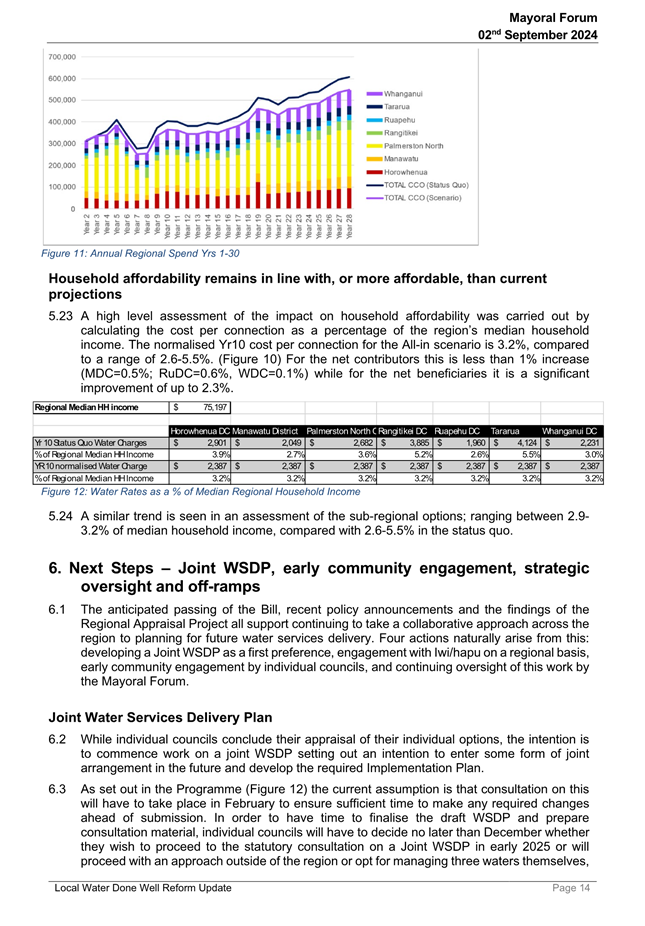
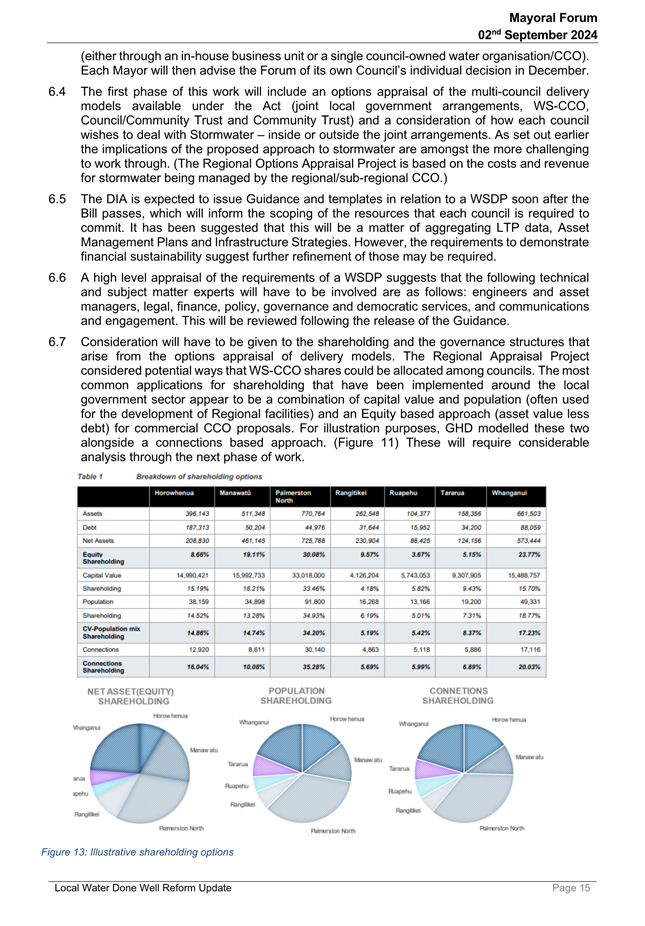
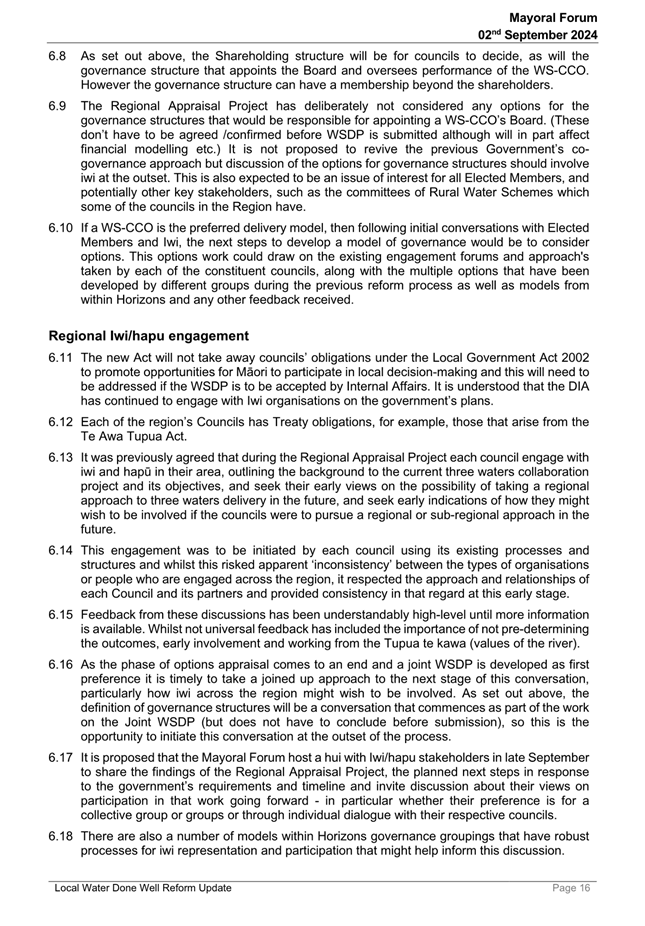
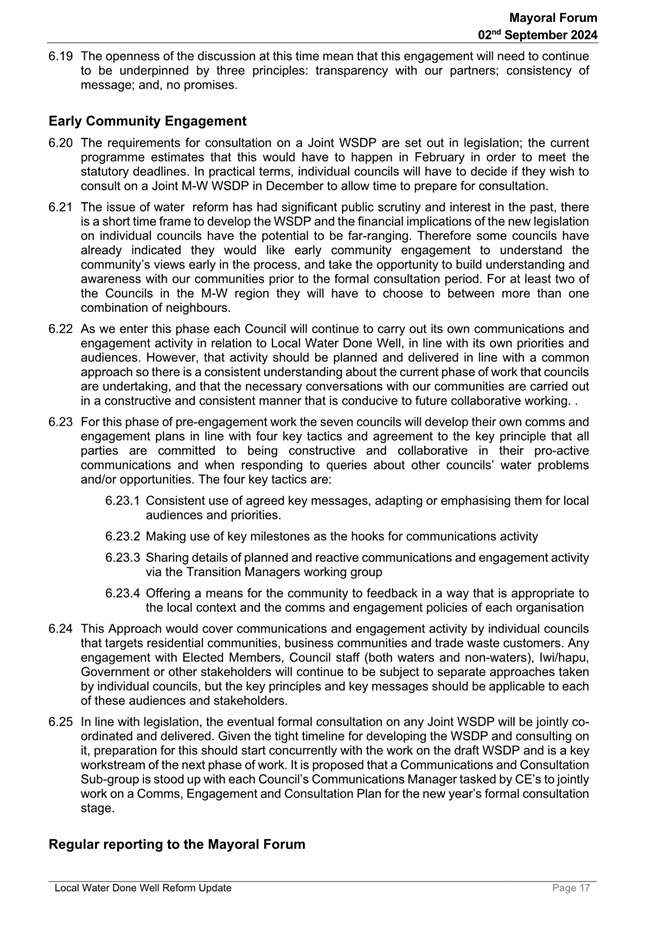
Barrett (Chair)
|
|
Kaydee
Zabelin (Deputy Chair)
|
|
Grant
Smith (The Mayor)
|
|
Roly
Fitzgerald
|
Lorna
Johnson
|
|
Patrick
Handcock (ONZM)
|
Debi
Marshall-Lobb
|
|
Leonie
Hapeta
|
Karen
Naylor
|
Sustainability Committee
MEETING
16 October 2024
Order of Business
1. Karakia Timatanga
2. Apologies
3. Notification
of Additional Items
Pursuant to Sections 46A(7) and
46A(7A) of the Local Government Official Information and Meetings Act 1987, to
receive the Chairperson’s explanation that specified item(s), which do
not appear on the Agenda of this meeting and/or the meeting to be held with the
public excluded, will be discussed.
Any additions in accordance with
Section 46A(7) must be approved by resolution with an explanation as to why
they cannot be delayed until a future meeting.
Any additions in accordance with
Section 46A(7A) may be received or referred to a subsequent meeting for further
discussion. No resolution, decision or recommendation can be made in
respect of a minor item.
4. Declarations
of Interest (if any)
Members are reminded of their duty
to give a general notice of any interest of items to be considered on this
agenda and the need to declare these interests.
5. Public
Comment
To receive comments from members of
the public on matters specified on this Agenda or, if time permits, on other
Committee matters.
(NOTE: If
the Committee wishes to consider or discuss any issue raised that is not
specified on the Agenda, other than to receive the comment made or refer it to
the Chief Executive, then a resolution will need to be made.)
6. Confirmation
of Minutes Page 7
That the minutes of the Sustainability Committee meeting of
21 August 2024 Part I Public be confirmed as a true and correct record.
7. Local
Water Done Well Update Page 13
Memorandum, presented by Mike Monaghan, Manager - 3
Waters and Julie Keane, Transition Manager.
8. Summary
of Actions by the Manawatū-Whanganui Climate Action Joint Committee Page 59
Memorandum, presented by Adam Jarvis, Manager Climate
Change and Sustainability.
9. Proposed
Scope for the Co-development of a City-wide Climate Action Plan Page 77
Memorandum, presented by Adam Jarvis, Manager Climate
Change and Sustainability.
10. Palmerston North
City-wide Emissions Inventory 2023 Page 81
Memorandum, presented by Adam Jarvis, Manager Climate
Change and Sustainability.
11. Palmerston North
City Council Organisational Emissions Inventory 2023/2024 Page 87
Memorandum, presented by Adam Jarvis, Manager Climate
Change and Sustainability.
12. Waste Management
and Minimisation Plan 2019 - Progress on Actions Page
95
Memorandum, presented by Natasha Hickmott, Activities
Manager - Resource Recovery and Sustainability and Melissa Doyle, Waste
Minimisation Officer.
13. Manawatū River
Pathway Project Page 105
Memorandum, presented by Glen O'Connor, Manager
Transport and Development and Michael Bridge, Service Manager Active Transport.
14. Committee Work
Schedule Page 129
15. Karakia
Whakamutunga
16. Exclusion of Public
|
|
To be
moved:
“That the public be excluded from the
following parts of the proceedings of this meeting listed in the table below.
The general subject of each matter to be considered
while the public is excluded, the reason for passing this resolution in
relation to each matter, and the specific grounds under Section 48(1) of the
Local Government Official Information and Meetings Act 1987 for the passing
of this resolution are as follows:
|
General subject of each matter to be
considered
|
Reason for passing this resolution in
relation to each matter
|
Ground(s) under Section 48(1) for
passing this resolution
|
|
17.
|
Confirmation of the minutes of the Sustainability
Committee meeting of 21 August 2024 Part II Confidential
|
For the reasons set out in the Sustainability
Committee of 21 August 2024, held in public present.
|
|
18.
|
Manawatū River Pathway Project - Progress on
Landowner Engagment
|
PRIVACY: This information needs to be kept
private to protect personal information that is confidential or
sensitive. This includes people who are no longer alive
NEGOTIATIONS: This information needs to be
kept confidential to ensure that Council can negotiate effectively,
especially in business dealings
|
s7(2)(a) and s7(2)(i)
|
This resolution is made in reliance on Section
48(1)(a) of the Local Government Official Information and Meetings Act 1987
and the particular interest or interests protected by Section 6 or Section 7
of that Act which would be prejudiced by the holding of the whole or the
relevant part of the proceedings of the meeting in public as stated in the
above table.
Also that the persons listed below be permitted to
remain after the public has been excluded for the reasons stated.
[Add Third Parties], because of their knowledge and ability to assist the
meeting in speaking to their report/s [or other matters as specified] and
answering questions, noting that such person/s will be present at the meeting
only for the items that relate to their respective report/s [or matters as
specified].
|
Palmerston North City Council
Minutes of
the Sustainability Committee Meeting Part I Public, held in the Council Chamber,
First Floor, Civic Administration Building, 32 The Square, Palmerston North on 21 August 2024,
commencing at 9.00am.
|
Members
Present:
|
Councillors Brent Barrett (in the Chair),
Kaydee Zabelin, Roly Fitzgerald, Patrick Handcock, Debi Marshall-Lobb and
Karen Naylor.
|
|
Non Members:
|
Councillors Mark Arnott, Vaughan
Dennison, Lew Findlay, Billy Meehan, and William Wood.
|
|
Apologies:
|
The Mayor (Grant Smith), Councillors
Lorna Johnson (absent on Council business), and Leonie Hapeta.
|
|
|
Karakia
Timatanga
|
|
|
Councillor William Wood opened the meeting with karakia.
|
|
19-24
|
Apologies
|
|
|
Moved Brent Barrett, seconded Kaydee Zabelin.
The
COMMITTEE RESOLVED
1. That
the Committee receive the apologies.
|
|
|
Clause 19-24 above was carried 11 votes to 0, the voting being as
follows:
For:
Councillors Brent Barrett,
Kaydee Zabelin, Roly Fitzgerald, Patrick Handcock, Debi Marshall-Lobb, Karen
Naylor, Mark Arnott, Vaughan Dennison, Lew Findlay, Billy Meehan and William
Wood.
|
|
20-24
|
Public
Comment
The following speakers spoke
on Item 8: Draft Food Security and Resilience Policy approval for
consultation. They both spoke in support of the policy going out for
consultation.
· Jose Gutry
· Rachel Blacher
|
|
|
Moved Brent Barrett, seconded Kaydee Zabelin.
The
COMMITTEE RESOLVED
1. That
the Sustainability Committee receive the public comments.
|
|
|
Clause 20-24 above was carried 10 votes to 0, with 1 abstention, the
voting being as follows:
For:
Councillors Brent Barrett,
Kaydee Zabelin, Roly Fitzgerald, Patrick Handcock, Debi Marshall-Lobb, Karen
Naylor, Mark Arnott, Vaughan Dennison, Lew Findlay and Billy Meehan.
Abstained:
Councillor William Wood.
Note: Councillor William Wood declared a conflict
of interest for public comment by Jose Gutry, he withdrew and sat in
the gallery when Jose made comment and then returned to the table.
|
|
21-24
|
Presentation
- Just Zilch
Rebecca Culver, Managing
Director of Just Zilch outlined the work that Just Zilch undertakes to rescue
food in Palmerston North, and to redistribute it to people in the region. She
highlighted the positive environmental effects of the work on reducing CO2 emissions, saving water and creating meals.
The full presentation is attached.
|
|
|
Moved
Brent Barrett, seconded Kaydee Zabelin.
The COMMITTEE RESOLVED
1. That the Sustainability Committee receive the
presentation for information.
|
|
|
Clause 21-24 above was
carried 11 votes to 0, the voting being as follows:
For:
Councillors Brent Barrett,
Kaydee Zabelin, Roly Fitzgerald, Patrick Handcock, Debi Marshall-Lobb, Karen
Naylor, Mark Arnott, Vaughan Dennison, Lew Findlay, Billy Meehan and William
Wood.
|
|
22-24
|
Confirmation
of Minutes
|
|
|
Moved
Brent Barrett, seconded Kaydee Zabelin.
The COMMITTEE RESOLVED
1. That
the minutes of the Sustainability Committee meeting of 22 May 2024
Part I Public be confirmed as a true and correct record.
|
|
|
Clause 22-24 above was
carried 7 votes to 0, with 3 abstentions, the voting being as follows:
For:
Councillors Brent Barrett,
Kaydee Zabelin, Roly Fitzgerald, Patrick Handcock, Debi Marshall-Lobb, Karen
Naylor and Lew Findlay.
Abstained:
Councillors Vaughan
Dennison, Billy Meehan and William Wood.
Note:
Councillor Mark Arnott did not vote.
|
|
23-24
|
Draft
Food Security and Resilience Policy approval for consultation
Report, presented by Julie
Macdonald, Manager Strategy and Policy.
|
|
|
Moved
Kaydee Zabelin, seconded Patrick Handcock.
The COMMITTEE RESOLVED
1. That the Committee approve the Draft Food Security
and Resilience Policy for consultation (Attachment 1).
|
|
|
Clause 23-24 above was
carried 11 votes to 0, the voting being as follows:
For:
Councillors Brent Barrett,
Kaydee Zabelin, Roly Fitzgerald, Patrick Handcock, Debi Marshall-Lobb, Karen
Naylor, Mark Arnott, Vaughan Dennison, Lew Findlay, Billy Meehan and William
Wood.
|
|
24-24
|
Low
Carbon Fund allocations 2023/2024
Memorandum, presented by Adam
Jarvis, Manager Climate Change and Sustainability.
|
|
|
Moved
Brent Barrett, seconded Kaydee Zabelin.
The COMMITTEE RESOLVED
1. That the Committee receive the memorandum titled ‘Low
Carbon Fund allocations 2023/2024’ presented to the Sustainability
Committee on 21 August 2024.
|
|
|
Clause 24-24 above was
carried 10 votes to 0, the voting being as follows:
For:
Councillors Brent Barrett,
Kaydee Zabelin, Roly Fitzgerald, Patrick Handcock, Debi Marshall-Lobb, Karen
Naylor, Mark Arnott, Vaughan Dennison, Billy Meehan and William Wood.
Note:
Councillor Lew Findlay did not vote.
|
|
25-24
|
Wastewater
Treatment Plant - Nature Calls: Quarterly Update
Memorandum, presented by Mike
Monaghan, Manager Three Waters and Anna Lewis, Project Manager –
Wastewater Discharge Consent Programme.
|
|
|
Moved
Brent Barrett, seconded Kaydee Zabelin.
The COMMITTEE RESOLVED
1. That the
Committee receive the report titled ‘Wastewater Treatment Plant –
Nature Calls: Quarterly Update’ presented to the Sustainability
Committee on 21 August 2024.
|
|
|
Clause 25-24 above was
carried 11 votes to 0, the voting being as follows:
For:
Councillors Brent Barrett,
Kaydee Zabelin, Roly Fitzgerald, Patrick Handcock, Debi Marshall-Lobb, Karen
Naylor, Mark Arnott, Vaughan Dennison, Lew Findlay, Billy Meehan and William
Wood.
|
|
26-24
|
Committee
Work Schedule
|
|
|
Moved
Brent Barrett, seconded Kaydee Zabelin.
The COMMITTEE RESOLVED
1. That the Committee receive its Work Schedule dated
August 2024.
|
|
|
Clause 26-24 above was
carried 11 votes to 0, the voting being as follows:
For:
Councillors Brent Barrett,
Kaydee Zabelin, Roly Fitzgerald, Patrick Handcock, Debi Marshall-Lobb, Karen
Naylor, Mark Arnott, Vaughan Dennison, Lew Findlay, Billy Meehan and William
Wood.
|
Exclusion
of Public
|
27-24
|
Recommendation to
Exclude Public
|
|
|
Moved Brent Barrett, seconded Kaydee Zabelin.
The
COMMITTEE RESOLVED
That the public
be excluded from the following parts of the proceedings of this meeting
listed in the table below.
The general
subject of each matter to be considered while the public is excluded, the
reason for passing this resolution in relation to each matter, and the
specific grounds under Section 48(1) of the Local Government Official
Information and Meetings Act 1987 for the passing of this resolution are as
follows:
|
General subject of each matter to be
considered
|
Reason for passing this resolution in
relation to each matter
|
Ground(s) under Section 48(1) for passing
this resolution
|
|
14.
|
Comprehensive Resource Recovery Services Review
Scope
|
COMMERCIAL ACTIVITIES: This information needs to
be kept confidential to allow Council to engage in commercial activities
without prejudice or disadvantage
|
s7(2)(h)
|
|
|
|
|
This
resolution is made in reliance on Section 48(1)(a) of the Local Government
Official Information and Meetings Act 1987 and the particular interest or
interests protected by Section 6 or Section 7 of that Act which would be
prejudiced by the holding of the whole or the relevant part of the
proceedings of the meeting in public as stated in the above table.
|
|
|
Clause 27-24 above was carried 11 votes to 0, the voting being as
follows:
For:
Councillors Brent Barrett,
Kaydee Zabelin, Roly Fitzgerald, Patrick Handcock, Debi Marshall-Lobb, Karen
Naylor, Mark Arnott, Vaughan Dennison, Lew Findlay, Billy Meehan and William
Wood.
|
The public part
of the meeting finished at 10.25am.
Confirmed 16 October 2024
Chair
Memorandum
TO: Sustainability
Committee
MEETING DATE: 16
October 2024
TITLE: Local
Water Done Well Update
Presented
By: Mike
Monaghan, Manager - 3 Waters and Julie Keane, Transition Manager
APPROVED BY: Chris
Dyhrberg, General Manager Infrastructure
RECOMMENDATION(S) TO Sustainability Committee
1. That the
Committee receive the memorandum titled ‘Local Water Done Well
Update’, presented to the Sustainability Committee on 16 October 2024,
and note the next steps arising from the passing of the legislation and the
future work programme.
1. overview
1.1 The
Government repealed the Three Waters Legislation and has moved quickly to
establish a replacement model under the Local Water Done Well policy.
Council water infrastructure assets will no longer be transferred to
government-mandated entities, but councils will have choices about how they
deliver water services in the future in a way that meets new rules for
investment, borrowing and pricing.
1.2 This
memorandum provides an update on:
· the
workshop held with Elected Members on 19 June and subsequent drop-in sessions
on 6 and 27 August and 11 September;
· details
on new policy settings;
· the
next steps that arise from the passing of the Local Government (Waters Services
Preliminary Arrangements) Act (the Act) and the Government’s recent
policy announcement about the future settings for Water Services Delivery;
· a
new Accountability Framework that effectively ‘ring-fences’ Waters
strategy; and
· future
planning and reporting requirements from Council’s Long-Term Plan (LTP),
regardless of the delivery model that is chosen.
1.3 With
the passing of the Act, it is now a statutory requirement that all councils
submit a Water Services Delivery Plan (WSDP) and Implementation Plan to the
Government by 2 September 2025. The WSDP must show how the councils will
meet the new rules for financially sustainable water services. It is
anticipated that the new rules will increase the costs to the end-users,
whether Council continues to go alone or join up with some of its neighbours.
1.4 The
new borrowing limits announced by the Government will only be available to
councils who establish a Water Services CCO (WS-CCO); they will not be
available to councils who continue to deliver services in-house. This
will be a key consideration for Council in assessing its options.
2. elected member engagement
2.1 On
19 June 2024, an Elected Member (EM) workshop was held to update EMs on the
current programme of work relating to Local Water Done Well, including
information that had been presented to the Mayoral Forum on 10 June 2024 (see
Attachment 1). Since the change of Government and the repeal of the Three
Waters legislation, the region has been considering what any new legislation
might mean for the region.
2.2 In
2019/2020, the region’s Territorial Authorities (TAs) had commissioned
work to develop initial thinking on Three Waters delivery options on a regional
scale. This work was overtaken by the Government’s intentions on
what at the time was an opt-in Three Waters reform programme. Because of
this direction from Central Government, the regional work was not concluded.
2.3 Following
the announcement of the Government’s legislation and proposed
‘Local Water Done Well’ programme, the region’s TAs agreed to
reshape and bring back to life this programme of work. The scope of this
work considered all seven of the region’s councils and sub-group
variations.
2.4 Taking
a regional approach to EMs engagement, two separate briefing sessions were held
on 18 and 20 September. PN City Council EMs were invited to attend the
briefing on 20 September along with EMs from Manawatu District Council,
Horowhenua District Council and Tararua District Council to receive an update
on the regional work.
2.5 At
the time of writing this report an EM workshop has been scheduled for 2 October
to consider the approach to 2 vs 3 waters transferring into a new CCO and to
update on progress with options appraisal.
3. options appraisal
3.1 Officers
are currently considering several water service delivery options in line with
the requirements of the new Act. A number of factors will have to be balanced
in any future decision making, including financial impacts on ratepayers and
costs to Council, the long-term strategic benefits relating to efficiency and
resilience and the community’s views.
3.2 The
new rules and regulations that the Government is introducing mean that
‘going it alone’ is unlikely to be the same as what is envisaged in
the current LTP. Additionally, the new policy announcements regarding
higher borrowing limits will need to be considered in the options assessment
process.
3.3 The
appraisal of the Manawatu-Whanganui project (M-W) has now been completed and
findings reported to the Mayoral Forum on 2 September (refer Attachment
2). The Mayoral Forum has received regular progress reports on this
project to respond to this matter of strategic regional importance, with a view
that they report back to their respective councils.
3.4 This
appraisal established that whilst the financial case is marginal, there is a
compelling strategic case for a (sub-)regional approach to the future delivery
of water services in the region, including reducing the impact of higher
overheads and compliance costs under any of the new delivery models.
3.5 There
is a continued desire by the region’s Mayors and Chief Executives to take
a collaborative approach to planning across the region and developing a Joint
WSDP as a first preference, while councils continue to finalise their own
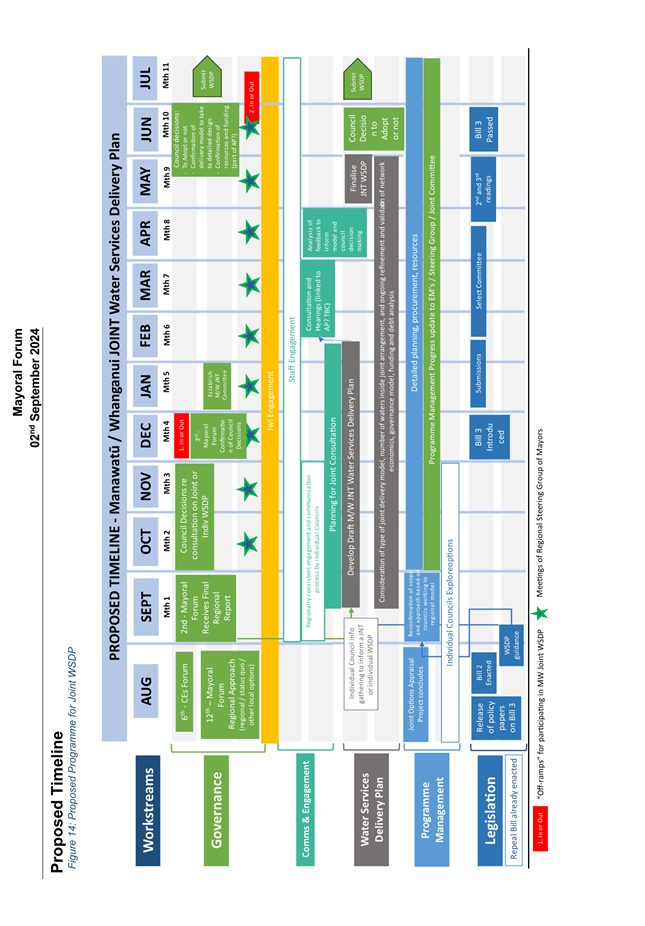
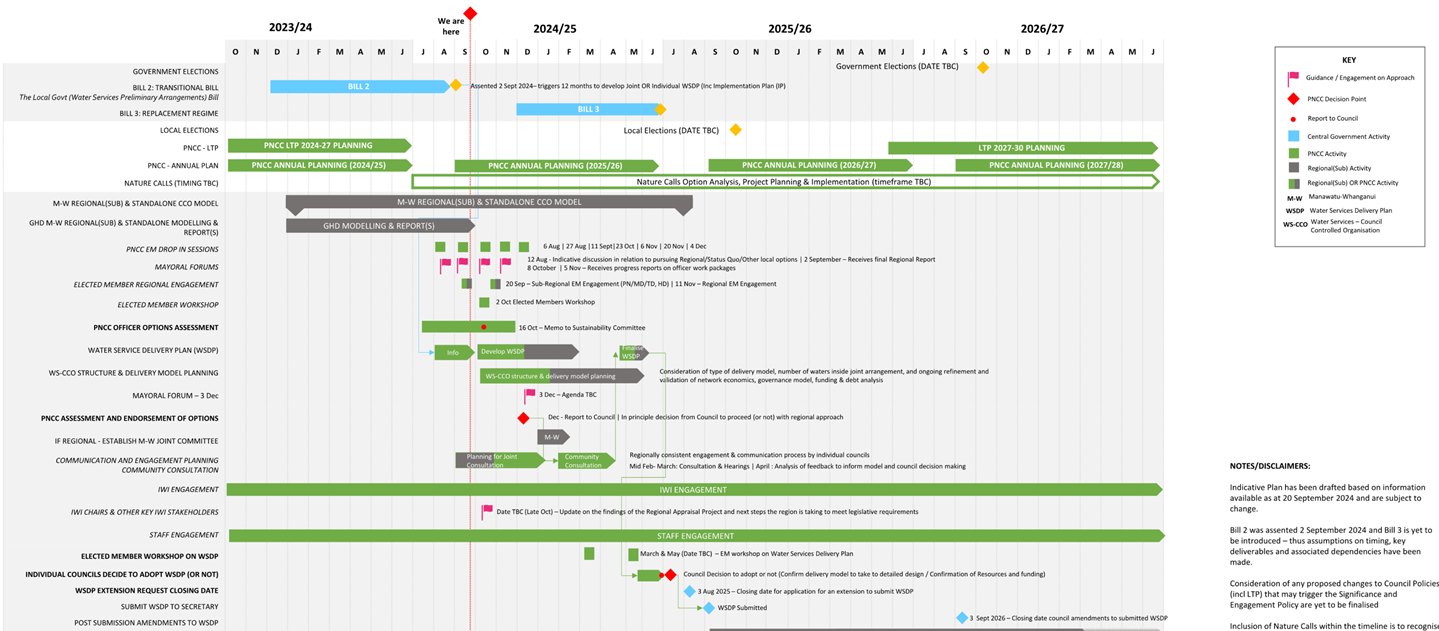
individual options appraisals. This approach supports the tight timeline
(refer Attachment 3) to develop a WSDP and can continue on a no regrets basis
for each council, as this work will inform any WSDP irrespective of the option
chosen.
3.6 The
next phase of work on the regional options will consider the form of the
delivery model, the proposed shareholding and governance arrangements, the
implications of each council’s approach to the treatment of stormwater
and the development of the implementation plan that arises from this work.
3.7 In
December, Council will need to decide if they wish to proceed to consult on the
delivery model included in the Joint WSDP or instead proceed with an
alternative approach. Consultation will occur in early 2025.
4. policy and legislation update
4.1 The
Government has been clear about the principles behind its Local Water Done Well
policy since taking office; councils will retain ownership of their water
assets but will have to meet new rules and regulations. Councils will
have choices, but within the parameters set by the Government.
4.2 The
signals continue to be that some form of amalgamation is encouraged, and
consideration of this is expected to be the outcome for many councils, although
this will not be mandated.
4.3 As
the Bill progressed through the final stages of the process, some key changes
were made:
a) The
WSDP must include an Implementation Plan and a commitment to give effect to
that;
b) Clarification
of the consultation requirements in relation to the WSDP The Act
clarifies that a council must consult on its anticipated or proposed model or
arrangement for delivering water services in its Plan and ensure that its
consultation and decision-making complies with section 61 to 63 (Part 3 of the
Act). These sections relate to the streamlined consultation provisions
that allow a council to only identify and assess two options when one of them
is joining up in some way; and specify the requirements in relation to any
amendments to the LTP that may be required as a consequence of the decision and
the information requirements of consultation; and
c) Giving
levy-making powers to recover the costs of the Commerce Commission from the
providers of Water Services, i.e. Council or whatever delivery arrangement they
enter.
4.4 In
mid-August the Government announced the policy settings for the enduring
arrangements for future water services delivery, which will be included in the
third piece of legislation to be introduced in December and anticipated to be
passed in June 2025.
4.5 The
proposed changes relate to the models for service delivery, financing
arrangements, a new accountability framework, and changes to the regulation of
water, stormwater and wastewater. The proposals will be subject to the
parliamentary process, but when they are passed into law, they will change how
we operate over time. This update sets out the key points from that
announcement, and highlights where there is uncertainty about the implications
of the proposals.
5. water services council controlled organisations
and other delivery models
5.1 The
Act defines a Water Services CCO (WS-CCO) as one that delivers water services,
or provides goods or services that are related to delivering water
services. The Government proposes to increase the range of local government
water service providers by enabling the establishment of new, financially
separate water organisations. WS-CCOs will need to align with the
requirements for these water organisations. These new water organisations
are intended to enable enhanced access to long-term borrowing for water
infrastructure.
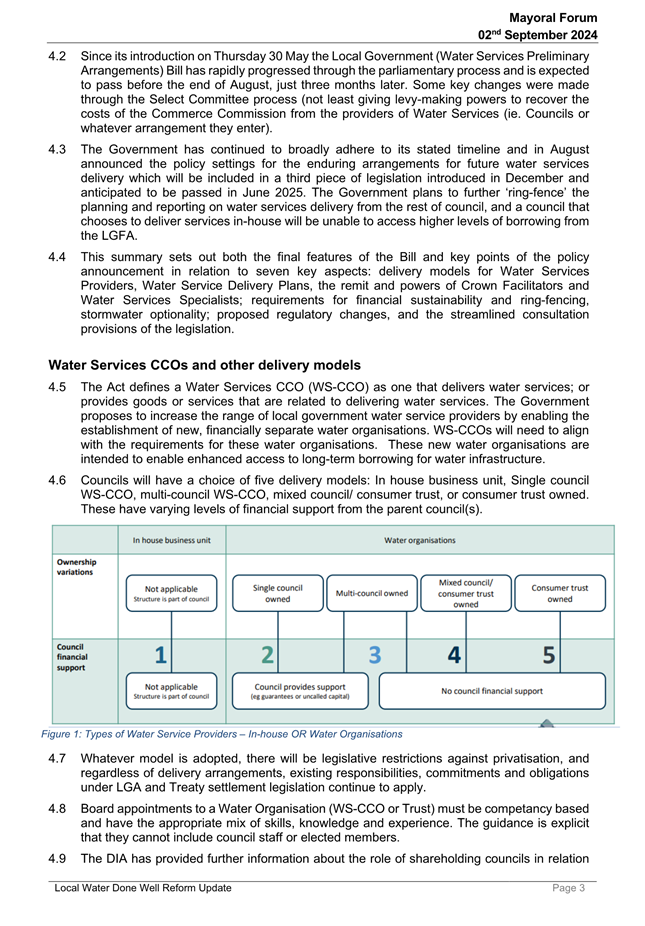
5.2 Councils
will have a choice of five delivery models: In-house business unit,
single council WS-CCO, multi-council WS-CCO, mixed council/ consumer trust, or
consumer trust owned. These have varying levels of financial support from
the parent council(s) (see Figure 1 below).
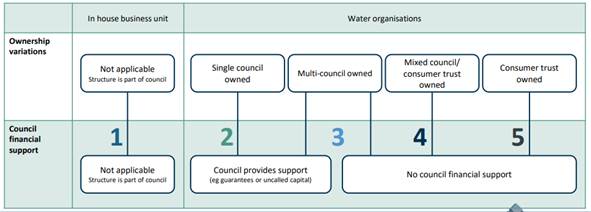
Figure
1: Types of Water Service Providers – In-house or Water
Organisations (source: Department of Internal Affairs (DIA)
5.3 Whatever
model is adopted, there will be legislative restrictions against privatisation,
and regardless of delivery arrangements, existing responsibilities, commitments
and obligations under the LGA and Treaty settlement legislation will continue
to apply.
5.4 Board
appointments to a Water Organisation (WS-CCO or trust) must be competency based
and have the appropriate mix of skills, knowledge and experience. The
guidance is explicit that they cannot include council staff or Elected Members.
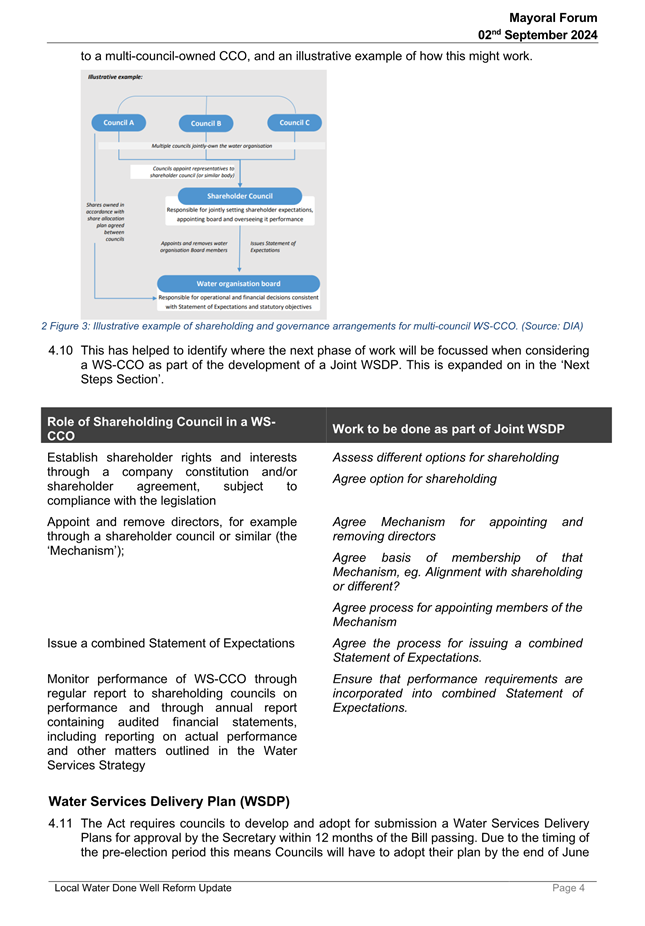
5.5 The
DIA has also provided further information about the role of shareholding
councils in relation to a multi-council owned CCO, and an illustrative example
of how this might work is shown in Figure 2 below.
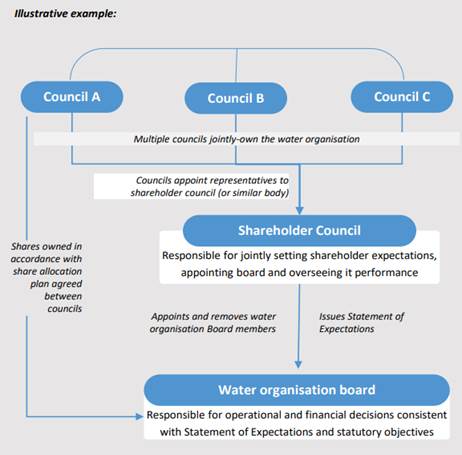
Figure 2: Illustrative
example of shareholding and governance arrangements for multi-council WS-CCOs
(source: DIA)
5.6 This
has helped to identify where the next phase of work will be focussed when
considering a WS-CCO as part of the development of a Joint WSDP. This is
expanded on in the ‘Next Steps Section’.
6. higher water related borrowing limits for
ws-ccos
6.1 The
Minister’s announcement regarding the future policy settings included
confirmation that the Local Government Funding Agency (LGFA) will lend up to
500% of operating revenue to WS-CCOs that are financially supported by their
parent council or councils, subject to WS-CCOs meeting prudent credit
criteria. This is available to both single and multi-council WS-CCOs, but
not available to councils who retain water services in-house.
6.2 A
WSDP must demonstrate how the council will ring-fence its water related
finances from the rest of council. This potentially has implications for
PN City Council, where we currently borrow based on the revenue of the whole of
council, rather than just water related revenue. There are likely to be
additional reporting requirements in relation to financial statements regarding
the water activities. Some early information is included in Section 7
below.
6.3 The
impact on individual councils’ credit ratings, or financial covenants in
relation to the remainder of their business, will depend on a range of
factors. The DIA has indicated that it thinks that borrowing from the
LGFA with the support of shareholding councils will provide a transitional step
towards water organisations borrowing independently in the future. This
is expected to allow time for water organisations to develop an operating and
revenue gathering track record.
7. new accountability framework – ring
fencing pLanning anD reporting
7.1 The
new policy settings include a new Accountability Framework that effectively
‘ring-fences’ Waters strategy, planning and reporting from
Council’s LTP, regardless of the delivery model chosen. It will
replace and/or modify the requirements for water-related planning and reporting
for councils under the LGA 2002 and will mean it is no longer required to
include extensive information on water services in their LTP, infrastructure
strategy, financial strategy, or annual report.
7.2 The
new approach replaces these requirements with three core documents:
a) A
statement of expectations for service delivery arrangements that include
separate water organisations (prepared by shareholders if delivery is by a
WS-CCO);
b) A
water services strategy (prepared by water service providers); and
c) A
water services annual report (prepared by water service providers).
7.3 In
addition, water service providers will be required to develop standalone
financial statements for all water services (drinking water, wastewater,
stormwater, and aggregated water services) that separate these from other
council activities, any unspent revenues or cash generated to be retained and
tagged for future water services expenditure or activity. Similarly,
councils will need to track and disclose borrowing arrangements for water services,
including total borrowings and movements in borrowings.
7.4 The
standalone financial statements will provide accountability and transparency
relating to water charges and expenditure, and evidence that water services
revenues are being spent on water services. They will also provide
transparency and accountability over the amount of council debt that is
allocated to water services.
8. stormwater optionality
8.1 The
inclusion of stormwater in any future joint delivery arrangements had been
understood to be fully optional in the Local Water Done Well policy – the
question of ‘two waters or three’. The legislative
requirements for a WSDP in relation to stormwater support this.
8.2 The
policy announcement about the future settings has set out the proposed options
councils will have, but is explicit that councils will retain legal
responsibility and control of stormwater services regardless of which delivery
mechanism they choose. However, the implications of the proposed policy
are not entirely clear at this stage and may introduce some complexity and risk
in the future, which will need to be better understood in the coming months as
Officers assess the pros and cons of the approach to stormwater.
8.3 If
councils choose to transfer some or all aspects of the delivery of stormwater
services, they will still be responsible for determining the levels of service
and performance targets for the delivery of stormwater management services
(subject to regulatory requirements and community preferences) and for raising
the required revenue from rates. The water organisation(s) contracted to
provide these services will be responsible for identifying the costs of
delivering services that meet the expected levels of service and meet
performance targets. Councils will then rate for that cost and pass the
revenue to the water service organisation.
8.4 Whilst
not explicit in the policy detail released so far, it seems that if councils
retain delivery of stormwater in-house, rather than transferring it in some
way, then the rates revenue from stormwater and borrowing will need to be
ring-fenced as per legislation, and therefore rates income will need to be high
enough to cover borrowing for stormwater (i.e. it cannot be spread across other
council activities).
8.5 The
Government is also proposing regulatory changes to improve the management of
overland flow paths and urban watercourses. The changes include
specifying statutory roles and responsibilities in relation to the management
of overland flow paths and urban watercourses, and enabling new planning and
regulatory tools, such as stormwater network risk management plans and
stormwater rules. This will enable Territorial Authorities, Regional
Councils and transport corridor managers to agree ‘service agreements’
to support the integrated management of stormwater networks.
8.6 The
Government believes this approach will manage the pressure that urban
intensification and climate change are putting on the stormwater networks, and
balance that with the overlaps that stormwater management has with land use
planning and other areas of councils’ responsibilities, including roads,
parks and reserves, and urban watercourses that impact on the operation of the
stormwater network.
9. regulation changes
9.1 The
Government has provided more detail on a range of proposed regulation changes
alongside the new economic regulation. Regulation by the Commerce
Commission is expected to increase costs, while the change to the network and
quality regime aim to provide greater certainty and therefore reduce
cost. The key changes proposed relate to:
a) Changing
the approach Taumata Arowai takes to regulating drinking water suppliers so
that they can be more proportionate, cost effective and efficient in its
functions and duties;
b) Changing
the approach Taumata Arowai takes to regulating drinking water suppliers so
that they can be more proportionate, cost effective and efficient in its
functions and duties;
c) Reducing
the regulatory burden on small suppliers, by excluding ‘shared domestic supplies’
serving 25 consumers or fewer from regulation; and
d) A new
approach to the wastewater discharge standards that Taumata Arowai is already
developing under the Water Services Act to a single standard rather than a
maximum or minimum range. A new set of standards is likely to have some
impact on costs in the future.
9.2 These
changes are broadly supported but the implications of the detail of this will
need to be considered through the consultation process. The Select
Committee process on the third piece of legislation and Taumata Arowai’s
consultation on the development of the wastewater standards is expected to
commence in December. The financial impact of them on currently planned
expenditure is not yet understood and will need to be considered through the
process of developing the WSDP.
10. next steps
10.1 The
recently announced policy settings for Local Water Done Well, and the
legislative requirements that arise from the Local Government (Water Services
Preliminary Arrangements) Act, have created a statutory framework and tight
timeframe for the next phase of the Council’s work.
10.2 To meet
the Government’s timeline for developing a WSDP within 12 months of the
first piece of legislation being passed, Council will have to adopt the WSDP in
June 2025. Formal consultation on the proposed Delivery Model would have
to be carried out in early 2025. A decision on what Delivery Model is
proposed as the preferred option would have to be made in December.
10.3 The
Mayoral Forum has agreed that councils should continue to work together on a
Joint WSDP for the region while councils conclude their own appraisals of their
options. Each council will have to decide in December if they wish to
consult on the proposed joint arrangement or something else. This joint
plan will set out an intention to enter some form of joint arrangement.
10.4 Following
the regional Whanganui-Manawatu appraisal work, and the recent policy
announcements, we have narrowed the options for the development of a joint WSDP
which will include all regional capital programmes, including the Palmerston
North Nature Calls Project.
10.5 This next
phase of joint work will include:
a) Amalgamation
and refinement of Financial and Asset Information to meet legislative
requirements;
b) Appraisal
of shareholding options;
c) Options
for the structure and membership of the ‘Shareholder Committee’
(the body that appoints Board of Directors, sets Statement of Expectations and
monitors performance);
d) Appraisal
of Service Delivery Models;
e) Consideration
of how each council wishes to deal with stormwater affecting the proposed
delivery arrangement;
f) Developing
an Implementation Plan;
g) Joint
Planning for formal consultation on Service Delivery Model in the new year; and
h) Iwi
engagement on a regional basis.
10.6 At the
same time, Officers will continue with the following work:
a) Finalisation
of ‘Go it Alone; modelling under the new rules and regulations;
b) Options
appraisal for the approach to stormwater in the event of a joint arrangement;
c) Ongoing
information sharing with the community and early engagement with the community
to understand their high-level priorities in relation to water service
delivery; and
d) Ongoing
iwi engagement at a district level.
10.7 These work
packages all align with the mandatory information requirement for the
consultation process as set out in legislation.
10.8 As set out
earlier, the implications of the proposed approach to stormwater are amongst
the more challenging aspects to work through (the Regional Options Appraisal
Project is based on the costs and revenue for stormwater being managed by the
regional/sub-regional CCO.)
11. Compliance and administration
|
Does the Committee have
delegated authority to decide?
|
Yes
|
|
Are the decisions significant?
|
No
|
|
If they are significant do they
affect land or a body of water?
|
No
|
|
Can this decision only be made
through a 10 Year Plan?
|
No
|
|
Does this decision require
consultation through the Special Consultative procedure?
|
No
|
|
Is there funding in the current
Annual Plan for these objectives?
|
No
|
|
Are the recommendations
inconsistent with any of Council’s policies or plans?
|
No
|
|
The recommendations contribute
to:
Whāinga 4: He tāone
toitū, he tāone manawaroa
Goal 4: A sustainable and resilient
city
|
|
The
recommendations contribute to the achievement of objective/objectives
in:
13.
Mahere wai
13. Water Plan
The objective is: Provide water
services to our community
|
|
Contribution
to strategic direction and to social, economic, environmental and cultural
well-being
|
Water services have undergone
significant reform in the past few years. The National-led Government has
repealed the previous government’s Three Waters programme and replaced
it with ‘Local Water Done Well’. The Government is still working
through the details of what this reform involves, but it does include local
government keeping ownership of water assets. Councils will be encouraged to
form regional groupings (to get the benefits of size) and Council-Controlled
Organisations (to be able to borrow funds without affecting Council balance
sheets).
|
|
|
|
Attachments
|
1.
|
2024
06 10 Three Waters Reform Update to Mayoral Forum_DISPATCH ⇩ 
|
|
|
2.
|
2024
09 02 Local Water Reform Update to Mayoral Forum ⇩ 
|
|
|
3.
|
Local
Water Done Well Workplan - Indicative High Level Timeline 20092024 ⇩
|
|
Memorandum
TO: Sustainability
Committee
MEETING DATE: 16
October 2024
TITLE: Summary
of Actions by the Manawatū-Whanganui Climate Action Joint Committee
Presented
By: Adam
Jarvis, Manager Climate Change and Sustainability
APPROVED BY: David
Murphy, General Manager Strategic Planning
RECOMMENDATION(S)
TO Sustainability Committee
1. That the
Committee receive the memorandum titled ‘Summary of Actions by the
Manawatū-Whanganui Climate Action Joint Committee’, presented to the
Sustainability Committee on 16 October 2024, for information.
1. Context
1.1 The
Palmerston North City Council (Council), through its regional agreements,
supports and engages with region-wide climate change actions through several
joint groups including the Manawatū-Whanganui Climate Action Joint
Committee (Joint Committee). This Joint Committee has produced the
Manawatū-Whanganui Joint Climate Action Plan (Action Plan), which includes
actions to be led by local councils and further actions to be led by the Joint
Committee.
1.2 The
Sustainability Committee on 16 August 2023 resolved that financial support for
these actions and the Joint Committee be deferred to the 2024-34 Long Term Plan
process.
1.3 Members
of the Joint Committee agreed to work to ensure that appropriate information is
available to local councils to enable them to consider climate change
initiatives through their Long-Term Plan processes.
1.4 The
National Emissions Reduction Plan (NERP) is due to be updated later in 2024,
resulting in changes in priority and potential funding sources from Government.
Council has reviewed the consultation document on the proposed changes and
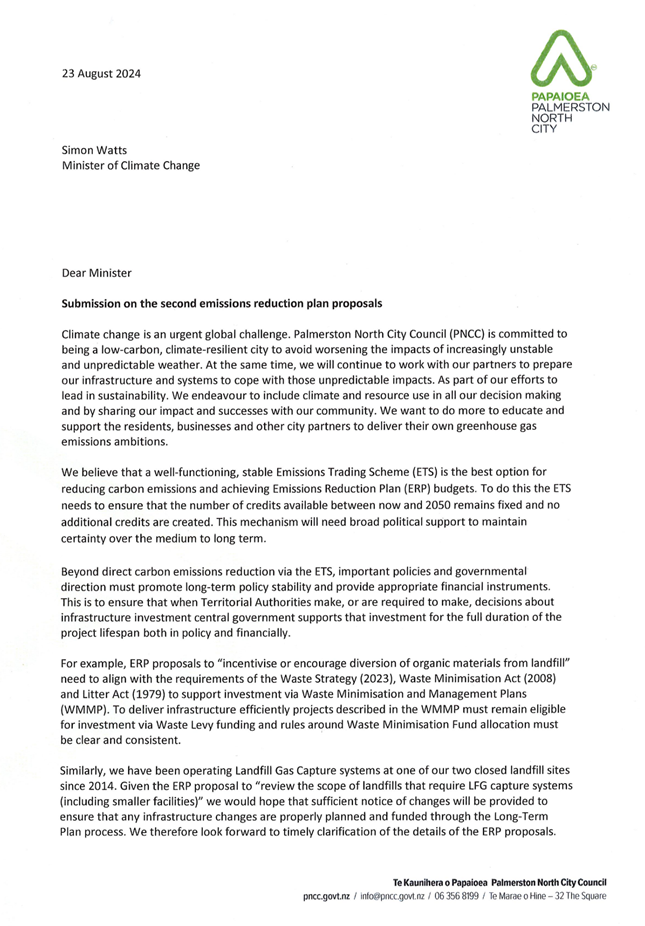
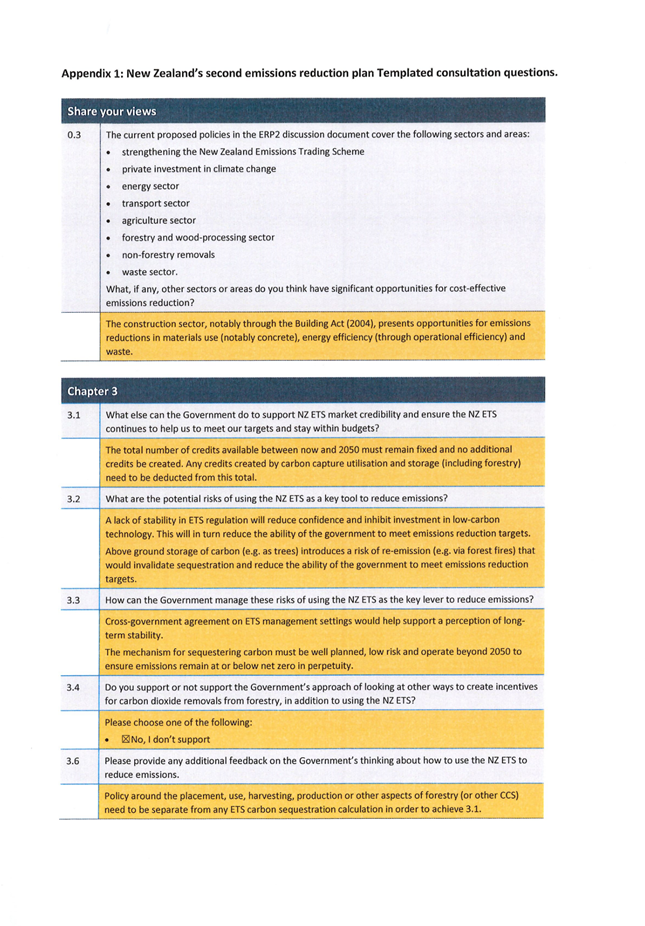
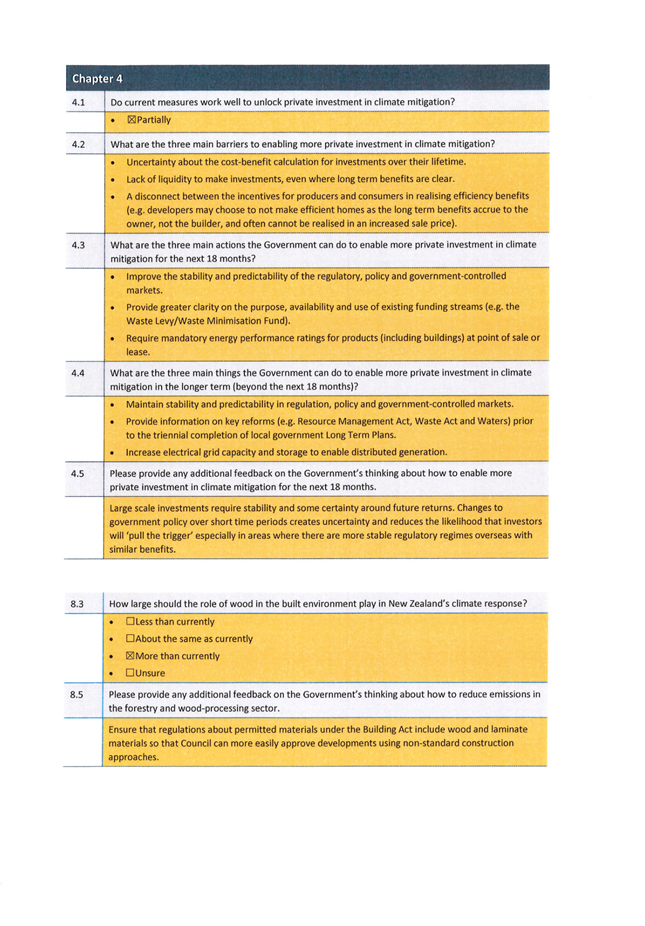
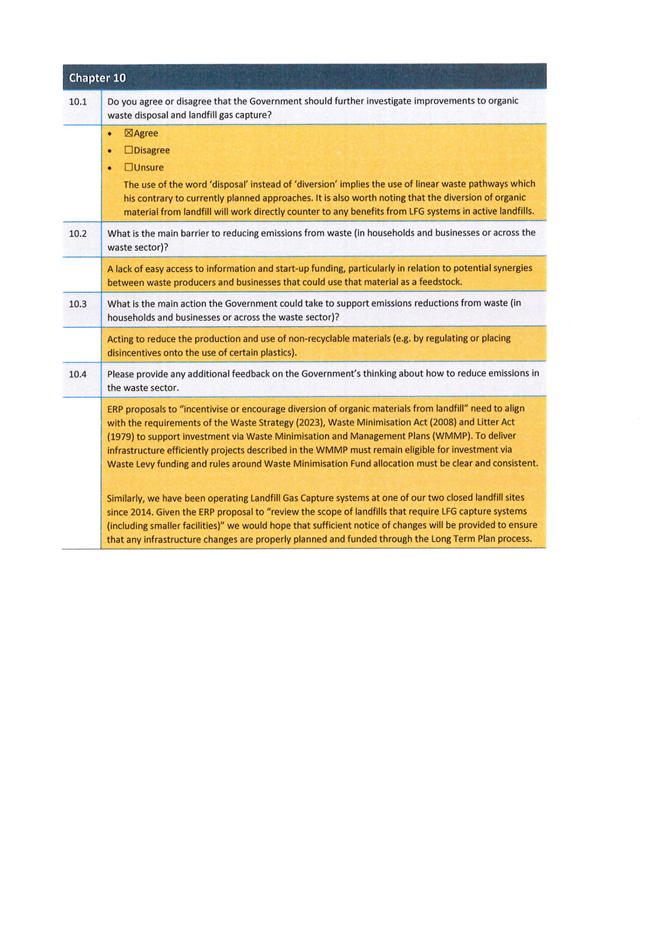
submitted a formal response on 25 August 2024 (see Attachment 1).
1.5 The
National Institute of Water and Atmospheric Research (NIWA) recently completed
revised national climate and rainfall projections, last released in 2018. These
provide information about key climate variables such as temperature, rainfall,
wind, and drought and how they might change into the future.
2. BACKGROUND
2.1 In
September 2019, in recognition of the urgency of responding to climate change,
eight councils that comprise the Manawatū-Whanganui region, signed a
Memorandum of Understanding to collectively address climate change resilience,
mitigation and communication. In 2021 the signatories, comprising the sitting
Mayors, formed the local government members of the Joint Committee in
accordance with the committee’s terms of reference. Seven tangata whenua
members were appointed by Horizons Regional Council on the recommendation of
Iwi leaders in order to ensure that a Māori perspective is reflected in
the work of the Joint Committee.
2.2 The
Joint Committee began drafting a joint action plan in 2022. Council responded
to the draft action plan in February 2023 broadly supporting its aims and
intent. The Joint Committee adopted and published the Action Plan in early
2023. This plan is about understanding how we will collectively respond to
climate change in the Manawatū-Whanganui region and working together to
reduce potential harm.
3. Ongoing
Work
3.1 Minutes
of Joint Committee Meetings are provided in Attachment 2.
3.2 The
work program for the Joint Committee (see Attachment 3 for details) includes:
a) Regional Flood Vulnerability
Assessment - Identifying communities in greatest need of support.
b) Regional Hazard/ Risk
Register.
c) Climate Change Wānanga -
Supporting action taken by tangata whenua and communities.
d) Community-led adaptive
planning progress and learnings.
e) Horizons Region Pre-Spatial
Planning Progress Report - Identify and define data and information
requirements to enable adaptive planning for communities, tangata whenua and
councils.
f) Emission Reduction
Tools and Resource for Iwi.
g) Supporting action by tangata
whenua and communities.
h) Emissions modelling.
4. NEXT
STEPS
4.1 The
work programme agreed at the September 2024 meeting will be actioned over the
next 12 months. The next Joint Committee meeting will be scheduled in early 2025
to discuss progress and any issues arising in the intervening period. The Joint
Committee could hold funds, but has yet to. Progressing the work programme is
therefore reliant on local and regional councils’ existing resources and
capacity.
4.2 Officers
will continue to meet regularly with their peers in other local councils and
exchange information, ideas and any work that can be used to avoid duplication
or achieve co-benefits across local authority boundaries.
5. Compliance
and administration
|
Does the Committee have
delegated authority to decide?
|
Yes
|
|
Are the decisions significant?
|
No
|
|
If they are significant, do they
affect land or a body of water?
|
No
|
|
Can this decision only be made
through a 10 Year Plan?
|
No
|
|
Does this decision require consultation
through the Special Consultative procedure?
|
No
|
|
Is there funding in the current
Annual Plan for these actions?
|
Yes
|
|
Are the recommendations
inconsistent with any of Council’s policies or plans?
|
No
|
|
The recommendations contribute
to:
Whāinga 4: He tāone
toitū, he tāone manawaroa
Goal 4: A sustainable and
resilient city
|
|
The
recommendations contribute to the achievement of objectives
in:
10.
Mahere āhuarangi hurihuri, toitūtanga
10. Climate Change and
Sustainability Plan
The objective is: Encourage and
promote sustainable best-practices in Council activities and the wider
community
|
|
Contribution to strategic
direction and to social, economic, environmental and cultural well-being
|
This memorandum details the
progress in delivering the identified action.
|
|
|
|
Attachments
|
1.
|
PNCC
Consultation Response to the National Emissions Reduction Plan 2024 ⇩
|
|
|
2.
|
Joint
Committee Meeting Minutes 2023-24 ⇩
|
|
|
3.
|
Joint
Committee Work Programme 2024-25 ⇩
|
|
Memorandum
TO: Sustainability
Committee
MEETING DATE: 16
October 2024
TITLE: Proposed
Scope for the Co-development of a City-wide Climate Action Plan
Presented
By: Adam
Jarvis, Manager Climate Change and Sustainability
APPROVED BY: David
Murphy, General Manager Strategic Planning
RECOMMENDATION(S)
TO Sustainability Committee
1. That the
Committee receive the memorandum titled ‘Proposed scope for the
co-development of a city-wide climate action plan’, presented to the
Sustainability Committee on 16 October 2024.
1. ISSUE
1.1 The
Climate Change and Sustainability Plan 2024 contains a new action to
‘co-develop a community-focused city-wide climate action plan, including
the articulation of local co-benefits and the identification of projects that
may attract co-funding’. This memorandum proposes a scope for the delivery
of this report.
1.2 It
is assumed that the goal of the action plan will be to inform the 2027-2037
Long-Term Plan deliberations and decision-making more generally. Resources are
inevitability limited, and the plan can provide guidance regarding priorities
and return on investment, including both expected carbon reduction and wider
strategic benefits per dollar. This would serve a similar function as the Low
Carbon Fund, but targeting broader citywide emissions, rather than being
limited to organisational.
1.3 Development
of the plan would first cast a wide net for ideas and proposals. This would
include an open-ended community consultation exercise, and engagement with the
business and research communities, before analysing these to ultimately
recommend a series of priorities for future Council investment.
2. SCOPE
2.1 The proposed plan development process would cast as broad a
net as possible, gathering community aspirations, potential project and
investment ideas, and then analysing the costs and benefits of these in a
manner similar to the process established by the Low Carbon Fund, i.e.
determining cost per unit carbon, after wider co-benefits are properly
accounted for.
2.2 The Low Carbon Fund operates by providing capital to enable
operational emission reductions. The scope for funding is therefore the same as
that in Council’s annual organisational emissions inventory. These are
emissions that occur across the lifetime of an asset or activity and sit within
our operational control. Conversely, ‘embodied emissions’ of
construction materials, or emissions otherwise controlled by another
organisation, are out of scope for allocation through the Fund.
2.3 Council officers have identified several eligible and
operationally deliverable projects which were assessed by the Senior Climate
Change Advisor with assistance from the Finance Unit. Each project is analysed
in terms of its ‘Net Present Value’ (specifically, looking at their
projected operational savings discounted by the Council’s cost of capital
subtracted by the capital cost of the project), the projected carbon savings,
and a 30% weighting to wider strategic benefit, if any. Applications are then prioritised by which projects deliver
the greatest benefit per dollar. Consequently, leaving aside deliverability
concerns, the fund is generally ambivalent to the scale of the project, and a
$30,000 application is at no inherent disadvantage compared to a $300,000
application. If the former provides greater value for money, then it will
receive priority. The current cut-off benchmark for funding is the spot price
of carbon through the New Zealand Emissions Trading Scheme (ETS) – only
projects that deliver emission reductions at a lower cost per tonne of carbon
equivalent than the cost Council could pay through the ETS are eligible.
2.4 Following this analysis, a series of recommendations are
made to the Chief Executive to approve the reallocation of funds from the Low
Carbon Fund into the respective programmes associated with each project that
meets the above criteria. These are then delivered by the respective activity
teams as with any other programme.
2.5 The Low Carbon Fund approach has been highly successful as
a method of allocating limited resources towards organisational emission
reductions efficiently. Replicating a similar process through the development
of the action plan to prioritise Council resources aimed at city-wide climate
action would be similarly useful.
2.6 Practically, we would develop the ‘community-focused
city-wide climate action plan’ by directly engaging with interested
community groups, the business sector and with the broader public, and then
running a series of workshops. We also intend to run a micro-conference
(or potentially combine this work with another sustainability-oriented
conference), soliciting ‘Low Carbon Fund’ type quantified
cost/benefit case studies from businesses, and other institutions from across
the country that have implemented low-carbon projects. Officers would then
utilise all of these information sources in the compilation of the draft action
plan.
3. NEXT
STEPS
3.1 Develop
the community-focused city-wide climate action plan as proposed above.
3.2 Deliver
a draft back to this committee in spring 2025 for Elected Member consideration.
4. Compliance
and administration
|
Does the Committee have
delegated authority to decide?
|
Yes
|
|
Are the decisions significant?
|
No
|
|
If they are significant do they
affect land or a body of water?
|
No
|
|
Can this decision only be made
through a 10 Year Plan?
|
No
|
|
Does this decision require
consultation through the Special Consultative procedure?
|
No
|
|
Is there funding in the current
Annual Plan for these objectives?
|
Yes
|
|
Are the recommendations
inconsistent with any of Council’s policies or plans?
|
No
|
|
The recommendations contribute
to:
Whāinga 4: He tāone
toitū, he tāone manawaroa
Goal 4: A sustainable and
resilient city
|
|
The
recommendations contribute to the achievement of objective/objectives
in:
10.
Mahere āhuarangi hurihuri, toitūtanga
10. Climate Change and
Sustainability Plan
The objective is: Co-develop a
community-focused city-wide climate action plan, including the articulation
of local co-benefits and the identification of projects that may attract
co-funding
|
|
Contribution to strategic
direction and to social, economic, environmental and cultural well-being
|
Forward planning for future
environmental well-being investment and programmes.
|
|
|
|
Attachments
Nil
Memorandum
TO: Sustainability
Committee
MEETING DATE: 16
October 2024
TITLE: Palmerston
North City-wide Emissions Inventory 2023
Presented
By: Adam
Jarvis, Manager Climate Change and Sustainability
APPROVED BY: David
Murphy, General Manager Strategic Planning
RECOMMENDATION(S)
TO Sustainability Committee
1. That the
Committee note that total net emissions for Palmerston North City for 2023 were
647,252 tCO2e, which is a 21,880 tCO2e reduction compared to 2022 and an
11,929 tCO2e increase since the 2016 baseline.
1. ISSUE
1.1 Through
the 2021-31 Long-Term Plan, Council set a target of a 30% reduction in CO2e
emissions in Palmerston North by 2031, compared to the 2016/17 baseline. This
2023 inventory has been prepared to measure progress against this target (2023
sat within the 2021-31 Long-Term Plan period).
1.2 The
city-wide target was revised as part of the 2024-34 Long-Term Plan and is
currently set at a 44% reduction in per capita emissions by 2034 compared to
the 2016 baseline.
1.3 Total
net emissions for 2023 were 647,252 tCO2e. This is a 21,880 tCO2e reduction
compared to the previous year, and an 11,929 tCO2e increase since the 2016/17
baseline. However, on a per capita basis, city-wide emissions have declined 9%
over the same period.
2. BACKGROUND
2.1 In
2016 Palmerston North City Council conducted its first city-wide inventory to
provide context for the Eco City Strategy’s 25% city-wide carbon emission
reduction target. This inventory was conducted by AECOM and was presented to
Council in 2018.
3. results
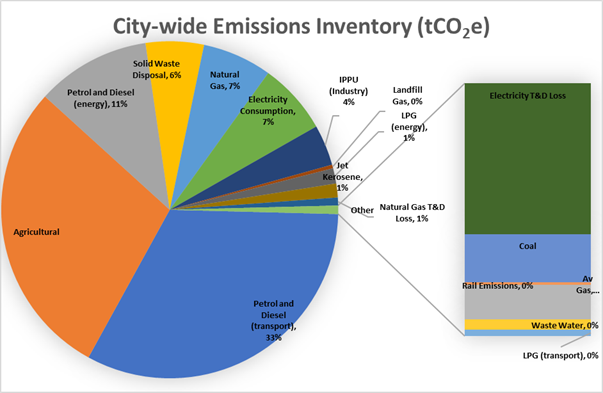
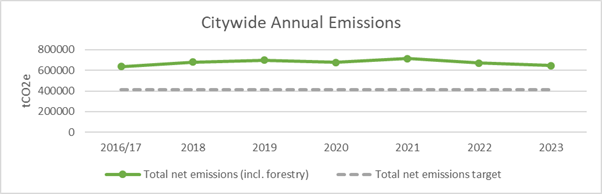
3.1 A
breakdown of 2023 inventory by emissions source, and a timeseries showing the
inventory in the context of previous years, are presented below.
3.2 A
summary table of the inventory, broken down by emissions and sequestration
source, is included below.
|
Emissions per activity
(tCO2e)
|
|
Stationary Energy
19,5117
|
Electricity Consumption
|
44731.64
|
|
Electricity T&D Loss
|
3153.34
|
|
Petrol and Diesel
|
71729.42
|
|
Natural Gas
|
43596.17
|
|
Natural Gas T&D Loss
|
4995.09
|
|
LPG
|
9581.81
|
|
Landfill Gas
|
2313.47
|
|
Coal
|
1003.16
|
|
Biofuels
|
14013.62
|
|
Transportation
222,973
|
Petrol
|
115,564
|
|
Diesel
|
97,790
|
|
Rail Emissions
|
62
|
|
Jet Kerosene
|
8,697
|
|
Av Gas
|
721
|
|
LPG
|
141
|
|
Waste
36,687
|
Solid Waste Disposal
|
36,484
|
|
Waste Water
|
204
|
|
IPPU (Industry)
25,607
|
IPPU (Industry)
|
25,607
|
|
Agricultural
18,7927
|
Agricultural
|
187,927
|
|
Total gross emissions
(excl. forestry)
|
|
668313
|
|
|
|
|
|
Forestry
-21,060
|
Exotic Forest Sequestration
|
-93198.04
|
|
Native Forest Sequestration
|
-19040.66
|
|
Total Harvest Emissions
|
91177.83
|
|
Total net emissions
(incl. forestry)
|
|
3.3 City-wide
emissions are reported in tonnes of CO2 equivalent (tCO2e) in order to provide
a single comparable number for a variety of greenhouse gases such as methane
and nitrous oxide.
3.4 Per
capita emissions are 6.8 tCO2e, a 5% reduction compared to 2022 and a 9%
decrease since 2016. Emissions are likely to vary widely between individuals.
3.5 It
is worth noting that some areas of the inventory are based on data that is a
pro-rata calculation from regional or national data using nationally published
emissions factors. This introduces uncertainty into the data which currently is
unable to be resolved further.
4. Discussion
4.1 Forestry
emissions decreased by 19%. The number of trees aged 1-5 increased by 54% as a
result of the planting season. It is important to note that due to the cyclical
nature of the forestry industry, carbon emissions fluctuate by a large number
from year-to-year based on plant versus harvest. Therefore, a longer-term view
should be taken of the impact of forestry on emissions.
4.2 Rail
emissions fell by 22% as part of a moderate mode shift of freight from rail to
road, particularly following Cyclone Gabriel and the closure of some rail
lines.
4.3 Aviation
gas emissions rose by 32%, due to an increase in flight school training, with
an observed increase of 1,600 hours of training flights compared to 2022.
4.4 Solid
waste disposal emissions fell by 14%; landfill gas emissions fell by 11%. Due
to the relatively high level of data, it remains to be seen whether this change
is consistent with the expected change to waste policy. Waste levels are
dependent on a large number of variables, so we would like to keep an eye on
this data and see if it is an anomaly or whether a trend is establishing.
4.5 Natural
gas emissions are down by 7%, largely due to declining use of gas heating, due
both to a warm year and the probable electrification of heating. 2023 saw a
change in eligibility criteria for the Warmer Kiwi Homes grant, meaning more
people were able to install heat pumps and insulate their homes for more
efficient heating.
4.6 What
evidence we have suggests a mild increase in per capita vehicle kilometres
travelled (VKT). Despite this, a small decrease in petrol transport emissions
was observed, suggesting increased vehicle electrification.
5. NEXT
STEPS
5.1 This
latest inventory represents a step forward in the accuracy and richness of the
data. Council plans to continue to improve in this regard.
5.2 A
city-wide inventory for the 2024 calendar year cannot be compiled until after
key datasets are made available in mid-2025. The 2024 city-wide inventory is
expected to be delivered around this time next year.
6. Compliance
and administration
|
Does the Committee have
delegated authority to decide?
|
Yes
|
|
Are the decisions significant?
|
No
|
|
If they are significant do they
affect land or a body of water?
|
No
|
|
Can this decision only be made
through a 10 Year Plan?
|
No
|
|
Does this decision require
consultation through the Special Consultative procedure?
|
No
|
|
Is there funding in the current
Annual Plan for these objectives?
|
Yes
|
|
Are the recommendations
inconsistent with any of Council’s policies or plans?
|
No
|
|
The recommendations contribute
to Goal 4: An Eco City
|
|
The
recommendations contribute to the achievement of objective/objectives
in:
10. Climate Change and
Sustainability Plan
The objective is: Develop a road
map to achieving a low carbon city.
|
|
Contribution to strategic
direction and to social, economic, environmental and cultural well-being
|
Measuring progress towards the
carbon reduction target.
|
|
|
|
Attachments
Nil
Memorandum
TO: Sustainability
Committee
MEETING DATE: 16
October 2024
TITLE: Palmerston
North City Council Organisational Emissions Inventory 2023/2024
Presented
By: Adam
Jarvis, Manager Climate Change and Sustainability
APPROVED BY: David
Murphy, General Manager Strategic Planning
RECOMMENDATION(S)
TO Sustainability Committee
1. That the
Committee note that Palmerston North City Council organisational
emissions have fallen from 18,255 tCO2e in 2022/23, to 17,180 tCO2e in 2023/24:
a 6% reduction.
2. That the
Committee note that Palmerston North City Council organisational emissions have
fallen from 26,444 tCO2e in 2015/16, to 17,180 tCO2e in 2023/24: a 35%
reduction.
1. ISSUE
1.1 Through
the 2021-31 Long-Term Plan, Palmerston North City Council (Council) has set
itself the target of a city-wide 30% reduction in carbon emissions by 2031,
compared to the 2015/16 baseline. This 2023/24 inventory has been prepared to
measure progress against this target (2023/24 sat within the 2021-31 Long-Term
Plan period).
1.2 The
organisation emissions target was revised as part of the 2024-34 Long-Term Plan
and is currently set at a 60% reduction by 2034 compared to the 2015/16
baseline.
1.3 Provided
below are the preliminary findings of Council's corporate emissions
(i.e. emissions resulting from Council activities) during the 2023/24 financial
year. These findings, and the associated source data, are being independently
assessed against ISO14064-3 by an external auditor.
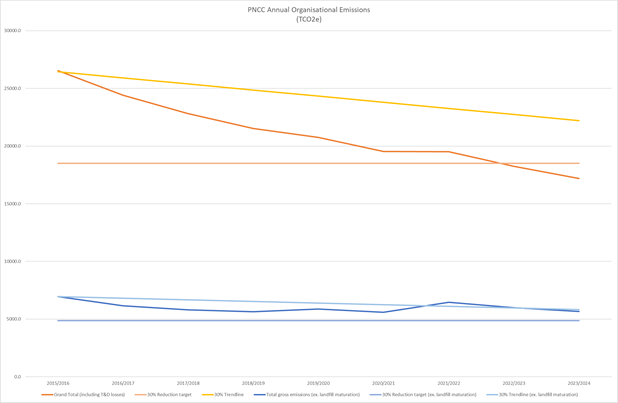
1.4 As
a result of Council actions, the organisation's emissions have fallen from
26,444 tCO2e in 2015/16, to 17,180 tCO2e in 2023/24: a 35% reduction.
Non-landfill-related emissions fell from 6,942 tCO2e to 5,661 tCO2e over the
same period: an 18.46% reduction since 2015/16 and a 5.6% decrease from
the previous 2022/23 period. A time series of emissions since the baseline year
is provided in the results section.
2. BACKGROUND
2.1 The
organisation's Internal Emissions Report is compiled from usage and
emissions data from the following emissions sources:
• Council stationary energy use
(electricity, piped natural gas)
• Wastewater processing emissions
• Vehicles (petrol, diesel)
• ‘Small Plant Item’
(petrol-powered chainsaws, leaf blowers, etc.)
• Diesel use by Council
generators
• Methane release from Awapuni
and Ashhurst landfills
• Waste collected from all sites
• Air travel and taxi travel
• Staff commuting
• Air-conditioning unit gas
refills
• Fertilizer
use
2.2 This
inventory is conducted entirely ‘in-house’ by Council Officers. The
inventory follows the Ministry for the Environment’s standard emissions
inventory methodology and is being externally audited by Edge Environmental
Ltd.
2.3 An
overview of Council’s 2023/24 emissions inventory is provided below in
the results section. These break down Council’s emissions by emissions
source
in order to show those areas that could be targeted for further reductions. A
detailed breakdown of the inventory data is provided in the results section.
2.4 The
inventory is presented in terms of ‘carbon dioxide equivalent’ or
‘CO2e’. This is because other gases such as methane and nitrous
oxide have
different relative impacts per unit weight. For example, the refrigerant R-22,
typically only released in very small volumes, has a global warming potential
12,000 greater than carbon dioxide. CO2e accounting allows for the global
warming potential of different greenhouse gases to be compared with one
another.
3. Results

|
Business Group
|
Sum of Calculated
emissions (t CO2e)
|
|
Customer
|
232.4
|
|
Ashhurst Library
|
0.9
|
|
Awapuni Library
|
0.2
|
|
City Library
|
205.3
|
|
City Pound
|
0.8
|
|
Highbury Library
|
0.8
|
|
Mobile Library
|
10.9
|
|
Roslyn Library
|
0.8
|
|
Wildbase Recovery Centre
|
3.9
|
|
Youth Space
|
8.7
|
|
Historic Business Units
|
16.7
|
|
Ashhurst Transfer
Station
|
0.0
|
|
Garages
|
1.3
|
|
Square Gardens
|
15.3
|
|
Infrastructure/Logistics
& Support
|
1721.6
|
|
Heavy Plant
|
587.9
|
|
Heavy Trucks
|
290.6
|
|
Leased Vehicles
|
0.0
|
|
Light Plant
|
37.2
|
|
Light Trucks
|
24.1
|
|
Medium Trucks
|
76.8
|
|
Mowers
|
80.1
|
|
Nursery
|
11.9
|
|
Pool Vehicles
|
212.1
|
|
Quad Bikes
|
25.2
|
|
Tankers
|
21.9
|
|
The Depot
|
16.6
|
|
Tractors
|
96.3
|
|
Utility Vehicles
|
241.0
|
|
Infrastructure/Parks
& Reserves
|
747.9
|
|
Ashhurst
|
98.3
|
|
Cemeteries
|
2.7
|
|
Citywide Reserves
|
29.2
|
|
Freyberg Aquatic Centre
|
208.0
|
|
Lido Aquatic Centre
|
355.9
|
|
Local Reserves &
Sports Fields
|
53.7
|
|
Infrastructure/Property
|
228.7
|
|
Civic Administration
Building
|
224.8
|
|
Community Centres
|
8.8
|
|
Property
|
-14.1
|
|
Public Toilets
|
6.9
|
|
Social Housing Buildings
|
2.3
|
|
Infrastructure/Three
Waters
|
1490.6
|
|
Stormwater Pump Stations
|
6.6
|
|
Wastewater Pump Stations
|
20.4
|
|
Wastewater Treatment
|
1342.1
|
|
Water Treatment &
Pumps
|
121.5
|
|
Infrastructure/Transport
|
168.2
|
|
City Bus Terminal
|
1.0
|
|
Street Lighting
|
162.2
|
|
Traffic Signals
|
5.0
|
|
Infrastructure/Waste
Management
|
11592.1
|
|
Ashhurst Landfill
|
70.7
|
|
Awapuni Landfill
|
11521.2
|
|
Waste Management
|
0.1
|
|
Waste Management
Operations
|
0.0
|
|
Marketing &
Communications
|
141.5
|
|
Arena Operations
|
141.5
|
|
Palmerston North City
Council
|
212.4
|
|
Palmerston North City
Council
|
212.4
|
|
Workplace Travel
|
541.9
|
|
Air Travel
|
141.2
|
|
Hire Cars and Taxis
|
0.1
|
|
Staff Commuting
|
400.5
|
|
Grand Total
|
17093.9
|
4. discussion
4.1 There
has been a notable reduction in natural gas emissions this financial year
– a 34% decrease since the 2022/2023 inventory. This is likely due both
to the relatively warm weather over this time period, and a continued push for
electrification through the Low Carbon Fund. It is noted that despite this
push, levels of electricity emissions have remained within 2% of those of the
previous inventory.
4.2 Staff
commuting has shown emissions have decreased by 51% for private car usage. It
is indicated by the 137% increase in bus emissions for staff commuters that the
decrease in private car use is due in part to an increase in public transport
usage. It is worth noting that bus emissions should decrease in next
year’s emissions due to the recent electrification of Palmerston North
Buses.
5. next
steps
5.1 Completing
the audit process. A final report will then be sent to Elected Members, noting
any substantial changes.
5.2 Use
the information from this inventory to inform the delivery of Council emission
reductions, including through the 'Low Carbon Fund'. The fund is allocated each
year towards the projects that will deliver the greatest operational emission
reductions per net-present dollar spent (i.e. taking future cost savings into
account), with a 30% weighting towards wider strategic benefits.
5.3 To
inform future capital investment and benchmark performance, Council will
continue to collect corporate emissions data and report these annually.
6. Compliance
and administration
|
Does the Committee have
delegated authority to decide?
|
Yes
|
|
Are the decisions significant?
|
No
|
|
If they are significant do they
affect land or a body of water?
|
No
|
|
Can this decision only be made
through a 10 Year Plan?
|
No
|
|
Does this decision require consultation
through the Special Consultative procedure?
|
No
|
|
Is there funding in the current
Annual Plan for these objectives?
|
Yes
|
|
Are the recommendations
inconsistent with any of Council’s policies or plans?
|
No
|
|
The recommendations contribute
to:
Whāinga 4: He tāone
toitū, he tāone manawaroa
Goal 4: A sustainable and
resilient city
|
|
The
recommendations contribute to the achievement of objective/objectives
in:
10.
Mahere āhuarangi hurihuri, toitūtanga
10. Climate Change and Sustainability
Plan
The objective is: Monitor, and
have externally audited, PNCC greenhouse gas emissions
|
|
Contribution to strategic
direction and to social, economic, environmental and cultural well-being
|
The emissions inventory and
management plan detail Council’s progress on reducing its own internal
corporate emissions goal.
|
|
|
|
Attachments
Nil
Memorandum
TO: Sustainability
Committee
MEETING DATE: 16
October 2024
TITLE: Waste
Management and Minimisation Plan 2019 - Progress on Actions
Presented
By: Natasha
Hickmott, Activities Manager - Resource Recovery and Sustainability and Melissa
Doyle, Waste Minimisation Officer
APPROVED BY: Chris
Dyhrberg, General Manager Infrastructure
RECOMMENDATION(S)
TO Sustainability Committee
1. That the
Committee receive the memorandum titled ‘Waste Management and
Minimisation Plan 2019 – Progress on Actions’ presented to the
Sustainability Committee on 16 October 2024.
1. ISSUE
1.1 The 2019 Waste Management and Minimisation
Plan (WMMP) requires progress on each of the actions and targets within the
WMMP to be reported annually to the Sustainability Committee.
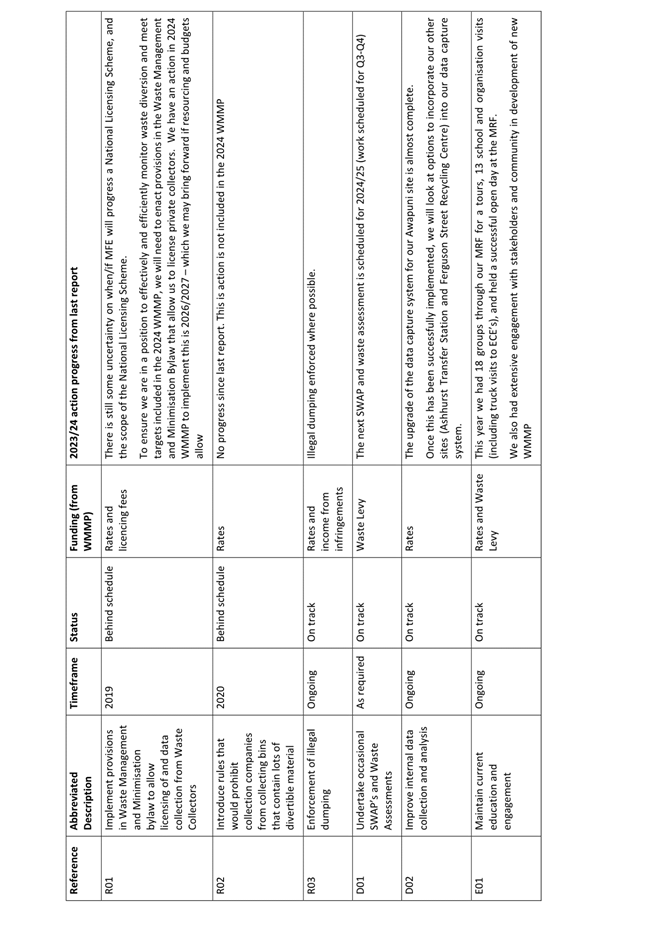
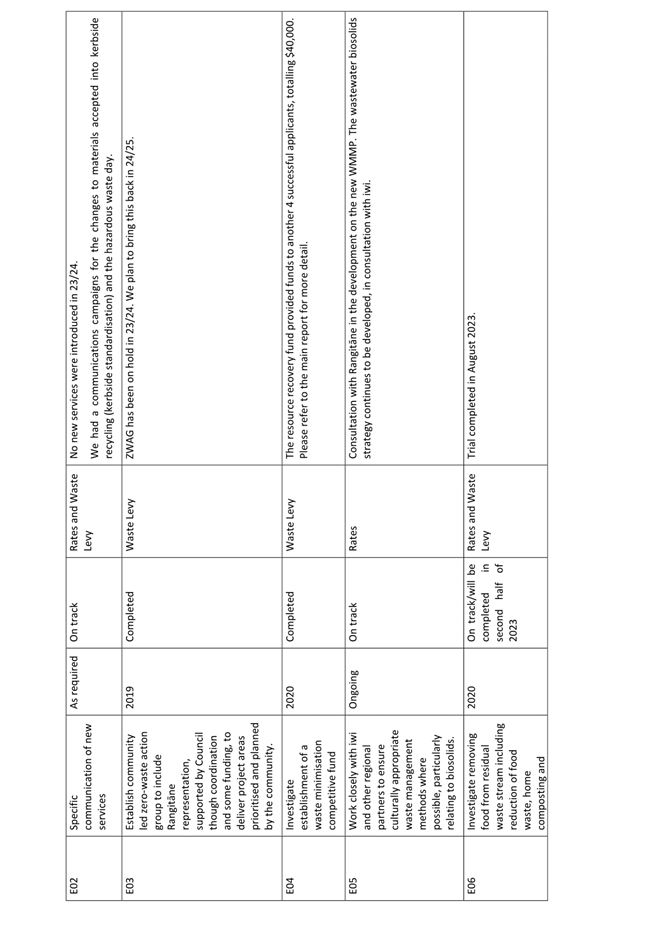
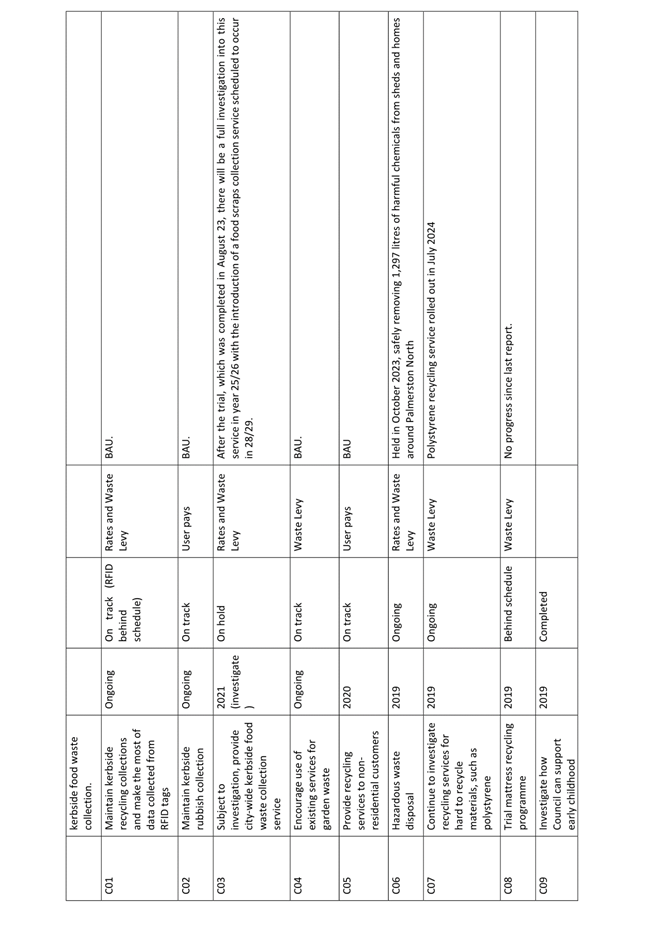
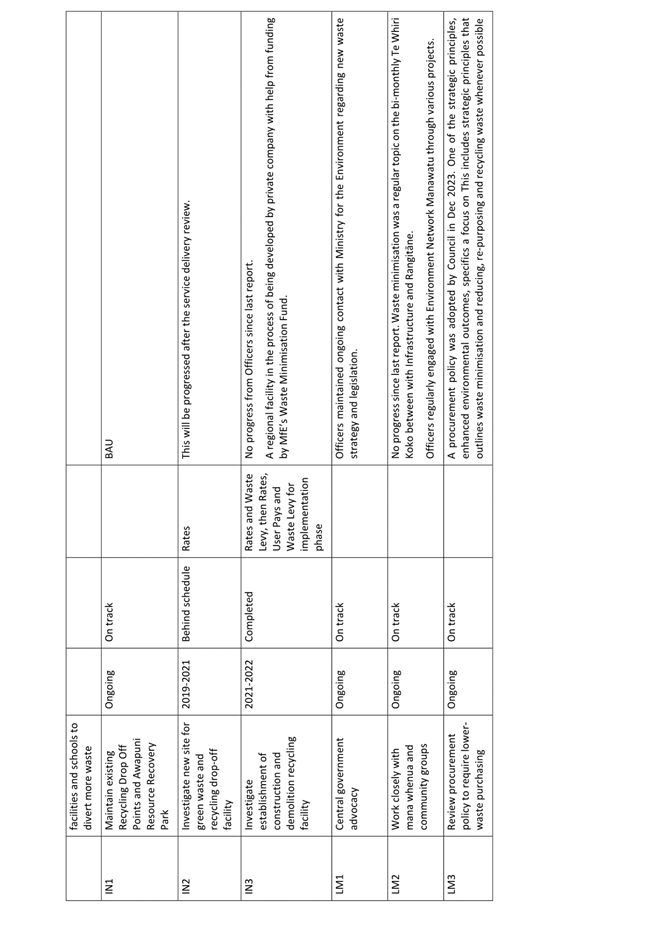
1.2 This report provides the annual progress
update from the 2023/24 financial year. Please also refer to Attachment 1
for detail on progress towards the specific actions within the WMMP.
1.3 Please note that this annual update will
be the last for the 2019 WMMP as Council reviewed and updated its WMMP in
2023/24. The next WMMP progress report to Council will, therefore, report
on progress towards actions and targets in the 2024 WMMP.
2. BACKGROUND
2.1 The Palmerston North City Council
(Council) has a statutory requirement under the Waste Minimisation Act 2008 to
promote effective and efficient waste management and minimisation within the
Palmerston North City.
2.2 This is done through adopting a WMMP which
sets the priorities, actions, targets, and strategic framework for managing
waste in the city. The 2019 WMMP sets a target of increasing waste
diversion from 36% to 48% by 2025. Reducing the amount of material sent to
landfill will be achieved via 26 actions in the WMMP.
3. Key
Achievements in 2023/24
Development of a new 2024 WMMP
3.1 Considerable time was spent over the last
year developing the newly adopted WMMP. This gave us an opportunity to
engage with the public and ensure a fit for purpose plan was developed that
aligns well with signalled government direction.
3.2 Part of the engagement included a
successful open day at the Awapuni materials recovery facility (MRF), which saw
120 people visit the facility. The sorting line was running throughout
the open day which gave participants valuable insight into how recycling is
sorted. Officers also had a recycling truck available for participants to
explore up close. Alongside this, Officers were present during the event
to discuss and answer questions on the new 2024 WMMP.
Waste
Diversion
3.3 In 2023/24 the amount of recycled material
collected via our kerbside service is estimated to be 50kg per capita, which is
the same as the previous year.
3.4 Unfortunately, the total citywide waste diversion cannot be
ascertained because of incomplete (voluntary) reporting by the private waste
sector, who hold much of the market share for waste collection in the
city. Obtaining this data is often a challenge, and Officers continue to
consider options for how we can improve this moving forward.
3.5 For context, the best tool for getting an
in-depth understanding of the waste diversion in the city is a full waste
assessment. These are scheduled to occur every three years, with the next
waste assessment scheduled for 2025/26.
3.6 A hazardous waste collection day diverted
1,297 litres of harmful chemicals to safe disposal. Some of these
chemicals were particularly toxic, including phosphorus, lindane, paraquat and
2,4-D (herbicide).
3.7 A big success in 2023/24 was the successful negotiation of a polystyrene
recycling service with an external provider. Officers placed a strong
focus on establishing a viable and enduring arrangement to ensure this is a long-term
opportunity for the city. Alongside this, Officers continued support for
existing auxiliary recycling services including batteries, e-waste, and tyres.
Resource
Recovery Fund
3.8 The Resource Recovery Fund was again well
utilised in its third year. The fund reflects Council's commitment to
sustainability and environmental responsibility, and empowering the community
to be involved in waste minimisation. The total amount awarded this year
was $40,000, to four successful projects:
· Environment Network Manawatu (ENM): Repair
Café –
continued support for the successful repair café, now in its third
year. We intend to fund the repair cafe directly from the operating
budgets after the current allocation expires, allowing the current allocation
to be available for other initiatives.
· Mason
Brothers Honey: Project Clean Comb – developing a system to
wash plastic hive frames, preventing the need to throw them away.
· Just
Zilch: storage capacity upgrade – increasing capacity in the
food recovery warehouse to allow more food to be diverted from landfill and
distributed to the community.
· Precycle:
Sustainable is Attainable – bringing the successful sustainable is
attainable model to the Manawatu, which will allow pathways for by-products of
industry to be diverted from landfill, either by other existing businesses or
new ventures.
Education and Engagement
3.9 Alongside
the WMMP engagement, the successful
MRF open day and tours throughout the year, the extra resource in the waste
minimisation team allowed for an increased focus on education in 2023/24.
An example of this is the introduction of recycling truck visits to early
childhood education centres, which was very well received.
3.10 Waste Minimisation Officers have also been
more available to visit groups and schools to give talks about waste
minimisation. Overall, we have engaged directly with over 30 interested
groups in the last year.
4. NEXT
STEPS
4.1 The coming year will see a shift to
delivering the actions in the latest 2024 WMMP.
4.2 Undertake a comprehensive service review
of the Resource Recovery activity and begin scoping for the development of a
new material recovery facility.
4.3 Continue momentum with focused education
talks, either at the MRF, in schools and presentations to community
groups. Officers will also run a few education campaigns aimed at busting
a recycling myth that “it all just ends up in landfill,” followed
up by a “rethink” campaign that will promote activities at the top
of the waste hierarchy. Additionally, Officers will also plan to hold
more open days at Awapuni during the October school holidays.
4.4 Continue to investigate avenues to divert
hard to recycle materials and develop waste management and minimisation frameworks
for construction and demolition and events.
4.5 Continue to follow central government
changes. We expect more consultation to come from Ministry for the
Environment over the next 12 months on the initiatives previously signalled.
5. Compliance
and administration
|
Does the Committee have
delegated authority to decide?
|
Yes
|
|
Are the decisions significant?
|
No
|
|
If they are significant do, they
affect land or a body of water?
|
No
|
|
Can this decision only be made
through a 10 Year Plan?
|
No
|
|
Does this decision require
consultation through the Special Consultative procedure?
|
No
|
|
Is there funding in the current
Annual Plan for these objectives?
|
Yes
|
|
Are the recommendations
inconsistent with any of Council’s policies or plans?
|
No
|
|
The recommendations contribute
to:
Whāinga 4: He tāone
toitū, he tāone manawaroa
Goal 4: A sustainable and
resilient city
|
|
The
recommendations contribute to the achievement of objective/objectives
in:
12.
Mahere taumanu para
12. Resource Recovery Plan
The objective is:
· Promote waste
reduction
· Divert waste
from landfill
· Provide support
for for-purpose organisations and local communities to recover, reuse,
repurpose or regenerate products
· Provide
recycling collection services including kerbside recycling, drop-off centres
and public space recycling bins
· Provide waste
collection services, including kerbside collection, the Ashhurst transfer
station, and public space rubbish bins
· Monitor and
manage closed landfills
|
|
Contribution to strategic
direction and to social, economic, environmental, and cultural well-being
|
This report on actions in the
Waste Management and Minimisation Plan (WMMP) provides Elected Members with
an update on progress to achieving the outcomes of that Plan and provides
information that will support the next review of the WMMP.
|
|
|
|
Attachments
|
1.
|
WMMP
Action Progress 2024 ⇩ 
|
|
Memorandum
TO: Sustainability
Committee
MEETING DATE: 16
October 2024
TITLE: Manawatū
River Pathway Project
Presented
By: Glen
O'Connor, Manager Transport and Development and Michael Bridge, Service Manager
Active Transport
APPROVED BY: Chris
Dyhrberg, General Manager Infrastructure
RECOMMENDATION(S)
TO COUNCIL
1. That Council:
EITHER
a. Defers all
activity on the Manawatū River Pathway until Year 4 of the Long-Term Plan;
at no cost over the 2024-2027 Financial Years.
OR
b. Directs the
Chief Executive to continue engagement with affected landowners and progress
planning and preparations for the Notice of Requirement over the 2024-2027
Financial Years; with the Notice of Requirement to be lodged in Year 4 of the
Long-Term Plan, or earlier if all directly affected landowners provide their
written support prior to lodgement.
OR
c. Directs the
Chief Executive to continue engagement with affected landowners and lodge the
Notice of Requirement over the 2024-2027 Financial Years; with land acquisition
and construction commencing from Year 4 of the Long-Term Plan.
OR
d. Considers 2b and 2c in conjunction with the 6 November 2024
report to Council regarding Transport Funding.
2. That Council
allocates EITHER $350,000 (for 1b) OR $800,000 (for 1c) from Programme 2057
‘City-wide Shared Pathways New and Link Improvements’ for this work
over the next three years.
1. ISSUE
1.1
There are two significant shared pathway projects for delivery through
Programme 2057 ‘City-wide Shared Pathways New and Link
Improvements’.
The projects are:
· Palmerston North
Feilding Pathway (PNFP), connecting Feilding, Bunnythorpe and Palmerston North;
and
· Manawatū
River Pathway (MRP), which connects Ashhurst and Palmerston North, following
the river edge alignment.
1.2 A
report on the PNFP was presented to the Sustainability Committee on 22 May
2024, when the Committee endorsed a motion calling for a report on the MRP.
1.3 On
30 May 2024, during the Long-Term Plan (LTP) hearings, Council agreed to budget
$6M over three years to construct the PNFP.
1.4 Council
also deferred further expenditure and work on the MRP to Year 4 of the LTP,
with the expectation that in the meantime engagement with landowners would
continue. However, Officers cannot continue to engage with landowners without a
budget.
1.5 The
implications of Council not providing a budget for the River Pathway project
for Years 1-3 of the LTP, are that further work, including landowner
engagement, cannot be resourced.
1.6 Programme
2057 consists of $6M over the 2024-2027 Financial Years for the Palmerston
North Feilding Pathway (PNFP); it does not currently have funding in the LTP
specific to delivering the MRP.
1.7 This
report provides an update on the current status of the Manawatū River
Pathway and outlines three options to complete construction of the pathway
within the LTP period.
2. SUMMARY
OF OPTIONS ANALYSIS
|
Problem
or Opportunity
|
Council
has committed to implementing the Manawatū River Pathway, however the
project is not funded in the current Long Term Plan (LTP). The opportunity is
for Council to determine to what extent the project progresses over the next
3 years, through to completion within the current LTP period.
|
|
OPTION 1a:
|
Defer
all activity on the Manawatū River Pathway until Year 4 of the Long-Term
Plan (2027/28 Financial Year).
|
|
Community
Views
|
Not specifically canvassed for this report.
|
|
Benefits
|
No expenditure
over the next three financial years.
|
|
Risks
|
· Losing the
goodwill and benefits of engagement to date with affected landowners,
including the established relationships with Officers;
· Reducing the
currency of work to date on reports and preparations for the Notice of
Requirement; this work would have to be reviewed and at least some would have
to be re-litigated at a later date;
· Losing the
specialised knowledge and expertise of Officers and contractors involved in
work to date;
· Potential for
increased costs in the future for the Notice of Requirement, land acquisition
and construction;
· Risk to
Council’s reputation by not delivering on commitment to complete the
Manawatū River Pathway.
|
|
Financial
|
No
expenditure over the next three financial years.
|
|
OPTION 1b:
|
Officers
continue engagement with affected landowners and progress planning and
preparations for lodgement of the Notice of Requirement in Year 4 of the
Long-Term Plan (2027/28 Financial Year), or earlier if all directly affected
landowners provide their written support prior to lodgement.
|
|
Community
Views
|
Not specifically canvassed for this report.
|
|
Benefits
|
· Maintaining the
connection with affected landowners;
· Retaining the
currency of most of the work to date on reports and preparations for the
Notice of Requirement;
· Retaining the
specialised knowledge and expertise of Officers and contractors involved in
work to date;
· Reducing the
risk of increased costs in the future for the Notice of Requirement, land
acquisition and construction.
|
|
Risks
|
· Losing some of
the benefits and goodwill of engagement with affected landowners, some of
whom are frustrated with Council;
· Reducing the
currency of some work to date on reports and preparations for the Notice of
Requirement; some of this work would have to be re-litigated;
· Potential for
increased costs in the future for the Notice of Requirement, land acquisition
and construction;
· Moderate risk to
Council’s reputation by only partially delivering on commitment to
complete the Manawatū River Pathway.
|
|
Financial
|
Estimate
$350,000 over the 2024-2027 Financial Years, including Officer time.
|
|
OPTION 1c:
|
Continue
engagement with affected landowners and lodge the Notice of Requirement over
the 2024-2027 Financial Years, with land acquisition and construction
commencing from Year 4 of the Long-Term Plan (2027/28 Financial Year).
|
|
Community
Views
|
Not specifically canvassed for this report.
|
|
Benefits
|
· Completing the
essential first step (Notice of Requirement), providing a clear path forward
for land acquisition and construction;
· Maintaining the
engagement and goodwill with affected landowners;
· Retaining the
specialised knowledge and expertise of Officers and contractors involved in
work to date;
· Reducing the
risk of increased costs in the future for land acquisition and construction.
|
|
Risks
|
· The outcome of
the Notice of Requirement process is not certain;
· Affected landowners
may raise objections through the Notice of Requirement process, which could
negatively affect Council’s reputation;
· Minor risk to
Council’s reputation by not fully delivering on commitment to complete
the Manawatū River Pathway.
|
|
Financial
|
Estimate
$800,000 over the 2024-2027 Financial Years, including Officer time.
|
3. BACKGROUND
3.1 The
Manawatū River Pathway (MRP) follows the river’s edge alongside the
Manawatū River, connecting Ashhurst with Palmerston North, He Ara Kotahi,
the Mangaone Pathway and the wider shared pathway and urban networks. While
some sections have been completed, significant portions remain unconnected.
3.2 In
December 2020, Council directed the Chief Executive to explore legal options to
expedite the completion of the MRP. A petition from local residents supporting
the project was also presented to Council at that time. Since then, substantial
progress has been made, including engagement with affected landowners,
development of feasibility designs and preparation for a Notice of Requirement
to designate land for the pathway.
3.3 A
Notice of Requirement under the Resource Management Act 1991 is an important
precursor to any subsequent land acquisition and construction, as well as
providing the necessary planning approval for any such work.
3.4 By
early 2023, the Chief Executive advised Council that the Notice of Requirement
for land designation would be initiated in the second quarter of 2023. While
work on the Notice of Requirement was well advanced, this was not completed or
lodged with Council, as work was paused to allow for further negotiations with
affected landowners.
3.5 On
22 May 2024, Council’s Sustainability Committee passed a resolution
requesting a progress report on the establishment of the riverside shared path
between Palmerston North and Ashhurst. Subsequently, on 30 May 2024, Council
resolved to defer further expenditure and work on the MRP until Year 4 of the
Long Term Plan (LTP).
Strategic Context
3.6 Our
shared pathways are key links to our regional and urban networks, supporting
economic growth and social activity; contributing to a liveable city. They
provide safe, functional and attractive walking and cycling options for
everyone, whether for commuting to work and school, recreational use,
connecting with whanau, getting to the shops, health and well-being.
3.7 The
MRP links with existing and future shared pathways, trails, footpaths and
cycleways, growing the connected local and regional network for walking and
cycling. Linkages include the Mangaone Pathway, Pioneer Pathway, He Ara Kotahi
to Linton and Massey, urban cycle network and the future Te Ahu a Turanga
pathway to Woodville (anticipating NZTA Waka Kotahi completion by 2026), as
well as the proposed City to Sea pathway to Foxton.
3.8 The
MRP aligns with the Te Āpiti Masterplan, through Te Ahu a Turanga pathway to Woodville, including
the new walking and cycling bridge to be built across the Manawatū River,
and corresponding access through the Domain and proposed Pembroke Street bridge
into the heart of Ashhurst. The strategic opportunity to develop connections
with the MRP formed a key part of Council’s review and comment on Te Ahu
a Turanga and its recommendation for a shared pathway as part of that project.
3.9 Once
complete, there will be a comprehensive shared pathway network across the
region, connecting Palmerston North with Ashhurst, Woodville, Feilding and
Foxton; our local network connecting to the national cycle trail running the
length of New Zealand.
3.10 The MRP is
essential to implementing the key directions of the 2016 Manawatū River Framework (in respect of
developing the shared path network along the river edge for connectivity and
activation), 2019 Urban Cycle Network Masterplan and 2023 Strategic Networks, and aligns with the 2020 Palmerston North Integrated Transport Initiative (PNITI)
through ‘Making it safer and easier for people to choose to walk or cycle’.
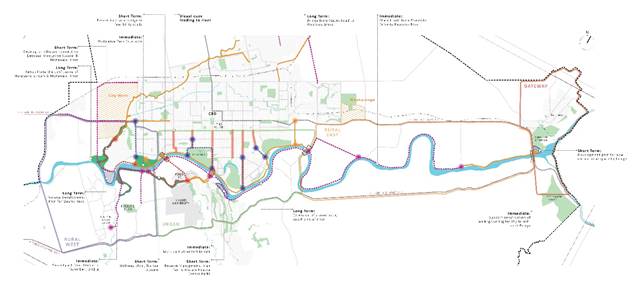
Figure 1: Manawatū River Framework 2016
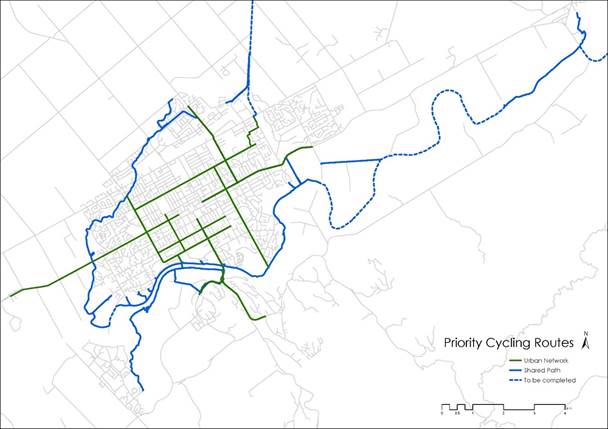
Figure 2: Regional shared pathways and core urban
cycle network (Strategic Networks)
4. MANAWATŪ
RIVER PATHWAY OVERVIEW
4.1 The
MRP runs between Ashhurst and Mangaone Stream to the west of the city, along
the river edge alignment.
4.2 The
completed sections of the MRP currently connect Ahimate Reserve with Riverside
Drive, as well as Ashhurst with Raukawa Road.
4.3 There
are two segments not yet complete, creating a disconnect between rural and
peri-urban communities and the urban centre:
· Riverside Drive to Te Matai Road and Raukawa Road, to the east of
the city; approximately 12km.
· Ahimate Reserve to
Tip Road, to the west of the city, at the bottom of Maxwells Line and near the
confluence with Mangaone Stream; approximately 400m.
4.4 Currently
people wanting to walk or cycle between Palmerston North and Ashhurst have only
the option of Te Matai Road and Napier Road, or Napier Road, which is a 100km/h
state highway, without proper provision for active modes.
4.5 There
are six landowners covering the gaps in the MRP network. PN City Council has
easement rights over some segments of river edge land within some of these
privately owned sections.
4.6 We
have been engaging with all affected landowners with the aim of completing the
pathway following the river edge alignment. An update
of these engagements is provided in the separate confidential report titled
‘Manawatū River Pathway Project - Progress on Landowners
Engagement’.
4.7 The
ultimate intention for the MRP is to construct a 3m wide limestone shared
pathway following the river edge alignment, which will connect Ashhurst to He
Ara Kotahi and beyond, to Mangaone Stream.
4.8 Following
Council’s decision on 30 May 2024, further work on the MRP is now
deferred to Year 4 of the LTP. Construction of the pathway is still proposed
for completion within the current LTP.
4.9 Subject
to funding, the proposal is to phase implementation, covering designation, land
acquisition and construction:
a) Notice
of Requirement (NoR): the NoR is required to designate the land necessary
to complete the MRP. This process, governed under the Resource Management Act,
will formally identify the corridor within which we can construct and maintain
the pathway;
b) Business
case: this supports our submission to NZTA Waka Kotahi for co-funding;
c) Detailed
designs for construction;
d) Land
acquisition: land acquisition can include purchases and easements, a
process that is governed under the Public Works Act;
e) Construction.
Throughout these phases, we will continue to engage with
affected landowners.
Financial
4.10 The
estimated cost to implement the above phases and complete construction is
$27.7M.
4.11 Since 2018
approximately $660K has been spent on the MRP project. Since December 2020,
when Council resolved to investigate legal options for completion of the MRP,
approximately $450K has been spent on designs, consultant reports, legal costs
and staff time.
4.12 The
Manawatū River Pathway project will be delivered under programme 2057
‘City-wide Shared Pathways New and Link Improvements’:
· Officers
propose to phase land acquisition and construction of the MRP to spread the
cost over multiple years and better ensure affordability.
· Subject
to funding, the project will be completed within the current LTP.
· Phasing
will prioritise key steps and sections to build the connections and maximise
short and medium term benefits.
· Additionally,
there are elements that can be deferred to subsequent LTPs without compromising
deliverability of the core assets (minimal viable product).
· NZTA
Waka Kotahi confirmed in September 2024 that the MRP project is not a co-funded
project in the 2024-27 National Land Transport Plan (NLTP).
· The MRP project is proposed to be submitted again for co-funding in
the next NLTP cycle, coinciding with year 4 of PN City Council’s current
LTP and the start of the 2027-2037 LTP.
4.13 Refer to
Attachment 1 ‘Delivery Phasing and Cost Summary Options’ for a
breakdown of the current estimated costs for each option and proposed
programme.
Project phasing and costs
4.14 Subject to funding, implementation will be
split into three phases:
PHASE 1 is the Notice of Requirement (NoR) to designate land necessary to
complete the MRP, which will be undertaken through the Resource Management Act 1991.
· The NoR is the essential next step towards completing the MRP;
securing the designation provides the foundation for all future implementation,
from land acquisition to construction.
· The NoR phase is estimated to take approximately 12-18 months and is
proposed to commence as soon as possible, subject to the decision by Council.
· We
propose two separate NoRs, lodged simultaneously:
1. NoR for the small section of land between Ahimate Reserve and Tip
Road, at the bottom of Maxwells Line to the west of the city. This is a
distinct section, separate from the majority of incomplete pathway; and
2. NoR for the balance of incomplete pathway, between Riverside Drive
and Raukawa Road.
· The NoR costs and timeline depend on multiple factors, such as
landowner objections. Based on previous NoRs, we have allowed for $650K in the
LTP, not including Officer time.
· The costs for the NoR will be 100% funded by Council.
· Concurrent with the NoR process we will:
1. Continue engagement with landowners, seeking to
negotiate access agreements;
2. Develop a business case (which strengthens our case
for NZTA Waka Kotahi co-funding) at an estimated cost of $350K; and
3. Complete construction drawings at an estimated cost of $1M.
The estimated cost for Phase 1 including the NoR, business
case and final designs is $2M.
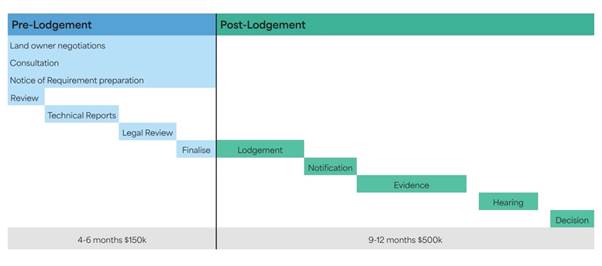
Figure 3: Notice of Requirement timeline and cost estimate
(not including Officer time)
PHASE 2 is the acquistion of the land necessary to construct and maintain
the MRP, at an estimated cost of $3.7M (100% PN City Council funded; not
including Officer time, valuation reports and surveys):
· This
phase is proposed to commence as soon as possible in the LTP, subject to the
decision by Council.
· Negotiations with landowners may lead to options other than land
purchase – such as easements – that can provide the necessary
access to the land to construct and maintain the pathway.
PHASE 3 is construction of the pathway, split into two sections over 12.3km
at a total cost of $22M (Engineers estimate for construction of the
minimum viable product).
· This
phase is proposed to commence as soon as possible, subject to funding, progress
with the NoR, land acquisition and negotiations with landowners:
1. Section one – Riverside Drive to Te Matai Road, plus the short
section betwee Ahimate Reserve and Tip Road; 5.6km, Engineers estimate $9.3M.
2. Section
two – Te Matai Road to Raukawa Road; 6.7km, Engineers estimate $12.7M.
The total estimated cost for delivering all three phases is $27.7M.
Value engineering and scope
change opportunities
4.15 The bulk
of the construction costs for the MRP are driven by:
· Material and contractor costs
· Stormwater works, such as culverts
· Civil works, such as retaining walls, cut and fill
· Bridges
Minimum viable product
4.16 We have
explored value engineering options that could be considered to reduce costs and
provide direction on a minimum viable product to establish a connected route.
Landscaping and amenity
4.17 Landscape
designs for the entire corridor will be developed before procurement and
construction, ensuring a cohesive and consistent product throughout implementation.
4.18 We propose
to defer implementation of the following elements to better ensure
affordability and deliverability of the minimum viable product:
· Landscaping, including vegetation planting – we propose to
deliver the landscaping elements incrementally and iteratively, subject to
available funding;
· Seating, shelter,
lighting and other amenities – we propose to construct seating and other
amenity elements over time, subject to available funding.
4.19 The
minimum viable product will combine new pathway construction with existing
pathways to create a safe connection between Ashhurst and Mangaone Stream, away
from busy 100km/h roads.
4.20 There are
three remaining segments to complete the MRP:
a) Tip
Road to Ahimate Reserve
· 400m, Engineer’s estimate $700K
· This small section will link the existing pathway through Ahimate
Reserve at the bottom of Maxwells Line with Tip Road and ultimately on to the
Mangaone Pathway and Pioneer Pathway; connecting via Marae Tarata to
significant residential urban growth areas to the west of the city - Kākātangiata and Kikiwhenua.
· Construction will
commence, subject to the decision by Council.
b) Riverside
Drive to Te Matai Road
· 5.2km, Engineer’s estimate $8.6M
· This section will link the existing pathway from the city currently
terminating at Riverside Drive with Te Matai Road.
· Construction will
commence, subject to the decision by Council.
c) Te
Matai Road to Raukawa Road
· 6.7km, Engineer’s estimate $12.7M
· This final section will link Te Matai Road with Raukawa Road and the
existing pathway on to Ashhurst, thus completing the pathway between Ashhurst,
Te Ahu a Turanga and Mangaone Stream.
· Construction will
commence, subject to the decision by Council.
4.21 Refer to
Attachment 1 ‘Delivery Phasing and Cost Summary Options’.
Alternative routes
4.22 The
existing route options available to people walking and on bikes between
Palmerston North and Ashhurst use combinations of Napier Road, Te Matai Road
and Raukawa Road.
4.23 Currently
there is a 2km section of pathway along Te Matai Road, between Riverside Drive
and 236 Te Matai Road. This section of pathway does not connect to other
pathways at either end and is not well used or maintained.
4.24 The
Traffic Safety Assessment and Multi Criteria Analysis explored the option of a
complete shared pathway along Te Matai Road, Napier Road and Raukawa Road,
concluding that this was a less safe option compared with a pathway along the
river edge, and did not meet Council’s objective to deliver a riverside
pathway.
4.25 Key
considerations during the safety assessment:
· 100km/h speeds along these roads
· Volumes of heavy vehicles
· Number of quarry truck movements along Te Matai Road and Raukawa
Road
· Crossing Napier Road
4.26 Additionally,
this alternative route presents some engineering complexities, including
bridges, narrow corridors, culverts and steep gradients. Acquisition of some
private land would be required along Te Matai Road and Raukawa Road to provide
enough width to construct a shared pathway.
4.27 NZTA Waka
Kotahi has developed concepts for shared pathways along Napier Road between Te
Matai Road and Raukawa Road, as well as Roberts Line to the city perimeter.
However, the agency has not progressed either concept and we do not expect that
funding will be forthcoming in the short or medium term.
4.28 Given the
constraints, risks, costs and sub-optimal benefits to constructing an
alternative route along Te Matai Road, Napier Road and Raukawa Road, we do not
recommend Council divert resources from the Manawatū River Pathway to
develop this concept.
Feasibility designs
4.29 Feasibility
designs for the Manawatū River Pathway have been completed, showing the
pathway alignment within the designated corridor.
4.30 The draft
feasibility designs show:
· The temporary designation boundary required for construction
· The permanent designation boundary required for operation
· The pathway alignment within the designation corridor
· The main civil works, such as retaining walls, cut and fill
· Culverts and bridges
· Fencing
· Multiple inputs contributed to the development of the draft
feasibility designs:
o Input
from affected landowners
o Traffic
safety assessment
o Civil
engineering report
o Multi
Criteria Analysis
o Cultural
Impact Assessment
o Ecology
report
o Geo
tech report
o Manawatū
river flood mapping
o Landscape
report
o Organic
farming report
o Site
visits
o Land surveys
4.31 We are
continuing to seek feedback from affected landowners on the feasibility
designs, particularly regarding the designation boundaries.
4.32 We have
been working with Horizons to define the designation corridor and pathway
alignment, accounting for the river’s morphology (performance, including
flooding). Consistent with their River Management Plan, Horizons has advised
where along the designation corridor they are most likely to invest resources
to protect assets such as property and roads. We may seek advice on additional
civil works to add resilience to the construction at key points along the
route.
4.33 The MRP
will be constructed within a newly designated corridor along the river edge.
This designation corridor is consistent with existing pathway sections along
the Manawatū River Pathway, and allows for:
· Space for vegetation and fencing between the pathway and adjacent
properties, for privacy, safety, security and amenity;
· Sufficient distance from the active river edge;
· Maintenance and
renewal.
4.34 The
pathway is designed to be 3m wide, which is the minimum NZTA Waka Kotahi shared
path standard, enabling people walking and cycling to use the space and pass
safely. Strips of low vegetation each side of the pathway will provide
additional space for passing and help address safety issues, such as
sightlines.
4.35 The MRP is
designed as a compacted limestone pathway, which is consistent with the
Manawatū River Framework, with limestone pathways in the rural /
peri-urban areas. Where additional resilience is warranted, we may use asphalt
or concrete in place of limestone.
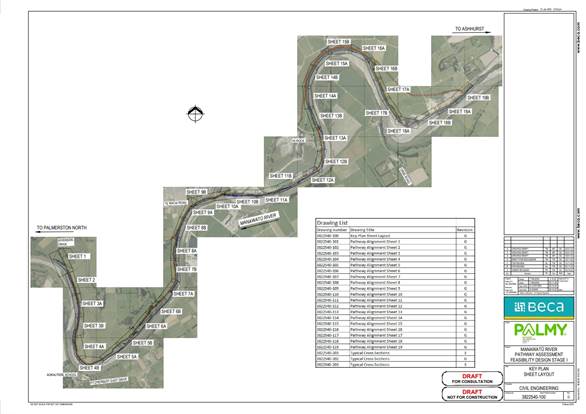
Figure 4: Feasibility designs
have been developed along the full corridor
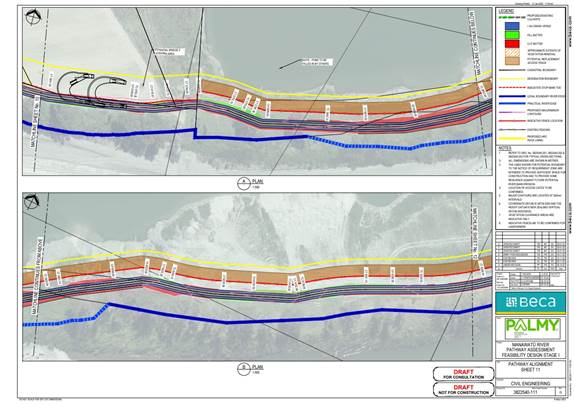
Figure 5: Feasibility
design example page
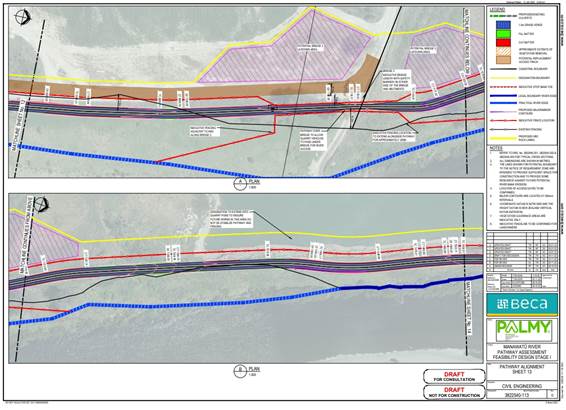
Figure 6: Feasibility
design example page
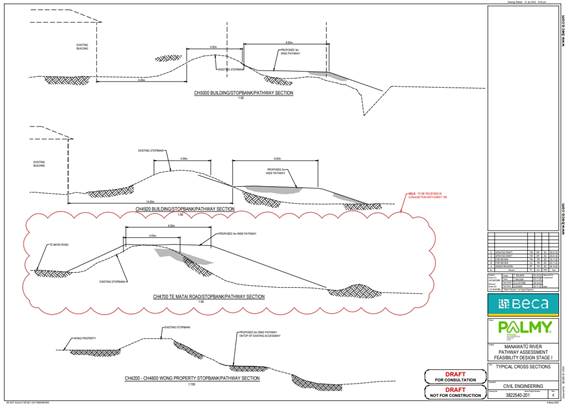
Figure 7: Feasibility design example cross section
Rangitāne
4.36 We
continue to engage with Rangitāne on the project, providing updates at Te
Whiri Kōkō.
4.37 Rangitāne
support the project and are keen to see the connection complete between
Ashhurst and the City (refer to Attachment 2: Rangitāne letter of
support).
4.38 A Cultural
Impact Assessment was commissioned from Te Ao Turoa Environmental for the NoR,
which highlighted a number of issues and opportunities through this project.
4.39 Part 5 of
the Cultural Impact Assessment, ‘Conclusions and recommendations’
states that:
“The Manawatū Awa is central to
our worldview, our culture and traditions. This connection is thriving and is promoted through the Awa Park Framework which the project
[Manawatū River Pathway] gives effect to. We have identified a range of
positive effects as a result of the project:
· The pathway will enable us to access our wāhi tapu, wāhi
tupuna, and wāhi taonga;
· Kaitiakitanga actions around the awa corridor can support mahinga
kai populations, our cultural connections to the landscape and our local taonga
species;
· We have the
opportunity to build on the awa park, our cultural expression; and comunication
of our narrative.”
5. CONCLUSION
5.1 Significant
work has been completed on the Manawatū River Pathway project since 2020,
in preparation for the Notice of Requirement, followed by land acquisition and
construction.
5.2 Feasibility
designs have been drafted, showing how the pathway can be constructed and what
it will cost.
5.3 Open
lines of communication with affected landowners have been established,
providing important feedback on the feasibility designs and Council’s
plans to complete the river pathway connection between Ashhurst and the city.
5.4 There
are three options for Council to consider regarding completion of the pathway
within the current
LTP.
6. Compliance
and administration
|
Does the Committee have
delegated authority to decide?
If Yes quote relevant clause(s)
from Delegations Manual
|
No
|
|
Are the decisions significant?
|
No
|
|
If they are significant do they
affect land or a body of water?
|
No
|
|
Can this decision only be made
through a 10 Year Plan?
|
No
|
|
Does this decision require
consultation through the Special Consultative procedure?
|
No
|
|
Is there funding in the current
Annual Plan for these actions?
|
No
|
|
Are the recommendations
inconsistent with any of Council’s policies or plans?
|
No
|
|
The recommendations contribute
to:
Whāinga 1: He tāone
auaha, he tāone tiputipu
Goal 1: An innovative and
growing city
|
|
The
recommendations contribute to the achievement of action/actions
in:
3.
Mahere tūnuku
3. Transport Plan
The action is: Prioritise active
transport programmes that deliver on Council goals, the purpose of this plan,
and the Government Policy Statement on Transport.
|
|
Contribution to strategic
direction and to social, economic, environmental and cultural well-being
|
Our shared pathways are key
links to our regional and urban networks, providing safe, functional and
attractive walking and cycling options for everyone, whether for commuting to
work and school, recreational use, connecting with whanau, getting to the
shops, health and wellbeing.
|
|
|
|
Attachments
|
1.
|
Delivery
Phasing and Cost Summary Options ⇩ 
|
|
|
2.
|
Rangitāne
letter of support ⇩
|
|
Committee Work Schedule
TO: Sustainability
Committee
MEETING DATE: 16
October 2024
TITLE: Committee
Work Schedule
RECOMMENDATION TO Sustainability Committee
1. That the
Sustainability Committee receive its Work Schedule dated October 2024.
Sustainability
Committee Work Schedule – OCTOBER 2024
|
Estimated Report Date
|
Subject
|
Officer Responsible
|
Current Position
|
Date of Instruction &
Clause number
|
|
16 October 2024
|
Manawatū-Whanganui
Climate Joint Action Committee Update
|
General Manager Strategic Planning
|
|
Climate change plan ongoing
|
|
16 October 2024
|
Progress on establishing the riverside
shared path from Palmerston North to Ashhurst
|
General Manager Infrastructure
|
|
22 May 2024
Clause 17
|
|
16 October 2024
|
Citywide Emissions Inventory 2023 Annual
Report
|
General Manager Strategic Planning
|
|
Climate change plan ongoing action #3
|
|
16 October 2024
|
Proposed scope for the co-creation of a
city-wide climate change action plan
|
General Manager Strategic Planning
|
|
30 March 2022
Clause 6-22,
Climate change plan ongoing
action #5
|
|
16 October 2024
|
PNCC Organisational Emissions Inventory
2023/24 Annual Report
|
General Manager Strategic Planning
|
|
Climate change plan ongoing action #1
|
|
16 October 2024
|
Waste management and minimisation plan
2019 - annual progress update for 2023/24 FY
|
General Manager Infrastructure
|
|
9 Sept 2020
Clause 17-20
|
|
1 February 2025
|
Alternative options for BPO – Nature Calls
|
General Manager Infrastructure
|
|
Council
29 May 2024
Clause 95.11 -25 (rec 2)
|
|
2025
|
Annual Sector Lead Report: Environment Network
Manawatū
|
General Manager Customer & Community
|
|
Terms of Reference
|
|
2025
|
Options to enable inclusion of organisational and
community-wide sustainability indicators in the 2026 Sustainability Review
|
General Manager Corporate Services/CFO
|
|
22 May 2024
Clause 15
|
|
TBC 2026
|
Develop a city-wide stormwater strategy
|
General Manager Strategic Planning
|
Prior to the development of 2027 FDS
|
Council
29 May 2024
Clause 95.7 -24
2F(3)
|