|
Brent
Barrett (Chair)
|
|
Kaydee
Zabelin (Deputy Chair)
|
|
Grant
Smith (The Mayor)
|
|
Roly
Fitzgerald
|
Lorna
Johnson
|
|
Patrick
Handcock (ONZM)
|
Debi
Marshall-Lobb
|
|
Leonie
Hapeta
|
Karen
Naylor
|
Sustainability Committee
MEETING
18 June 2025
Order of Business
1. Karakia Timatanga
2. Apologies
3. Notification
of Additional Items
Pursuant to Sections 46A(7) and
46A(7A) of the Local Government Official Information and Meetings Act 1987, to
receive the Chairperson’s explanation that specified item(s), which do
not appear on the Agenda of this meeting and/or the meeting to be held with the
public excluded, will be discussed.
Any additions in accordance with
Section 46A(7) must be approved by resolution with an explanation as to why
they cannot be delayed until a future meeting.
Any additions in accordance with
Section 46A(7A) may be received or referred to a subsequent meeting for further
discussion. No resolution, decision or recommendation can be made in
respect of a minor item.
4. Declarations
of Interest (if any)
Members are reminded of their duty to
give a general notice of any interest of items to be considered on this agenda
and the need to declare these interests.
5. Public
Comment
To receive comments from members of
the public on matters specified on this Agenda or, if time permits, on other
Committee matters.
6. Presentation
- Manawatū River Catchments Collective Page 7
7. Confirmation
of Minutes Page 9
That the minutes of the Sustainability
Committee meeting of 16 April 2025 Part I Public be confirmed as a true and
correct record.
8. Wastewater
Treatment Plant - Nature Calls; Quarterly Update Page 15
Memorandum, presented by Mike
Monaghan, Manager Three Waters and Anna Lewis, Project Manager.
9. Draft
Stormwater Strategy Page 21
Memorandum, presented by Hilary Webb,
Planner and Jono Ferguson-Pye, Manager City Planning.
10. Update
on opportunities for native species re-introductions in the Turitea Reserve
(2025) Page 63
Memorandum, presented by David Watson,
Senior Climate Change and Sustainability Advisor.
11. Options
of new indicators to include in the 2026 Sustainability Review Page 67
Report, presented by Olivia Wix, Communications
Manager and David Watson, Senior Climate Change and Sustainability Advisor.
12. Committee
Work Schedule Page 75
13. Karakia
Whakamutunga
14. Exclusion of Public
|
|
To be
moved:
That the public be excluded from the following parts
of the proceedings of this meeting listed in the table below.
The general subject of each matter to be considered
while the public is excluded, the reason for passing this resolution in
relation to each matter, and the specific grounds under Section 48(1) of the
Local Government Official Information and Meetings Act 1987 for the passing
of this resolution are as follows:
|
General subject of each matter to be
considered
|
Reason for passing this resolution in
relation to each matter
|
Ground(s) under Section 48(1) for
passing this resolution
|
|
|
|
|
|
|
|
|
|
This resolution is made in reliance on Section
48(1)(a) of the Local Government Official Information and Meetings Act 1987
and the particular interest or interests protected by Section 6 or Section 7
of that Act which would be prejudiced by the holding of the whole or the
relevant part of the proceedings of the meeting in public as stated in the
above table.
Also that the persons listed below be permitted to
remain after the public has been excluded for the reasons stated.
[Add Third Parties], because of their knowledge and ability to assist the
meeting in speaking to their report/s [or other matters as specified] and
answering questions, noting that such person/s will be present at the meeting
only for the items that relate to their respective report/s [or matters as
specified].
|
Presentation
TO: Sustainability
Committee
MEETING DATE: 18
June 2025
TITLE: Presentation
- Manawatū River Catchments Collective
RECOMMENDATION(S) TO Sustainability Committee
1. That the
Sustainability Committee receive the presentation for information.
Fiona Burke, Catchment Coordinator and Christine Finnigan,
Nguturoa Linton Catchment Leader will provide an overview of the Manawatu River
Catchments Collective and the Nguturoa Linton Catchment Group.
Attachments
Nil
Palmerston North City Council
Minutes of
the Sustainability Committee Meeting Part I Public, held in the Council Chamber,
First Floor, Civic Administration Building, 32 The Square, Palmerston North on
16 April 2025, commencing at 9.03am
|
Members
Present:
|
Councillor Brent Barrett (in the Chair),
The Mayor (Grant Smith) and Councillors Kaydee Zabelin, Patrick Handcock,
Leonie Hapeta, Lorna Johnson and Karen Naylor.
|
|
Members
Present Online:
|
Councillors Roly Fitzgerald and Debi
Marshall-Lobb.
|
|
Non Members:
|
Councillors Mark Arnott, Rachel Bowen,
Lew Findlay, Billy Meehan, Orphée Mickalad.
|
Councillor Rachel Bowen left the meeting at 9.52am during
consideration of clause 7. She was not present
for clauses 7 to 11 inclusive.
Councillor Vaughan Dennison entered the meeting at 11.53am during
consideration of clause 9. He was not present for
clauses 6 to 8 inclusive.
Councillor Lew Findlay left the
meeting at 12.10pm after consideration of clause 9. He was not present
for clauses 10 and 11.
|
|
Karakia
Timatanga
|
|
|
Councillor Brent Barrett opened the meeting with karakia.
|
|
6-25
|
Local
Water Done Well - Hearing of Submissions
|
|
|
Moved
Brent Barrett, seconded Kaydee Zabelin.
The COMMITTEE RESOLVED
1. That the
Committee receive the submissions and hear submissions from presenters who
indicated their wish to be heard in support of their submission.
2. That the Committee
note the Procedure for Hearing of Submissions, as described in the procedure
sheet.
|
|
|
Clause 6-25 above was
carried 14 votes to 0, the voting being as follows:
For:
The Mayor (Grant Smith) and
Councillors Brent Barrett, Kaydee Zabelin, Roly Fitzgerald, Patrick Handcock,
Leonie Hapeta, Lorna Johnson, Debi Marshall-Lobb, Karen Naylor, Mark Arnott,
Rachel Bowen, Lew Findlay, Billy Meehan and Orphée Mickalad.
|
|
|
The Committee considered
submissions on Local Water Done Well with supporting oral statements
including additional tabled material.
The following persons
appeared before the Committee and made oral statements in support of their
submission and replied to questions from Elected Members.
Chris Teo-Sherrell (186)
Chris spoke to his submission and made the following
additional comments:
• Strong
concerns with the CCO model due to the potential difficulty in controlling a
CCO, noting it is not directly accountable to the public. Potential
difficulties are likely to be greater when there is more than one council
involved.
• Why not
have independent CCOs making joint purchases each year?
• The
prospect of saving money in the short term seems to too strongly affect the
thinking of councils and central government; the proposal to form joint water
CCOs is a good example of this.
• Palmerston
North City Council has not charged enough for water services over the years,
knowing that one day major upgrades to infrastructure would be
required. We have to be willing to pay what it costs to do water well
locally.
• Submission
180 demonstrates real knowledge of the system. Its point about the
problems likely to arise from the disconnection between water and roading
infrastructure that occurs when either is taken out of Council’s direct
control is one Council should pay attention to.
Christine Staples (196)
Christine spoke to her submission and made the following
additional comments:
• With the
Local Government Water Services Bill currently before Select Committee having
not passed the final reading and uncertainty because options have yet to be
negotiated and finalised, what are we actually consulting on?
• Lack of
clarity on how a transfer of legal ownership of existing ratepayer funded
water services assets would be made. Who actually owns the assets that
ratepayers have paid for, for years?
• The
community like to know where water comes from, it is important to them.
There needs to be local input into the service. Options presented seem
to decrease the public’s say.
• Concerned
about the increased costs that would be borne by councils and
households. New separate entity would involve substantial set up costs
and compliance with new and unattainable regulations under current
conditions. Would create more administrative debt. Iwi involvement
would likely add to that as demands for further restrictions, agreements and
consultants would be required which would add to ratepayer burden.
• Water
provision has to be a priority over other spending.
Ian Staples (281)
Ian spoke to his submission and made the following
additional comments:
• Not enough
information in the public arena to make an informed decision. The Bill
is still in the Committee stages of Parliament.
• Would like
to see rates capped at 2-3% annual increase and Council would need to cut its
non-essential spending to do so.
• The
proposal should not cost this much. LGNZ should be at the water bill
committee lobbying for reduction in standards so an affordable situation can
be obtained.
• All
councils should lobby Parliament that the new legislation needs to be written
to get the job done in a sustainable way over a longer period of time.
Malcolm Frith (283)
Malcolm spoke to his submission and made the following
additional comments:
• Real
concern about affordability of water for the general public. He noted
Papaioea Park bore water and public toilets and was concerned about future
free access.
• We all
need water. If we lose control of our water, it will cost us to the
advantage of those who do not live here.
• Our water
has been paid for by the ratepayers of this city to be our asset, over many
generations. We have good water here, the city has invested a lot of
money in making sure that we do, we have a sewerage system which works
well.
• $480M
price tag to discharge clean water into our river is over the top.
Could power a plant which would generate electricity which could then
evaporate the water.
• He does
not think it is the intention of the government to price us all out of
existence; it is to make councils accountable to their residents as to how
they spend residents’ money.
John Bent (188)
John spoke to his submission,
providing additional material (appended to these Minutes) and made no
additional comments.
Janet Darragh (195)
Janet spoke to her submission and made the following
additional comments:
• Water is a
basic human need and people who struggle should not be penalised or lose
services. She hopes the water bill payment system will include
flexibility and compassion for those who struggle and may get behind with
their payments.
• Given
Option 3 is not viable, Option 1 is preferred as it is more affordable and
more local, with a smaller number of representatives involved.
Brett Hill (252)
Brett spoke to his submission and made the following
additional comments:
• As many
people are already struggling financially, they will be paying very close
attention to what Elected Members prioritise spending on in the upcoming
budget. Many people want Council spending only on absolute basics and
anything else will have to wait.
|
|
7-25
|
Wastewater Treatment Plant -
Nature Calls; Quarterly Update and Submission to Taumata Arowai on Draft
Standards
Memorandum, presented by Mike
Monaghan, Manager 3 Waters and Anna Lewis, Project Manager – Wastewater
Discharge Consent Programme.
Officers advised the budget
update to the end of March is $640,865.
Councillor
Rachel Bowen left the meeting at 9.52am.
|
|
|
Moved
Brent Barrett, seconded Kaydee Zabelin.
The COMMITTEE RESOLVED
1. That the
Committee receive the report titled ‘Wastewater Treatment Plant –
Nature Calls; Quarterly Update and Submission to Taumata Arowai on Draft
Standards’ presented to the Sustainability Committee on 16 April 2025.
2. That the
Committee note the matters to be included in the submission on the Draft
National Wastewater Standards.
|
|
|
Clause 7-25 above was
carried 13 votes to 0, the voting being as follows:
For:
The Mayor (Grant Smith) and
Councillors Brent Barrett, Kaydee Zabelin, Roly Fitzgerald, Patrick Handcock,
Leonie Hapeta, Lorna Johnson, Debi Marshall-Lobb, Karen Naylor, Mark Arnott,
Lew Findlay, Billy Meehan and Orphée Mickalad.
|
The meeting adjourned at 10.22am.
The meeting resumed at 10.42am.
|
8-25
|
Local
Water Done Well - Summary of Submissions
Memorandum, presented by
Olivia Wix, Manager Communications, Mike Monaghan, Manager 3 Waters and Julie
Keane, Transition Manager.
Officers tabled updated
graphs for the report, which are appended to these Minutes.
|
|
|
Moved
Brent Barrett, seconded Kaydee Zabelin.
The COMMITTEE RESOLVED
1. That the
Committee receive the memorandum titled ‘Local Water Done Well –
Summary of Submissions,’ presented to the Sustainability Committee on
16 April 2025.
2. That the
Committee note that deliberations will be referred to Council.
|
|
|
Clause 8-25 above was
carried 13 votes to 0, the voting being as follows:
For:
The Mayor (Grant Smith) and
Councillors Brent Barrett, Kaydee Zabelin, Roly Fitzgerald, Patrick Handcock,
Leonie Hapeta, Lorna Johnson, Debi Marshall-Lobb, Karen Naylor, Mark Arnott,
Lew Findlay, Billy Meehan and Orphée Mickalad.
|
|
9-25
|
Annual
Sector Lead Report: Environment Network Manawatū
Memorandum, presented by Amy
Viles, Community Development Advisor, Madz BatachEl, ENM Coordinator and Jean
Hera, Acting ENM Chairperson.
Councillor
Vaughan Dennison entered the meeting at 11.53am.
|
|
|
Moved
Brent Barrett, seconded Kaydee Zabelin.
The COMMITTEE RESOLVED
1. That the
Committee receive the memorandum titled ‘Annual Sector Lead Report:
Environment Network Manawatū’ presented to the Sustainability
Committee on 16 April 2025.
|
|
|
Clause 9-25 above was
carried 14 votes to 0, the voting being as follows:
For:
The Mayor (Grant Smith) and
Councillors Brent Barrett, Kaydee Zabelin, Roly Fitzgerald, Patrick Handcock,
Leonie Hapeta, Lorna Johnson, Debi Marshall-Lobb, Karen Naylor, Mark Arnott,
Vaughan Dennison, Lew Findlay, Billy Meehan and Orphée Mickalad.
|
Councillor Lew Findlay left the meeting at 12.10pm.
|
10-25
|
Committee
Work Schedule
|
|
|
Moved
Brent Barrett, seconded Kaydee Zabelin.
The COMMITTEE RESOLVED
1. That the
Sustainability Committee receive its Work Schedule dated April 2025.
|
|
|
Clause 10-25 above was
carried 13 votes to 0, the voting being as follows:
For:
The Mayor (Grant Smith) and
Councillors Brent Barrett, Kaydee Zabelin, Roly Fitzgerald, Patrick Handcock,
Leonie Hapeta, Lorna Johnson, Debi Marshall-Lobb, Karen Naylor, Mark Arnott,
Vaughan Dennison, Billy Meehan and Orphée Mickalad.
|
|
11-25
|
Confirmation
of Minutes
|
|
|
Moved
Brent Barrett, seconded Kaydee Zabelin.
The COMMITTEE RESOLVED
1. That the
minutes of the Sustainability Committee meeting of 19 February 2025 Part I
Public be confirmed as a true and correct record.
|
|
|
Clause 11-25 above was
carried 11 votes to 0, with 2 abstentions, the voting being as follows:
For:
The Mayor (Grant Smith) and
Councillors Brent Barrett, Kaydee Zabelin, Roly Fitzgerald, Patrick Handcock,
Leonie Hapeta, Lorna Johnson, Debi Marshall-Lobb, Karen Naylor, Vaughan
Dennison and Orphée Mickalad.
Abstained:
Councillors Mark Arnott and
Billy Meehan.
|
|
|
Karakia
Whakamutunga
|
|
|
Councillor Brent Barrett closed the meeting with karakia.
|
The meeting finished at 12.17pm.
Confirmed 18 June 2025
Chair
Memorandum
TO: Sustainability
Committee
MEETING DATE: 18
June 2025
TITLE: Wastewater
Treatment Plant - Nature Calls; Quarterly Update
Presented
By: Mike
Monaghan, Manager Three Waters and Anna Lewis, Project Manager
APPROVED BY: Chris
Dyhrberg, General Manager Infrastructure
RECOMMENDATION(S)
TO Sustainability Committee
1. That the
Committee receive the report titled ‘Wastewater Treatment Plant –
Nature Calls; Quarterly Update’ presented to the Sustainability Committee
on 18 June 2025.
1. ISSUE
1.1 The Nature Calls Project Team completed
the concept design and development of the resource consent application to
Horizons Regional Council (Horizons) in late 2022. This was the
culmination of four years of work developing the Best Practicable Option (BPO),
which comprises highly treated wastewater being discharged to the Manawatū
River or to land.
1.2 Quarterly updates for the project were
requested by Council. This report provides an update on the project for
the period from December 2024 to April 2025.
2. wastewater
standards
2.1 The
draft Council response to the national wastewater standards was presented to
the Sustainability Committee on 16 April 2025 for Elected Member feedback.
2.2 The
Committee provided valuable feedback on a few items, including strengthening
the message on the value we place on our relationship with treaty partners.
This feedback was incorporated into the response document.
2.3 The
Council response was submitted to Taumata Arowai in April 2025.
2.4 Council
Officers met with Taumata Arowai staff on 23 May 2025 to discuss the
implication of the draft standards on the Nature Calls project in person, as a
follow up to the content in the response document.
3. best
practicable option (bpo) update
3.1 The
project team revisited the long list of BPO options after the release of the
draft standards. These were assessed against the project objectives, cost and
draft standards and presented to Elected Members at the 7 May Council meeting.
3.2 At
the same meeting the report titled ‘Consideration of options to take
forward for Nature Calls’ was presented to Council. The decisions made
are detailed below, including which options Council will not commit further
technical resource to.
3.3 Council
resolved to not progress further technical development on five options as they
were either exceeding the cost threshold; were misaligned with treaty party
values and/or non-compliant with the draft wastewater standards. It was decided:
· That Council direct the
Chief Executive to discard Option I as not a practicable option for Nature
Calls because of cost.
· That Council direct the
Chief Executive to discard Option H as not a practicable option for Nature
Calls because of cost and compliance.
· That Council direct the
Chief Executive to discard Option G as not a practicable option for Nature
Calls because of cost and compliance.
· That Council direct the
Chief Executive to discard Option F as not a practicable option for Nature
Calls because of cost and likelihood of Treaty Partner objections.
· That Council direct the
Chief Executive to discard Option D as not a practicable option for Nature
Calls because of cost.
3.4 The
remaining options are:
· Option A – Discharge
to River at Opiki
· Option B1 –
Discharge to River at Totara Road
· Option B2 –
Discharge to River at Totara Road + Adaptive Management
· Option E – Discharge
to River at Totara/Opiki and Discharge to Land (soil moisture dependent,
>75% ADWF
3.5 The project team have
established the scope for the next stage of technical work, up to the estimated
release date for the wastewater standards. The work is on a ‘low
regrets’ basis and balances progressing some work while being mindful of
the current uncertainties of the standards development. This work is now
underway.
4. horizons
regional council
4.1 The next quarterly update with Horizons
will be held in person to update them on the recent Council decisions and our
estimated timeframe to reach a BPO. This meeting will be held on 17 June 2025.
5. Iwi
EngAGEMENT
5.1 In March 2025 Rangitāne leadership
and Palmerston North City Council Officers visited the Cambridge Wastewater
Treatment Plant (WWTP) to discuss the in-construction treatment plant and the
approach to working with treaty partners while integrating cultural concerns.
Cambridge WWTP has a river discharge via land passage.
5.2 The updated programme discussed with
Elected Members will allow for more robust engagement with iwi on options both
prior to shortlisting, and selection.
5.3 Regular meetings continue with
representatives from Rangitāne, Te Tūmatakahuki and Ngāti
Whakatere.
5.4 Council senior leadership and Iwi
leadership from Rangitāne, Ngāti Whakatere, and Te Tūmatakahuki
have a meeting in June 2025 to discuss the Nature Calls project.
6. BIOSOLIDS
STRATEGY
6.1 Design activities are underway for the
Awapuni southern slopes development. A programme has been included in the
2025/26 Annual Plan to facilitate this work.
7. ORGANISATIONAL
STRUCTURE
7.1 Procurement of construction expert advisor
for the TAG (Technical Advisory Group) is underway.
8. RISK
8.1 The following top risks have been
identified and are being actively managed by the project team.
|
Risk
|
Risk Level
|
Mitigations
|
Residual Risk
|
|
Long-Term Plan budget
The project may fail to secure funding or be unable to proceed due to
exceeding the Long-Term Plan FY24-34 budget allocation.
|
¢ VERY HIGH
|
· Introduce fatal flaw
screening on estimated option cost.
· Adjustment of weighting of
BPO selection considered with input from EMs.
· Determine P90 costs for
options before shortlisting.
|
¢ HIGH
|
|
Ratepayer affordability
The project may face public opposition, delays, or inability to proceed due
to ratepayers being unable to afford the proposed scheme. This could
lead to reputational damage for the Council.
|
¢ VERY HIGH
|
· Council has set Long-Term
Plan budget cap, with instructions to reduce further if possible.
· Council decision not to
progress work on several more expensive options.
· Options will go out to public
engagement before final BPO selection.
|
¢ HIGH
|
|
Iwi relationships
The project risks damaging relationships with Iwi and breaching obligations
under the Treaty of Waitangi, potentially leading to reputational harm and
project disruptions.
|
¢ HIGH
|
· Iwi represented on Project
Oversight Committee.
· Iwi involvement and
consultation in operational project activities to be determined by Council
and Iwi agreement.
|
¢ HIGH
|
|
National Wastewater Standards
Additional cost and time incurred due to standards release. Standards could
affect how the project can be consented and require high levels of rework to
options.
|
¢ HIGH
|
· Continuing with low regrets works only.
· Determine on standards
release if delays will be
required to reach required level of information for decisions.
|
¢ MEDIUM
|
|
Programme Delays
Additional costs (overhead and project management) may be incurred due to
schedule slippages. Some slippages are outside the control of the
project team.
|
¢ HIGH
|
· Planning possible programme
scenarios.
· Conversations with governance
about available slots this year.
· Booked in relevant Council
Meetings.
|
¢ MEDIUM
|
9. BUDGET
9.1 At the end of April 2025, a total of
$794,935 has been spent YTD from the revised $1.55M Nature Calls budget for
2024/25.
10. Compliance
and administration
|
Does the Committee have delegated
authority to decide?
|
Yes
|
|
Are the decisions significant?
|
No
|
|
If they are significant do they
affect land or a body of water?
|
No
|
|
Can this decision only be made
through a 10 Year Plan?
|
No
|
|
Does this decision require
consultation through the Special Consultative procedure?
|
No
|
|
Is there funding in the current
Annual Plan for these objectives?
|
Yes
|
|
Are the recommendations
inconsistent with any of Council’s policies or plans?
|
Yes
|
|
The recommendations
contribute to: Whāinga 4: He tāone toitū, he
tāone manawaroa
Goal 4: A sustainable and resilient city
|
|
The recommendations contribute to this
plan:
13.
Mahere wai
13. Water Plan
The objective is: Lodge resource
consent application for future discharge of Wastewater Treatment Plant.
|
|
Contribution to strategic
direction and to social, economic, environmental and cultural well-being
|
Lodging for resource consent
allows Council to continue to provide its wastewater services and allows for
future proofing the city.
|
|
|
|
Attachments
Nil
Memorandum
TO: Sustainability
Committee
MEETING DATE: 18
June 2025
TITLE: Draft
Stormwater Strategy
Presented
By: Hilary
Webb, Planner and Jono Ferguson-Pye, Manager City Planning
APPROVED BY: David
Murphy, General Manager Strategic Planning
RECOMMENDATION(S)
TO Sustainability Committee
1. That the Committee approve the Draft
Stormwater Strategy for public consultation.
2. That the Committee adopt either Option 1
or 2 as the preferred timeframe for public consultation and deliberations on
the Draft Stormwater Strategy.
Summary
of options analysis
|
Problem or
Opportunity
|
The Water Plan and Future
Development Strategy adopted as part of the 2024 Long Term Plan included an
action to develop a Stormwater Strategy.
A draft Stormwater Strategy
has been co-developed with Rangitāne o Manawatū
following engagement with stakeholders and a Council workshop.
The
Committee now need to consider the Draft Stormwater Strategy and the
preferred timeframe for public consultation and deliberations.
|
|
OPTION 1:
|
Pre-election public consultation and
deliberations on the Draft Stormwater Strategy
|
|
Community Views
|
Will be sought through the public
consultation process. Further direct engagement with key stakeholders can
occur alongside formal public consultation.
|
|
Benefits
|
Creates certainty by
ensuring timely finalisation of the strategy in the current term of Council.
Avoids creation of a
disjointed public consultation, hearings, deliberations and decision-making
process.
Ensures alignment with cycle
of growth policy and planning, starting with Future Development Strategy
Review in September 2025.
|
|
Risks
|
Could be perceived as
limiting the public’s ability to reasonably present their views on the
strategy and for these to be robustly considered by Elected Members.
|
|
Financial
|
Within existing Long-Term Plan budgets.
|
|
OPTION 2:
|
Pre-election public consultation and
post-election deliberations on the Draft Stormwater Strategy
|
|
Community Views
|
Will be sought through suggested public
consultation process. Further direct engagement with key stakeholders can
occur alongside formal public consultation.
|
|
Benefits
|
Enables more time for direct
engagement with stakeholders alongside public consultation and more time for
Officers and Elected Members to consider submissions.
|
|
Risks
|
Additional time and
uncertainty resulting from a potentially lengthy and disjointed public
consultation, hearings, deliberations and decision-making process.
Delay to interrelated and
dependant policy planning work.
|
|
Financial
|
Within existing Long-Term Plan budgets.
|
|
OPTION 3:
|
Do not adopt the Draft
Stormwater Strategy
|
|
Community Views
|
Not required.
|
|
Benefits
|
Avoids the additional
time/cost associated with further public consultation.
|
|
Risks
|
Exposes the Council to a high level of
relationship and reputational risk.
Fails to provide high-level,
integrated direction on how stormwater is managed in the city.
Council has previously
resolved to prepare a Stormwater Strategy as part of the 2024 Long-Term Plan
process.
|
|
Financial
|
None.
|
|
OPTION 4:
|
Do not adopt the Draft Stormwater
Strategy at this time and direct that further engagement occurs with key
stakeholders, Rangitāne o Manawatū and Elected Members
|
|
Community views
|
Additional community views
sought via further engagement prior to considering the Draft Stormwater
Strategy.
|
|
Benefits
|
Provides more time for key
stakeholders, Rangitāne o Manawatū and Elected Members to shape the
Draft Stormwater Strategy prior to public consultation.
|
|
Risks
|
The further engagement is
likely to reinforce the feedback already received, i.e. we have already
obtained the views of key stakeholders, Rangitāne o Manawatū and
Elected Members.
|
|
Financial
|
Additional time and costs
prior to public consultation.
|
Rationale
for the recommendations
1. Overview
1.1 As
previously signalled the Council is currently co-developing with Rangitāne
o Manawatū a city-wide Stormwater Strategy.
1.2 A
copy of the Draft Stormwater Strategy (the strategy) is included as Attachment
1.
1.3 The intended purpose of
the strategy is to provide high-level, integrated direction on how the city and
its residents can live and grow with stormwater in future. Additionally, it
will usefully serve to inform and support future Council
decision-making relating to the Future Development Strategy, Long-Term Plan,
District Plan, Bylaws, and Asset Management Plans.
1.4 The
strategy identifies the stormwater challenges confronting the city and sets out
a series of strategic outcomes sought in response to these challenges. It also
outlines a number of supporting implementation principles and priorities to
guide how these will be achieved.
1.5 A
workshop was held on 16 April 2025 to update Elected Members on progress and
provide input on the strategy.
2. Background
2.1 As
outlined at the April workshop, the strategy has been developed in partnership
with Rangitāne o Manawatū, with supporting input from a range of
external parties and sector interests including Horizons Regional Council,
central government agencies (KiwiRail, Waka Kotahi, Ministry of Education,
Kainga Ora), the Greater Bunnythorpe Committee, OraKonnect, representatives of
the development community and representatives of the environment and
sustainability community (Green Corridors, Forest & Bird, Environment
Network Manawatu and Massey University).
2.2 Although
the general nature and proposed direction of travel of the strategy was well
received by Elected Members at the workshop, mixed views were expressed
regarding the potential pace of further consultation with the public on the
proposal. To this end, two public consultation options have been provided
(Option 1 and Option 2) and an option to undertake further engagement with key
stakeholders, Rangitāne o Manawatū and Elected Members (Option 4).
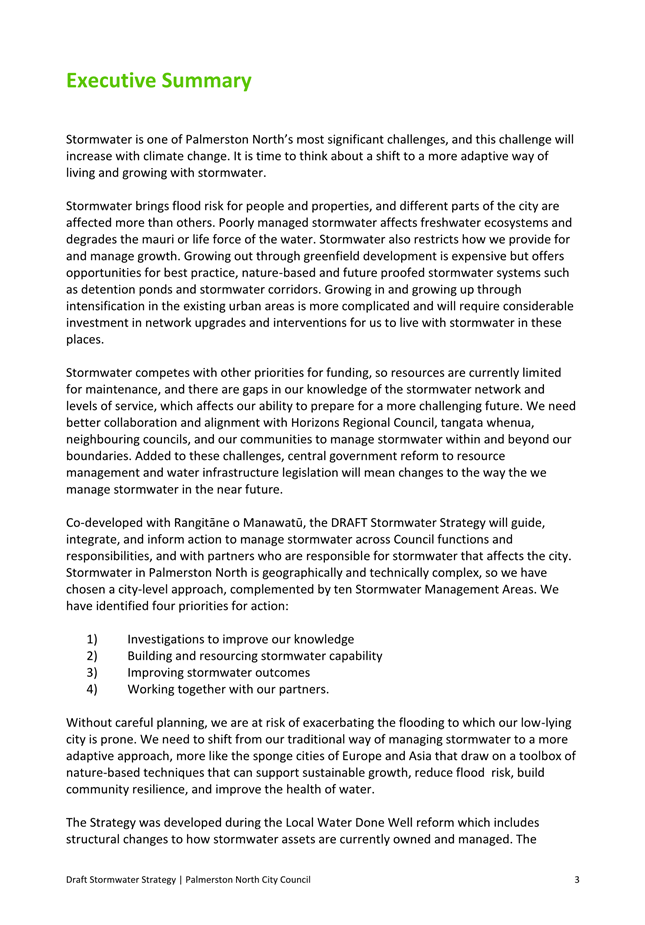
3. summary of strategic approach
3.1 The
strategy identifies the following stormwater challenges:
- Stormwater
flood risk
- Inequity
of risk
- Changes
to natural flows
- Loss
of freshwater biodiversity
- Degradation
of the mauri of water
- Climate
change
- Limited
understanding
- Need
for better collaboration and alignment
- Limited
resources
- Obtaining
access for maintenance
- Legislative
change
- Stormwater
constrains the way we plan for growth
3.2 The
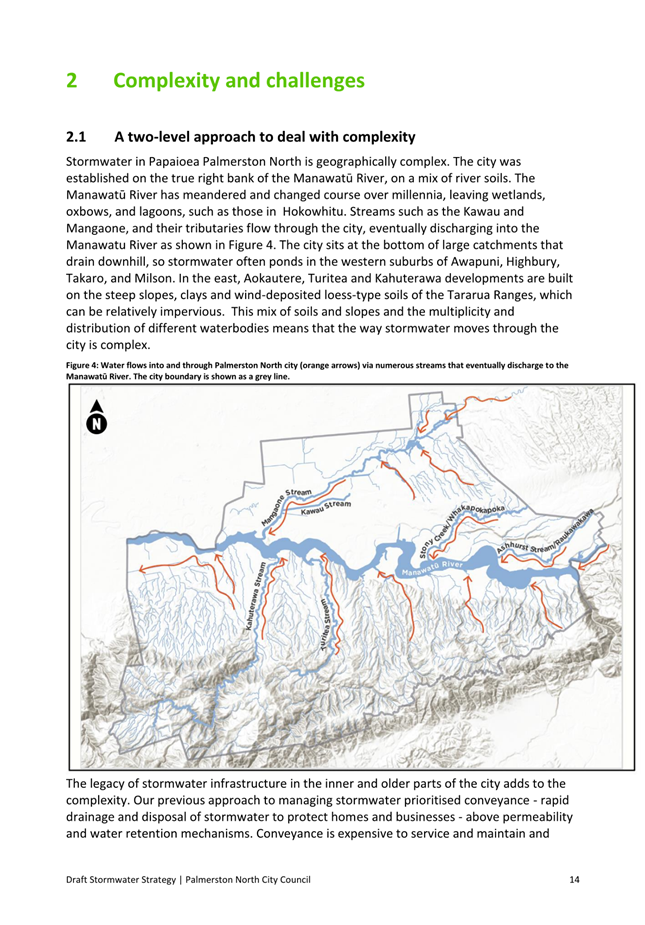
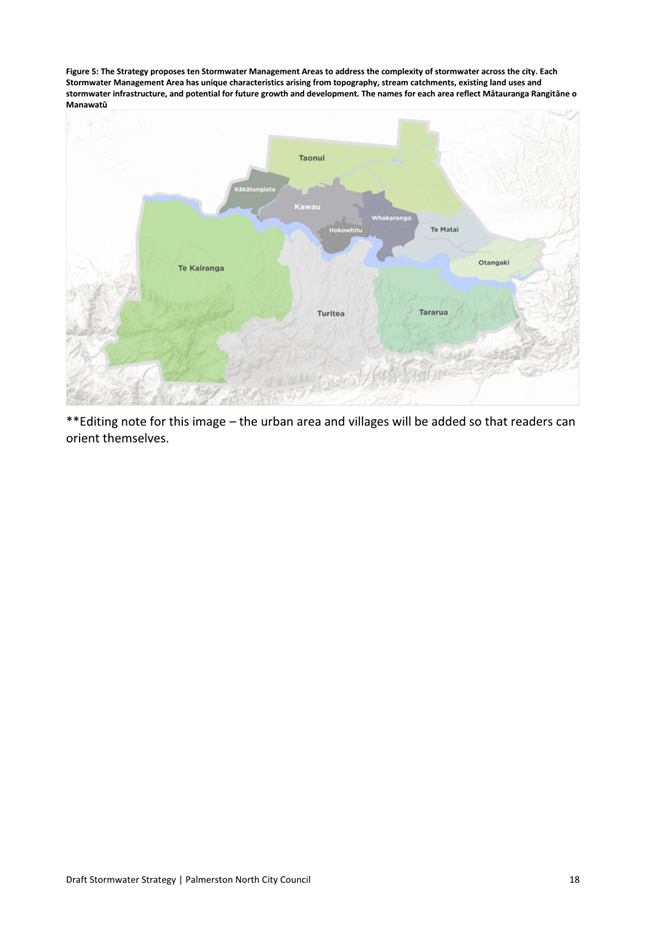
strategy identifies ten stormwater management areas:
- Taonui
- Kākātangiata
- Kawau
- Hokowhitu
- Whakarongo
- Te Matai
- Otangaki
- Tararua
- Turitea
- Te Kairanga
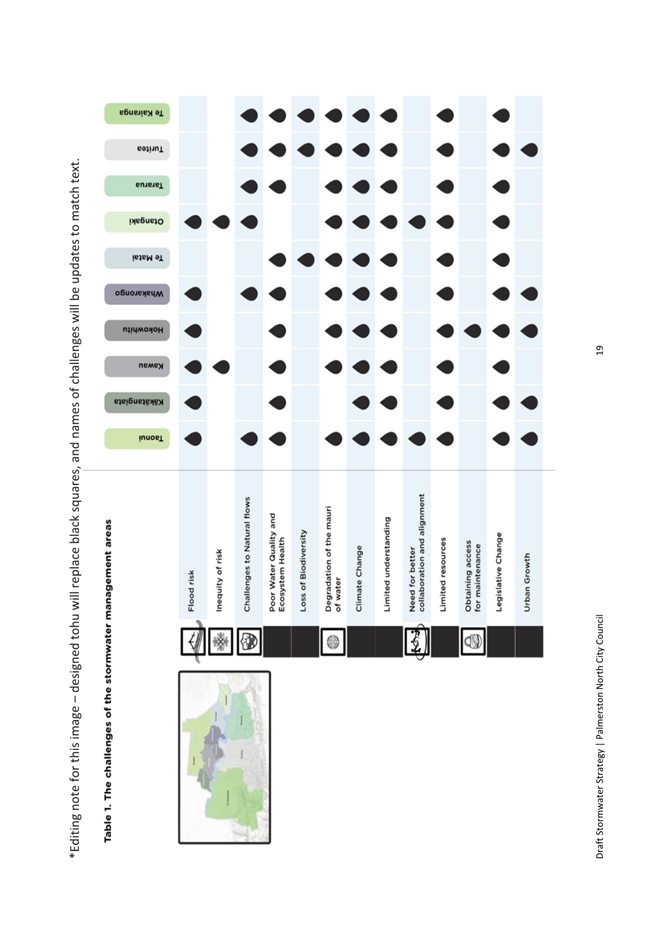
3.3 While
all the city-level challenges are largely present in all ten Stormwater
Management Areas, some of these challenges are more complex in some areas
relative to others. As a result, it is likely that management will need to be
tailored by area, with some areas such as Kawau, Taonui, Hokowhitu, Otangaki,
and Whakarongo requiring bespoke implementation plans because of the demand for
development by growing in, growing up, and growing out.
3.4 The
strategy also includes a set of aspirational outcomes (section 3.2) and
principles (section 3.3), and culminates with the following four priorities for
action (section 4.1):
1. Investigations,
increasing our knowledge through:
o Updating
the stormwater model to better inform decision-making.
o Using
the updated stormwater model to review the extent of increased density against
overland flow paths in existing neighbourhoods.
o Collecting,
storing, and sharing monitoring data to support future stormwater models.
o A
detailed assessment of Council’s consenting obligations for the
stormwater network.
o A
stormwater risk assessment using upgraded models to inform future growth.
o A gap analysis to understand
levels of service in the Stormwater Asset Management Plan.
2. Building stormwater
capability through:
o Choosing
a stormwater champion within Council to drive and co-ordinate work across
Council functions.
o Building
a team to implement the Strategy.
o Careful
consideration of resourcing for stormwater management as part of the next Long-Term
Plan process and establishment of the Local Water Done Well entity.
o Ensuring
that Rangitāne o Manawatū are represented in stormwater governance,
management, and operations.
o Monitoring and reviewing the
Strategy to be current and relevant
3. Improving stormwater
outcomes by:
o Developing
stormwater plans for priority Stormwater Management Areas, i.e., Kawau and
Taonui in the next three years, Hokowhitu, Otangaki and Whakarongo within 10
years.
o Utilise
blue and green infrastructure for nature-based solutions where this is
possible.
o Restore
ecosystems where possible and practicable through restoration and
rehabilitation.
o Prioritising
avoidance over stormwater flood mitigation for new development.
o Carrying
out flood risk assessments at rezoning stage for new developments.
o Ensuring
that levels of service for flood protection structures are in place prior to
new development.
o Securing
a global consent for the stormwater network.
o Resourcing
enforcement to ensure compliance with rules and regulations that are designed
to improve stormwater outcomes.
o Making changes to the District
Plan on stormwater as recommended by investigations such as flood risk
assessments.
4. Working together with
partner agencies through:
o A
working group of Rangitāne o Manawatū, Council, and Horizons Regional
Council.
o Working
with Horizons Regional Council, Manawatū District Council. and landowners
in upper catchments to identify funding sources for riparian retirement and
other measures to mitigate stormwater flows into the city.
o Practical
working service agreements with private owners for stormwater assets on private
land.
o Community
education and communication about stormwater,
o Working
with Rangitāne o Manawatū to name un-named streams, tributaries, and
stormwater reserves.
o Working
with Rangitāne o Manawatū to grow capacity to be involved in
stormwater management.
o Help community groups and
volunteers to share riparian revegetation and freshwater ecosystem knowledge.
4. description
and analysis of options
4.1 In
response to this request four high level options have been identified:
· Option 1:
Pre-election public consultation and deliberations on the Draft Stormwater
Strategy.
· Option 2:
Pre-election public consultation and post-election deliberations on the Draft
Stormwater Strategy.
· Option 3: Do
not adopt the Draft Stormwater Strategy.
· Option 4: Do
not adopt the Draft Stormwater Strategy at this time and direct that further
engagement occurs with key stakeholders and Elected Members.
4.2 Each
of these options are described in more detail and assessed below:
|
Option
|
Description
|
Benefits/Risks
|
|
Option 1
|
This option involves
implementation of a public consultation process followed by deliberations and
adoption of the draft strategy prior to the local government elections in
October 2025.
|
- Enables finalisation of
the strategy in the current term of Council.
- Provides a timely outcome
regarding high level direction on stormwater management in the city.
- Reduces the potential risk
of the strategy being relitigated part way through the consultation and
adoption process if there are significant changes in the composition of the
incoming Council.
- Could be perceived as limiting
the public’s ability to reasonably present their views on the proposal
and the time available to Council to robustly consider these views in
arriving at a decision on the strategy.
- Alignment with growth
policy and planning cycles.
|
|
Option 2
|
This option is a
variation on Option 1 and involves public consultation on the draft strategy
in the lead up to the local government elections, with deliberations and
adoption of the strategy deferred until after the elections (i.e. late
2025/early 2026).
|
- Enables more time for
direct engagement with stakeholders alongside public consultation and more
time for Officers and Elected Members to consider submissions.
- Creates uncertainty and a
potentially disjointed and lengthy public consultation and deliberations and
adoption process, with the potential risk of the strategy being relitigated
if there are significant changes in the composition of the incoming Council.
|
|
Option 3
|
This option involves no
further need for public consultation due to Council deciding not to proceed
with the draft strategy and placing continued reliance on existing Council
plans, policies and strategies to manage stormwater (e.g. District Plan,
Asset Management Plans).
|
- Avoids the additional
time/cost associated with further public consultation.
- Exposes the Council to a
high level of relationship and reputational risk, particularly in relation to
Rangitāne o Manawatū.
- Fails to provide high-level, integrated
direction on how stormwater is managed in the city, with consequences arising
which unintentionally impact on property owners and Council operations.
|
|
Option 4
|
Do
not adopt the Draft Stormwater Strategy at this time and direct that further
engagement occurs with key stakeholders, Rangitāne o Manawatū and
Elected Members.
|
- Additional community views
sought via further engagement prior to considering the Draft Stormwater
Strategy.
- Provides more time for key
stakeholders, Rangitāne o Manawatū and Elected Members to shape the
Draft Stormwater Strategy prior to public consultation.
- The further engagement is
likely to reinforce the feedback already received, i.e. we already know the
views of key stakeholders and Rangitāne o Manawatū.
- Additional time and costs
prior to public consultation.
|
5. Next
actions
5.1 Following
adoption of a preferred option by the Committee a tailored consultation plan
will be developed by Council Officers.
6. Compliance
and administration
|
Does the Committee have
delegated authority to decide?
|
Yes
|
|
Are the decisions significant?
|
No
|
|
If they are significant do they
affect land or a body of water?
|
No
|
|
Can this decision only be made
through a 10 Year Plan?
|
No
|
|
Does this decision require
consultation through the Special Consultative procedure?
|
No
|
|
Is there funding in the current
Annual Plan for these objectives?
|
No
|
|
Are the recommendations
inconsistent with any of Council’s policies or plans?
|
No
|
|
The recommendations
contribute to: Whāinga 1: He tāone auaha, he tāone
tiputipu
Goal 1: An innovative and growing city
Whāinga 3: He
hapori tūhonohono, he hapori haumaru
Goal 3: A connected and safe community
Whāinga
4: He tāone toitū, he tāone manawaroa
Goal 4: A sustainable and resilient cityGiving effect to Te Patuinga me
Rangitāne o Manwatū Partnership with Rangitāne o Manwatū
|
|
The recommendations contribute to this
plan:
13.
Mahere wai
14. Governance and Active
Citizenship Plan
For Mahere Wai Water Plan, the
objective is: We want our city to be safe from flooding during storm events.
For Mahere Mana Urungi,
Kirirarautanga Hihiri Governance & Active Citizenshop Plan, the objective
is: We want to actively engage with the community to enable well-informed,
transparent, and joined-up decisions. We want to work in partnership with
Rangitāne o Manawatū.
Mahere Wai Water Plan includes a
one-off action to develop a Stormwater Strategy.
|
|
Contribution to strategic
direction and to social, economic, environmental and cultural well-being
|
Stormwater affects all four
aspects of well-being, now and in the future. Stormwater also interacts with
almost all of Council functions.
The recommendation of this memo
contributes to fulfilling the following objectives:
Mahere Wai Water Plan has the
new or one-off action for Years 1 & 2 to develop a Stormwater Strategy,
to keep our city safe from flooding during storm events.
Mahere Mana Urungi,
Kirirarautanga Hihiri – the direction by Council for further public
consultation will enable well-informed, transparent, and joined-up decisions
informed by active engagement with our communities. The Stormwater
Strategy is being co-developed in partnership with Rangitāne o Manawatū.
|
|
|
|
Attachments
|
1.
|
Draft
Stormwater Strategy ⇩ 
|
|
Memorandum
TO: Sustainability
Committee
MEETING DATE: 18
June 2025
TITLE: Update
on opportunities for native species re-introductions in the Turitea Reserve
(2025)
Presented
By: David
Watson, Senior Climate Change and Sustainability Advisor
APPROVED BY: David
Murphy, General Manager Strategic Planning
RECOMMENDATION(S)
TO Sustainability Committee
1. That the Committee receive the memorandum titled
‘Update on opportunities for native species re-introductions in the
Turitea Reserve (2025)’ presented to the Sustainability Committee on 18
June 2025.
1. ISSUE
1.1 This
memorandum follows a previous memo, which was presented to the 22 May 2024
Sustainability Committee. The memo recommended conducting a follow-up
translocation of toutouwai (North Island robins) to supplement the existing
population from the 2021 release and seeking expert advice about the
suitability of the Turitea Reserve for kiwi and weka. The Committee
received this information and endorsed investigations into the feasibility of
future translocations. We have since completed a successful supplementary
toutouwai translocation and have consulted wildlife specialists on future
possible kiwi and weka translocations.
Toutouwai translocation
1.2 Following
last year’s resolution, Council have worked with Rangitāne towards a
translocation of toutouwai. In April 2025, 30 toutouwai were gifted by Ngaa
Rauru and Bushy Park Trust and were successfully released in the Turitea
Reserve. This raised the number of birds in the reserve to 64, increasing the
genetic diversity of the population and strengthening resilience against
environmental threats, such as an unusually cold winter.
Turitea Reserve pest control
1.3 Increased
Council investment and contractor efforts in predator control through the
current Long-Term Plan have resulted in consistently low predator numbers in
Turitea. December 2024 monitoring results showed zero rats in the 400-ha
‘core zone’, where the majority of toutouwai have established
territories. These pest control results gave confidence both to Ngaa Rauru, the
kaitiaki who were gifting us the toutouwai, and Rangitāne to allow us to
pursue the translocation. Maintaining current pest control levels should
provide security for the future of the Turitea toutouwai population.
Kiwi and weka translocation
1.4 The
May 2024 Sustainability Committee endorsed investigating the future
reintroduction of kiwi and weka into Turitea. Expert advice was sought through
the Kiwi Recovery Group, and a site visit has determined the habitat quality in
Turitea to be suitable for kiwi. Mustelid monitoring is currently underway,
which will help determine whether current predator control methods are adequate
for kiwi survival or if more targeted measures are required.
1.5 A
member of the Weka Recovery Group has advised that, due to the competitive and
omnivorous nature of weka, the introduction of kiwi and any other
ground-nesting bird species to the area should be completed prior to a weka
reintroduction. Council’s priority should therefore be to focus initial
efforts towards a kiwi translocation.
2. BACKGROUND
2.1 Council-run
predator control efforts in Turitea began in 2003 and have expanded
significantly since then. Today, the project spans 40 square kilometres across
the Turitea Reserve and Hardings Park, with thousands of traps and bait
stations in place. The programme has resulted in a large increase in key native
bird species, including a 10- to 15-fold increase in the populations of
tūī and kererū.
Toutouwai translocation
2.2 Building
on the success of the predator control programme, Council partnered with
Rangitāne, Massey University, and expert volunteers to reintroduce the
locally extinct toutouwai to the Turitea Reserve in 2021. Unfortunately, a
nation-wide surge in rat numbers later that year significantly impacted the
breeding season of the birds, leaving the population small and potentially
vulnerable to environmental shocks, disease, or other threats.
2.3 To
mitigate the increased rat numbers, Council conducted a targeted rat control
programme within the core breeding area where the toutouwai had established
their population. Rat monitoring was substantially increased, and 13,000 rat
bait strips have been annually deployed within the core area over the last 4
years. As a result, rat numbers have remained remarkably low over the last
several years, with our December pest monitoring yielding results of zero rats
or mice in the core toutouwai zone – a nationally leading statistic for
an unfenced mainland site.
2.4 Increased
pest control has yielded noticeable improvements in toutouwai survival. A
highly successful 2024/2025 breeding season left us with a growing population
of 34 robins (12 adults and 22 juveniles), demonstrating that the Reserve
provides favourable conditions for long-term habitation. These numbers provided
the confidence for a supplementary translocation in autumn this year to boost
numbers and increase genetic diversity.
2.5 In
the week of 14 April 2025, the Climate Change and Sustainability Team worked
with Ngaa Rauru and conservation biologists to capture and band 30 toutouwai
from Bushy Park Tarapuruhi. The birds were blessed by Ngaa Rauru before their
departure, and on 16 April they were welcomed by Rangitāne and
successfully released into the Turitea Reserve. The arrival of these 30 birds
has increased the total number within the reserve to 64. Monitoring of the
population will be ongoing. However, early monitoring has shown the recent
arrivals have quickly acclimated to their new environment.
2.6 The
permit allows for a further 10 toutouwai to be translocated from a more remote
site. Investigations are underway for the practicality and desirability of this
operation.
Turitea Reserve pest control
2.7 Our
pest control contractors in the reserve currently maintain ~3,500 bait stations
and ~1,500 predator traps. Following the first year of the initial
translocation, pest control measures were increased to include the installation
of modern self-resetting ‘AT220’ traps, alongside the deployment of
the rat bait strips each year.
2.8 Rat
monitoring has been substantially improved since the 2021 translocation, and
pest monitoring now includes a network of 20 automatic trail cameras that are
regularly set up on a rotating grid to ensure both a wide coverage and an early
warning system for any sudden increase in predator numbers.
Kiwi and weka translocation
2.9 Professor
Isabel Castro (Kiwi Recovery Group) advises that the Rowi is the most
suitable kiwi for Turitea, due to their historic presence in Turitea.
2.10 Rhys Burns
(Weka Recovery Group) explained that weka are very competitive and territorial
in nature, and their omnivorous diet can pose a risk to ground nesting birds
and skinks. He therefore advised not to pursue a weka translocation until we
have considered all other species we would want to translocate in the near
future.
2.11 Both
experts recommended ensuring low mustelid numbers before pursuing a
translocation. A trial run of monitoring is currently being conducted, with
trail cameras positioned according to the Kiwi Recovery Group’s
monitoring protocol. The results of this monitoring will determine whether or
not additional, targeted pest control measures are needed.
3. NEXT STEPS
3.1 Continue
monitoring the existing and new toutouwai population. Plan logistics for a
possible second translocation.
3.2 Continue
current pest control measures, including the delivery of a winter striker
operation conducted whenever rat numbers increase to dangerous levels within
the core toutouwai zone.
3.3 Alter
pest control measures, depending on the results of mustelid monitoring, if
necessary. Begin application process for kiwi translocation permit once low
mustelid numbers confirmed.
4. Compliance
and administration
|
Does the Committee have
delegated authority to decide?
|
Yes
|
|
Are the decisions significant?
|
No
|
|
If they are significant do they
affect land or a body of water?
|
No
|
|
Can this decision only be made
through a 10 Year Plan?
|
No
|
|
Does this decision require
consultation through the Special Consultative procedure?
|
No
|
|
Is there funding in the current
Annual Plan for these objectives?
|
Yes
|
|
Are the recommendations
inconsistent with any of Council’s policies or plans?
|
No
|
|
The recommendations contribute
to:
Whāinga
4: He tāone toitū, he tāone manawaroa
Goal 4: A sustainable and resilient city
|
|
The recommendations contribute to this
plan:
11.
Mahere mō te kanorau koiora me Te Awa o Manawatū
11. Biodiversity and the
Manawatū River Plan
The objective is:
|
|
Contribution to strategic
direction and to social, economic, environmental and cultural well-being
|
Reintroductions of locally
extinct species contribute to the restoration of the Turitea Reserve’s
biodiversity.
|
|
|
|
Attachments
Nil
REPORT
TO: Sustainability
Committee
MEETING DATE: 18
June 2025
TITLE: Options
of new indicators to include in the 2026 Sustainability Review
PRESENTED BY: Olivia
Wix, Communications Manager and David Watson, Senior Climate Change and
Sustainability Advisor
APPROVED BY: Danelle
Whakatihi, General Manager Customer & Community
David Murphy, General Manager Strategic Planning
RECOMMENDATION(S)
TO Council
1. That the
Chief Executive continue using existing data, include additional data already
collected, and draw on data from other organisations to support the 2026
Sustainability Review (Option 3).
Summary of options analysis
|
OPTION 1:
|
Continue to use only the
existing data that has been reported in previous Sustainability Reviews
|
|
Benefits
|
Consistent approach.
|
|
Risks
|
There is an opportunity to add
more data which could further enhance the purpose of the report.
|
|
Financial
|
No impact.
|
|
OPTION 2:
|
Continue to use the existing
data, as well as include new data from information Council already collects
|
|
Benefits
|
Assists in meeting the purpose of
the Sustainability Review.
|
|
Risks
|
None.
|
|
Financial
|
No impact.
|
|
OPTION 3:
|
Continue using existing data,
include additional data already collected by Council, and draw on data from
other organisations to support the report
|
|
Benefits
|
Includes more data, which assists
in meeting purpose of Sustainability Review.
|
|
Risks
|
The data tends to be more
regional without localised breakdowns. There is no oversight or awareness of
how the data is collected or managed. Council has no ability to control or
influence the outcomes of the data reported.
|
|
Financial
|
No impact.
|
|
OPTION 4:
|
Create new datasets for
information not currently collected by Council or organisational
partners.
|
|
Benefits
|
Could fill gaps of knowledge.
|
|
Risks
|
These should form part of the
Long-Term Plan process.
|
|
Financial
|
Depending on data desired, there could
be costs in setting up and collecting the data.
|
Rationale for the recommendations
1. Background and previous council decisions
1.1 The
Environmental Sustainability Review is published every two years for our
community, partners, and stakeholders. It shows how committed our organisation
is to sustainability. The report combines stories and data to highlight the
work we have undertaken over the past two years. It is organised into key areas
like transport, housing, energy, water, rubbish and recycling. In recent years,
we have also included stories about partnerships with Council and other
organisations in the city doing great work in this area.
1.2 When
receiving the latest Environmental Sustainability Review in 2024, Elected
Members asked for options to include more organisational and community-wide
indicators in the 2026 report.
2. Analysis of options
Option
1: Continue to use only the existing data that has been reported
in previous Sustainability Reviews
2.1 One
of the main challenges with the review since it began is that data is collected
at different times. This makes it hard to compare information from year to
year. For example, the city-wide waste audit only happens every six
years.
2.2 Currently,
the Sustainability Review reports on the following measures:
|
Carbon
Emissions
|
· Organisational
Emissions Inventory (Water treatment and pumps, Depot and operations, pools,
transport, waste management, workplace travel by staff, property, CET Arena
operations, libraries, parks and reserves and streetlights)
· Annual
emissions (tCO2e) compared to council goal for city and organisation
|
|
Transport
|
· Km’s
of roads, footpaths and bus stops
· Number
of street trees
· Annual
cycling counts
· E-scooter
kms
|
|
Water
|
· Km’s
of pipes, reservoirs, bores, manholes, pump stations, drains for all three
waters
· Water
treatment, consumption and disposal
|
|
Resource
Recovery
|
· Number
of public bins
· City
wide waste audit (six yearly data) including amount of waste gone to
landfill, and what could have been diverted
· Rubbish
collected from kerb
· Recycling
collected from kerb
· Glass
collected from kerb
· Recycling
at drop-off points
· E-waste
· Motor
oil recycling
· Green
waste drop-off
· Compost
sold
· Number
of rubbish bags collected
· Number
of recycling bins emptied
|
|
Biodiversity
|
· Robin
bird counts
|
Option 2: Continue to
use the existing data, as well as include new data from information Council
already collects
2.3 The
information below includes data we already collect but have not included in
past Sustainability Reviews, as well as new data that was not available before.
In many cases, this data is reported in the aggregate, such as through the
carbon reporting, but is not currently presented at the granular level. This
data could be added to the 2026 Sustainability Review easily and at no extra
cost.
|
|
Data
|
Where
from:
|
|
Carbon
Emissions
|
· Fertiliser use
· Refrigerant use
· Wastewater
emissions
·
· Air travel
· Taxi use
· Workplace travel
|
· Manual
records
· Contractor
records
· Calculated from wastewater data
· Agent
data
· Invoices
· Internal
survey
|
|
Energy
|
· Power
use / Generation
· Gas
use
· Non-transport fuel use
|
· Energy
invoices
· Tanker meters
|
|
Transport
|
· Active
and Public transport to work/education on Census Day
· Fuel
use
|
· Census
data already being used in city dashboards
· Fuel
invoicing
|
|
Water
|
· Power
use / generation
|
· Internal
dashboards
|
|
Resource
Recovery
|
· Polystyrene
recycled
· Tetrapak
recycled
· Waste collected from Council facilities
|
· New
data from recycling partners
· Triennial
waste audit
|
|
Biodiversity
|
· Native
bird count
· Predator catch numbers and tracking rates
|
· City
dashboards
· Contractor records and surveys
|
|
Other
|
· Access
to green spaces
|
· City
dashboards
|
Option 3: Continue
using existing data, include additional data already collected by Council, and
draw on data from other organisations to support the report
2.4 There
are several external data sources we could consider including in the 2026
Sustainability Review. However, we recommend using them with caution, as in
many cases we do not have full visibility of how the data was collected or
analysed, which makes it harder to judge its accuracy or how well it applies to
our local context.
2.5 Some
of the data looks at things from a regional perspective or groups together
multiple areas – such as different rivers or catchments – so it
does not always give a clear picture of what is happening in our city. Many of
the indicators reflect outcomes that Council has little or no control over,
which means we can’t always take direct action to improve them.
2.6 Because
of these issues, the data is less relevant to the purpose of the Sustainability
Review and to our intended audience (our wider community), who are primarily
interested in what is happening locally and where Council can make a
difference.
2.7 That
said, some of this data may still be useful for providing context or telling
the wider story – particularly when highlighting the work of other
organisations through the stories in the review. We suggest treating these
indicators in this way, rather than using them as key indicators in the
review. For example, Horizons State of the Environment Report could be a
story within the 2026 Sustainability Review. The report is released every five
years but the data set that includes our city also includes Feilding,
Woodville, Pahiatua, Eketahuna and Foxton.
|
|
Data
|
Where
from:
|
Comments
|
|
Carbon
Emissions
|
· Regional
climate inventory
· National climate inventory
|
· Horizons
Regional Council (HRC)
· Ministry for the Environment (MfE)
|
· Confusing
for readers as scope and methodology vary considerably
|
|
Energy
|
· Detailed
generation and use statistics (fossil fuels, renewables, etc.)
|
· Ministry
of Business, Innovation and Employment (MBIE)
|
· Not
held at PN City Council level
|
|
Transport
|
· Bus
statistics – patronage, energy use, etc.
|
· HRC
|
· May
further confuse public that we’re responsible for buses
|
|
Water
|
· Water
Quality of Manawatu River
· Mangaone Water Quality Indicators
|
· Land
Air Water Aotearoa (LAWA), HRC
· HRC
|
· Snapshot
in time, likely to vary considerably from one report to next. Scope of these
catchments considerably larger than Palmerston North City Council boundary
|
|
Resource
Recovery
|
· Landfill tonnage received, and forward
investments
|
· MBIE
|
· Bonny
Glen (i.e. regional) level only
|
|
Biodiversity
|
· Regional
biodiversity indicators, particularly for Te Apiti
|
· HRC,
Department of Conservation
(DOC)
|
· Reserve only partly within rohe. Palmerston
North City Council is not directly involved in operations
|
|
Other
|
· Regional
Climate Vulnerability Assessment
· State
of Environment Report
|
· HRC
|
· Top
50 communities at risk from climate related hazards
· Palmerston
North City Council is included in a wide regional data set
|
Option 4: Create new datasets for information not currently
collected by Council or organisational partners
2.8 If
Elected Members would like to see additional sustainability indicators included
in the report, but we do not currently hold the necessary data, we could work
on sourcing this. In this case, Officers would need direction as to what data
Elected Members would like to include, and then they can explore what it would
take to collect or source that information; however, this would involve
additional time and cost (to be confirmed depending on data needed and ease of
collecting). We recommend considering new indicators as part of the next
Long-Term Plan process. That is the point at which we review and update
existing measures, and since some supporting data is already available, it is
the ideal time to formally introduce and resource any new indicators within our
ongoing monitoring and reporting framework.
3. Conclusion
3.1 Officers
recommend Option 3. This would see us continue to use the data we have used in
the past, as well as add new data we have access to.
3.2 Regional
data is helpful, but has risks, as outlined above. Officers recommend using
this data as part of wider storytelling in the report.
4. Next actions
4.1 Work
is already underway determining the stories that will be highlighted in the
next edition. Indicators selected today will be added to the next review, along
with existing data we report on. The publication will be brought to council in
early 2026 for release.
5. Compliance and administration
|
Does the Committee have
delegated authority to decide?
|
No
|
|
Are the decisions significant?
|
No
|
|
If they are significant do they
affect land or a body of water?
|
No
|
|
Can this decision only be made
through a 10 Year Plan?
|
No
|
|
Does this decision require
consultation through the Special Consultative procedure?
|
No
|
|
Is there funding in the current
Annual Plan for these objectives?
|
Yes
|
|
Are the recommendations
inconsistent with any of Council’s policies or plans?
|
No
|
|
The recommendations contribute
to:
Whāinga 4: He
tāone toitū, he tāone manawaroa
Goal 4: A sustainable and resilient city
|
|
The recommendations contribute to this
plan:
10.
Mahere āhuarangi hurihuri, toitūtanga
10. Climate Change and
Sustainability Plan
The objective is: access
to relevant information and education to support more sustainable choices.
|
|
Contribution to strategic
direction and to social, economic, environmental and cultural well-being
|
The review highlights what we
are doing and also includes examples of what our community are doing to help.
|
|
|
|
Attachments
Nil
Committee Work Schedule
TO: Sustainability
Committee
MEETING DATE: 18
June 2025
TITLE: Committee
Work Schedule
RECOMMENDATION TO Sustainability Committee
1. That the
Sustainability Committee receive its Work Schedule dated June 2025.
Sustainability
Committee Work Schedule – JUNE 2025
|
Estimated Report Date
|
Subject
|
Officer Responsible
|
Current Position
|
Date of Instruction &
Clause number
|
|
18 June 2025
|
Wastewater Treatment Plant -Nature Calls:
Quarterly Report
|
General Manager Infrastructure
|
|
Council
29 May 2024
Clause 95.11 -25 (rec 2)
|
|
18 June 2025
|
Options to enable inclusion of
organisational and community-wide sustainability indicators in the 2026
Sustainability Review
|
General Manager Strategic Planning/
General Manager Customer & Community
|
|
22 May 2024
Clause 15
|
|
18 June 2025
|
Draft city-wide stormwater strategy
|
General Manager Strategic Planning
|
|
16 October 2024
Clause 42-24
Council
29 May 2024
Clause 95.7 -24
2F(3)
|
|
As required
|
Manawatū-Whanganui
Climate Joint Action Committee Update
|
General Manager Strategic Planning
|
Subject to agenda of Joint Committee or any changes
at a national level
|
Climate change plan ongoing
|
|
|
Resource Recovery Services Review
|
General Manager Infrastructure
|
Council
6 August
|
21 August 2024 Clause 28-24
|
|
PNCC Organisational Emissions Inventory 2024/25
Annual Report
|
General Manager Strategic Planning
|
Council
8 October
|
Climate change plan ongoing action #1
|
|
Waste management and
minimisation plan 2024 - annual progress update for 2024/25 FY
|
General Manager Infrastructure
|
Council
8 October
|
9 Sept 2020
Clause 17-20
|
|
Citywide Emissions Inventory 2024 Annual Report
|
General Manager Strategic Planning
|
Council
8 October
|
Climate change plan ongoing action #3
|
|
|
Low Carbon Fund Allocations 2024/25
|
General Manager Strategic Planning
|
Council
8 October
|
21 August 2024
Clause 24-24
|
|
2026
|
Annual Sector Lead Report: Environment Network
Manawatū
|
General Manager Customer & Community
|
|
Terms of Reference
|
|
18 June 2025
2026
|
Draft community-focused city-wide climate action
plan
|
General Manager Strategic Planning
|
Community engagement underway
|
Climate change plan ongoing
action #5
16 October 2024
Clause 34-24
|