Finance, Performance & Audit Committee
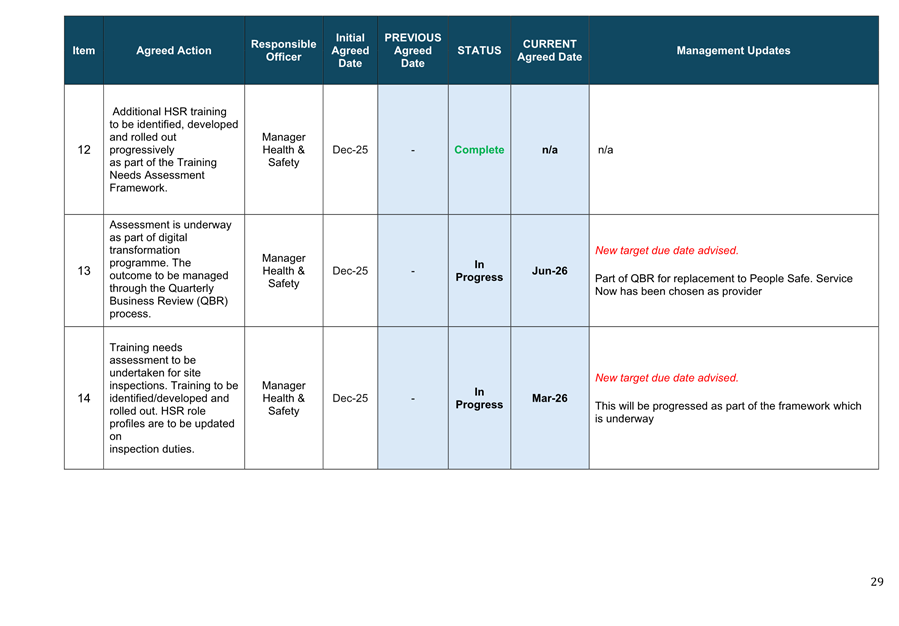
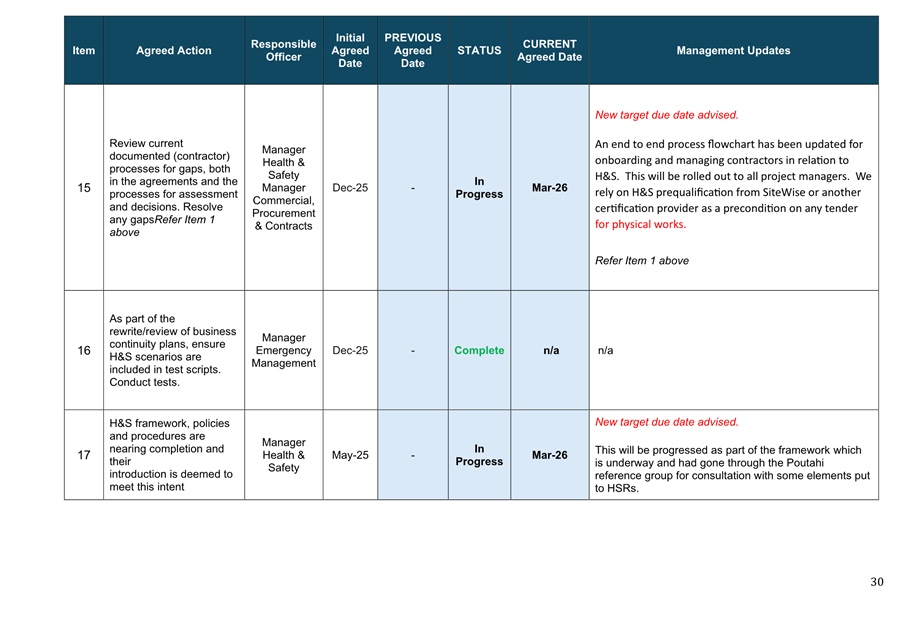
|
Vaughan
Dennison (Chair)
|
|
Karen
Naylor (Deputy Chair)
|
|
Grant
Smith (The Mayor)
|
|
Mark
Arnott
|
Bonnie
Kuru
|
|
Brent
Barrett
|
Debi
Marshall-Lobb
|
|
Lew
Findlay (QSM)
|
Billy
Meehan
|
|
Hayden
Fitzgerald
|
Orphée
Mickalad
|
|
Leonie
Hapeta
|
William
Wood
|
|
Lorna
Johnson
|
Kaydee
Zabelin
|
Finance, Performance & Audit Committee MEETING
4 March 2026
Order of Business
1. Karakia
Timatanga
2. Apologies
3. Notification
of Additional Items
Pursuant to
Sections 46A(7) and 46A(7A) of the Local Government Official Information and
Meetings Act 1987, to receive the Chairperson’s explanation that
specified item(s), which do not appear on the Agenda of this meeting and/or the
meeting to be held with the public excluded, will be discussed.
Any
additions in accordance with Section 46A(7) must be approved by resolution with
an explanation as to why they cannot be delayed until a future meeting.
Any
additions in accordance with Section 46A(7A) may be received or referred to a
subsequent meeting for further discussion. No resolution, decision or recommendation
can be made in respect of a minor item.
4. Declarations
of Interest (if any)
Members are
reminded of their duty to give a general notice of any interest of items to be
considered on this agenda and the need to declare these interests.
5. Public
Comment
To receive
comments from members of the public on matters specified on this Agenda or, if
time permits, on other Committee matters.
6. Speed
Management Plan - Hearing of Submissions Page 7
7. Speed
Management Plan - Summary of Submissions Page 11
Memorandum, presented by Peter Ridge,
Acting Manager Strategy and Policy.
8. New
Zealand Food Awards - Annual Report Page 39
Report, presented by Jessica Papple,
Manager Marketing.
9. Business
Assurance Accountability Report Page 45
Memorandum, presented by Emy Bastillo,
Internal Auditor/Business Assurance Advisor & Desiree Viggars, Manager
Legal Risk & Assurance/Legal Counsel.
10. Setting
Council's Risk Management Appetite and Tolerance Levels Page 77
Memorandum, presented by Stephen
Minton, Risk Management Advisor and Desiree Viggars, Manager Legal, Risk and
Assurance.
11. Health
and Safety Report, 1 July to 30 September 2025 (Quarter 1) Page 93
Memorandum, presented by Selwyn
Ponga-Davis, Health and Safety Manager.
12. Health
and Safety Report, 1 October to 31 December 2025 (Quarter 2) Page 109
Memorandum, presented by Selwyn
Ponga-Davis, Health and Safety Manager.
13. Wellbeing
Report, 1 July to 30 September 2025 (Quarter 1) Page 127
Memorandum, presented by Connie Roos,
Manager Employee Experience and Wayne Wilson, Manager People Operations.
14. Wellbeing
Report, 1 October to 31 December 2025 (Quarter 2) Page 137
Memorandum, presented by Connie Roos,
Manager Employee Experience and Wayne Wilson, Manager People Operations.
15. Six-monthly
report on International Relations and Education Activities Page 145
Memorandum, presented by Gabrielle
Loga, Manager International Relations and Kunal Chonkar, International
Relations and Education Advisor.
16. Committee
Work Schedule Page 235
17. Karakia
Whakamutunga
18. Exclusion of Public
|
|
That the public be excluded from the
following parts of the proceedings of this meeting listed in the table below.
The general subject of each matter to be
considered while the public is excluded, the reason for passing this
resolution in relation to each matter, and the specific grounds under Section
48(1) of the Local Government Official Information and Meetings Act 1987 for
the passing of this resolution are as follows:
|
General subject of each matter to be
considered
|
Reason for passing this resolution in
relation to each matter
|
Ground(s) under Section 48(1) for
passing this resolution
|
|
11.
|
Health
and Safety Report, 1 July to 30 September 2025 (Quarter 1)
Confidential
Attachment 2
|
Releasing this information could negatively effect
similar confidential information or discourage people from sharing such
information;
Sharing this information could put someone's
health and safety at risk.
|
s7(2)(c)(i)
PREJUDICE THE SUPPLY OF SIMILAR INFORMATION: Releasing this information
could negatively effect similar confidential information or discourage
people from sharing such information
and
s6(d)
ENDANGER THE SAFETY OF A PERSON: the sharing of the information supplied
within could also place the involved employee(s) health and safety at risk.
|
|
12.
|
Health
and Safety Report, 1 October to 31 December 2025 (Quarter 2)
Confidential
Attachment 2
|
Releasing this information could negatively effect
similar confidential information or discourage people from sharing such
information;
Sharing this information could put someone's
health and safety at risk.
|
s7(2)(c)(i)
PREJUDICE THE SUPPLY OF SIMILAR INFORMATION: Releasing this information
could negatively effect similar confidential information or discourage
people from sharing such information
and
s6(d)
ENDANGER THE SAFETY OF A PERSON: the sharing of the information supplied
within could also place the involved employee(s) health and safety at risk.
|
This resolution is made in reliance on
Section 48(1)(a) of the Local Government Official Information and Meetings
Act 1987 and the particular interest or interests protected by Section 6 or
Section 7 of that Act which would be prejudiced by the holding of the whole
or the relevant part of the proceedings of the meeting in public as stated in
the above table.
Also that the persons listed below be
permitted to remain after the public has been excluded for the reasons
stated.
[Add Third Parties], because
of their knowledge and ability to assist the meeting in speaking to their
report/s [or other matters as specified] and answering questions, noting that
such person/s will be present at the meeting only for the items that relate
to their respective report/s [or matters as specified].
|
Submission From Consultation
TO: Finance,
Performance & Audit Committee
MEETING DATE: 4
March 2026
TITLE: Speed
Management Plan - Hearing of Submissions
RECOMMENDATION(S) TO Finance, Performance & Audit Committee
1. That the Finance, Performance
& Audit Committee receive the submissions and hear
submissions from presenters who indicated their wish to be heard in support of
their submission.
2. That the Committee note the
Procedure for Hearing of Submissions, as described in the procedure sheet.
Submitters
wishing to be heard in support of their submission
|
Submission
No.
|
Submitter
|
|
170
|
Steve Wrathall
|
|
19
|
Chris Teo-Sherrell
|
|
173
|
St James Catholic School
|
|
40
|
Turitea School
|
|
45
|
Catherine Millar
|
|
137
|
City to Sea Rail Trust -
Manawatū
|
|
157
|
Max The Plumber Ltd
|
|
177
|
Peter French
|
|
179
|
RACE Group & Kikiwhenua Group
Ltd
|
|
73
|
Fraser Ponsford
|
|
78
|
Richard Woolgar
|
|
145
|
Lorraine Cook
|
Attachments
|
1.
|
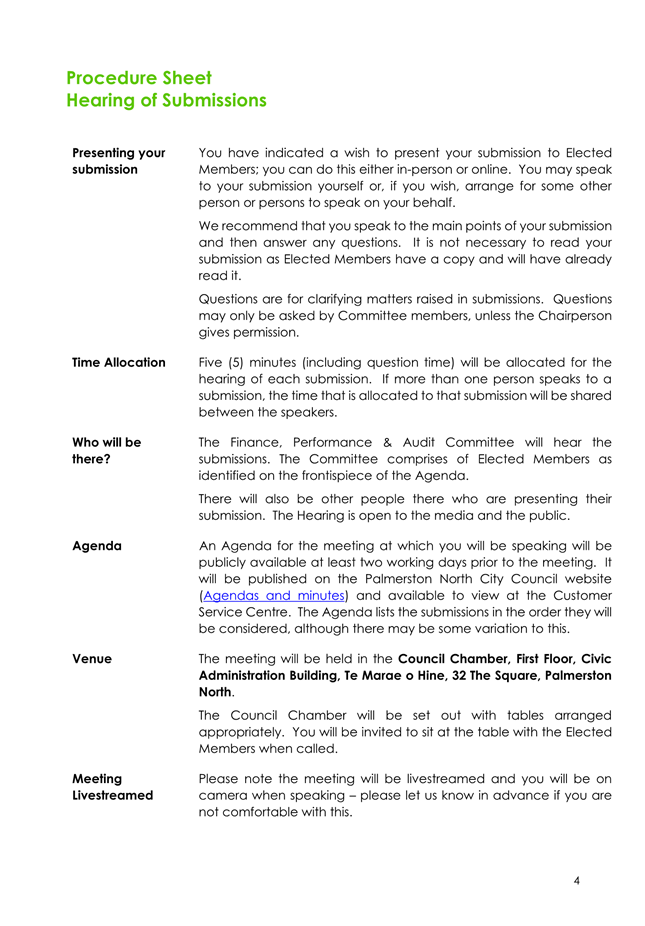
Procedure Sheet ⇩ 
|
|
|
2.
|
Submissions (attached
separately) 
|
|

Memorandum
TO: Finance,
Performance & Audit Committee
MEETING DATE: 4
March 2026
TITLE: Speed
Management Plan - Summary of Submissions
PRESENTED BY: Peter
Ridge, Acting Manager Strategy and Policy
APPROVED BY: David
Murphy, General Manager Strategic Planning
RECOMMENDATION(S)
TO Finance, Performance &
Audit Committee
1. That the Committee
receive the memorandum titled ‘Speed Management Plan – Summary of Submissions’
presented to the Finance, Performance & Audit Committee on 4 March 2026.
1. ISSUE
1.1 The
Council received 180 submissions on the draft Speed Management Plan. Fifteen
submitters indicated they wish to make an oral submission.
1.2 This
memorandum provides an initial summary of the key issues raised in the written
submissions. A full analysis of the written and oral submissions will be
provided to the Committee in April 2026.
2. BACKGROUND
2.1 On
20 August 2025 the Council approved the draft Speed Management Plan for public
consultation. The written submission period was open from 1 November to
15 December 2025. The Council received 180 written submissions during
this time. The submissions are included in the agenda.
2.2 There
were 33 proposals for variable speed limits around schools. Some
proposals concerned multiple schools in the same area; in total, 40 schools
were included in these proposals. In addition, there were two proposals
relating to other speed limit changes:
· an
intersection speed zone for Longburn-Rongotea Rd/Number 1 Line, and
· a
50km/h speed limit for Te Wanaka Road.
Submitters were able to submit on as many proposals as they
chose, and also make general comments.
3. Summary of submissions
3.1 Table
1 provides a breakdown of the ‘raw’ number of submitters in support
or opposed to each proposal, as indicated by their response on the online
form. The number of submitters in support exceeded the number opposed for
every proposal except for one – Turitea School.
3.2 While
the vast majority of submitters said that the Turitea School proposal needed
further work, analysis of their comments show they are largely supportive of
the Council’s proposal, but request that it go further. Submitters
note that there is no speed limit reduction on SH57/Old West Road, which is
controlled by NZTA. As the road controlling authority for SH57, NZTA has
stated that the entrance to the school is more than 150m away from the state
highway; therefore, they are not required by the Speed Limits Rule to implement
a variable speed limit on SH57 for Turitea School.
Table 1: Number of submissions on
each proposal where "in support", "opposed", or "needs
further work" was indicated
|
Proposal
|
In
Support
|
Opposed
|
Needs
Further Work
|
|
Ashhurst School
|
4
|
0
|
1
|
|
Awapuni School
|
5
|
1
|
0
|
|
Awatapu College and West End School
|
9
|
2
|
2
|
|
Bunnythorpe School
|
2
|
0
|
1
|
|
Carncot Independent School
|
3
|
1
|
2
|
|
Central Normal School
|
7
|
3
|
0
|
|
Cloverlea School
|
2
|
0
|
1
|
|
College Street Normal School
|
6
|
1
|
2
|
|
Cornerstone Christian School
|
6
|
2
|
0
|
|
Freyberg High School, Ross Intermediate & St
Mary's School
|
9
|
3
|
2
|
|
Hokowhitu School & St James School
|
12
|
5
|
5
|
|
Kairanga School
|
4
|
0
|
1
|
|
Longburn Adventist College
|
4
|
0
|
1
|
|
Longburn School
|
7
|
0
|
2
|
|
Mana Tamariki
|
4
|
0
|
0
|
|
Manawatū Kura a Iwi
|
4
|
0
|
0
|
|
Milson School
|
7
|
0
|
1
|
|
Monrad Te Kura Waenga o Tirohanga & Te Kura o
Takaro School
|
5
|
0
|
1
|
|
Our Lady of Lourdes School
|
4
|
0
|
0
|
|
Parkland School
|
5
|
0
|
0
|
|
Palmerston North Adventist Christian & Palmerston
North Intermediate Normal School
|
6
|
0
|
0
|
|
Palmerston North Boys’ High School & Queen
Elizabeth College
|
12
|
2
|
1
|
|
Palmerston North Girls’ High School
|
12
|
5
|
0
|
|
Riverdale School
|
9
|
1
|
0
|
|
Roslyn School
|
36
|
1
|
3
|
|
Russell St School
|
15
|
2
|
3
|
|
St Peters College
|
5
|
0
|
0
|
|
Te Kura Kaupapa Maori o Manawatū
|
4
|
0
|
0
|
|
Te Kura o Wairau
|
3
|
0
|
0
|
|
Terrace End School
|
4
|
1
|
0
|
|
Turitea School
|
2
|
0
|
14
|
|
Whakarongo School
|
4
|
1
|
1
|
|
Winchester School
|
3
|
1
|
1
|
|
Intersection Speed Zone – Longburn-Rongotea
Road/Number 1 Line
|
32
|
8
|
7
|
|
Te Wanaka Road
|
28
|
5
|
3
|
3.3 A
full analysis of the specific points of support or opposition will be completed
for the next report to the Committee. However, some initial insights into
the comments made by those who supported or opposed the proposals can be
provided:
In support of proposed variable speed limits for schools
3.4 Submitters
that support the proposed variable speed limit for schools note that slower
speeds will protect children. They also express concern about unsafe
driving.
Opposed to proposed variable speed limits for schools
3.5 Submitters
opposed to the proposed variable speed limits for schools often take issue with
the 30km/h variable speed limit. They instead argue that a 40km/h
variable speed limit (as is in effect around some existing schools) is sufficient.
The proposals need further work
3.6 Those
who submitted and suggested the proposals need further work often point to
additional changes that they believe would make the environment safer for
school children, such as new or upgraded school crossings, or extending the
variable speed limits to other roads.
Engagement
3.7 Throughout
the consultation period the draft Speed Management Plan was promoted through
Council’s communication channels. In addition to the consultation
page on the Council website the consultation document was made available at the
Council’s Customer Service Centre and at each of its libraries. It
was also directly provided to identified key stakeholders. Schools were
provided with information that included details of the proposals and
information that they could share with school families to encourage engagement
and participation in the consultation process.
3.8 The
consultation process was promoted with both ‘organic’ and promoted
posts on social media platforms. A drop-in session was held at the City
Library on 19 November 2025.
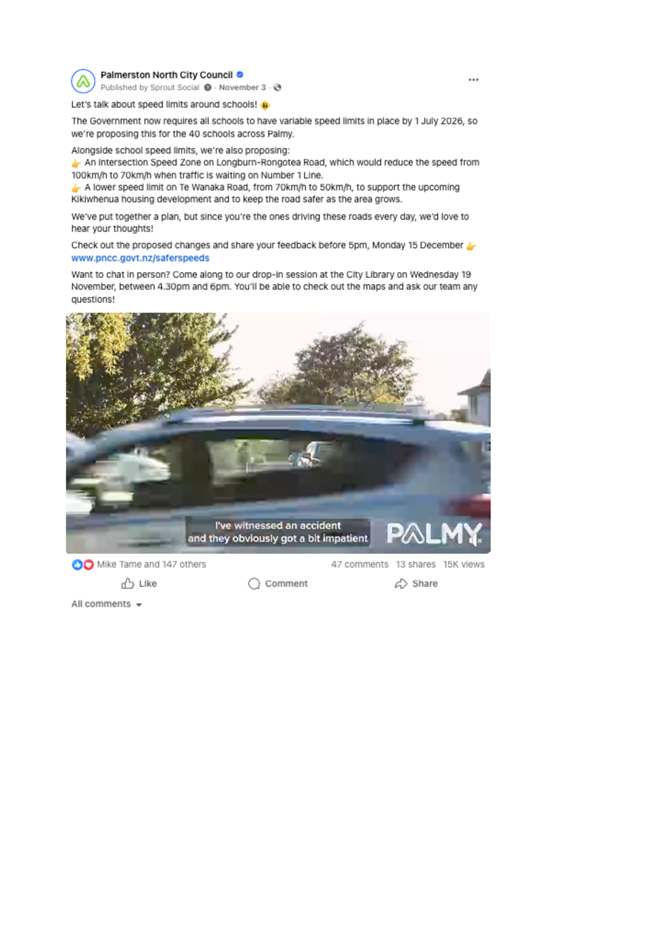
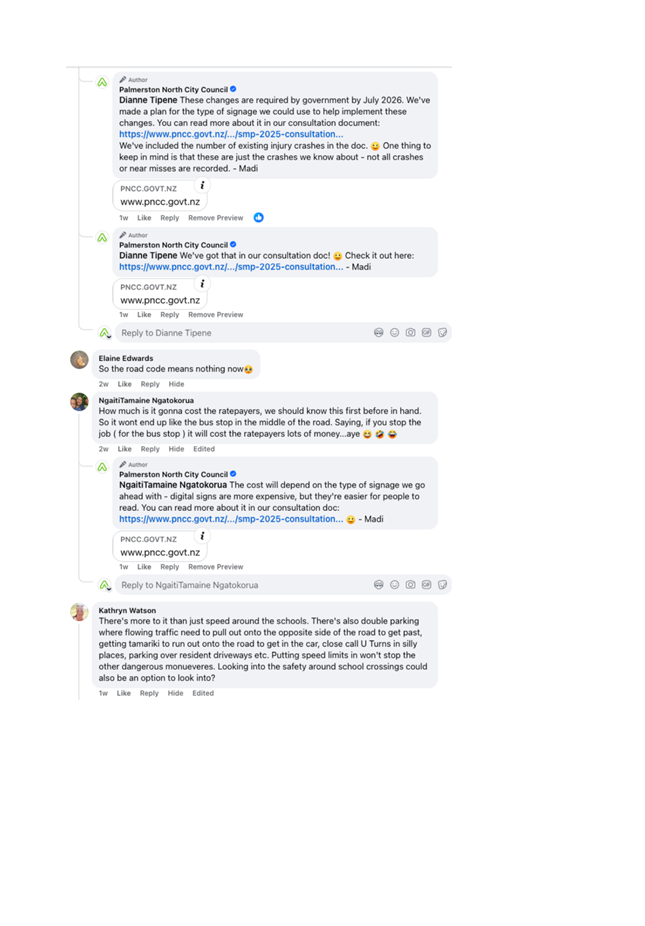
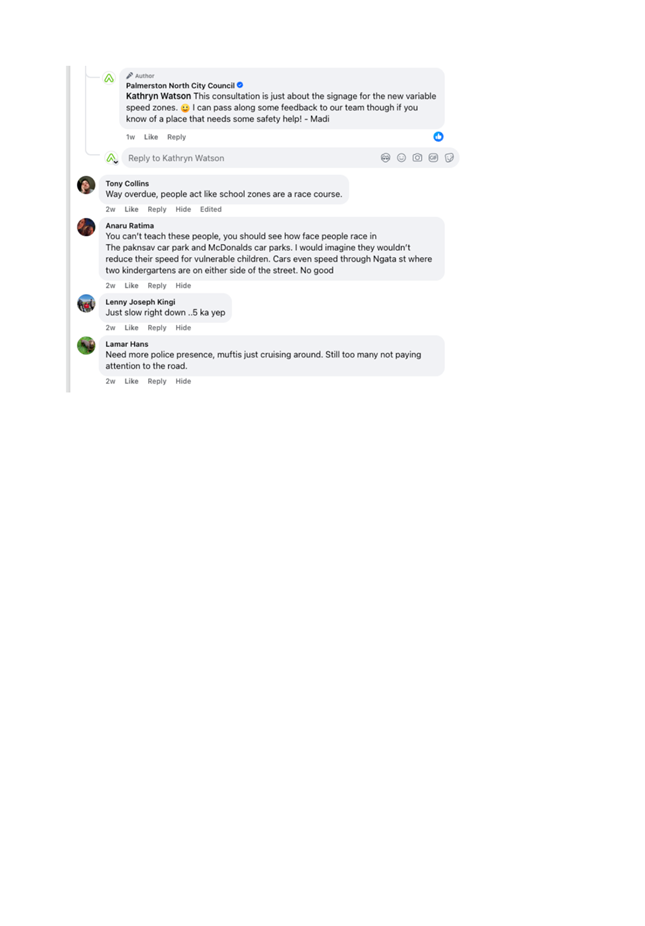
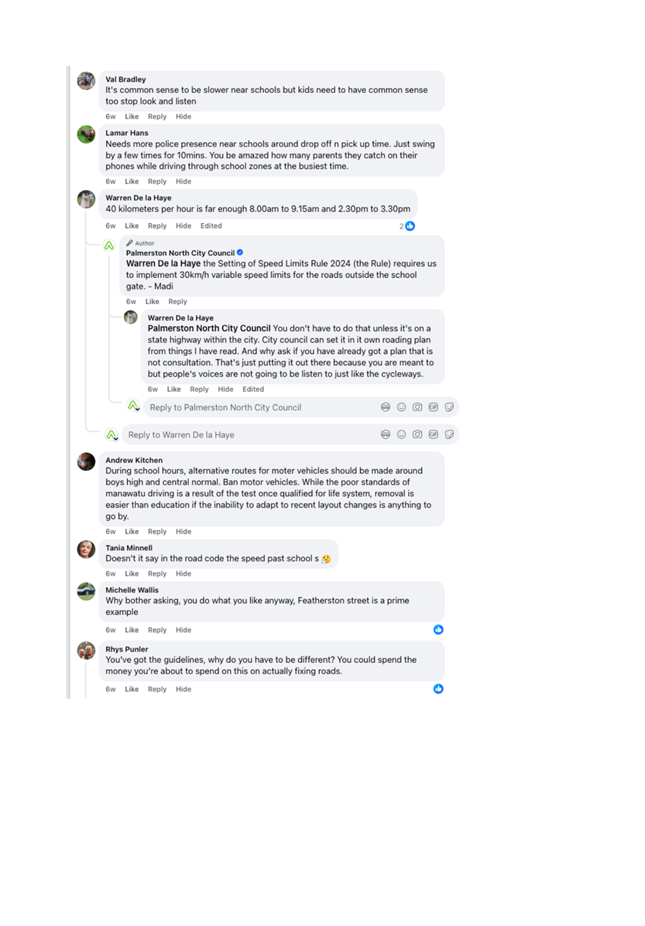
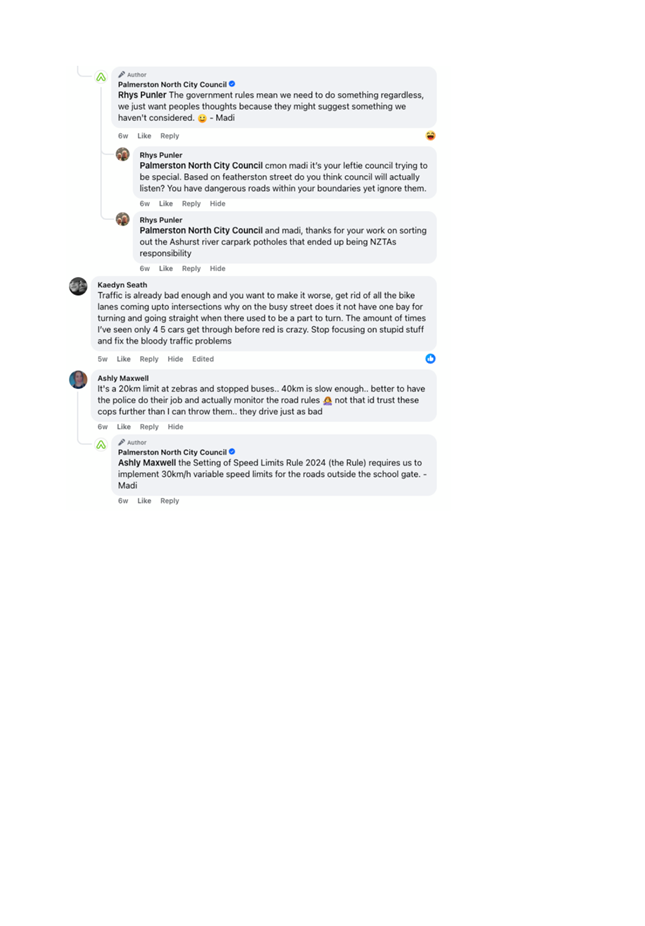
3.9 Social
media promotion included organic posts on LinkedIn and Facebook, and paid ads
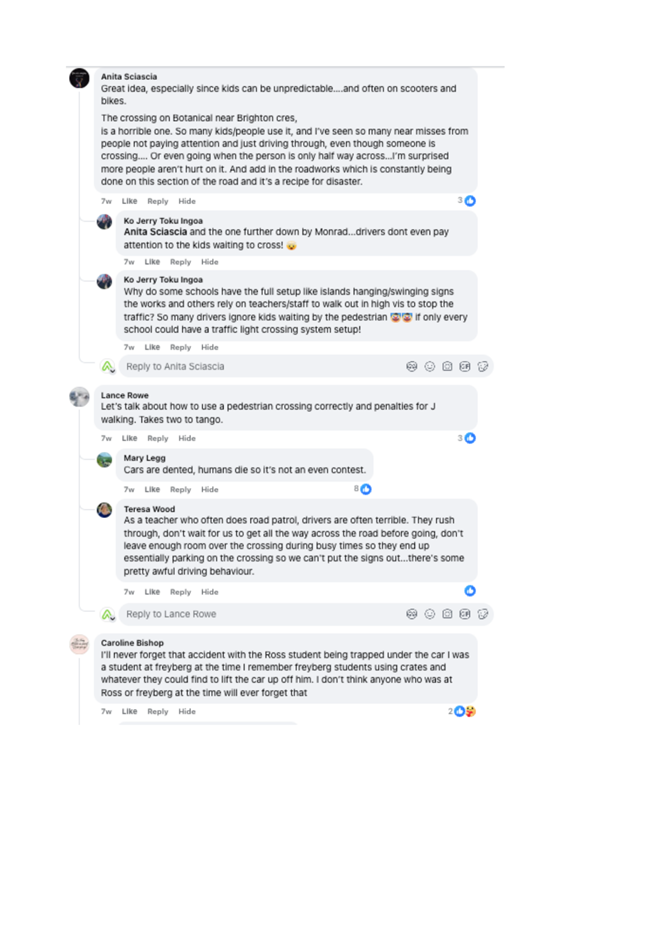
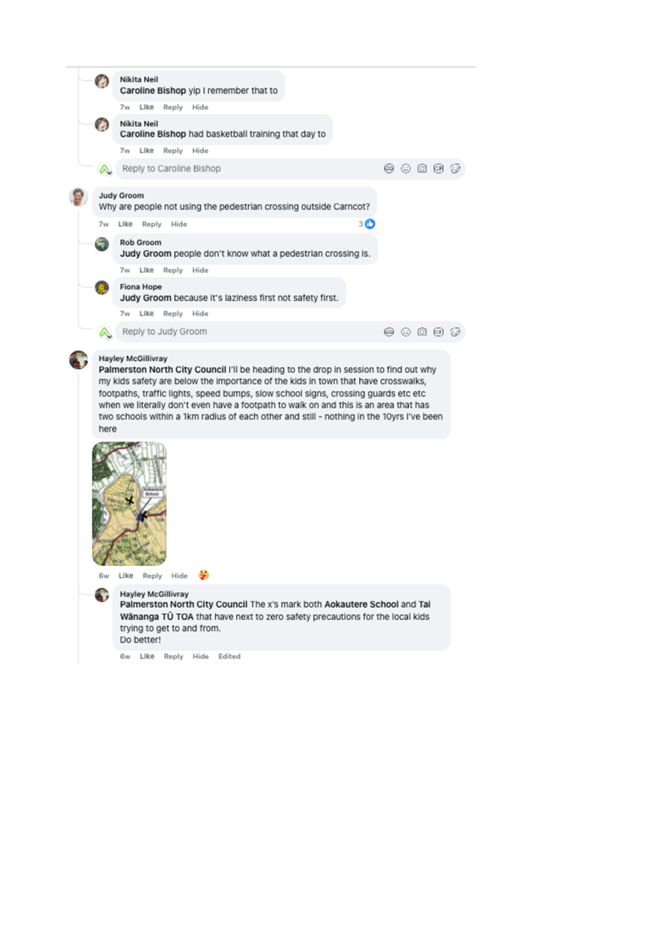
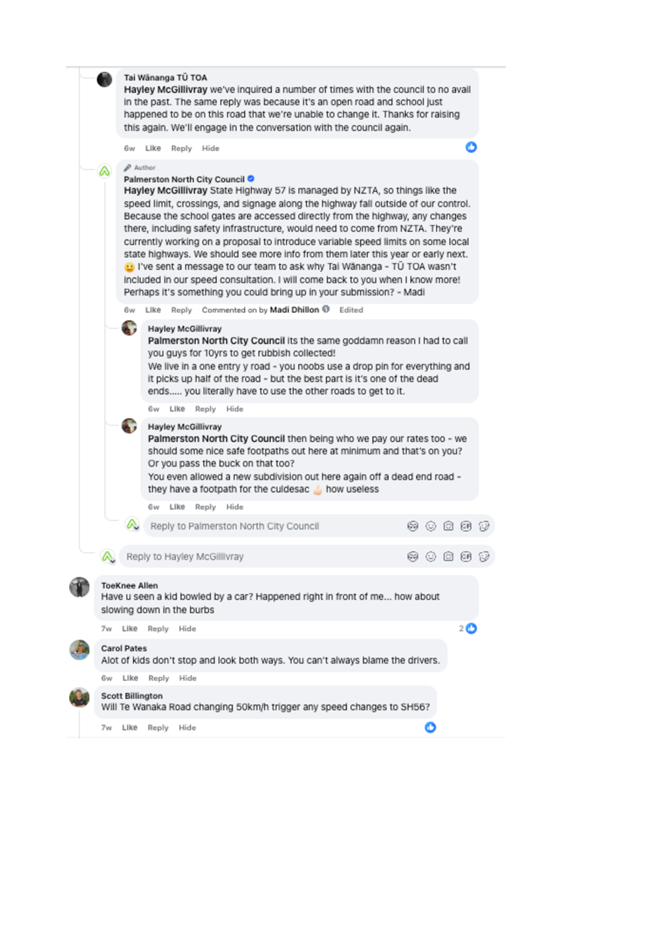
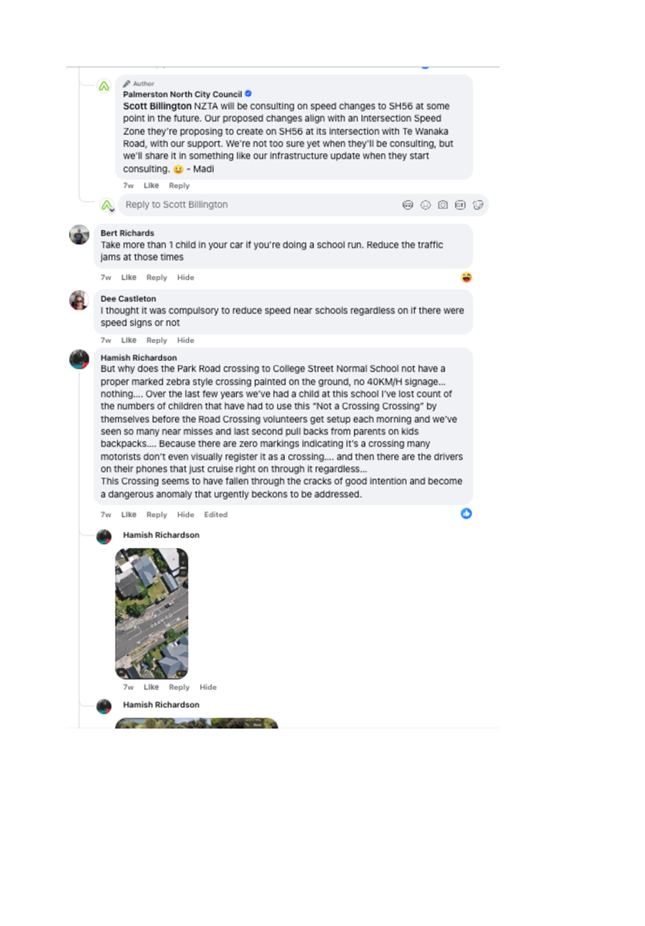
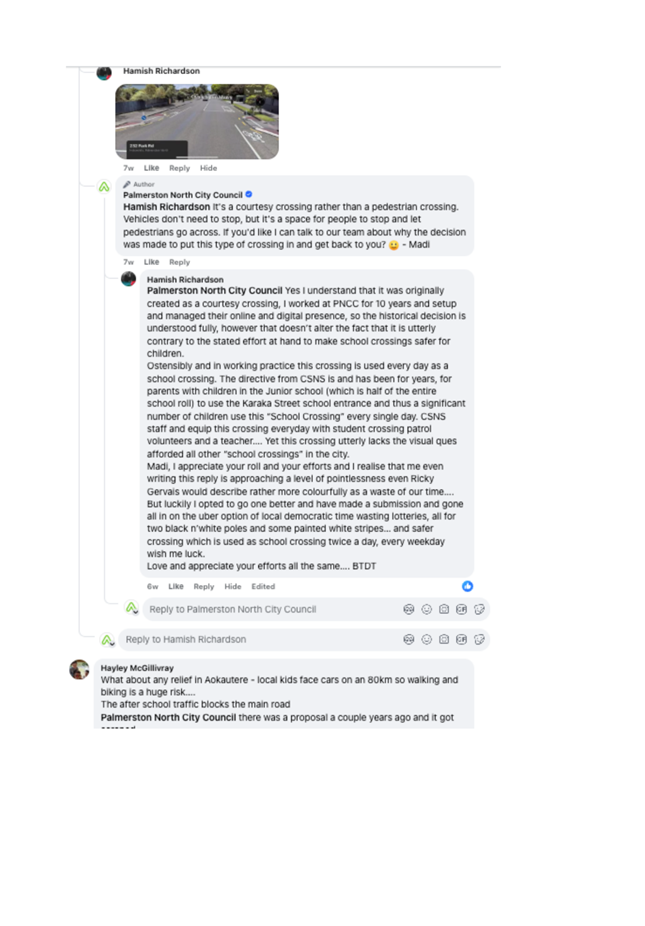
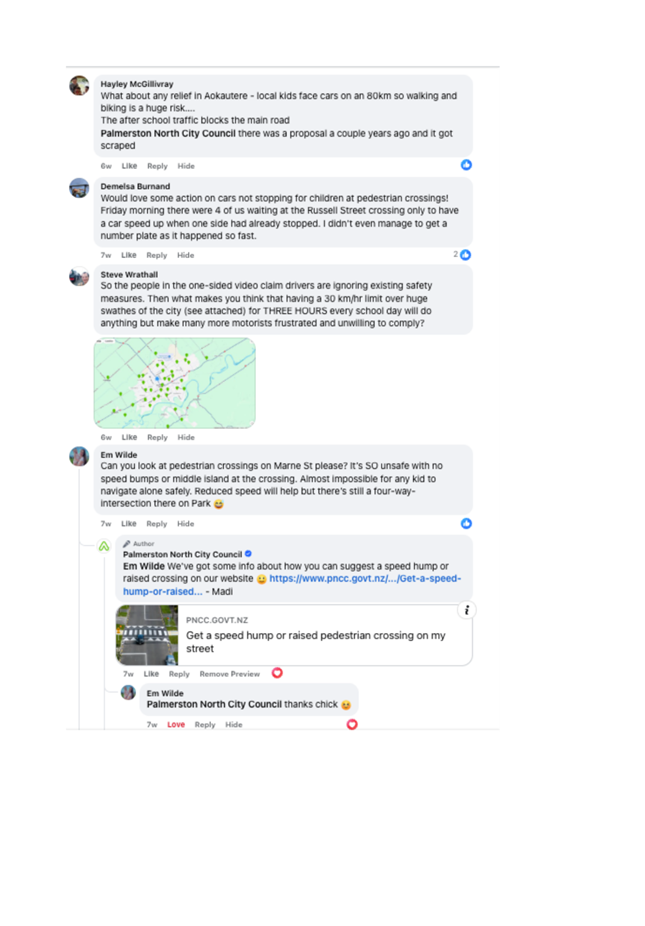
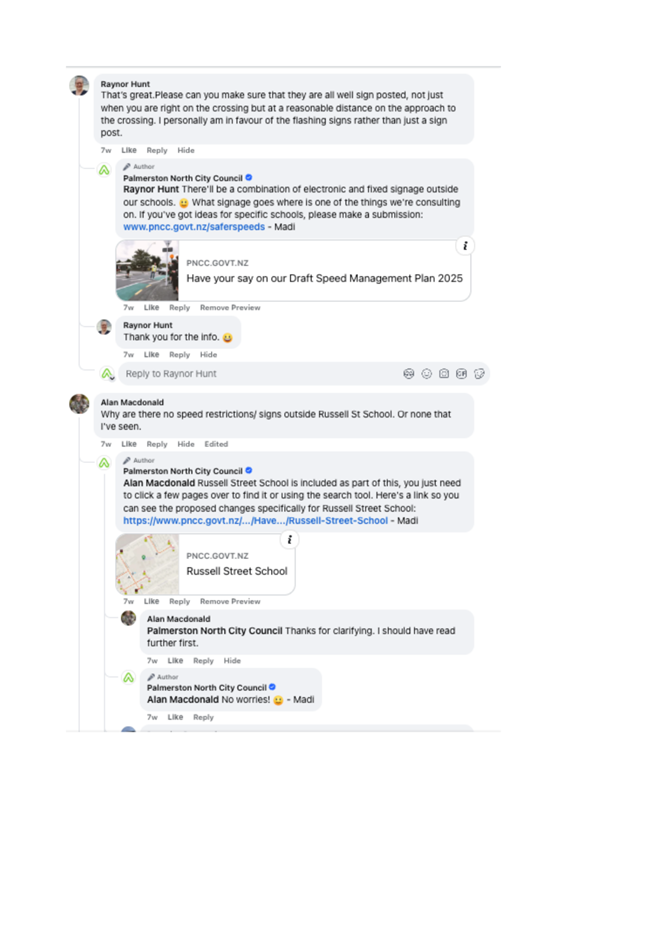
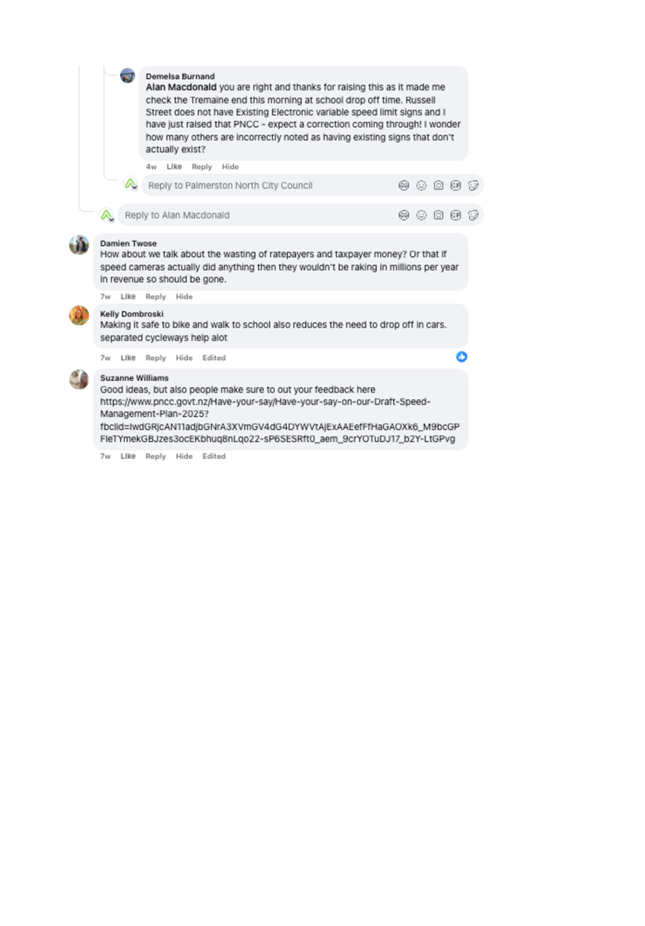
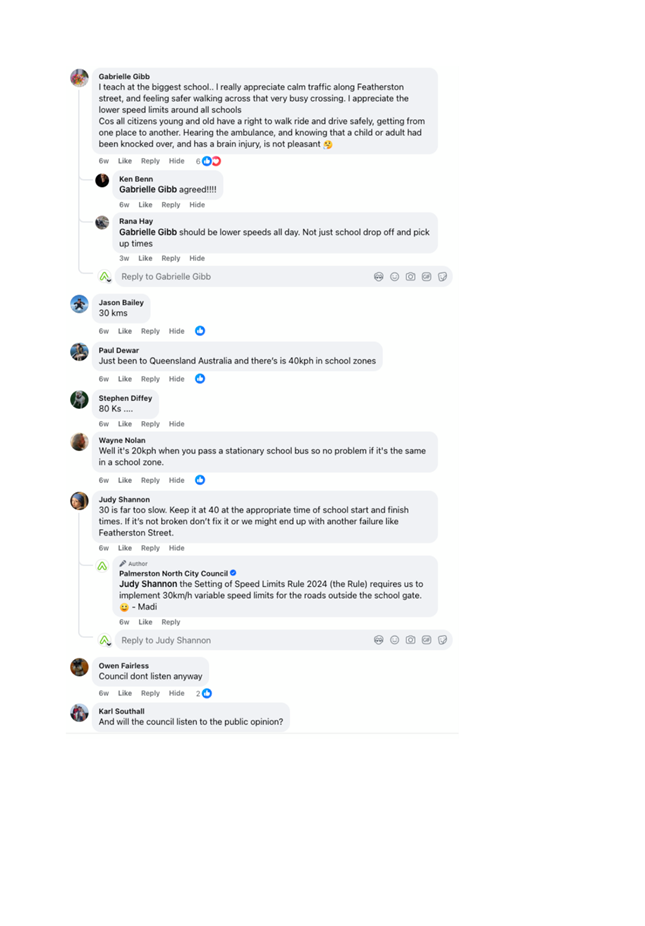
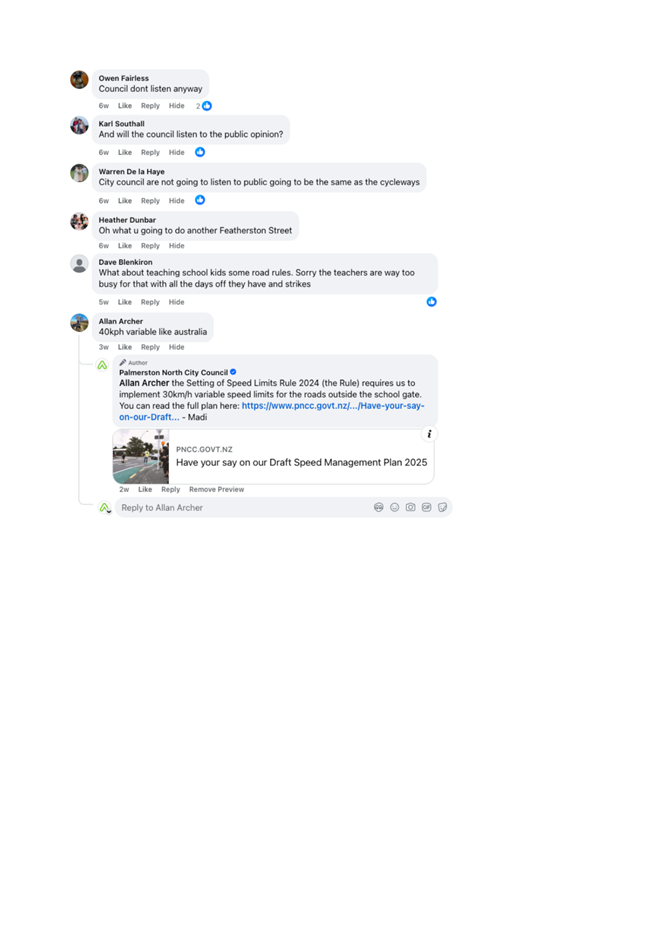
on Facebook and Instagram. Screenshots of social media comments on both
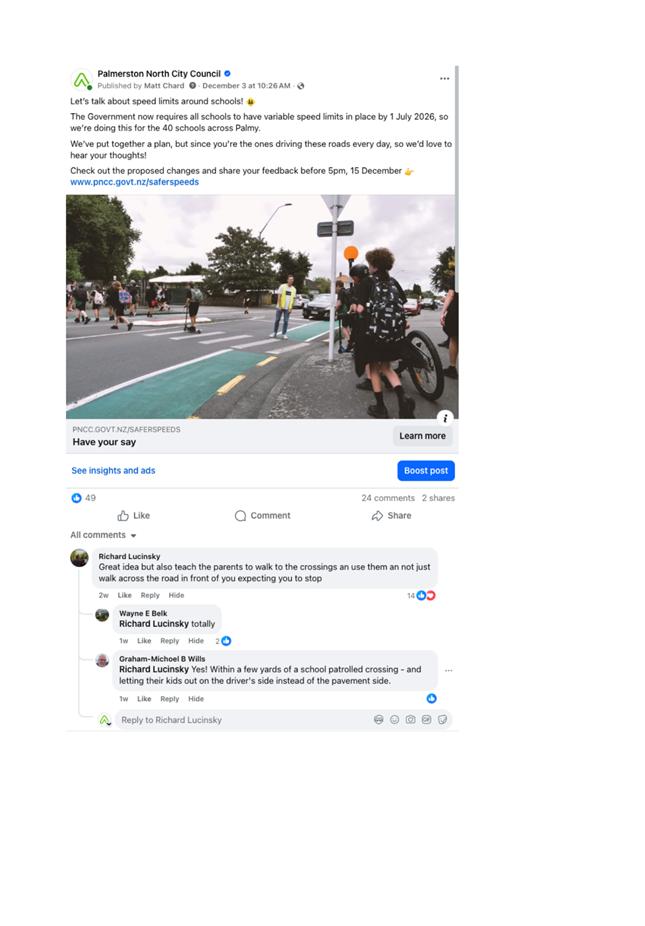
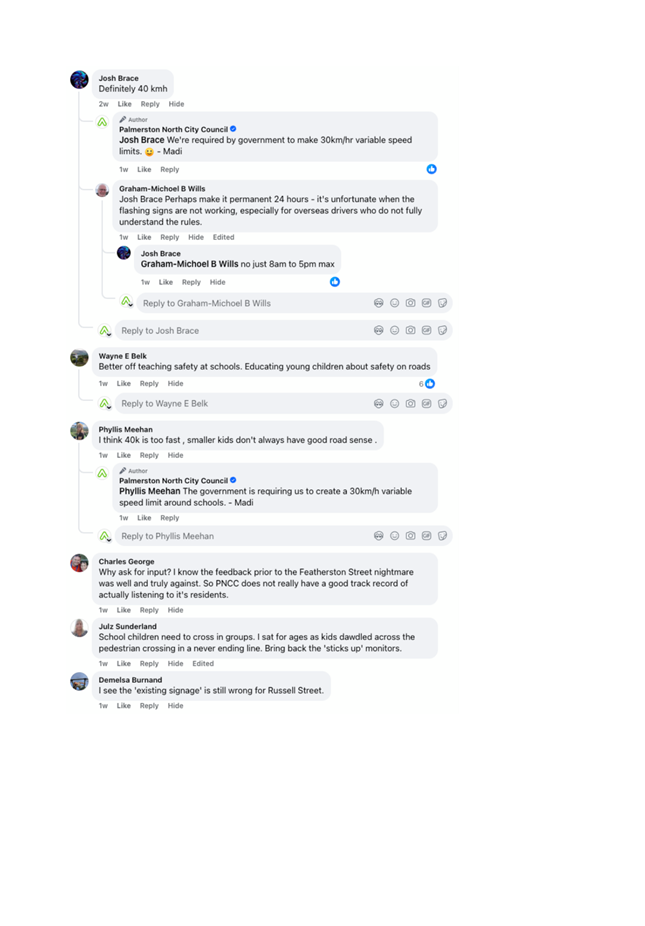
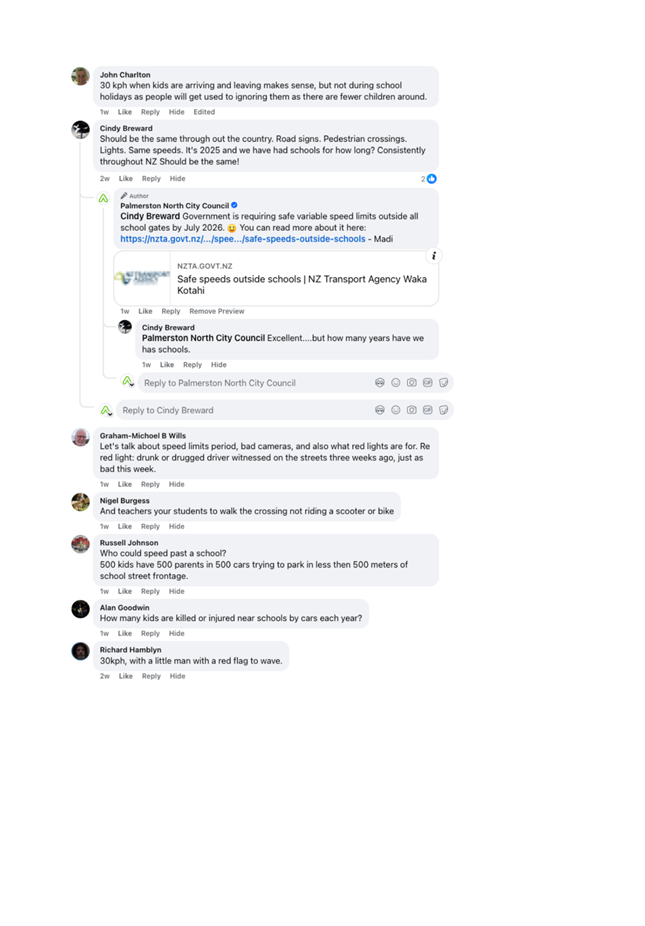
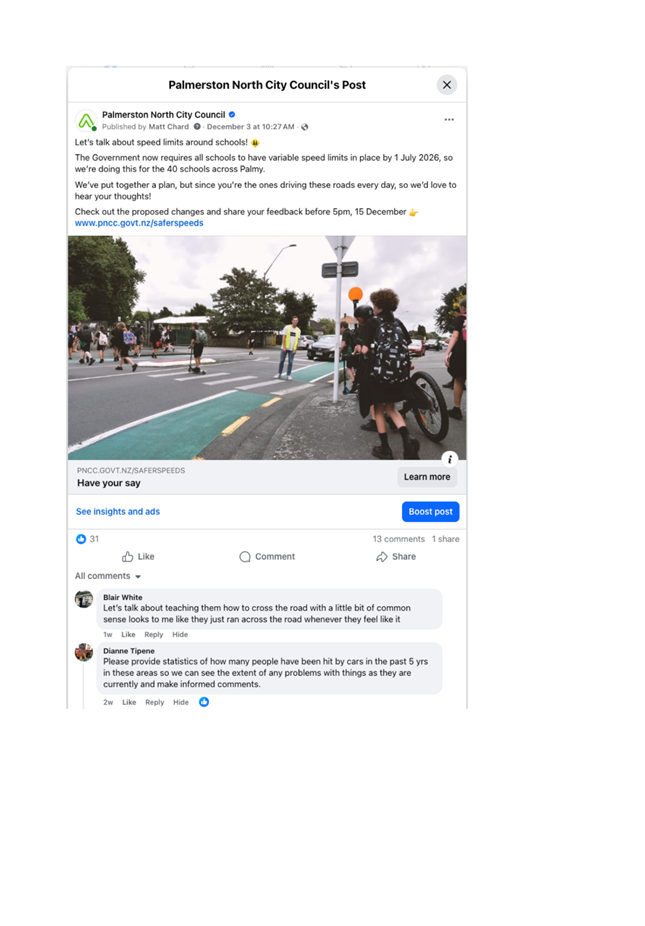
the organic and promoted posts are included as attachment 1. Across all
posts and ads, 96 comments were made. These will be considered with the
analysis of formal submissions in the report presented to the April committee
meeting.
4. NEXT STEPS
4.1 Staff
will provide analysis of all the issues raised in the written and oral
submissions and provide advice and recommendations to the Committee in April
2026.
5. Compliance and administration
|
Does the Committee have
delegated authority to decide?
|
Yes
|
|
Are the decisions significant?
|
No
|
|
If they are significant do they
affect land or a body of water?
|
No
|
|
Can this decision only be made
through a 10 Year Plan?
|
No
|
|
Does this decision require
consultation through the Special Consultative procedure?
|
No
|
|
Is there funding in the current
Annual Plan for these objectives?
|
Yes
|
|
Are the recommendations
inconsistent with any of Council’s policies or plans?
|
No
|
|
The recommendations contribute
to:
Whāinga 1: He tāone auaha, he tāone
tiputipu
Goal 1: An innovative and growing city
|
|
The recommendations contribute to this
plan:
3. Mahere tūnuku
3. Transport Plan
The objective is: Provide a
safe, low-carbon, integrated and multi-modal transport network.
|
|
Contribution to strategic
direction and to social, economic, environmental and cultural well-being
|
Safe speed limits are a key part
of managing the city’s transport network, for the benefit of all road
users. Consultation on the draft Speed Management Plan, including the
hearing of oral submissions, ensures that the Council understands the
community’s views about these proposed changes before making a final
decision.
|
|
|
|
Attachments
|
1.
|
Draft Speed Management Plan
Consultation Social Media Comments ⇩
|
|
Report
TO: Finance, Performance & Audit Committee
MEETING DATE: 4 March 2026
TITLE: New Zealand Food Awards - Annual Report
PRESENTED BY: Jessica Papple, Manager Marketing
APPROVED BY: Danelle Whakatihi, General Manager Customer & Community
RECOMMENDATION(S)
TO Finance,
Performance & Audit Committee
1. That
the Committee refer the continuation of Programme 2446 of up to $64k over three
years to support the New Zealand Food Awards as part of the Annual Budget
2026/27 deliberations in May;
or
2. Decline
the request to sponsor.
|
Problem or
Opportunity
|
Should we
continue to fund the New Zealand Food Awards post the 2025 sponsorship
agreement?
|
|
OPTION 1:
|
Refer the
continuation of Programme 2446 of up to $64k over three years to support the
New Zealand Food Awards as part of the Annual Budget 2026/27 deliberations in
May
|
|
Benefits
|
Maintains
Council’s association with a nationally recognised industry event
aligned to identified sector strengths.
Supports
continued promotion of Palmerston North and the Manawatū region’s
food innovation ecosystem to a national audience.
Provides
opportunities for local businesses, researchers, and students to engage with
national industry networks.
The sponsorship
aligns with Palmerston North’s established strengths in food science,
research, and education.
Hosting and
supporting a national event reinforces the city’s reputation as a
centre for food innovation.
Hosting the
event provides economic benefits for the city by bringing more visitors to
the region.
Demonstrates to
event organisers that our venues are capable of hosting large conferences and
business events.
|
|
Risks
|
Reduction in
funding for other Council initiatives.
|
|
Financial
|
Requires funding
of up to $64k over
three years.
|
|
OPTION 2:
|
Decline
the request to sponsor
|
|
Benefits
|
More funding is
available for other Council initiatives.
|
|
Risks
|
Loss of national
profile and reduced visibility for the city’s food innovation
ecosystem.
Potential
reduction in opportunities for local businesses and researchers to engage
with national food industry networks.
Potential
weakening of relationships with the New Zealand Food Awards and/or Massey
University.
|
|
Financial
|
No financial
impact on Council.
|
Rationale for the recommendations
1. Overview of opportunity
1.1 In 2023, Council approved $64k over a three-year sponsorship
agreement (Calendar year 2023 – 2025) with the New Zealand Food Awards
(NZFA).
1.2 The current sponsorship term with NZFA has concluded. Funding levels
were staged across the term, with the highest investment in 2025, when the
Awards were hosted in Palmerston North.
1.3 This report outlines the outcomes of Council’s sponsorship of
the NZFA and presents sponsorship options for consideration over the next
three-year period.
2. Background on the
awards and sponsorship
2.1 The purpose of the New Zealand Food Awards is to recognise
excellence and innovation across New Zealand’s food and beverage sector.
Council sponsors the Awards because they align with the city’s identified
sector strengths, particularly in food innovation, research, and technology.
2.2 The event provides an opportunity to present Palmerston North and
the wider Manawatū region’s food ecosystem to a national audience,
including businesses, researchers, and industry leaders. This raises the
awareness of the region’s capabilities, facilities, and talent base for
food innovation.
2.3 Council has supported the NZFA for over 10 years, including hosting
the event in Palmerston North on two occasions.
Category
Partner – Years 2023 and 2024
2.4 In
2023 and 2024, the Awards were held in Auckland, with Council participating as
a Category Partner in the Hauora and Wellbeing category. This sponsorship was
funded at $12,000 + GST per year.
2.5 As
a Category Partner of the NZFA, we received formal recognition across the Gala
Dinner. This included category naming and presentation rights, inclusion of
Council branding across Awards collateral, access to communication
opportunities through Awards channels and acknowledgment of our support at the
Awards Dinner. Council was also allocated ten tickets to each Awards Dinner.
2.6 The
partnership included acknowledgment in Awards-related media releases,
promotional placement on the Awards website for the duration of the agreement,
access to the Awards database, and social media posts through the Awards
channels.
Strategic
Partnership – 2025
2.7 In
2025, Council increased its involvement, becoming a Strategic Partner. This
sponsorship included hosting the Awards Dinner in Palmerston North and
supporting the Emerging Talent category, at a cost of $40,000 + GST.
2.8 As
a Strategic Partner, Council received increased recognition, including brand
presence at the Awards Dinner, an introductory address, and a Council brand
message prior to category announcement. We were also allocated twenty tickets
to the Awards Dinner. The partnership included digital and media recognition,
access to communication opportunities through Awards channels, and the right of
first refusal for the 2026 Awards.
2.9 As
part of the 2025 programme, judging activities were relocated from Auckland
campuses to Palmerston North, allowing judges to access Massey University’s
Food Pilot facilities on the Manawatū campus.
2.10 The
Awards Dinner format was refreshed to reflect its Palmerston North setting,
rather than replicating the Auckland-based event. This allowed the programme to
better showcase the city’s food innovation and research strengths, with
the local food network featured through on-site activations and displays.
2.11 The
NZFA programme was extended to include a networking breakfast held the day
after the gala dinner. This included tours of local facilities such as the Fonterra
Research and Development Centre, FEAST labs, and the Massey Food Pilot. These
activities were designed to provide attendees with insight into food innovation
happening in the city.
2.12 Council
sponsored the newly created Emerging Talent category, which recognises
individuals who demonstrate significant potential early in their careers in
food science and technology. This category aligns with the city’s sector
of strengths by supporting the education and food innovation sectors,
particularly given Palmerston North’s role as the home of Massey
University’s Food Technology degree and as a base for future food
technologists.
Performance
of the Awards
2.13 Participation in the New Zealand Food Awards provides opportunities
for businesses and individuals to engage with national industry networks,
including food companies, researchers, and sector organisations. These
connections can support businesses’ collaboration, knowledge sharing, and
increased visibility within the food technology sector.
2.14 An example of this is Eat Kinda, a Palmerston North-based food
business and winner of the Below Zero and Novel categories of the 2023 New Zealand Food Awards. Eat Kinda developed a
cauliflower-based ice cream, combining food science expertise with a focus on
sustainability and inclusive eating. The business received support from Massey
University through access to the Food Pilot, the New Zealand Food Innovation Network,
and Massey Ventures, which helped it progress from concept to commercial
production.
2.15 Since
launch, the business has expanded into international markets. Participation in
the Awards contributed to increased industry exposure and recognition.
Number of award entries overall and by
Manawatū-Whanganui region
|
|
2023
|
2024
|
2025
|
|
Total award
entries
|
411
|
309
|
364
|
|
Manawatū-Whanganui
entries
|
Less
than 5
|
4
|
10
|
|
Number of
products entered
|
182
|
151
|
179
|
|
Number of
companies entered
|
124
|
89
|
138
|
Gala dinner attendance
|
|
Venue
|
Attendance
|
|
2022
|
Central Energy
Trust Arena
|
320
|
|
2023
|
Aotea Centre,
Auckland
|
355
|
|
2024
|
Viaduct Events
Centre
|
267
|
|
2025
|
Central Energy
Trust Arena
|
281*
|
1.1.1
Networking Breakfast and
industry tours |
72
|
*Of the 281 gala dinner
attendees in 2025, 60 tickets were purchased or redeemed by finalists
travelling from outside the Manawatū-Whanganui region, from as far afield
as Pukenui in Northland to Dunedin.
3. Description of options
Option 1: Refer the continuation of Programme 2446
of up to $64k over three years to support the New Zealand Food Awards as part
of the Annual Budget 2026/27 deliberations in May.
3.1 Council
would be a Category partner in years 2026 and 2028 in the Emerging
Talent: Food Science & Technology category at $12,000 + GST per year.
Council would then become a Strategic partner in 2027 at $40,000 + GST,
with the gala dinner hosted in Palmerston North to coincide with Massey University’s
centenary year and related regional promotional activity.
3.2 Continued
investment in the New Zealand Food Awards provides Council with an avenue to
maintain and develop relationships within New Zealand’s agri-food sector.
3.3 Sponsorship
signals support in the region’s role within New Zealand’s agri-food
economy and support for initiatives related to innovation, skills, research,
and industry development.
3.4 Investment
in the New Zealand Food Awards enables Council to participate in a national
agri-food sector programme, maintain sector relationships, and align with
activity relevant to a significant regional industry.
Option 2: Decline request.
3.5 Annual
judging of the New Zealand Food Awards would remain based in Palmerston North,
using Massey University’s specialist facilities. This arrangement
maintains the current location of the judging process and results in a
recurring programme of awards-related activity.
3.6 The
gala dinner is proposed as a complementary activity following the annual judging
process. Event organisers have stated that, without funding, the New Zealand
Food Awards gala dinner would be less financially viable in Palmerston North
due to limited ability to offset venue, production, and delivery costs. In this
scenario, organisers may reduce the scale of the event or consider an
alternative host city with greater access to commercial sponsorship and more
efficient infrastructure.
4. Next Steps
4.1 Chief Executive to confirm funding outcome with New Zealand Food
Awards post Annual Budget deliberations.
5. Compliance and administration
|
Does the
Committee have delegated authority to decide?
|
Yes
|
|
Are the
decisions significant?
|
No
|
|
If they are
significant do they affect land or a body of water?
|
No
|
|
Can this
decision only be made through a 10 Year Plan?
|
No
|
|
Does this
decision require consultation through the Special Consultative procedure?
|
No
|
|
Is there
funding in the current Annual Plan for these objectives?
|
No
|
|
Are the
recommendations inconsistent with any of Council’s policies or plans?
|
No
|
|
The
recommendations contribute to: Whāinga
1: He tāone auaha, he tāone tiputipu
Goal 1: An innovative and growing city
|
|
The recommendations contribute to this
plan:
2. Mahere
whakawhanake ohaoha
2. Economic
Development Plan
The objective
is: Attract and support major events and activities.
|
|
Contribution to
strategic direction and to social, economic, environmental and cultural
well-being
|
Sponsoring the
annual New Zealand Food Awards attracts a nationally significant event
aligned to the city’s food innovation strengths. The event contributes
to economic development through visitor spend and national exposure, while
also delivering other benefits through industry connection and profile-raising
for the city.
|
|
|
|
Attachments
Nil
Memorandum
TO: Finance,
Performance & Audit Committee
MEETING DATE: 4
March 2026
TITLE: Business
Assurance Accountability Report
Presented
By: Emy
Bastillo, Internal Auditor/Business Assurance Advisor & Desiree Viggars,
Manager Legal Risk & Assurance/Legal Counsel
APPROVED BY: Cameron
McKay, General Manager Corporate Services
RECOMMENDATION(S)
TO Council
1. That the
Committee receive the memorandum titled ‘Business
Assurance Accountability Report’ presented on 4 March 2026.
1. ISSUE
The Palmerston North City
Council’s Business Assurance Charter requires that follow-up procedures
for review recommendations are undertaken regularly and reported to the
Finance, Performance & Audit Committee.
2. BACKGROUND
Follow-up
is a process by which internal auditors evaluate the adequacy, effectiveness,
and timeliness of actions taken by management on reported observations and
recommendations, including those made by external auditors and others. This
process also includes determining whether senior management and/or the
Committee have assumed the risk of not taking corrective action on reported
observations.
Where an external review/audit
has been completed and reported to the Finance, Performance & Audit
Committee, the recommendations form part of the accountability report.
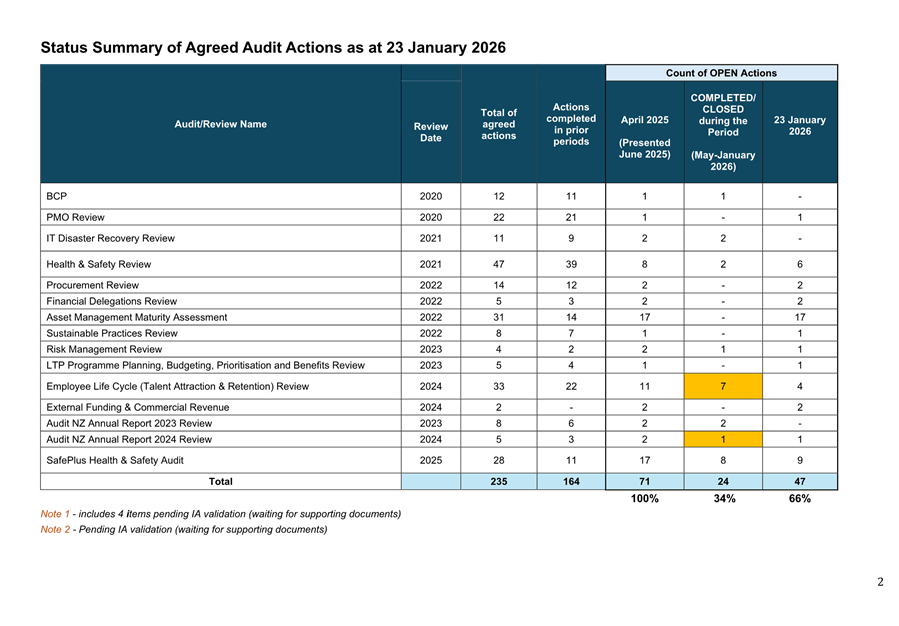
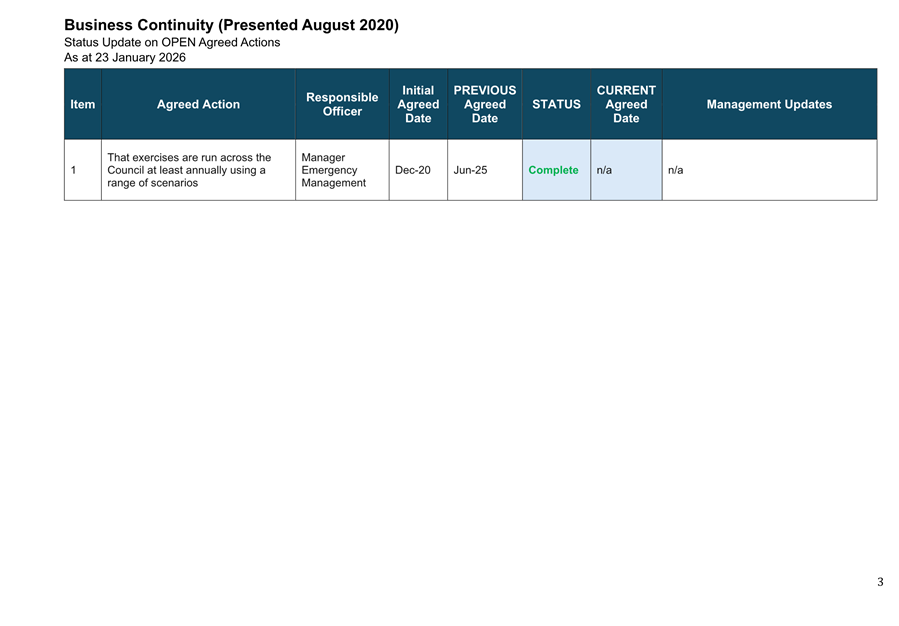
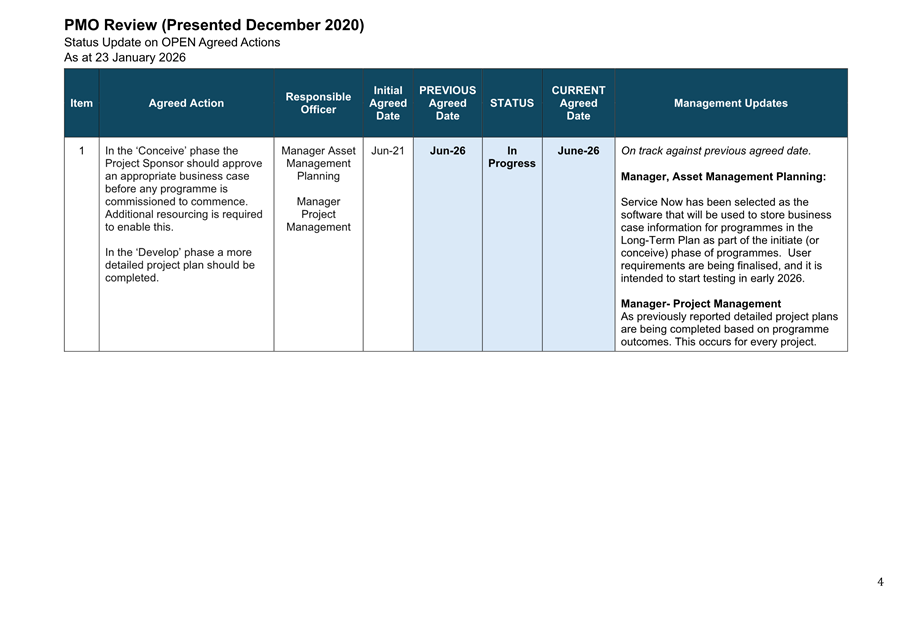
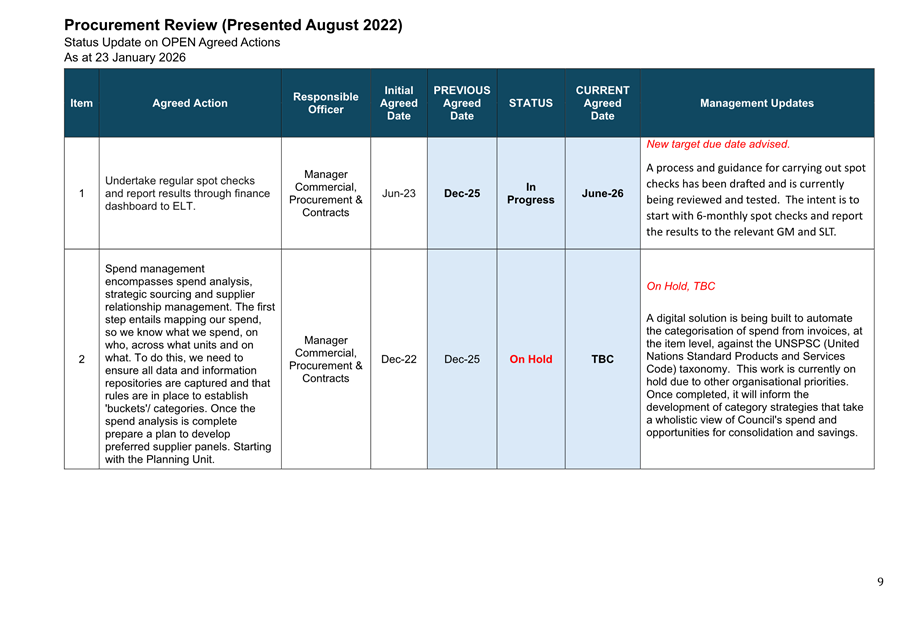
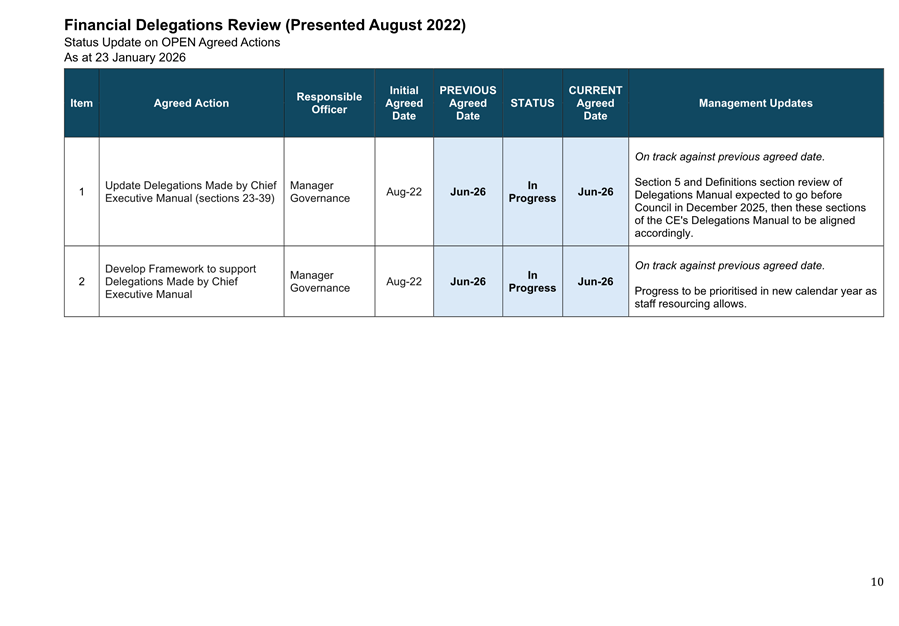
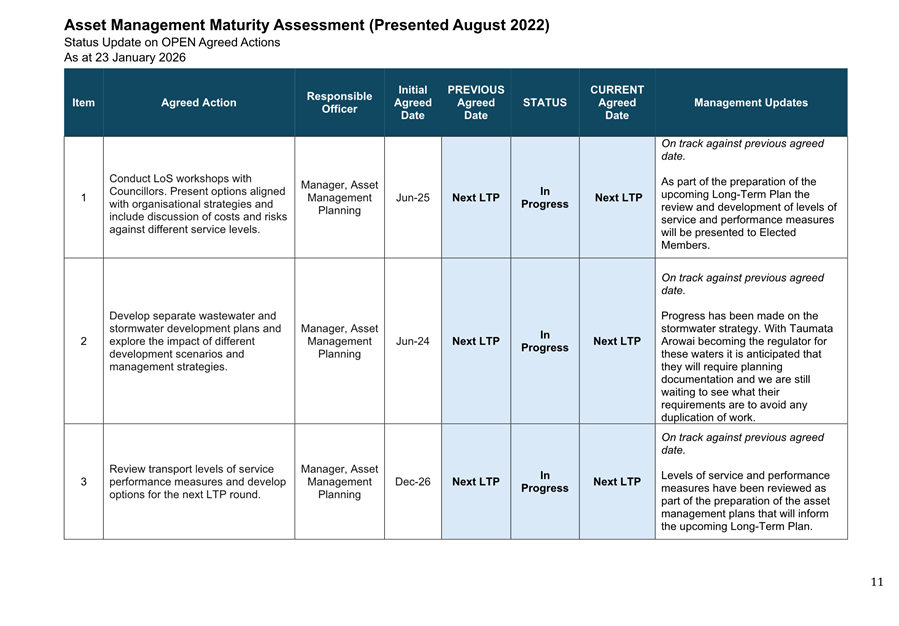
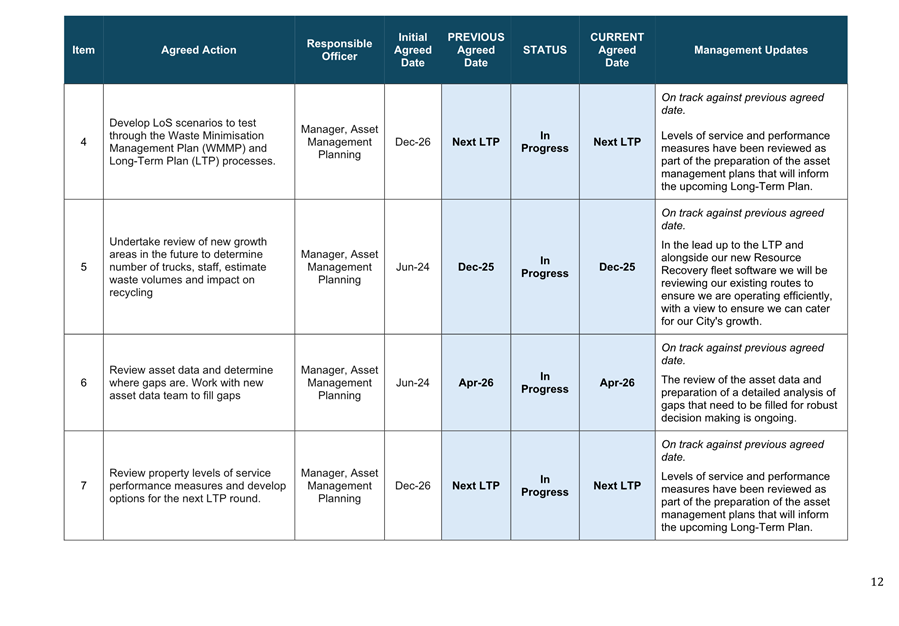
Attached
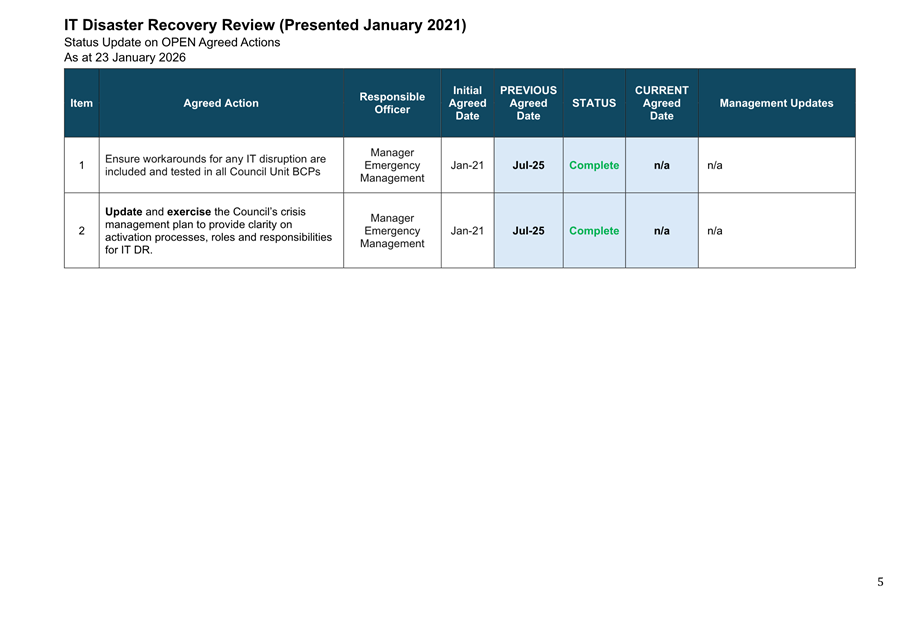
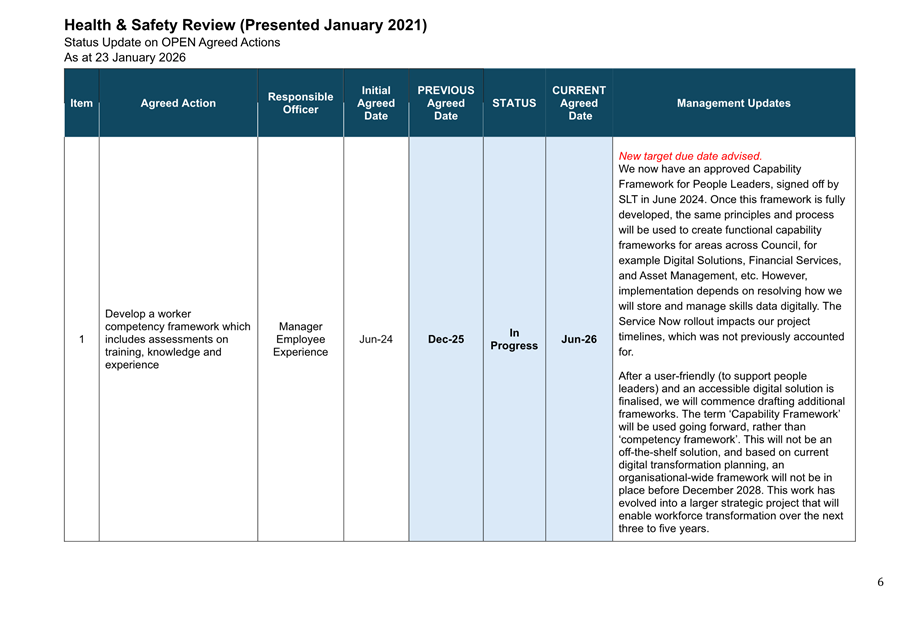
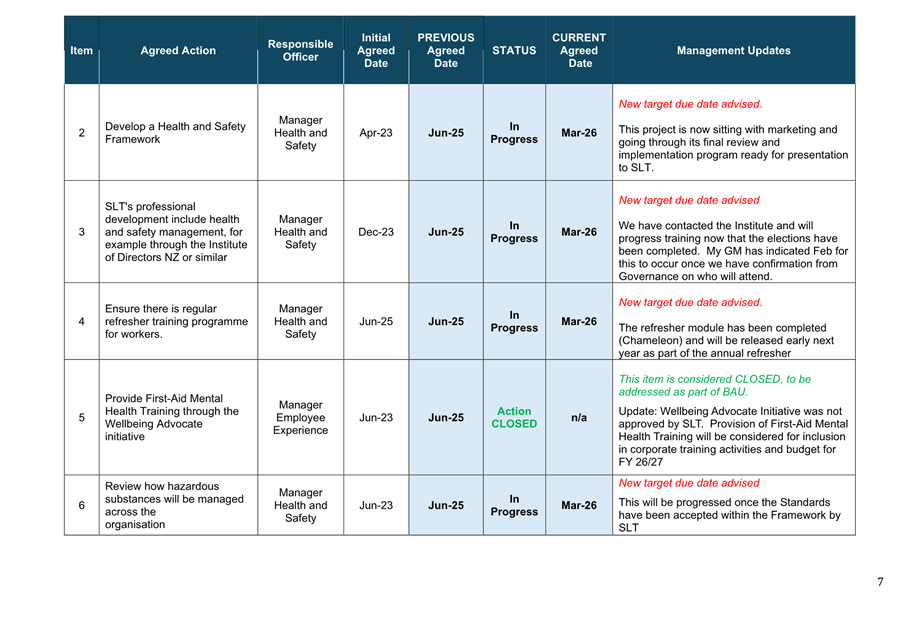
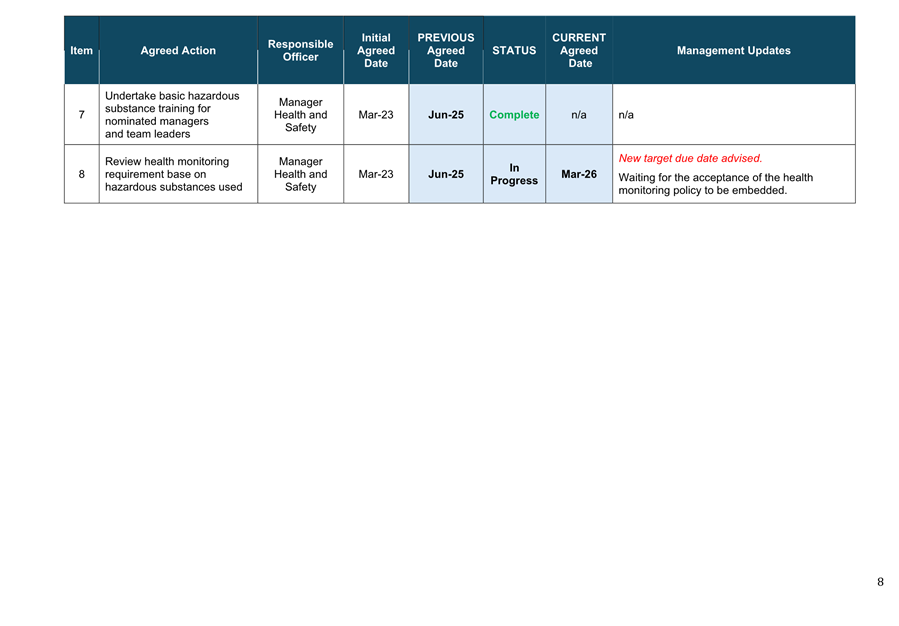
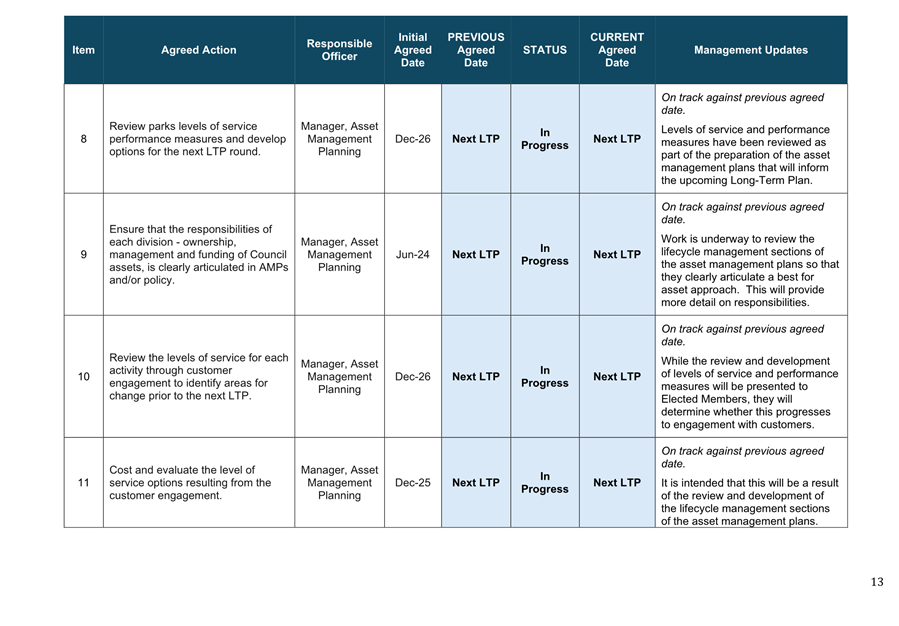
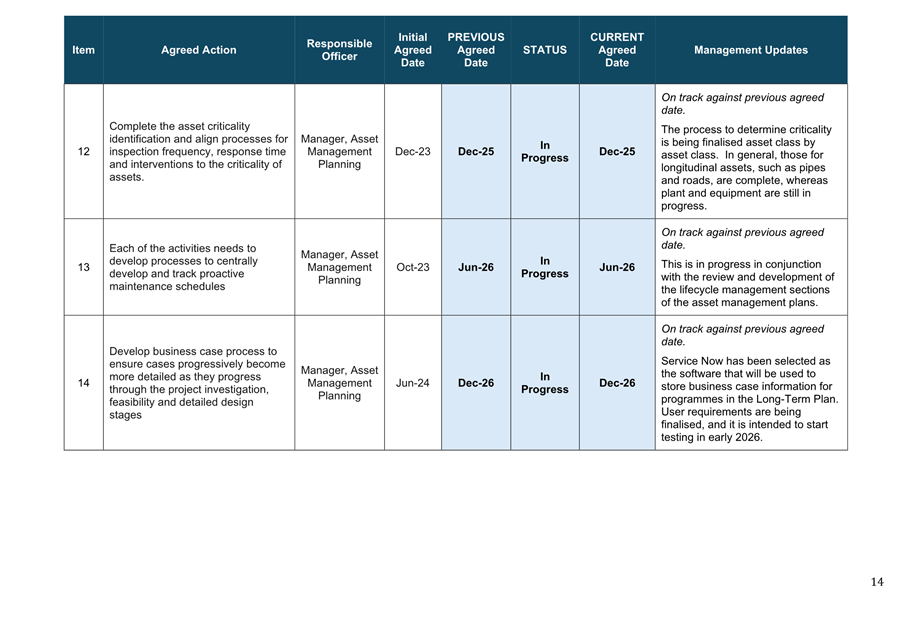
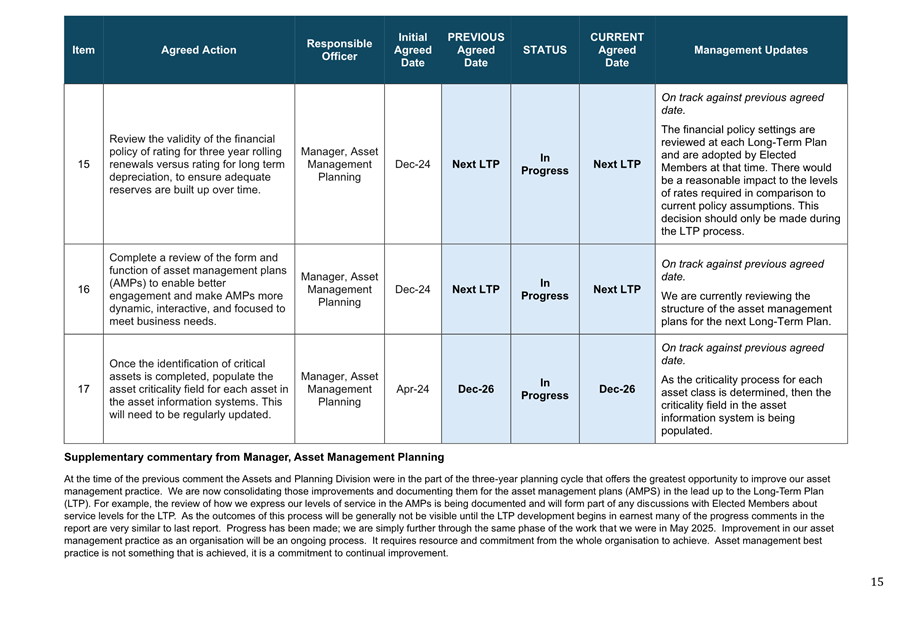
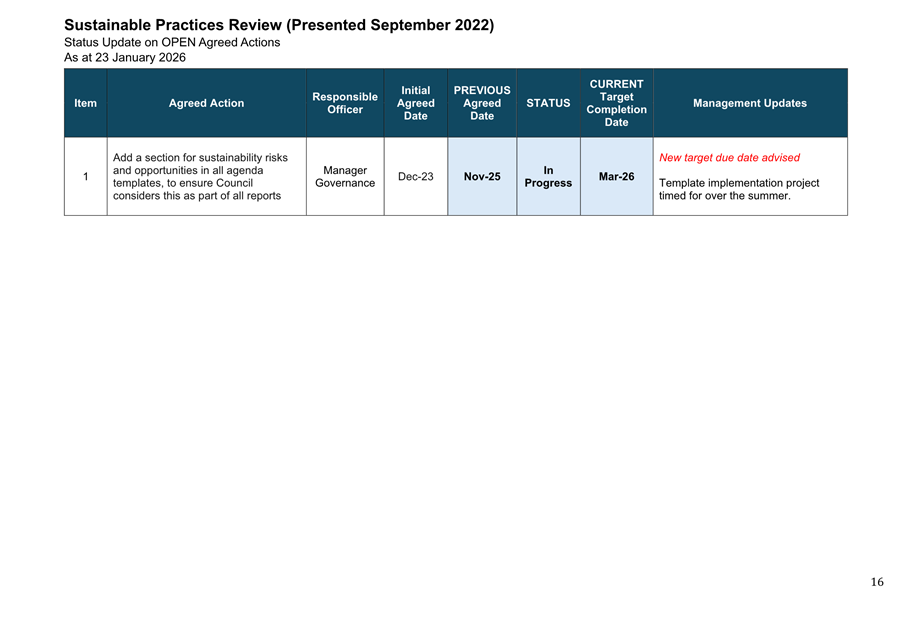
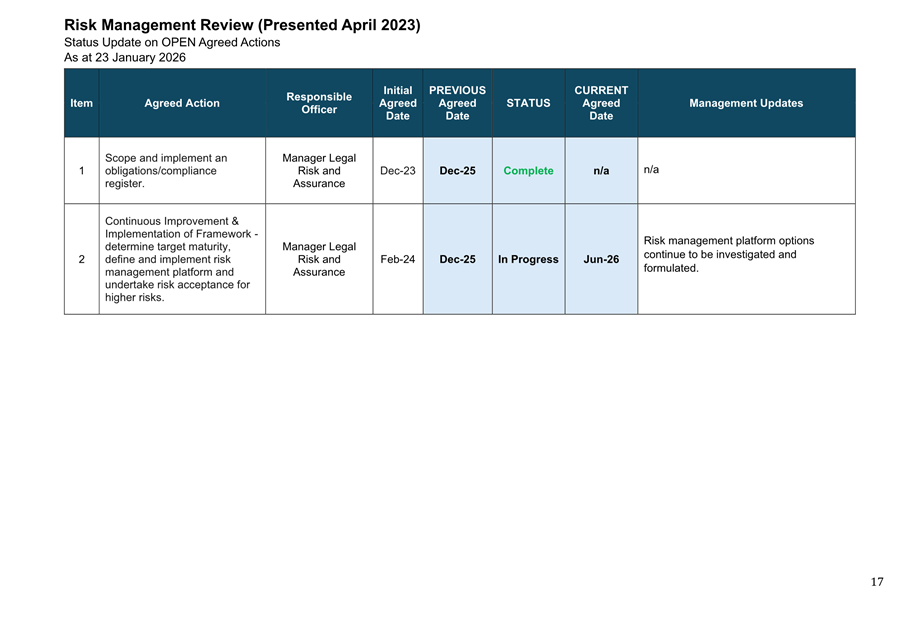
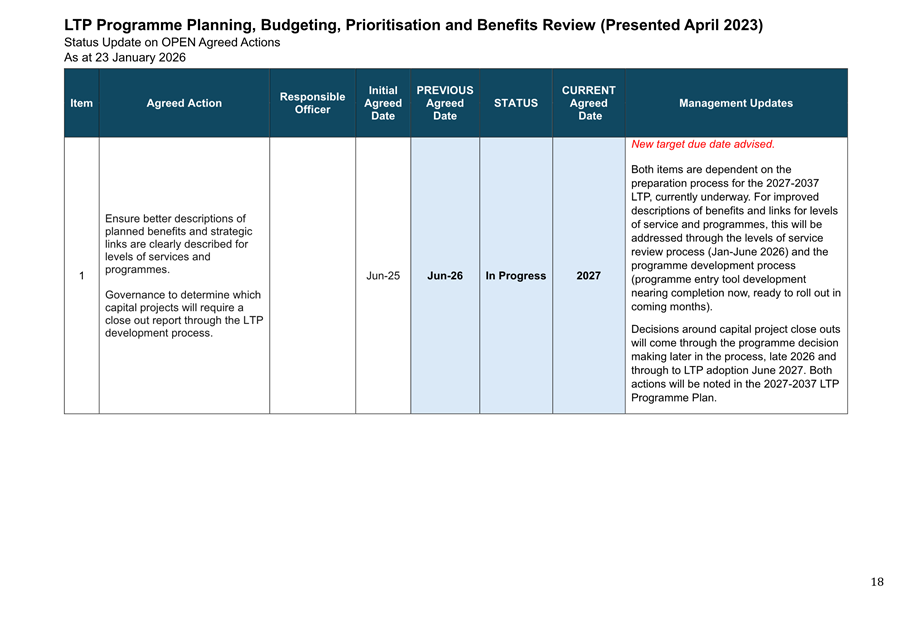
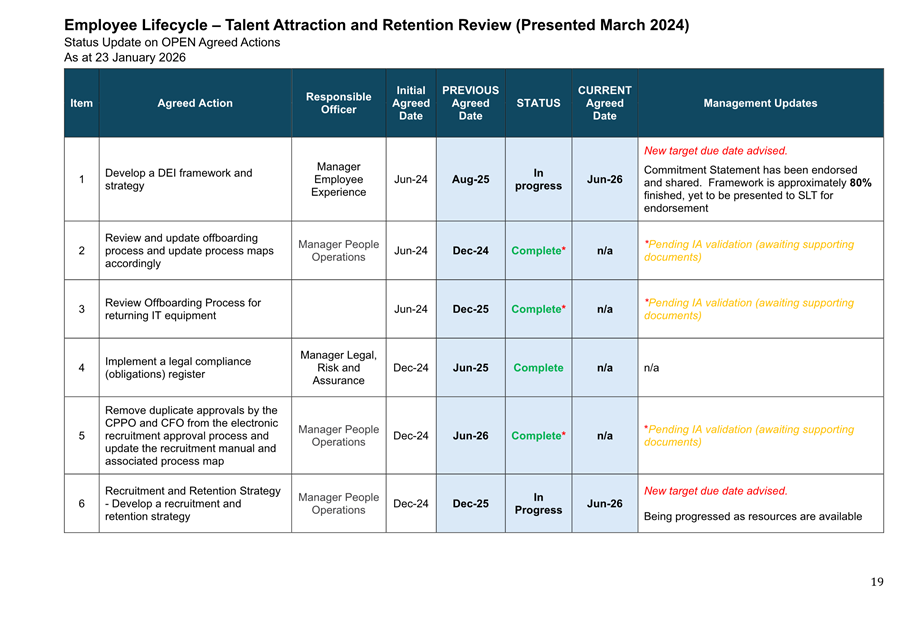
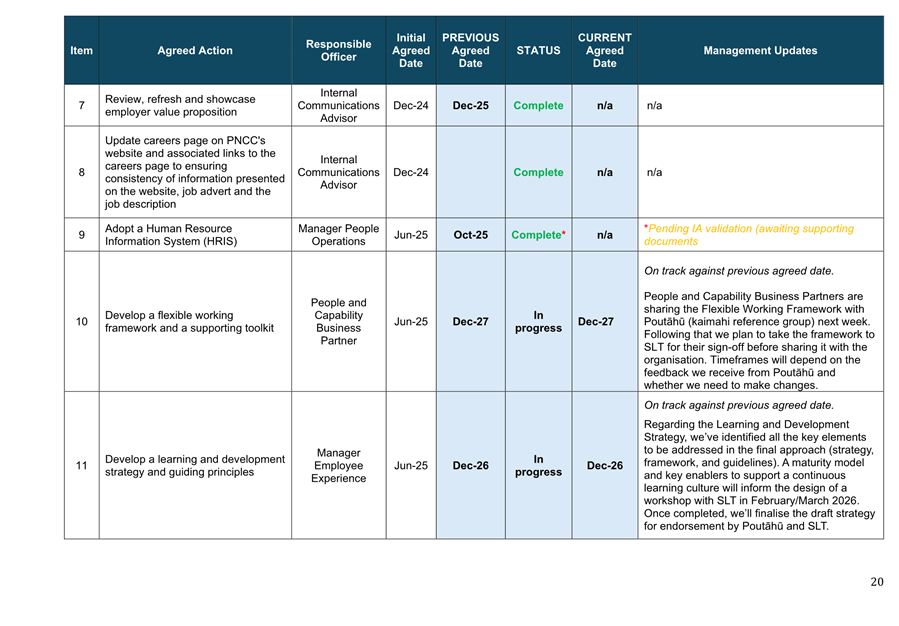
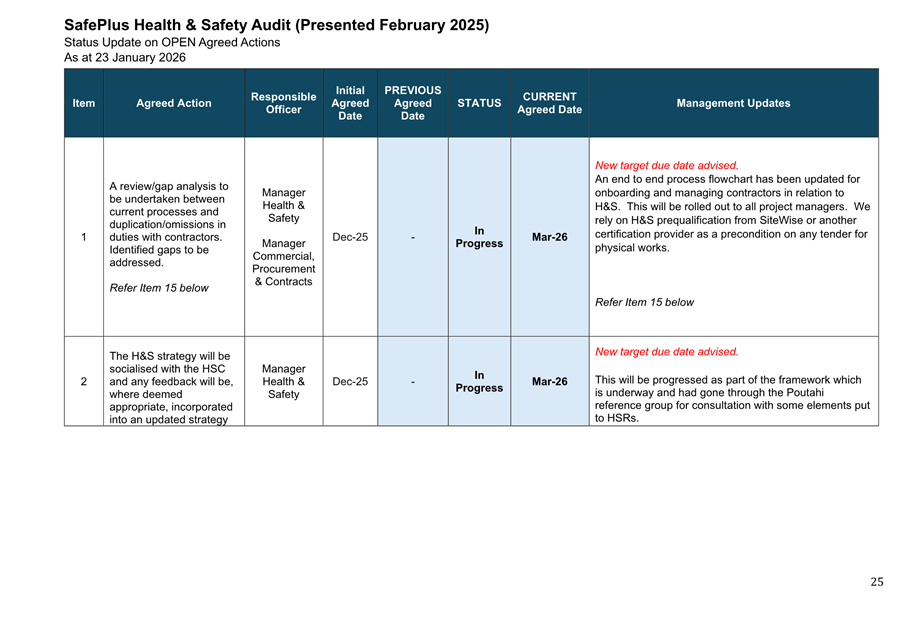
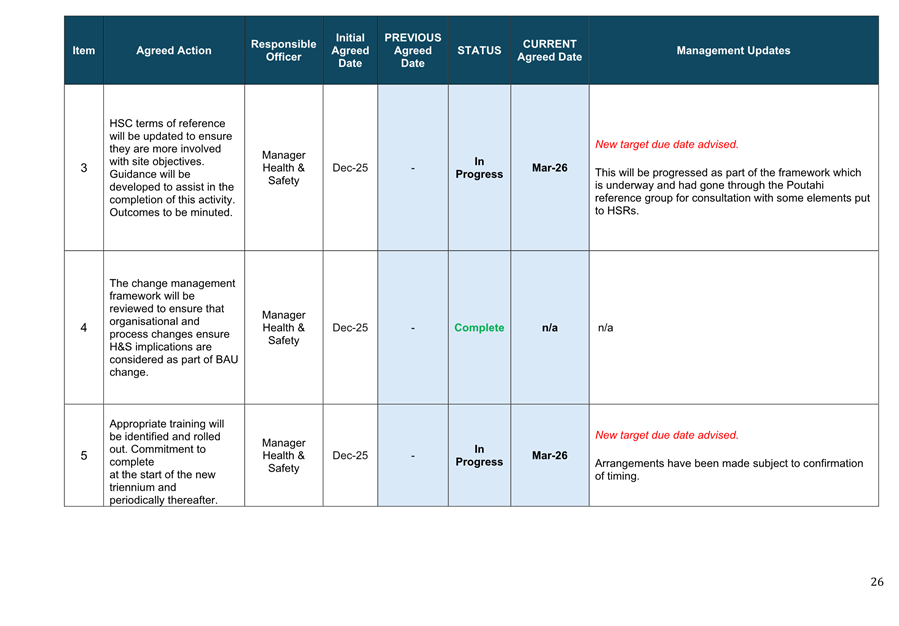
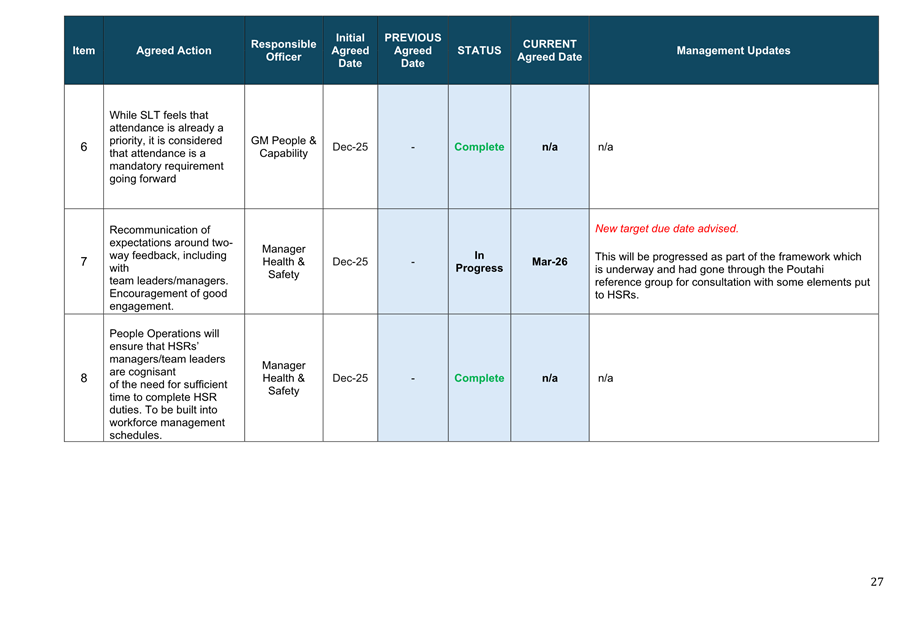
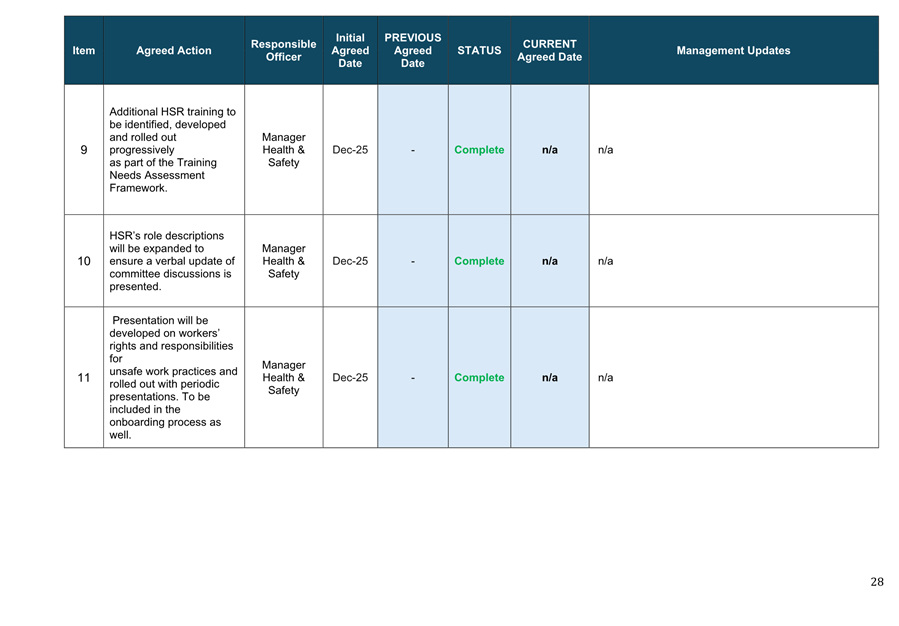
is the report that shows the status of each agreed action. As items are reported as completed or closed, they are
removed in the report.
3. NEXT STEPS
A six-monthly accountability
report will be reported to the Finance, Performance & Audit Committee.
As further reviews are
completed (as per the approved audit work programme) and reported to the
Finance, Performance & Audit Committee, their recommendations will form
part of future accountability reports presented by Internal Audit / Business
Assurance.
4. Compliance and administration
|
Does the Committee have
delegated authority to decide?
|
Yes
|
|
Are the decisions significant?
|
No
|
|
If they are significant do they
affect land or a body of water?
|
No
|
|
Can this decision only be made
through a 10 Year Plan?
|
No
|
|
Does this decision require
consultation through the Special Consultative procedure?
|
No
|
|
Is there funding in the current
Annual Plan for these actions?
|
Yes
|
|
Are the recommendations
inconsistent with any of Council’s policies or plans?
|
No
|
|
The recommendations contribute
to:
All goals.
|
|
The recommendations contribute
to this plan:
14. Mahere mana urungi,
kirirarautanga hihiri
14. Governance and Active
Citizenship Plan
|
|
Contribution to strategic direction
and to social, economic, environmental and cultural well-being
|
Business Assurance aims to
help the Council succeed by building trust and confidence in the core
controls relied on by management.
|
|
|
|
Attachments
|
1.
|
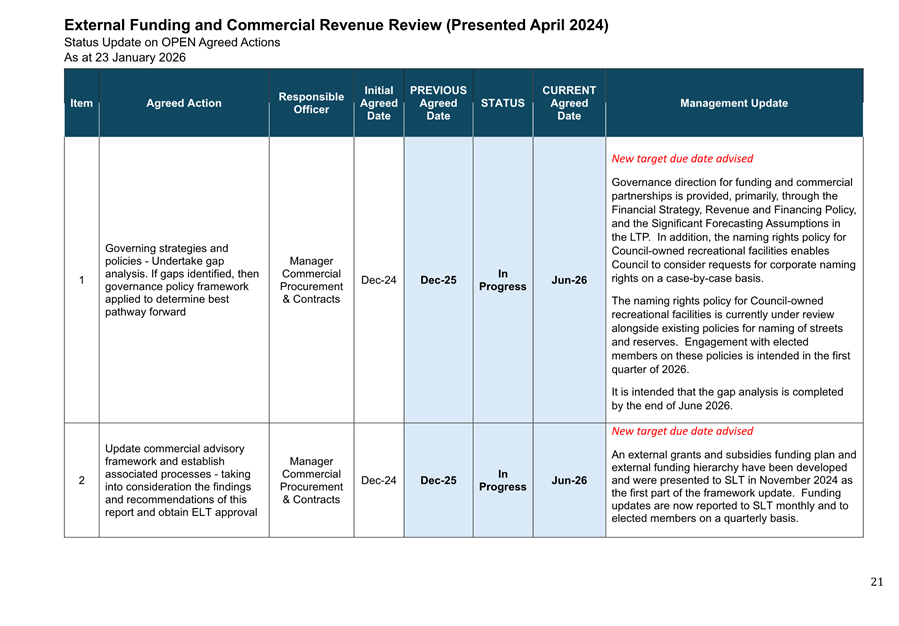
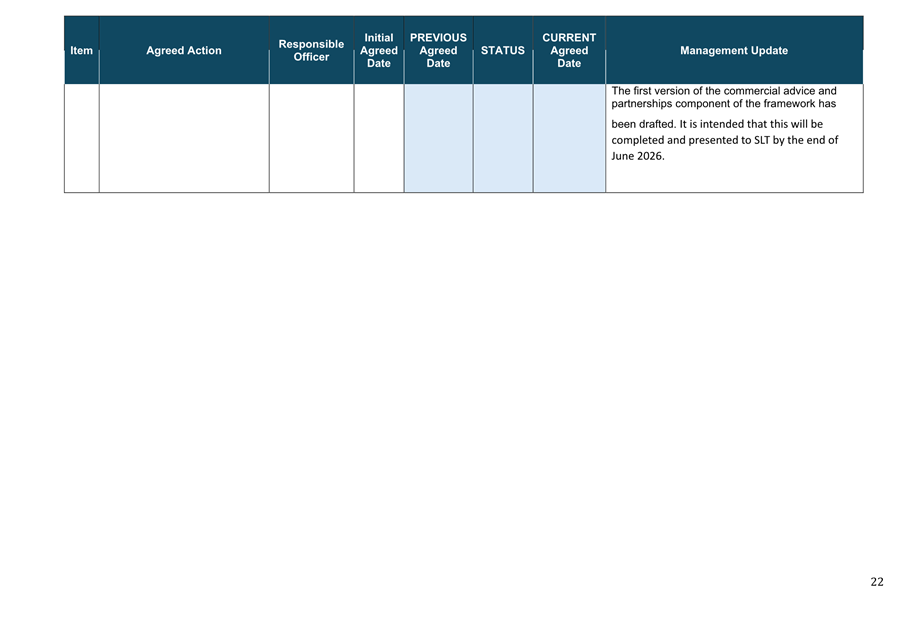
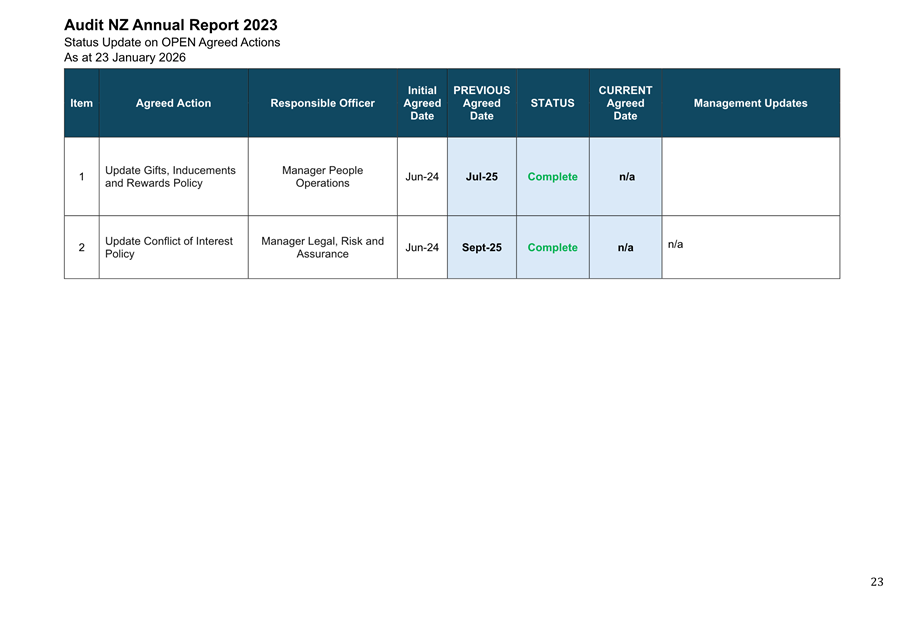
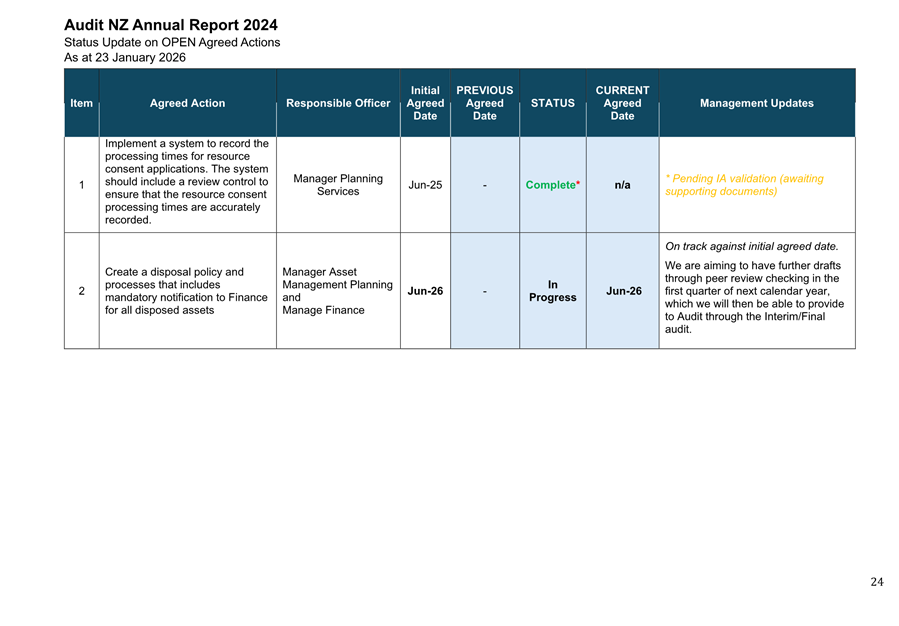
Accountability Report as at 23
January 2026 ⇩ 
|
|
Memorandum
TO: Finance,
Performance & Audit Committee
MEETING DATE: 4
March 2026
TITLE: Setting
Council's Risk Management Appetite and Tolerance Levels
Presented By: Stephen
Minton, Risk Management Advisor and Desiree Viggars, Manager Legal, Risk and
Assurance
APPROVED BY: Cameron
McKay, General Manager Corporate Services
RECOMMENDATION(S)
TO Council
1. That Council
re-confirm the risk appetite and risk tolerance levels as noted in section 4.1
and 4.2 of the memorandum titled ‘Setting Council’s Risk Management
Appetite and Tolerance Levels’ presented on 4 March 2026.
2. That Council
agree to review risk appetite and tolerance levels triennially hereafter.
1. ISSUE
1.1 The
Risk Management Framework requires the Council to adopt risk appetite and
tolerance levels. The levels describe the amount and category of risk the
Council is willing to accept to pursue its goals and the level of risk the
Council should endure without significantly affecting its ability to achieve
its objectives.
1.2 The
levels were presented to the Risk & Assurance Committee in March 2024 where
current levels were agreed with the request “That the Committee review
risk appetite and tolerance levels annually” (Clause 4-24). They were
reconfirmed by the Risk & Assurance Committee in March 2025 (Clause 9-25).
1.3 This
paper provides that opportunity and sets out Officer recommendations to
Council.
2. BACKGROUND
2.1 Effective risk management means
attempting to control, as much as possible, future outcomes by acting
proactively rather than reactively.
2.2 Council’s
Risk Management Policy outlines its policy statement and objectives along with
the roles and responsibilities of Officers. This policy is operationalised
through the Council's Risk Management Framework, a structured approach that
Council follows to identify, assess, and manage risks that could affect its
objectives or goals.
2.3 Council’s
Risk Management Framework was developed using ISO:31000 International Risk
Management standards. The Risk Policy and Framework were presented to the Risk
& Assurance Committee on 18 October 2023 for information and remains
current. Both are next due for review in quarter two 2026.
2.4 The
Risk Management Framework describes the Council's risk appetite and tolerance,
which allows Officers to manage identified risks appropriately, escalates risks
outside of the Council's tolerance levels for approval, and assists in good
decision-making.
2.5 Officers
created risk appetite and tolerance levels based on several factors, including
legislative requirements, acceptance level of tolerance, cost of compliance
with tolerance, current maturity of risk management in the organisation and
peer review where data exists.
2.6 The
risk matrix (Figure 1) determines the Council's risk ratings and should be read
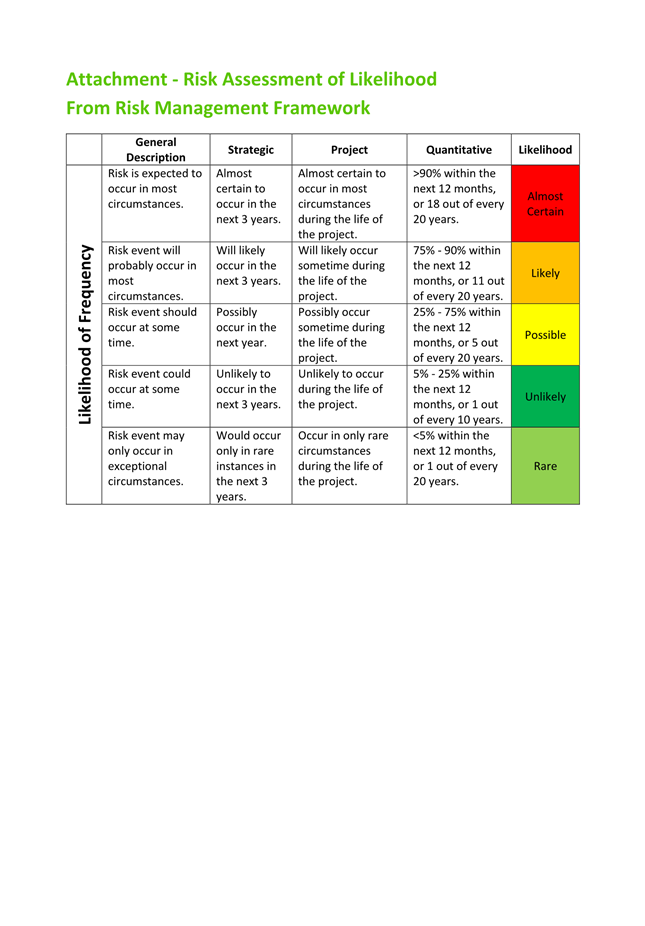
in conjunction with the likelihood and consequence tables in Attachment 2.
2.7 The
data used to determine the consequence and likelihood tables is largely subjective
and the risk ratings are therefore largely qualitative.
Figure 1: Risk Matrix
|
|
CONSEQUENCE
|
|
Minor
(1)
|
Moderate
(2)
|
Serious
(3)
|
Major
(4)
|
Severe
(5)
|
|
LIKELIHOOD
|
Almost Certain (5)
|
Medium
5
|
High
10
|
Very High
15
|
Extreme
20
|
Extreme
25
|
|
Likely (4)
|
Medium
4
|
High
8
|
Very High
12
|
Very High
16
|
Extreme
20
|
|
Possible (3)
|
Low
3
|
Medium
6
|
High
9
|
Very High
12
|
Very High
15
|
|
Unlikely (2)
|
Low
2
|
Medium
4
|
Medium
6
|
High
8
|
High
10
|
|
Rare (1)
|
Low
1
|
Low
2
|
Low
3
|
Medium
4
|
Medium
5
|
2.8 The
Council uses a five-scale risk matrix, relatively common across organisations,
which provides more insight into levels of severity. Apart from those risk
categories that are rated at the absolute lowest levels of our tolerance (e.g.
health and safety harm to our people), most tolerance levels for organisations
will be slightly higher than the absolute minimum given this five-scale
graduality. Because of this increased granularity, and in the sphere of
subjective assessments, most risk appetite and tolerance levels are relatively
conservative.
2.9 The
Risk Management Framework defines risk appetite as the amount of risk the
Council is willing to accept or retain, on a broad level, in order to achieve
its objectives/goals.
It also defines risk tolerance as the level of risk-taking
acceptable to achieve a specific objective or manage a category of risk.
The difference between the two is that risk appetite is a
broad-based description of the desired level of risk that Council will take in
pursuit of its goals, whereas risk tolerance reflects the acceptable variation
in outcomes related to specific measures linked to objectives the Council seeks
to achieve.
Also, risk tolerance will not always be seen as a hard
line; there may be circumstances where an appropriately authorised, informed
decision with the conscious knowledge that tolerance may be exceeded will be
made.
2.10 The Risk
Management Framework categorises risk appetite into three broad bands:
averse, neutral, and seeking. These are defined below.
|
Averse:
|
Avoidance of
risk must be the priority, with minimal risk exposure and maximum treatment
effort required.
Any
uncertainty or risk that remains after treatment efforts (controls and/or
mitigation) should only be allowable where necessary to achieve goals.
|
|
Neutral:
|
Risk exposure
is not preferred but is recognised as part of achieving objectives.
Treatments to
minimise risks and uncertainties are expected to be in place where reasonably
considered necessary.
|
|
Seeking:
|
The
organisation is actively seeking to take on more of this risk/uncertainty as
it relates to and enhances the achievement of goals.
|
3. Peer
data
3.1 Information
has been obtained on the risk tolerance settings of other New Zealand councils.
Direct comparison across all areas is a challenge for a number of reasons,
including 1) different definitions of the risk category, 2) different
consequence and likelihood settings, 3) different risk matrix settings (e.g.
4X4 verse our 5X5), 4) different external context in some risk categories for
some councils, and 5) interchange use of tolerance and appetite descriptions.
3.2 Comparing
Palmerston North City Council’s appetite settings shows, with
extrapolation across risk category descriptions, that they are broadly in line
with the settings of other councils. The category with the greatest correlation
is health and safety, and there are no categories that are seen as obviously
out of alignment with other councils. There are a few examples where other
councils on certain risk categories are pushing their appetite towards the
neutral/seeking phases. For example, one council has a risk appetite for people
and capability of ‘Open’, which maps to Palmerston North City
Council’s rating of 6 to 7 (refer section 4.1 below)
4. Setting
Council’s risk appetite and tolerance levels
4.1 Officers
recommend maintaining the risk appetite for Council at the existing settings.
This, outlined below, broadly follows other councils and general expectations
of a publicly funded local government entity; that is, tending to the conservative/aversion
side of the matrix.
|
Risk Category
|
Risk
Appetite
|
|
Averse
|
Neutral
|
Seeking
|
|
1
|
2
|
3
|
4
|
5
|
6
|
7
|
8
|
9
|
|
Financial
|
|
|
|
|
|
|
|
|
|
|
Legal/Compliance
|
|
|
|
|
|
|
|
|
|
|
Environmental
|
|
|
|
|
|
|
|
|
|
|
Health, Safety & Wellbeing
|
|
|
|
|
|
|
|
|
|
|
Reputational
|
|
|
|
|
|
|
|
|
|
|
Service Delivery
|
|
|
|
|
|
|
|
|
|
|
Performance and Capability
|
|
|
|
|
|
|
|
|
|
|
Cultural
|
|
|
|
|
|
|
|
|
|
|
Strategic
|
|
|
|
|
|
|
|
|
|
For
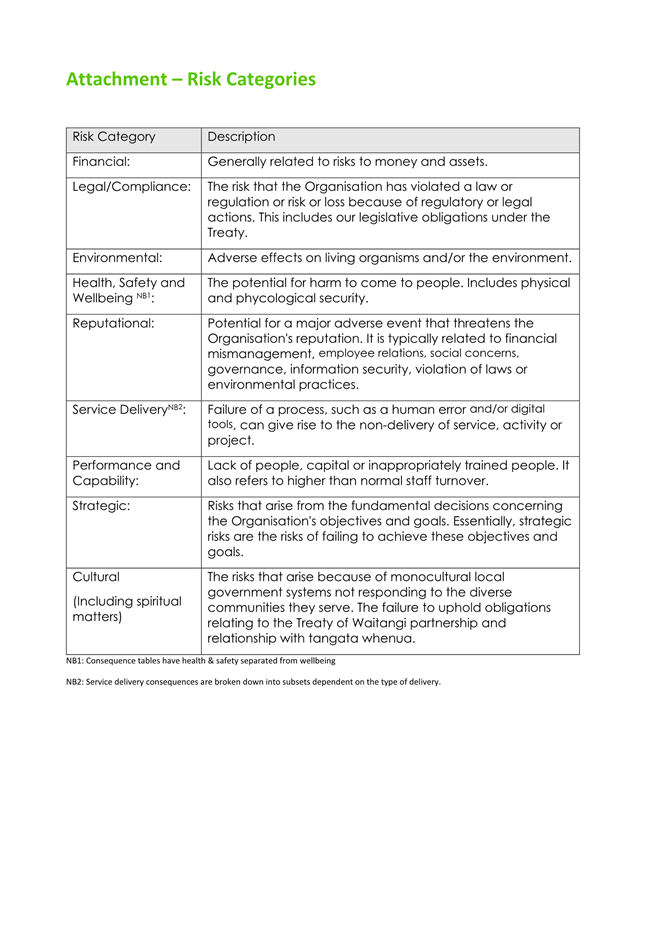
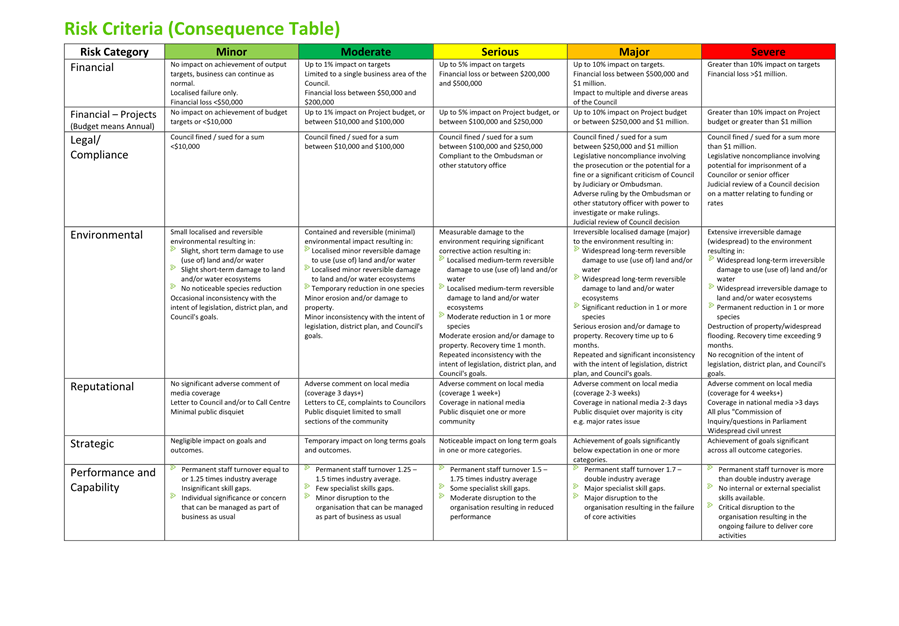
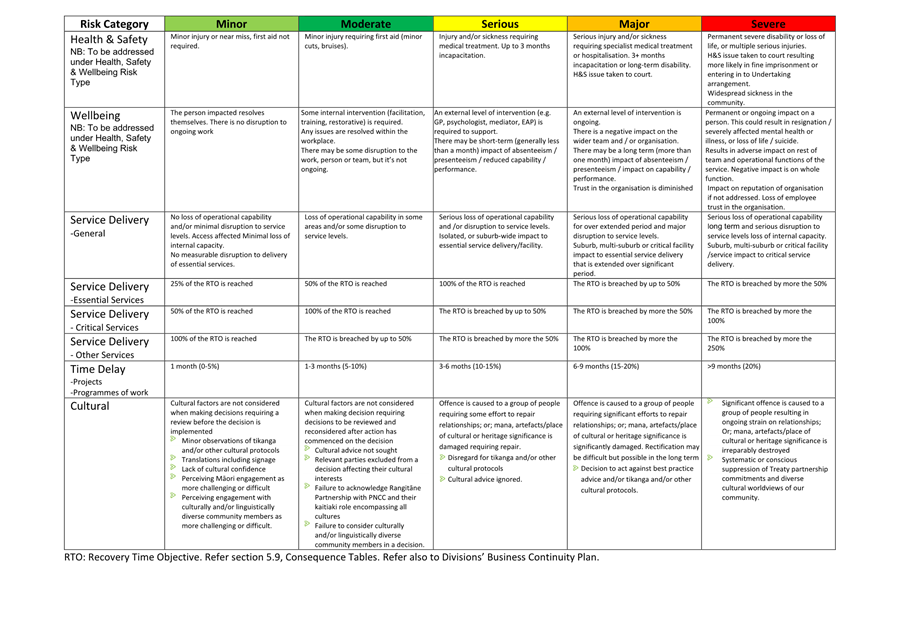
risk category descriptions, refer to Attachment 1 to this memorandum.
4.2 Setting
Council’s Risk Tolerance
Officers recommend maintaining the risk
tolerance for the Council at the current levels. The risk matrix should be
referenced while reviewing the risk tolerance levels. This risk matrix will help guide users to the level of
likelihood and relevant consequences acceptable to Council.
|
Risk Category
|
Risk
Tolerance
|
|
Financial
|
Medium
|
|
Legal/Compliance
|
Medium
|
|
Environmental
|
Medium
|
|
Health, Safety & Wellbeing
|
Low
|
|
Reputational
|
Medium
|
|
Service Delivery
|
Medium
|
|
Performance and Capability
|
Medium
|
|
Cultural
|
Medium
|
|
Strategic
|
Medium
|
(The
terminology of risk tolerance maps to the risk rating (low, medium, high,
etc.).
4.3 Ultimately,
risk tolerance, versus risk appetite, is the final determinant on the amount of
risk the Council is prepared to take, setting the line to which it endeavours
not to cross.
4.4 The
tolerance levels determine in part the degree of mitigation required to
maintain risk within these levels, generally involving increasing or decreasing
costs and/or consequences depending on the level set. For example, if a risk
category had an extremely high appetite and tolerance, there may be zero cost
to implement controls and mitigation, albeit with increasing levels of costly
events occurring.
4.5 The
Risk Management Framework requires escalation of risk tolerance breaches to an
appropriate Officer level for acceptance and remedial actions/management. This
involves explaining the current state and proposed actions to reduce the risk
through new and/or improved controls and mitigation, or in a worst-case
scenario, ceasing the activity if the risk is considered unacceptable.
4.6 Implications
on risk appetite and risk tolerance if different to recommendations:
|
Risk Category
|
Implications
|
|
Increased Appetite & Tolerance
|
Decreased Appetite & Tolerance
|
|
Financial
|
· Increased
potential financial losses
· Reduced
costs (through non-delivery of services/activities and reduced mitigation
costs)
· Increased
legal disputes
· Increased
public disquiet
· Greater
occurrences of project costs blowouts
· Greater
opportunities for fraud (internal & external)
|
· Increased
financial costs through control/mitigation implementation
· Reduced financial losses, albeit at
cost of implementation of controls
· Requirement for higher buffers/contingencies
to mitigate unforeseen events
· Increased insurance requirements
and resultant premium costs
· Slower delivery of outcomes due to
burdensome processes and procedures
|
|
Legal/ Compliance
|
· Increased
defensive litigation
· Increased
legal defence costs
· Appointment
of a commissioner
· Judicial
or Ombudsman adverse rulings
· Increased
legal fines and adverse litigious outcomes
|
· Increased
legal advice costs
· Increased internal legal resource
costs
· Increased cost through transfer of
legal risk
|
|
Environmental
|
· Increased
measurable, reversible damage to the environment
· Breaches
of environmental protection legislation and regulations
· Potential
public discourse at environmental inaction and/or damage
· Higher
recovery costs
|
· Decreased measurable, reversible
damage to the environment
· Higher mitigation/compliance costs
· Perceived
imbalance from the public of costs versus environmental protections
· More opportunities for realising
co-benefits
· Restrictive growth opportunities
|
|
Health, Safety and Wellbeing
|
· Causing
death or serious injury to our people
· Increased
incidence of health & safety events
· Breaches
of Health & Safety at Work Act 2015, and potentially prosecution
· Increased
absenteeism, and resultant decreased productivity
|
· Not applicable (already lowest
level)
|
|
Reputational
|
· Increased
public disquiet across the city
· Ineffective
community engagement
· Increasing
loss of public trust
|
· Additional resource and increased
engagement requirements
· Increased costs for community
well-being and activity delivery to meet broader level of satisfaction
· Increased costs to meet goals
· Increasing conflicts between
priorities
|
|
Service Delivery
|
· Reduced
activities provision
· Provision
of services not meeting community expectations and low customer satisfaction
· More
regular suspension of activities and services
|
· Significant increase in costs to
meet greater service delivery goals
· Potential stifling of innovation,
including productivity gains
|
|
Performance and Capability
|
· Higher
turnover rates
· Continuous
loss of corporate knowledge
· Reduced
technical expertise
· Not
seen as an employer of choice, actual or perceived
|
· Increased remuneration costs
· Increased costs for benefits and
wellbeing provisions
|
|
Cultural (including spiritual matters)
|
· Causing
cultural/spiritual offence
· Undermine
relationships with Maori and cultural/ethnic representatives/groups
· Not
fulfil fully our Treaty commitments and obligations
|
· Increased operational costs of
control/mitigation for avoidance
· Increased advisor resourcing within
Maori Advisory, Community Development or consultancy costs
· Strengthened cultural resilience
and resultant costs, including cultural events, engagement, etc.
· Increasing conflict in priorities
across segments of the community
|
|
|

|

|
|
|
|
|
4.7 Risk
appetite and tolerance levels would not be expected to change in any material
way over time. Circumstances that may give rise to adjustments are significant
systemic changes to the strategic direction, regulatory or legislative changes,
changes in expectations of the community, major adverse events triggering
reassessment or change on governance body (Elected Members).
In short, risk appetite and tolerance should be reviewed
whenever the organisation’s context, capability, or strategic objectives
change in a way that affects its ability or willingness to take on risk.
Accordingly, it is proposed that levels are reviewed and
reconfirmed on a triennial basis.
5. NEXT STEPS
5.1 Officers
will continue to embed risk management in Council processes.
5.2 Risk
appetite and tolerance will be presented to the Finance, Performance &
Audit Committee on a triennial basis.
5.3 Officers
will continue to report on strategic risks to the Finance, Performance &
Audit Committee.
6. Compliance and administration
|
Does the
Committee have delegated authority to decide?
|
No
|
|
Are the
decisions significant?
|
No
|
|
If they are
significant do they affect land or a body of water?
|
No
|
|
Can this
decision only be made through a 10 Year Plan?
|
No
|
|
Does this
decision require consultation through the Special Consultative procedure?
|
No
|
|
Is there
funding in the current Annual Plan for these objectives?
|
Yes
|
|
Are the recommendations
inconsistent with any of Council’s policies or plans?
|
No
|
|
The recommendations contribute to:
Whāinga 3: He hapori
tūhonohono, he hapori haumaru
Goal 3: A connected and safe community
|
|
The recommendations contribute
to this plan:
14. Mahere mana urungi,
kirirarautanga hihiri
14.
Governance and Active Citizenship Plan
The objective
is: Oversee Council operations and communicate outcomes and decisions to our
communities.
|
|
Contribution to strategic
direction and to social, economic, environmental and cultural well-being
|
The risk management system is
one of the aspects that assists in ensuring Council can fulfil the tasks
required to achieve its purpose and objectives. These objectives will cover
all aspects of the organisation, including strategy, tactics, operations and
compliance. The risk appetite and risk tolerance guide the parameters within
which to operate.
|
|
|
|
Attachments
|
1.
|
Risk Categories ⇩ 
|
|
|
2.
|
Risk Consequence and Likelihood
Tables ⇩ 
|
|
Memorandum
TO: Finance,
Performance & Audit Committee
MEETING DATE: 4
March 2026
TITLE: Health
and Safety Report, 1 July to 30 September 2025 (Quarter 1)
PRESENTED BY: Selwyn
Ponga-Davis, Health and Safety Manager
APPROVED BY: Sarah
Morris, General Manager People & Capability
RECOMMENDATION(S)
TO Finance, Performance &
Audit Committee
1. That the Committee
receive the memorandum titled ‘Health and Safety Report, 1 July to 30
September 2025 (Quarter 1)’ presented on 4 March 2026.
1. EXECUTIVE SUMMARY
1.1 Monthly
incidents rose from 162 in Quarter 4 (April to June) to 180 in Quarter 1 (July
to September). Frontline Working (CR1) remains the highest risk category
across both quarters, accounting for 45-46% of incidents. Peaking in September,
greater awareness and reporting had increased but highlighted the need for
ongoing mitigation efforts (enhanced security, kaimahi training, process
changes).
1.2 Notable
events over Quarter 1 period:
· Frontline
awareness and situational training delivered to Central Energy Trust Wildbase Recovery (July).
· 3 Steps for Life
training opportunity (August). Introduced our kaimahi to life saving skills for
people in cardiac arrest.
· Investigation
training for a select group of Health & Safety Representatives.
· SiteWise
(prequalification system that grades health and safety capability and publishes
that information in a database) and Duress Alarm training for kaimahi involved
in frontline working.
1.3 Current
activities:
· Safety
Management Framework progressing to SLT during the second half of 2025; Health
& Safety Reporting platform transition to ServiceNow is underway for
improved data capture and insights.
· Management
consideration on the operating hours or ways of working for the external I-site
toilets (rough sleepers and alleged drug misuse); the Lone Worker program of
work tied in with that risk exposure.
· Frontline
Working risk mitigation also included induction/training on trespass procedures
and engagement of security contractors for mobile patrols (City Library,
I-site, Youth Space).
1.4 Next
priorities
· Upon the
recruitment of a Security Advisor (early 2026) the opportunity to seek safety
design improvements in static features will be considered.
· Develop
role against Government guidelines, Protective Security Requirements and
Crowded Places Strategy.
2. HEALTH AND SAFETY REPORT
2.1 This
report includes year on year comparative data, as well as Quarter 1 2025
standalone data. Hazards – anything that can cause harm (this
includes a person’s behaviour); Incidents – any unplanned
event/occurrence resulting or having the potential for an injury, ill-health,
damage or other loss; incidents that almost cause an injury or fatality,
ill-health, damage or other loss are labelled as Near Misses. Some
incidents can also be notifiable.
A. Hazards,
Incidents and Near Misses Reported
Table 1: Hazards, Incidents and Near Misses
|
Quarter
|
Sep-24
|
Dec-24
|
Mar-25
|
Jun-25
|
Sep-25
|
|
PNCC
|
CON
|
PNCC
|
CON
|
PNCC
|
CON
|
PNCC
|
CON
|
PNCC
|
CON
|
|
Hazards[1]
|
57
|
0
|
73
|
7
|
69
|
7
|
94
|
1
|
66
|
2
|
|
Incidents[2]
|
78
|
9
|
108
|
6
|
97
|
9
|
156
|
6
|
166
|
14
|
|
Near Misses
|
16
|
2
|
17
|
1
|
16
|
2
|
33
|
2
|
20
|
3
|
Key: PNCC = Staff /
Kaimahi; CON = Contractor
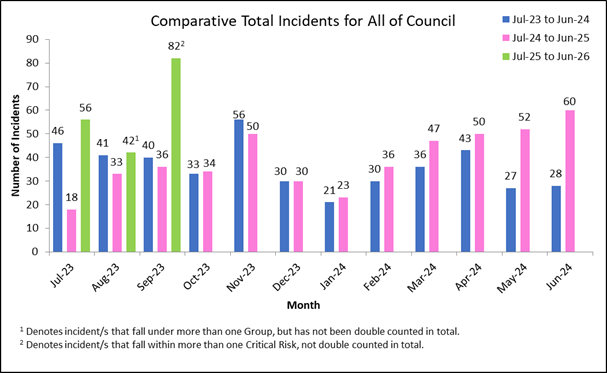
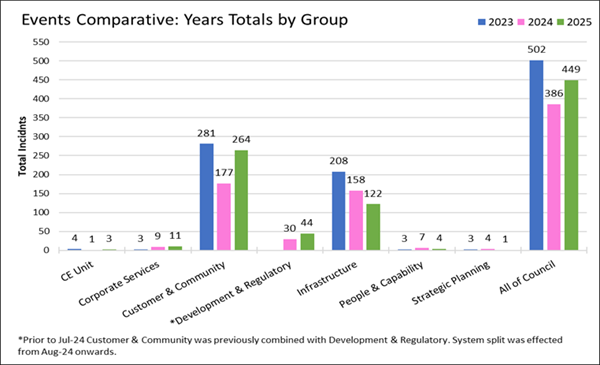
· The Total Incidents
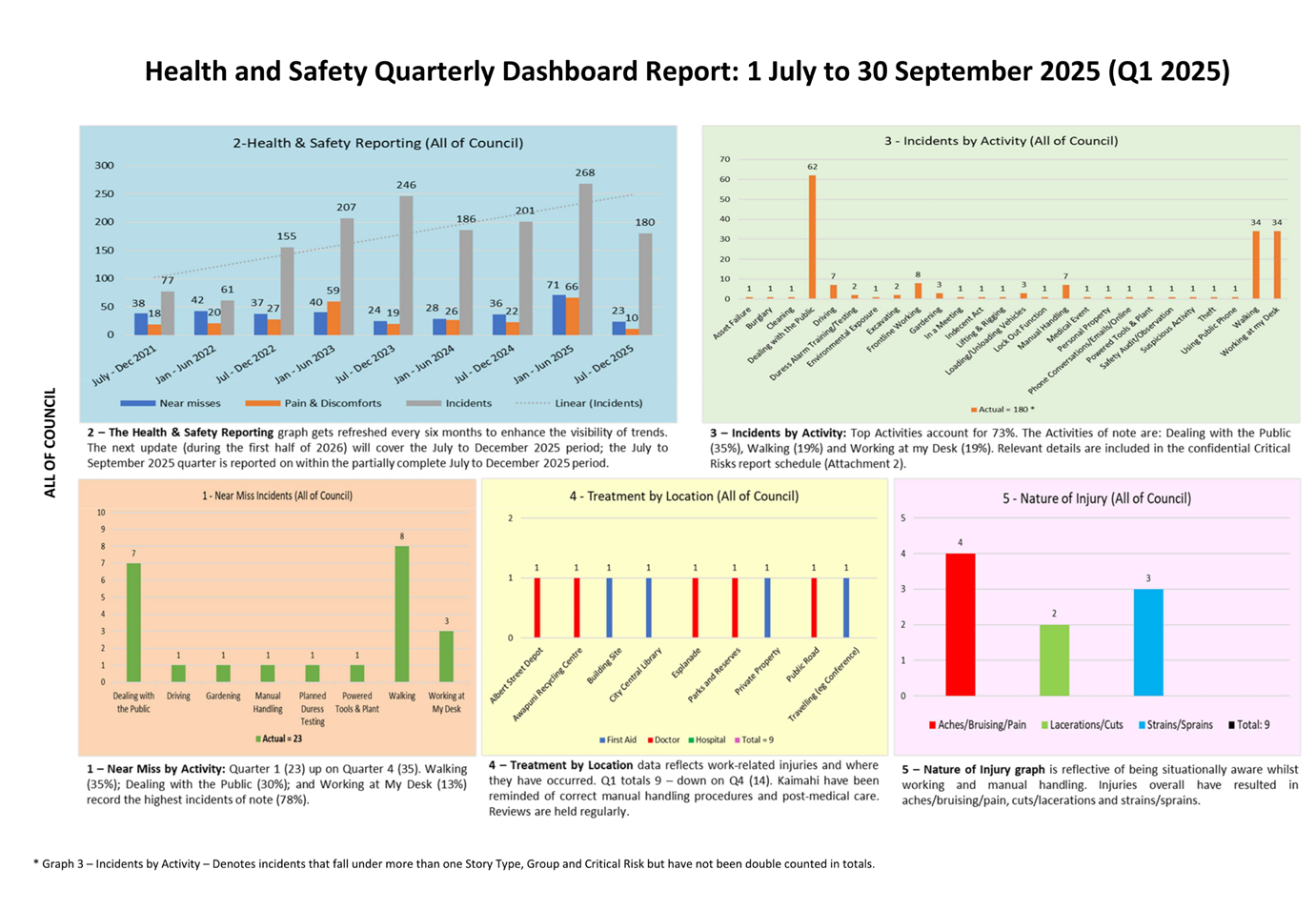
(12 Months) are reflected in the below graphs by month and business group.
 Graph 1
 Graph 2
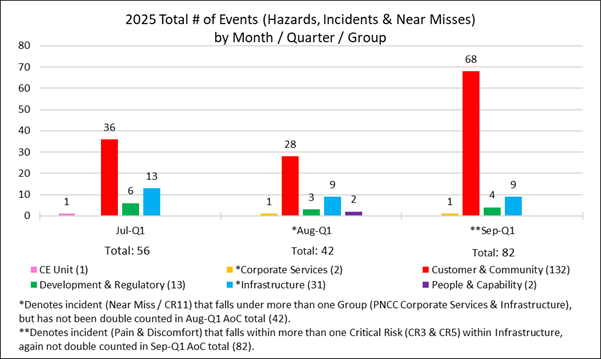
· The
number of incidents by month/quarter and group are graphed below –
provides visibility on the events reported during Quarter 1 2025, categorised by
business group.
Graph 3
2.2 Comments
· Frontline
Working (Critical Risk 1) focus still dominates, indicating persistent
exposure in operational areas. Attributed to verbal abuse, suspicious activity
and aggressive individuals – particularly in public facing roles.
o The September 2025 spike,
particularly in Frontline Working, can be attributed to increased incidents and
improved incident reporting mechanisms and audits.
· Hazards and
Incidents – during the 1 July to 30 September 2025 period the
following risks were identified and addressed.
o Frontline Working (Critical Risk
1)
§ Aggressive
and threatening behaviour towards kaimahi (cleaners, parking officers,
gardeners) and trespass breaches.
Corrective Action:
De-escalation training, lockdowns, Police involvement.
§ Emergency
door lock button repeatedly triggered accidentally within Front of House.
Corrective Action: Flip
cover installed.
§ Underage
alcohol offered to minors near Youth Space.
Corrective Action: Safe
transport arranged for minors with guardians.
§ Hazardous
substance inhalation and public defacement by members of the public.
Corrective Action: Police
notified; offensive material removed.
§ Wheelie
bin arson attempts.
Corrective Action: Secure
Parks and Reserves storage implemented.
§ Indecent
Acts witnessed by kaimahi.
Corrective Action: Police
apprehended offender; security patrols increased.
§ Aggression
by homeless individuals near I-Site/Square.
Corrective Action:
Considering environmental design changes to discourage sleeping.
o Work Environment (Critical Risk
2)
§ Congestion
and welding hazards at Albert Street Depot.
Corrective Action:
Signage and shields erected; tidied and improved storage.
o Driving (Critical Risk 7)
§ Forklift
near-miss with contractor.
Corrective Action:
Awareness raised; responsibility acknowledged.
o Hazardous Substances (Critical
Risk 10)
§ Asbestos
dust risk during pipe cutting.
Corrective Action:
Standard Operating Procedure (SOP) review required.
o Powered Tools and Plant (Critical
Risk 11)
§ Lock
Out/Tag Out non-compliance.
Corrective Action:
Re-inductions, signage upgrades, retraining.
§ Concrete
saw misuse (no water, worn blade).
Corrective Action:
Reinforce SOP adherence.
§ Cremator
door seal damage from oversized cremation flames.
Corrective Action: Seal
replaced; PPE and extinguishers available.
· Overall
risk management actions were taken for all incidents. Further emphasis on SOP
compliance, training, and environmental design changes were recommended to
reduce recurrence.
B. Critical
Risks
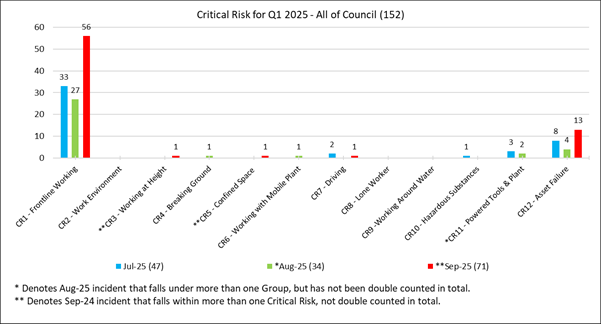
· Critical Risk 1
– Frontline Working – remains the top risk category still with
116 events making up for the 152 total Critical Risk events reported. 42 Police
notifications and 9 Trespass notices were issued in Quarter 1, an increase of
14 notifications on the previous quarter (Quarter 4 - 37).
· 35
events involved frontline worker Verbal Altercation (VA) and/or Physical Danger
(PD).
Graph 4
· For
more information on the individual events please refer to the confidential
Critical Risks report (Attachment 2).
C. Investigations
2.3 During
1 July to 30 September (Q1) 2025 PN City Council classified nil incidents as
‘notifiable’. WorkSafe investigation information remains on the
report for 12 months or until actions are completed.
Table 2: Investigations
|
Investigations
occurred this quarter
|
0
|
|
Previous
investigations (last 12 months)
|
|
Number of
remedial actions required
|
0
|
|
Number of
remedial actions completed
|
0
|
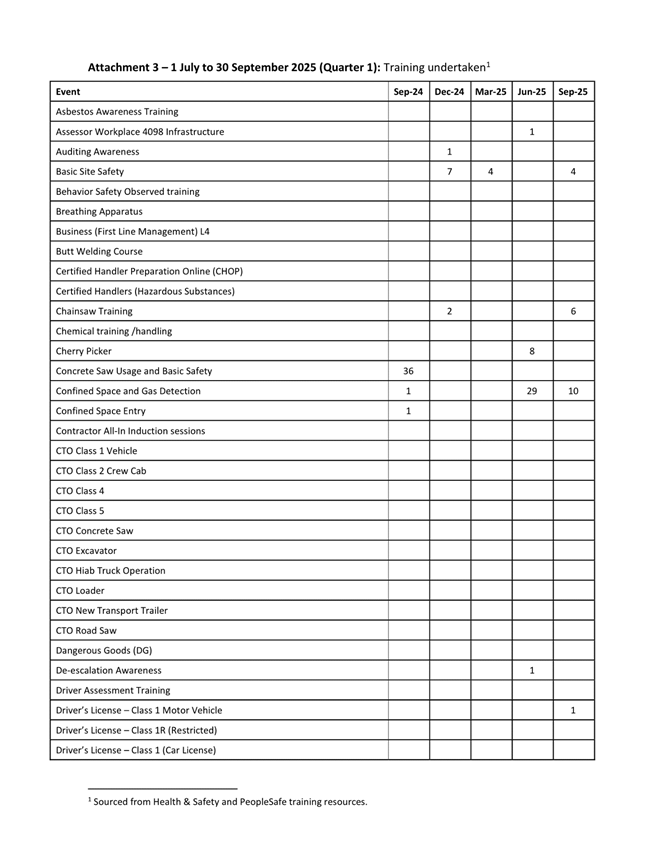
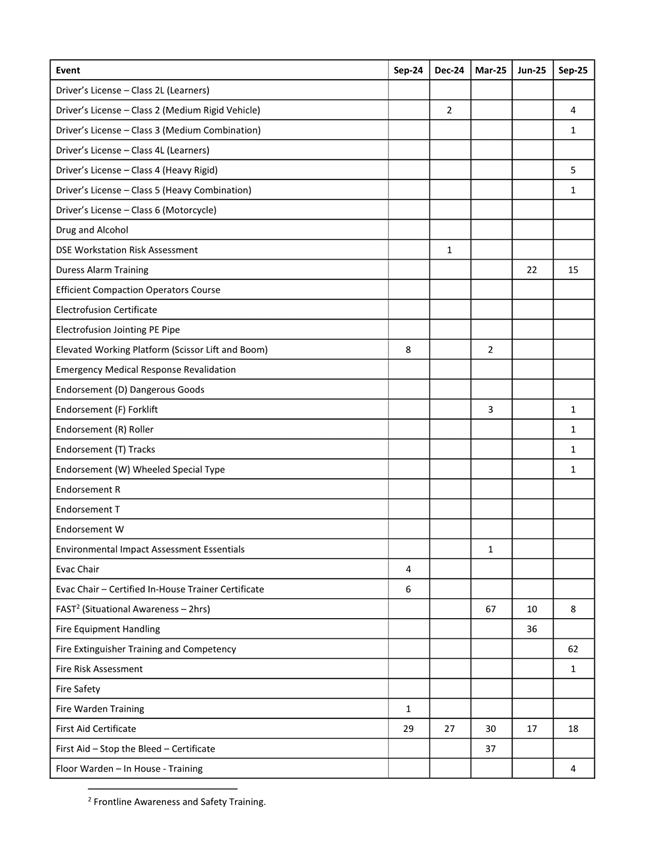
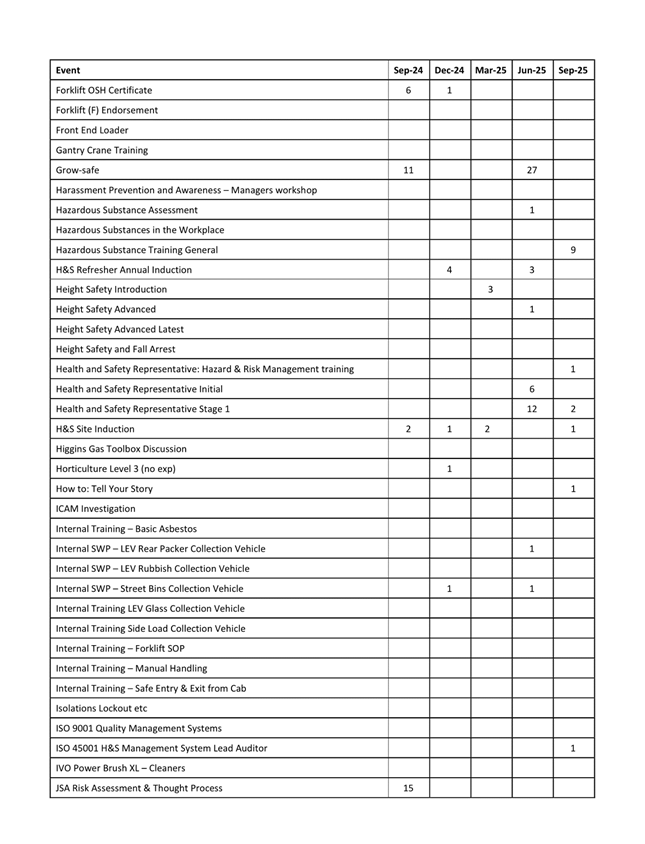
D. Training
2.4 Group performances during
Quarter 1 reflect fluctuations that can be attributed to seasonal or cyclic
factors, such as training lapses occurring at differing times of the year.
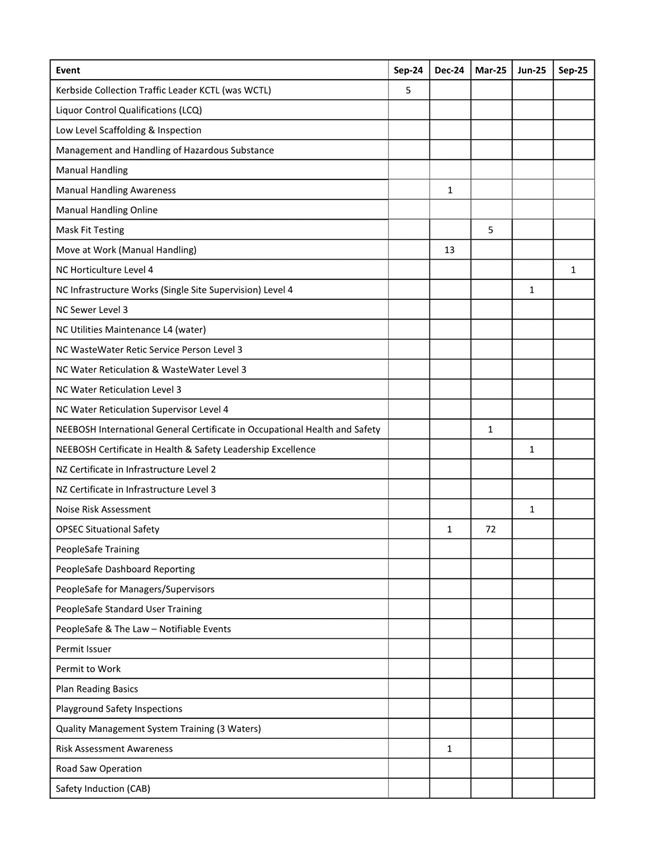
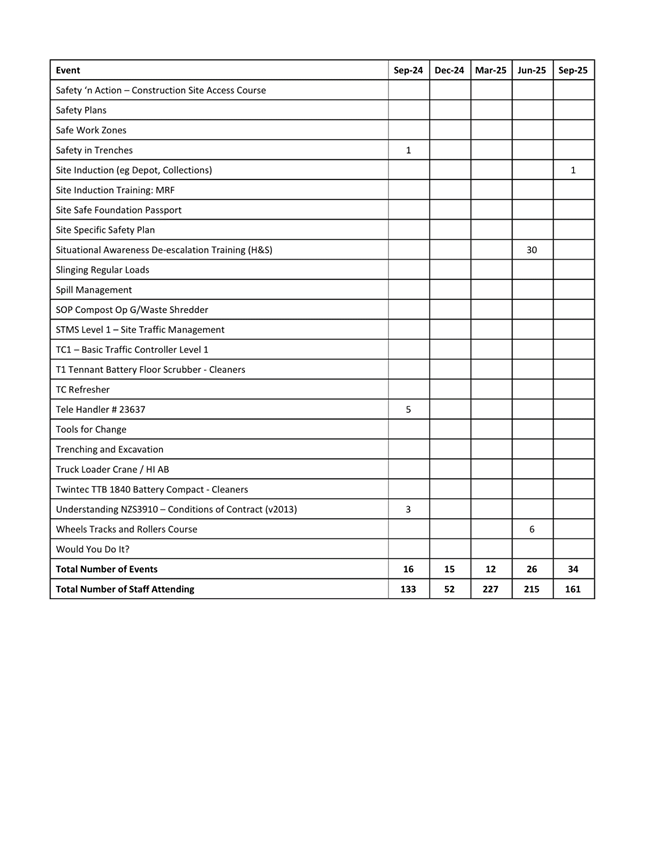
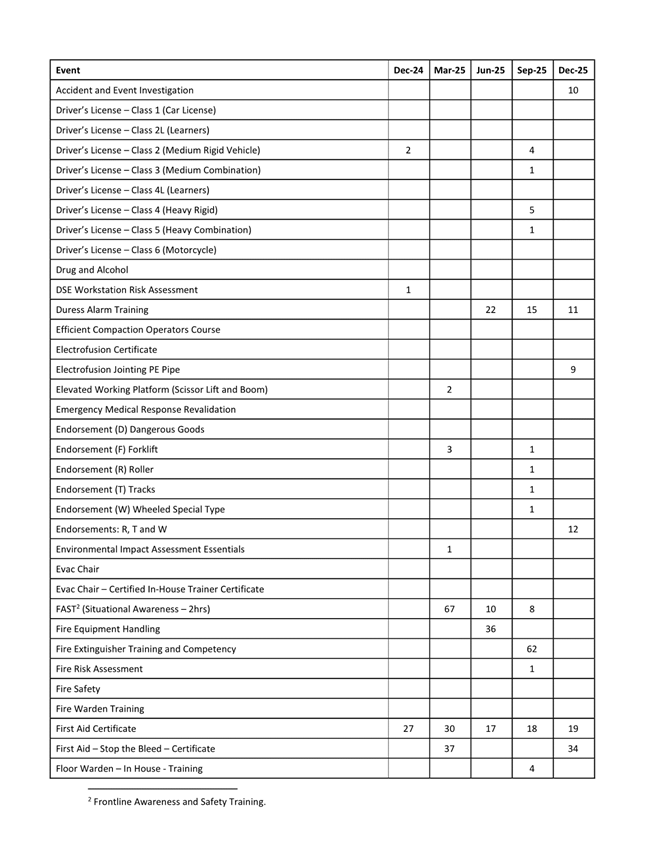
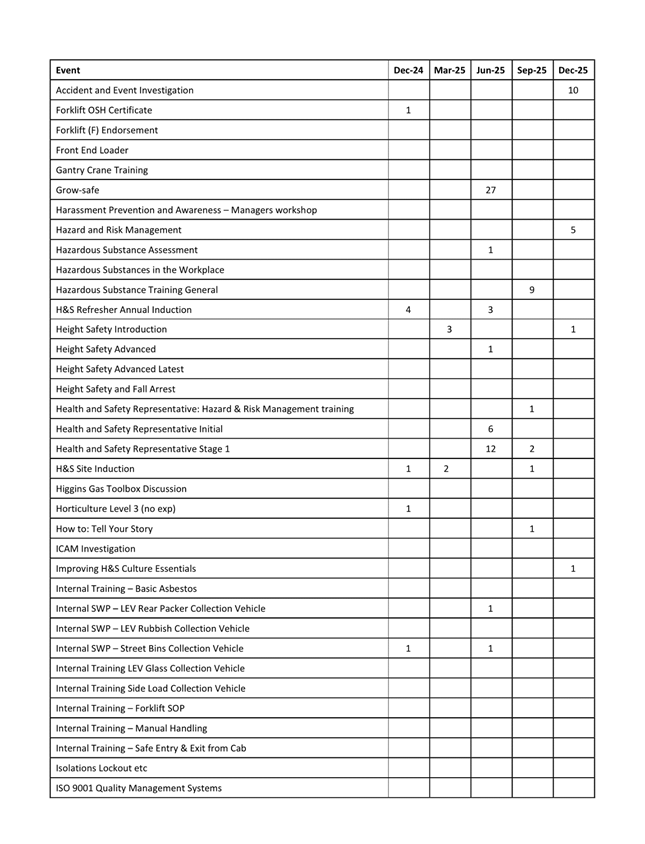
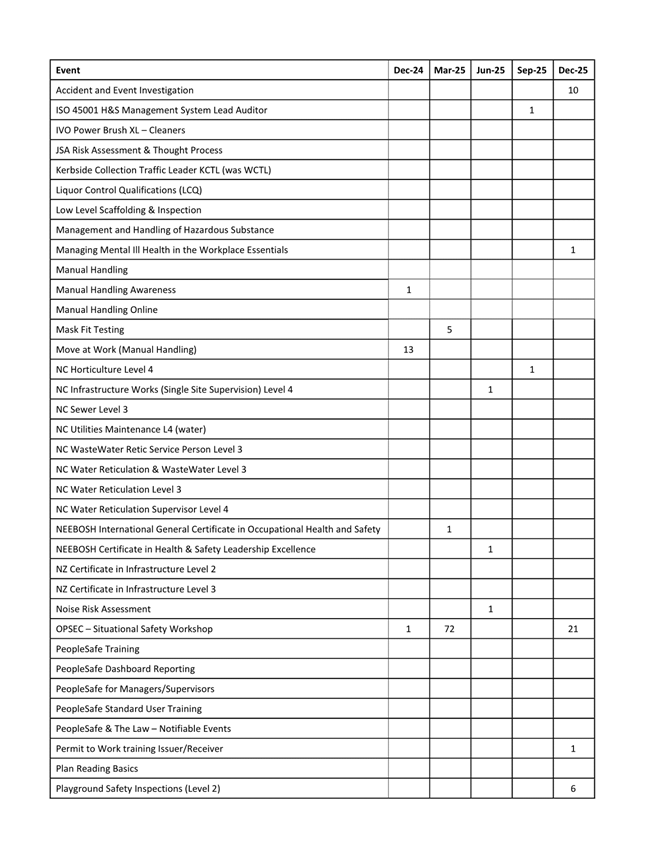
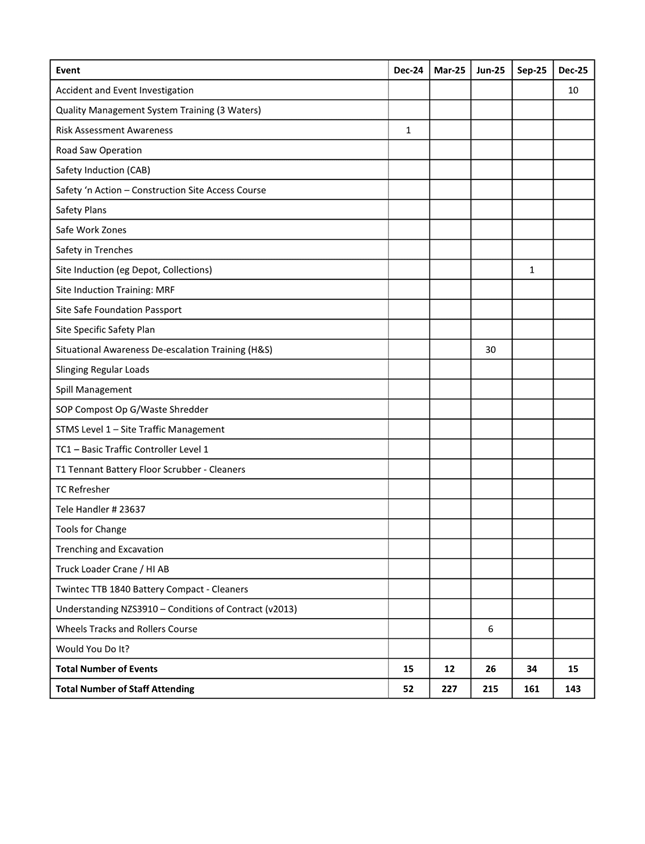
For more expansive information on training for Quarter 1, please refer to the Training
Update schedule (Attachment 3) appended separately.
· Training Course/s delivered Internally – Quarter 1 #
of Courses: 13
o Duress Alarm – frontline
working kaimahi (includes Contact Centre, Front of House, Council Chambers,
Wildbase, Building Services, etc).
o Hazardous Substances Training
General – job specific refresh for Cleaners.
o Chainsaw Basic Handling and Safety
training.
o Site Safety and Health & Safety
Inductions.
o Floor/Fire Warden Training –
Concentrated within the CAB.
o Situational Awareness &
De-escalation Training – addressing frontline working kaimahi across the
wider organisation.
o PeopleSafe: How to Tell Your Story
training.
· Training
Course/s delivered Externally – Quarter 1 #
of Courses: 21
o Confined Space and Gas Detection
renewals.
o Driver’s Licence/Endorsements
renewals.
o Fire Extinguisher Training and
Competency.
o First Aid.
o Health & Safety Representative:
Stage 1 training; Hazard and Risk Management training.
o Fire Risk Assessment refreshers.
o Health & Safety Management Lead
Auditor specific training.
o National Certificate in
Horticulture, Level 4.
Table 3: Training
|
Date
/ Quarter
|
Dec-24
|
Mar-25
|
Jun-25
|
Sep-25
|
|
Number
of Courses
|
15
|
12
|
26
|
34
|
|
Staff
/ Kaimahi attending
|
52
|
227
|
215
|
161
|
3. Compliance and administration
|
Does the Committee have
delegated authority to decide?
|
Yes
|
|
Are the decisions significant?
|
No
|
|
If they are significant do they
affect land or a body of water?
|
No
|
|
Can this decision only be made
through a 10 Year Plan?
|
No
|
|
Does this decision require
consultation through the Special Consultative procedure?
|
No
|
|
Is there funding in the current
Annual Plan for these objectives?
|
No
|
|
Are the recommendations
inconsistent with any of Council’s policies or plans?
|
No
|
|
The recommendations contribute
to:
Whāinga 3: He hapori tūhonohono, he hapori
haumaru
Goal 3: A connected and safe community
|
|
The recommendations contribute to this
plan:
9. Mahere haumaru hapori,
hauora hapori
9. Community Safety and
Health Plan
|
|
Contribution to strategic
direction and to social, economic, environmental and cultural well-being
|
Providing
information to Council about the ongoing progress towards the good performance
of the organisation regarding health and safety.
|
|
|
|
Attachments
|
1.
|
Health & Safety Dashboard
report, Q1 2025 ⇩
|
|
|
2.
|
Health & Safety Critical
Risks report, Q1 2025 - Confidential
|
|
|
3.
|
Training Update for Q1 2025 ⇩
|
|
Memorandum
TO: Finance,
Performance & Audit Committee
MEETING DATE: 4
March 2026
TITLE: Health
and Safety Report, 1 October to 31 December 2025 (Quarter 2)
PRESENTED BY: Selwyn
Ponga-Davis, Health and Safety Manager
APPROVED BY: Sarah
Morris, General Manager People & Capability
RECOMMENDATION(S)
TO Finance, Performance &
Audit Committee
1. That the Committee
receive the memorandum titled ‘Health and Safety Report, 1 October to 31
December 2025 (Quarter 2)’ presented to the Finance, Performance and
Audit Committee on 4 March 2026.
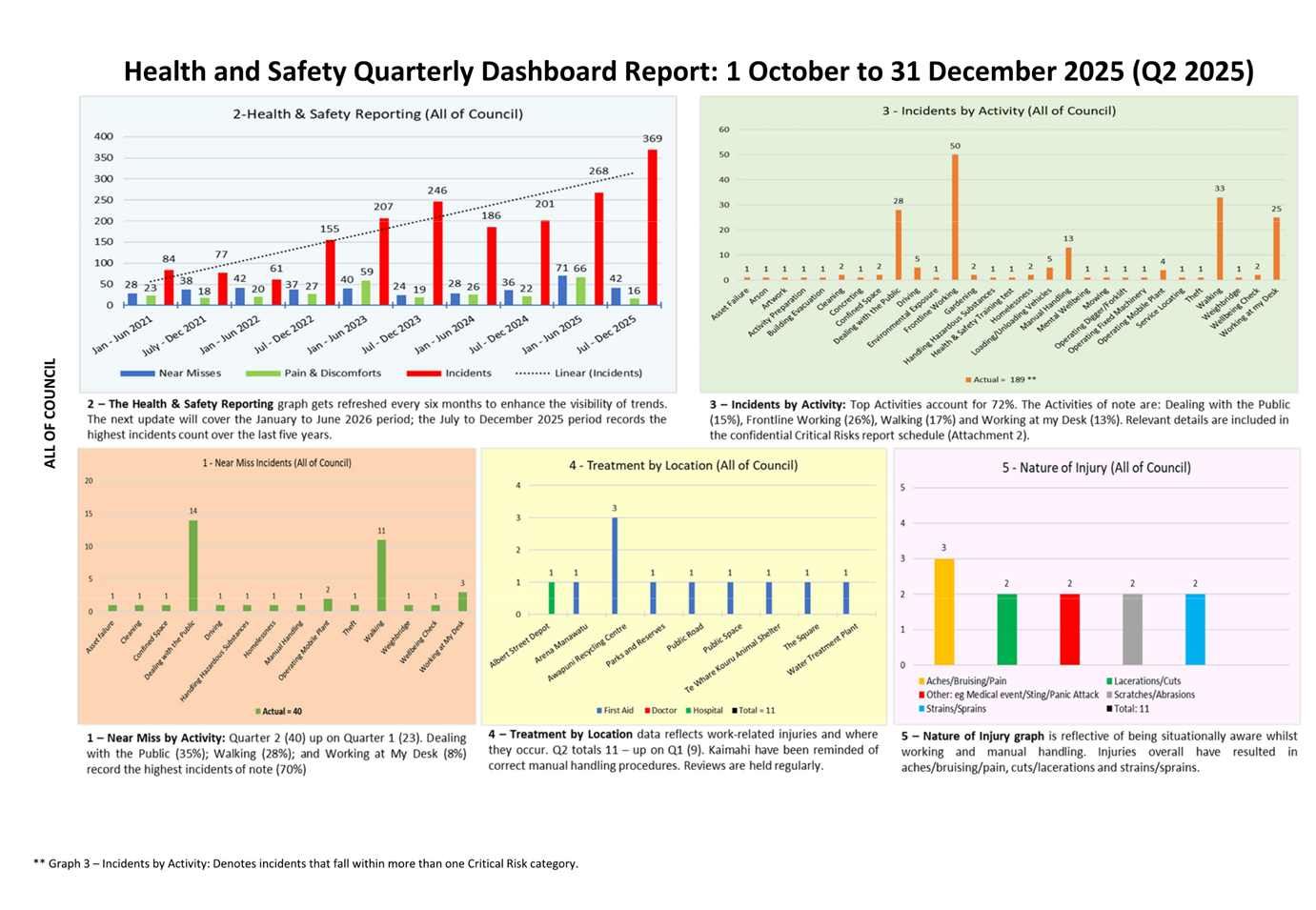
1. EXECUTIVE SUMMARY
1.1 Monthly
incidents rose slightly from 180 in Quarter 1 (July to September 2025) to 189
in Quarter 2 (October to December 2025).
· Following
September’s spike in Q1 incident trends stabilised across the Q2 period
and the organisation continued to demonstrate a strong and improving reporting
culture, particularly in high-risk customer-facing environments such as our
libraries. Frontline Working (Critical Risk 1) remains the primary
exposure area with no new major risks emerging.
· The
organisation ended 2025 in a stable critical risk position, with a stronger
reporting culture and progress across key security, systems and safety priorities.
Work completed during the quarter establishes a strong foundation for 2026,
enabling capability uplift (stabilised training) and ongoing growth of risk and
safety controls (safety protocols).
1.2 Notable
events over the Q2 period:
· Targeted Hazard
& Risk Management and Accidents & Investigation training for a select
group of Health & Safety Representatives.
· Gold SiteWise
accreditation achieved for 2025 – 2026.
· WorkSafe audit on
hazardous substances (Depot) completed (November).
· An
Opsec audit of protective security measures conducted during the period
(December) also.
1.3 Current
activities:
· Safety
Management Framework is on track for presentation to SLT early 2026 (Q3).
· Health &
Safety reporting platform – ServiceNow is in the early stages of
development for consideration - planned for the first half of 2026.
· Security
portfolio continues to transition to Health & Safety; integrating
safety-in-design principles for public spaces and leveraging role recruitment
(proposed for early February/March 2026).
1.4 Next
priorities:
· Security
enhancements are progressing at an accelerated pace, driven by external
audit recommendations arising from protective security findings and the planned
recruitment of a Security Advisor.
· Develop
role against Government guidelines, Protective Security Requirements and
Crowded Places Strategy.
2. HEALTH AND SAFETY REPORT
2.1 This
report includes year on year comparative data, as well as Q2 2025 standalone
data. Hazards – anything that can cause harm (this includes a
person’s behaviour); Incidents – any unplanned
event/occurrence resulting or having the potential for an injury, ill-health,
damage or other loss; incidents that almost cause an injury or fatality,
ill-health, damage or other loss are labelled as Near Misses. Some
incidents can also be notifiable.
A. Hazards,
Incidents and Near Misses Reported
Table 1: Hazards,
Incidents and Near Misses
|
Quarter
|
Mar-25
|
Jun-25
|
Sep-25
|
Dec-25
|
|
PNCC
|
CON
|
PNCC
|
CON
|
PNCC
|
CON
|
PNCC
|
CON
|
|
Hazards[3]
|
69
|
7
|
94
|
1
|
66
|
2
|
80
|
4
|
|
Incidents[4]
|
97
|
9
|
156
|
6
|
166
|
14
|
170
|
19
|
|
Near Misses
|
16
|
2
|
33
|
2
|
20
|
3
|
32
|
8
|
Key: PNCC = Staff /
Kaimahi; CON = Contractor
· The
Total Incidents (12 Months) is reflected in the below graphs by Month
and Business Group.
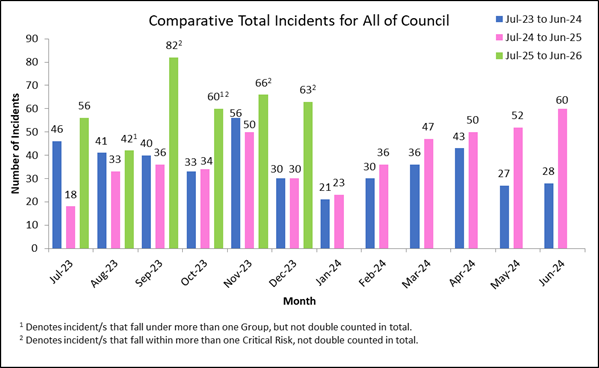
Graph 1
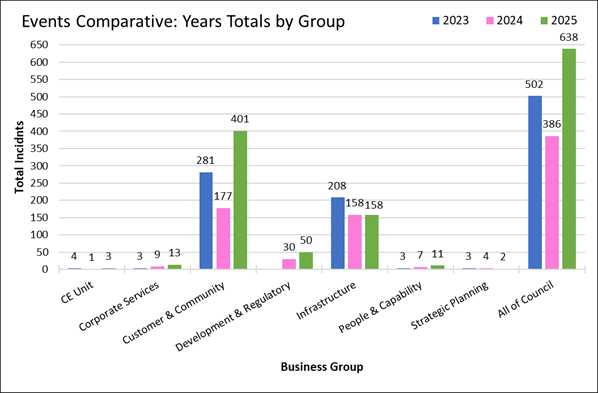
Graph 2
· The
number of incidents by Month/Quarter and Group is graphed below –
provides visibility on the events reported during Q2 2025, categorised by
business group.
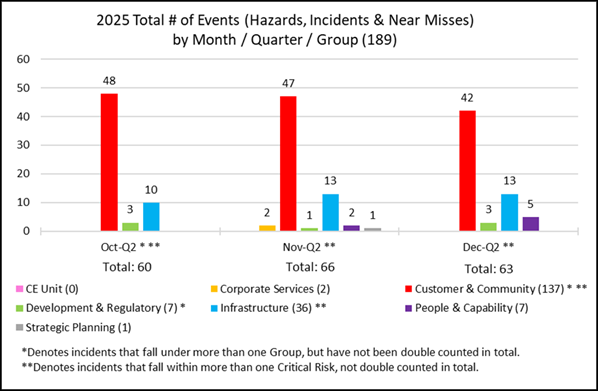
Graph 3
2.2 Comments
· Frontline
Working (Critical Risk 1) remains the most dominant and persistent risk,
consistent with patterns noted in broader SLT reporting. Q2 shows escalating
behavioural risk (more complex, sustained patterns of aggression) from members
of the public and increased strain on frontline roles.
o Q2
incidents indicate a noticeable rise in both severity and scale, marked by
heightened aggression across parks, campgrounds, events, and roadways. The
corrective actions taken in Q2 reflect a move toward more robust responses
(increased Police engagement and enhanced signage/traffic controls) and more
structured security and risk‑management practices (improved Front of
House security‑sensitive environment).
· Hazards
and Incidents – During the 1 October to 31 December 2025 period the
following risks were identified and addressed.
o Frontline Working
(Critical Risk 1)
§ Persons frequenting campground
verbally/physically aggressive, over-staying and exceeding conditions of stay.
Corrective Action:
External services contacted to provide services; Police notified/in
attendance; verbal Trespass Notice actioned; longer trespass bans to be
considered.
§ Members of the public/transient persons
frequenting our parks and reserves, verbally abusive and physically
threatening.
Corrective Action: Police
notified; de-escalation training utilised.
§ Dangerous weapon found
unattended in a public area.
Corrective Action:
Police notified; CCTV footage bookmarked.
§ Security consideration due
to the unmonitored vulnerability of Front of House at the time of events
occurring nearby.
Corrective Action: Ensure
appropriate risk assessments are in place to manage security vulnerabilities.
§ Parking Officers verbally
abused/physically threatened by members of the public – using vehicles
and other items to threaten.
Corrective Action: Body
Worn Cameras initiated; Police notified.
§ Members of the public
harassing/harming wildlife within parks and reserves.
Corrective Action:
Situations will continue to be monitored; Trespass notices will be issued where
required.
§ Large truck and trailer
transporter caught safety cones from an inner-city worksite.
Corrective Action:
Roading team to consider clearer redirection signage for excessively large
vehicles.
§ Lack of event signage
resulted in a person travelling through where they should not.
Corrective Action: Parks
staff placed temporary signage/barriers at the event entrance where bollards
were removed.
o Work Environment
(Critical Risk 2)
§ Designated CAB carparks for
shift workers are being impeded/used by contractors.
Corrective Action:
Building Custodian held a meeting with contractors to ensure the designated
spaces are not used.
§ Worker observed persons and a large
dog (wearing a vest and being prepared to work during the Christmas parade)
exit a vehicle in the restricted access CAB basement.
Corrective Action: Staff
to be reminded to liaise with Health & Safety Representatives/Health and
Safety team first – to check CCTV before reporting.
o Working at Height (Critical Risk
3)
§ Falling from height –
When neighbouring private business workers are operating at risk.
Corrective Action:
Mitigation resulted in a moral obligation to report such incidents;
feedback/concerns ought to be relayed to the private business operating the
business site.
o Breaking Ground (Critical Risk 4)
§ Digging out trench –
damage to sewer lateral sustained.
Corrective Action:
Plans/Geographic Information System are to be checked but this procedure does
not always locate services.
o Working with Mobile Plant
(Critical Risk 6)
§ Trailer with jockey wheel missing
sat placed on block of wood.
Corrective Action:
Trailer tagged out and reported.
o Driving (Critical Risk 7)
§ Contractor hydro vac vehicle
struck an overhead cable whilst driving with the boom up.
Corrective Action: Work
stop placed on hydro vac contractor until procedures could be confirmed;
contractor investigation findings also to be shared.
o Working Around Water (Critical
Risk 9)
§ Boating – Especially
when contractors are involved at our work sites.
Corrective Action:
Policy requires two people are to be present when using a boat; persons are
also to be inducted and aware of requirements.
o Hazardous Substances (Critical
Risk 10)
§ Glue fumes during remedial
carpet work carried out by a contractor.
Corrective Action:
Material Safety Data Sheet checked – glue was non-hazardous. In future
consider completing work on a weekend or arrange for kaimahi to hybrid
work/work remotely from another location.
§ Fibreglass rods may splinter
or shed small fibres when people touch them.
Corrective Action:
Emergency management tape applied around both stands of the fibreglass rods;
temporary fencing erected to prevent people from getting closer. A plan is
being developed to permanently fence the work.
§ Underground sewage sludge pipe
ruptured onsite during works on the surface above.
Corrective Action:
Kaimahi completed emergency repairs. Concrete pipe to be disposed of.
§ Chemical and chlorine lock up shed
contained multiple unlabelled and unrecognisable containers.
Corrective Action:
Chemicals shed was emptied and new register system implemented.
o Asset Failure (Critical Risk 12)
§ Staff lift operating
dangerously – dropping/jolting, not level with the floor upon exiting.
Corrective Action:
Situation is being monitored by leadership / technician as a result of lodged
service requests.
§ Lack of air conditioning
within buildings, especially over the summer period, may impact kaimahi/members
of the public.
Corrective Action:
Consider air conditioning installation, especially within buildings already
utilising open doors/windows/fans for ventilation.
§ Depot fire alarm went off.
Staff in the yard were confused on process – no communication provided.
Corrective Action:
Safety Plan review – Property and Depot manager to provide feedback on
separate alarms.
B. Critical
Risks
· Critical Risk 1
– Frontline Working – remains the top risk category still with
110 events during Q2 (Q1 – 116) making up for 152 (same as Q1) total
Critical Risk events reported. 40 Police notifications and 3 Trespass notices
were issued in Q2, a notification decrease on the previous quarter (Q1 - 51).
· 30
events involved frontline worker Verbal Altercation (VA) and/or Physical Danger
(PD).
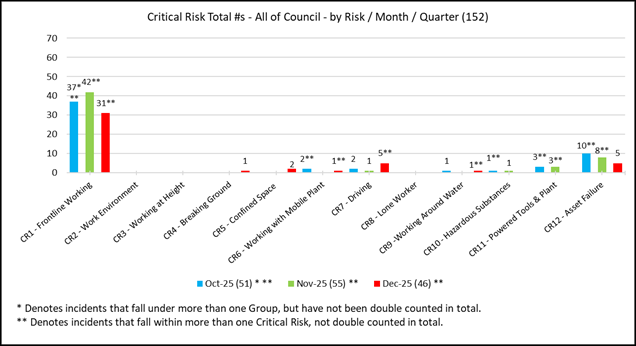
Graph 4
· For
more information on the individual events please refer to the confidential
Critical Risks report (Attachment 2).
C. Investigations
2.3 During
1 October to 31 December (Q2) 2025 PN City Council classified nil incidents as
‘notifiable’. WorkSafe investigation information remains on the
report for 12 months or until actions are completed.
Table
2: Investigations
|
Investigations occurred this quarter
|
0
|
|
Previous investigations (last 12
months)
|
|
Number of remedial actions required
|
0
|
|
Number of remedial actions
completed
|
0
|
D. Training
2.4 Group
performances during Q2 reflect fluctuations that can be attributed to seasonal
or cyclic factors, such as training lapses occurring at differing times of the
year. For more expansive information on training for Q2, please refer to the
Training Update schedule (Attachment 3) appended separately.
· Training Course/s delivered Internally – Q2 #
of Courses: 2
o Basic Site Safety 1
o Duress Alarm training 11
· Training
Course/s delivered Externally – Q2 #
of Courses: 13
o Hazard & Risk Management 5
o First Aid 19
o First Aid – Stop the Bleed 34
o Endorsements: R, T & W 12
o Confined Space & Gas Detection 11
o Accident & Event Investigation 10
o Electrofusion Jointing PE Pipe 9
o Height Safety – Introduction 1
o Improving H&S Culture Essentials 1
o Managing Mental Ill Health in the
Workplace Essentials 1
o OPSEC – Situational Safety
Workshop 21
o Permit to Work Training
Issuer/Receiver 1
o Playground
Safety Inspections Level 2 6
Table 3: Training
|
Date / Quarter
|
Mar-25
|
Jun-25
|
Sep-25
|
Dec-25
|
|
Number of Courses
|
12
|
26
|
34
|
15
|
|
Staff / Kaimahi attending
|
227
|
215
|
161
|
143
|
3. Compliance and administration
|
Does the Committee have
delegated authority to decide?
|
Yes
|
|
Are the decisions significant?
|
No
|
|
If they are significant do they
affect land or a body of water?
|
No
|
|
Can this decision only be made
through a 10 Year Plan?
|
No
|
|
Does this decision require
consultation through the Special Consultative procedure?
|
No
|
|
Is there funding in the current
Annual Plan for these objectives?
|
No
|
|
Are the recommendations
inconsistent with any of Council’s policies or plans?
|
No
|
|
The recommendations contribute
to:
Whāinga 3: He hapori
tūhonohono, he hapori haumaru
Goal 3: A connected and safe community
|
|
The recommendations contribute to this
plan:
9. Mahere haumaru hapori,
hauora hapori
9. Community Safety and
Health Plan
|
|
Contribution to strategic
direction and to social, economic, environmental and cultural well-being
|
Providing information to Council
about the ongoing progress towards the good performance of the organisation
regarding health and safety.
|
|
|
|
Attachments
|
1.
|
Health & Safety Dashboard
report, Q2 2025 ⇩
|
|
|
2.
|
Health & Safety Critical
Risks report, Q2 2025 - Confidential
|
|
|
3.
|
Training Update for Q2 2025 ⇩
|
|
Memorandum
TO: Finance,
Performance & Audit Committee
MEETING DATE: 4
March 2026
TITLE: Wellbeing
Report, 1 July to 30 September 2025 (Quarter 1)
PRESENTED BY: Connie
Roos, Manager Employee Experience and Wayne Wilson, Manager People Operations
APPROVED BY: Sarah
Morris, General Manager People & Capability
RECOMMENDATION(S)
TO Finance, Performance &
Audit Committee
1. That the Committee receive
the memorandum titled ‘Wellbeing Report, 1 July to 30 September
2025 (Quarter 1)’ presented to the Finance, Performance
& Audit Committee on 4 March 2026.
1. ISSUE
1.1 Wellbeing
continues to be a focus area for leadership at all levels of Council and is
core to our Employee Experience.
1.2 Employee
initiated turnover and lost time is included in this report.
Wellbeing
Activities
1.3 Free
hearing checks were held on site January to August 2025.
1.4 Blood
pressure checks were delivered across multiple Council sites. Participant
feedback was consistently positive.
Table 1
|
Quarter 1 Wellbeing Report – Prevent Harm
|
Q1 2025
|
YTD
|
Average Quarter
for 2024/25 FY
|
|
|
Wellness space usage
|
1664
|
1664
|
1737
|
The comparative data shows continuous and active
utilisation of the wellness space. The decision was made this quarter
to allow Te Manawa kaimahi (staff) to be able to access the CAB gym following
appropriate induction.
|
|
Biennial health / eye check
|
17
|
17
|
14
|
There has been a slight increase from 15 to 17 checks
this quarter. People Operations are exploring avenues to make this process
less administratively heavy.
|
Table 2
|
Quarter 1 Wellbeing Report – Provide Support
|
Q1 2025
|
YTD
|
Average Quarter
for 2024/25 FY
|
|
|
Vitae – On-site services
|
239
|
239
|
200
|
Vitae On-site Support staff
visit I-site, FoH, Depot and Awapuni Material Recovery Facility to conduct
informal wellbeing check-ins.
|
|
Reflect and Learn sessions
|
5
|
5
|
7
|
Sessions to assist staff to deal constructively with
high conflict incidents in front facing customer roles.
|
Table 3
|
Quarter 1 2025 – Enhance Wellbeing
|
Year to date
Number of
attendees
|
Target to be
completed by end of FY 25/26
|
|
|
Creating
Cultures of Respect (attendees)
|
19
|
30
|
This training encourages positive workplace
relationships by addressing unacceptable behaviours such as bullying and
harassment that could create internal and unhealthy conflict.
|
|
Challenging
Conversations & Resilience (attendees)
|
0
|
N/A
|
EEx is currently
exploring alternative solutions to this training that are more cost-effective
while still delivering high quality learning.
|
|
Tools for
Change (attendees)
|
0
|
N/A
|
This
training helps employees to identify thinking styles, recognise thinking
traps and manage responses to change. Most staff (61%) previously attended
this training, so this course is now offered on demand. No targets set.
|
|
Manager Completion of Leading Through Change (Manager attendees)
|
13
|
15
|
One way to support employees’ wellbeing is to
provide managers with the skills to lead their team through change. A significant percentage of People
Leaders previously attended this training (97%), so this course is now
offered annually for new People Leaders.
|
|
Change
Ready: Implementer Essentials
|
83
|
100
|
To enable
use of Palmerston North City Council’s Change Management Framework, we
now offer Change Ready: Implementer Essentials, a practical, role-specific
workshop on applying our change practices. This workshop supports wellbeing
and psychological safety along the change journey. A total of 118 kaimahi
(staff) are trained to date, since April 2025.
|
|
Situational
Awareness and De-escalation training
|
8
|
N/A
|
Situational
Awareness and De-escalation training is an offering developed by the Health
and Safety team. This course is offered on demand.
|
|
Wellbeing Presentation (attendees)
|
23/23 (100% of new
starters)
|
90% of new starters
|
This presentation helps to orient new starters to the
wellbeing support available here at Council. This presentation is presented
to all staff who attend Orientation Day.
|
1.5 Unmind
is a tool that takes a proactive, preventative approach to mental health. This
includes wellbeing and mood trackers, courses and short videos focused on
wellbeing. Unmind has a total uptake of 50%. The benchmark compared to
similarly sized organisations is 33-39%. Top completed Unmind activity in this
quarter are in sleep tools and personal growth exercises.
Offboarding
Data
1.6 The
offboarding data represents the number of people that have completed the
survey, not the number of people who have left.
Graph 1
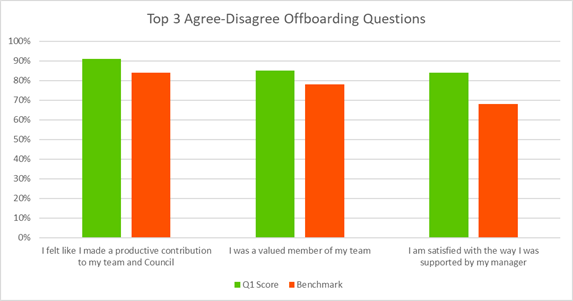
Graph 2
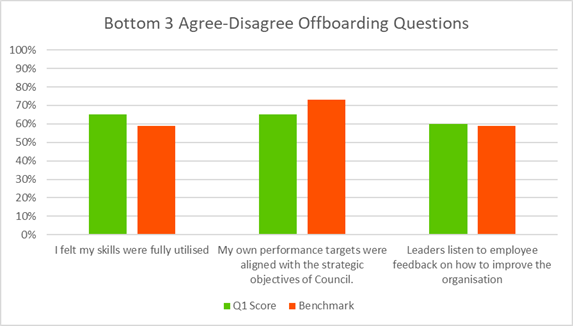
1.7 The
above graphs present the top three and bottom three
rated agree/disagree questions in the offboarding survey and compares them to
the benchmarked Local Government average. This approach represents a change to
the previous report as this information can provide an indication of what was
perceived as working well and what isn’t.
1.8 In
addition, overall sentiment expressed in the open-ended offboarding survey
responses is mixed, with a generally positive tone regarding people, team
culture, and work-life balance, alongside clear areas of negative sentiment
related to career development, consistency of management practice, and aspects
of organisational culture.
Table 4
|
Offboard survey participation
|
Number of responses
|
Response Rate
|
Target
|
|
Q1
|
11
|
55%
|
>49%
|
|
Previous FY
|
20
|
32.8%
|
>49%
|
1.9 The
Offboarding Survey Response rate above presents the
quarterly response rate, as well as the total number of responses received each
quarter. This table also includes both the Ask Your Team New Zealand Local
Government response rate (49%) for exit surveys and our Council target response
rate. The table above indicates that over the last quarter there was a
response rate of 55% in the offboarding survey. It is noted that of the 20
eligible terminated staff during this quarter 1 (5%) did not receive the survey
in time.
Table 5: Turnover
|
Year
|
19/20
|
20/21
|
21/22
|
22/23
|
23/24
|
24/25
|
25/26
Sep 1/4
|
|
Employee
Initiated
|
85
|
120
|
123
|
114
|
95
|
62
|
20
|
|
%
|
14.1%
|
20.9%
|
19.8%
|
18.8%
|
14.6%
|
9.2%
|
15.2%
|
|
Other
|
|
|
13
|
8
|
14
|
8
|
1
|
|
%
|
|
|
2.1%
|
1.3%
|
2.1%
|
1.2%
|
0.6%
|
Table 6
|
Month
|
Employee
Initiated Turnover for Month
|
Turnover
Previous 12 Months
|
Percentage
(annual)
|
|
Oct 24
|
8
|
90
|
13.7%
|
|
Nov 24
|
6
|
89
|
13.4%
|
|
Dec 24
|
3
|
83
|
12.5%
|
|
Jan 25
|
8
|
83
|
12.5%
|
|
Feb 25
|
2
|
75
|
11.4%
|
|
Mar 25
|
7
|
77
|
11.8%
|
|
Apr 25
|
5
|
71
|
10.9%
|
|
May 25
|
1
|
65
|
9.7%
|
|
Jun 25
|
5
|
62
|
9.2%
|
|
Jul 25
|
4
|
60
|
8.9%
|
|
Aug 25
|
6
|
58
|
8.6%
|
|
Sep 25
|
2
|
56
|
8.4%
|
Table 7:
Turnover by Group (12 months to September 2025)
|
Corporate
Services
|
5
|
10.4%
|
|
Customer &
Community
|
23
|
12.6%
|
|
Development
& Regulatory
|
8
|
9.6%
|
|
Infrastructure
|
18
|
6.7%
|
|
People &
Capability
|
1
|
2.0%
|
|
Strategic
Planning
|
3
|
11.5%
|
|
Headquarters
|
1
|
20.0%
|
1.10 Turnover
is still trending lower.
1.11 There
were no areas of concern in the last 12 months.
Table 8:
ACC Lost Time (Days)
|
Period
|
Sep 24
|
Dec 24
|
Mar 25
|
Jun 25
|
Sep 25
|
|
Work
|
|
|
|
|
|
|
Injuries
|
8
|
6
|
7
|
6
|
9
|
|
Days Off
|
180
|
51
|
135
|
95
|
129
|
|
Non-Work
|
|
|
|
|
|
|
Injuries
|
13
|
15
|
8
|
6
|
10
|
|
Days Off
|
306
|
188
|
139
|
90
|
99
|
|
Total
|
|
|
|
|
|
|
Injuries
|
21
|
21
|
15
|
12
|
19
|
|
Days Off
|
486
|
239
|
274
|
185
|
228
|
1.12 In the
September quarter work injuries made up 56.6% of lost time.
1.13 The 10 non-work
accidents resulted in 99 lost days.
2. BACKGROUND
2.1 Wellbeing
is interconnected with a variety of individual and systemic factors which makes
it a difficult area to report on. The above metrics have been recorded with
that in mind.
3. NEXT STEPS
3.1 Explore
opportunities in the wellbeing space to prevent harm, provide support and
enhance wellbeing.
3.2 Mental
Health Awareness Week will be 6-10 October. Employee Experience will be
promoting the wellbeing tools and resources available to all kaimahi (staff), with each day focusing on a
different facet of the 5 ways to wellbeing and an associated Unmind course.
Additionally, korero cards will be distributed to all sites to encourage
connection and conversations about wellbeing.
4. Compliance and administration
|
Does the Committee have
delegated authority to decide?
|
Yes
|
|
Are the decisions significant?
|
No
|
|
If they are significant do they
affect land or a body of water?
|
No
|
|
Can this decision only be made
through a 10 Year Plan?
|
No
|
|
Does this decision require
consultation through the Special Consultative procedure?
|
No
|
|
Is there funding in the current
Annual Plan for these objectives?
|
No
|
|
Are the recommendations
inconsistent with any of Council’s policies or plans?
|
No
|
|
The recommendations contribute to this
plan:
14. Mahere mana urungi,
kirirarautanga hihiri
14. Governance and Active
Citizenship Plan
The objective is: N/A
|
|
Contribution to strategic
direction and to social, economic, environmental and cultural wellbeing
|
Providing information to
Council about the ongoing progress towards the good performance of the
organisation regarding wellbeing. The wellbeing of our kaimahi (staff)
directly relates to how the strategic direction is implemented.
|
|
|
|
Attachments
Nil
Memorandum
TO: Finance,
Performance & Audit Committee
MEETING DATE: 4
March 2026
TITLE: Wellbeing
Report, 1 October to 31 December 2025 (Quarter 2)
PRESENTED BY: Connie
Roos, Manager Employee Experience and Wayne Wilson, Manager People Operations
APPROVED BY: Sarah
Morris, General Manager People & Capability
RECOMMENDATION(S)
TO Finance, Performance &
Audit Committee
1. That the Committee receive
the memorandum titled ‘Wellbeing Report, 1 October to 31 December
2025 (Quarter 2)’ presented on 4 March 2026
1. ISSUE
1.1 Wellbeing
continues to be a focus area for leadership at all levels of Council and is
core to our Employee Experience.
1.2 Employee
initiated turnover and lost time is included in this report.
Wellbeing Activities
1.3 Mental
Health Awareness Week was in 6-10 October. Employee Experience have promoted
wellbeing tools and resources available to all kaimahi (staff), with each day
focusing on a different facet of the 5 ways to wellbeing and an associated
Unmind course. Additionally, kōrero cards were distributed to all sites to
encourage connection and conversations about wellbeing. Feedback was generally
positive.
|
Quarter 2 Wellbeing Report
– Prevent Harm
|
Q1 2025
|
YTD
|
Average Quarter for 2024/25
FY
|
|
|
Wellness space usage
|
1673
|
3337
|
1737
|
The comparative data shows
continuous and active utilisation of the wellness space.
|
|
Biennial health / eye check
|
10
|
27
|
14
|
There has been a decrease from
17 to 10 checks this quarter. People Operations are now utilising ServiceNow
to make it easier for kaimahi (staff) to apply for these health and eye
checks.
|
|
Quarter 2 Wellbeing Report -
Provide Support
|
Q1 2025
|
YTD
|
Average Quarter for 2024/25
FY
|
|
|
Vitae – On-site services
|
225
|
464
|
200
|
Vitae
Onsite Support staff visit I-site, FoH, Depot and Awapuni MRF to conduct
informal wellbeing check-ins.
|
|
Reflect and Learn sessions
|
13
|
18
|
7
|
Sessions to assist staff to deal
constructively with high conflict incidents in front facing customer roles.
|
|
Quarter 2 Wellbeing Report
– Enhance Wellbeing
|
Year to date
Number of attendees
|
Target to be completed by
end of FY 25/26
|
|
|
Creating Cultures of Respect (attendees)
|
28
|
30
|
This training encourages
positive workplace relationships by addressing unacceptable behaviours such
as bullying and harassment that could create internal and unhealthy conflict.
|
|
Tools for Change (attendees)
|
0
|
N/A
|
This training helps employees to identify thinking styles,
recognise thinking traps and manage responses to change. Most staff (61%)
previously attended this training, so this course is now offered on a demand
basis. No targets set.
|
|
Manager Completion of Leading Through Change (Manager
attendees)
|
13
|
15
|
One way to support
employees’ wellbeing is to provide managers with the skills to lead
their team through change. A
significant percentage of People Leaders previously attended this training
(97%), so this course is now offered annually for new people leaders.
|
|
Change Ready: Implementer Essentials
|
89
|
100
|
To enable use of PNCC’s Change Management Framework,
we now offer Change Ready: Implementer Essentials, a practical, role-specific
workshop on applying our change practices. This workshop supports wellbeing
and psychological safety along the change journey. A total of 124 kaimahi are
trained to-date, since April 2025.
|
|
Situational Awareness and De-escalation training
|
8
|
N/A
|
Situational Awareness and De-escalation training is an
offering developed by the Health and Safety team. This course is offered on
demand.
|
|
Wellbeing Presentation
(attendees)
|
42/45 (93% of new starters)
|
90% of new starters
|
This presentation helps to orient
new starters to the wellbeing support available here at Council. This
presentation is presented to all staff who attend Orientation Day.
|
1.4 Unmind
is a tool that takes a proactive, preventative approach to mental health. This
includes wellbeing and mood trackers, courses and short videos focused on
wellbeing. Unmind has a total uptake of 50%. The benchmark compared to
similarly sized organisations is 33-39%. Top completed Unmind activity themes
in this quarter are in body exercises, relaxing tools and daily boosts
(including suggested content to align with Mental Health Awareness Week).
Offboarding
Data
1.5 The
offboarding data represents the number of people that have completed the
survey, not the number of people who have left.
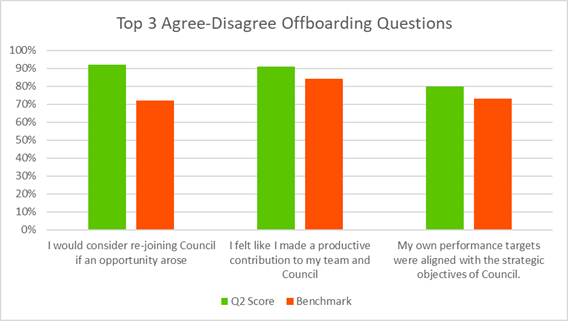
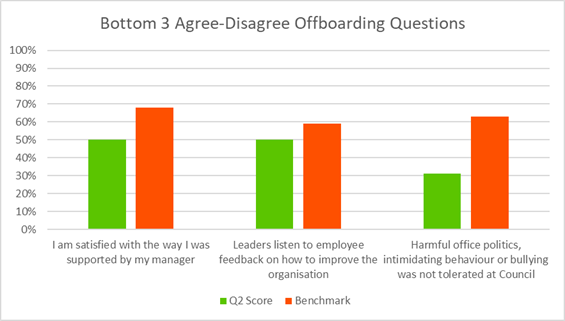
1.6 The
above graphs present the top three and bottom three rated agree/disagree
questions in the offboarding survey and compares them to the benchmarked Local
Government average. This indicates that more work needs to be done to create a
culture of respect at Council for kaimahi (staff). Additionally, these graphs
illustrate the variability in response patterns across reporting periods. For
example, in the previous quarter, one of the highest-rated agreement items in
the offboarding survey was: “I am satisfied with the way I was supported
by my manager.” In the current quarter, this item has shifted
significantly and now sits within the bottom three ranked items. Conversely,
the statement “My own performance targets were aligned with the strategic
objectives of Council” was among the lowest-rated items last quarter. In
the current quarter, it has moved into the top three ranked items.
|
Offboard survey participation
|
Number of responses
|
Response Rate
|
Target
|
|
Q1
|
11
|
55%
|
>49%
|
|
Q2
|
7
|
28%
|
>49%
|
|
Previous FY
|
20
|
32.8%
|
>49%
|
1.7 The
Offboarding Response rate above presents the quarterly response rate, as well
as the total number of responses received each quarter. This table also
includes both the Ask Your Team New Zealand Local Government (LGO) response
rate for exit surveys and our Council goal response rate. Participation rate
decreased significantly compared to Q1, and it is noted that of the 25 eligible
terminated staff during this quarter 4 (16%) did not receive the survey in time
for them to complete it. Please note that the proximity to the end of the year
break may have affected completion rate.
1.8 The
Quarter 2 open-ended responses reflect a mixed sentiment profile, with strong
positive feedback regarding team experience and community connection, alongside
negative sentiment concentrated around leadership capability, workplace
culture, remuneration, and organisational change.
Turnover
|
Year
|
20/21
|
21/22
|
22/23
|
23/24
|
24/25
|
25/26
Sep 1/4
|
25/26
Dec 1/4
|
|
Employee
Initiated
|
120
|
123
|
114
|
95
|
62
|
20
|
15
|
|
%
|
20.9%
|
19.8%
|
18.8%
|
14.6%
|
9.2%
|
15.2%
|
9.2%
|
|
Other
|
|
13
|
8
|
14
|
8
|
1
|
1
|
|
%
|
|
2.1%
|
1.3%
|
2.1%
|
1.2%
|
0.6%
|
0.6%
|
|
Month
|
Employee
Initiated Turnover for Month
|
Turnover
Previous 12 Months
|
Percentage
(annual)
|
|
Jan 25
|
8
|
83
|
12.5%
|
|
Feb 25
|
2
|
75
|
11.4%
|
|
Mar 25
|
7
|
77
|
11.8%
|
|
Apr 25
|
5
|
71
|
10.9%
|
|
May 25
|
1
|
65
|
9.7%
|
|
Jun 25
|
5
|
62
|
9.2%
|
|
Jul 25
|
4
|
60
|
8.9%
|
|
Aug 25
|
6
|
58
|
8.6%
|
|
Sep 25
|
2
|
56
|
8.4%
|
|
Oct 25
|
6
|
54
|
8.2%
|
|
Nov 25
|
4
|
52
|
7.9%
|
|
Dec 25
|
11
|
60
|
9.2%
|
Turnover by Group (12 months
to Dec 2025)
|
Corporate
Services
|
3
|
6.1%
|
|
Customer &
Community
|
23
|
13.0%
|
|
Development
& Regulatory
|
7
|
8.4%
|
|
Infrastructure
|
24
|
9.1%
|
|
People &
Capability
|
2
|
4.2%
|
|
Strategic
Planning
|
3
|
12.0%
|
|
Headquarters
|
1
|
20.0%
|
1.9 Turnover
is still low despite a bump in December.
1.10 There were
no areas of concern in the last 12 months. The Library had 9 terminations but 4
were retirements.
ACC Lost
Time (Days)
|
Period
|
Dec 24
|
Mar 25
|
Jun 25
|
Sep 25
|
Dec 25
|
|
Work
|
|
|
|
|
|
|
Injuries
|
6
|
7
|
6
|
9
|
4
|
|
Days Off
|
51
|
135
|
95
|
129
|
114
|
|
Non-Work
|
|
|
|
|
|
|
Injuries
|
15
|
8
|
6
|
10
|
9
|
|
Days Off
|
188
|
139
|
90
|
99
|
96
|
|
Total
|
|
|
|
|
|
|
Injuries
|
21
|
15
|
12
|
19
|
13
|
|
Days Off
|
239
|
274
|
185
|
228
|
210
|
1.11 In the Dec
Quarter work injuries made up 54.3% of lost time. Of the 4 work-related
injuries only one was a new injury and accounted for 32.2 days of lost time.
1.12 The 9
non-work accidents resulted in 96 lost days.
2. BACKGROUND
2.1 Wellbeing
is interconnected with a variety of individual and systemic factors which makes
it a difficult area to report on. The above metrics have been recorded with
that in mind.
3. NEXT STEPS
3.1 Explore
opportunities in the wellbeing space to prevent harm, provide support and
enhance wellbeing.
3.2 A
proposed approach for psychosocial risk assessments has been developed and is
being piloted.
4. Compliance and administration
|
Does the Committee have
delegated authority to decide?
|
Yes
|
|
Are the decisions significant?
|
No
|
|
If they are significant do they
affect land or a body of water?
|
No
|
|
Can this decision only be made
through a 10 Year Plan?
|
No
|
|
Does this decision require
consultation through the Special Consultative procedure?
|
No
|
|
Is there funding in the current
Annual Plan for these objectives?
|
No
|
|
Are the recommendations
inconsistent with any of Council’s policies or plans?
|
No
|
|
The recommendations contribute to this
plan:
14. Mahere mana urungi,
kirirarautanga hihiri
14. Governance and Active
Citizenship Plan
The objective is: N/A
|
|
Contribution to strategic
direction and to social, economic, environmental and cultural well-being
|
Providing information to Council
about the ongoing progress towards the good performance of the organisation regarding
wellbeing. The wellbeing of our kaimahi (staff) directly relates to how the
strategic direction is implemented.
|
|
|
|
Attachments
Nil
Memorandum
TO: Finance,
Performance & Audit Committee
MEETING DATE: 4
March 2026
TITLE: Six-monthly
report on International Relations and Education Activities
PRESENTED BY: Gabrielle
Loga, Manager International Relations and Kunal Chonkar, International
Relations and Education Advisor
APPROVED BY: David
Murphy, General Manager Strategic Planning
RECOMMENDATION(S)
TO Finance, Performance & Audit
Committee
1. That the Committee
receive the ‘Six-monthly report on International Relations and Education
Activities’, presented on 4 March 2026.
1. ISSUE
1.1 The
purpose of this memorandum is to update the Finance, Performance and Audit Committee
on the Council’s key international relations and education activities in
the six months from April 2025 to October 2025 and their contribution to the
relevant goal, strategy and plan.
2. BACKGROUND
2.1 On
11 June 2025, Council approved the following goals set for the city’s
international relations and education in 2025-2026:
· Goal
1: Foster deeper engagement with strategic international partners to
enhance the city’s profile as a preferred destination for education,
tourism, and investment.
· Goal
2: Strengthen local economies through the promotion of tourism,
international education, and facilitation of business connections and
investment opportunities.
· Goal
3: Promote research collaboration, innovation and entrepreneurship to
increase the city’s diversification and resilience against future
challenges.
2.2 This
report outlines the key international relations and education activities since
May 2025 and measures them against the agreed goals. It also provides an
updated activity schedule from the International Relations and Education Annual
Plan 2025-2026.
INTERNATIONAL RELATIONS
3. Highlights of the global/national context
3.1 Global
instability and the threat of conflict remained elevated through the second and
third quarters of 2025, particularly in the Indo-Pacific. Ongoing major-power
competition, regional military activity, and unresolved conflicts elsewhere in
the world continued to disrupt global trade routes, supply chains, and investor
confidence. For New Zealand, this reinforced the importance of diplomacy,
regional partnerships, and economic resilience rather than reliance on any
single market or geopolitical alignment. For Palmerston North, this global
context strengthens the value of city-to-city relationships, education
diplomacy, and international engagement as long-term stabilising tools that
support trade, talent attraction, and institutional cooperation beyond
short-term shocks.
3.2 New
Zealand’s export performance in 2025 remained comparatively strong but increasingly
exposed to global volatility. While demand for high-quality food, education,
and services held up, exporters faced uncertainty from trade tensions, supply
chain disruptions, and changing regulatory environments. This highlighted the
need to move beyond volume-based exports toward higher-value,
knowledge-intensive and services-based offerings. Palmerston North, with its
concentration of AgriTech, food innovation, logistics, and education
institutions, is well positioned to contribute to this shift by supporting
export-ready businesses, applied research partnerships, and international
students as part of New Zealand’s broader export ecosystem.
3.3 The
Association of Southeast Asian Nations (ASEAN) continued to grow in importance
as a strategic and economic partner for New Zealand. As one of the
world’s fastest-growing regions, ASEAN offers diversified demand, a
growing middle class, and increasing openness to collaboration in education,
sustainability, and innovation. For New Zealand, deepening ASEAN ties helps
balance exposure to larger, more volatile markets. For Palmerston North,
stronger ASEAN engagement translates into opportunities to attract students,
build institutional partnerships, host delegations, and connect local firms,
particularly in AgriTech, food innovation, education, and urban solutions, to
rapidly growing Southeast Asian markets.
3.4 Vietnam
emerged as a particularly important market within ASEAN, with continued
economic growth, urbanisation, and demand for trusted international partners.
In 2025, Vietnam’s appetite for high-quality food products, skills
development, research collaboration, and sustainable technologies aligned
closely with New Zealand’s strengths. For Palmerston North, Vietnam
presents concrete opportunities for education pathways, applied research links,
workforce development partnerships, and city-level cooperation, building on
meaningful people-to-people and sustainable institutional connections rather
than purely transactional trade.
3.5 As
the economic need for diversification and sustainability became more pronounced
in 2025, New Zealand’s national strategy increasingly emphasised
spreading risk across markets, embedding sustainability into trade, and growing
sectors that are resilient, low-emissions, and knowledge-based. At a city
level, Palmerston North has translated this strategy into action by supporting
internationally connected education and research, fostering innovation-led
businesses, and positioning the city as a credible, outward-looking hub that
contributes to national resilience while delivering local economic and social
benefits.
4. activitiy OutCome Report
AgriTech and Food Innovation
Connection with Nancy, France
4.1 On
11 April 2025, Palmerston North City Council facilitated an international
engagement meeting between Palmerston North and Nancy (France) to explore
collaboration opportunities in the AgriTech and Food Innovation sector. The
activity aligned with Council’s objectives to support economic
diversification, innovation-led growth, and international connectivity by
strengthening relationships between local and international research,
education, and innovation ecosystems.
4.2 The
engagement brought together senior representatives from Crown Research
Institutes, universities, commercialisation entities, incubators, and startups
from both cities. The meeting confirmed a strong alignment between Palmerston
North’s research-led agri-food innovation ecosystem and Nancy’s
FoodTech Grand Est cluster, with both cities sharing a focus on sustainable
food systems, applied research, and commercialisation.
4.3 The
activity resulted in the identification of multiple priority collaboration
areas, including alternative proteins, fermentation technologies, smart
farming, food system resilience, sensing and imaging technologies, animal
health, and climate-adaptive food testing. These areas align with Palmerston
North’s existing strengths and provide a platform for future innovation,
research, and commercial partnerships.
4.4 Agreed
next steps include facilitating direct connections between participating
organisations, supporting follow-up discussions to scope pilot projects or
exchanges, and exploring opportunities for Palmerston North/New Zealand
participation in Nancy’s Food Innovation Days in 2026. This event was
identified as a practical mechanism to showcase local capability, support
soft-landing opportunities, and deepen international partnerships.
4.5 Overall,
the activity contributed to Council’s international relations and
economic development outcomes by advancing high-value relationships, increasing
international visibility of Palmerston North’s innovation ecosystem, and
laying the groundwork for future collaborations that support productivity,
sustainability, and long-term economic resilience.
The 3rd China
– New Zealand Mayoral Forum
4.6 Palmerston
North participated in the 3rd China-New Zealand Mayoral Forum and
Festival, held in Chengdu, China from 19 – 22 May 2025. The event was
co-hosted by the Chinese People’s Association for Friendship with Foreign
Countries (CPAFFC) and Global Cities New Zealand (GCNZ), marking the tenth
anniversary of the China–New Zealand Mayoral Forum mechanism, which first
began in 2015. Palmerston North has previously participated in the first forum in
Xiamen (2015) and the second in Wellington (2017)
4.7 The
Mayor led a delegation of five delegates from Palmerston North City Council,
Central Economic Development Agency, Manawatū Charitable Trust Rōpu,
and Rangitāne o Manawatū, Te Matatini group of fifteen members. In
his capacity as President of Global Cities New Zealand, Mayor Smith also
represented the national association.
4.8 The
theme of the 2025 Forum was “Mapping Out a New Decade of Sister City
Relationships.” Delegates from 22 cities across China and New Zealand
participated, focusing on strengthening bilateral subnational ties. Discussions
and exchanges covered areas such as economic cooperation, education, cultural
exchange, tourism, innovation, and urban governance. The Mayor emphasised the
importance of reconnection and enhancing people-to-people links to support
ongoing cooperation in education, trade, research and cultural exchanges.
4.9 Palmerston
North’s participation in the 3rd China–New Zealand Mayoral Forum in
Chengdu strengthened the city’s international relationships and
reaffirmed its commitment to sister-city collaboration. The delegation engaged
in strategic dialogue with Chinese counterparts on economic, educational,
cultural, and innovation opportunities, shared best practice in subnational
diplomacy, and explored avenues for future cooperation. The Forum highlighted
the importance of people-to-people connections in building mutual
understanding, enhancing bilateral engagement, and advancing Palmerston
North’s broader objectives for international engagement, regional
development, and global profile-building.
4.10 The Forum
and Palmerston North’s contribution received positive coverage across
major national and regional Chinese media platforms, including China Daily
(English and Asia editions), People’s Daily, Xinhua News, QQ News, Sohu,
Weixin News, and regional outlets such as Good Morning Chengdu. This coverage
amplified the city’s international visibility and reinforced its
reputation as an active and credible partner in international cooperation.
4.11 Participation
in the Forum supports the City’s strategic objectives to raise its
international profile and strengthen global networks that deliver benefits for
local economic, education, research, and cultural sectors. The
delegation’s involvement aligns with Council’s commitment to
leadership in subnational diplomacy and to pursuing collaborative opportunities
that contribute to long-term regional growth and resilience.
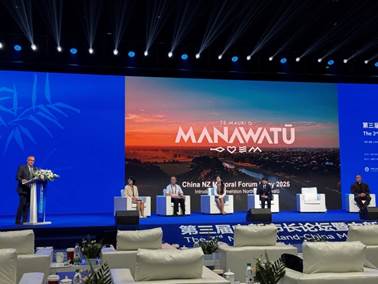
Figure 1:
CEDA CEO presenting on investment opportunities in Palmerston
North/Manawatū
Figure 2:
Palmerston North delegation featured at the China NZ Mayoral Forum
Remembering For Peace: 80
Years On from the Atomic Bomb Poster Exhibition
4.12 On 4
August 2025, an opening ceremony was held at the City Library to commemorate
the 80th anniversary of the atomic bombings of Hiroshima and Nagasaki. The
ceremony brought together government officials, local business leaders, and
institutional representatives. Proceedings included a welcome address by Mayor
Smith, followed by pre-recorded remarks from Mihara City Mayor Okada and
Minister Oshima of the Embassy of Japan. A reflection was shared by the
grandson of a Hibakusha (atomic bomb survivor). Following the formal
proceedings, attendees viewed the exhibition displayed within the library.
4.13 The
exhibition marked the 80th anniversary of the bombings through visual and
educational displays. Featured materials included a series of posters
containing photographs and detailed historical accounts of the events that
occurred in Hiroshima and Nagasaki in 1945. The exhibition also featured a
display of the Samurai armour gifted to the city by Mihara, symbolising Japan's
cultural heritage and resilience. The exhibition opened to the public on 5
August 2025 and remained at the City Library for one month before being
relocated to Massey University and subsequently to IPU New Zealand, extending
its reach across local educational institutions.
4.14 Several
weeks following the opening ceremony, the city received one thousand paper
cranes or ‘senbazuru’ from Mihara City. These cranes had been part
of Mihara's Peace Memorial Ceremony held on 2 August 2025. The display of one
thousand paper cranes from Mihara City at the City Library, further
strengthened the sister-city relationship and encouraged community
participation through interactive engagement. Collectively, these activities
increased public awareness of the humanitarian consequences of nuclear weapons,
strengthened international and institutional partnerships, and demonstrated the
value of civic-led remembrance initiatives in fostering peace and global
connection.
Figure 3:
Display of 1000 ‘Senbazuru’ from Mihara and make-your-own crane
table for the public
ASEAN Forum 2025: 50 Years +
$50 Billion
4.15 In 2025,
New Zealand marked 50 years of dialogue relations with the Association of
Southeast Asian Nations (ASEAN), celebrating half a century of diplomatic,
economic, and cultural engagement. To highlight this milestone, the ASEAN Forum
2025: “50 Years + $50 Billion” was held in Auckland,
co-hosted by the ASEAN New Zealand Business Council and supported by the New Zealand
Ministry of Foreign Affairs and Trade, the Asia New Zealand Foundation, and ANZ
Bank. The Forum brought together national leaders, ASEAN representatives,
business leaders, and stakeholders to explore deeper economic connectivity,
trade opportunities, and regional partnership priorities.
4.16 While
Palmerston North was not the primary host, the city’s participation
reflected its strategic commitment to international cooperation, trade
engagement, and regional connectivity. City representatives engaged with ASEAN delegates
and business leaders through networking and information exchange, reinforcing
local interests in aligning economic, education, and innovation sectors with
emerging opportunities from ASEAN–New Zealand relations. The Mayor
also hosted a dynamic Business Panel Discussion with business leaders from
Vietnam, Malaysia, and New Zealand to explore market trends, sector
opportunities, and practical advice for businesses operating across New Zealand
and ASEAN. These engagements strengthened Palmerston North’s profile
within national initiatives that support business linkages and regional
integration.
4.17 Participation
in the ASEAN Forum reinforced the city’s commitment to strengthening ties
with Southeast Asia and leveraging regional opportunities for local growth. The
Forum celebrated five decades of ASEAN–New Zealand dialogue and
highlighted pathways for enhanced trade, digital innovation, supply chain
resilience, and improved market access for New Zealand businesses. Engagement
facilitated knowledge sharing, developed people-to-people and business
networks, and positioned Palmerston North to expand economic, cultural, and
educational partnerships within the ASEAN region.
4.18 More
broadly, Palmerston North’s involvement in ASEAN-related activities, both
direct and via national coordination, aligns with Council’s
internationalisation objectives, including expanding global trade links,
promoting local business opportunities abroad, and raising the city’s
profile in dynamic regional markets. These efforts support strategic goals to
foster economic growth, deepen global networks, and strengthen Palmerston
North’s role as an active partner within Asia-Pacific economic corridors.

Figure 4:
Business Panel Discussion at ASEAN Forum 2025
Visit by Embassy of Vietnam
to Palmerston North
4.19 On 8
September 2025, the newly appointed Ambassador of Vietnam, Mr Phan Minh Giang,
visited Palmerston North. Mayor Smith welcomed the Ambassador and his
delegation to the city for discussions on potential areas of cooperation, including
education and research partnerships, trade and economic development, and
agricultural collaboration between Palmerston North and Vietnam. The
conversation also acknowledged the broader regional and strategic context
underpinning bilateral relations between New Zealand and Vietnam.
4.20 The
delegation visited UCOL and Massey University to explore collaboration
opportunities with polytechnic universities in Vietnam and discuss the
potential for joint degree programmes with Vietnamese tertiary institutions.
These discussions align with New Zealand's broader educational engagement with
Vietnam, following the establishment of a comprehensive strategic partnership
between the two countries in February 2025.
4.21 The visit
strengthened Palmerston North's relationship with the Embassy of Vietnam and
reinforced the city's position as a hub for international education and global
engagement. It provided an opportunity to highlight Palmerston North's
innovation and research capabilities, particularly in the agri-food and
tertiary education sectors, which present significant opportunities for
Vietnamese collaboration given the strategic focus on educational and
agricultural partnerships.
4.22 This
engagement aligns with Council's objectives of fostering international
partnerships, promoting economic and educational exchange, and enhancing the
city's global connections. Direct engagement with the Vietnamese Ambassador
enables Palmerston North to strengthen collaboration across multiple sectors
while exploring trade and agricultural opportunities that benefit both regions.
These relationships are expected to lead to future student exchanges, joint
research projects, and institutional partnerships that enhance the city's
international profile.
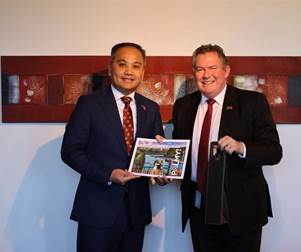
Figure
5: Visit by the new Ambassador of Vietnam
Visit by U.S. Embassy to
Palmerston North
4.23 On 23
September 2025, Mr David Gehrenbeck, Chargé d'Affaires at the U.S.
Embassy, visited Palmerston North accompanied by Mrs Lauren Gehrenbeck, and Ms
Kathryn Plummer, Public Engagement Coordinator at the U.S. Embassy. The visit
provided an opportunity to strengthen bilateral ties and explore areas of
mutual interest between the United States and the Palmerston North region
across economic development, education, and research sectors.
4.24 The
delegation's programme included visits to key regional institutions and
businesses. At Moana New Zealand, discussions focused on the company's
operations and innovation in the aquaculture sector. The visit continued to
Massey University, where the delegation met with senior leadership from the
College of Sciences and School of Veterinary Science to discuss research
collaboration opportunities and international education partnerships. The
delegation also met with Council staff and the Central Economic Development
Agency to discuss regional economic development priorities and investment
opportunities.
4.25 The visit
concluded with the delegation’s attendance at the talk and book launch of
'General Lucian K. Truscott: Quite a Talent for Fighting' by Professor Glyn
Harper at the City Library. During the event, Mr Gehrenbeck spoke about the
enduring military connections between the United States and New Zealand,
highlighting the historical and contemporary significance of defence cooperation
between the two nations. His remarks underscored the shared values and
partnership that continue to define the bilateral relationship.
4.26 Following
the visit, several connections have been facilitated. CEDA has established
contact with the U.S. Embassy's commercial team regarding investment
possibilities at Te Utanganui, positioning the region to attract potential U.S.
investment in logistics and distribution infrastructure. Additionally,
connections have been made between Massey University's Business School and the
American Chamber of Commerce in New Zealand, creating pathways for enhanced
business education collaboration and commercial partnerships.
4.27 This
engagement reflects Palmerston North's growing profile as a centre for
international dialogue and collaboration. The visit enabled direct discussions
on areas of strategic importance, including aquaculture innovation, veterinary
science research, and tertiary education partnerships. These connections align
with Council's objectives of fostering international relationships and
positioning Palmerston North as an active participant in global networks that
generate tangible economic and educational benefits for the region.
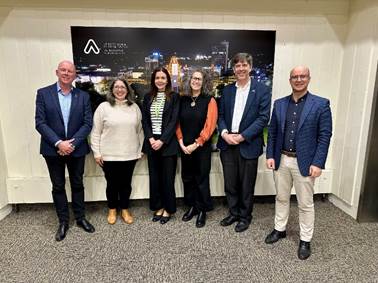
Figure
6: The U.S. Embassy delegation with Council staff and Massey University
representatives
Visit from the Malaysian
High Commission to Diwali Mela
4.28 On 1
November 2025, Ms Nadzatul Hilmi, Counsellor of Training and Culture and Mr
Abdul Ampuan Tajudin, Education Attaché, at the High Commission of
Malaysia attended Diwali Mela in Palmerston North. Their attendance reflected
Malaysia’s continued engagement with this particular event and support
for Palmerston North for three consecutive years.
4.29 During the
visit, Ms Hilmi and Mr Tajudin met with the Mayor, the Manager International
Relations and representatives of the Manawatū Malaysian
Council, providing an opportunity to strengthen relationships between the High
Commission, the city, and the Malaysian community in the region. Discussions
highlighted the value of education linkages, the ongoing people-to-people connections,
as well as the many opportunities for trade and investment between Palmerston
North and Malaysia.
4.30 The presence of senior representatives from the High Commission of
Malaysia, together with their engagement with civic and community leaders,
supported Palmerston North’s international relations objectives by
reinforcing links with ASEAN partners and enhancing the city’s profile as
a welcoming community.
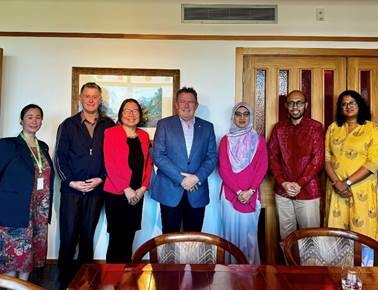
Figure
7: Malaysian High Commission delegates welcomed by PNCC and Manawatū
Malaysian Council
INTERNATIONAL EDUCATION
5. Overview of the global, national AND LOCAL
context
5.1 New
Zealand’s international education sector has demonstrated strong recovery
and growth within a highly competitive global environment. In 2024,
international student enrolments reached 83,425, a 21% increase on 2023 and 72%
of pre-pandemic (2019) levels.
5.2 Globally,
international student mobility is being reshaped by tightening immigration and
work-rights settings in traditional destination countries such as the United
States of America, United Kingdom, Canada, and Australia. In this context, New
Zealand is increasingly positioned as a stable, high-quality, and welcoming
study destination. China and India remain New Zealand’s largest source
markets, accounting for 34% and 14% of enrolments respectively, followed by
Japan (9%) and South Korea (4%).
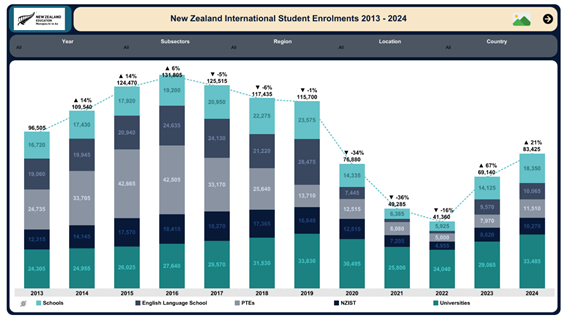
Figure
8: New Zealand International Student Enrolments 2013-2024 (Source: ENZ)
5.3 In
July 2025, the Government released the International Education Going for Growth
Plan, setting a strategic target to double the sector’s economic
contribution from $3.6 billion in 2024 to $7.2 billion by 2034. The plan
responds to global competition for students by strengthening New
Zealand’s value proposition as a study destination.
5.4 International
education remains one of New Zealand’s largest export sectors and a
significant contributor to local economies and community vitality.
International students are high-value participants who live, shop, travel, and
engage locally, enriching communities while building long-term international
goodwill through their experiences in New Zealand. According to the New Zealand
International Student Expenditure Survey 2024, the average international
student reported annual living expenditure of $45,776, excluding tuition fees
(see Figure 9). Postgraduate international students make an additional
contribution through research and innovation, strengthening New Zealand’s
global knowledge networks. Many former international students also continue to
act as long-term ambassadors for New Zealand, supporting enduring international
connections and economic opportunities. The New Zealand International Student
Expenditure Surveys for 2024 and 2025 are attached as Attachment 1 and 3.
5.5 Realising
the international education sector’s potential, the International
Education Going for Growth plan aims at three objectives:
· Raise
awareness of New Zealand as a study destination from 40% in 2024 to 42% in 2027
and 44% by 2034.
· Grow
student enrolments from 83,400 in 2024 to 105,000 in 2027 and 119,000 by 2034.
· Increase the
proportion of prospective students rating New Zealand among their top three
choices of study destination from 18% in 2024 to 20% in 2027 and 22% in 2034.
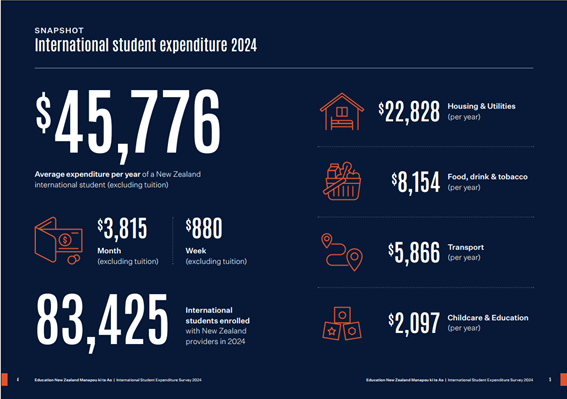
Figure
9: Snapshot of International Student Expenditure 2024
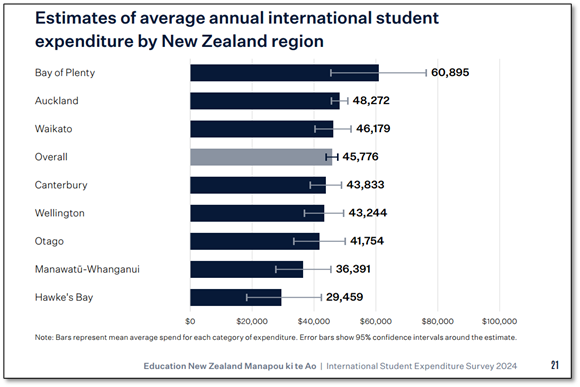
Figure
10: Estimates of average annual international student expenditure by
region
5.6 International
education is a significant contributor to the economic and cultural vitality of
Palmerston North and the wider Manawatū-Whanganui region. International
students studying at local schools and tertiary institutions — including
Massey University, UCOL, Te Wānanga o Aotearoa, and IPU New Zealand
— live, study, and participate locally, contributing to the vibrancy of
the city while building long-term international connections. On average, an
international student in Palmerston North and Manawatū spends
approximately $36,391 per year on living costs, excluding tuition fees, with
expenditure flowing directly into accommodation, retail, hospitality, and
transport sectors (See Figure 10).
5.7 Consistent
with the national trend, China and India remain the region’s largest
source markets for international students, followed by Japan, the United
States, and Vietnam. Immigration New Zealand provides monthly regional-level
data on valid international student visa holders across all study types (see
Figure 12); however, this data does not disaggregate by institution or
territorial authority, and student numbers fluctuate throughout the year due to
arrivals, programme completions, and changes in visa status. Annual higher
education enrolment data (see Figure 13 and Figure 14) for Palmerston
North/Manawatū campuses is provided to Council in alignment with Tertiary
Education Commission reporting requirements.
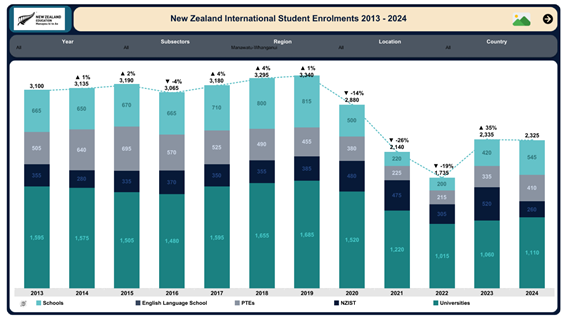
Figure
11: Manawatu-Whanganui International Student Enrolments 2013-2024 (ENZ)
|
Valid
international student visa holders who are studying in
Manawatu-Whanganui
|
|
|
6
Oct 2024
|
3
Nov 2024
|
1
Dec 2024
|
5
Jan 2025
|
2
Feb 2025
|
3
Mar 2025
|
6
Apr 2025
|
4
May 2025
|
1
Jun 2025
|
5
Aug 2025
|
1
Sep 2025
|
7
Oct 2025
|
|
Polytechs
|
130
|
128
|
125
|
124
|
145
|
182
|
177
|
177
|
180
|
188
|
187
|
191
|
|
PTEs
|
239
|
246
|
237
|
205
|
241
|
237
|
279
|
277
|
267
|
256
|
262
|
259
|
|
Schools
|
198
|
207
|
123
|
43
|
153
|
255
|
237
|
242
|
245
|
228
|
227
|
224
|
|
Universities
|
778
|
704
|
529
|
424
|
479
|
810
|
795
|
854
|
839
|
919
|
850
|
897
|
|
Total
|
1345
|
1285
|
1014
|
796
|
1018
|
1484
|
1488
|
1550
|
1531
|
1519
|
1526
|
1571
|
Figure 12:
Valid international student visa holders in Manawatu-Whanganui 2024-2025 (INZ)
5.8 It
is also important to note that official datasets capture only students holding
valid student visas and exclude short-term students studying for three months
or less. Palmerston North schools are estimated to host around 400 short-term
international students annually, though variations in reporting limit the
precision of aggregate figures.
|
Student headcount as at 15 April each year
|
|
|
|
Massey University
|
UCOL
|
Te Wānanga o Aotearoa
|
IPU New Zealand
|
Total Higher Education
|
|
2019
|
Domestic
|
4,598
|
2,949
|
534
|
65
|
8,146
|
|
International
|
1,367
|
217
|
0
|
243
|
1,827
|
|
Total
|
5,965
|
3,166
|
534
|
308
|
9,973
|
|
2020
|
Domestic
|
4,310
|
3,003
|
494
|
42
|
7,849
|
|
International
|
1,335
|
175
|
0
|
177
|
1,687
|
|
Total
|
5,645
|
3,178
|
494
|
219
|
9,536
|
|
2021
|
Domestic
|
4,133
|
3,164
|
493
|
49
|
7,839
|
|
International
|
1,098
|
151
|
0
|
137
|
1,386
|
|
Total
|
5,231
|
3,315
|
493
|
186
|
9,225
|
|
2022
|
Domestic
|
3,814
|
3,108
|
378
|
31
|
7,331
|
|
International
|
896
|
150
|
0
|
138
|
1,184
|
|
Total
|
4,710
|
3,258
|
378
|
169
|
8,515
|
|
2023
|
Domestic
|
3,182
|
2,678
|
514
|
31
|
6,405
|
|
International
|
836
|
185
|
0
|
161
|
1,182
|
|
Total
|
4,018
|
2,863
|
514
|
192
|
7,587
|
|
2024
|
Domestic
|
2,830
|
3,984
|
517
|
21
|
7,352
|
|
International
|
965
|
174
|
0
|
173
|
1,312
|
|
Total
|
3,800
|
4,158
|
517
|
194
|
8,664
|
|
2025
|
Domestic
|
2,650
|
3,610
|
548
|
16
|
6,824
|
|
International
|
1,060
|
191
|
0
|
197
|
1,448
|
|
Total
|
3,705
|
3,801
|
548
|
213
|
8,272
|
Figure 13:
Student headcount numbers 2019-2025 (Source: Individual providers)
|
Equivalent full-time students as at 15 April each year
|
|
|
Massey University
|
UCOL
|
Te Wānanga o Aotearoa
|
IPU New Zealand
|
Total Higher Education
|
|
2019
|
Domestic
|
3,080
|
1,860
|
484
|
61
|
5,484
|
|
International
|
952
|
130
|
0
|
181
|
1,263
|
|
Total
|
4,031
|
1,990
|
484
|
242
|
6,747
|
|
2020
|
Domestic
|
2,969
|
1,908
|
471
|
48
|
5,397
|
|
International
|
911
|
108
|
0
|
144
|
1,162
|
|
Total
|
3,880
|
2,016
|
471
|
192
|
6,559
|
|
2021
|
Domestic
|
2,851
|
1,934
|
469
|
37
|
5,291
|
|
International
|
726
|
99
|
0
|
123
|
947
|
|
Total
|
3,576
|
2,033
|
469
|
160
|
6,238
|
|
2022
|
Domestic
|
2,528
|
1,675
|
356
|
30
|
4,589
|
|
International
|
584
|
45
|
0
|
103
|
732
|
|
Total
|
3,112
|
1,720
|
356
|
133
|
5,321
|
|
2023
|
Domestic
|
2,202
|
1,486
|
423
|
26
|
4,137
|
|
International
|
602
|
63
|
0
|
150
|
815
|
|
Total
|
2,804
|
1,549
|
423
|
176
|
4,952
|
|
2024
|
Domestic
|
1,855
|
2,174
|
405
|
16
|
4,450
|
|
International
|
680
|
107
|
0
|
140
|
927
|
|
Total
|
2,535
|
2,281
|
405
|
156
|
5,377
|
|
2025
|
Domestic
|
1,780
|
1,813
|
480
|
13
|
4,086
|
|
International
|
730
|
188
|
0
|
155
|
1,073
|
|
Total
|
2,515
|
2,001
|
480
|
168
|
5,164
|
Figure 14:
Equivalent full-time student numbers 2019-2025 (Source: Individual providers)
5.9 Overall,
international education continues to support employment, strengthen
people-to-people connections, and enrich the region’s cultural fabric,
with students from over 50 countries contributing to community life. Local
education providers are actively growing their international student cohorts in
line with the Government’s International Education Going for Growth Plan,
with particular emphasis on partnerships across Asia and Europe. As enrolments
continue to recover, Palmerston North and the Manawatū-Whanganui region
are well positioned to benefit from sustained economic activity, global
connectivity, and long-term international goodwill.
6. Activity outcome report
Guiyang Global Youth Summer
Camp
6.1 In
July 2025, 19 secondary students from Palmerston North participated in the
inaugural Global Youth Summer Camp in Guiyang, China, marking a significant
milestone in the 33-year sister city partnership between the two cities. The
10-day programme, held during the Term 2 school holidays, represented an
evolution of the relationship from formal diplomatic ties to meaningful
cultural exchange that shapes the next generation of global citizens.
6.2 Unlike
conventional student tours, the programme offered authentic cultural immersion
through homestays with families from Guiyang No. 6 High School. Students
experienced daily life in a city of over 6 million people, creating
transformative cross-cultural connections. The programme included traditional
crafts such as wax dyeing, visits to ancient towns, interactions with ethnic
minority groups, and a performance at Guiyang's renowned Roadside Music
Concert. Most significantly, students formed genuine friendships with their
Guiyang counterparts, navigating language barriers through shared experiences,
laughter, and contemporary cultural exchanges.
6.3 The
programme's impact extends beyond cultural appreciation. Participating students
returned with enhanced communication skills, greater cultural awareness, and an
international network that may provide future educational and professional
opportunities. The experience demonstrated the practical value of sister city
relationships in developing globally competent young people who understand
interconnectedness and cross-cultural collaboration. Feedback from students and
their families has been overwhelmingly positive, with many describing the
experience as life changing.
6.4 The
success of this pilot programme has established a foundation for annual exchanges,
with plans for reciprocal visits by Guiyang students to Palmerston North in
August 2026. The initiative also opens pathways for expanded educational
collaboration, including potential high school student recruitment
opportunities and revitalised tertiary-level research exchanges between
institutions in both cities. This aligns with Council's broader international
education objectives and the national Going for Growth Plan.
6.5 The
Global Youth Summer Camp was coordinated by Palmerston North City Council in
partnership with Guiyang Municipal Government, with support from the Guiyang
Foreign Affairs Office and the Department of Education. The programme
demonstrates how sister city relationships create tangible benefits beyond
diplomatic goodwill, serving as an investment in future partnerships,
innovations, and solutions that will benefit both communities for generations
to come.
6.6 The
programme received local and national recognition through features in the July
2025 edition
of Focus on Manawatu and the September 2025 edition
of the Global Cities New Zealand newsletter.
Figure
15: Students getting into the groove at the Roadside Music Concert
Waseda Short-Term Study
Programme
6.7 The
sixth cohort of 15 students participated in a two-week programme in Palmerston
North from 9 to 30 August 2025. Students were hosted by Awatapu College,
Palmerston North Boys High School, and Palmerston North Girls High School. The
students studied English, attended regular classes, participated in
extracurricular activities and lived with local homestay families.
6.8 During
the programme, students were introduced to local tertiary education
opportunities. Activities included a tour of Massey University, meetings with
international student support staff, participation in a campus ‘Amazing
Race’, and an information session on New Zealand’s tertiary
education system. The cohort also visited UCOL, where they undertook a campus
tour and participated in hands-on group activities with English language
learners. These experiences provided students with insight into New
Zealand’s education system and the study pathways available in the
region.
6.9 A
seventh cohort of students will participate in a three-week programme in
Palmerston North from 9 to 29 August 2026. Due to limited flight availability
between Japan to New Zealand during the Easter period, no cohort will be hosted
in April 2026.
6.10 This
programme supports economic development by generating additional revenue for
local schools. The short-term exchange has also facilitated longer-term
educational outcomes, with Palmerston North Boys' High School enrolling Waseda
students in one-year, fee-paying international programmes. This initiative
strengthens international educational partnerships and enhances Palmerston
North's profile as a destination for international students, contributing to
the city's economic and educational objectives.
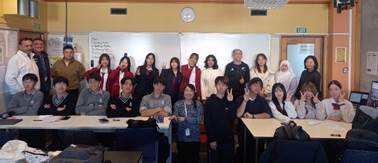
Figure
16: Waseda students and English language learners at UCOL after their
group activity
City Welcome Session
6.11 On 22
August 2025, Council hosted a City Welcome Session for new international
students in the Council Chamber. The event was coordinated by the International
Relations and Education Advisor and Community Development Advisor (Welcoming
Communities), in partnership with Rangitāne and the Maori Advisory team.
6.12 The
session brought together nearly 100 students from nine local education
institutions: Massey University, UCOL, IPU New Zealand, ETC, Pathways Bible
College, Awatapu College, Freyberg High School, Palmerston North Boys' High
School, and Palmerston North Girls' High School.
6.13 The event
provided an opportunity to formally welcome international learners to the city
and acknowledge their contribution to the community. Participating students
received goodie bags, and the session facilitated connections between students,
Council representatives, and local cultural leaders.
6.14 The
Welcoming Communities programme aims to foster a sense of belonging and
integration for newcomers, including migrants, former refugees, and
international students, through partnerships with local iwi and key community
stakeholders. This aligns with broader Council objectives of promoting
inclusivity, cultural exchange, and community engagement in Palmerston North.
6.15 Following
positive feedback from education providers and participants, Council plans to
establish this as an annual event, with the next session tentatively scheduled
for August 2026.
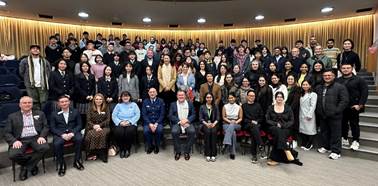
Figure
17: City Welcome Session participants in the Council Chamber
Visit by Embassy of Japan to
Palmerston North
6.16 On
5 September 2025, Council hosted Ms Takako Taguchi, Director of the Japan
Information and Cultural Centre at the Embassy of Japan, during her visit to
Palmerston North.
6.17 The visit
focused on engaging with Japanese language students at Palmerston North Boys'
High School and Freyberg High School. Ms Taguchi observed Year 9, 10, and 12
Japanese language classes, during which she promoted the Japan Exchange and
Teaching (JET) Programme and the Japanese-Language Proficiency Test (JLPT).
These initiatives encourage students to deepen their understanding of Japanese
language and culture while exploring future opportunities to study or work in
Japan.
6.18 The visit
aligns with Council's objectives of fostering international partnerships and
promoting cultural exchange. Palmerston North maintains a strong relationship
with the Embassy of Japan, strengthened through the sister city connection with
Mihara. Discussions during the visit explored potential areas of future
collaboration, including food security and resilience education and disaster
management expertise. This engagement reflects Palmerston North's commitment to
cultural diversity and to maintaining and expanding its relationship with
Japan.
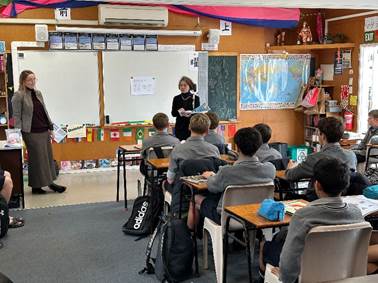
Figure
18: Director of Japan Information Culture Centre speaking to PNBHS
students
International Education
Forum
6.19 On 5 May
2025, Council hosted the International Education Forum in the Missoula Room,
bringing together education providers from across the region to discuss
strategic priorities for international education in Palmerston North. The forum
was attended by representatives from Massey University, UCOL, IPU New Zealand,
ETC, Whakarongo School, Palmerston North Boys' High School, Palmerston North
Girls' High School, Freyberg High School, Awatapu College, Queen Elizabeth
College and International Student Ministry. Mayor Smith opened the forum,
emphasising Council's commitment to the international education sector and the
city's ambition to position itself as a competitive study destination.
6.20 Key
discussion areas included student recruitment priorities, accommodation
challenges, market focus, pathways and retention, regional marketing, and
student experience. Providers expressed strong consensus on prioritising
long-term student enrolments over short-term groups, with accommodation
capacity, particularly homestay availability, identified as a critical
constraint. Schools highlighted their focus on markets including South Korea,
Thailand, Norway, Germany, and Switzerland, while tertiary providers outlined
diversification strategies targeting Nepal, Africa, India, and selective
recruitment from China. Concerns were raised about student retention, with
international students often relocating to Auckland after initial enrolment in
Palmerston North.
6.21 The forum
resulted in several action items to enhance the region's international
education offering. These included developing a coordinated regional
recruitment roadshow in partnership with Education New Zealand and relevant
embassies, creating promotional materials highlighting complete educational
pathways from primary to tertiary level, and reinstating Mayoral City Welcome
events for international students. Participants also discussed the need for
improved student experience initiatives, including holiday activities, sports
tournaments in partnership with Sport Manawatū, and the development of an
international student calendar of events.
6.22 A
significant outcome of the forum was the decision to disestablish the
International Education Leadership Group (IELG) that was stood up post-Covid
due to declining engagement and duplication with International Education
Manawatū (IEM). Moving forward, Council's International Relations and
Education Advisor will attend IEM meetings quarterly to ensure coordination
between Council initiatives and provider activities. This streamlined approach
aims to improve communication and strategic alignment across the sector.
6.23 Council
has committed to hosting this forum annually to establish priorities for
international education over the next 12 months and ensure continued
collaboration among providers. The forum format enables strategic dialogue
between education institutions and Council, facilitating coordinated approaches
to sector challenges and opportunities. This annual engagement reflects
Council's ongoing investment in international education as a key economic and
cultural contributor to the region.
Friendly School Agreement
Signed between Palmerston North and Fuzhou schools
6.24 Following
the signing of a Letter of Intent to cooperate in education between the cities
of Fuzhou and Palmerston North in December 2024, education collaboration
between the two cities progressed further with the signing of a Friendly School
Agreement (Attachment 2) between Queen Elizabeth College and Fuzhou No. 4 High
School Juyuanzhou campus in December 2025.
6.25 The
Friendly School Agreement establishes a framework for cooperation between the
two schools, with a focus on fostering student and teacher exchanges, cultural
understanding and educational collaboration. Importantly, the arrangements also
support international student recruitment pathways, creating opportunities for
students from Fuzhou to study in Palmerston North. These pathways strengthen
the city’s attractiveness as a destination for international secondary
students.
6.26 This
development demonstrates a tangible outcome of the 2024 Letter of Intent and
highlights the role of international education as both a people-to-people
connector and an economic enabler. It aligns with Palmerston North’s
internationalisation and economic development objectives by strengthening
education linkages with New Zealand’s biggest student source market,
enhancing the city’s global profile, supporting additional revenue for
local education providers as well as contributing to sustainable income streams
for local economy.
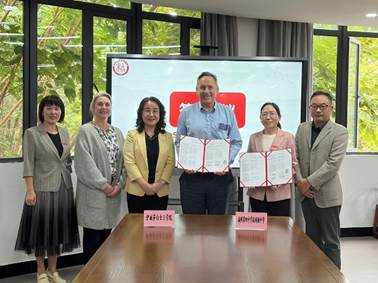
Figure
19 - Queen Elizabeth College's principal signed Friendly School Agreement in
Fuzhou
7. 2025-2026 annual plan – SUMMARY UPDATE
|
Timeline
|
Planned Activities
|
Status /Outcomes
|
|
July 2025
|
Guiyang Global
Youth Summer Camp
|
Completed
|
|
August 2025
|
Atomic Bomb Poster
Exhibition, commemorating the 8th anniversary of the U.S. bombing
of Hiroshima-Nagasaki
|
Completed
|
|
Facilitate
Waseda Study Group
|
Completed
|
|
ASEAN Forum 2025: 50 Years
+ $50 Billion
|
Completed
|
|
September 2025
|
Support City
Welcome Session
|
Completed
|
|
Launch 25/26 Global
Ambassador Programme
|
Cancelled due to lack of
response and personnel change
|
|
October 2025
|
Support Diwali
Mela
|
Completed
|
|
Support the Latin American
and Spanish Film Festival
|
Completed
|
|
1. November 2025
|
Support City
Welcome Session
|
Completed
|
|
December 2025
|
Fuzhou International
Friendship Cities Tourism & Cultures Festival
|
Postponed by partner to
2026
|
|
Guizhou
Gui-Series Brand Launch Event in Guiyang
17 December
2025
|
Declined
|
|
January 2026
|
Preparing for February
events
|
Progressing
|
|
February 2026
|
Support the
Lunar New Year Celebration
|
Progressing
|
|
Host an economic
development-focused delegation from Missoula to Palmerston North
|
Progressing
|
|
Host a 2-day
programme for the diplomatic delegation during the 2026 Festival of Cultures
|
Progressing in
partnership with CEDA
|
|
March
2026
|
Support Holi –
Festival of Light
|
Not yet started
|
|
Taipei Smart
Cities Summit & Expo
|
Progressing
|
|
April 2026
|
Regional International
Education Forum
|
Not yet started
|
|
May 2026
|
Lead an
Education Mission to Japan, South Korea and Thailand
|
Under
reconsideration
|
|
June 2026
|
Annual Plan 2026-2027
|
Not yet started
|
8. Compliance and administration
|
Does the Committee have
delegated authority to decide?
|
Yes
|
|
Are the decisions significant?
|
No
|
|
If they are significant do they
affect land or a body of water?
|
No
|
|
Can this decision only be made
through a 10 Year Plan?
|
No
|
|
Does this decision require consultation
through the Special Consultative procedure?
|
No
|
|
Is there funding in the current
Annual Plan for these objectives?
|
Yes
|
|
Are the recommendations
inconsistent with any of Council’s policies or plans?
|
No
|
|
The recommendations contribute
to:
Whāinga 1: He tāone auaha, he tāone
tiputipu
Goal 1: An innovative and growing city
|
|
The recommendations contribute to this
plan:
2. Mahere whakawhanake
ohaoha
2. Economic Development
Plan
The objective is:
- Support
international education and promote Palmerston North’s interests to
global partners
- Promote
Palmerston North’s interests to global city partners
- Facilitate
international economic and education partnerships with city institutions
- Manage
official delegations and relationships with the diplomatic corps
- Participate
in international forums and events
|
|
Contribution to strategic
direction and to social, economic, environmental and cultural well-being
|
The 6-monthly report on International
Relations and Education Activities outlines the progress of actions in the
International Relations Chapter, which contributes to the Economic
Development Plan and Innovative and Growing City Strategy.
|
|
|
|
Attachments
|
1.
|
ENZ - International Student
Expenditure Survey 2024 ⇩ 
|
|
|
2.
|
QEC - Fuzhou Friendly School
Agreement 2025 ⇩
|
|
|
3.
|
ENZ - International Student
Experience Survey 2025 ⇩
|
|


Committee Work
Schedule
TO: Finance,
Performance & Audit Committee
MEETING DATE: 4
March 2026
TITLE: Committee
Work Schedule
RECOMMENDATION(S) TO Finance, Performance & Audit Committee
1. That the
Finance, Performance & Audit Committee receive its Work Schedule dated
March 2026.
|
COMMITTEE
WORK SCHEDULE – MARCH 2026
|
|
|
Estimated
Report Date
|
Subject
|
Officer
Responsible
|
Current
Position
|
Date
of Instruction
|
|
|
|
|
|
|
|
|
1.
|
TBC
|
Breakdown of Fees and Charges – Planning Services
|
General Manager Corporate Services
|
Briefing
papers 3/12/25
|
4 June 2025
Clause 86-25
|
|
2.
|
4
March 2026
5
August 2026
|
Business
Assurance six monthly accountability report
|
General
Manager Corporate Services
|
Alignment with Committee
schedule
|
16
December 2020
Clause 68.2
|
|
3.
|
4
March 2026
|
Annual review of Council’s Risk Management Appetite
and Tolerance Levels
|
General
Manager Corporate Services
|
|
6
March 2024
Clause 4-24
|
|
4.
|
4
March 2026
|
New Zealand Food Awards - Annual Report
|
General Manager Customer & Community
|
|
31
May 2023
Clause 88.12-23
|
|
5.
|
4 March 2026
4 March 2026
3 June 2026
2 September 2026
2 December 2026
|
Health and Safety Quarterly Update
Q1 July to September 2025
Q2 October to December 2025
Q3 January to March 2026
Q4 April to June 2026
Q1 July to September 2026
|
General Manager People & Capability
|
Alignment with Committee
schedule
|
|
|
6.
|
4 March 2026
4 March 2026
3 June 2026
2 September 2026
2 December 2026
|
Wellbeing Quarterly Update
Q1 July to September 2025
Q2 October to December 2025
Q3 January to March 2026
Q4 April to June 2026
Q1 July to September 2026
|
General Manager People & Capability
|
Alignment with Committee
schedule
|
|
|
7.
|
4
March 2026
5 August 2026
|
International Relations and Education Activities –
six monthly update
|
General Manager Strategic Planning
|
Alignment with Committee
schedule
|
Terms of Reference
Council
Clause 203-23
|
|
8.
|
4
March 2026
|
Speed Management Plan – Hearings
|
General Manager Strategic Planning
|
|
28 May 2025
Clause 21
|
|
9.
|
4
March 2026
|
Speed Management Plan – Summary of Submissions
|
General Manager Strategic Planning
|
|
|
|
|
1
April 2026
3 June 2026
2 September 2026
2 December 2026
|
Strategic Risk Management Reporting
Q2 October to December 2025
Q3 January to March 2026
Q4 April to June 2026
Q1 July to September 2026
|
General Manager Corporate Services
|
|
Terms of Reference
|
|
10.
|
4
March 2026
1 April 2026
|
Tamakuku Terrace six monthly update FINAL
|
General Manager Infrastructure
|
Awaiting
final costs and reconciliation in order to be a full and final report of the
project
|
Terms
of Reference
|
|
11.
|
1 April 2026
|
Palmerston North Airport Limited – Six Month Report
and draft SOI
|
General Manager Corporate Services
|
|
Terms of Reference
|
|
12.
|
1
April 2026
|
Traffic situation and calming options for Ascot and
Pahiatua Streets
|
General Manager Infrastructure
|
Following specialist staff
recruitment
|
Economic Growth
11 June 2025
Clause 16-25
|
|
13.
|
1
April 2026
|
Speed Management Plan – Deliberations
|
General Manager Strategic Planning
|
|
20 August 2025
Clause 33
|
|
14.
|
1
April 2026
|
Featherston Street – Investigate options for bus and
vehicle pick-ups in green road reserve outside PNBHS
|
General Manager Infrastructure
|
|
Council
14 May 2025
Clause 78.10
|
|
15.
|
1
April 2026
|
CEDA – Six Month Report and draft SOI 2026-29
|
General Manager Strategic Planning
|
|
Terms of Reference
|
|
16.
|
1
April 2026
3 June 2026
2
September 2026
2
December 2026
|
Economic Report
Q2 October-December 2025
Q3 January-March 2026
Q4
April-June 2026
Q1 July to September 2026
|
General Manager Strategic Planning
|
|
Terms of Reference
|
|
17.
|
13 May 2026
5 August 2026
4
November 2026
|
Quarterly
Performance Report
Q3 January to March 2026
Q4 April to June 2026
Q1 July to September 2026
|
General
Manager Corporate Services
|
|
Terms
of Reference
Council
5 June 2024
Clause 104-24
|
|
18.
|
13 May 2026
5 August 2026
4 November 2026
|
Quarterly
Treasury Report
Q3 January to March 2026
Q4 April to June 2026
Q1 July to September 2026
|
General
Manager Corporate Services
|
|
Terms
of Reference
|
|
19.
|
13 May
2026
|
City Central Indicative Business Case (CCIBC) Update
|
General
Manager Strategic Planning
|
|
19
June 2024
Clause 42-24
|
|
20.
|
13 May
2026
|
Food HQ Innovation Limited – Director’s
company progress report
|
General Manager Infrastructure
|
Alignment with Committee
schedule
|
6 September 2023
Clause 143-23
|
|
21.
|
3 June
2026
|
Economic Profile: Agri-food (3 yearly)
|
General
Manager Strategic Planning
|
|
30
August 2023
Clause 35-23
|
|
22.
|
3 June
2026
|
Palmerston North Airport Ltd - Final Statement of Intent
for 2026-2029
|
General
Manager Corporate Services
|
|
Terms
of Reference
|
|
23.
|
3 June
2026
|
Additional lease or MaaS options to the PN City Council
fleet
|
General
Manager Corporate Services
|
|
20
August 2025
Clause 38
|
|
24.
|
3 June
2026
2
December 2026
|
Road Maintenance Contract (six monthly report on work
programme and performance)
|
General
Manager Infrastructure
|
|
16
March 2022
Clause 4-22
|
|
25.
|
3 June
2026
|
City Economic Structure Report (annually)
|
General Manager Strategic Planning
|
|
|
|
26.
|
3 June
2026
|
CEDA – Final Statement of Intent for 2026-2029
|
General Manager Strategic Planning
|
|
Terms of Reference
|
|
27.
|
5
August 2026
|
Review of cyber security
|
General Manager Corporate Services
|
Overview of Cyber Security
status was provided at June 2025 meeting; an audit to be scoped in 2026
|
6 March 2024
Clause 11-24
|
|
28.
|
5
August 2026
|
Review of Legal Compliance Framework
|
General Manager Corporate Services
|
|
26 April 2023 Clause 2-23
|
|
29.
|
5
August 2026
|
2026-2027 Annual Plan – International Relations
Activity
|
General Manager Strategic Planning
|
|
Council
5 June 2024
Clause 102-24
|
|
30.
|
2
September 2026
|
Review Annual Report
|
General Manager Corporate Services
|
|
Terms of Reference
|
|
31.
|
7
October 2026
|
Palmerston North Airport Ltd – Annual Report 2025/26
|
General Manager Corporate Services
|
|
Terms of Reference
|
|
32.
|
7
October 2026
|
Revenue & Finance Policy review
|
General Manager Corporate Services
|
|
|
|
33.
|
7
October 2026
|
Delegation Manual – Fees & Charges review
|
General Manager Corporate Services
|
Review alongside the Revenue and
Financing Policy
|
8 May 2024
Clause 24
|
|
34.
|
7
October 2026
|
CEDA – Annual Report 2025/26
|
General Manager Strategic Planning
|
|
Terms of Reference
|
|
35.
|
2
December 2026
|
Road Maintenance Contract (six monthly report on work
programme and performance)
|
General Manager Infrastructure
|
|
|
|
36.
|
2
December 2026
|
CEDA - Statement of Expectations 2027-2030
|
General Manager Strategic Planning
|
|
30 August 2023
Clause 37-23
|
|
37.
|
2
December 2026
|
Economic Profile: For purpose organisations (5 yearly)
|
General Manager Strategic Planning
|
|
30 August 2023
Clause 35-23
|
|
38.
|
Early
2026
|
Ratepayer Assistance Scheme - Progress of implementation
|
General Manager Corporate Services
|
Awaiting Minister decisions on
business case
|
6 August 2025
Clause
|
|
39.
|
Before
LTP 2027
|
Review the effects of the changes to the rating system
|
General Manager Corporate Services
|
|
Council
10 June 2024
Clause 111-24
|
|
40.
|
March
2027
|
Economic Profile: Tourism (3 yearly)
|
General Manager Strategic Planning
|
|
30 August 2023
Clause 35-23
|
|
41.
|
June
2027
|
Economic Profile: Logistics and Distribution (3 yearly)
|
General Manager Strategic Planning
|
|
30 August 2023
Clause 35-23
Schedule
|
|
42.
|
June
2027
|
Manawatū Regional Economic Structure Report (2
yearly)
|
General Manager Strategic Planning
|
|
30 August 2023
Clause 35-23
|
|
43.
|
October
2027
|
Review of Procurement and Investment Policies - ethical
investing
|
General Manager Corporate Services
|
|
3 September 2025
Clause 133-25
|
|
44.
|
As
required
|
Fraud and Whistleblowing Policy quarterly update
|
General Manager Corporate Services
|
When new matters arise
|
26 April 2023 Clause 12-23
|
|
45.
|
TBC
|
Review of Contract Management Framework
|
General Manager Corporate Services
|
To be reviewed with Business
Assurance work plan
|
26 April 2023 Clause 2-23
|
|
46.
|
TBC
|
Report back on Investment options for Palmerston North
Airport Ltd
|
General Manager Corporate Services
|
|
6 December 2023
Clause 197-23
|
|
47.
|
TBC
|
City Centre (Streets for People) 6 monthly update
|
General Manager Infrastructure
|
Paused until Steering Group
reconvenes
|
Terms of Reference
28 February 2024
Clause 18-24
|
|
48.
|
TBC
|
Annual presentation: The Factory
|
|
|
|