Finance, Performance &
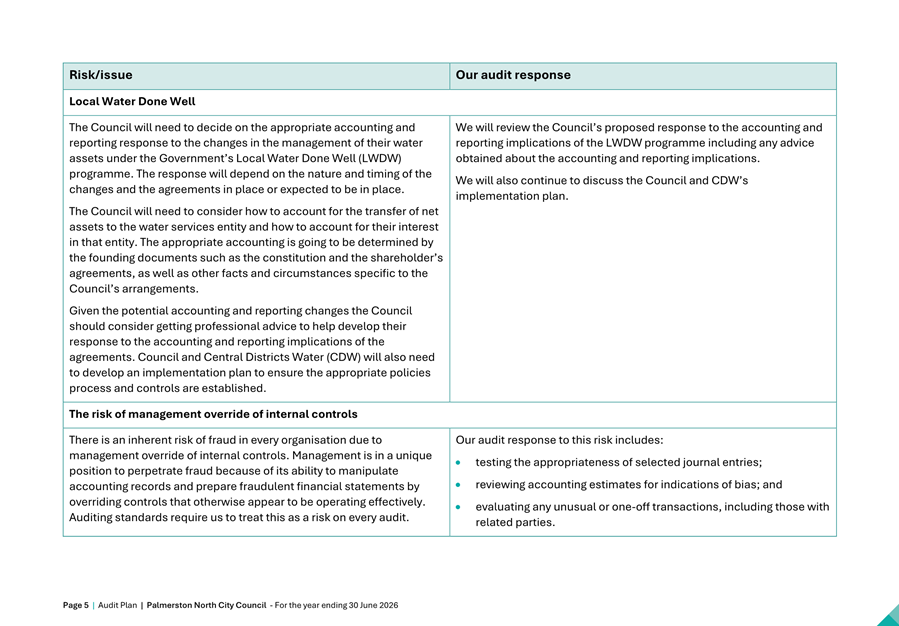
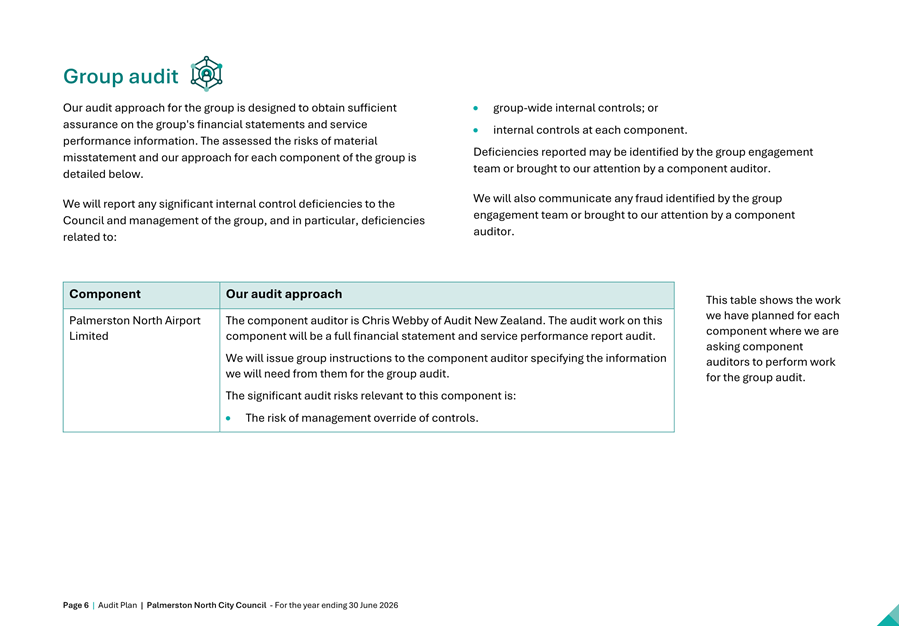
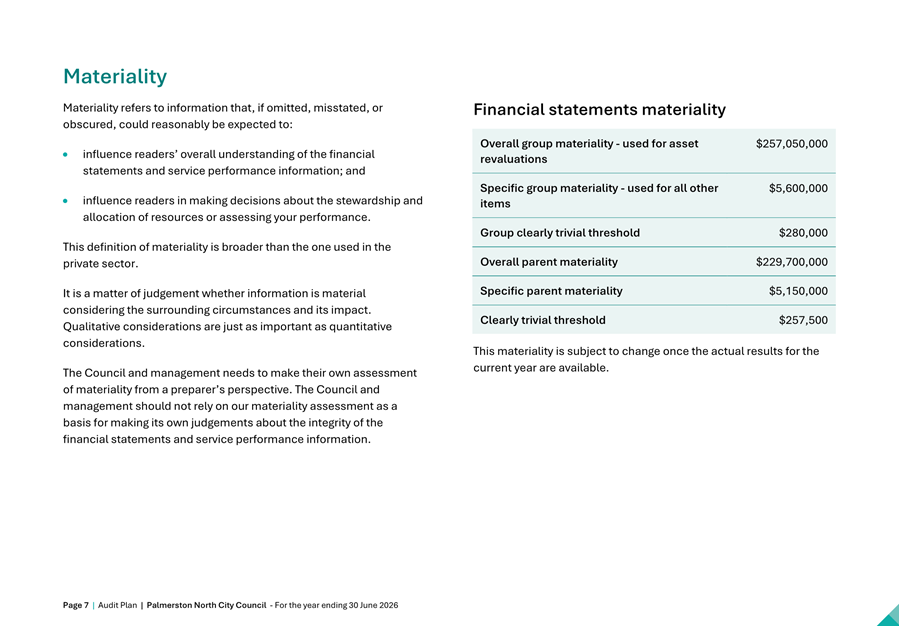
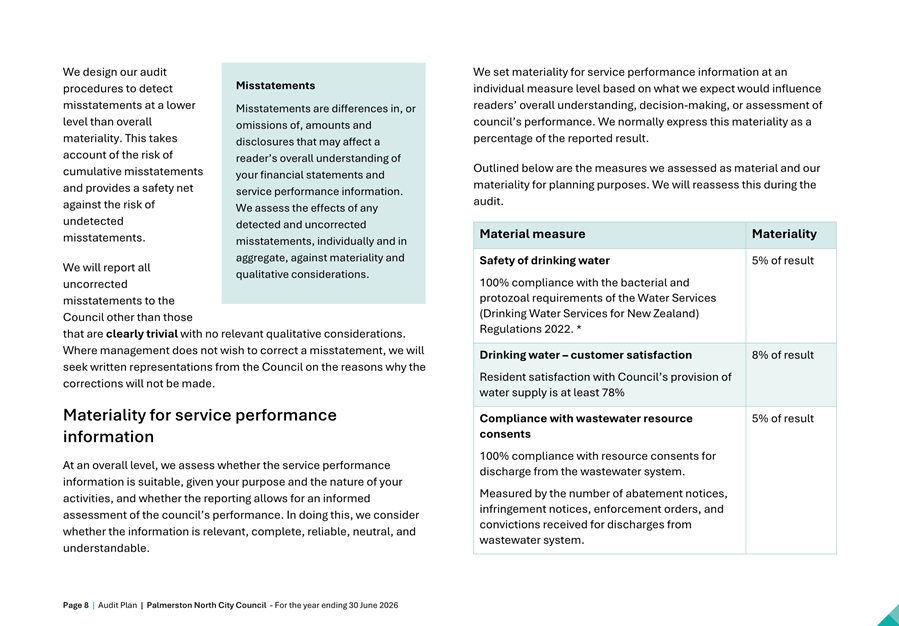
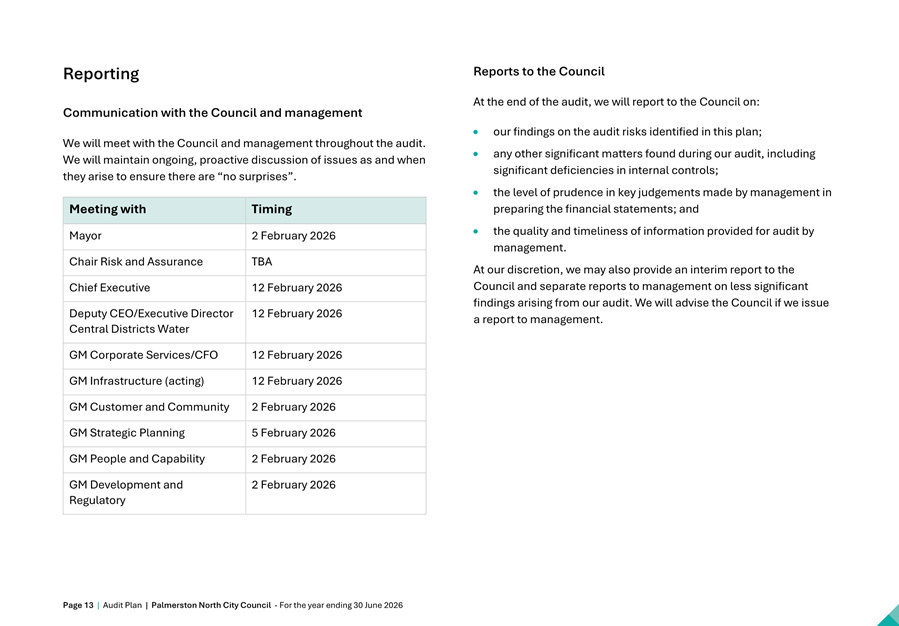
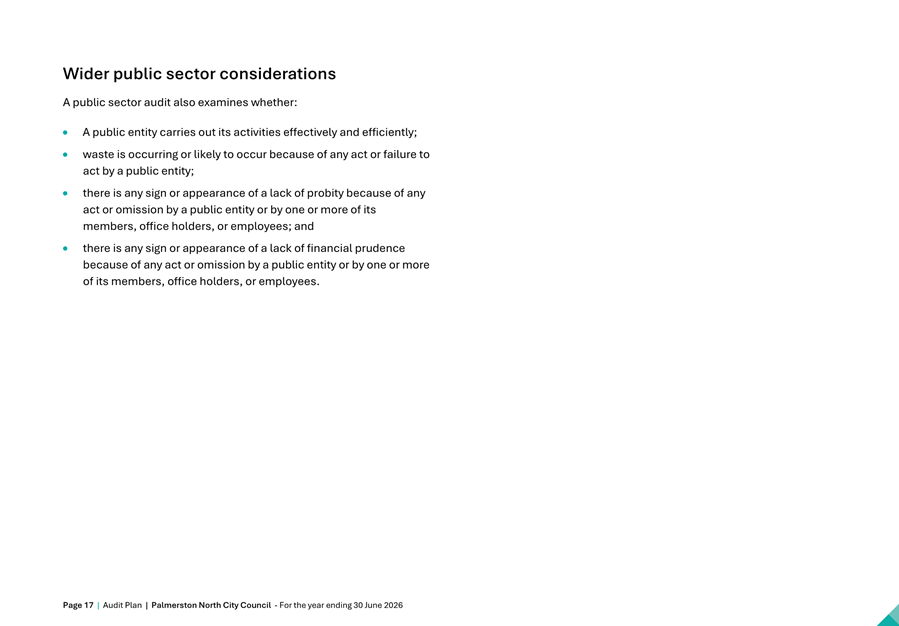
Audit Committee
|
Vaughan Dennison (Chair)
|
|
Karen Naylor (Deputy Chair)
|
|
Grant Smith (The Mayor)
|
|
Mark Arnott
|
Bonnie Kuru
|
|
Brent Barrett
|
Debi Marshall-Lobb
|
|
Lew Findlay (QSM)
|
Billy Meehan
|
|
Hayden Fitzgerald
|
Orphée Mickalad
|
|
Leonie Hapeta
|
William Wood
|
|
Lorna Johnson
|
Kaydee Zabelin
|
Finance, Performance & Audit Committee MEETING
1 April 2026
Order of Business
1. Karakia
Timatanga
2. Apologies
3. Notification
of Additional Items
Pursuant to
Sections 46A(7) and 46A(7A) of the Local Government Official Information and
Meetings Act 1987, to receive the Chairperson’s explanation that
specified item(s), which do not appear on the Agenda of this meeting and/or the
meeting to be held with the public excluded, will be discussed.
Any
additions in accordance with Section 46A(7) must be approved by resolution with
an explanation as to why they cannot be delayed until a future meeting.
Any
additions in accordance with Section 46A(7A) may be received or referred to a
subsequent meeting for further discussion. No resolution, decision or
recommendation can be made in respect of a minor item.
4. Declarations
of Interest (if any)
Members
are reminded of their duty to give a general notice of any interest of items to
be considered on this agenda and the need to declare these interests.
5. Public
Comment
To receive
comments from members of the public on matters specified on this Agenda or, if
time permits, on other Committee matters.
6. Confirmation
of Minutes Page 7
That the minutes of the Finance, Performance &
Audit Committee meeting of 4 March 2026 Part I Public be confirmed as a true
and correct record.
7. Audit
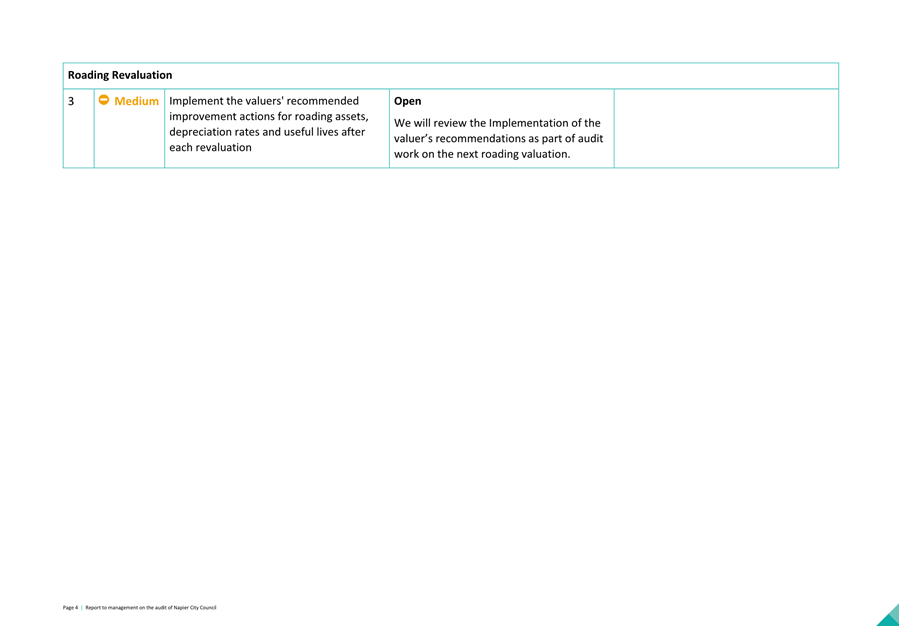
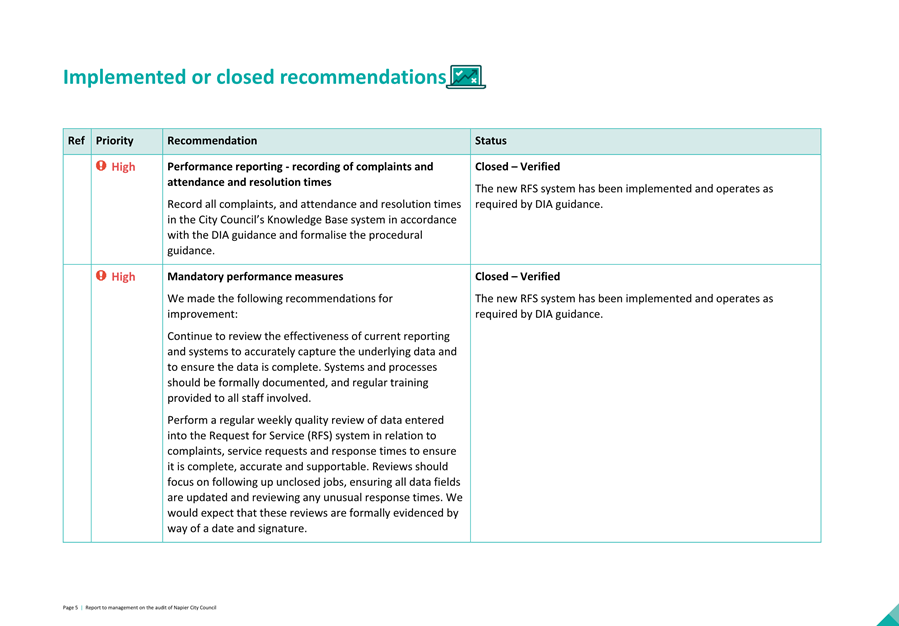
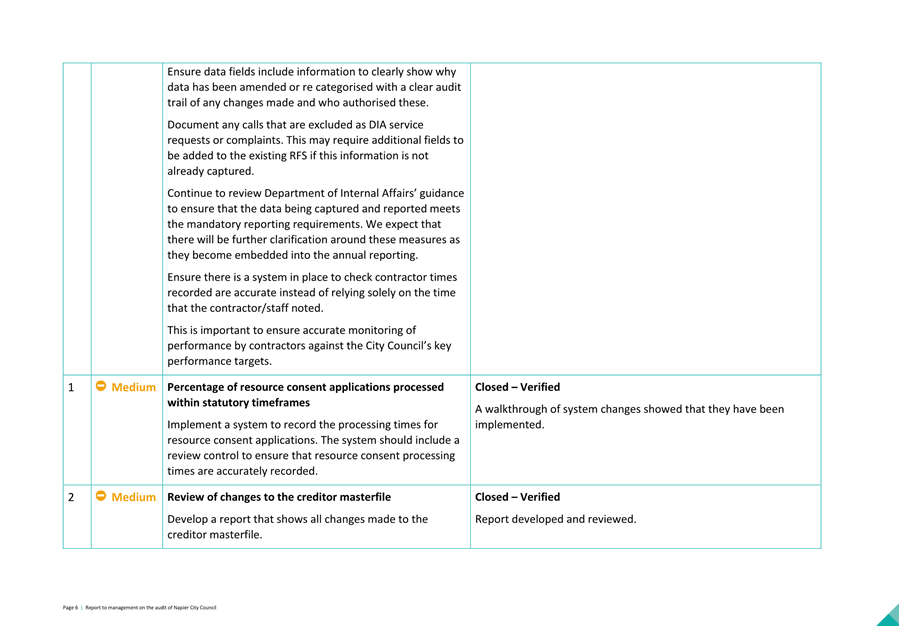
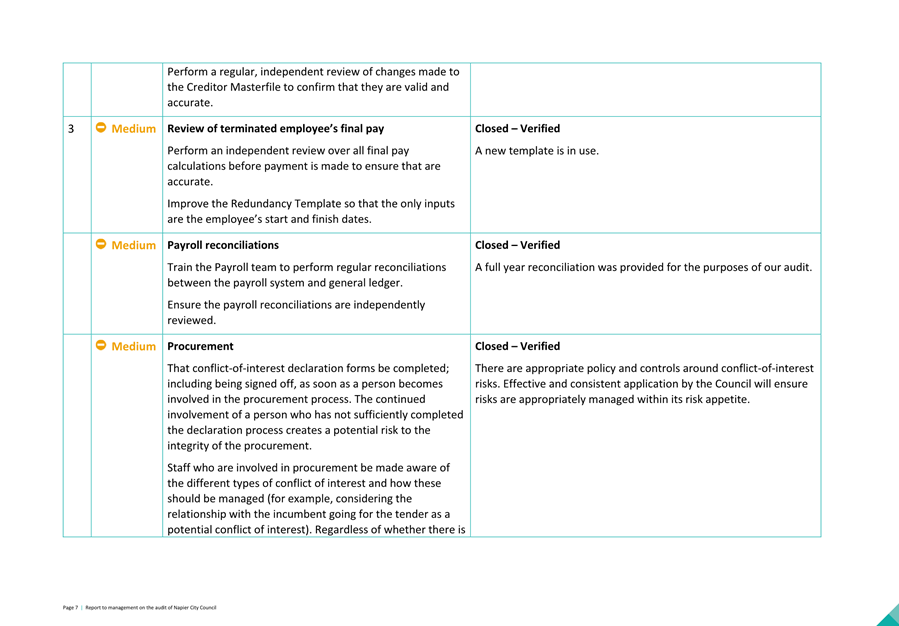
New Zealand 2025 Management Report Page 15
Memorandum,
presented by Scott Mancer, Manager Finance and Debbie Perera, Audit Director,
Audit New Zealand.
8. Audit
New Zealand 2025/26 Financial Year Audit Plan Page 39
Memorandum,
presented by Scott Mancer, Manager Finance and Chris Webby, Audit Director,
Audit New Zealand.
9. Palmerston
North Airport Limited - Interim report for six months ending 31 December 2025 Page 65
Memorandum,
presented by Steve Paterson, Manager - Financial Strategy.
10. Palmerston
North Airport Limited - Draft Statement of Intent for 2026/27 to 2028/29 Page 69
Memorandum,
presented by Steve Paterson, Manager - Financial Strategy.
11. Draft
Speed Management Plan - deliberations on submissions and adoption Page 77
Report,
presented by Peter Ridge, Manager Strategy and Policy.
12. Central
Economic Development Agency (CEDA): 6 month report 1 July 2025 to 31 December
2025 and Draft Statement of Intent 2026/27 Page 91
Memorandum,
presented by David Murphy, General Manager Strategic Planning.
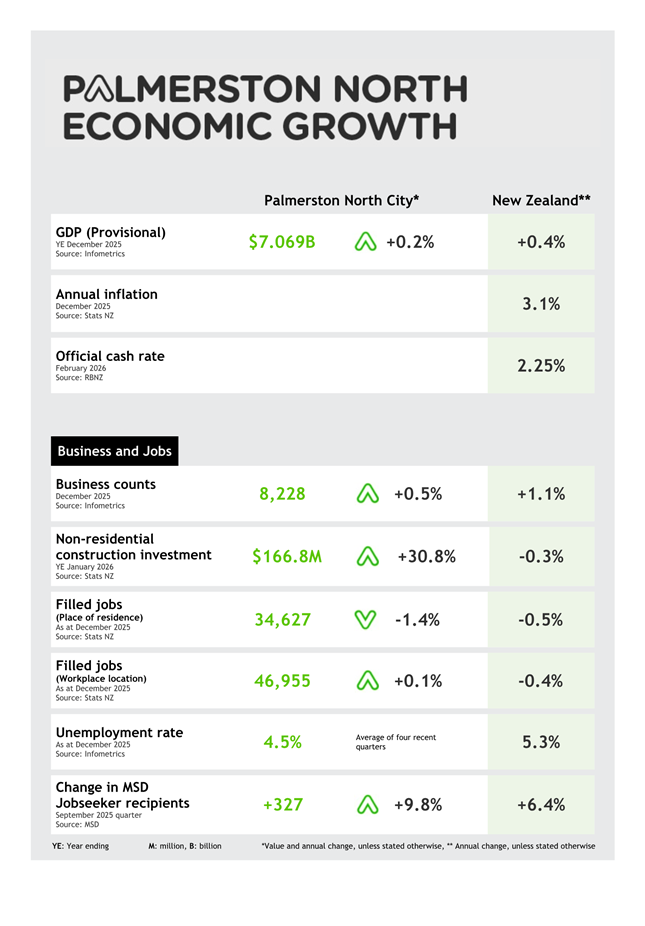
13. Palmerston
North Quarterly Economic Update - April 2026 Page 99
Memorandum,
presented by Stacey Andrews, City Economist.
14. Manderson
Private District Plan Change acceptance and notification approval Page 125
Memorandum,
presented by Simon Mori, Principal Planner and Jono Ferguson-Pye, Manager City
Planning.
15. Plan
Change Tahi - Review of Designation to Public Notification Page 129
Memorandum,
presented by Haechang Kwon, Planner and Jono Ferguson-Pye, Manager City
Planning.
16. Traffic
situation and calming options for Ascot and Pahiatua Streets Page 135
Report,
presented by Tyler da Silva, Acting Transport and Development Manager.
17. Committee
Work Schedule Page 141
18. Strategic
Risk Management Reporting October to December 2025 (Quarter 2) Page 149
Memorandum,
presented by Stephen Minton, Risk Management Advisor.
19. Karakia
Whakamutunga
20. Exclusion of Public
|
|
That the public be excluded from the
following parts of the proceedings of this meeting listed in the table below.
The general subject of each matter to be
considered while the public is excluded, the reason for passing this
resolution in relation to each matter, and the specific grounds under Section
48(1) of the Local Government Official Information and Meetings Act 1987 for
the passing of this resolution are as follows:
|
General subject of each matter to be
considered
|
Reason for passing this resolution in
relation to each matter
|
Ground(s) under Section 48(1) for
passing this resolution
|
|
18.
|
Strategic Risk Management Reporting October to
December 2025 (Quarter 2)
Confidential Attachment 1
|
It is to the greater public interest that
Council information security processes and any risks are discussed
confidentially, as failure to manage and safely protect Council information
could result in breaches under the Privacy Act and Public Records Act, as
well as significant disruption to Council services.
|
S7(2)(a) PRIVACY
S7(2)(c)(ii) PREVENT DAMAGE TO THE PUBLIC INTEREST
S7(2)(e) PREVENT MATERIAL LOSS TO THE PUBLIC
|
|
|
|
|
This resolution is made in reliance on
Section 48(1)(a) of the Local Government Official Information and Meetings
Act 1987 and the particular interest or interests protected by Section 6 or
Section 7 of that Act which would be prejudiced by the holding of the whole
or the relevant part of the proceedings of the meeting in public as stated in
the above table.
Also that the persons listed below be
permitted to remain after the public has been excluded for the reasons
stated.
[Add Third Parties], because
of their knowledge and ability to assist the meeting in speaking to their
report/s [or other matters as specified] and answering questions, noting that
such person/s will be present at the meeting only for the items that relate
to their respective report/s [or matters as specified].
|
Palmerston North City Council
Minutes of
the Finance, Performance & Audit Committee Meeting Part I Public, held in
the Council Chamber, First Floor, Civic Administration Building, 32 The Square,
Palmerston North on 04 March 2026, commencing at 9.00am
|
Members Present:
|
Councillor Vaughan Dennison (in the
Chair), The Mayor (Grant Smith) and Councillors Karen Naylor, Mark Arnott,
Brent Barrett, Lew Findlay, Hayden Fitzgerald, Leonie Hapeta, Lorna Johnson,
Bonnie Kuru, Debi Marshall-Lobb, Billy Meehan, William Wood and Kaydee
Zabelin.
|
|
Apologies:
|
Councillors Lorna Johnson and Kaydee
Zabelin (early departure, on Council business), Councillor Orphée Mickalad (late arrival).
|
|
|
Karakia Timatanga
Councillor Debi Marshall-Lobb opened the
meeting with karakia.
|
|
1-26
|
Apologies
|
|
|
Moved
Vaughan Dennison, seconded Karen Naylor.
The COMMITTEE RESOLVED
1. That the
Committee receive the apologies.
|
|
|
Clause 1-26 above was
carried 14 votes to 0, the voting being as follows:
For:
The Mayor (Grant Smith) and
Councillors Vaughan Dennison, Karen Naylor, Mark Arnott, Brent Barrett, Lew
Findlay, Hayden Fitzgerald, Leonie Hapeta, Lorna Johnson, Bonnie Kuru, Debi
Marshall-Lobb, Billy Meehan, William Wood and Kaydee Zabelin.
|
|
|
Declarations of Interest
|
|
|
Councillor Debi Marshall-Lobb declared an interest in Item
15 (Six-monthly report on International Relations and Education Activities)
and stated she would consider the item with an open mind.
|
|
2-26
|
Speed
Management Plan - Hearing of Submissions
|
|
|
Moved
Vaughan Dennison, seconded Karen Naylor.
The COMMITTEE RESOLVED
1. That the Finance, Performance & Audit
Committee receive the submissions and hear submissions from presenters who indicated
their wish to be heard in support of their submission.
2. That the Committee note the Procedure for Hearing
of Submissions, as described in the procedure sheet.
|
|
|
Clause 2-26 above was
carried 14 votes to 0, the voting being as follows:
For:
The Mayor (Grant Smith) and
Councillors Vaughan Dennison, Karen Naylor, Mark Arnott, Brent Barrett, Lew
Findlay, Hayden Fitzgerald, Leonie Hapeta, Lorna Johnson, Bonnie Kuru, Debi
Marshall-Lobb, Billy Meehan, William Wood and Kaydee Zabelin.
|
|
|
The Committee considered submissions on the Speed
Management Plan with supporting oral statements including additional tabled
material (appended to these Minutes).
The
following persons appeared before the Committee and made oral statements in
support of their submissions and replied to questions from Elected Members.
Steve
Wrathall (170)
Steve spoke to his submission and made the following
additional comment:
· Allowing
drivers to get where they want to at reasonable speeds actually improves
driver behaviour and increases respect for the law and for existing speed
limits; in contrast, forcing drivers to travel at unreasonably slow speeds
decreases driver compliance and increases tiredness and frustration.
St
James Catholic School (Andy Whitson) (173)
Andy spoke to their submission, provided additional
material, and made the following additional comments:
· Referenced
example of parent who wears a high visibility vest while walking with his
daughter to and from St James school, due to safety concerns around the speed
with which some motorists pass through this area (refer tabled photograph).
· Spoke
of an incident in Auckland recently where a student on road patrol was hit by
a car.
Turitea
School (Troy Duckworth, Principal) (40) and Fraser Ponsford (73)
Troy and Fraser spoke to their submissions and made the
following additional comments:
· Propose
a reduced speed zone at Turitea School during pick up/drop off times of
8.15-9.15am and 2.45pm-3.15pm.
· They
don’t want a fatality to be the thing that effects change.
Catherine
Millar (45)
Catherine spoke to her submission and made the following
additional comments:
· Throughout
New Zealand 36% of crashes are rural and 71% of those crashes result in
deaths; there is a higher hit rate in rural communities than in urban
centres.
· Long
term a roundabout at the intersection of Longburn-Rongotea Road and No. 1
Line is supported, especially given Longburn-Rongotea Road will be a huge
part of the proposed ring road around Palmerston North, meaning there will
always be a high volume of traffic. This remediation is at least five
years away.
City to
Sea Rail Trust – Manawatū (Alice Williamson) (137)
Alice spoke to their submission and provided additional
material, appended to these Minutes. She made no additional comments.
Max the
Plumber Ltd (Max Lichtnecker) (157)
Max spoke to his submission and made the following
additional comments:
· Would
like to see a 70-80km zone on Longburn-Rongotea Road, No. 1 Line on all sides
of the junction, as there is a lack of visibility due to the bridge.
· Rumble
strips would help make motorists aware of the Stop sign ahead, like there is
at the Karere Road intersection.
· It
would be a lot easier for New Zealanders to have a consistently standardised
system with a 70km zone approaching all major intersections.
· Would
like to have the no engine braking signs moved to before Reserve Road,
further away from the residential properties, to reduce noise and improve
safety.
Peter
French (177)
Peter spoke to his submission, providing additional
material noting earlier start and closing times for schools in the area, and
made the following additional comment:
· Suggest
Council staff contact the 40 schools again to obtain more information about
foot and vehicle traffic at both the start and close of the day.
RACE
Group & Kikiwhenua Group Ltd (Glenn Young) (179)
Glenn spoke to their submission and made no additional
comments.
Lorraine
Cook (145)
Lorraine spoke to her submission and made the following
additional comment:
· Noted reduced speed
areas in other cities have the effect of making things feel calm, traffic
moves smoothly, does not cause disruption.
|
|
3-26
|
Speed
Management Plan - Summary of Submissions
Memorandum, presented by
Peter Ridge, Acting Manager Strategy and Policy and James Miguel, Senior
Transport Planner.
Councillor
Orphée Mickalad entered the meeting at 10.05am.
|
|
|
Moved
Vaughan Dennison, seconded Karen Naylor.
The COMMITTEE RESOLVED
1. That the
Committee receive the memorandum titled ‘Speed Management Plan –
Summary of Submissions’ presented to the Finance, Performance &
Audit Committee on 4 March 2026.
|
|
|
Clause 3-26 above was
carried 15 votes to 0, the voting being as follows:
For:
The Mayor (Grant Smith) and
Councillors Vaughan Dennison, Karen Naylor, Mark Arnott, Brent Barrett, Lew Findlay,
Hayden Fitzgerald, Leonie Hapeta, Lorna Johnson, Bonnie Kuru, Debi
Marshall-Lobb, Billy Meehan, Orphée Mickalad, William Wood and Kaydee
Zabelin.
|
|
4-26
|
Setting
Council's Risk Management Appetite and Tolerance Levels
Memorandum, presented by
Stephen Minton, Risk Management Advisor.
|
|
|
Moved Vaughan Dennison, seconded Karen Naylor.
The COMMITTEE
RECOMMENDS
1. That Council
re-confirm the risk appetite and risk tolerance levels as noted in section
4.1 and 4.2 of the memorandum titled ‘Setting Council’s Risk
Management Appetite and Tolerance Levels’ presented on 4 March 2026.
|
|
|
Clause 4.1-26 above was carried 13 votes to 2, the
voting being as follows:
For:
The Mayor (Grant Smith) and
Councillors Vaughan Dennison, Karen Naylor, Mark Arnott, Lew Findlay, Leonie
Hapeta, Lorna Johnson, Bonnie Kuru, Debi Marshall-Lobb, Billy Meehan,
Orphée Mickalad, William Wood and Kaydee Zabelin.
Against:
Councillors Brent Barrett and Hayden Fitzgerald.
|
|
|
Moved
Vaughan Dennison, seconded Karen Naylor.
2. That Council
agree to review risk appetite and tolerance levels triennially hereafter.
|
|
|
Clause 4.2-26 above was carried 10 votes to 5, the
voting being as follows:
For:
The Mayor (Grant Smith) and
Councillors Vaughan Dennison, Karen Naylor, Mark Arnott, Lew Findlay, Hayden
Fitzgerald, Leonie Hapeta, Billy Meehan, Orphée Mickalad and William
Wood.
Against:
Councillors Brent Barrett,
Lorna Johnson, Bonnie Kuru, Debi Marshall-Lobb and Kaydee Zabelin.
|
The meeting adjourned
at 10.41am.
The meeting resumed at 11.00am.
|
5-26
|
New
Zealand Food Awards - Annual Report
Report, presented by Jessica
Papple, Manager Marketing and Rebekah Sulman, Associate Director Events and
Sponsorships, Massey University.
Councillors
Lorna Johnson and Kaydee Zabelin left the meeting at 11.30am.
|
|
|
Moved William Wood, seconded Hayden Fitzgerald.
The COMMITTEE
RECOMMENDS
1. That
the Committee decline the request to sponsor the
New Zealand Food Awards.
|
|
|
Clause 5-26
above was carried 7 votes to 6, the voting being as follows:
For:
Councillors
Karen Naylor, Mark Arnott, Brent Barrett, Lew Findlay, Hayden Fitzgerald,
Orphée Mickalad and William Wood.
Against:
The Mayor (Grant
Smith) and Councillors Vaughan Dennison, Leonie Hapeta, Bonnie Kuru, Debi
Marshall-Lobb and Billy Meehan.
|
|
|
Moved Vaughan Dennison, seconded Grant Smith.
|
|
|
Note:
On a motion:
‘That the Committee refer the continuation of Programme 2446 of up to
$64k over three years to support the New Zealand Food Awards as part of the
Annual Budget 2026/27 deliberations in May’, the motion was lost 6
votes to 7, the voting being as follows:
For:
The Mayor (Grant
Smith) and Councillors Vaughan Dennison, Brent Barrett, Leonie Hapeta, Bonnie
Kuru and Debi Marshall-Lobb.
Against:
Councillors
Karen Naylor, Mark Arnott, Lew Findlay, Hayden Fitzgerald, Billy Meehan,
Orphée Mickalad and William Wood.
|
|
6-26
|
Business
Assurance Accountability Report
Memorandum, presented by Emy
Bastillo, Internal Auditor/Business Assurance Advisor & Desiree Viggars,
Manager Legal Risk & Assurance.
Councillors Lorna Johnson
and Kaydee Zabelin entered the meeting again at 12.00pm.
Councillor
Leonie Hapeta left the meeting at 12.11pm.
|
|
|
Moved
Vaughan Dennison, seconded Karen Naylor.
The COMMITTEE RESOLVED
1. That the Committee
receive the memorandum titled ‘Business
Assurance Accountability Report’ presented on 4 March 2026.
|
|
|
Clause 6-26 above was
carried 12 votes to 2, the voting being as follows:
For:
The Mayor (Grant Smith) and
Councillors Vaughan Dennison, Karen Naylor, Brent Barrett, Lew Findlay, Lorna
Johnson, Bonnie Kuru, Debi Marshall-Lobb, Billy Meehan, Orphée
Mickalad, William Wood and Kaydee Zabelin.
Against:
Councillors Mark Arnott and
Hayden Fitzgerald.
|
|
7-26
|
Health
and Safety Report, 1 July to 30 September 2025 (Quarter 1) and
Health
and Safety Report, 1 October to 31 December 2025 (Quarter 2)
Memorandums, presented by Danny
Kidd, Health and Safety Advisor and Sarah Morris, General Manager People
& Capability.
|
|
|
Moved
Vaughan Dennison, seconded Karen Naylor.
The COMMITTEE RESOLVED
1. That the
Committee receive the memorandums titled ‘Health and Safety Report, 1
July to 30 September 2025 (Quarter 1)’ and ‘Health and Safety
Report, 1 October to 31 December 2025 (Quarter 2)’ presented to the
Finance, Performance & Audit Committee on 4 March 2026.
|
|
|
Clause 7-26 above was
carried 14 votes to 0, the voting being as follows:
For:
The Mayor (Grant Smith) and
Councillors Vaughan Dennison, Karen Naylor, Mark Arnott, Brent Barrett, Lew
Findlay, Hayden Fitzgerald, Lorna Johnson, Bonnie Kuru, Debi Marshall-Lobb,
Billy Meehan, Orphée Mickalad, William Wood and Kaydee Zabelin.
|
The
meeting adjourned at 1.04pm.
The meeting resumed at
2.00pm.
Councillor
Leonie Hapeta was present when the meeting resumed.
Councillor Orphée
Mickalad was not present when the meeting resumed.
|
8-26
|
Wellbeing
Report, 1 July to 30 September 2025 (Quarter 1) and
Wellbeing
Report, 1 October to 31 December 2025 (Quarter 2)
Memorandums, presented by
Connie Roos, Manager Employee Experience and Wayne Wilson, Manager People
Operations.
Officers noted the following
updates to the reports:
Quarter 1 Report: Table
5 Turnover
25/26 Sep 1/4
Employee Initiated: 20 should
read 12
%: 15.2% should read
8.4%
Quarter 2 Report: Table
5 Turnover
25/26 Sep 1/4
Employee Initiated: 20 should
read 12
%: 15.2% should read
8.4%
25/26 Dec 1/4
Employee Initiated: 15 should read 21
|
|
|
Moved
Vaughan Dennison, seconded Kaydee Zabelin.
The COMMITTEE RESOLVED
1. That the
Committee receive the memorandums titled ‘Wellbeing Report, 1 July to
30 September 2025 (Quarter 1)’ and ‘Wellbeing Report, 1 October
to 31 December 2025 (Quarter 2)’ presented to the Finance, Performance
& Audit Committee on 4 March 2026.
|
|
|
Clause 8-26 above was
carried 14 votes to 0, the voting being as follows:
For:
The Mayor (Grant Smith) and
Councillors Vaughan Dennison, Karen Naylor, Mark Arnott, Brent Barrett, Lew
Findlay, Hayden Fitzgerald, Leonie Hapeta, Lorna Johnson, Bonnie Kuru, Debi
Marshall-Lobb, Billy Meehan, William Wood and Kaydee Zabelin.
|
|
9-26
|
Six-monthly
report on International Relations and Education Activities
Memorandum, presented by Gabrielle
Loga, Manager International Relations and Kunal Chonkar, International
Relations and Education Advisor.
Councillor
Orphée Mickalad entered the meeting at 2.14pm.
|
|
|
Moved
Vaughan Dennison, seconded Leonie Hapeta.
The COMMITTEE RESOLVED
1. That the
Committee receive the ‘Six-monthly report on International Relations
and Education Activities’, presented on 4 March 2026.
|
|
|
Clause 9-26 above was
carried 15 votes to 0, the voting being as follows:
For:
The Mayor (Grant Smith) and
Councillors Vaughan Dennison, Karen Naylor, Mark Arnott, Brent Barrett, Lew
Findlay, Hayden Fitzgerald, Leonie Hapeta, Lorna Johnson, Bonnie Kuru, Debi
Marshall-Lobb, Billy Meehan, Orphée Mickalad, William Wood and Kaydee
Zabelin.
Note:
Councillor Debi Marshall-Lobb declared
an interest and stated she would consider the item with an open mind.
|
|
10-26
|
Committee
Work Schedule
|
|
|
Moved
Vaughan Dennison, seconded Leonie Hapeta.
The COMMITTEE RESOLVED
1. That the
Finance, Performance & Audit Committee receive its Work Schedule dated
March 2026.
|
|
|
Clause 10-26 above was
carried 15 votes to 0, the voting being as follows:
For:
The Mayor (Grant Smith) and
Councillors Vaughan Dennison, Karen Naylor, Mark Arnott, Brent Barrett, Lew
Findlay, Hayden Fitzgerald, Leonie Hapeta, Lorna Johnson, Bonnie Kuru, Debi
Marshall-Lobb, Billy Meehan, Orphée Mickalad, William Wood and Kaydee
Zabelin.
|
|
|
Karakia Whakamutunga
Councillor Debi Marshall-Lobb closed the
meeting with karakia.
|
The meeting finished at 2.26pm.
Confirmed 1 April 2026
Chair
Memorandum
TO: Finance,
Performance & Audit Committee
MEETING DATE: 1
April 2026
TITLE: Audit
New Zealand 2025 Management Report
PRESENTED BY: Scott
Mancer, Manager Finance and Debbie Perera, Audit Director, Audit New Zealand
APPROVED BY: Cameron
McKay, General Manager Corporate Services
RECOMMENDATION(S) TO Finance, Performance & Audit Committee
1. That
the Committee receive the memorandum titled ‘Audit New Zealand 2025
Management Report’ presented to the Finance, Performance & Audit
Committee on 1 April 2026.
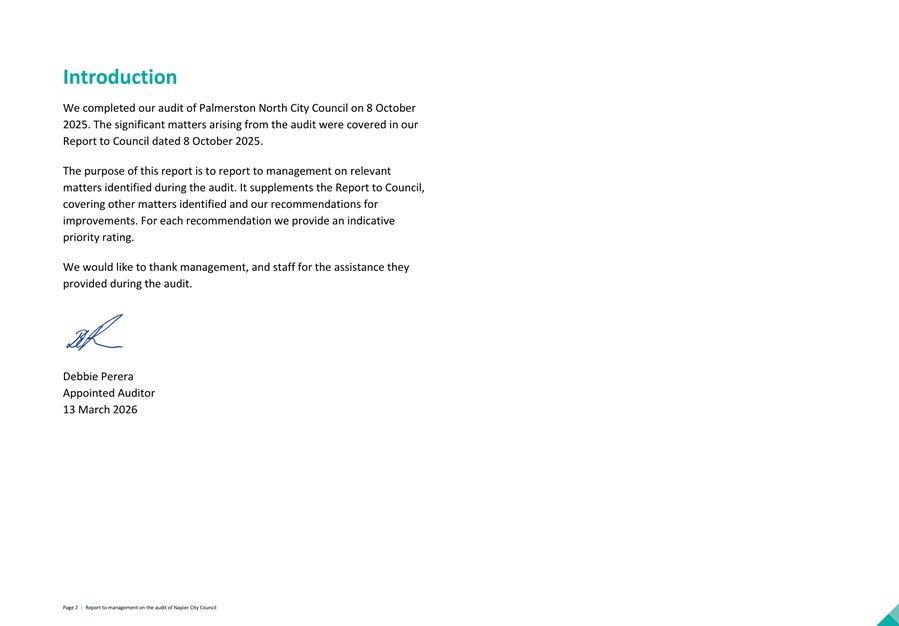
1. ISSUE
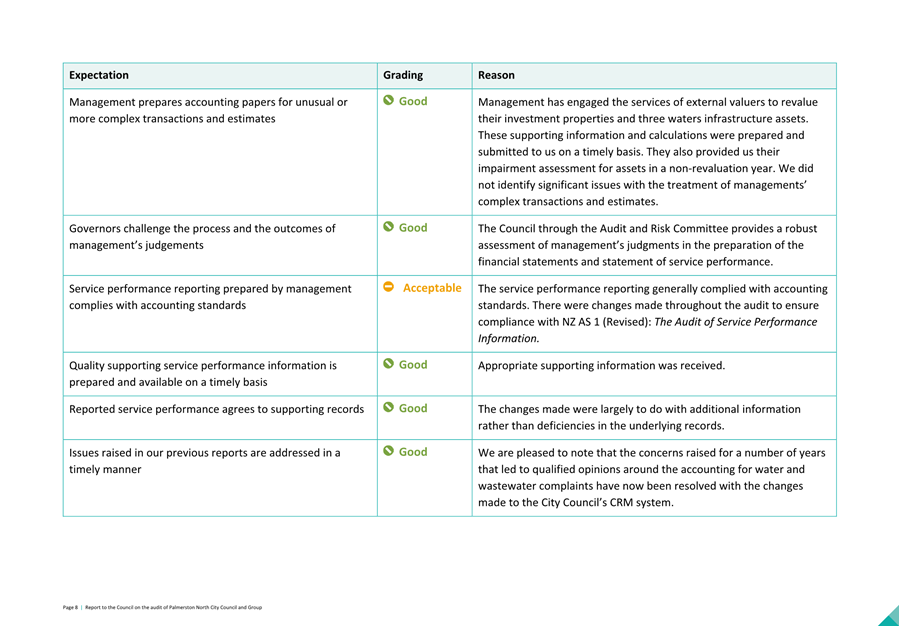
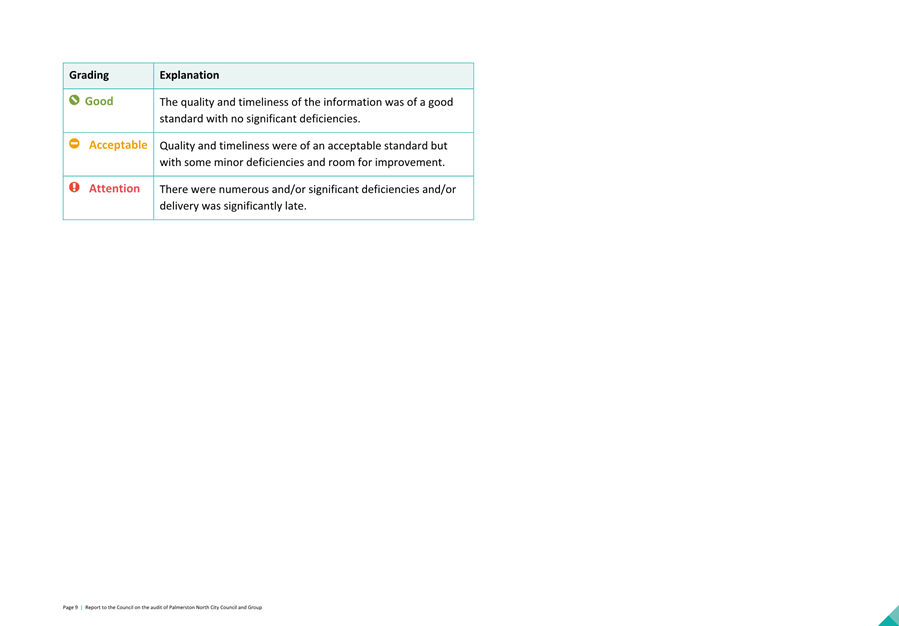
Audit New Zealand undertook the annual Statutory Financial
Statement Audit for Year End 30 June 2025.
As part of the annual audit,
each year Audit New Zealand produces an Audit Management Report providing an
overview of the audit and outlining any matters from the audit, and an
assessment of Council’s internal controls. Recommendations for
improvements are included in this report, along with progress against previous
recommendations raised in prior audits.
In February 2026 Audit New
Zealand released a draft management report for the June 2025 audit. This
report was finalised by Audit New Zealand on 15 March 2026 (Attachment 1).
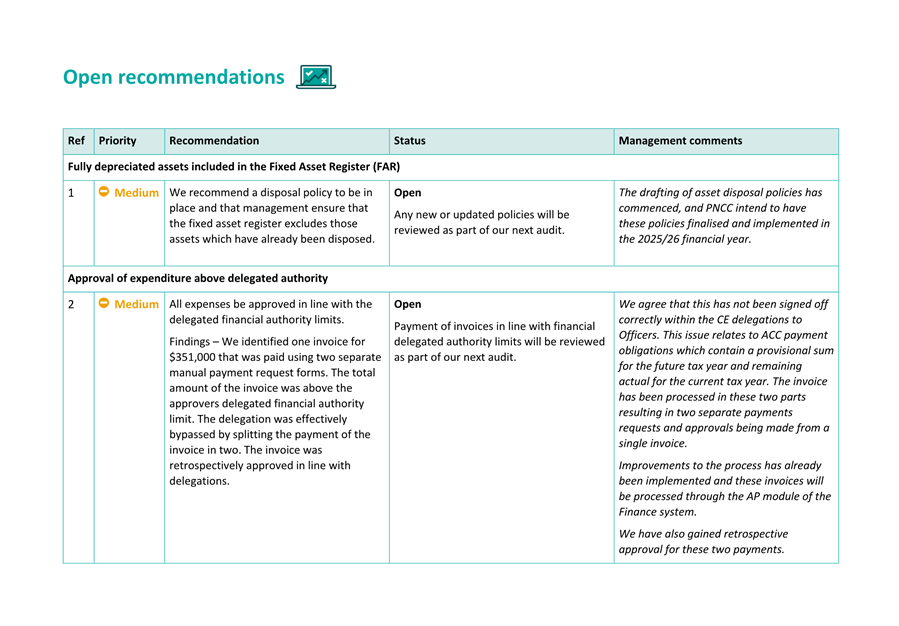
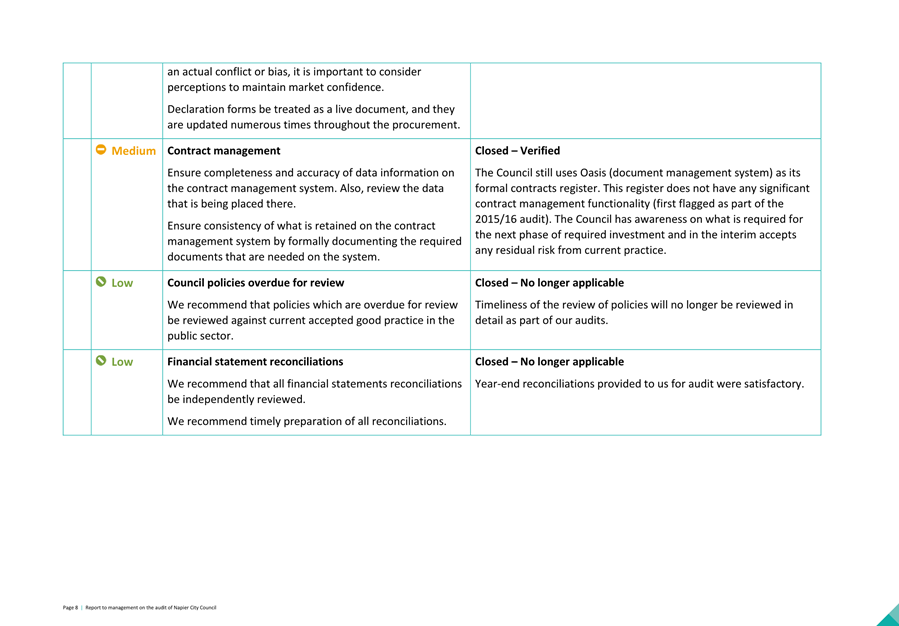
The issues remaining open on
the Management Letter have either been resolved already or are already being
reported on through the accountability reporting. A large number of items (10)
were closed due to the progress in the 2024/25 financial year.
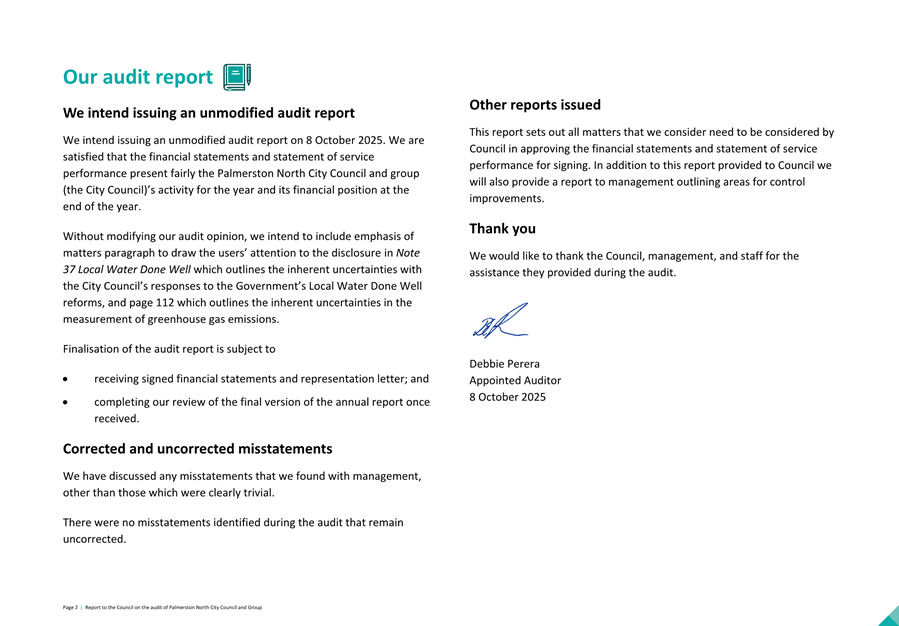
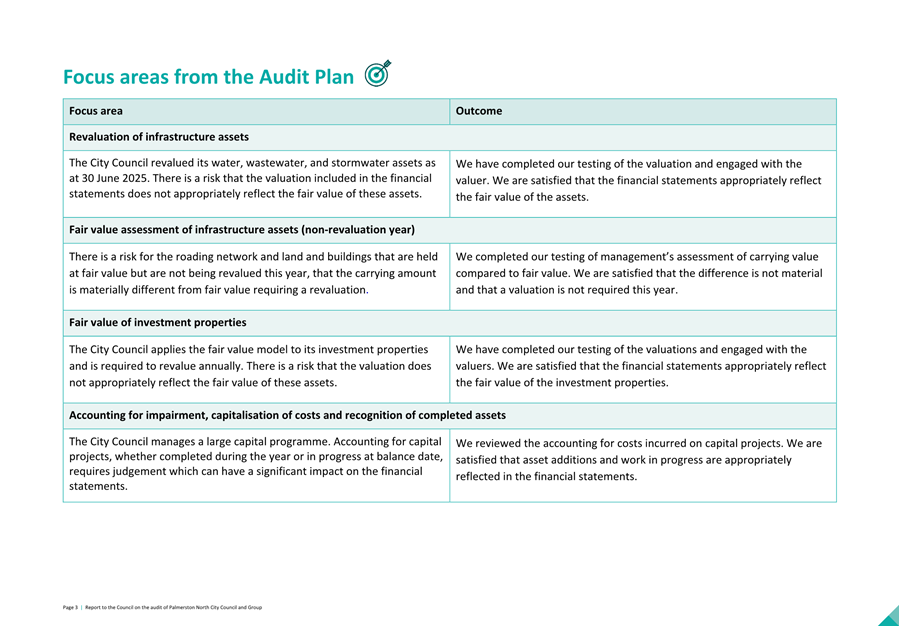
Audit New Zealand have refined
the approach to reporting to governors on audit work completed and key focus
areas. A separate report to governors is now also produced (Attachment 2).
2. BACKGROUND
Officers have noted that a
number of items were closed through the audit with a small number of new items
raised. New and outstanding items are in progress and expected to be closed
during the upcoming audit.
3. NEXT
STEPS
Regular reporting will continue
through the Accountability Report of the outstanding issues.
4. Compliance
and administration
|
Does the Committee have
delegated authority to decide?
|
Yes
|
|
Are the decisions significant?
|
No
|
|
If they are significant do they
affect land or a body of water?
|
No
|
|
Can this decision only be made
through a 10 Year Plan?
|
No
|
|
Does this decision require
consultation through the Special Consultative procedure?
|
No
|
|
Is there funding in the current
Annual Plan for these objectives?
|
Yes
|
|
Are the recommendations
inconsistent with any of Council’s policies or plans?
|
No
|
|
The recommendations contribute
to:
Not
Applicable
|
|
The recommendations contribute
to the achievement of objective/objectives in:
14. Mahere mana urungi,
kirirarautanga hihiri
14. Governance and Active
Citizenship Plan
The objective is: Oversee
Council operations and communicate outcomes and decisions to our communities.
|
|
Contribution to strategic
direction and to social, economic, environmental and cultural well-being
|
Business Assurance aims to help
the Council succeed by building trust and confidence in the core controls
relied on by management and governance.
|
|
|
|
Attachments
|
1.
|
Audit New
Zealand 2025 Report to Management ⇩ 
|
|
|
2.
|
Audit New
Zealand 2025 Report to Governors ⇩
|
|
Memorandum
TO: Finance,
Performance & Audit Committee
MEETING DATE: 1
April 2026
TITLE: Audit
New Zealand 2025/26 Financial Year Audit Plan
PRESENTED BY: Scott
Mancer, Manager Finance and Chris Webby, Audit Director, Audit New Zealand
APPROVED BY: Cameron
McKay, General Manager Corporate Services
RECOMMENDATION(S)
TO Finance, Performance &
Audit Committee
1. That the Committee receive the
Audit Plan for the 2025/26 Financial Year from our appointed auditor –
Audit New Zealand, presented to the Finance, Performance & Audit Committee
on 1 April 2026.
1. ISSUE
Palmerston North City Council
must undergo a legislative audit at the completion of each financial year. This
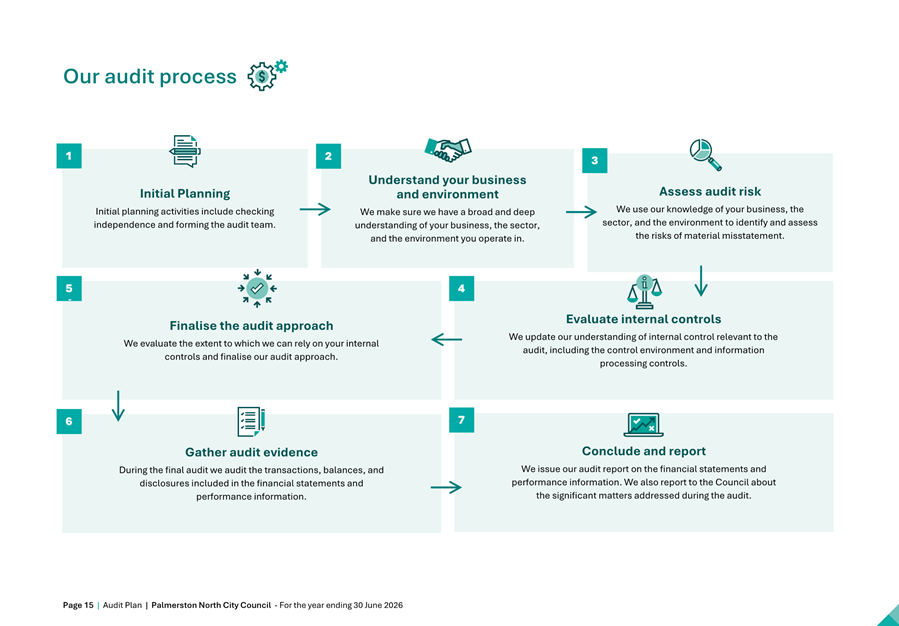
report outlines the key focus areas for the upcoming audit as well as the
attached Audit Plan.
2. BACKGROUND
Council’s appointed
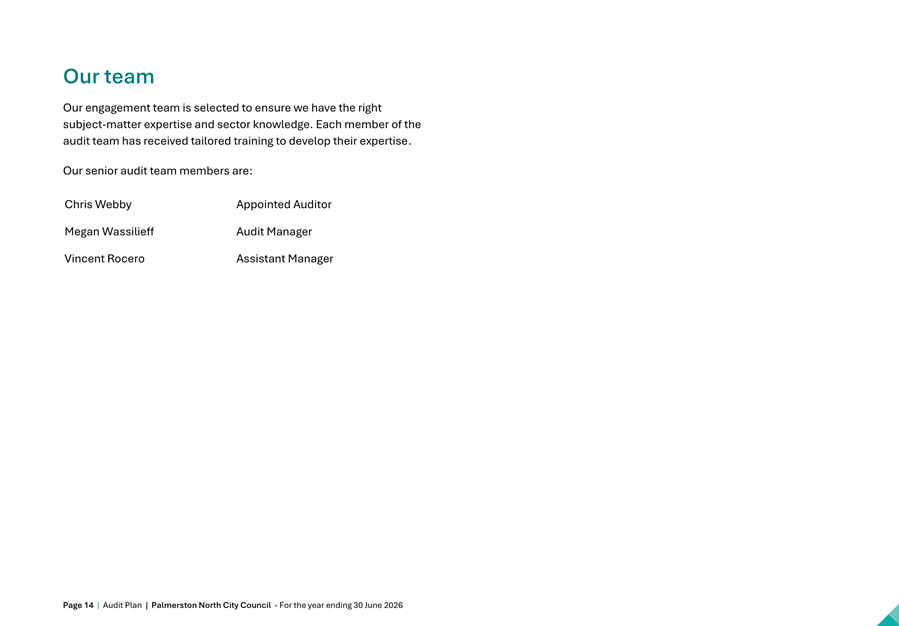
auditor is Chris Webby, Audit Director, Audit New Zealand.
For the upcoming audit, the
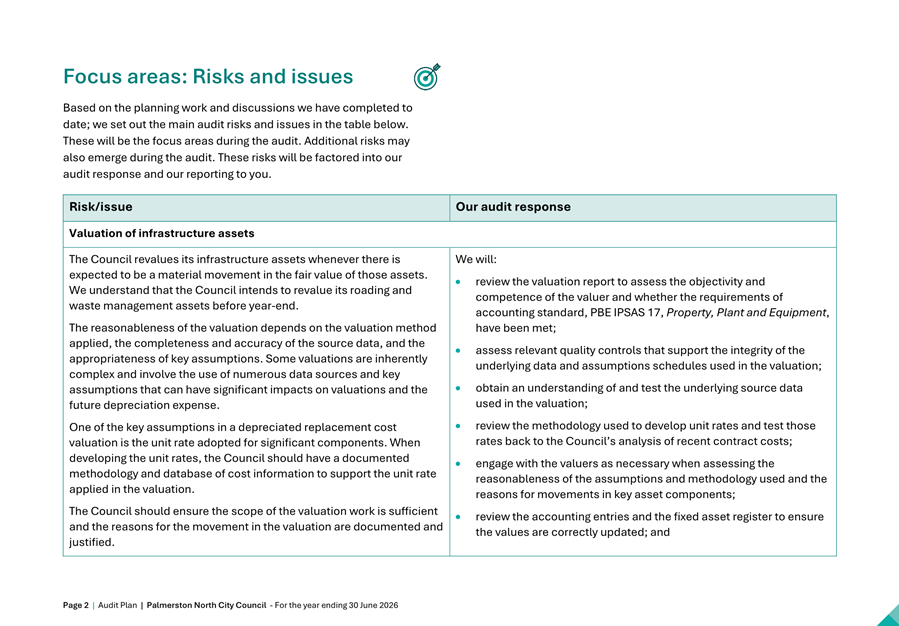
following areas have been highlighted as a key focus, based on the work that
the Office of the Auditor General has undertaken in planning for the audits of
the Local Government sector.
Key focus areas for 2025/26
Audit:
i) Valuation
of infrastructure assets – Roading & Waste Management
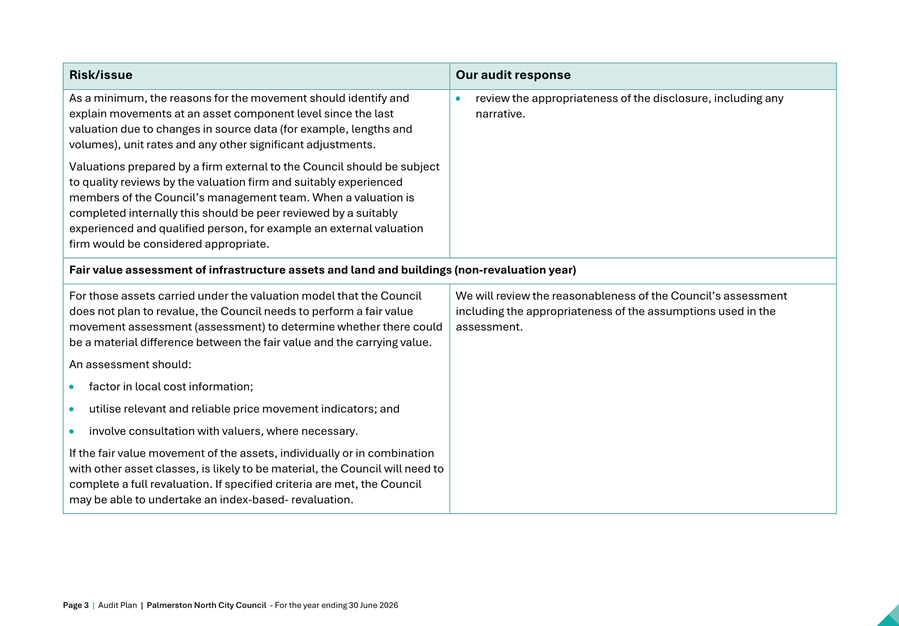
ii) Fair
value assessment of infrastructure assets, land and buildings (non-revaluation
year)
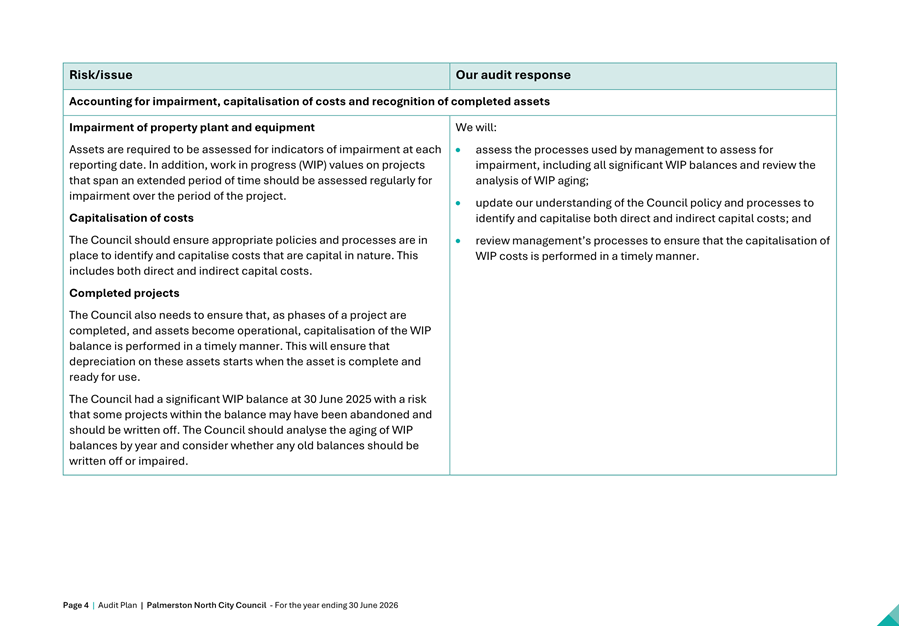
iii) Accounting
for impairment, capitalisation of costs and recognition of completed assets
iv) Local
Water Done Well
v) The
risk of management override of internal controls
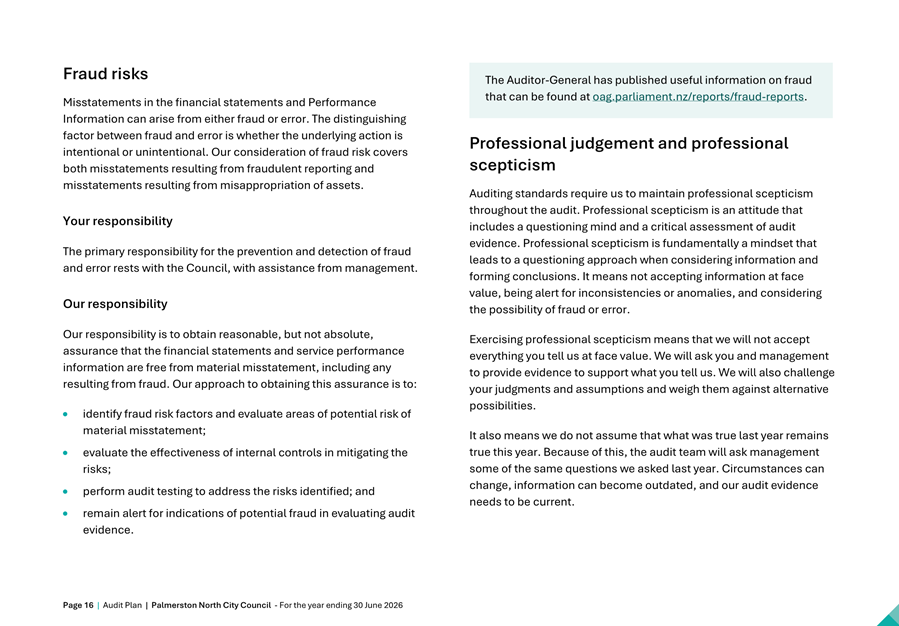
Other areas of focus for the
wider public sector, as part of a public sector audit examines whether:
i) A
public entity carries out its activities effectively and efficiently.
ii) Waste
is occurring or likely to occur because of any act or failure to act by a
public entity
iii) There
is a sign or appearance of a lack or probity because of any act or omission by
a public entity or by one or more of its members, office holders, or employees
iv) There
is any sign or appearance of a lack of financial prudence because of any act or
omission by a public entity or by one or more of its members, office holders,
or employees.
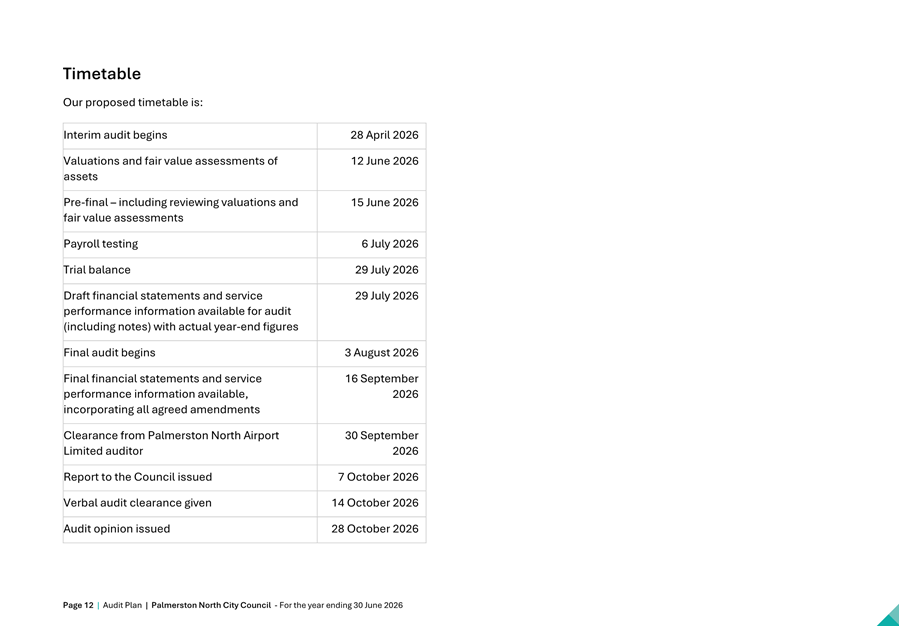
The attached audit plan
outlines the full detail of the items above, including further details on the
full plan. The timetable is included it the table below, as well as in the
attachment.
|
Table 1: Audit Timeline
|
Date
|
|
Planning meetings
|
February
2026
|
|
Interim audit begins
|
28
April 2026
|
|
Finance Performance & Audit
Committee – Audit Plan
|
1
April 2026
|
|
Valuations and fair value assessments
of assets
|
12
June 2026
|
|
Pre-Final audit
|
15
June 2026
|
|
Draft Financial Statements
available for Audit (including notes) with actual year-end figures
|
29
July 2026
|
|
Final Audit begins
|
3
August 2026
|
|
Final Financial Statements
available, incorporating all agreed amendments
|
16
September 2026
|
|
Clearance from Palmerston North
Airport Limited auditor
|
30
September 2026
|
|
Report to the Council issues
|
7
October 2026
|
|
Verbal audit clearance given
|
14
October 2026
|
|
Audit opinion issued
|
28
October 2026
|
3. NEXT
STEPS
The end of year audit will be
undertaken by the auditors and any new issues (if applicable) will be reporting
to the Finance, Performance & Audit Committee following the adoption of the
Annual Report 2025/26.
The Annual Report 2025/26 is
scheduled to be approved for adoption by the Finance, Performance & Audit
Committee on 14 October 2026 and adopted by Council on 28 October 2026.
4. Compliance
and administration
|
Does the Committee have
delegated authority to decide?
|
Yes
|
|
Are the decisions significant?
|
No
|
|
If they are significant do they
affect land or a body of water?
|
No
|
|
Can this decision only be made
through a 10 Year Plan?
|
No
|
|
Does this decision require
consultation through the Special Consultative procedure?
|
No
|
|
Is there funding in the current
Annual Plan for these objectives?
|
Yes
|
|
Are the recommendations
inconsistent with any of Council’s policies or plans?
|
No
|
|
The recommendations contribute
to:
Not Applicable.
|
|
The recommendations contribute
to the achievement of objective/objectives in:
14. Mahere mana urungi,
kirirarautanga hihiri
14. Governance and Active
Citizenship Plan
The objective is: Oversee
Council operations and communicate outcomes and decisions to our communities.
|
|
Contribution to strategic
direction and to social, economic, environmental and cultural well-being
|
The Business Assurance
function of Council aims to enable Council to succeed by building trust and
confidence in the core controls that are relied on by management and
governance.
|
|
|
|
Attachments
|
1.
|
2025/26
Financial Year Audit Plan ⇩
|
|
Memorandum
TO: Finance,
Performance & Audit Committee
MEETING DATE: 1
April 2026
TITLE: Palmerston
North Airport Limited - Interim report for six months ending 31 December 2025
PRESENTED BY: Steve
Paterson, Manager - Financial Strategy
APPROVED BY: Cameron
McKay, General Manager Corporate Services
RECOMMENDATION(S)
TO Finance, Performance &
Audit Committee
1. That the Committee receive the
Interim Report and Financial Statements of Palmerston North Airport Ltd for the
period ended 31 December 2025, presented to the Finance, Performance &
Audit Committee on 1 April 2026.
1. ISSUE
1.1 Palmerston
North Airport Ltd (PNAL), as a Council-Controlled Organisation, is required to
provide a 6-monthly report to Council. The report for the period ending
31 December 2025 is attached.
2. BACKGROUND
2.1 PNAL
draft Statement of Intent (SOI) for 2025/26 was considered by Council in April
2025 and the final SOI was agreed to by Council in June 2025.
2.2 Performance
for the six-month period to 31 December 2025 is covered in the attached report
by the Chair and Chief Executive.
2.3 Key
matters highlighted in the report include:
• Continuing
suppressed passenger demand (but still close to budget assumptions).
• Commenced
construction of stage 1 of the Terminal development project and a 5,000m2
purpose-built warehouse facility (with Freightways as anchor tenant).
• Arrangement
of new credit lines with banks to supplement the line provided through the
Council.
• Recertification
at Level 4 of the Airport Carbon Accreditation programme a retention of Qualmark
Gold certification.
• Key
performance targets (apart from passenger movements and net promoter score
result) have all been achieved for the six months.
• Capital
expenditure for the 6 months ($7.3m) was 34% less than the SOI assumed due to
timing differences for the start of the construction of the terminal and
warehouse.
2.5 At
31 December PNAL had drawn a total of $23.5m through the debt facility made
available by the Council. No further sums are planned to be drawn before
30 June 2026 as PNAL intend to use the new facility from Industrial and
Commercial Bank of China for the time being.
2.6 As
earlier agreed with Council a dividend of $300,000 has been paid in relation to
the 2024/25 year and a $400,000 dividend is anticipated to be declared for
2025/26, payable in 2026/27 as assumed in Council’s draft annual budget
for 2026/27.
2.7 PNAL
has prepared its draft SOI for the 2026/27 – 2028/29 period and this is
being considered under a separate report.
3. NEXT
STEPS
3.1 PNAL
will prepare and forward an annual report after 30 June 2026.
4. Compliance
and administration
|
Does the Committee have
delegated authority to decide?
|
Yes
|
|
Are the decisions significant?
|
No
|
|
If they are significant do they
affect land or a body of water?
|
No
|
|
Can this decision only be made
through a 10 Year Plan?
|
No
|
|
Does this decision require consultation
through the Special Consultative procedure?
|
No
|
|
Is there funding in the current
Annual Plan for these objectives?
|
Yes
|
|
Are the recommendations
inconsistent with any of Council’s policies or plans?
|
No
|
|
The recommendations contribute
to:
Whāinga 1: He tāone
auaha, he tāone tiputipu
Goal 1: An innovative and growing city
|
|
The recommendations contribute
to the achievement of objective/objectives in:
3. Mahere tūnuku
3.
Transport Plan
The action is: Work with the
airport company to ensure the airport’s strategic intent aligns with
the City’s aspirations.
|
|
Contribution to strategic
direction and to social, economic, environmental and cultural well-being
|
This report outlines progress
to date.
|
|
|
|
Attachments
|
1.
|
PNAL
interim report for six months ending 31 December 2025 (attached separately) 
|
|
Memorandum
TO: Finance,
Performance & Audit Committee
MEETING DATE: 1
April 2026
TITLE: Palmerston
North Airport Limited - Draft Statement of Intent for 2026/27 to 2028/29
PRESENTED BY: Steve
Paterson, Manager - Financial Strategy
APPROVED BY: Cameron
McKay, General Manager Corporate Services
RECOMMENDATION(S)
TO Finance, Performance &
Audit Committee
1. That the
Committee receive the Palmerston North Airport Limited (PNAL) draft Statement
of Intent for 2026/27 to 2028/29, presented to the Finance, Performance &
Audit Committee on 1 April 2026.
2. That
Palmerston North Airport Limited be advised:
(a) Council
supports the proposed direction and implementation strategy;
(b) Council
recognises the projected requirement for loans totalling $73.4m by 30
June 2027 and that Palmerston North Airport Limited will be seeking to utilise
the loan facility provided by the Council to fund a portion of this and the
remainder through external bank facilities.
1. ISSUE
1.1 To
present and provide comment on the draft Statement of Intent for Palmerston
North Airport Limited (PNAL) for 2026/27 and the following two years.
2. BACKGROUND
2.1 PNAL
is deemed a Council-Controlled Trading Organisation (CCTO) under the Local
Government Act 2002. A CCTO must deliver a draft Statement of Intent
(SOI) to shareholders by 1 March each year and adopt it by 30 June. The
Council must, as soon as possible after a draft SOI is delivered to it, agree
to a CCTO’s SOI or, if it does not agree, take all practicable steps
under clause 6 of Schedule 8 of the Local Government Act 2002 to require the
SOI to be modified. The Board of the CCTO must consider any shareholder
feedback by 1 May 2026.
2.2 The
Council’s reason for its shareholding in PNAL is to ensure that the
capacity and image of the City’s key transportation gateway is consistent
with the Council’s economic development objectives.
2.3 As
a CCTO PNAL is required under the Local Government Act 2002 to have the
following principal objective:
• Achieve
the objectives of its shareholders, both commercial and non-commercial, as
specified in the Statement of Intent; and
• Be a
good employer; and
• Exhibit
a sense of social and environmental responsibility by having regard to the
interests of the community in which it operates and by endeavouring to
accommodate or encourage these when able to do so; and
• Conduct
its affairs in accordance with sound business practice.
2.4 Council’s
shareholding represents 100% of the issued and paid-up capital.
2.5 On
8 October 2025 the Council adopted a Statement of Expectations for PNAL and
this was provided to PNAL in advance of its development of the draft SOI.
3. DRaft soi – overview
3.1 Attached
is a letter from PNAL to shareholders (Attachment 1) explaining the enclosed
draft SOI (Attachment 2) and outlining the key assumptions.
3.2 The
draft SOI retains the vision from the current year, ‘New Zealand’s
leading regional airport’, and the purpose statement, ‘Launching
our communities into a promising future’, as well as the five strategic
objectives.
3.3 The
SOI addresses all of the matters outlined in Council’s Statement of
Expectations.
3.4 It
has been assumed there will be an approx. 5% growth in passenger numbers to
537,000 in 2028/29 off a base of 511,000 in 2025/26 with the bulk of the growth
being in the latter part of the three-year period.
3.5 Aeronautical
revenues are budgeted to increase by $3.1m over the three-year period and
whilst movements in costs are variable, the reasons are explained in the
covering letter and on page 21 of the SOI.
3.6 The
three-year budgets assume capital development totalling $59m (including
terminal ($18.5m), Ruapehu Aeropark ($24.7m), airside infrastructure ($4.5m),
landside infrastructure ($3.3m) and airside infrastructure ($9.8m)) will be
able to be accomplished by PNAL with net additional borrowing ($42.6m) but
without the need for additional share capital.
3.7 The
terminal development project is progressing well and is scheduled to be
completed within the first year of the SOI period. The SOI indicates the
budget for the project remains at $43.4m plus contingency.
3.8 Shareholders’
funds as a percentage of total assets is forecast to reduce to 50% through the
rest of the three-year term of the SOI. This is still well above the
expectation that it will remain over 40% and is consistent with previous
year’s assumptions.
4. draft soi – performance targets
4.1 The
following financial performance targets are included in the draft SOI.
The draft SOI outlines the budgeted outcomes for 2027/28 and 2028/29 in
addition to 2026/27 shown below.
|
|
SOI
2025/26
Budget
|
Forecast
2025/26
|
Draft SOI
2026/27
Budget
|
|
NPBIT: Total assets
|
5%
|
6%
|
5%
|
|
NPAIT: Shareholders’ funds
|
0%
|
1%
|
2%
|
|
Shareholders’ funds: Total assets (>40%)
|
60%
|
63%
|
50%
|
|
Interest cover (>2.5)
|
5.0%
|
6.6%
|
2.7%
|
|
Tangible Net Worth (>$80m)
|
$81.2m
|
$84.8m
|
$85.8m
|
|
Net debt
|
$40.5m
|
$34.5m
|
$73.1m
|
|
Total Debt to Total Debt + Equity ratio
|
33%
|
29%
|
46%
|
|
Net Debt*/EBIDA (long term target < 4.5)
|
5.5
|
4.7
|
8.7
|
|
Funds from Operations (FFO**)/Net Debt (long term
target > 11%)
|
14.6%
|
17%
|
6%
|
|
Total shareholder returns > 8%
|
NA
|
NA
|
2.1%
|
*Net
Debt = total borrowings less cash on hand
**FFO =
EBIDA less interest less tax
***Total shareholder return = movement in commercial value (currently
measured as equity) plus dividends
4.2 There
are non-financial measures of performance for each of the strategic areas
– compliance, customer, community, culture and commercial.
4.3 Examples
include:
• Various
compliance requirements including CAA part 139 recertification
• Maintaining
a customer satisfaction Net Promoter score of 35 in line with the tourism
industry benchmark
• Serving
511,200 passengers during the 2026/27 year increasing to 520,800 for the
following year and 536,900 in the June 2029 year
• Zero
lost time injuries to those who work within the airport community
• Maintaining
Airport Carbon Accreditation level 4 and implementing several specific
initiatives
• Completion
of physical works:
§ Terminal
development with stage 1 (Western end) complete in late-2026 and stage 2
(Eastern end) complete in late-2027;
§ Airside
pavement upgrades and staged runway overlay;
§ Commercial
developments in the Ruapehu Aeropark focused in the immediate future on freight
and logistics.
5. Draft soi – dividend policy
5.1 Council’s
Statement of Expectations (SOE) outlines the expectation that:
“PNAL is required to have a commitment to
retaining and growing long-term shareholder value. Council
recognizes that shareholder value accretion occurs through PNAL’s ongoing
and significant investment in critical infrastructure including the terminal
redevelopment to improve the customer experience and to facilitate sustainable
growth in passenger and airfreight volumes, and investment in the development
of Ruapehu Business Park which will provide income diversification and value
accretion benefits.
Council further recognizes that
given the magnitude of
the capital programme associated with the terminal development project and
planned commercialization within Ruapehu Aeropark PNAL’s ability to
preserve cash is likely to be constrained in the short-term. However as
outlined previously Council has an expectation that a dividend payment will be
progressively re-instated, in line with PNAL’s dividend policy and that
the implications of this will be addressed annually through the SOI. As a
guide Council has the following dividend expectations:
• the dividend payment for the 2025/26 year
(payable in 2026/27) will be no less than 40% of net profit after tax excluding
fair value gains and one-off capital gains (e.g. land sales) or $400,000,
whichever is greater,
• the dividend payment for the succeeding years will be no less than
40% of net profit after tax excluding fair value gains
and one-off capital gains (e.g. land sales) or $500,000, whichever is
greater.”
5.2 The
draft SOI contains a section relating to its dividend policy. It
acknowledges the Council’s dividend expectations and provides for them at
the levels indicated in the SOE. PNAL provides information about
projected cashflows and it’s ability to fund the payment of
dividends. It had also added a new financial metric to demonstrate the
total shareholder return generated annually, inclusive of dividends. It also
notes as is the case for the current SOI:
“Directors
assess a range of criteria before determining an appropriate dividend,
including:
• The
expectations of the shareholder,
• The
scale of the company’s capital expenditure plans,
• The
company’s financial performance including cashflows from operations,
• The
company’s ability to raise debt finance and the terms thereof,
• Compliance
with performance metric targets,
• The
risks associated with airline schedule uncertainty in the short to medium
term.”
5.3 In
summary the forecast position is as outlined in the following table:
|
Forecast/Budget
|
Forecast 2025/26
|
SOI 2026/27
|
SOI 2027/28
|
SOI 2028/29
|
|
Net profit/(loss) after tax (excluding one-off
capital gains)
|
$0.928m
|
$1.795m
|
$1.767m
|
$3.244m
|
|
Dividend declaration
|
$0.4m
|
$0.718m (40% of NPAT)
|
$0.707m (40% of NPAT)
|
$1.298m (40% of NPAT)
|
|
Dividend payment
|
$0.3m
|
$0.4m
|
$0.718m
|
$0.707m
|
5.4 Council’s
Long-term Plan 2024-34 currently assumes there will be a dividend received of
$150k each year and indicates there is a high level of uncertainty regarding
this assumption. Council recognises the dividend in the year of
payment. Council’s proposed annual budget for 2026/27 assumes the
Council will receive a dividend payment of $400k during 2026/27.
6. draft soi – debt funding
6.1 The
Council and PNAL have entered a $50m loan facility agreement that aims to
reduce the interest expense for PNAL and involves the Council borrowing from
the Local Government Funding Agency then on-lending to PNAL at a market-related
margin to cover Council’s costs and the risks involved. The intention of
the agreement is that the Statement of Intent is a mechanism for determining
the maximum facility agreement in any given year.
6.2 To
date $23.5m has been raised and on-lent under the terms of the facility. The
draft SOI forecasts term liabilities increasing to $77.4m over the coming three
years (up to $73.49m in year one) and that revenue will be adequate to service
this level of debt. PNAL has recently obtained a $45m line of credit from
the Industrial and Commercial Bank of China (ICBC) in addition to a $5m BNZ
facility. PNAL has advised they intend to begin using the new ICBC
facility before drawing anything more from the Council facility though there is
flexibility to use the Council facility if required.
6.3 The
basis of the loan arrangement is that the PNAL borrowing will not impact on the
Council’s ability to borrow for other Council funded capital
expenditure. This relies on LGFA being prepared to treat the loan advance
from the Council to PNAL as an asset that it will net off against the related
borrowing. It is important PNAL‘s assessment of its ability to
service the debt is robust and it is acknowledged there are many assumptions
involved and there are potential risks. PNAL recognise this and will
assure themselves each investment proposal is sufficiently robust to be able to
be sustained.
7. next steps
7.1 Council
can either endorse the SOI as presented or make suggestions for change to a
greater or lesser extent.
8. Compliance and administration
|
Does the Committee have
delegated authority to decide?
|
Yes
|
|
Are the decisions significant?
|
No
|
|
If they are significant do they
affect land or a body of water?
|
No
|
|
Can this decision only be made
through a 10 Year Plan?
|
No
|
|
Does this decision require
consultation through the Special Consultative procedure?
|
No
|
|
Is there funding in the current
Annual Plan for these objectives?
|
Yes
|
|
Are the recommendations
inconsistent with any of Council’s policies or plans?
|
No
|
|
The recommendations contribute to:
Whāinga 1: He tāone auaha,
he tāone tiputipu
Goal 1: An innovative and growing city
|
|
The recommendations contribute to the achievement of
objective/objectives in:
3. Mahere tūnuku
3. Transport Plan
The action is: These relate to having an innovative,
resilient & low-carbon city economy where people, whanau and communities
can prosper & achieve their goals and a city transport system that links
people & opportunities.
|
|
Contribution to strategic
direction and to social, economic, environmental and cultural well-being
|
The airport is a key strategic
gateway to the City. The draft Statement of Intent includes a direction and
specific actions that are designed to continue to improve the airport for
customers and stimulate growth.
|
|
|
|
Attachments
|
1.
|
Cover
letter from Palmerston North Airport Ltd (attached separately) 
|
|
|
2.
|
Draft
Statement of Intent 2026/27 to 2028/29 (attached separately)
|
|
Report
TO: Finance,
Performance & Audit Committee
MEETING DATE: 1
April 2026
TITLE: Draft
Speed Management Plan - deliberations on submissions and adoption
PRESENTED BY: Peter
Ridge, Manager Strategy and Policy
APPROVED BY: David
Murphy, General Manager Strategic Planning
RECOMMENDATION(S)
TO Council
1. That Council adopt the Final
Draft Palmerston North Speed Management Plan 2026 (Attachment 1).
2. That the Chief Executive is given
delegated authority to approve the Final Draft Palmerston North Speed
Management Plan 2026 (Attachment 1), to include the revised technical maps and
text descriptions of the proposed speed limit changes, as described in the document
in Attachment 1.
3. That Council endorse the analysis
of issues raised in submissions (Attachment 2), to be used as the basis for
providing responses to submitters.
4. That the Palmerston North Speed
Limits Bylaw 2020 is revoked.
Summary of options analysis for Adoption
of Final Draft Palmerston North Speed Management Plan 2026
|
Problem or Opportunity
|
The Council has completed public
consultation on the proposed speed limit changes. The Council can now
consider the issues raised by submitters, make decisions on the proposals,
and adopt the draft Speed Management Plan so that these speed limit changes
can be implemented.
|
|
OPTION 1:
|
Adopt the Final Draft
Palmerston North Speed Management Plan 2026 for certification by NZTA
|
|
Community Views
|
We have completed formal
consultation on the proposed speed limit changes, and received 180 written
submissions, ten oral submissions, and 96 comments on social media. A
full analysis of the issues raised by submitters has been completed and is
included with this report as Attachment 2. It shows that the
vast majority of submitters are supportive of the proposed speed limit
changes.
|
|
Benefits
|
A majority of submitters are supportive
of the proposed speed limit changes. Adopting the Final Draft Speed
Management Plan 2026 for certification by NZTA will allow installation of
those speed limit changes to begin. The proposed speed limit changes
will bring safety improvements for schools across our city, improve safety at
the intersection of Longburn-Rongotea Road/Number 1 Line, and will allow the
development of the Kikiwhenua subdivision to proceed as planned.
|
|
Risks
|
There are no significant risks
identified.
|
|
Financial
|
Council has received $655k in
confirmed funding from NZTA to allow implementation of the first tranche of
variable speed limits for schools. A further $300k of funding has been
approved by NZTA to support the installation of the remaining variable speed
limits for schools. There is an existing approved $350k NZTA budget for
the installation of the intersection speed zone at Longburn-Rongotea
Road/Number 1 Line.
|
|
OPTION 2:
|
Do not adopt the Final Draft
Palmerston North Speed Management Plan 2026
|
|
Community Views
|
We have completed formal
consultation on the proposed speed limit changes, and analysis shows that a
majority of submitters were supportive of the proposed speed limit
changes. There were no significant arguments to justify not proceeding
with the Speed Management Plan.
|
|
Benefits
|
There are no identified benefits
for this option.
|
|
Risks
|
If we do not adopt the Final
Draft Palmerston North Speed Management Plan 2026 then we will be unable to
implement the proposed speed limit changes. This would make us
non-compliant with the Speed Limits Rule requirement to create variable speed
limits for the road outside the school gate for schools in our
district. Additionally, failing to make these speed limit changes
potentially leaves known safety risks unaddressed.
|
|
Financial
|
If the Council does not proceed
with the proposed speed limit changes then it may forfeit the funding which
has been approved by NZTA. If the Council chooses to re-commence these
speed limit changes at a later date it may not be able to access funding from
NZTA.
|
Rationale for the recommendations
1. Overview
of the problem or opportunity
1.1 The
Council is required to create variable speed limits around the entrances of
each school within its district by 1 July 2026. This requirement comes
from the Land Transport: Setting of Speed Limits Rule 2024 (the Speed Limits
Rule).
1.2 In
addition to the mandatory requirement to introduce variable speed limits for
all schools, there are two urgent speed limit changes that the Council has
proposed:
· An
intersection speed zone (ISZ) on Longburn-Rongotea Road/Number 1 Line for
improved road safety.
· Lowering
the speed limit on Te Wanaka Road to 50km/h to meet the Kikiwhenua subdivision
consenting requirements.
1.3 The
Council has completed public consultation on these proposed changes. The
Council can now consider the issues raised by submitters, make decisions on the
proposals, and adopt the draft Speed Management Plan so that these speed limit
changes can be implemented.
2. Background
and previous council decisions
2.1 On
20 August the Council approved the Draft Speed Management Plan for public
consultation. The written submission period was open from 1 November to
15 December 2025. The Council received 180 submissions during this time.
2.2 The
Finance, Performance and Audit Committee held hearings for oral submissions
from ten submitters on 4 March 2026.
3. Summary
of issues raised by submitters
3.1 Attachment
2 provides a detailed summary of the issues raised by submitters, with analysis
of those issues and recommendations for how the Council should respond.
The attachment is divided into the following sections:
· General
issues and comments raised by submitters about the draft Speed Management Plan
as a whole.
· Issues
and comments made about the proposal on Council’s social media platforms.
· Issues
and comments made by submitters for each school proposal.
· Issues
and comments made by submitters for the proposed ISZ for Longburn-Rongotea
Road/Number 1 Line and the proposed 50km/h speed limit for
Te Wanaka Road.
General issues
3.2 The
comments made by submitters traversed familiar topics in the field of speed
management. Council has attracted attention in recent years for some of
its transport-related projects such as Featherston Street, and this was
demonstrated by the frustration that some submitters felt. Other
submitters also felt that Council setting speed limits was “not core
business.”
3.3 Questions
were raised about enforcement of the proposed variable speed limits.
Submitters expressed concern that speed limits are not complied with, and that
lower speed limits would not be effective. This concern about compliance
was also related to other road rules and parking practices. Some
submitters suggested that physical infrastructure treatments should be used to
slow vehicles down.
3.4 There
were comments made both for and in opposition to speed limit reductions
generally. Those who supported speed limit reductions referred to the
need for safer streets, especially for children. Those who opposed speed
limit reductions asserted that slower speed limits aren’t safer, but that
slowing drivers increases frustration and tiredness and this makes roads less
safe.
3.5 These
themes are common to most speed limit proposals that the Council has consulted
on previously. Staff recognise these issues, though these are largely
out-of-scope. The Council is required to create variable speed limits for
schools, which means that it is part of Council’s core business.
Changes to physical infrastructure are out of scope for this proposal; we have
noted all the suggested changes and have referred them for further
consideration and prioritisation.
3.6 More
details about these general issues can be found in section 1 of Attachment 2.
Social media
comments
3.7 Commenters
on social media raised a number of themes, including poor road safety practices
(by both drivers and pedestrians), disparities in the levels of road safety
infrastructure around schools, and dissatisfaction with Council. Many of
these themes echoed similar themes raised in formal submissions.
3.8 The
issue of poor road safety practices emerged more strongly, with several
anecdotal examples of drivers failing to stop at pedestrian crossings, speeding
past schools, and using cellphones while driving. Commenters also
recounted examples of pedestrians, especially schoolchildren, not using
crossings correctly, or not looking both ways when crossing the road.
Commenters suggested these safety concerns were more important than lowering speed
limits around schools.
3.9 While
these examples are accepted, and there may be scope to improve road safety
education for all road users, it doesn’t preclude also making roads safer
by creating variable speed limits around schools as required by the Government.
3.10 More
details about the themes raised in social media comments can be found in
section 2 of Attachment 2.
Variable speed
limit proposals for schools
3.11 Details
of the issues raised for each variable speed limit proposal are included in
section 3 of Attachment 2, sorted by school. This includes a
summary of the arguments in favour and against the proposal, a summary of
additional changes suggested by submitters, and analysis of the arguments made
by submitters, and a recommendation for each variable speed limit proposal.
3.12 We recommend that two of
the proposals for variable speed limits for schools are amended. They are
Cloverlea School and Winchester School.
3.12.1 Cloverlea
School – submitters noted that there is a school entrance via an
accessway on Bendigo Street, similar to an accessway on Benmore Avenue which is
already included in the proposed variable speed limit zone. We therefore
have recommended that the variable speed limit includes Bendigo Street.
The revised map is included in Attachment 2.
3.12.2 Winchester
School – submitters queried why variable speed limit zone on Harrow
Place did not also include Pahiatua Street. The Speed Limits Rule
requires that 300m section of road outside the school gate needs to have a
variable speed limit. In the case of Harrow Place, this should extend to
include part of Pahiatua Street. Therefore we have recommended that the
variable speed limit zone from Harrow Place extend both eastwards and westwards
on Pahiatua Street, as shown in the revised map included in Attachment 2.
3.13 For
the remaining 38 variable speed limit proposals for schools we recommend that
they are confirmed without change.
Proposed ISZ for Longburn-Rongotea Road/Number 1 Line
3.14 Details
of the issues raised by submitters on this proposal are included in section 4
of Attachment 2.
3.15 Most
submitters were supportive of the proposed ISZ for Longburn-Rongotea
Road/Number 1 Line. Those who were opposed did not make persuasive
arguments for not proceeding with this proposal. The changes suggested by
submitters were out-of-scope such as installing a roundabout instead of an ISZ,
or installing speed cameras at the intersection. Some submitters also suggested
speed limit changes on other roads. We have referred those suggestions to
the second stage of the speed limits review, scheduled to begin in the next few
months.
3.16 We
therefore recommend that the proposed ISZ for Longburn-Rongotea Road/Number 1
Line is confirmed without change.
Te Wanaka Road
3.17 Details
of the issues raised by submitters on this proposal are included in section 5
of Attachment 2.
3.18 Most
submitters supported the proposal, recognising the importance of making this
road (and intersection) safer for the development of Kikiwhenua as an urban
area.
3.19 The
main argument in opposition to the proposal was that Te Wanaka Road is a
country road and therefore the speed limit should not be lowered until the
urban development has already occurred. However, this argument does not
recognise that the development of Kikiwhenua is dependent on a lower speed
limit being in place before development occurs. If the speed limit is not
lowered on Te Wanaka Road and a lower speed limit is not in place for the
intersection with SH56 (such as the ISZ that has been proposed with NZTA) then
the sections being developed will have to be set further back from the road in
accordance with the conditions of the consent. Lowering the speed limit
as we have proposed allows the full allocation of sections to be developed in
this block.
3.20 We
therefore recommend that the proposal to lower the speed limit for Te Wanaka
Road to 50km/h is confirmed without change.
Out-of-scope
suggestions
3.21 A
large number of additional suggestions were made by submitters across the
variable speed limit proposals for schools, and for the two additional speed
limit change proposals. These are addressed in the analysis of issues
raised by submitters in Attachment 2.
3.22 Where
these changes are in scope (e.g. relating directly to the proposal to create a
30km/h variable speed limit for the road outside the school gate) we have
addressed these and either recommended a change (for instance, for Cloverlea
School and Winchester School) or not recommended a change.
3.23 Where
these changes are out-of-scope (for instance, suggesting a change which is not
permitted by the Speed Limits Rule, or suggesting additional physical
infrastructure to slow vehicle speeds) were have noted these as
out-of-scope. These have also been compiled into appendices in Attachment
2 for easy reference.
3.24 These
out-of-scope suggestions will be referred to the appropriate place for further
consideration and prioritisation. For infrastructure changes on local
roads these will be considered by the Council’s Transport Team. For
changes relating to other agencies, we will refer these suggestions to the
correct agency for further consideration.
4. School
travel periods
4.1 A
“school travel period” is the time during which a variable speed
limit for a school is activated. Under the Speed Limits Rule, the maximum
duration of a school travel period is 45 minutes before the start of the school
day and 45 minutes after the start of the school day (maximum 90 minutes), and
45 minutes before the end of the school day and 45 minutes after the end of the
school day (maximum 90 minutes) – a maximum total of three hours.
4.2 We
have developed proposed school travel periods for each school, based on the
following criteria:
· Applying
an initial school travel period of 45 minutes at the start of the day
(30 minutes before the start of school, and 15 minutes after the start of
school), and 35 minutes at the end of the day (15 minutes before the end
of school, and 20 minutes after the end of school).
· Modifying
this initial school travel period to account for overlapping variable speed
limit zones and differing school times for neighbouring schools.
4.3 We
used these criteria to develop proposed school travel periods for each
school. We then contacted each school and asked for their views on these
proposed school travel periods.
4.4 In
most cases, the schools confirmed the school travel periods we proposed.
A few suggested alternatives. Recognising the schools are often best
placed to know what works well for the safety of their students, we have
accepted these suggestions. These are included in the Final Draft
Palmerston North Speed Management Plan in Attachment 1.
4.5 There
are some schools where the start or end of the school day varies by the day of
the week. In these cases, the electronic variable speed limit signs will
be programmed to use the same “offset” for those different
hours. For example,
St Peter’s College starts at 8.45am most days but starts at 9.30am on Tuesdays.
So while the school travel period for St Peter’s College will ordinarily
start at 8.15am (30 mins before the start of school), on Tuesdays the
electronic variable speed limit signs will activate at 9am instead.
4.6 It
is not practical to include these variations on the static variable speed limit
signs. NZTA have advised that common practice around the country is for
the static variable speed limit signs to include only the
“ordinary” school travel period. Including variations would
make signs cluttered and hard to read.
5. Implementation
and budget
5.1 The
Speed Limits Rule requires that the variable speed limits for schools are
implemented by 1 July 2026, and that the Council uses “reasonable
effort” to meet this deadline. We applied for and received $655k in
funding from NZTA to support the installation of variable speed limits for
schools. This figure was calculated based on best information in mid-2025
of the likely scope of the project. However, as the project has developed
we have undertaken further work to refine the details of the proposal. We
identified that this funding will not cover the full cost of installing the
electronic and static variable speed limit signs for all schools included in
our proposal.
5.2 We
applied to NZTA for additional funding to complete the installation of variable
speed limit signs for all schools. On 17 March 2026 NZTA advised that
they have approved additional funding of $300k. This is subject to the “Funding
Assistance Rate”, meaning Council will need to provide 49% of this
amount. Council officers will utilise other capital new programmes to be
proportionally underspent to fund this requirement.
5.3 Due
to any uncertainty of equipment supply we have developed a staged
implementation plan that prioritises the installation of variable speed limit
signs for those schools which do not currently have any variable speed limit
zones. Schools in this category have been designated “tranche
1.” Planning is underway to install variable speed limits for these
schools by 1 July 2026.
5.4 The
remaining schools are designated “tranche 2” for implementation and
are primarily schools with an existing 40km/h variable speed limit.
Implementation of the new 30km/h variable speed limits for these schools will
commence very early in the 2026/27 FY.
5.5 NZTA
have advised that there are no financial consequences for not meeting the 1
July 2026 deadline, provided we are using “reasonable efforts” to
implement variable speed limits for schools. Our progress on implementation
planning demonstrates that we are meeting the “reasonable efforts”
test.
6. Revocation
of Speed Limits Bylaw 2020
6.1 Prior
to 2022, speed limits were set by the Council as road controlling authority by
making a bylaw under the Land Transport Act 1998. In 2022, the Speed
Limits Rule introduced a new method for setting speed limits – the Speed
Management Plan. Speed limits that were set by a bylaw were transferred
to the National Speed Limits Register (NSLR), which is the central repository
for speed limit records. The Speed Limits Bylaw became defunct.
6.2 It
was intended to formally revoke the Speed Limits Bylaw when the Council adopted
the first Speed Management Plan in 2023. However that Speed Management
Plan was abandoned when the incoming government indicated that it would be
changing the Speed Limits Rule and advised local government to not proceed with
any proposed speed management plans in development. Therefore, the Speed
Limits Bylaw was not revoked at that time.
6.3 Section
13 of the Land Transport (Register of Land Transport Records – Speed
Limits) Regulations 2022 states that “a road controlling authority may,
at the first available opportunity, revoke a part of a bylaw setting a speed
limit after the speed limit applies under a land transport record.”
Section 168AAA(2) of the Land Transport Act 1998 (the Act) states that section
22AD of the Act (which requires consultation when revoking a bylaw made under
that Act) does not apply when revoking a bylaw in accordance with
regulations.
6.4 Therefore,
consultation to revoke the Speed Limits Bylaw 2020 is not required, as it is
effectively a “dead letter.” All of the speed limits set via
the Bylaw have since been transferred to the NSLR, and there is now a new
process for setting new speed limits.
6.5 We
therefore recommend that the Council formally revokes the
Speed Limits Bylaw 2020 at the same time it adopts the Final Draft Palmerston
North Speed Management Plan 2026.
7. Certifying
the Final Draft Speed Management Plan
7.1 The
Council is required to prepare a Final Draft Speed Management Plan and submit
this to NZTA for certification. This is a compliance check where the
Director NZTA confirms that:
· The
Plan includes the required content;
· Permanent
speed limits will be set in accordance with the classifications in schedule 3
of the Rule;
· Consultation
has been carried out in accordance with clause 3.8 of the Rule;
· Requirements
to undertake and have regard to cost benefit disclosure statements have been
met;
· Requirements
regarding roads outside schools where speed limits must be set in accordance
with section 5 of the Rule have been met.
7.2 We
are also required to submit a summary of submissions that shows changes made as
a result of consultation, and the reasons for those changes.
7.3 The
Final Draft Speed Management Plan must also include technical versions of the
maps that show the precise start and end point of the variable speed limit
zones, and text descriptions of the roads and the speed limits that will
apply. These are being prepared by our consultant but were not available
to be included in this report. We are therefore recommending that the
Council adopt the Final Draft Palmerston North Speed Management Plan 2026 as
shown in Attachment 1, and that the Chief Executive be delegated
authority to approve the final document to be submitted to NTZA for
certification. The final document will include the final maps and text
descriptions of roads and speed limits to match the maps shown in the document
in Attachment 1.
8. Description
of options
8.1 There
are two options for the Committee to consider:
Option 1 – Adopt the Final Draft Palmerston North
Speed Management Plan 2026 for certification by NZTA
8.2 This
option confirms the proposed speed limit changes that were set out in the
consultation document, with the amendments recommended by staff as detailed in
the analysis of submission (Attachment 2). This option adopts the
document titled “Final Draft Palmerston North Speed Management Plan
2026” (Attachment 1) so that it can be sent to NZTA for
certification under the Land Transport: Speed Limits Rule 2024.
Option 2 – Do not adopt the Final Draft Palmerston
North Speed Management Plan 2026
8.3 This
option brings the current process to a halt. If the Final Draft
Palmerston North Speed Management Plan 2026 is not adopted then it cannot be
sent to NZTA for certification, and we are unable to make the changes to speed
limits that were identified in the consultation document.
9. Analysis
of options
Option 1 – Adopt the Final Draft Palmerston North
Speed Management Plan 2026 for certification by NZTA
9.1 There
are several benefits to proceeding with option 1. Council has completed
consultation on the proposed speed limit changes. Most submitters were
supportive of the proposed speed limit changes. Deliberating on those
submissions and making decisions about the proposed speed limit changes will
conclude the process. This will allow the Final Draft Speed Management
Plan 2026 to be submitted to NZTA for certification and installation of those
speed limit changes to begin. The proposed speed limit changes will bring
safety improvements for schools across our city.
9.2 There
are no significant disadvantages with option 1. While some submitters
were opposed to these proposed changes, the vast majority of community feedback
supported these changes. We have received funding from NZTA to progress
implementation of the variable speed limits for schools, so the cost to the
community is minimised while allowing speed limits to be reduced and improve
safety.
9.3 Therefore
option 1 – adopt the Final Draft Palmerston North Speed Management Plan
2026 for certification by NZTA – is recommended.
9.4 If
the Committee supports option 1, then this incorporates:
· The
amended variable speed limit zones for Cloverlea School and Winchester School,
as discussed in paragraph 0 and shown in the Final Draft Palmerston North Speed
Management Plan 2026.
· The
confirmed variable speed limit zones for the remaining schools, as shown in the
Final Draft Palmerston North Speed Management Plan 2026.
· The
proposed intersection speed zone for Longburn-Rongotea Road/Number 1 Line, as
shown in the Final Draft Palmerston North Speed Management Plan 2026.
· The
50km/h speed limit for Te Wanaka Road, as shown in the Final Draft Palmerston
North Speed Management Plan 2026.
Option 2 – Do not adopt the Final Draft Palmerston
North Speed Management Plan 2026
9.5 There
are no specific benefits with option 2. The process would come to a halt
and Council would be non-compliant with the Speed Limits Rule for the
installation of variable speed limits for all schools in the district.
9.6 There
are several disadvantages with option 2. Council would be non-compliant
with the Speed Limits Rule if we did not install variable speed limits for all
schools in the district. NZTA has approved funding for the installation
of variable speed limits which would be forfeit if we did not proceed with the
proposals to install variable speed limits for schools. Furthermore, all
of the proposals are associated with improved safety outcomes, which would not
be addressed if the Council did not proceed with the proposed Speed Management
Plan.
9.7 Option
2 is not recommended.
10. Conclusion
10.1 We
recommend that the Council adopts the Final Draft Palmerston North Speed
Management Plan 2026, and that it is submitted to NZTA for certification.
10.2 We
recommend that the Chief Executive is given delegated authority to approve the
final document before it is submitted to NZTA for certification, to include the
revised technical maps and text descriptions of the proposed speed limit
changes, as shown in the document in Attachment 1.
10.3 We
recommend that the Council endorses the analysis of issues raised in
submissions (Attachment 2), to be used as the basis for providing
responses to submitters.
10.4 In
accepting these recommendations, Council will be able to conclude the process
for the first stage of the Speed Limits Review. The consultation process
has shown a high-level of support for the proposed speed limit changes.
Adopting the Final Draft Palmerston North Speed Management Plan 2026 confirms
these changes and allows Council staff to begin implementing them. These
changes will improve safety outcomes around schools and improve the safety
around a known dangerous rural intersection. Lowering the speed limit on
Te Wanaka Road will support the development of Kikiwhenua to proceed as
planned.
11. Next actions
11.1 Staff
will work with our consultant to finalise the information required for the Final
Draft Palmerston North Speed Management Plan 2026. We will then provide
this updated document for the Chief Executive to approve, and then submit it to
NZTA for certification.
11.2 We
will prepare responses for submitters based on the information included in our
analysis of the issues raised in submissions (Attachment 2). We
will also provide an update on our website.
11.3 We
will continue with implementation planning and – once the Final Draft
Palmerston North Speed Management Plan 2026 has been certified by NZTA –
begin installing speed limit signs to bring them into effect.
11.4 We
will prepare a communications plan to ensure that our communities are aware of
the changes to speed limits and when they will come into effect.
12. Outline of
community engagement process
12.1 On
20 August the Council approved the Draft Speed Management Plan for public
consultation. The written submission period was open from 1 November to
15 December 2025. The Council received 180 submissions during this time.
12.2 We
provided a community drop-in session at the City Library on 19 November 2025
where staff were available to answer questions and provide support for people
wanting to learn more about the proposals in the consultation draft Speed
Management Plan and make a submission.
12.3 We
also promoted the consultation draft Speed Management Plan on our social media
platforms, including Facebook and LinkedIn. We received 96 comments which
were included in our summary and analysis of submissions.
13. Compliance and
administration
|
Does the Committee have
delegated authority to decide?
|
No
|
|
Are the decisions significant?
|
No
|
|
If they are significant do they
affect land or a body of water?
|
No
|
|
Can this decision only be made
through a 10 Year Plan?
|
No
|
|
Does this decision require consultation
through the Special Consultative procedure?
|
No
|
|
Is there funding in the current
Annual Plan for these objectives?
|
Yes
|
|
Are the recommendations
inconsistent with any of Council’s policies or plans?
|
No
|
|
The recommendations contribute
to:
Whāinga 1: He tāone auaha,
he tāone tiputipu
Goal 1: An innovative and growing city
|
|
The recommendations contribute
to the achievement of objective/objectives in:
3. Mahere tūnuku
3. Transport Plan
The objective is: Provide a
safe, low-carbon, integrated and multi-modal transport network.
|
|
Contribution to strategic
direction and to social, economic, environmental and cultural well-being
|
Safe speed limits are a key
part of managing the city’s transport network, for the benefit of all
road users. Adopting the Final Draft Speed Management Plan allows the Council
to begin implementation of the changed speed limits.
|
|
|
|
Attachments
|
1.
|
Final
Draft Palmerston North Speed Management Plan 2026 (attached separately)
|
|
|
2.
|
Draft
Speed Management Plan 2026 - Analysis of Submissions (attached separately)
|
|
Memorandum
TO: Finance,
Performance & Audit Committee
MEETING DATE: 1
April 2026
TITLE: Central
Economic Development Agency (CEDA): 6 month report 1 July 2025 to 31 December
2025 and Draft Statement of Intent 2026/27
PRESENTED BY: David
Murphy, General Manager Strategic Planning
APPROVED BY: Waid
Crockett, Chief Executive
RECOMMENDATION(S)
TO Finance, Performance &
Audit Committee
1. That the Committee
receive the Central Economic Development Agency (CEDA) 6 Month Report 1 July
2025 to 31 December 2025 (Attachment 1), presented to the Finance, Performance
& Audit Committee on 1 April 2026.
2. That the Committee
receive Central Economic Development Agency (CEDA) draft Statement of Intent
2026/27 (Attachment 3), presented to the Finance, Performance & Audit
Committee on 1 April 2026.
3. That the Committee
approve the comments outlined in the Central Economic Development Agency (CEDA)
draft Statement of Intent 2026/27 (Table 1), presented to the Finance,
Performance & Audit Committee on 1 April 2026.
1. ISSUE
1.1 The
Central Economic Development Agency (CEDA) has delivered its six-month report 1
July 2025 to 31 December 2025 (six-month report) and draft Statement of Intent
2026/27 (SOI 2026/27). This report includes analysis of both documents.
1.2 The
six-month report is included as Attachment 1.
1.3 The
approved Statement of Expectations 2024/25 to 2026/27 (SOE 2024/25 to 2026/27)
and draft SOI 2026/27 are included as Attachment 2 and 3.
1.4 Under
the Local Government Act 2002 (LGA), when preparing the final SOI, a Council
Controlled Organisation (CCO) must consider any comments made on the draft by
the Council prior to delivering a final SOI by 30 June 2026.
1.5 The
Finance, Performance and Audit Committee has the delegation to receive the
6-month report and agree the Statement of Intent for CEDA on Council’s
behalf.
1.6 The
purpose of this report is to receive the six-month report and provide an
opportunity for Council to give feedback to CEDA on their draft SOI 2026/27.
2. BACKGROUND
2.1 CEDA
is a Council Controlled Organisation (CCO) under the LGA and is jointly owned
by PNCC and MDC. A CCO must deliver a draft SOI to PNCC and MDC and a final SOI
by 30 June 2026.
2.2 The
CEDA Board must consider any feedback from the shareholders before delivering a
final SOI for approval in June 2026.
2.3 The
Council is required by the LGA to regularly undertake performance monitoring of
its CCOs. Council is required to evaluate:
· The
contribution of each CCO to the Council’s objectives for the CCO;
· The
desired results set out in the SOI; and
· The
overall aims and outcomes of the Council based on the six-month reports.
3. six-month report 1 july 2025 to 31 december
2025
3.1 The
six-month report allows the Committee to track CEDA’s progress against
their SOI 2025/26.
3.2 A
copy of the six-month report is included as Attachment 1.
3.3 From
a contract-manager perspective, we have seen a continued focus from CEDA to
actively connect with partners and foster inward investment opportunities that
are aligned to the region’s strategic objectives. This has been
particularly evident with regards to the work completed on Te Utanganui,
Central New Zealand Distribution Hub, where projects of this nature require a
commitment to long-term relationships. We have also seen an increased focus on
fostering investment in the city centre, particularly accommodation / hotels
and participation in various city centre planning processes. CEDA has helped
fostered strong commercial interest in a further hotel in the City centre.
3.4 The
six-month report is based around the following three strategic pillars and
strategic priorities:
Strategic Pillars
· Business
- Attract, retain, and develop business and investment in the region.
· People
- Attract, retain, and develop talent in the region.
· Place
- Profile the region to attract people, business, and investment.
Strategic Priorities
· Te
Utanganui Central New Zealand Distribution Hub.
· Manawatū
Regional Food Strategy.
· Manawatū
Destination Management Plan.
· Central
Business District Investment.
3.5 Key
focus areas within CEDA’s six-month report include:
3.6 Business:
· Te
Utanganui – Central New Zealand Distribution Hub.
· Regional
investment prospectus.
· Review
and analysis of commercial accommodation.
· Manawatū
Garden Festival.
· Primary
Exchange programme.
· Community
Sentiment Survey.
· Business
engagements.
· Partnerships
with The Factory and Sprout Agritech.
· Callaghan
Innovation annual programme of work.
3.7 People:
· Food
technology scholarship.
· ‘Live
Here’ digital refresh.
· Young
Enterprise Scheme.
3.8 Place:
· Eight
content pieces created and published.
· 24
media features profiling the city and region.
· Manawatū
Garden Festival.
· Central
NZ campaign.
· ManawatuNZ.co.nz.
· Quarterly
economic snapshots.
· Sector
profile reports.
· Regional
economic structure.
3.9 Partnerships:
· He
Ara Kotahi, Hei Ara Kōrero project.
· A
recent milestone for He Ara Kotahi, Hei Ara Kōrero was the installation
and unveiling of the carved pou, Tamakuku, at the He Ara Kotahi bridge.
· Strengthening
connections across the wider district remains a core focus for CEDA, and part
of this work saw a new project established and delivered in partnership with Te
Roopu Hokowhitu¸ a collective of seven marae across the district that are
focused on providing opportunities to improve the economic well-being of their
people and the areas of business, health, education and environment.
3.10 CEDA’s
financial performance is detailed on pages 15 to 19 of the six-month report and
includes a $125,501 surplus for the six-months to 31 December 2025 (unaudited).
4. STATEMENT OF EXPECTATIONS 2024/25 TO 2026/27
(2024/34 LONG TERM PLAN)
4.1 A
copy of the Statement of Expectation (SOE) 2024/25 to 2026/27 as approved by
Palmerston North City Council and Manawatū District Council is included as
Attachment 2
4.2 The
SOE 2024/25 to 2026/27 was largely a rollover from previous years and
maintained a focus on developing a talent pipeline (people); inward investment
(business); and domestic visitation (place).
4.3 A
key addition to the SOE 2024/25 to 2026/27 was the inclusion of ‘Inward
investment in the Feilding town centre and Palmerston North city centre’
as a top priority for both councils. CEDA has been active in this space
following investment leads for new hotels in both Feilding and Palmerston North.
5. DRAFT STATEMENT OF INTENT 2026/27
5.1 A
copy of the draft SOI 2026/27 is included as Attachment 3.
5.2 CEDA
has presented a draft SOI that aligns with the SOE, as outlined in table 1
below.
Table 1: Comparison of CEDA
SOE with the SOI
|
Statement of Expectation
|
CEDA Draft SOI 2026/27
|
Comments
|
|
Taking a leadership position and
building strategic relationships in the Manawatū region and beyond, is
fundamental for CEDA to achieve its purpose. The shareholders have identified
the following key partners for CEDA: Palmerston North City Council,
Manawatū District Council, Horizons Regional Council, Iwi, Manawatū
Chamber of Commerce, NZ Defence Force, Federated Farmers, Accelerate 25,
KiwiRail, FoodHQ, Massey University, The Factory, Palmy BID, Feilding & District
Promotions, and key Government agencies
|
CEDA has addressed strategic
partners at page 18 of the SOE and in the performance measures on page 26.
|
No comment. Priorities addressed.
|
|
Stimulate inward investment (both
national and international), retention and expansion of business in the
Manawatū region. Developing a talent pipeline. Support domestic
visitation and tourism.
|
CEDA has addressed these outcomes
via the three pillars, statement of intent outcomes, projects, activities and
strategies summarised on page 9 and the performance measures for each are
captured on pages 25 and 26.
|
No comment.
Priorities addressed.
|
|
Top priorities are:
Te Utanganui, Central New Zealand
Distribution Hub. Strategic oversight and coordination of the Manawatū
Food Strategy.
Promotion and development of key
tourism and visitor destinations.
Inward investment in the Feilding
town centre and Palmerston North city centre.
|
CEDA has addressed its work to
support Te Utanganui, Central NZ Distribution Hub at page 11.
Manawatū Regional Food
Strategy is addressed at page 11.
Visitor activity is addressed via
pillar three (place) and the supporting statement of intent outcomes,
projects and activities summarised on page 9.
The focus on Feilding town centre
and Palmerston North city centre is addressed at page 11 under inward investment
opportunities.
|
No comment.
Priorities addressed.
|
5.3 A
budget for 2026/7 (year 3) is included in the financial performance on pages 30
and 31 of the Draft SOI. The Council funding assumption is based on the figures
contained within the PNCC and MDC Draft 2024/34 Long Term Plans. While CEDA are
forecasting a small deficit, this is not considered significant given the Group
Statement of Financial position detailed on page 32.
5.4 Provide
comments on the draft SOI in writing to CEDA, noting that any comments on the
draft SOI agreed by Council will need to be cognisant of what they mean for MDC
as a joint shareholder.
5.5 CEDA
will deliver its final SOI to both councils (shareholders) in June 2026.
6. Compliance and administration
|
Does the Committee have
delegated authority to decide?
If Yes quote relevant clause(s) from Delegations Manual
|
Yes
|
|
Are the decisions significant?
|
No
|
|
If they are significant do they
affect land or a body of water?
|
No
|
|
Can this decision only be made
through a 10 Year Plan?
|
No
|
|
Does this decision require
consultation through the Special Consultative procedure?
|
No
|
|
Is there funding in the current
Annual Plan for these objectives?
|
Yes
|
|
Are the recommendations
inconsistent with any of Council’s policies or plans?
|
No
|
|
The recommendations contribute
to:
Whāinga 1: He tāone auaha,
he tāone tiputipu
Goal 1: An innovative and growing city
Whāinga 2: He tāone
whakaihiihi, tapatapahi ana
Goal 2: A creative and exciting city
|
|
The recommendations contribute to this
plan:
2. Mahere whakawhanake
ohaoha
2. Economic Development
Plan
The objective is:
· Provide opportunities
and infrastructure to accommodate business growth
· Support sustainable
business activity and labour market development
· Promote the city
|
|
Contribution to strategic
direction and to social, economic, environmental and cultural well-being
|
Our city’s economic
wellbeing depends on opportunities to improve our standard of living and
reduce economic disadvantage. A profitable business sector, knowledge and
skills, work, health, environmental amenity, and housing, all contribute to
living standards. We will partner with agencies and organisations to improve
wellbeing. We will focus on delivering the conditions needed to support
economic activity in the city, now and into the future.
|
|
|
|
Attachments
|
1.
|
CEDA 6
Month Report 1 July 2025 to 31 December 2025 (attached separately) 
|
|
|
2.
|
CEDA
Statement of Expectations 2024/25 to 2026/27 (attached separately)
|
|
|
3.
|
CEDA Draft
Statement of Intent 2026/27 (attached separately)
|
|
Memorandum
TO: Finance,
Performance & Audit Committee
MEETING DATE: 1
April 2026
TITLE: Palmerston
North Quarterly Economic Update - April 2026
PRESENTED BY: Stacey
Andrews, City Economist
APPROVED BY: David
Murphy, General Manager Strategic Planning
RECOMMENDATION(S)
TO Council
1. That the Committee
receive the Palmerston North Quarterly Economic Update – April 2026,
including:
a. Palmerston North
Economic Growth Indicators – April 2026 (Attachment 1), and
b. Palmerston North
Quarterly Economic Card Spending Report – December 2025 (Attachment 2),
presented to the Finance, Performance & Audit
Committee on 1 April 2026.
1. Introduction and purpose
1.1 This
memorandum presents a summary of the key themes in the Palmerston North
Quarterly Economic Update to April 2026, and the Palmerston North Quarterly
electronic card spending report for the December quarter 2025.
1.2 The
quarterly economic update is prepared in-house, using data from a range of
sources to provide the most up-to-date information available on the city
economy. This includes national and global data where appropriate, to
inform decision makers of broader conditions that are impacting on local
economic conditions.
1.3 The
quarterly economic update is organised under the categories of ‘Gross
Domestic Product (GDP) and national indicators’, ‘business and
jobs’, ‘earnings and income’, ‘spending’, and
‘housing’. National data that influences the city economy,
such as the Consumer Price Index (CPI) and the Official Cash Rate (OCR), are
also included in the quarterly economic update. This update is attached
as Attachment 1.
1.4 The
Palmerston North Quarterly electronic card spending report is prepared in-house
and provided as a resource to the city retail sector. This report includes
information on retail spending across the city and by precinct. The
electronic card spending report for the city is included as Attachment 2.
1.5 Section
2 of this report includes a high-level summary of economic outcomes for the
city based on the most recent economic data. A more in-depth analysis of
economic performance, including the economic outlook for the city, is included
within sections 3 to 5 of this report. This memorandum presents a summary
of the key themes in the Palmerston North Quarterly Economic Update to April
2026, and the Palmerston North Quarterly electronic card spending report for
the December quarter 2025.
2. Economic summary
2.1 The
city and the wider New Zealand economy entered 2026 with genuine signs of
strengthening recovery. Local GDP had returned to growth, national conditions
were stabilising, and key indicators such as recruitment activity and wage
pressure were all moving in a more favourable direction.
a) Data for the 2025
calendar year reflects these signs of recovery, with city GDP rising to just
over $7 billion. Although growth was slightly slower than the national
rate at 0.2% compared with 0.4%, the return to positive territory marked an
important shift after a period of subdued activity. These improvements pointed
to a gradual return to more stable economic conditions after several years of
volatility (see section 3.1).
b) This emerging momentum
has been tempered however, by conflict in the Middle East, where the human toll
is mounting, and a new layer of uncertainty has been introduced at a critical
stage in New Zealand’s economic recovery. Now in its seventeenth day with
no clear strategy or end point in sight, the conflict has disrupted global
supply chains and driven up fuel and fertiliser costs, adding pressure to
tradable inflation and heightening uncertainty for households, organisations
and businesses.
c) The duration and
scale of the conflict remain highly uncertain. A swift resolution would enable
the recovery path evident before the escalation to resume, while a prolonged
conflict would deepen human suffering, heighten global uncertainty and slow the
easing of inflation and the pace of economic recovery. By the time this
report comes to Committee, the conflict could be resolved, and the trajectory
of economic recovery largely restored, or it could be ongoing.
d) At this point in
the conflict, this report is prepared on the basis that risks to the recovery
are more likely to be concentrated in the near term, while recognising that a
more prolonged or wider escalation could alter that assessment. It also
outlines the underlying signs of improvement that were evident prior to the escalation
and that are likely to continue to strengthen, should geopolitical conditions
stabilise.
e) Despite elevated
global risks, the fundamentals of the local economy remain strong. New
Zealand’s distance from major conflict zones, its reputation as a safe
and stable place to live, and its growing appeal to international investors
supported by the new Active Investor Plus visa, continue to underpin confidence
in the outlook.
f) These
strengths are evident across the city’s economic indicators. The elevated
level of non-residential investment reflects growing confidence in the
city’s long-term prospects and a commitment to strengthening public
assets and productive capacity. Labour market conditions remain more resilient
than the national picture, consumer loyalty is consolidating locally, and
sectors linked to visitation and events have gained momentum. Housing market
conditions are steady, affordability remains stronger than the national
average, and the wider investment pipeline signals further development on the
horizon that will support the city’s future. Together, these
factors reinforce the city’s underlying resilience even as global
uncertainty remains an important factor to monitor.
3. quarterly economic update
3.1 GDP
and National Indicators Early 2026 was characterised by clear signs of genuine
economic recovery, with a range of indicators pointing to an
improving trajectory. This marked a welcome shift after several years of
unpredictable financial and economic conditions.
a) Over the past six
years the wider economy has been defined by volatility rather than stability.
Instead of moving through normal cycles, the world has faced overlapping shocks
including the pandemic, supply chain failures, geopolitical conflict and rapid
shifts in monetary policy. These forces pushed commodity prices, inflation and
borrowing costs in unpredictable directions and disrupted the usual
relationships that decision makers rely on. In this environment, institutions
such as the Treasury and the Reserve Bank of New Zealand have struggled to
judge the path of inflation and interest rates. This sustained volatility,
largely outside local control, has made financial planning difficult for
households, businesses, and organisations. Economic stability relies on
predictable global and domestic policy and steady inflation and interest rate
pressures, conditions that have been missing in recent years slowing efforts to
restore social and economic progress.
b) Reflecting these
strengthening conditions, Infometrics reports that Palmerston North’s GDP
increased by 0.2% over the 2025 calendar year, reaching a total value of $7.069
billion. This marks the first annual expansion since the September 2024
quarter. By comparison, national GDP increased by 0.4% over the same
period. Statistics New Zealand’s national GDP data for the December
2025 quarter will be released on 24 March.
c) The December CPI
increased 3.1% over the year, pushing headline inflation back above the
1–3% target band. This rise was driven mainly by higher electricity
costs, local authority rates, and elevated food prices. These categories are
largely regulated or supply side constrained, meaning their prices are shaped
by institutional decisions and international cost pressures rather than
responding quickly to interest rates. In contrast, annual core inflation
continued to ease, reflecting the continuation of excess capacity across the
New Zealand economy. The RBNZ notes that the remaining areas of price
stickiness are concentrated in sectors where monetary policy has limited short‑term influence,
conditions that also apply to rising fuel and fertiliser costs driven by
offshore factors.
d) Domestic interest
rates remain expansionary, with the OCR held at 2.25% to support the fragile recovery.
At its 18 February meeting, the Monetary Policy Committee signalled that policy
would stay accommodative, with inflation expected to ease toward the 2%
midpoint. However, heightened global supply‑side
disruption has made this outlook less certain, raising the risk of higher
inflation alongside weaker growth. While some commentators see scope for
earlier rate increases, the Reserve Bank is likely to look through these
pressures, as higher fuel and food costs are dampening demand and global prices
for fuel and key inputs remain largely unresponsive to interest rates. As the
recovery firms, the OCR is expected to move back toward its neutral level of
around 3%, but for now rates are likely to remain on hold until there is
greater clarity.
e) Export conditions
continue to support both regional and national activity, with record red meat
exports of $11.7 billion and strong dairy prices lifting incomes across
the agri-food sector. For our region, where dairy, beef and sheep production
dominate the export base, these favourable conditions are directly
strengthening farm returns and supportive the economic performance of the
region.
f) Business
confidence surveys have been showing a renewed increase in concerns about
finding the right skills, suggesting that skill shortages are likely to re‑emerge as the economic
recovery picks up. When job opportunities expand and employers struggle to find
the skills they need, New Zealand typically sees stronger net migration
inflows as both returning New Zealanders and new migrants respond to
improving employment prospects. Should recruitment activity continue to firm
through 2026, the region is likely to see rising migration inflows that help
ease skill pressures while supporting population and employment growth.
3.2 Business
and jobs
Stable
business numbers, resilient construction activity, and steady city‑based employment
point to a more positive outlook for 2026. This is noted against a backdrop of
higher jobseeker numbers and an increase in people looking for work.
a) A total of 8,228
businesses were located in Palmerston North in December 2025; an increase of 43
businesses from the previous year (+0.5%). This compares with a 1.1%
increase in the number of businesses registered nationally, over the same timeframe.
b) There was a total
of $166.8 million worth of non-residential consents issued in Palmerston North
over the year to December 2025. This is an annual increase of 30.8%,
compared with a decrease in non-residential consent values of 0.3% nationally.
This follows a recent peak in non‑residential
building activity, which reached $177.5 million in the year to October
2025.
c) Elevated
non-residential investment in the city reflects growing confidence in the
city’s long-term prospects and a commitment to strengthening public
assets that support community services. Over the past year, the city recorded
$12.6 million of investment in new accommodation, an increase of 114.6%.
Investment in hospitals, nursing homes and other health facilities rose to
$28.6 million, a more than 12-fold increase over the year. Commercial
building investment reached $65.2 million, up 148.2%, while investment in
factories and industrial buildings increased to $11.3 million, up 128.6%.
Together, these developments signal a clear commitment to expanding the
city’s productive capacity and enhancing the public sector infrastructure
that underpins service delivery for the community.
d) Labour market
conditions in the region are showing early signs of improvement, with SEEK
reporting that job ads rose 2.6% month‑on‑month, the second‑strongest increase in
the country behind Gisborne. Nationally, job ads also increased, indicating a
gradual strengthening in recruitment activity as confidence improves. This sits
alongside the latest labour market data, which shows unemployment has lifted
but largely because more people are entering the labour force, a pattern
typical of the early stages of recovery.
e) Infometrics
reports that the city’s annual average unemployment rate edged up to 4.5%
in the December quarter, from 4.4% in September. This remains below the
national annual average of 5.3% and the Statistics NZ December‑quarter rate of 5.4%.
Although labour‑force
detail isn’t available at the TA level, the slight rise in unemployment
is likely to reflect more people actively seeking work, consistent with
national trends, rather than a material increase in job losses.
f) Jobseeker
data for the December 2025 quarter has been delayed, so the most recent figures
available are for September 2025. In the year to September, 3,648 Palmerston
North residents were receiving Jobseeker Support, an increase of 327 people or
9.8%, compared with 6.4% nationally. Of these, 1,710 were receiving support due
to health conditions or disabilities, up 12.4% over the year, broadly in line
with national trends. Increases were recorded across all age groups, with the
number of jobseekers aged 18 to 24 rising by 141 people, or 16.9%, and those
aged 25 to 39 increasing by 117 people, or 10.6%. These patterns reflect the
lingering effects of weak economic activity on labour market conditions through
2025.
Figure 1: Jobseeker benefit recipients by age group
– September 2025
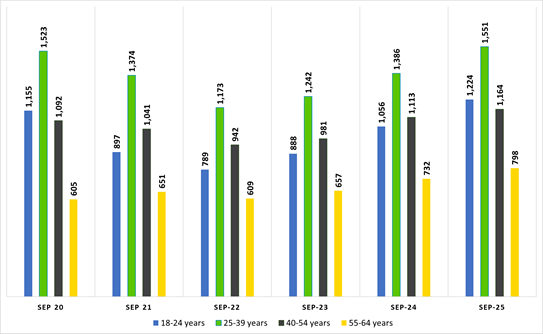
g) Employment among
Palmerston North residents fell by 491 people, a decrease of 1.4% in the year
to December 2025, bringing the total to 34,627. In contrast, jobs located
within the city increased slightly, with 30 additional positions lifting
workplace-based employment by 0.1% to 46,955. This compares with national
trends, where filled jobs by place of residence fell by 0.5% and
workplace-based jobs declined by 0.4% over the same period. These results
reinforce the view that recent changes in the labour market reflect increased
job seeking activity rather than widespread job losses. Please note that these
quarterly job figures cover salary and wage earners only and do not include
self-employed workers or sole traders.
h) The city’s
economic base has been strengthening, and if geopolitical tensions ease, the
recovery would likely return to a trajectory similar to that signalled before
the conflict. Strong export activity, lower mortgage rates, and significant
public and private investment are expected to support employment, aligning with
the Reserve Bank’s pre‑conflict
projection of around 64,000 additional jobs nationally in 2026.
3.3 Earnings
and income
Earnings growth slows as labour market pressures ease
and wage growth moderates.
a) Median earnings
in the city increased 4.8% over the year to December 2024, compared with
4.6% growth nationally. These figures are drawn from the LEED dataset, which
has roughly a 14‑month
lag, meaning the data is not current but remains one of the most reliable
measures of earnings trends because it captures all income sources. The
stronger growth recorded in 2024 reflects the period of intense wage pressure
early in the year, when demand for labour was high and employers were offering
higher wages to attract and retain workers.
b) Statistics
NZ’s business collection data offers a timely, albeit less comprehensive,
view of quarterly earnings at the territorial authority level. In the year to
December 2025, total annual earnings in the city increased by 0.5%,
compared with 1.4% growth nationally. This marks a clear moderation from the
strong annual increases of 7–10% recorded between late 2021 and the
June 2024 quarter. The softer pace of growth reflects the effects of job
losses and a more subdued labour market, which have eased wage pressures across
employers.
c) Building
on this moderation in earnings growth, broader wage indicators also point to
easing labour‑market
pressures. The Labour Cost Index (LCI) returned to its longer‑term average of 2.0% in
the year to December 2025, down from the elevated wage growth recorded
between 2022 and 2024 when strong demand and acute labour shortages pushed
costs higher. These earlier pressures have now unwound as spare labour capacity
has emerged across the economy. The Reserve Bank expects this trend to have
continued, with annual labour‑cost
inflation projected to have eased further to 1.9% in the March quarter.
3.4 Spending
Softer household spending continued to weigh on overall
activity yet strengthening international tourism and the uplift from major
events have helped to bolster returns and rebuild confidence in the regional
economy.
a) Retail spending
in the city fell by 1.1% over the year to January 2026, to a total value of
$1.483 billion. This corresponds with a 1.1% fall in retail spending
nationally.
b) Spending on
‘groceries and liquor’ was the only storetype to grow in the city
over the year, rising 2.6%. Because this remains below the 3.1% annual
inflation rate, the category experienced negative real growth. ‘Groceries
and liquor’ is also the city’s largest retail category, accounting
for 36.5% percent of all retail spending and totalling $542.4 million
over the year to January.
c) Some weakness has
emerged in new vehicle registrations in the city in the December year,
following several years when buying levels were elevated compared to longer
term averages. New car registrations fell 7.6%, compared with a 1.1%
national decline, while commercial vehicle registrations dropped 23.7% locally
against a 7.3% fall nationally. Because these are durable, high‑value purchases made
only occasionally, a pullback from the elevated activity seen between 2019 and
early 2024 is not unexpected. Spending patterns over the longer term will
be monitored to understand whether the recent declines are indicating continued
weak confidence in the economy or simply a normal cyclical adjustment after a
period of strong investment.
d) Spending linked
to visitation also showed signs of improvement. Over the three months to
January 2026, spending on ‘accommodation’ increased 2.1%,
while ‘arts, recreation and visitor transport’ spending rose
3.2% percent compared with the same period a year earlier. These are
small lifts, but they point to some strengthening of spending in sectors tied
to discretionary and visitor-related activity, a trend we have not seen for
some time. Recent high‑attendance
events in the city likely provided an additional boost, suggesting that
confidence to spend in these areas are starting to rebuild.
e) Tourism spending
in the city totalled $295.8 million in the year to December 2025, a
1.5% decline from the previous year compared with a 0.7% fall nationally. The
drop was driven mainly by weaker domestic tourism, with domestic visitor
spending in the city down 2.9% versus a 3.2% fall nationally. In contrast,
international tourism continued to strengthen, with spending up 13.5% in the
city compared with a 6.8% increase nationally.
f) Guest
nights in the city fell 1.9% in the year to January, compared with a 2.2%
increase nationally. Although the annual total shows a small decline, several
months performed strongly, including November 2025, when guest nights
were up 12.3% on the previous year, and March, which saw a 27.5% increase.
These peaks coincided with major events such as Central Districts Field Days
and the Bridge Conference, both of which attracted large numbers of visitors
from outside the region.
3.5 Housing
The market remains steady with stable prices, increasing
sales and ongoing affordability. At the same time, housing pressures are
growing for those most in need.
a) Over the year to
January 2026, the city’s average house value edged down 0.1% to
$637,709. This compares with a 0.4% decrease in the New Zealand average
house price to $910,285. Market activity continued to strengthen, with 1,383
sales recorded over the year, a 9.3% increase that exceeded the 8.3% rise
nationally. The higher level of available stock is helping to stabilise prices
and support relative housing affordability both in the city.
b) Home ownership
affordability, as measured by Infometrics as the ratio of the average house
price to average annual income, remained at 4.7 in the December quarter 2025.
This compares with the average house price of 6.3 times the average income,
nationally.
c) Average annual
rents in the city declined by 4.0% over the year to December 2025,
falling to an average of $479 per week. Nationally, rents decreased by 1.4% to
$566 per week over the same period. The number of properties rented in
Palmerston North rose by 4.2%, compared with a 5.0% increase nationally. As at
July 2025, 13,314 homes were formally rented in the city.
Infometrics estimates that 19.5% of household income in the city is spent on
rent, compared with 21.4% nationally. This lower share indicates that
Palmerston North remains relatively more affordable for renters.
d) The number of
households on the public housing register in Palmerston North fell by 54 (‑10.0%) over the year to
September 2025, reaching a total of 486, broadly consistent with the
11.5% decline recorded nationally.
e) On a quarterly
basis however, registrations increased both locally and across the country,
with the city’s register rising by 84 and national registrations
increasing by 318 between June and September. This represents the largest
quarterly increase in Palmerston North’s register in the past five years.
f) Changes to
eligibility criteria following the formation of the new government in
late 2023 contributed to the earlier sharp decline in registrations. The
recent rise may reflect growing need as economic conditions have softened, alongside the system adjusting after a period of tighter
entry requirements.
g) The Ministry of Social
Development issued 27 emergency housing Special Needs Grants in the city during
the September 2025 quarter. These grants totalled $28,895, with an
average value of $1,070. Nationally, 3,930 grants were issued, amounting to
$9,649,449 and an average grant of $2,455.
h) The city issued
412 new dwelling consents in the 2025 calendar year, a decrease of 46 (‑10%) compared with the
previous year. Nationally, new dwelling consents increased by 9.0% over the
same period. Activity in Palmerston North had been elevated in earlier years,
during a time when national consenting levels remained comparatively subdued.
i) Net
dwelling analysis for the 2025 calendar year indicates that 314 of the 412
dwellings consented are expected to add to Palmerston North’s housing
stock. This represents 76.2% of all consents issued, above the longer‑term annual average of
70%. The provisional total sits slightly below the Long‑Term Plan forecast of 328 dwellings per
year for 2024–2027, with annual figures likely to fluctuate in line with
economic conditions. The series adjusts for relocations into and out of the
city, as well as uplifted dwellings, and remains subject to revision.
4. palmerston north electronic card spending
report – December 2025
4.1 Consumer
loyalty reaches a five-year high while international visitor spending
strengthens significantly, providing positive support to Palmerston
North’s retail and hospitality sectors.
a) Spending
conditions remained soft in the year to December 2025 but are broadly in line
with national trends. Total electronic card spending was $1.484 billion, a
decrease of 1.1%, similar to the national decline of 0.9%. This suggests that
current conditions reflect wider economic softness rather than any city
specific weakness.
b) Consumer spending
is also consolidating locally. Resident spending outside the city fell 3.8%,
and the loyalty rate increased to 82.1%, the highest level in five years. This
shows that a larger share of household spending is staying within Palmerston
North and supporting local businesses.
c) Visitor spending
continues to play an important role in the city economy. Visitors generated a
net inflow of $291 million, as their spending exceeded the amount residents
spent outside the city. The City Centre remains the main retail area,
accounting for 56% of all spending. International visitor spending in the City
Centre increased by 27% over the year. Although international visitors make up
only 2.7% of total spending, this growth provides useful support for retail and
hospitality activity.
d) Essential
spending remains steady while discretionary spending has softened. Groceries
and liquor were the only categories to grow, increasing 2.6% across the city
and 6.1% in the City Centre, partly reflecting higher food prices. Hospitality
and home related retail categories declined, consistent with tighter household
budgets. Weekly spending reached its highest point in the week ending 20
December at $21.6 million, with 23 December the busiest single day at $4.6
million.
e) The Quarterly
Economic Card Spending Report for December 2025 is attached as Attachment 2.
5. Economic outlook
5.1 The
city entered 2026 with clear signs of strengthening economic momentum,
supported by improving domestic conditions and a resilient local base. Renewed
global conflict and rising cost pressures are now putting this momentum at
risk, and the pace of recovery will depend in part on how these external
factors evolve.
a) Palmerston North
and the wider New Zealand economy began the year on a firmer footing, with GDP
returning to growth, recruitment activity lifting and wage pressures easing.
These trends pointed to a gradual return to more stable conditions after
several years of volatility driven by global shocks.
b) This emerging
momentum has been disrupted by the escalation of conflict in the Middle East,
which has pushed up fuel and input costs. These increases are flowing through
to households, businesses, organisations and government, adding pressure to
already elevated costs and creating uncertainty around the speed at which
inflation will ease.
c) As a result, the
near-term outlook is more uncertain. Higher costs from global supply chain
disruption are likely to impact on the pace of recovery, with the extent
depending on how long the conflict persists and how significantly it affects
global markets and confidence. If geopolitical tensions ease quickly, the
recovery evident before the conflict is likely to re-emerge.
d) The fundamentals
of the local economy remain strong. Elevated levels of public and private
investment across Palmerston North show growing confidence in the city’s
longer-term prospects and are expanding its productive capacity and public
service infrastructure. Together with a diverse economic base, resilient labour
market conditions and comparatively affordable housing, this investment
activity provides an important buffer that will help the city remain resilient
if conditions for households and businesses, remain challenging.
e) Taken together,
these indicators show that Palmerston North has entered 2026 with a solid base
of activity and a level of resilience that continues to support confidence in
the local and regional economy. At the same time, the escalation of global
tensions and the resulting rise in costs have created disruption and added
uncertainty, making the scale and duration of impacts difficult to predict. The
city’s near-term outlook will be influenced by how these external
conditions evolve.
f) Factors
affecting the city and the wider domestic economy will continue to be monitored
and reported through the quarterly economic update series.
6. Compliance and administration
|
Does the Committee have
delegated authority to decide?
|
Yes
|
|
Are the decisions significant?
|
No
|
|
If they are significant do they
affect land or a body of water?
|
No
|
|
Can this decision only be made
through a 10 Year Plan?
|
No
|
|
Does this decision require consultation
through the Special Consultative procedure?
|
No
|
|
Is there funding in the current
Annual Plan for these objectives?
|
Yes
|
|
Are the recommendations
inconsistent with any of Council’s policies or plans?
|
No
|
|
The recommendations contribute
to:
Whāinga 1: He tāone auaha,
he tāone tiputipu
Goal 1: An innovative and growing city
|
|
The recommendations contribute to this
plan:
2. Mahere whakawhanake
ohaoha
2. Economic Development
Plan
The objective is: Support
sustainable business activity and labour market development, in particular,
providing information and education resources to city businesses.
|
|
Contribution to strategic
direction and to social, economic, environmental and cultural well-being
|
Reporting on economic trends
in the city and the longer-term outlook for growth, is important for
encouraging local business to invest, growing their business and attracting
new businesses to the city. It is also important to support businesses
to make informed decisions under the current economic conditions.
|
|
|
|
Attachments
|
1.
|
Palmerston
North Economic Growth Indicators - April 2026 ⇩ 
|
|
|
2.
|
Palmerston
North Quarterly Electronic Retail Card Spending Report - December 2025 ⇩
|
|
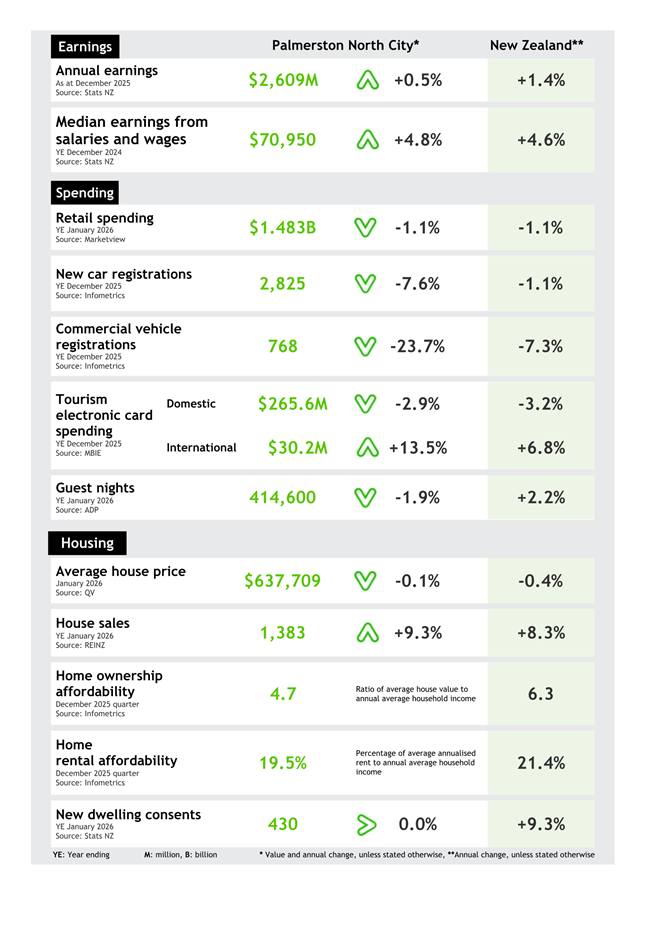
Memorandum
TO: Finance,
Performance & Audit Committee
MEETING DATE: 1
April 2026
TITLE: Manderson
Private District Plan Change acceptance and notification approval
PRESENTED BY: Simon
Mori, Principal Planner and Jono Ferguson-Pye, Manager City
Planning
APPROVED BY: David
Murphy, General Manager Strategic Planning
RECOMMENDATION(S)
TO Finance, Performance &
Audit Committee
1. That Council accept the Manderson
Bush Private Plan Change request in accordance with 25(2)(b) of Schedule 1 of
the Resource Management Act 1991.
2. That Council approve the request
for public notification under clause 5, Schedule 1 of the Resource Management
Act 1991.
1. ISSUE
1.1 The
purpose of this memorandum is to seek approval to accept the Private Plan
Change request (the request) from Peters Avenue Company Ltd (PACL) in
accordance with clause 25 of Schedule 1 of the Resource Management Act 1991
(RMA).
1.2 In
addition, approval is sought to publicly notify the request in accordance with
Schedule 1 clause 5(1)(b) of the RMA.
2. BACKGROUND
2.1 On
11 November 2025, Palmerston North City Council received the Manderson Bush
Private Plan Change request from PACL.
2.2 The
purpose of the plan change is to rezone approximately 77 hectares of rural
zoned land to a combination of Residential, Recreation and Conservation and
Amenity; please refer to the following website link for further information and
documentation: https://www.pncc.govt.nz/Have-your-say/Manderson-Bush-Private-Plan-Change-Request-Documentation.
2.3 The
area is located at the western urban edge of Palmerston North. The suburb of
Cloverlea is to the south-east, and the area adjoins the existing residential
area along Peters Avenue and Tararua Terrace. To the immediate south is the
North Island Main Trunk Line. The area is part of the Kakatangiata Urban Growth
Area. The location of the Manderson Bush Private Plan Change request is
detailed on the website.
2.4 Key
elements of the request include:
a. Protection
of an 8-hectare remnant kahikatea forest (Manderson Bush), via ecological
reserve that will be vested in the Council (see ‘Proposed
Structure Plan’ via the website link);
b. The
creation of an open space recreation reserve adjoining the ecological reserve
to the north;
c. The
ability to provide for approximately 800-900 dwellings with sections likely to
average around 500m2;
d. The
provision of land for medium-density residential development;
e. Reducing
the extent of the flood-prone overlay;
f. Creation of
stormwater detention areas.
2.5 The
subsequent changes to the District Plan will be the introduction of a new
Development Area chapter specific to the Manderson Bush Plan Change area.
The structure of this chapter is in accordance with the National Planning
Standards, which Palmerston North City Council is required to implement.
There will also be minor amendments to the definitions, cultural and heritage
and information chapters of the Operative District Plan.
2.6 In
accordance with section 36(1)(a) of the RMA, as this is a private plan change
rather than initiated by the Council, Council will recover actual and
reasonable costs relating to its role in the processing of the request.
3. THE
LEGISLATION
3.1 Clause
25 of schedule 1 requires Council to consider the request and decide whether to
adopt the request or accept the request or deal with the request as if it were
a resource consent application. Given the size of the request, it is not
appropriate to deal with it as if it were a resource consent. Adopting
the request means that the Council takes ownership of the request as if it were
proposed by the Council itself, with Council leading all evaluation and
drafting (costs then lie with the Council). Accepting the request means
ownership of the request remains with the requestor who takes the evaluation
and evidence lead (costs lie with the requestor). In accepting the request
Council still has an evaluative role and can recommend changes to the request
and submit on the request.
3.2 On
20 August 2025, the Resource Management (Consenting and Other System Changes)
Amendment Bill received Royal Assent and became law. This Act prohibits
Councils from undertaking district and regional plan reviews without a
Ministerial exemption. A private plan change requested under clause 21 of
Schedule 1 is automatically exempted unless the Council adopts the plan
change. Therefore, in order for this plan change to proceed the
recommendation is to accept the plan rather than adopt it.
4. NEXT STEPS
4.1 Officers
are planning to commence public notification of this private plan
change on 15 April 2026.
5. Compliance
and administration
|
Does the Committee have
delegated authority to decide?
If Yes quote relevant clause(s)
from Delegations Manual 4.3 (2a)
|
Yes
|
|
Are the decisions significant?
|
No
|
|
If they are significant do they
affect land or a body of water?
|
No
|
|
Can this decision only be made
through a 10 Year Plan?
|
No
|
|
Does this decision require
consultation through the Special Consultative procedure?
|
No
|
|
Is there funding in the current
Annual Plan for these objectives?
|
No
|
|
Are the recommendations
inconsistent with any of Council’s policies or plans?
|
No
|
|
The recommendations contribute
to:
Whāinga 1: He tāone auaha,
he tāone tiputipu
Goal 1: An innovative and growing city
|
|
The recommendations contribute to this
plan:
15. Mahere whare
15. Housing Plan
The objective is: Rezone enough
land and provide infrastructure to accommodate residential growth.
|
|
Contribution to strategic
direction and to social, economic, environmental and cultural well-being
|
By agreeing to this, the
Council is allowing the plan change to be notified and open to public
participation.
|
|
|
|
Attachments
Nil
Memorandum
TO: Finance,
Performance & Audit Committee
MEETING DATE: 1
April 2026
TITLE: Plan
Change Tahi - Review of Designation to Public Notification
PRESENTED BY: Haechang
Kwon, Planner and Jono Ferguson-Pye, Manager City Planning
APPROVED BY: David
Murphy, General Manager Strategic Planning
RECOMMENDATION(S)
TO Finance, Performance & Audit
Committee
1. That the Committee
approve for public notification Palmerston North City District Plan: Proposed
Plan Change Tahi – Designations Review under clause 5, Schedule 1 of the
Resource Management Act 1991.
1. ISSUE
1.1 The
purpose of this memorandum is to seek approval to publicly notify Proposed Plan
Change Tahi (PC Tahi) to Section 24 – Designations of the Operative
Palmerston North City District Plan (ODP).
1.2 Although
the plan change was initially subject to the ’Plan Stop' prohibition
introduced through the Resource Management
(Consenting and Other System Changes) Amendment Act 2025, an exemption was
sought and Ministerial approval received on 13 January 2026.
1.3 PC
Tahi comprises a review and update of the information relating to the
designations listed in Section 24 of the ODP. The intention is to ensure the
ODP is accurate, comprehensive, and reflects the current and future needs of
the responsible Requiring Authorities (RAs)[1].
1.4 Consistent
with this intention PC Tahi:
· Identifies
existing designations that RAs have requested to be rolled over with or without
modification;
· Incorporates
eight new requirements requested by RAs;
· Corrects
inconsistent wording and formatting that have the potential to cause interpretive
confusion or administrative inefficiency;
· Updates
outdated purpose statements that no longer reflect the scope of activities
undertaken on existing designated sites; and
· Corrects
outdated or inaccurate mapping that risks unintentionally constraining
operational or growth-related works.
2. BACKGROUND
2.1 Designations
are a planning mechanism under the Resource Management Act 1991 (RMA) that
enable RAs such as Ministers of the Crown, local authorities (including
Palmerston North City Council), and approved network utility operators to
protect land required for public works and projects. In particular, they:
· Secure
and enable the use of land for any public works or projects (e.g. schools,
roads, utilities) within the authorised scope of a designation without the need
for a resource consent;
· Restrict
land, water, subsoil, or airspace where this is necessary for the safe or
efficient functioning or operation of a public work or infrastructure; and
· Restrict
other parties from doing anything that would prevent or impede any public work
or project or work to which the designation applies without the prior written
approval of the relevant RA.
2.2 The
designations contained in Section 24 of the ODP were last reviewed in 2012 and
became operative in 2014. Under section 79 of the RMA they are now overdue for
review, noting that many designations are now outdated and no longer reflect
the present or future infrastructure needs of Palmerston North or the
requirements of RAs, including Palmerston North City Council.
2.3 In
reviewing the list of current designations in the ODP several deficiencies were
identified. These include:
· Inaccurate
purpose statements: Designations held by NZTA, Horizons Regional Council,
and the Minister for Courts no longer reflect the scope of activities these RAs
undertake, creating uncertainty for future projects.
· Incomplete
spatial definition: Critical infrastructure such as the City’s
stopbank network is not fully captured within existing designation boundaries.
This increases exposure to hazard risk, particularly if flood protection assets
are unintentionally undermined by the activities of private landowners.
· Omission
of essential assets: Five state-integrated schools and the sites of
three stormwater detention areas in urban growth areas are currently
undesignated. In the absence of being designated these schools’ risk not
being able to readily expand to meet projected growth, while stormwater
detention areas run the risk of not providing timely capacity to service
growth, exposing nearby properties to flooding and costly remediation.
3. CONSULTATION
3.1 Refer https://www.pncc.govt.nz/Have-your-say/Proposed-Plan-Change-Tahi-Review-of-Palmerston-North-Designations.
Preparation of proposed PC Tahi
has involved the following consultation:
· Preliminary
engagement with RAs (22 November 2024 – 7 March 2025) – RAs
confirmed the status of their existing designations, including whether these
should be rolled over (with or without modification), removed, or replaced with
new Notices of Requirement. Supporting GIS mapping was provided to verify
boundaries.
· Draft
preparation and circulation (7 March – 14 June 2025) – Officers
reviewed the notices received and prepared a draft plan change with updated
designation tables and GIS mapping. The draft was circulated to RAs for review
and verification, with revisions made in response to feedback received.
· Initial
briefings were held with Rangitāne o Manawatū through Te Whiri
Kōkō on 11 April and 9 May 2025 to introduce and outline the scope of
PC Tahi.
3.2 A
copy of the draft plan change was provided to the Ministry for the Environment
for comment between 14 June and 27 June 2025[2].
3.3 A
copy of the draft plan change was provided to Rangitāne o Manawatū
(16 – 27 June 2025)[3]
for consideration and comment. Formal advice was received on 27 June 2025 and
has been used to inform the proposed plan change.
3.4 Consultation
undertaken to date meets the requirements of both clause 3 and 4A of the RMA.
4. KEY CHANGES
4.1 To
address the deficiencies outlined above PC Tahi includes the following key
changes:
· Restructuring
and reformatting the Designations Section to comply with the National Planning
Standards (2019). This will ensure mapping references and formatting is
consistent across all designations.
· Updating
outdated or inaccurate purpose statements (e.g. NZTA, Horizons Regional
Council, Minister for Courts) to ensure that each designation accurately
reflects the activities and functions of the relevant RAs.
· Correcting
inconsistent wording and mapping errors across the ODP to reduce interpretive
confusion and administrative inefficiency.
· Including
new designations for five state-integrated schools and three stormwater
detention areas in identified growth areas in the city. This will provide
greater certainty and security for these education facilities and more
resilient stormwater management in these areas.
· Modifying
the current designation footprint of critical infrastructure such as stopbanks
and state highways to ensure the spatial extent of these operational assets is
fully covered. This will offer increased protection of the city from flood
hazard risk and safeguard key transport corridors.
5. NEXT STEPS
5.1 Notify
PC Tahi for submissions under clause 5 of the RMA.
5.2 Subject
to the Committee’s approval, staff will proceed with public notification
of PC Tahi.
6. Compliance and administration
|
Does the Committee have
delegated authority to decide?
If Yes quote relevant clause(s) from Delegations Manual 4.3
(2a)
|
Yes
|
|
Are the decisions significant?
|
No
|
|
If they are significant do they
affect land or a body of water?
|
No
|
|
Can this decision only be made
through a 10 Year Plan?
|
No
|
|
Does this decision require
consultation through the Special Consultative procedure?
|
No
|
|
Is there funding in the current
Annual Plan for these objectives?
|
Yes
|
|
Are the recommendations
inconsistent with any of Council’s policies or plans?
|
No
|
|
The recommendations contribute
to:
Whāinga 1: He tāone auaha,
he tāone tiputipu
Goal 1: An innovative and growing city
Whāinga 4: He tāone
toitū, he tāone manawaroa
Goal 4: A sustainable and resilient city
|
|
The recommendations contribute to these
plans:
2. Mahere whakawhanake
ohaoha
2. Economic Development
Plan
15. Mahere whare
15. Housing Plan
The objectives are:
· Review and
rationalise existing designations within the ODP to ensure they remain appropriate,
efficient, and aligned with current and future infrastructure needs that
support economic development and housing growth.
· Enable the
ongoing operation, maintenance, and development of essential infrastructure
and community facilities while appropriately managing effects on surrounding
land, including residential areas.
· Ensure
designations do not unnecessarily constrain the development of housing or
economic activities, while continuing to protect the functional needs of
regionally and nationally significant infrastructure.
|
|
Contribution to strategic
direction and to social, economic, environmental and cultural well-being
|
Proposed PC Tahi will assist
Council in meeting its statutory obligations under the RMA to review plan
provisions at least every ten years (s79) and to ensure that the District
Plan accurately secures and protects land for essential public works and
infrastructure.
|
|
|
|
Attachments
Nil
Report
TO: Finance,
Performance & Audit Committee
MEETING DATE: 1
April 2026
TITLE: Traffic
situation and calming options for Ascot and Pahiatua Streets
PRESENTED BY: Tyler
da Silva, Acting Transport and Development Manager
APPROVED BY: Glen
O'Connor, Acting General Manager Infrastructure
RECOMMENDATION(S)
TO Finance, Performance &
Audit Committee
1. That the Committee
receive the report on the investigation into traffic impacts at Ascot Street
and Pahiatua Street.
Summary of options analysis
|
Problem or Opportunity
|
Residents of Ascot Street and
Pahiatua Street in Hokowhitu have raised concerns regarding traffic safety,
antisocial driving behaviour, and speeding at the intersection of Ascot
Street and Pahiatua Street and along Ascot Street more broadly.
|
|
OPTION 1:
(Preferred option)
|
Status quo (noting that yellow
no stopping lines at intersection of Ascot and Pahiatua Streets are being
installed).
|
|
Community views
|
Yellow no parking lines requested
in resident petition. Residents consulted on yellow no stopping lines were
supportive. Line marking programmed for installation under Officer
delegation.
|
|
Benefits
|
Improve sightlines at
intersection of Ascot/Pahiatua Streets for both drivers and pedestrians. Low
cost.
|
|
Risks
|
Minimal.
|
|
Financial
|
Minimal (maintenance of line marking).
|
|
OPTION 2:
|
Mid-block pedestrian refuge
island on Ascot Street at intersection with Pahiatua Street.
|
|
Community Views
|
Requested in resident petition.
|
|
Benefits
|
Provide refuge for pedestrians
crossing the street and reduce the size of the open carriageway.
|
|
Risks
|
Prioritising this improvement
above others in the transport network with a higher safety risk.
|
|
Financial
|
Estimated at $30,000.
|
|
OPTION 3:
|
Raised speed humps on Ascot
Street.
|
|
Community Views
|
Requested in resident petition.
|
|
Benefits
|
Reduce vehicle speeds and reduce
appeal to boy racers.
|
|
Risks
|
Prioritising these improvements
above others in the network with a higher safety risk.
|
|
Financial
|
Engineers estimate for two speed
humps estimated at $24,000.
|
|
OPTION 4:
|
Parking layout reconfiguration
to help reduce vehicle speeds.
|
|
Community Views
|
Requested in resident petition.
|
|
Benefits
|
Reduce vehicle speeds and reduce
appeal to boy racers.
|
|
Risks
|
This currently happens
spontaneously in the street without any additional marking, and may have loss
of on street parking if this is formalised by markings.
|
|
Financial
|
Estimate for line marking $1,000
+ ongoing maintenance.
|
Rationale for the recommendations
1. Overview
of the problem or opportunity
1.1 Residents
of Ascot and Pahiatua Streets in Hokowhitu have raised concerns regarding
traffic safety, antisocial driving behaviour, and speeding at the intersection
of Ascot Street and Pahiatua Street and along Ascot Street.
1.2 A
petition signed by 25 residents was presented to Council requesting that stronger
measures be implemented to address these issues.
1.3 Council
undertook a review of the traffic situation at Ascot and Pahiatua Streets,
relative to the wider transport network, and assessed whether traffic calming
or other safety interventions are warranted.
2. Background
and previous council decisions
2.1 On
11 June 2025 the Economic Growth Committee received a petition titled
‘Petition to Install Traffic Calming Measures on Ascot and Pahiatua
Streets’. In response to this petition the Committee resolved:
‘That the Chief Executive investigate the traffic
situation on Ascot and Pahiatua Streets (relative to the wider transport
network), and traffic calming options (if indicated), and report back to the
relevant committee in the new term.’
3. INVESTIGATION
OF TRAFFIC SITUATIOn
3.1 Speed
data for Ascot Street (2019) and Pahiatua Street (2023) shows an average speed
of 45km/h for both streets. In response to the petition, in December 2025,
speed tubes were installed to obtain current speed data for Ascot Street. The
2025 data shows a reduced average speed of 44km/h.
3.2 Traffic
count data collected in December 2025 indicates a reduction in the traffic
volumes when compared to traffic data collected in 2019. It is noted the
installation of traffic calming devices on the northern end of Ascot Street and
within the Newcastle Street area may have contributed to this reduction in
vehicle volumes and speed.
3.3 Crash data was analysed for
T-intersections in Palmerston North with a similar road function to the Pahiatua
Street / Ascot Street intersection. The comparison included intersections where
the major leg is classified as a collector road and the minor leg as a local
road. These classifications broadly reflect traffic volumes and provide a
simple way to compare locations across the urban road network and contextualise
the crash risk at Ascot/Pahiatua Street. Of the 30 intersections with similar
characteristics, Ascot/Pahiatua Street ranked 20th for the number of crashes
over the past 10 years with two crashes; (1 being highest number of crashes and
30 lowest).
3.4 Officers
discussed the matter of boy racer behaviour with local New Zealand Police who
commented broadly that antisocial driving activity typically occurs on the
industrial or rural edges of the city. While organised events do occasionally
take place within the urban area, these are less frequent but can involve large
numbers of attendees.
4. Description
of options
4.1 Option
1 (preferred option): Status quo, noting that installation of yellow no stopping
lines to improve intersection sightlines has been programmed to be installed
under Officer delegation.
4.2 Option
2: A mid-block pedestrian refuge island on Ascot Street near the intersection
with Pahiatua Street.
4.3 Option
3: Two raised speed humps.
4.4 Option
4: Parking layout reconfiguration, with no parking yellow lines on different
parts of the street to help reduce vehicle speeds.
5. Analysis
of options
5.1 Option
1: This option involves maintaining the current road layout, as available speed
and crash data do not indicate significant speed or traffic safety issues
relative to the wider transport network. As such, additional traffic calming
measures are not considered justified at this time. As a minor improvement,
installation of no stopping lines near the intersection have been programmed
for installation. This is a low-cost measure that will improve intersection
sightlines by preventing vehicles from parking close to the intersection,
allowing pedestrians and drivers to more clearly see approaching traffic.
5.2 Option
2: A mid-block pedestrian refuge island on Ascot Street near the intersection
with Pahiatua Street. The island provides a refuge for pedestrians to pause as
they cross the street. It also decreases the size of open pavement at the
intersection which reduces appeal to boy racers. Engineers estimate is that the
pedestrian island, realignment of pram crossings and lighting would cost
approximately $30,000. The key risk with this option is that there are other
intersections where similar improvements can have a greater impact.
5.3 Option
3: Speed humps on Ascot Street are an option which are designed to reduce
speeds to between 20-30km/h. These devices cost an estimated $12,000 each.
Speed and traffic count data shows a reduction in both volume and speeds in
recent years since the raised pedestrian crossing was installed near the
intersection with Newcastle Street. Traffic data presented in paragraphs 3.1
and 3.2 highlights decreasing speed and traffic volumes in this street.
5.4 Option
4: Placing broken yellow lines at alternating sides of the road can create
staggering of the on-street parking. This requires vehicles to weave rather
than drive in a straight line which naturally reduces speed. The location of
vehicle crossings on this street is already in a staggered pattern. It has been
observed that this has the same effect as the broken yellow lines. There is a
risk to installing yellow lines and removing on street parking with no
additional speed calming effect.
6. Conclusion
6.1 Residents
have raised concerns regarding speeding and driver behaviour at Ascot and
Pahiatua Streets. However, analysis of current and historical speed and crash
data does not indicate a significant safety issue at this location when
considered relative to the wider transport network.
6.2 Traffic
calming options have been assessed. A low-cost improvement (installation of no
stopping lines) has been programmed for installation. Other measures considered
are more appropriately prioritised at higher-risk locations across the
transport network.
7. Next
actions
7.1 Proceed
with installation of no stopping lines at the intersection of Ascot and
Pahiatua Streets.
7.2 Advise
petitioners and residents of the Committee’s decision.
8. Compliance
and administration
|
Does the Council have delegated authority to decide?
|
Yes
|
|
Are the decisions significant?
|
No
|
|
If they are significant do they
affect land or a body of water?
|
No
|
|
Can this decision only be made
through a 10 Year Plan?
|
No
|
|
Does this decision require
consultation through the Special Consultative procedure?
|
No
|
|
Is there funding in the current
Annual Plan for these objectives?
|
No
|
|
Are the recommendations
inconsistent with any of Council’s policies or plans?
|
No
|
|
The recommendations contribute
to: Whāinga 1: He tāone auaha, he tāone tiputipu
Goal 1: An innovative and growing city
|
|
The recommendations contribute to this
plan:
3. Mahere tūnuku
3. Transport Plan
The objective is: Develop,
maintain, operate, and renew the active and public transport network to
deliver on Council goals, the purpose of this plan, and the Government Policy
Statement on Transport.
|
|
Contribution to strategic
direction and to social, economic, environmental and cultural well-being
|
Investigating safety on local
roads is a key delivery vehicle towards having safer, well maintained, and
well utilised transport network.
|
|
|
|
Attachments
Nil
Committee
Work Schedule
TO: Finance,
Performance & Audit Committee
MEETING DATE: 1
April 2026
TITLE: Committee
Work Schedule
RECOMMENDATION(S) TO Finance, Performance & Audit Committee
1. That the Finance, Performance
& Audit Committee receive its Work Schedule dated April 2026.
|
COMMITTEE
WORK SCHEDULE – APRIL 2026
|
|
|
Estimated
Report Date
|
Subject
|
Officer
Responsible
|
Current
Position
|
Date
of Instruction
|
|
1.
|
1 April 2026
3 June 2026
2
September 2026
2
December 2026
|
Strategic Risk Management Reporting
Q2 October to December 2025
Q3 January to March 2026
Q4 April to June 2026
Q1 July to September 2026
|
General Manager Corporate Services
|
|
Terms of Reference
|
|
2.
|
1
April 2026
|
Palmerston North Airport Limited – Six Month Report
and draft SOI
|
General Manager Corporate Services
|
|
Terms of Reference
|
|
3.
|
1
April 2026
|
Traffic situation and calming options for Ascot and
Pahiatua Streets
|
General Manager Infrastructure
|
Following
specialist staff recruitment
|
Economic Growth
11 June 2025
Clause 16-25
|
|
4.
|
1
April 2026
|
Speed Management Plan – Deliberations
|
General Manager Strategic Planning
|
|
20 August 2025
Clause 33
|
|
5.
|
1
April 2026
|
CEDA – Six Month Report and draft SOI 2026-29
|
General Manager Strategic Planning
|
|
Terms of Reference
|
|
6.
|
1
April 2026
3 June
2026
2 September 2026
2 December 2026
|
Economic Report
Q2 October-December 2025
Q3 January-March 2026
Q4 April-June 2026
Q1 July to September 2026
|
General Manager Strategic Planning
|
|
Terms of Reference
|
|
7.
|
1
April 2026
13 May 2026
|
Tamakuku Terrace six monthly update FINAL
|
General Manager Infrastructure
|
Awaiting
updated financial information
|
Terms of Reference
|
|
8.
|
1
April 2026
13 May 2026
|
Featherston Street – Investigate options for bus and
vehicle pick-ups in green road reserve outside PNBHS
|
General Manager Infrastructure
|
Further stakeholder
feedback required
|
Council
14 May 2025
Clause 78.10
|
|
9.
|
13
May 2026
|
Food HQ Innovation Limited – Director’s
company progress report
|
General Manager Infrastructure
|
Going to
Council 27 May 2026, to ensure availability of key stakeholders
|
6 September 2023
Clause 143-23
|
|
10.
|
13 May 2026
5 August 2026
4
November 2026
|
Quarterly
Performance Report
Q3 January to March 2026
Q4 April to June 2026
Q1 July to September 2026
|
General
Manager Corporate Services
|
|
Terms
of Reference
Council
5 June 2024
Clause 104-24
|
|
11.
|
13 May 2026
5 August 2026
4 November 2026
|
Quarterly
Treasury Report
Q3 January to March 2026
Q4 April to June 2026
Q1 July to September 2026
|
General
Manager Corporate Services
|
|
Terms
of Reference
|
|
12.
|
13 May
2026
|
City Central Indicative Business Case (CCIBC) Update
|
General
Manager Strategic Planning
|
|
19
June 2024
Clause 42-24
|
|
13.
|
3 June 2026
2 September 2026
2 December 2026
|
Health and Safety Quarterly Update
Q3 January to March 2026
Q4 April to June 2026
Q1 July to September 2026
|
General Manager People & Capability
|
Alignment with Committee
schedule
|
|
|
14.
|
3 June 2026
2 September 2026
2 December 2026
|
Wellbeing Quarterly Update
Q3 January to March 2026
Q4 April to June 2026
Q1 July to September 2026
|
General Manager People & Capability
|
Alignment with Committee
schedule
|
|
|
15.
|
3 June
2026
|
Economic Profile: Agri-food (3 yearly)
|
General
Manager Strategic Planning
|
|
30
August 2023
Clause 35-23
|
|
16.
|
3 June
2026
|
Palmerston North Airport Ltd - Final Statement of Intent
for 2026-2029
|
General
Manager Corporate Services
|
|
Terms
of Reference
|
|
17.
|
3 June
2026
|
Additional lease or MaaS options to the PN City Council
fleet
|
General
Manager Corporate Services
|
|
20
August 2025
Clause 38
|
|
18.
|
3 June
2026
2 December
2026
|
Road Maintenance Contract (six monthly report on work
programme and performance)
|
General
Manager Infrastructure
|
|
16
March 2022
Clause 4-22
|
|
19.
|
3 June
2026
|
City Economic Structure Report (annually)
|
General Manager Strategic Planning
|
|
|
|
20.
|
3 June
2026
|
CEDA – Final Statement of Intent for 2026-2029
|
General Manager Strategic Planning
|
|
Terms of Reference
|
|
21.
|
5
August 2026
|
Review of cyber security
|
General Manager Corporate Services
|
Overview of Cyber Security
status was provided at June 2025 meeting; an audit to be scoped in 2026
|
6 March 2024
Clause 11-24
|
|
22.
|
5 August 2026
|
International Relations and Education Activities –
six monthly update
|
General Manager Strategic Planning
|
Alignment with Committee
schedule
|
Terms of Reference
Council
Clause 203-23
|
|
23.
|
5
August 2026
|
Business
Assurance six monthly accountability report
|
General
Manager Corporate Services
|
Alignment with Committee
schedule
|
16
December 2020
Clause 68.2
|
|
24.
|
5
August 2026
|
Review of Legal Compliance Framework
|
General Manager Corporate Services
|
|
26 April 2023 Clause 2-23
|
|
25.
|
5
August 2026
|
2026-2027 Annual Plan – International Relations
Activity
|
General Manager Strategic Planning
|
|
Council
5 June 2024
Clause 102-24
|
|
26.
|
5 August
2026
|
Report back on Investment options for Palmerston North
Airport Ltd
|
General Manager Corporate Services
|
|
6 December 2023
Clause 197-23
|
|
27.
|
2
September 2026
|
Review Annual Report
|
General Manager Corporate Services
|
|
Terms of Reference
|
|
28.
|
7
October 2026
|
Palmerston North Airport Ltd – Annual Report 2025/26
|
General Manager Corporate Services
|
|
Terms of Reference
|
|
29.
|
7
October 2026
|
Revenue & Finance Policy review
|
General Manager Corporate Services
|
|
|
|
30.
|
7
October 2026
|
Delegation Manual – Fees & Charges review
|
General Manager Corporate Services
|
Review alongside the Revenue and
Financing Policy
|
8 May 2024
Clause 24
|
|
31.
|
7
October 2026
|
CEDA – Annual Report 2025/26
|
General Manager Strategic Planning
|
|
Terms of Reference
|
|
32.
|
2 December
2026
|
Road Maintenance Contract (six monthly report on work
programme and performance)
|
General Manager Infrastructure
|
|
|
|
33.
|
2
December 2026
|
CEDA - Statement of Expectations 2027-2030
|
General Manager Strategic Planning
|
|
30 August 2023
Clause 37-23
|
|
34.
|
2
December 2026
|
Economic Profile: For purpose organisations (5 yearly)
|
General Manager Strategic Planning
|
|
30 August 2023
Clause 35-23
|
|
35.
|
Early
2026
|
Ratepayer Assistance Scheme - Progress of implementation
|
General Manager Corporate Services
|
Awaiting Minister decisions on
business case
|
6 August 2025
Clause
|
|
36.
|
As
required
|
Fraud and Whistleblowing Policy quarterly update
|
General Manager Corporate Services
|
When new matters arise
|
26 April 2023 Clause 12-23
|
|
37.
|
TBC
|
Review of Contract Management Framework
|
General Manager Corporate Services
|
To be reviewed with Business
Assurance work plan
|
26 April 2023 Clause 2-23
|
|
38.
|
TBC
|
City Centre (Streets for People) 6 monthly update
|
General Manager Infrastructure
|
Paused until Steering Group reconvenes
|
Terms of Reference
28 February 2024
Clause 18-24
|
|
39.
|
TBC
|
Annual presentation: The Factory
|
|
|
|
Memorandum
TO: Finance,
Performance & Audit Committee
MEETING DATE: 1
April 2026
TITLE: Strategic
Risk Management Reporting October to December 2025 (Quarter 2)
Presented By: Stephen
Minton, Risk Management Advisor
APPROVED
BY: Cameron
McKay, General Manager Corporate Services
RECOMMENDATION(S)
TO Finance, Performance &
Audit Committee
1. That
the Committee receive the following strategic risk assessments:
· Strategic Risk
3: Failure to Manage and Protect Council Information; and
· Strategic
Risk 8: Failure to Meet Legal Obligations.
1. ISSUE
1.1 Council
agreed on 11 Strategic Risk statements at the Risk & Assurance Committee on
6 March 2024 and all assessments have been presented to committee at least once
since then.
1.2 Officers
will undertake iterative reviews of the strategic risks periodically.
2. BACKGROUND
2.1 Officers
have completed an iterative review of Strategic Risks listed in the recommendation
above. The reviews have considered any new or emerging contextual aspects of
the risk, and progress on the detailed action plan/considerations articulated
in the last assessment.
2.2 The
‘Conclusion & Action Plan/Considerations’ commentaries have been
updated. The individual action plans have had a few additions with the notation
‘New’. A current update on the action plans has been created and
included. Progress of the detailed action plans is within the expected
timeframes. Key controls are unchanged from the last report (apart from a
couple of rewordings without contextual change) as Officers still consider
these to be current in the existing risk environment.
3. strategic
risk dashboard
3.1 The
full strategic risk dashboard is set out below. The risk ratings have been
determined based on the current risk environment and consequences of the risk
event, the controls and their effectiveness, and the reliance on individual
controls.
3.2 The
reassessment of the residual risk rating of Strategic Risk 9 is under review
and nearing completion and is expected to be reassessed at High on the basis of
several items in the plan having progressed.
|
Strategic Risk
Dashboard
As at March 2026
|
|
Risk Name
|
Raw Risk
|
Residual Risk
|
Target Risk
|
|
Risk
1: Failure to meet financial obligations
|
Extreme
|
Medium
|
Medium
|
|
Risk
2: Failure to deliver on key projects
and programmes
|
Extreme
|
Medium
|
Medium
|
|
Risk
3: Failure to manage and protect Council
information
|
Extreme
|
High
|
Medium
|
|
Risk
4: Failure to adapt to the effects of
climate change
|
Extreme
|
Medium
|
Medium
|
|
Risk
5: Ineffective relationship and
stakeholder engagement
|
Very High
|
Medium
|
Medium
|
|
Risk
6: Major failure of health, safety and
wellbeing policies and procedures
|
Extreme
|
Low
|
Low
|
|
Risk
7: Failure to attract and retain staff
|
Very High
|
Medium
|
Medium
|
|
Risk
8: Failure to meet legal obligations
|
Extreme
|
High
|
Medium
|
|
Risk
9: Significant disruption to
Council’s continuity and/or lifeline utility disruption
|
Extreme
|
Very High
|
Medium
|
|
Risk
10: Failure to manage critical/strategic
assets
|
Extreme
|
High
|
Medium
|
|
Risk
11: Loss of public trust
|
Very High
|
High
|
Medium
|
4. NEXT
STEPS
4.1 Further
Strategic Risks will be assessed and presented to the Committee going forward,
with a focus on those risks deemed to have changes in the control/mitigation
scene or new/emerging changes to the risk context, and at least annually.
4.2 The
Committee is reminded that reviews may also be triggered if there is a
significant change in one of the following parameters:
4.2.1 Significant
change in the internal or external context, including major organisational or
process changes (Reference Risk Management Framework, Section 4.3.1 for
external and internal context descriptors).
4.2.2 Major risk
event that is deemed to have an influence on the strategic risk.
4.2.3 Substantial
control or mitigation failure.
5. Compliance and administration
|
Does the
Committee have delegated authority to decide?
|
Yes
|
|
Are the
decisions significant?
|
No
|
|
If they are
significant do they affect land or a body of water?
|
No
|
|
Can this
decision only be made through a 10 Year Plan?
|
No
|
|
Does this
decision require consultation through the Special Consultative procedure?
|
No
|
|
Is there
funding in the current Annual Plan for these objectives?
|
Yes
|
|
Are the
recommendations inconsistent with any of Council’s policies or plans?
|
No
|
|
The
recommendations contribute to:
Whāinga
3: He hapori tūhonohono, he hapori haumaru
Goal 3: A
connected and safe community
|
|
The recommendations contribute to the achievement of
objective/objectives in:
14. Mahere mana urungi,
kirirarautanga hihiri
14.
Governance and Active Citizenship Plan
The objective
is: Oversee Council operations and communicate outcomes and decisions to our
communities.
|
|
Contribution to strategic
direction and to social, economic, environmental and cultural well-being
|
The risk management objectives
cover all aspects of Council, including strategy, tactics, operations and
compliance. The Risk Management Framework sets out the basis for managing
risk across Council and a large part of this is culminated through the
creation of risk registers and the strategic risk assessments.
|
|
|
|
Attachments
|
1.
|
Strategic
Risk 3: Failure to Manage and Protect Council Information - Confidential
|
|
|
2.
|
Strategic
Risk 8: Failure to Meet Legal Obligations ⇩ 
|
|