|
Grant Smith (Mayor)
|
|
Debi Marshall-Lobb (Deputy Mayor)
|
|
Mark Arnott
|
Leonie Hapeta
|
|
Brent Barrett
|
Lorna Johnson
|
|
Rachel Bowen
|
Billy Meehan
|
|
Vaughan Dennison
|
Orphée Mickalad
|
|
Lew Findlay (QSM)
|
Karen Naylor
|
|
Roly Fitzgerald
|
William Wood
|
|
Patrick Handcock (ONZM)
|
Kaydee Zabelin
|
Council MEETING
1 May 2024
Order of Business
1. Karakia
Timatanga
2. Apologies
3. Notification
of Additional Items
Pursuant to
Sections 46A(7) and 46A(7A) of the Local Government Official Information and
Meetings Act 1987, to receive the Chairperson’s explanation that
specified item(s), which do not appear on the Agenda of this meeting and/or the
meeting to be held with the public excluded, will be discussed.
Any
additions in accordance with Section 46A(7) must be approved by resolution with
an explanation as to why they cannot be delayed until a future meeting.
Any
additions in accordance with Section 46A(7A) may be received or referred to a
subsequent meeting for further discussion. No resolution, decision or
recommendation can be made in respect of a minor item.
4. Declarations
of Interest (if any)
Members
are reminded of their duty to give a general notice of any interest of items to
be considered on this agenda and the need to declare these interests.
5. Public
Comment
To receive
comments from members of the public on matters specified on this Agenda or, if
time permits, on other matters.
6. Presentation
- Changes to Featherston Street Page 7
7. Featherston
Street Cycleway Project - Stakeholder Engagement Review Page 9
Memorandum, presented by Masooma
Akhter, Business Assurance Manager.
8. Confirmation
of Minutes Page 23
“That the minutes of the
ordinary meeting of 3 April 2024 Part I Public be confirmed as a true and
correct record.”
9. Notice
of Motion - Māori Wards Page 35
Presented by Councillor Kaydee
Zabelin.
10. Nature Calls
Quality Assurance Framework Page 41
Memorandum, presented by Masooma
Akhter, Business Assurance Manager & Mike Monaghan, Group Manager - Three
Waters.
11. Adoption of Nature Calls
Steering Group Terms of Reference Page 55
Report, presented by Mike
Monaghan. Group Manager Three Waters.
12. 2023 Residents'
Survey Action Plan Page 63
Memorandum, presented by Andrew
Boyle, Head of Community Planning and Jessica Ballinger, Marketing Manager.
13. Progress report:
Youth Well-being Forum and Plan Page 71
Memorandum, presented by Remy Waldteufel-Irvine,
Youth Services Team Leader, and Anton Carter, Group Manager Community Services.
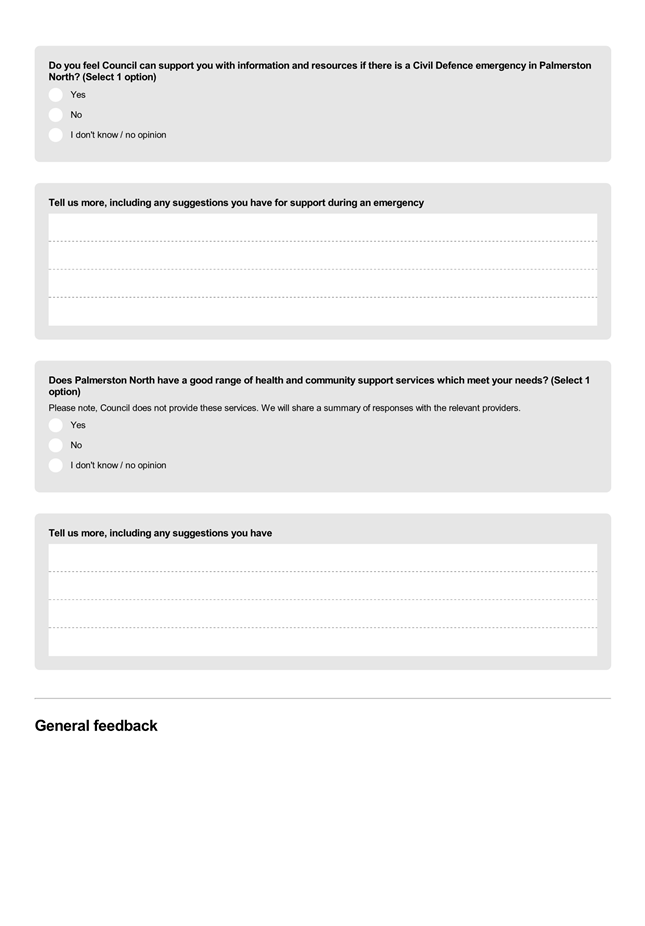
14. Age Friendly
Progress Report Page 115
Memorandum, presented by Kerry
Hocquard, Community Development Advisor and Amy Viles, Acting Community
Development Manager.
15. Elected Members'
Meeting Attendance Statistics - 1 July 2023 to 31 December 2023 Page 139
Memorandum, presented by Hannah
White - Democracy & Governance Manager.
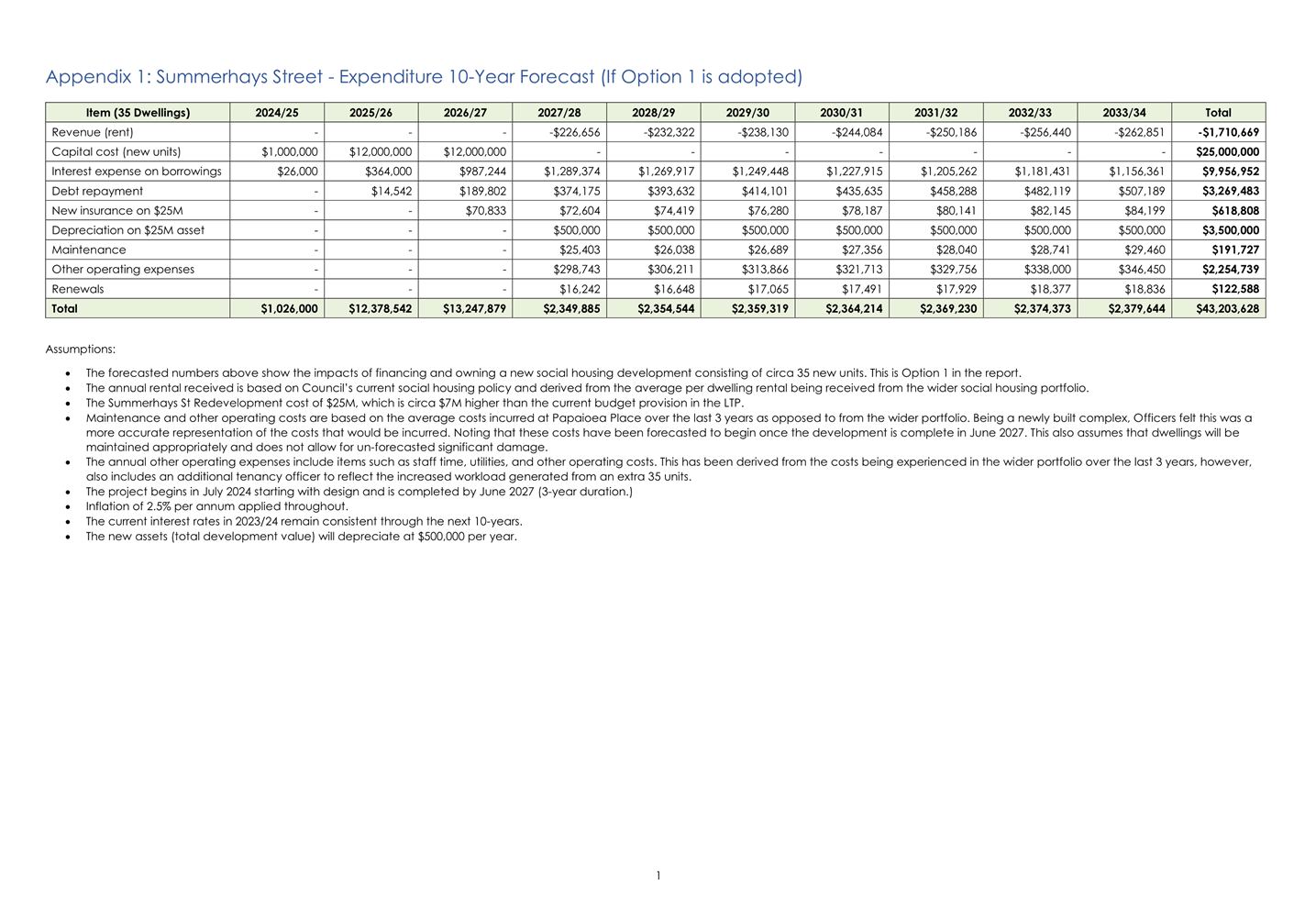
16. Summerhays Street Redevelopment
- Partnership Models Page 143
Report, presented by Bryce
Hosking, Group Manager - Property and Resource Recovery, and Anna Saunders,
Capital Projects Officer.
17. Council Work
Schedule Page 161
Recommendations from Committee Meetings
18. Presentation of the
Part I Public Culture & Sport Committee Recommendations from its 27 March
2024 Meeting Page 165
19. Presentation of the
Part I Public Economic Growth Committee Recommendations from its 24 April 2024
Meeting Page 167
20. Karakia
Whakamutunga
21. Exclusion
of Public
|
|
To be moved:
“That the public be excluded from the
following parts of the proceedings of this meeting listed in the table below.
The general subject of each matter to be considered
while the public is excluded, the reason for passing this resolution in
relation to each matter, and the specific grounds under Section 48(1) of the
Local Government Official Information and Meetings Act 1987 for the passing
of this resolution are as follows:
|
General subject of each matter to be
considered
|
Reason for passing this resolution in
relation to each matter
|
Ground(s) under Section 48(1) for
passing this resolution
|
|
22.
|
Minutes of the ordinary meeting - Part II
Confidential - 3 April 2024
|
For the reasons set out in the ordinary minutes of
3 April 2024, held in public present.
|
|
23.
|
Renewal of Contract Term - Road Maintenance,
Renewal, and Capital Improvement Services Contract
|
NEGOTIATIONS: This information needs to be kept
confidential to ensure that Council can negotiate effectively, especially
in business dealings
|
s7(2)(i)
|
|
24.
|
Summerhays Street Redevelopment - Expressions of
Interest Feedback
|
THIRD PARTY COMMERCIAL: Disclosing the information
could harm a company's commercial position and NEGOTIATIONS: This
information needs to be kept confidential to ensure that Council can
negotiate effectively, especially in business dealings
|
s7(2)(b)(ii) and s7(2)(i)
|
|
25.
|
Whakarongo Land Swap with Summerset Retirement
Village
|
NEGOTIATIONS: This information needs to be kept
confidential to ensure that Council can negotiate effectively, especially
in business dealings
|
s7(2)(i)
|
|
26.
|
District Licensing Committee- Additional
Commissioner
|
PRIVACY: This information needs to be kept private
to protect personal information that is confidential or sensitive.
This includes people who are no longer alive
|
s7(2)(a)
|
|
27.
|
Part IIB - Confirmation of Minutes - 3 April 2024
|
PRIVACY: This information needs to be kept private
to protect personal information that is confidential or sensitive.
This includes people who are no longer alive
|
s7(2)(a)
|
This resolution is made in reliance on Section
48(1)(a) of the Local Government Official Information and Meetings Act 1987
and the particular interest or interests protected by Section 6 or Section 7
of that Act which would be prejudiced by the holding of the whole or the
relevant part of the proceedings of the meeting in public as stated in the
above table.
Also that the persons listed below be permitted to
remain after the public has been excluded for the reasons stated.
[Add Third Parties], because of their knowledge and ability to assist the
meeting in speaking to their report/s [or other matters as specified] and
answering questions, noting that such person/s will be present at the meeting
only for the items that relate to their respective report/s [or matters as
specified].
|
Presentation
TO: Council
MEETING DATE: 1
May 2024
TITLE: Presentation
- Changes to Featherston Street
RECOMMENDATION
TO Council
1. That the
Council receive the presentation for information.
Mark Bell-Booth and Brian Holmes, owner of Ebony Coffee will
present to Council on the changes to Featherston Street.
Attachments
Nil
Memorandum
TO: Council
MEETING DATE: 1
May 2024
TITLE: Featherston
Street Cycleway Project - Stakeholder Engagement Review
Presented By: Masooma
Akhter, Business Assurance Manager
APPROVED BY: Donna
Baker, Acting Chief Executive Unit Manager
RECOMMENDATION TO Council
1. That Council
receive the memorandum titled ‘Featherston Street Cycleway Project
– Stakeholder Engagement Review’ and its attachment, presented on 1
May 2024.
1. ISSUE
In September 2023, Council
passed the following resolution:
“That the Chief Executive
provide a Business Assurance Report on Featherston Street Cycleway and Safety Improvements
process and engagement”
This memorandum presents the
outcome of this resolution.
2. BACKGROUND
In 2019 Council approved the
Urban Cycle Network Masterplan (Masterplan) through the Long Term Plan (LTP)
process. This Masterplan was consulted on with the community through the formal
LTP consultation process. The plan highlighted that Featherston Street was a
key priority for an improved cycleway.
PNCC confirmed the following
funding from Waka Kotahi NZ Transport Agency (NZTA) to put towards this
project.
· Streets
for People programme $1.875M
· Transport
Choices programme $2.6M
Stakeholder engagement
commenced when the first fund was made available in September 2023 allowing for
the feedback to inform the concept designs. Co-design workshops were also
undertaken to allow for stakeholder feedback to be taken into consideration in
real-time rather than retrospectively.
An independent review has been
completed of the stakeholder engagement processes for this project. During this
review, Elected Members and key internal stakeholders were interviewed, and all
project documentation that supported the engagement process was reviewed.
Refer to the attachment to see
the outcome of this review.
3. Management
Comment by chief executive
Overall, I feel that the report provides a good balance on
the engagement undertaken on this project. As noted in the report it has
probably been the most extensive engagement and/or opportunity provided to the
community to engage in a project.
There are always learnings from these processes, such as
provision of information to Elected Members (including ongoing communication)
and perhaps longer trial periods to ensure that there are no unintended
consequences. I’m confident these will be taken on board as we move forward
with future work programmes.
4. NEXT
STEPS
It is intended that any
learnings from this review are taken into consideration for any stakeholder
engagement processes for projects of a similar nature in the future.
5. Compliance
and administration
|
Does the Council have delegated
authority to decide?
If Yes quote relevant clause(s)
from Delegations Manual
|
Yes
|
|
Are the decisions significant?
|
No
|
|
If they are significant do they
affect land or a body of water?
|
No
|
|
Can this decision only be made
through a 10 Year Plan?
|
No
|
|
Does this decision require
consultation through the Special Consultative procedure?
|
No
|
|
Is there funding in the current
Annual Plan for these actions?
|
No
|
|
Are the recommendations
inconsistent with any of Council’s policies or plans?
|
No
|
|
The recommendations contribute
to Goal 3: A Connected and Safe Community
|
|
The recommendations contribute
to the achievement of action/actions in Active
Communities
|
|
Contribution to strategic
direction and to social, economic, environmental and cultural well-being
|
This report is presented as a
business assurance activity in response to the business assurance plan
endorsed by Council.
|
|
|
|
Attachments
|
1.
|
Featherston Street Cycleway Project - Stakeholder Engagement
Review Report ⇩ 
|
|
Palmerston North
City Council
Minutes of
the Council Meeting Part I Public, held in the Council Chamber, First Floor,
Civic Administration Building, 32 The Square, Palmerston North on 03 April 2024,
commencing at 9.00am
|
Members
Present:
|
Mayor Grant Smith (in the Chair) and
Councillors Debi Marshall-Lobb, Mark Arnott, Brent Barrett, Rachel Bowen,
Vaughan Dennison, Lew Findlay, Roly Fitzgerald, Patrick Handcock, Leonie
Hapeta, Billy Meehan, Orphée Mickalad, Karen Naylor, William Wood and
Kaydee Zabelin.
|
|
Apologies:
|
Councillors Lorna Johnson and Debi Marshall-Lobb (early
departure – Council business)
|
Councillor Debi
Marshall-Lobb left the meeting at 12.15pm after the consideration of clause 39.3-24. She entered the
meeting again at 2.55pm during consideration of clause 42-24. She was not present for clauses 39.4-24 to 41-24 inclusive.
|
35-24
|
Apologies
|
|
|
Moved Grant Smith, seconded Leonie Hapeta.
RESOLVED
1. That
Council receive the apologies from Councillor Lorna Johnson and Debi
Marshall-Lobb (early departure – Council business)
|
|
|
Clause 35-24 above was carried 15 votes to 0, the voting being as
follows:
For:
The Mayor (Grant Smith) and Councillors Debi Marshall-Lobb, Mark
Arnott, Brent Barrett, Rachel Bowen, Vaughan Dennison, Lew Findlay, Roly
Fitzgerald, Patrick Handcock, Leonie Hapeta, Billy Meehan, Orphée
Mickalad, Karen Naylor, William Wood and Kaydee Zabelin.
|
|
36-24
|
Notification
of Late Item
|
|
|
Moved Grant Smith, seconded Debi Marshall-Lobb.
RESOLVED
1. That
Council agree to receive the Late Item Appointment of Trustees to Te Manawa
Museums Trust for the following reasons:
Reasons for
lateness: The Appointment Panel were not able to meet on
Tuesday 26 March.
Reasons for
urgency: Te Manawa Board expectation is that appointments will be made at
the 3 April meeting, as per the report of 7 February.
|
|
|
Clause 36-24 above was carried 15 votes to 0, the voting being as follows:
For:
The Mayor (Grant Smith) and Councillors Debi Marshall-Lobb, Mark
Arnott, Brent Barrett, Rachel Bowen, Vaughan Dennison, Lew Findlay, Roly
Fitzgerald, Patrick Handcock, Leonie Hapeta, Billy Meehan, Orphée
Mickalad, Karen Naylor, William Wood and Kaydee Zabelin.
|
|
|
Declaration
of Interest
|
|
|
Councillor Vaughan Dennison declared an interest in item 14 Mihara,
Japan visit 2023 (clause 44) as he would be presenting the report.
|
|
37-24
|
Confirmation of Minutes – 6 March 2024 and
Correction of Minutes 13 December 2023
|
|
|
Moved Grant Smith, seconded Debi Marshall-Lobb.
RESOLVED
1. That
the minutes of the ordinary meeting of 6 March 2024 Part I Public be
confirmed as a true and correct record.
2. That
Council confirm the correction of clause 214-23, of the minutes of the 13
December 2023 as a true and correct record.
|
|
|
Clause 37-24 above was carried 15 votes to 0, the voting being as
follows:
For:
The Mayor (Grant Smith) and Councillors Debi Marshall-Lobb, Mark
Arnott, Brent Barrett, Rachel Bowen, Vaughan Dennison, Lew Findlay, Roly
Fitzgerald, Patrick Handcock, Leonie Hapeta, Billy Meehan, Orphée
Mickalad, Karen Naylor, William Wood and Kaydee Zabelin.
|
Reports
|
38-24
|
Draft 2024 Development Contributions Policy - Approval
for Consultation
Memorandum, presented by Jono
Ferguson-Pye, City Planning Manager and David Murphy, Chief Planning Officer.
|
|
|
Moved
Grant Smith, seconded Debi Marshall-Lobb.
RESOLVED
1. That Council
agree the Draft 2024 Development Contributions Policy (Attachment 1) for
public consultation concurrent with and linked to the Draft 2024-34 Long Term
Plan.
2. That Council
agree the Statement of Proposal for the review of the Draft 2024 Development
Contributions Policy (Attachment 2) for public consultation concurrent with
and linked to the Draft 2024-34 Long Term Plan.
|
|
|
Clause 38-24 above was
carried 15 votes to 0, the voting being as follows:
For:
The Mayor (Grant Smith) and
Councillors Debi Marshall-Lobb, Mark Arnott, Brent Barrett, Rachel Bowen,
Vaughan Dennison, Lew Findlay, Roly Fitzgerald, Patrick Handcock, Leonie
Hapeta, Billy Meehan, Orphée Mickalad, Karen Naylor, William Wood and
Kaydee Zabelin.
|
|
39-24
|
Adopting the 2024-34 Long-Term Plan Consultation Material
Memorandum, presented by
David Murphy - Chief Planning Officer, Cameron McKay - Chief Financial
Officer, Chris Dyhrberg - Chief Infrastructure Officer, Debbie Perera, Audit
Director.
The Chief Financial Officer and
Audit Director explained that Audit NZ had audited Council’s
assumptions in the draft Long-Term Plan (LTP) and would give Council a
qualified audit opinion due mainly to the uncertainty over the costs of the
Nature Calls programme.
Whilst Audit have verified that the use of a Special
Purpose Vehicle (SPV) through the IFF is appropriate as evidenced by other
councils, namely Wellington City Council for its new Sludge Minimisation
Facility. It noted that Council is not yet well advanced in its own application
to Crown Infrastructure Partners (Government) and therefore there is
uncertainty on what the levy would be. This could either result in an
Emphasis of Matter or a qualification due to the level of uncertainty.
Audit was also concerned about the number of large capital
projects in the Plan which Council is relying on external funding for (eg Te
Manawa and Central Library). It is unclear what would happen if
Council didn’t receive funding given Council’s constrained
debt limits.
The Audit Director also noted that Council has
historically under-delivered its capital programme, and this LTP, Council has
increased its capital programme significantly. Audit questioned whether the
proposed capital programme was achievable. The Chief Financial Officer outlined
that in part the driver for the increase in capital programme is a number of
large programmes, such as Nature Calls, seismic strengthening, and new
community facilities.
The meeting was adjourned 11.01am
The meeting resumed 11.20am
An
alternative recommendation 5 was moved to ensure greater visibility of the
breakdown of operating expenses in the activity budgets.
|
|
|
Moved
Grant Smith, seconded Debi Marshall-Lobb.
RESOLVED
1. That Council
include Programme 1681 – Urban Growth – Kikiwhenua –
Transport in the 2024-34 Long-term Plan Supporting Material (as in paragraph
6.6 of this report).
2. That Council
note that minor changes have been made to wording, supporting information,
budgets and disclosures as a result of the Audit review processes and
decision of Council following the 7 February 2024 Council meeting.
4. That Council
adopt for consultation the Statement of Proposal (Attachment 9) for the
review of the Rates
Remission and Postponement Policies (as agreed by Council 14 February
2024).
|
|
|
Clause 39.1-24 above was carried 15 votes to 0, the
voting being as follows:
For:
The Mayor (Grant Smith) and Councillors Debi
Marshall-Lobb, Mark Arnott, Brent Barrett, Rachel Bowen, Vaughan Dennison,
Lew Findlay, Roly Fitzgerald, Patrick Handcock, Leonie Hapeta, Billy Meehan,
Orphée Mickalad, Karen Naylor, William Wood and Kaydee Zabelin.
|
|
|
Moved
Grant Smith, seconded Debi Marshall-Lobb.
RESOLVED
3. That Council
adopt for consultation the Statement of Proposal (Attachment 8) for the
review of the Revenue
and Financing Policy (as agreed by Council 7 February 2024).
|
|
|
Clause 39.2-24 above was carried 14 votes to 1, the
voting being as follows:
For:
The Mayor (Grant Smith) and
Councillors Debi Marshall-Lobb, Mark Arnott, Brent Barrett, Rachel Bowen,
Vaughan Dennison, Lew Findlay, Roly Fitzgerald, Patrick Handcock, Leonie
Hapeta, Billy Meehan, Orphée Mickalad, William Wood and Kaydee
Zabelin.
Against:
Councillor Karen Naylor.
|
|
|
Moved
Karen Naylor, seconded Vaughan Dennison.
RESOLVED
5. That Council adopt for consultation the 2024-34
Long-Term Plan supporting Material (as listed in Table 1), subject to the inclusion of
operational programmes which are able to be identified and grant funding into
the Activity budgets (Attachment 3) and that total amounts are included.
|
|
|
Clause 39.3-24 above was carried 15 votes to 0, the
voting being as follows:
For:
The Mayor (Grant Smith) and Councillor Debi
Marshall-Lobb, Mark Arnott, Brent Barrett, Rachel Bowen, Vaughan Dennison,
Lew Findlay, Roly Fitzgerald, Patrick Handcock, Leonie Hapeta, Billy Meehan,
Orphée Mickalad, Karen Naylor, William Wood and Kaydee Zabelin.
|
|
|
Councillor Debi
Marshall-Lobb left the meeting at 12:15pm
|
|
|
Moved
Grant Smith, seconded Orphée Mickalad.
RESOLVED
6. That Council
adopt for consultation the 2024-34 Long-term Plan Consultation Document
(Attachment 7).
|
|
|
Clause 39.4-24 above was
carried 13 votes to 1, the voting being as follows:
For:
The Mayor (Grant Smith) and
Councillors Mark Arnott, Brent Barrett, Rachel Bowen, Vaughan Dennison, Lew
Findlay, Roly Fitzgerald, Patrick Handcock, Leonie Hapeta, Billy Meehan,
Orphée Mickalad, William Wood and Kaydee Zabelin.
Against:
Councillor Karen Naylor.
|
The meeting adjourned at 12.27pm
The meeting resumed at 1.32pm
|
40-24
|
Featherston Street Safety Improvements - Additional NZ
Transport Agency Waka Kotahi Streets for People External Funding
Memorandum, presented by
Bryce Hosking, Acting Group Manager - Transport and Development.
|
|
|
Moved
Grant Smith, seconded Rachel Bowen.
RESOLVED
1. That Council
agree an additional $500,000 of capital expenditure in FY2023/24 in Programme
2233 City-wide Urban Cycle Infrastructure Improvements – Streets for
People to deliver further enhancements to the Streets for People project on
Featherston Street. This additional capital expenditure to be funded as
follows:
a. 90%
($450,000) from NZ Transport Agency Waka Kotahi (capital revenue).
b. 10% ($50,000) from
Council, through a capital transfer from existing funds in Programme 1559
(City-wide – Urban Cycle Infrastructure Network Improvements).
|
|
|
Clause 40-24 above was
carried 8 votes to 6, the voting being as follows:
For:
The Mayor (Grant Smith) and
Councillors Brent Barrett, Rachel Bowen, Vaughan Dennison, Roly Fitzgerald,
Patrick Handcock, Orphée Mickalad and Kaydee Zabelin.
Against:
Councillors Mark Arnott,
Lew Findlay, Leonie Hapeta, Billy Meehan, Karen Naylor and William Wood.
|
|
41-24
|
Alternative Use of Speed Management Funds
Memorandum, presented by
Bryce Hosking, Acting Group Manager - Transport and Development.
An additional motion was
moved for officers to investigate options to use the money to build the
maximum number of pedestrian crossings at schools before 30 June 2024.
|
|
|
Moved
Grant Smith, seconded Brent Barrett.
RESOLVED
1. That Council
receive the memorandum titled ‘Alternative Use of Speed Management
Funds’ presented on 3 April 2024.
2. That the Chief
Executive investigate all other contractor options to deliver further
crossings within the financial year 2023/24.
|
|
|
Clause 41-24 above was
carried 14 votes to 0, the voting being as follows:
For:
The Mayor (Grant Smith) and
Councillors Mark Arnott, Brent Barrett, Rachel Bowen, Vaughan Dennison, Lew
Findlay, Roly Fitzgerald, Patrick Handcock, Leonie Hapeta, Billy Meehan,
Orphée Mickalad, Karen Naylor, William Wood and Kaydee Zabelin.
|
|
42-24
|
Fast-Track Approval Bill - Palmerston North City Council
Submission
Memorandum, presented by
James Miguel, Senior Transport Planner and David Murphy, Chief Planning
Officer.
Officers explained that Rangitāne had asked for some
additions to the submission. Officers sought Council approval for the Mayor
and Deputy Mayor to alter the submission before it is submitted.
Councillor Debi
Marshall-Lobb returned to the meeting at 2:55pm
|
|
|
Moved
Grant Smith, seconded Brent Barrett.
RESOLVED
1. That Council
approve the Fast-Track Approval Bill submission (Attachment 1).
2. That Council authorise the Mayor and Deputy Mayor to make minor
edits and additions to the submission to reflect the views of our partner
Rangitāne o Manawatū.
|
|
|
Clause 42-24 above was
carried 14 votes to 0, the voting being as follows:
For:
The Mayor (Grant Smith) and
Councillors Mark Arnott, Brent Barrett, Rachel Bowen, Vaughan Dennison, Lew
Findlay, Roly Fitzgerald, Patrick Handcock, Leonie Hapeta, Billy Meehan,
Orphée Mickalad, Karen Naylor, William Wood and Kaydee Zabelin.
Councillor Debi Marshall-Lobb
did not vote.
|
|
43-24
|
External Funding & Commercial Revenue - Business
Assurance Review
Memorandum, presented by
Masooma Akhter, Business Assurance Manager and Fiona Dredge, Commercial
Advisory Manager.
|
|
|
Moved
Grant Smith, seconded Debi Marshall-Lobb.
RESOLVED
1. That Council receive the memorandum titled ‘External Funding & Commercial Revenue –
Business Assurance Review’ and its attachments, presented on 03
April 2024.
|
|
|
Clause 43-24 above was
carried 15 votes to 0, the voting being as follows:
For:
The Mayor (Grant Smith) and
Councillors Debi Marshall-Lobb, Mark Arnott, Brent Barrett, Rachel Bowen,
Vaughan Dennison, Lew Findlay, Roly Fitzgerald, Patrick Handcock, Leonie
Hapeta, Billy Meehan, Orphée Mickalad, Karen Naylor, William Wood and
Kaydee Zabelin.
|
|
44-24
|
Mihara, Japan visit 2023
Memorandum, presented by
Councillor Vaughan Dennison.
|
|
|
Moved
Grant Smith, seconded Debi Marshall-Lobb.
RESOLVED
1. That Council
receive the memorandum titled ‘Mihara, Japan visit 2023’
presented on 3 April 2024.
|
|
|
Clause 44-24 above was
carried 14 votes to 0, the voting being as follows:
For:
The Mayor (Grant Smith) and
Councillors Debi Marshall-Lobb, Mark Arnott, Brent Barrett, Rachel Bowen, Lew
Findlay, Roly Fitzgerald, Patrick Handcock, Leonie Hapeta, Billy Meehan,
Orphée Mickalad, Karen Naylor, William Wood and Kaydee Zabelin.
Note: Councillor Vaughan Dennison declared an interest,
withdrew from the discussion and sat in the gallery.
|
|
45-24
|
Council Work Schedule
|
|
|
Moved
Grant Smith, seconded Debi Marshall-Lobb.
RESOLVED
1. That Council
receive its Work Schedule dated 3 April 2024.
|
|
|
Clause 45-24 above was
carried 15 votes to 0, the voting being as follows:
For:
The Mayor (Grant Smith) and
Councillors Debi Marshall-Lobb, Mark Arnott, Brent Barrett, Rachel Bowen,
Vaughan Dennison, Lew Findlay, Roly Fitzgerald, Patrick Handcock, Leonie
Hapeta, Billy Meehan, Orphée Mickalad, Karen Naylor, William Wood and
Kaydee Zabelin.
|
Recommendations from Committee Meetings
|
46-24
|
Risk & Assurance Committee Part I Public - 6 March
2024
Consideration was given to
Risk & Assurance Committee’s recommendations below.
|
|
|
Moved
Karen Naylor, seconded Grant Smith.
RESOLVED
1. That
Council approve the Risk & Assurance Committee’s recommendations
from 6 March 2024.
4-24 Setting
Council's Risk Management Appetite and Tolerance Levels
1. That
Council agree the recommended risk appetite and risk tolerance levels as
noted in section 3.1 and 3.2 of the memorandum titled ‘Setting
Council’s Risk Management Appetite and Tolerance Levels,’
presented to the Risk and Assurance Committee on 6 March 2024.
|
|
|
Clause 46-24 above was carried 13 votes to 2, the voting being as
follows:
For:
The Mayor (Grant Smith) and Councillors Debi Marshall-Lobb, Mark
Arnott, Rachel Bowen, Vaughan Dennison, Lew Findlay, Roly Fitzgerald, Patrick
Handcock, Leonie Hapeta, Billy Meehan, Orphée Mickalad, Karen Naylor
and William Wood.
Against:
Councillors Brent Barrett and Kaydee Zabelin.
|
|
|
Moved Karen Naylor, seconded Grant Smith.
RESOLVED
2. That
Council approve the Risk & Assurance Committee’s recommendations
from 6 March 2024.
5-24 Setting
Council's Strategic Risks
1. That Council
adds ‘Loss of Public Trust in Council’ to the Strategic Risk
Statement.
2. That
Council agree the strategic risk statements (Attachment 1), including
recommendation 1, in the memorandum titled ‘Setting Council’s
Strategic Risks’ presented to the Risk & Assurance Committee on 6
March 2024.
|
|
|
Clause 46-24 above was carried 13 votes to 0, with 2 abstentions, the
voting being as follows:
For:
The Mayor (Grant Smith) and Councillors Debi Marshall-Lobb, Mark
Arnott, Brent Barrett, Rachel Bowen, Vaughan Dennison, Lew Findlay, Roly
Fitzgerald, Patrick Handcock, Billy Meehan, Orphée Mickalad, Karen
Naylor and Kaydee Zabelin.
Abstained:
Councillors Leonie Hapeta and William Wood.
|
|
47-24
|
Sustainability Committee Part I Public - 13 March 2024
Consideration was given to
Sustainability Committee’s recommendations as appended to these
minutes.
|
|
|
Moved Brent Barrett, seconded Kaydee Zabelin.
RESOLVED
1. That
Council approve the Sustainability Committee’s recommendations from 13
March 2024.
7-24 Palmerston
North City Council Carbon Neutral Feasibility Study Update
1. That as part
of the process of finalising the 2024-34 Long-Term Plan, Council either
reaffirm the existing corporate emissions reduction target or replace the
existing corporate emissions reduction target with a different one.
2. That
Council note that further officer advice on the corporate emissions reduction
target will be provided alongside deliberations on the 2024-34 Long-Term
Plan.
|
|
|
Clause 47-24 above was carried 12 votes to 0, with 3 abstentions, the
voting being as follows:
For:
Councillors Debi Marshall-Lobb, Mark Arnott, Brent Barrett, Rachel
Bowen, Vaughan Dennison, Lew Findlay, Roly Fitzgerald, Patrick Handcock,
Billy Meehan, Orphée Mickalad, Karen Naylor and Kaydee Zabelin.
Abstained:
The Mayor (Grant Smith) and Councillors Leonie Hapeta and William
Wood.
|
|
48-24
|
Community Committee Part I Public - 20 March 2024
Consideration was given to
Community Committee recommendations as appended to these minutes.
|
|
|
Moved Patrick Handcock, seconded Orphée
Mickalad.
RESOLVED
1. That
Council approve the Community Committee’s recommendation from 20 March
2024.
4-24 Annual Sector
Lead Report: Housing Advice Centre
2.
That Council refer the increase Housing Advice Centre’s Sector
Lead grant funding by $21,131 to the Long-Term Plan 2024-2034 deliberations
for the 2024/25 financial year and adjusted for inflation in future years.
|
|
|
Clause 48-24 above was carried 14 votes to 0, with 1 abstention, the
voting being as follows:
For:
Councillors Debi Marshall-Lobb, Mark Arnott, Brent Barrett, Rachel
Bowen, Vaughan Dennison, Lew Findlay, Roly Fitzgerald, Patrick Handcock,
Leonie Hapeta, Billy Meehan, Orphée Mickalad, Karen Naylor, William
Wood and Kaydee Zabelin.
Abstained:
The Mayor (Grant Smith).
|
Exclusion
of Public
|
49-24
|
Recommendation to
Exclude Public
|
|
|
Moved Grant Smith, seconded Debi Marshall-Lobb.
RESOLVED
That the public
be excluded from the following parts of the proceedings of this meeting
listed in the table below.
The general
subject of each matter to be considered while the public is excluded, the
reason for passing this resolution in relation to each matter, and the
specific grounds under Section 48(1) of the Local Government Official
Information and Meetings Act 1987 for the passing of this resolution are as
follows:
|
General subject of each matter to be
considered
|
Reason for passing this resolution in
relation to each matter
|
Ground(s) under Section 48(1) for
passing this resolution
|
|
21.
|
Minutes of the ordinary meeting - Part II
Confidential - 6 March 2024
|
For the reasons set out in the ordinary minutes of
6 March 2024, held in public present.
|
|
|
22.
|
Environmental Health Contract- Follow up
|
THIRD PARTY COMMERCIAL: Disclosing the information
could harm a company's commercial position
|
s7(2)(b)(ii)
|
|
23.
|
Contact Centre Progress Review - Quality Assurance
Report
|
COMMERCIAL ACTIVITIES: This information needs to
be kept confidential to allow Council to engage in commercial activities
without prejudice or disadvantage
|
s7(2)(h)
|
|
24.
|
Employee Life Cycle - Business Assurance Review
|
THIRD PARTY COMMERCIAL: Disclosing the information
could harm a company's commercial position and NEGOTIATIONS: This
information needs to be kept confidential to ensure that Council can
negotiate effectively, especially in business dealings
|
s7(2)(b)(ii) and s7(2)(i)
|
|
25.
|
Tender Award - Wyndham Street, Ashhurst Upgrade
|
THIRD PARTY COMMERCIAL: Disclosing the information
could harm a company's commercial position
|
s7(2)(b)(ii)
|
|
26
|
Appointment of Trustees to Te Manawa Board
|
PRIVACY: This information needs to be kept private
to protect personal information that is confidential or sensitive.
This includes people who are no longer alive
|
s7(2)(a)
|
|
27.
|
Part IIB Review of Chief Executive Six Month
Performance
|
PRIVACY: This information needs to be kept private
to protect personal information that is confidential or sensitive.
This includes people who are no longer alive
|
s7(2)(a)
|
This
resolution is made in reliance on Section 48(1)(a) of the Local Government
Official Information and Meetings Act 1987 and the particular interest or
interests protected by Section 6 or Section 7 of that Act which would be
prejudiced by the holding of the whole or the relevant part of the
proceedings of the meeting in public as stated in the above table.
|
|
|
Clause 49-24 above was carried 15 votes to 0, the voting being as
follows:
For:
The Mayor (Grant Smith) and Councillors Debi Marshall-Lobb, Mark
Arnott, Brent Barrett, Rachel Bowen, Vaughan Dennison, Lew Findlay, Roly
Fitzgerald, Patrick Handcock, Leonie Hapeta, Billy Meehan, Orphée
Mickalad, Karen Naylor, William Wood and Kaydee Zabelin.
|
The public part of the meeting finished at 3.19pm
Confirmed 1 May 2024
Mayor
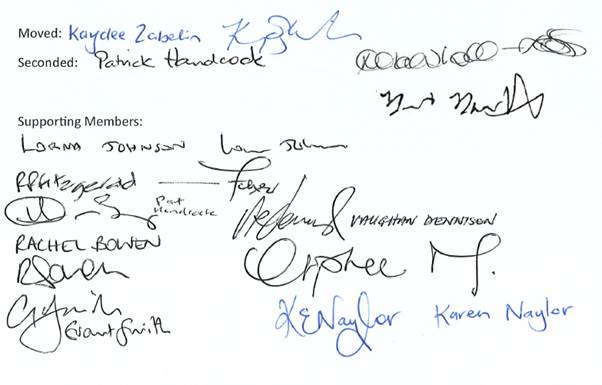
Notice of Motion
TO: Council
MEETING DATE: 1
May 2024
TITLE: Notice
of Motion - Māori Wards
FROM: Councillor
Kaydee Zabelin
THAT THE Council Resolves:
1. That Council formally endorse
its current representative structure of a Te Hirawanui General Ward and a Te
Pūao Māori Ward.
2. That a submission reflecting
this position be made to the select committee process.
I, Kaydee Zabelin,
in accordance with Standing Order 2.7.1 hereby GIVE NOTICE OF MOTION that I
will move at the next Council meeting on 1 May 2024 the following motion:
3. That
Council formally endorse its current representative structure of a Te Hirawanui
General Ward and a Te Pūao Māori Ward;
4. That
a submission reflecting this position be made to the select committee process.
AND I give further
notice that in compliance with Standing Order 2.7.2 the reasons for the Notice
of Motion include:
a) That the
Council’s current representation arrangement is working well at giving
effect to our obligations under sections 4 and 81(1)(a) and (1)(b) of the Local
Government Act 2002;
b) That the
presence and performance of Māori Ward Councillors has enhanced the mana
of Council and significantly contributed to our reputation as national leaders
in collaborative, mutually beneficial working relationships with the indigenous
people of our nation, and to those relationships themselves; and
c) That
having Māori Ward Councillors has positively benefitted Council by
increasing the engagement with parts of the city’s community that have
historically been representationally marginalised, and
d) That
Palmerston North has a long and proud history of partnership with local iwi
that we wish to foster, grow and celebrate.
Attachments
|
1.
|
Officer Response - Māori Wards ⇩ 
|
|
Memorandum
TO: Council
MEETING DATE: 1
May 2024
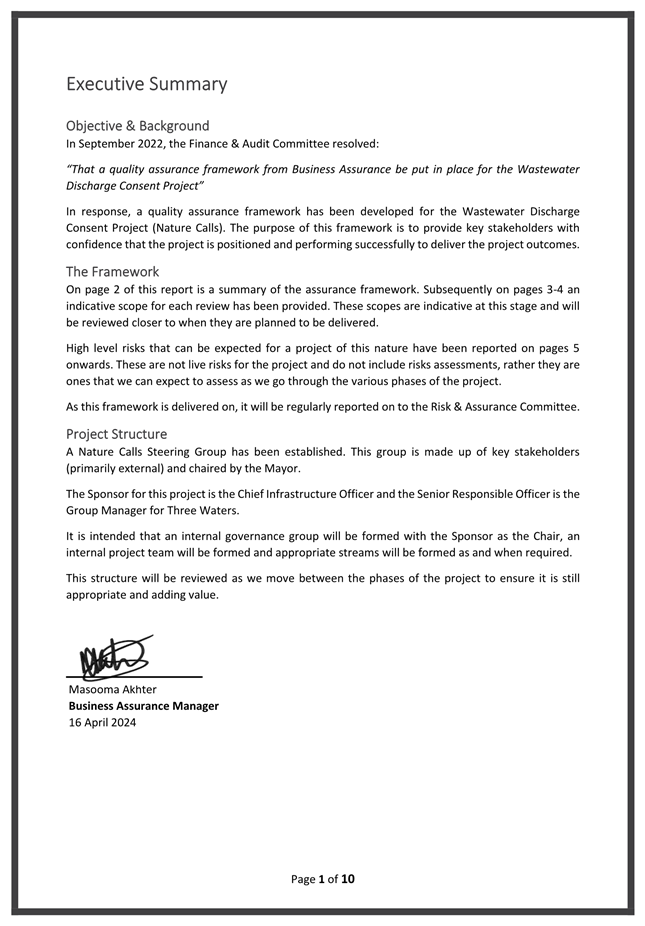
TITLE: Nature
Calls Quality Assurance Framework
Presented By: Masooma
Akhter, Business Assurance Manager & Mike Monaghan, Group Manager - Three
Waters
APPROVED BY: Donna
Baker, Acting Chief Executive Unit Manager
RECOMMENDATION TO Council
1. That Council
receive the memorandum titled ‘Nature Calls Quality Assurance
Framework’ and its attachment, presented on 1 May 2024.
1. ISSUE
In September 2022, the Finance
& Audit Committee passed the following resolution:
“That a quality
assurance framework from Business Assurance be put in place for the Wastewater
Discharge Consent Project”
This memorandum presents the
outcome of this resolution.
2. BACKGROUND
A quality assurance framework
has been developed for the Wastewater Discharge Consent Project (Nature Calls).
The purpose of this framework is to provide key stakeholders with confidence
that the project is positioned and performing successfully to deliver the
project outcomes.
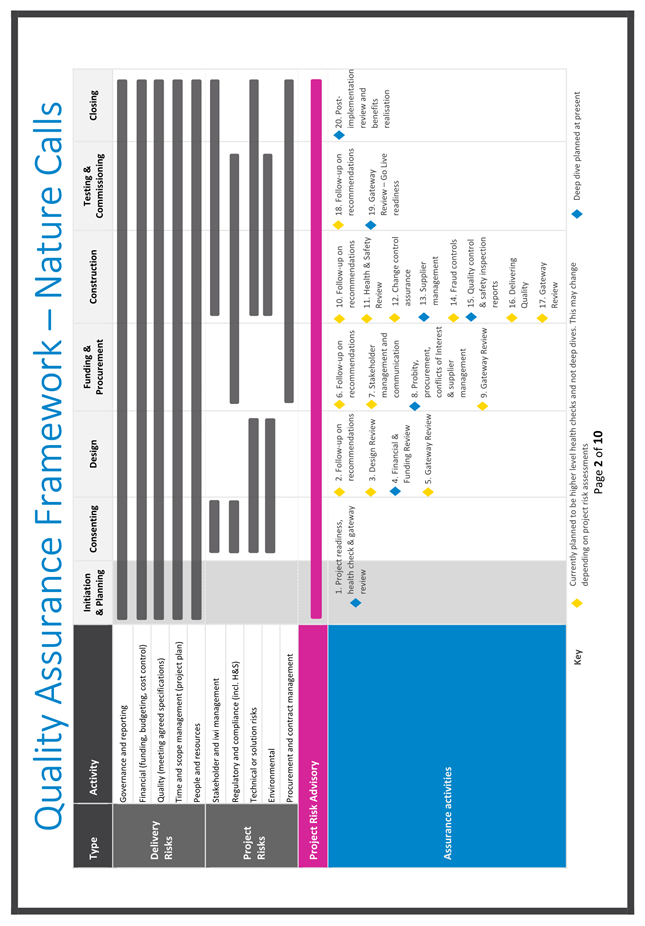
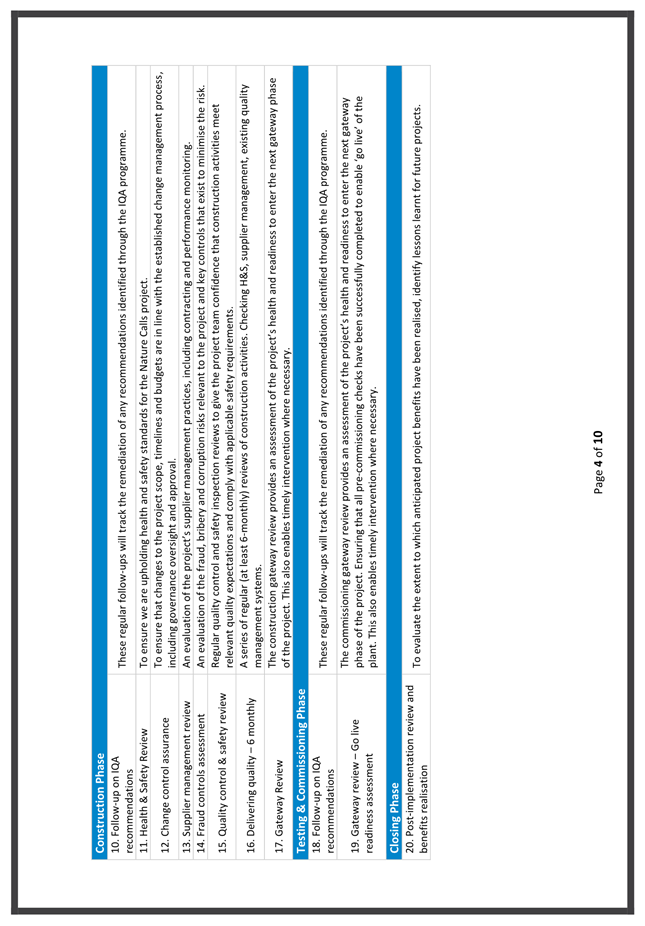
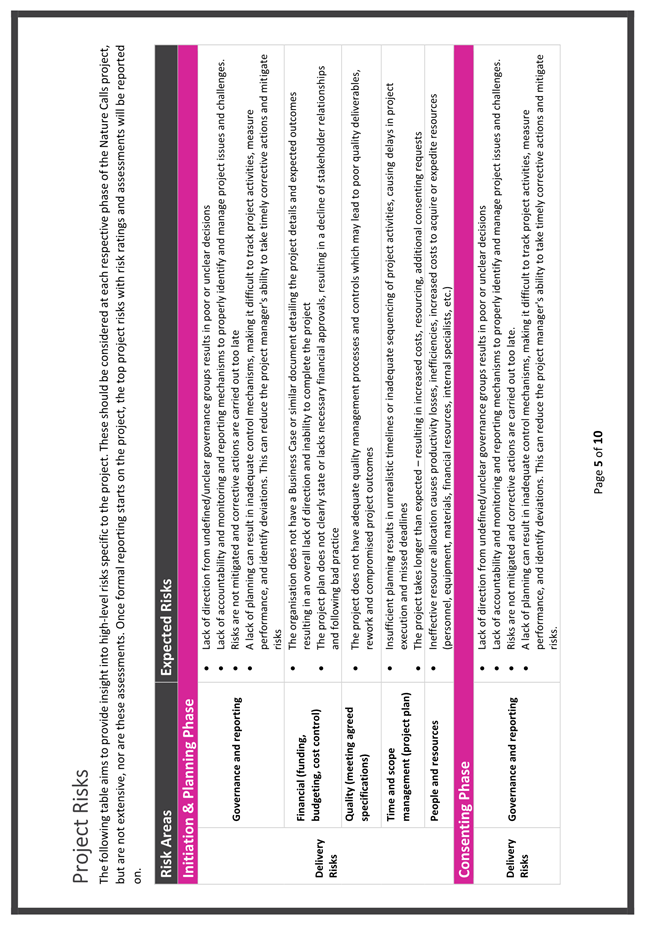
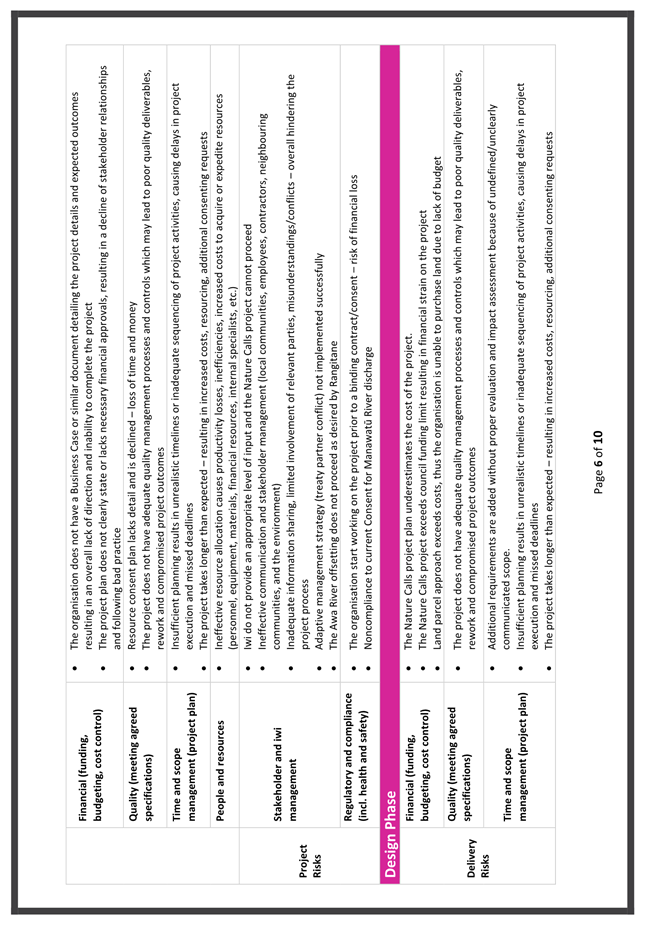
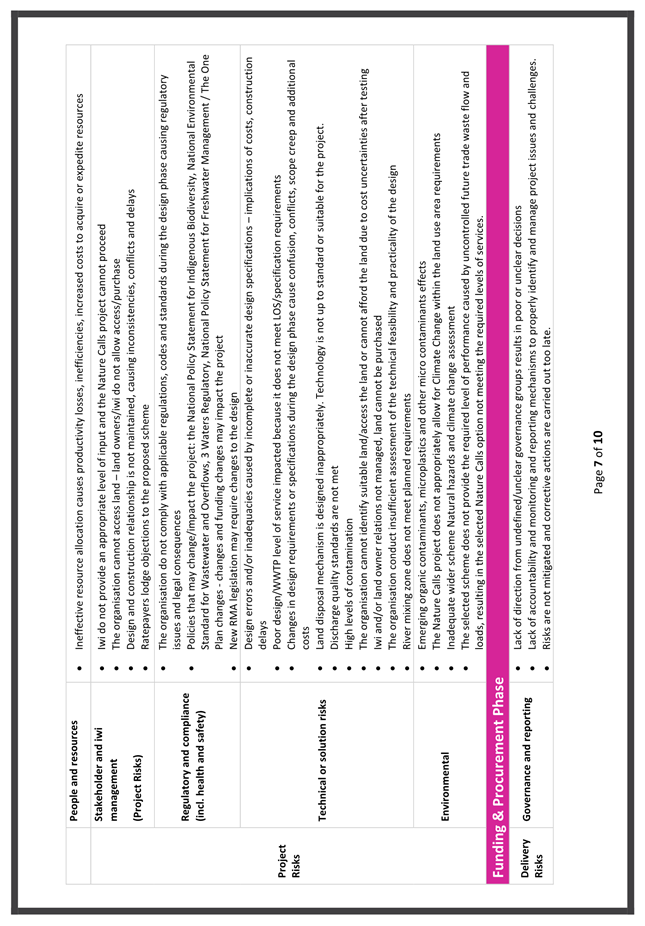
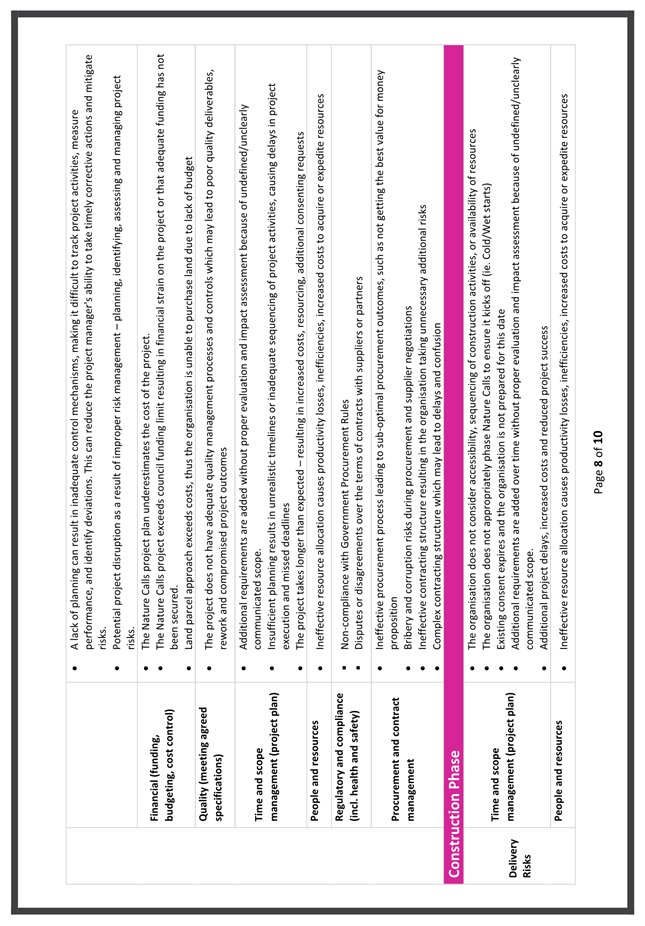
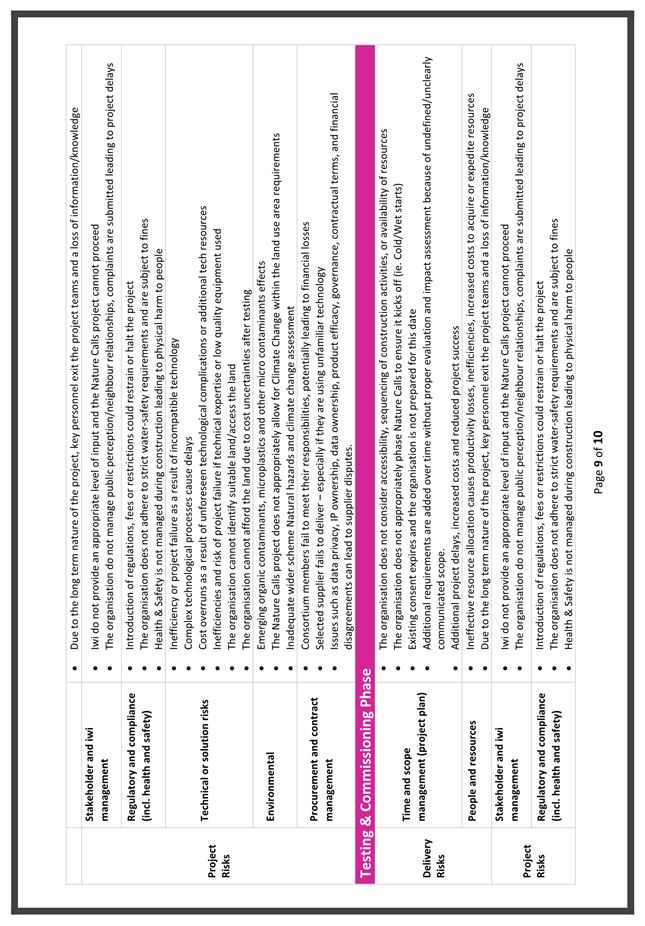
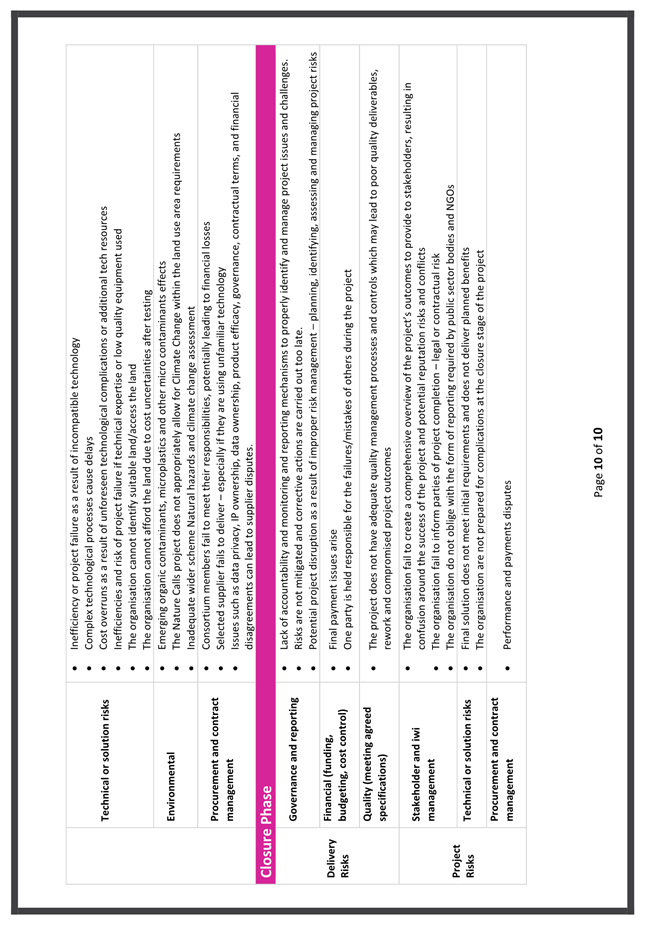
Refer to the attachment for:
· The
quality assurance framework
· An
indicative scope for each review proposed
· A
list of risks that Council can expect to assess as we transit through each
phase of the project.
For a project of this nature it
is expected that the framework would be reviewed at each phase to ensure that
it is aligned to actual and relevant risks.
3. NEXT
STEPS
It is intended that as the
framework is delivered on, and real-time risks assessments undertaken, the
outcome will be reported to the Risk & Assurance Committee.
4. Compliance
and administration
|
Does the Council have delegated
authority to decide?
If Yes quote relevant clause(s)
from Delegations Manual
|
Yes
|
|
Are the decisions significant?
|
No
|
|
If they are significant do they
affect land or a body of water?
|
No
|
|
Can this decision only be made
through a 10 Year Plan?
|
No
|
|
Does this decision require consultation
through the Special Consultative procedure?
|
No
|
|
Is there funding in the current
Annual Plan for these actions?
|
No
|
|
Are the recommendations
inconsistent with any of Council’s policies or plans?
|
No
|
|
The recommendations contribute
to Goal 4: An Eco City
|
|
The recommendations contribute
to the achievement of action/actions in Waters
|
|
Contribution to strategic
direction and to social, economic, environmental and cultural well-being
|
This report is presented as a
business assurance activity in response to the business assurance plan
endorsed by Council.
|
|
|
|
Attachments
|
1.
|
Nature Calls Quality Assurance Framework ⇩ 
|
|
TO: Council
MEETING DATE: 1
May 2024
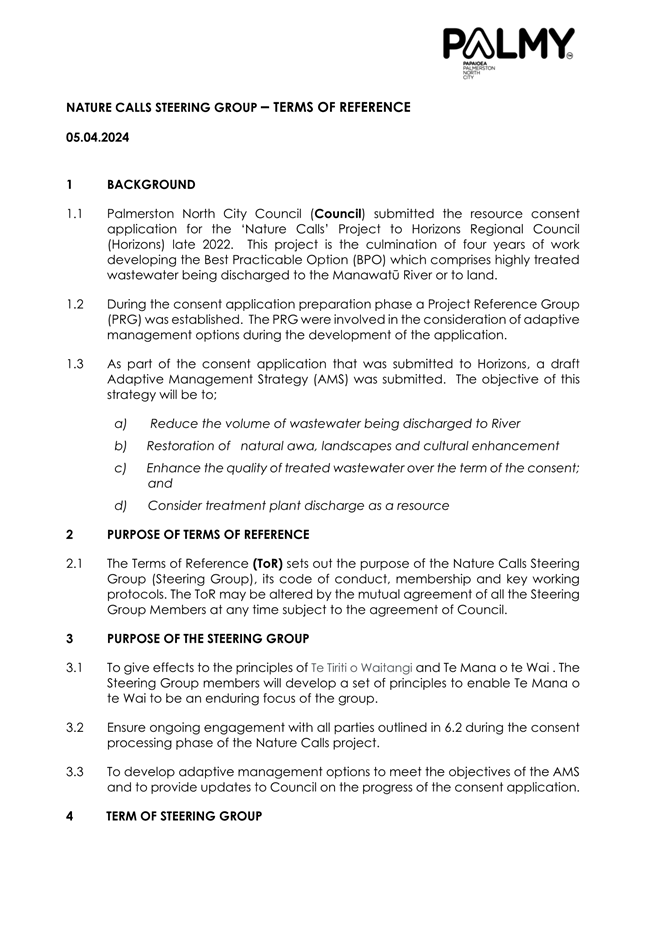
TITLE: Adoption
of Nature Calls Steering Group Terms of Reference
PRESENTED BY: Mike
Monaghan. Group Manager Three Waters
APPROVED BY: Chris
Dyhrberg, Chief Infrastructure Officer
RECOMMENDATION TO Council
1. That Council
adopt the Terms of Reference for the Nature Calls Steering Group (Attachment
1).
1. ISSUE
1.1 In
November 2022, a Council resolution agreed that a new Steering Group for the
Nature Calls Project would be established. This Steering Group would
replace the Project Reference Group (PRG) that was in place during the consent
preparation phase with a new steering group to be established during the
post-lodgement phase of the application until such time a decision is received
on the consent for the Project.
1.2 On
1 November 2023, Council agreed to a draft Terms of Reference (ToR) being
presented to the Nature Calls Steering Group for consideration. The draft
ToR would be circulated to the Steering Group members for discussion as an
order of business at the first meeting. The finalised version would be brought
back to Council for adoption by Elected Members.
1.3 Officers
are seeking Council adoption of the final Terms of Reference. Input and
agreement from key iwi partners and major stakeholders have been incorporated
in the final Terms of Reference presented as attachment 1.
2. Background
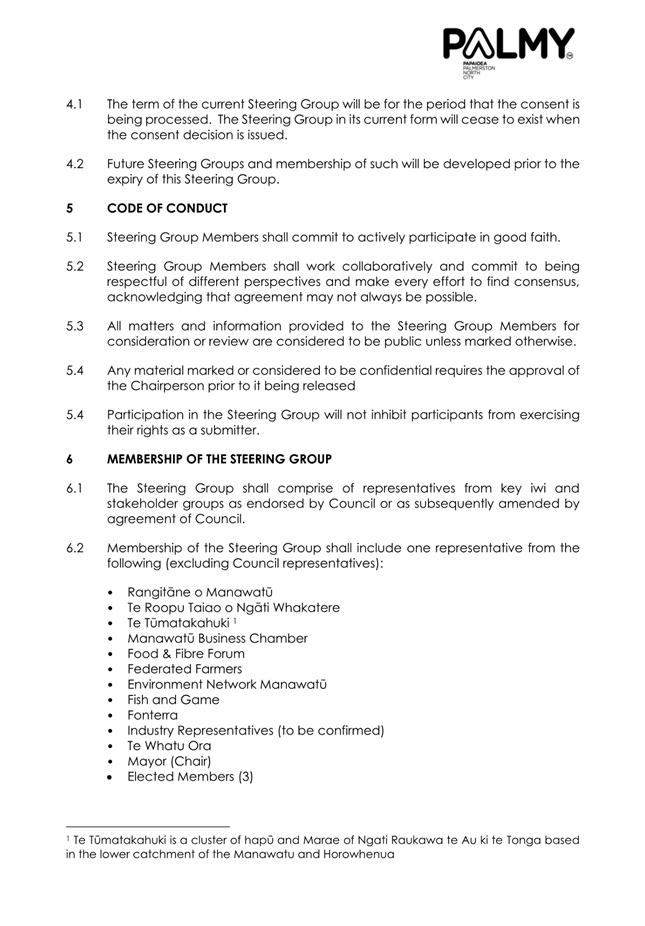
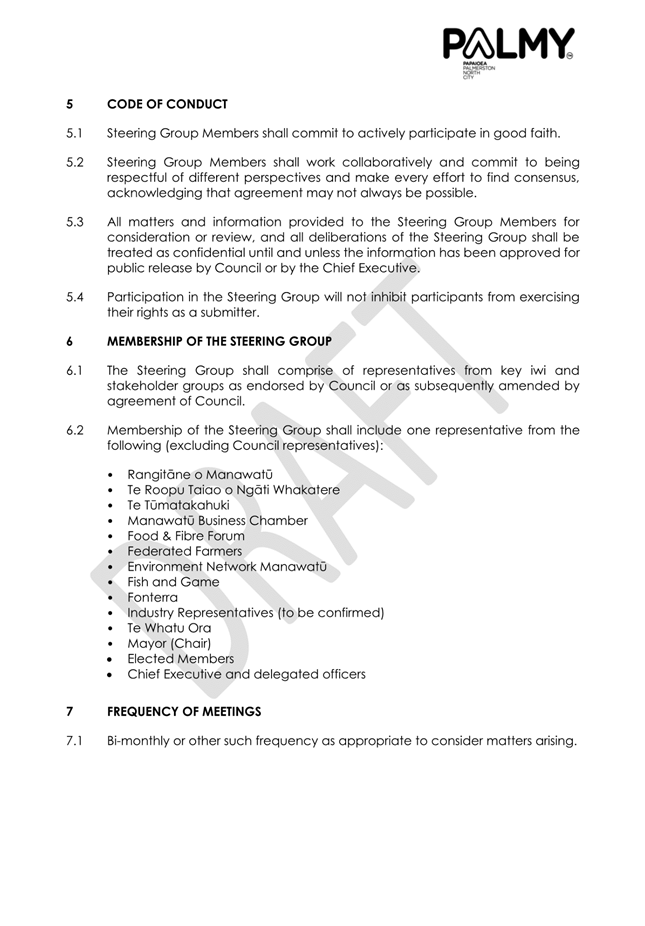
2.1 The
Nature Calls Steering Group met on 19 December 2023. The main agenda item
at this meeting was a discussion on the draft Terms of Reference.
Feedback was received both during and after the meeting from members in
attendance. The draft Terms of Reference were met with general agreement,
with a small number of amendments suggested and agreed to. Amendments to the
draft ToR are detailed below, with section reference and numbering to make it
clear to Elected Members what changes have been made. Attachment 1 is the
final version that is ready for adoption. Attachment 2 is the original
draft ToR, provided for Members reference.
Purpose of the Steering Group
3.1 - To give effects to the principles of
Te Tiriti o Waitangi and Te Mana o te Wai. The Steering Group members will
develop a set of principles to enable Te Mana o te Wai to be an enduring focus
of the group.
Term of the Steering Group
4.2 Future Steering Groups and membership
of such will be developed prior to the expiry of this Steering Group.
Code of Conduct
5.3 All matters and information provided to
the Steering Group Members for consideration or review are considered to be
public unless marked otherwise.
5.4 Any material marked or considered to
be confidential requires the approval of the Chairperson prior to it being
released
Membership of the Steering Group
6.1 The Steering Group shall comprise of
representatives from key Iwi and stakeholder groups as endorsed by Council or
as subsequently amended by agreement of Council
6.2 A foot note was provided by Te
Tūmatakahuki explaining that Te Tūmatakahuki is a cluster of
hapū and Marae of Ngati Raukawa te Au ki te Tonga based in the lower
catchment of the Manawatu and Horowhenua.
6.3 Advisors to the Committee include the Chief
Executive (PNCC) and/or their delegate(s).
6.4 Invited guests can include any technical
experts or regulatory representatives as agenda items require
Frequency of Meetings
7 Meetings will be bi-monthly starting in
February 2024 unless extraordinary meetings are required to consider matters
arising.
Secretariat
8 PNCC will provide secretariat support to take
and distribute meeting minutes in a timely manner and to ensure meeting invites
and relevant pre meeting reading material is shared and distributed
appropriately.
3. Next Steps
3.1 If
adopted, the Terms of Reference will be distributed to all members of the
Nature Calls Steering Group.
Compliance and administration
|
Does the Council have delegated
authority to decide?
If Yes quote relevant clause(s)
from Delegations Manual
|
Yes
|
|
Are the decisions significant?
|
No
|
|
If they are significant do they
affect land or a body of water?
|
No
|
|
Can this decision only be made
through a 10 Year Plan?
|
No
|
|
Does this decision require
consultation through the Special Consultative procedure?
|
No
|
|
Is there funding in the current
Annual Plan for these actions?
|
Yes
|
|
Are the recommendations
inconsistent with any of Council’s policies or plans?
|
No
|
|
The recommendations contribute
to Goal 4: An Eco City
|
|
The recommendations contribute
to the achievement of action/actions in Waters
|
|
Contribution
to strategic direction and to social, economic, environmental and cultural
well-being
|
|
|
|
|
Attachments
|
1.
|
Attachment 1 - Nature Calls Steering Group Terms of
Reference - Final ⇩ 
|
|
|
2.
|
Attachment 2 - Nature Calls Steering Group draft Terms of
Reference ⇩
|
|

Memorandum
TO: Council
MEETING DATE: 1
May 2024
TITLE: 2023
Residents' Survey Action Plan
Presented By: Andrew
Boyle, Head of Community Planning and Jessica Ballinger, Marketing Manager
APPROVED BY: David
Murphy, Chief Planning Officer
Donna Baker, Acting Chief Executive
Unit Manager
RECOMMENDATION TO Council
1. That Council
note the actions being undertaken in response to the 2023 Residents’
Survey results.
1. ISSUE
1.1 This
report looks at the trends from the 2023 Annual Residents’ Survey results
and outlines what Council needs to do to improve its reputation and satisfaction
with its services.
2. BACKGROUND
2.1 In
September 2023 Council received the results of the 2023 Residents’
Survey. Council resolved to request the Chief Executive to bring back an Action
Plan for the 2023 Residents’ Survey’s results.
2.2 Council
noted that the rationale for the resolution was that the survey results showed
a drop in satisfaction in various areas, including Council’s reputation,
and Elected Members needed to understand what work needs to be done to address
the issues.
3. discussion
of survey results
3.1 The
Residents’ Survey measures residents’ perceptions of
Council’s reputation and its services.
3.2 Trend
data from the survey shows that satisfaction with Council’s reputation
and services was fairly steady or increased between 2019 and 2021, but then
dropped considerably in 2022. The 2023 results were similar to 2022.
3.3 Other
councils experienced similar drops in 2022. This suggests that national factors
such as COVID-19, tough economic times, and cost of living increases all
impacted on how people felt and how they rated councils, including PNCC. This
led to lower satisfaction scores for our reputation and service.
3.4 The
survey also identifies the priorities for Council to improve satisfaction with
its reputation and services. In the 2023 Survey Report KeyResearch said that:
“The key priorities for [Palmerston North City]
Council include Value for Money, and perception of Council Reputation measures
that include Leadership, Trust and Financial Management. Another priority to
focus on is Roading.
“Verbatim comments left by the respondents
indicate general disagreement with how rates are spent, as well as not enough
effort from Council to consult the public before making financial decisions.
“Over the past years, road maintenance has
received the highest number of comments from respondents. The issues mentioned
include the need for improved maintenance and ensuring that roads are safe to
use.”
3.5 These
priorities are shown in the Opportunities and Priorities matrix from
KeyResearch. The areas Council should focus on improving are in the Priorities
quadrant. These are the areas that have the highest impact on how residents
perceive Council overall and the lowest performance. The 2023 priorities are
similar to previous years’ results.




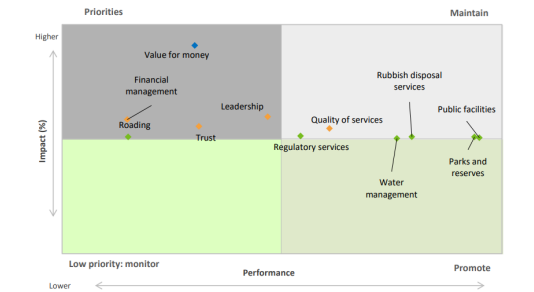
3.6 Other
areas are in the Maintain and Promote quadrants. “Maintain” means
the area has a high impact on how residents perceive Council and residents
consider it is performing well – hence Council should continue this level
of performance. “Promote” means Council is performing well but this
has little impact on how Council is perceived, so Council should let people
know what it does in these areas to get some reputational credit from its good
performance.
3.7 Four
reputational areas and one service area are in the Priorities Quadrant: Value
for Money, Trust, Leadership, Financial Management and Roading. Value for
Money, Trust, Leadership and Financial Management all overlap and actions to
address one will impact on the others. Hence they are considered together in
this report.
3.8 The
following graph also shows that reputational measures are a priority to
address.
3.9 Satisfaction
with Council’s Value for Money (the red line), Overall Reputation (green)
and Overall Satisfaction (blue) are all around 15-20 percentage points below
Satisfaction with Council’s Facilities, Infrastructure and Services
(yellow). In other words, residents are generally satisfied with our services,
but this does not fully flow through into Council’s reputation and
overall satisfaction.
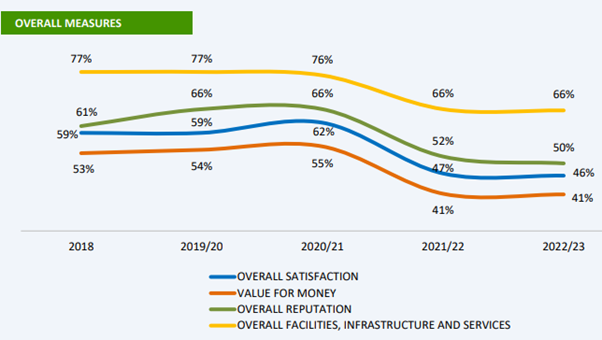
3.10 These two
charts mean that Council is unlikely to markedly improve its overall reputation
by focussing solely on improving its services. Instead, our main focus should
be on raising residents’ awareness that it is the Council that provides
many of the services that they trust and rely on every day.
4. priority
actions to address the residents’ survey results
4.1 Many
of Council’s actions to address the Survey’s results fall into
three broad areas:
· Raising
residents’ awareness of Council’s services and role in the city
· Leading
the city and providing reliable, value for money services through the Long-Term
Plan
· Improving
those services where satisfaction is low.
Raising residents’
awareness of Council’s services and role in the City
4.2 This
occurs through a wide mix of formal and informal actions.
4.3 Since
receiving the results from the last Residents’ Survey, a new initiative -
the “What does Palmerston North City Council do?” campaign –
has been launched. This gives residents “a peek behind the curtain of how
things work at Palmerston North City Council. It's all about community,
democracy, and making Palmy an even better place to call home.”
4.4 The
campaign is supported by a range of promotional material including video and
printed collateral. This material will continue to be promoted through Council
channels.
4.5 The
Residents’ Survey results show younger demographics are less satisfied in
Council services than older groups, so we have “What Council Does”
information specifically targeted at youth. We have been working with high
school students, teaching them about the different ways Council affects their
lives.
4.6 For
more information on the campaign see: www.pncc.govt.nz/whatwedo
4.7 The
other major initiative directly involves Elected Members talking about
Council’s role and services, including:
· Elected
Members have active roles in drop-in activities with diverse audiences for
different activities.
· Elected
Members tell people about their roles on Council. This includes talking at
schools and Chairs of committees speaking about their portfolios.
· Elected
Members’ photos and contact information are included on the website and
in publications like the Annual Budget/Long-Term Plan consultation documents.
· Elected
Members write newspaper columns and appear on radio talking about their roles
and Council projects.
· Elected
Members and officers use a wide range of communication methods to reach
community and stakeholders. This includes significant numbers of formal
letters, radio advertising, newspaper advertisements, social media etc. All
these communications encourage two-way conversations.
Leading the City and providing
reliable, value for money services through the Long-Term Plan
4.8 Trust,
leadership, value for money, and financial management are central to the
Council’s Long-term Plan. The LTP is all about what Council will do to
lead the city and to provide services that residents can rely on and that
provide value for money.
4.9 The
LTP rests on the Oranga Papaioea City Strategy and Plans. These set out how
Council will work towards social, economic, environmental and cultural
well-being of communities, now and in the future
4.10 Socialisation
of the LTP Consultation Document involves an open discussion with the community
about the future of Palmerston North, the services that Council could provide,
and the value for money people get for these services.
4.11 Council
is now holding its LTP discussions in public meetings, rather than closed
workshops, to engender more trust.
4.12 The
Residents’ Survey is a key source of information for Elected Members and
officers at various points of the LTP, including:
· The environmental
scan
· The direction
setting strategic retreat
· Oranga Papaioea
City Strategy and Plans
· Asset Management
Plans and Activity planning
· Prioritisation
Activity Summary Sheets.
Improving
Council services where satisfaction is low
4.13 The
Residents’ Survey clearly shows that the priority area amongst Council
services is transport, particularly road maintenance.
4.14 Council
and Fulton Hogan have been looking at improvements to the roading maintenance
process as part of the LTP. A report is going to Council in May proposing an
increased budget, more clearly defined key deliverables for the contract, and a
more transparent process.
4.15 Council’s
Business Assurance Team has overseen an external review on the performance of
the contract. Recommendations from this are considered in the Report going to
Council in May.
4.16 Other
improvements in the way Council invests in, and manages, its roading network
are highlighted in the Palmerston North Integrated Transport Initiative
(PNITI). These include:
· The
Manawatū regional freight ring road to stop trucks using residential
streets.
· Building
a more balanced network that allows more people to walk, cycle or use public
transport to get around.
· Building
safer roads and intersections.
· Incorporating
urban design into roading projects (such as Cuba St).
· Changing
the way streets in the city centre look and operate to make the CBD more
vibrant and attractive and to bring economic benefits.
· Footpaths
are inspected every two years and are covered by the roading maintenance
contract.
· Continuing
to upgrade lights to LED and increasing programme to replace failed LED units.
4.17 One other
service has dissatisfaction greater than 20% - community engagement. Here
Council encourages people to have their say by offering a range of easy-to-use
techniques. Through the “What does the Council do?” campaign it is
also working to ensure residents understand the breadth and relevance of
Council's services so they are more motivated to have their say.
4.18 Note that
community engagement and trust have a close two-way relationship.
Ongoing Implementation of
these actions
4.19 The
Council identified “Loss of public trust in Council” as a strategic
risk at the March 2024 Risk and Assurance Committee. Public trust in Council is
largely a result of residents’ perceptions of Council’s leadership
in the city and the reliability and value for money they feel they get from
Council’s services. It is the central issue raised in the
Residents’ Survey results.
4.20 Having
‘loss of public trust’ as a strategic risk means that:
· Officers will
prepare a risk register for a loss of public trust in Council. This will
identify the causes and consequences of a loss of trust. The risk register will
include controls and mitigations (actions) to improve trust in Council. Note:
the Risk and Assurance Committee adopted 11 strategic risks. Officers will
progressively prepare risk registers for each of these. The risk register for
loss of public trust is likely to be reported to Committee in September 2024.
· The Risk and
Assurance Committee will receive regular monitoring reports on the risk rating
of Council’s strategic risk registers.
4.21 In other
words, identifying “loss of public trust in Council” as a strategic
risk puts the actions identified in this report, along with other actions
subsequently identified, into a formal risk register that Council will
implement and monitor on an ongoing basis.
5. NEXT
STEPS
5.1 KeyResearch
is working on the 2024 Residents’ Survey. The survey is carried out in
quarterly batches and the annual report will be sent to Council in July.
Officers will prepare a report for Council to consider in September.
5.2 The
“What does Palmerston North City Council do?” campaign will
continue to roll out, reminding residents that it is Council that provides many
of the value for money services that they rely on every day.
5.3 Council
is currently consulting on the LTP. At its core the LTP is a community –
Council conversation about Council’s leadership, trust, and value for
money services. Council will adopt the LTP in June.
5.4 A
report will go to Council in May with an improved road maintenance contract.
5.5 Officers
will prepare a Strategic Risk Register. The strategic risks include “a
loss of public trust in Council”. This will identify the causes and
consequences of a loss of trust, along with mitigation actions. The risk
register for loss of public trust is likely to be reported to the Risk and
Assurance Committee in September. Council will receive regular monitoring
reports on its strategic risks.
6. Compliance
and administration
|
Does the Council have delegated
authority to decide?
If Yes quote relevant clause(s)
from Delegations Manual
|
Yes
|
|
Are the decisions significant?
|
No
|
|
If they are significant do they
affect land or a body of water?
|
No
|
|
Can this decision only be made
through a 10 Year Plan?
|
No
|
|
Does this decision require
consultation through the Special Consultative procedure?
|
No
|
|
Is there funding in the current Annual
Plan for these actions?
Some of the actions are
dependent on the programmes currently in the proposed 2024 long-term plan.
|
|
|
Are the recommendations
inconsistent with any of Council’s policies or plans?
|
No
|
|
Contribution to strategic direction
and to social, economic, environmental and cultural well-being
|
The recommendations contribute
to the Council’s contribution to the four well-beings and all of
Council’s goals and plans by giving Council feedback on its reputation
and services.
|
|
|
|
Attachments
Nil
Memorandum
TO: Council
MEETING DATE: 1
May 2024
TITLE: Progress
report: Youth Well-being forum and plan
Presented By: Remy
Waldteufel-Irvine, Youth Services Team Leader, and Anton Carter, Group Manager
Community Services
APPROVED BY: Kerry-Lee
Probert, Acting Chief Customer Officer
RECOMMENDATION TO Council
That Council receive the
memorandum titled ‘Progress report: Youth Well-being forum and
plan’ presented on 1 May 2024.
1. ISSUE
1.1 At
the Community Committee on 22 November 2023, the Committee resolved a Notice of
Motion:
‘That the establishment of a specific Youth
Well-being Plan be referred to the 2024-2034 Long Term Plan.
That officers facilitate a youth well-being forum in
early 2024 and complete a sector wide scan of youth focused programmes and or
initiatives within the city and identify any strategic or service gaps that can
be used to inform the development of the Youth Well-being Plan.
That officers provide a report to the Community
Committee before the Long-Term Plan deliberations, on the finding of the sector
wide scan, with associated recommendations and resource implications.’
1.2 This
memorandum summarises the findings and insights from the Youth Well-being
Forum, which was held on Friday 5 April 2024, and presents analysis from a
sector wide scan of youth focused programmes, initiatives and strategic or
service gaps.
1.3 Due
to the timing of the Long-Term Plan deliberations, and the Community Committee
meeting schedule, this report is being presented to Council.
2. BACKGROUND
Palmerston North Youth Population
2.1 There is a
total of 20,280 Young People aged 10 – 24 years in Palmerston North. This
equates to 22.1% of the city’s total population and is higher than the
national population average for the same age group, which is 19.2%.
2.2 In
recent years, young people have experienced increased challenges in a range of
areas including education, health, employment, safety and relationships.
Covid-19 had an impact on young people, particularly affecting education and
mental health outcomes.
2.3 Services
nationally and locally are finding it hard to keep pace with escalating needs.
Trends seen locally have been mirrored in many parts of New Zealand, and
negative trends have been well publicised through national and local media.
2.4 Some
recent local initiatives that have positively impacted the trajectory of these
trends have been:
· Increasing the
numbers of Ministry of Education (MoE) attendance officers to work alongside
community to triage young people’s needs in response to disengagement with
mainstream education.
· The introduction
of a community policing initiative in the Central Business District, with
specialist youth liaison staff.
· Youth-led
programming such as Bestcare Whakapai Hauora's Rongomai kaupapa, and
YCentral’s Rangatahi Ora Easter Event.
3. SUMMARY
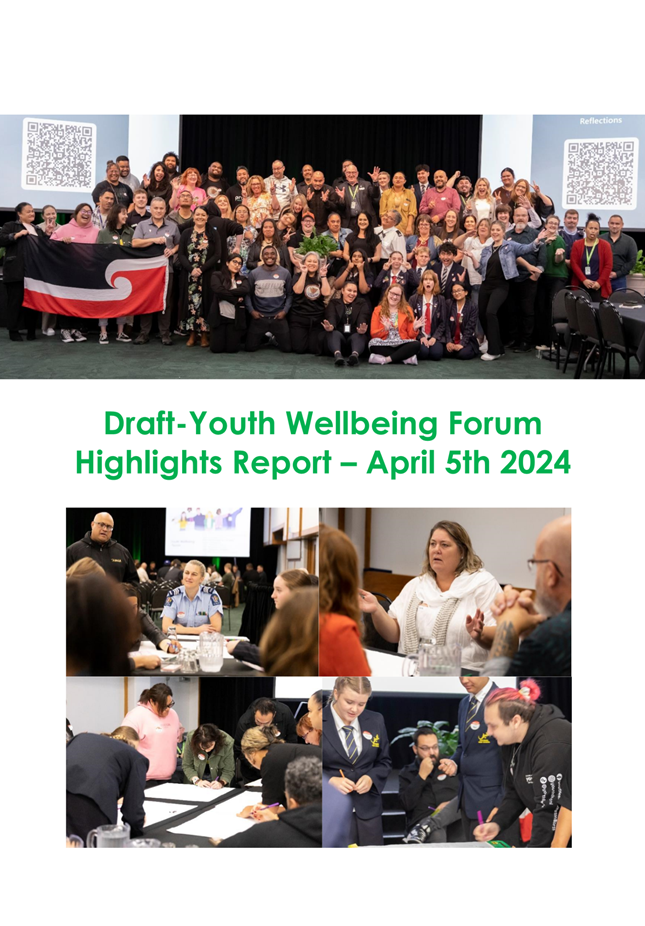
FROM THE YOUTH WELL-BEING FORUM
3.1 The
forum was held on 5 April 2024 at the Conference and Function Centre.
Ninety-five people attended, representing a wide range of services and
networks. The forum gave officers the opportunity to understand how Council
could better support the Youth Sector.
3.2 By
bringing people together forum attendees were able to share insights and
identify ways the sector works together, what is out there (including available
resources and challenges), collaborative opportunities and aspirations.
3.3 High level aspirations of the forum attendees were
consistent and best expressed through the following quotes:
“A connected, engaged, cohesive and resilient
youth sector, that operates within a collective, mana enhancing manner that
ensures youth services across Palmerston North are the best services they can
be for the Rangatahi / Whānau they serve”
“Develop
a shared understanding about how preventive and early intervention is key to
establishing a pathway to youth and community well-being”
“Networking
connections and an understanding of how we can best utilise our services to
meet the needs of both young people and the community.
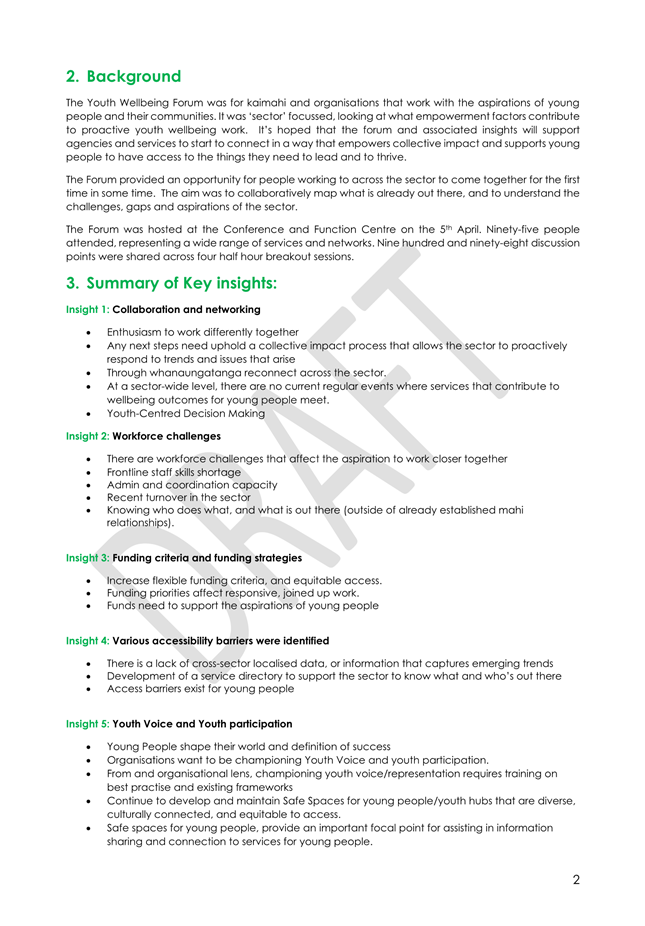
3.4 Table 1 provides an overview of
the key insights from the forum. The full Youth Well-being Forum Report is
provided in Attachment 1.
Table 1: Key Insights
from the Youth Forum
|
Insight 1:
Collaboration and networking
|
· Enthusiasm to
work differently together
· Want to be
delivering more collective impact and collaborative work.
· There was a
focus on whanaungatanga to reconnect the sector, currently there are no
regular events that support youth well-being services from across the sector
to meet.
|
|
Insight 2: Workforce
challenges
|
· There are
workforce challenges that affect the aspiration to work closer together.
· Frontline staff
skills shortage
· Lack of
administration and co-ordination capacity
· Recent high
turnover in the sector
· Strong desire to
know who does what, and what’s out there (outside of already
established mahi relationships).
|
|
Insight 3:
Funding criteria and funding strategies
|
· Increase
flexible funding criteria and equitable access
· Funding
priorities affect responsive joined up work.
|
|
Insight 4:
Various accessibility barriers were identified
|
· There is a lack
of cross-sector localised data, or information that captures emerging trends.
· Development of a
service directory to support the sector to know what and who’s out
there.
· Access barriers
exist for young people.
|
|
Insight 5: Youth Voice and Youth
participation
|
· Championing
Youth Voice and youth participation
· Empowering young
people participation and youth voice throughout services at both a strategic
and operational level, requires training on best practice and existing
frameworks.
· Create a shared
understanding across the sector on youth development frameworks and best
practice to do this.
· Continue to
develop and maintain safe spaces for young people that are diverse, culturally
connected, and equitable to access.
|
4. Sector
wide Scan
4.1 Undertaking
a sector wide scan of youth focused programmes and/or initiatives in Palmerston
North presented a number of challenges. These included:
· No
specific central repository that provides easy access to this information from
across the sector.
· The
organisations, roles and associated programmes and initiatives that contribute
to the well-being outcomes of young people are broad and varied.
· The
age range variance for different programmes and initiatives i.e. programmes
have a specific targeted age group and access criteria.
Youth Directory
4.2 Due
to the time constraints, a full analysis of current programmes and initiatives
could not be completed. To illustrate the breadth and number of services,
officers have analysed accessible directory information from the 2016 Youth One
Stop Shop (YOSS) Youth Services Directory, and the 2018 Index App Directory
Data.
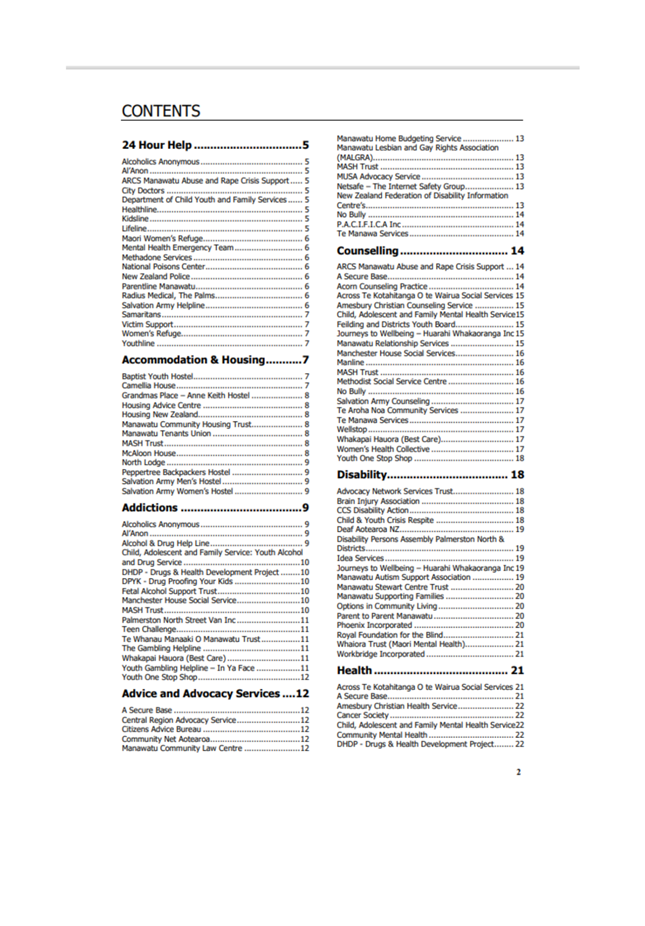
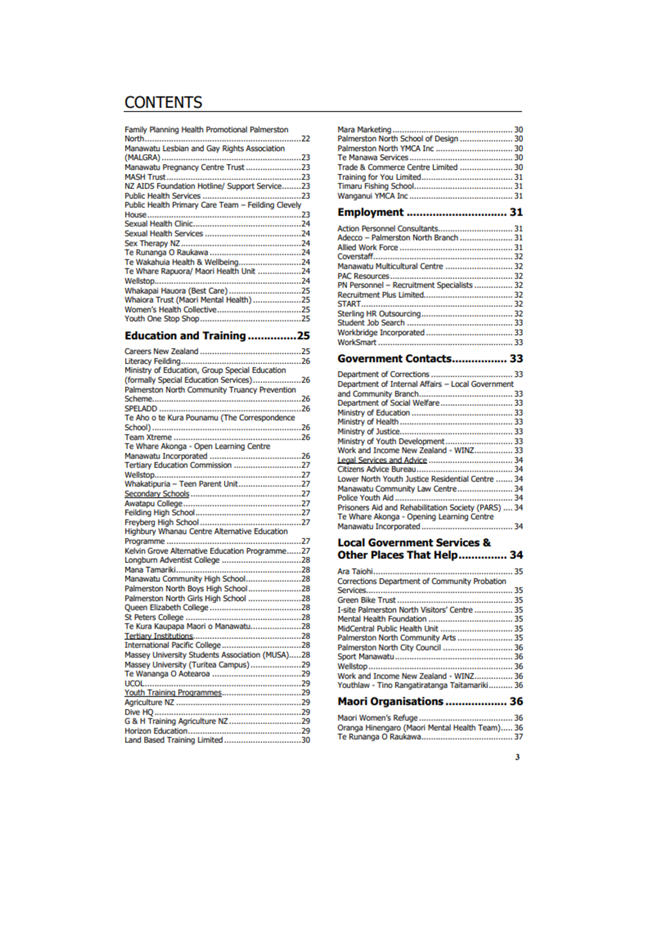
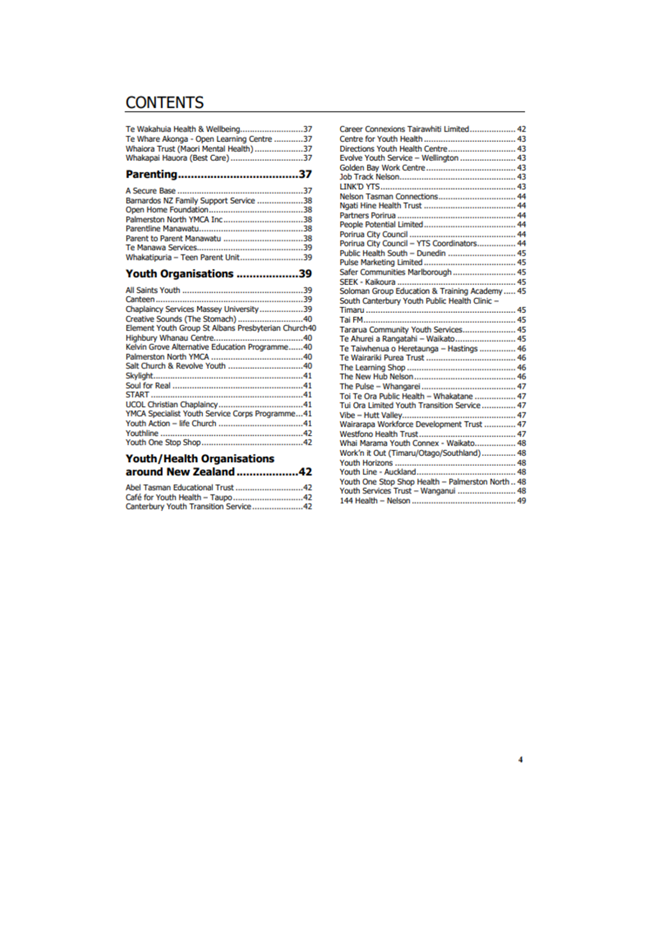
4.3 The
contents page of the Youth Directory provides a good example of the range and
types of services available. This is provided in Attachment 2.
4.4 No
update of a sector-wide directory has been completed since 2018. This can
be attributed to Covid-19, services capacity, and the end of the YOSS Strategic
Priority Grants contract.
4.5 Analysis
of current youth directories suggests there are several referral-based
directories that are specific to well-being workstreams. These are current and
of use to the organisations that require them but there is no high-level
sector-wide resource for services. This was identified as a gap at the forum.
Programmes and Initiatives
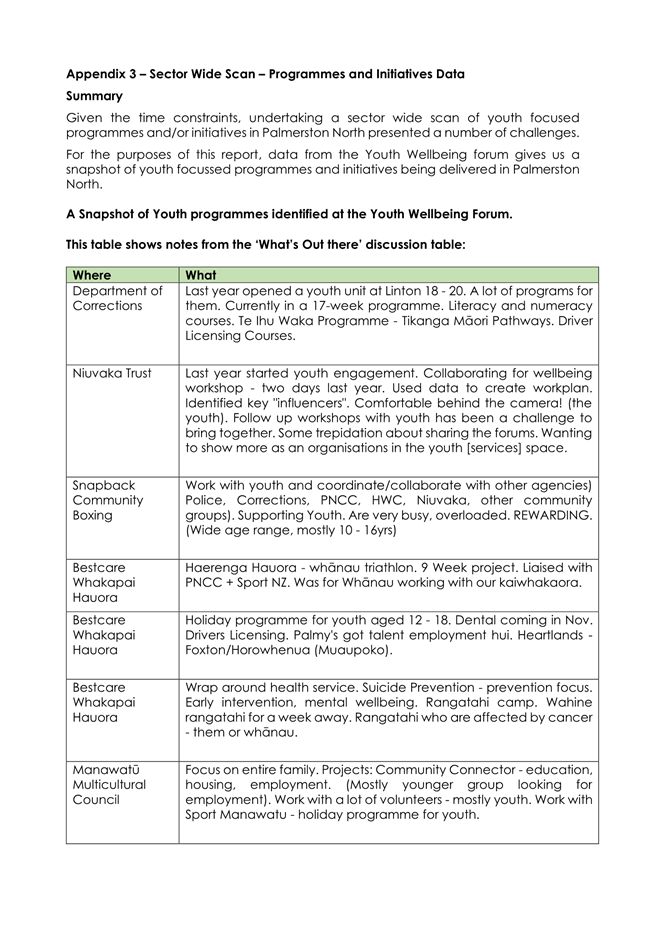
4.6 A snapshot of
existing programmes and initiatives are provided as examples of
the types and range of youth well-being activity being delivered in Palmerston
North. This snapshot is provided in Attachment 3.
Service Gaps
4.7 Initial
service gaps identified through the Youth Well-being Forum are set out in Table
2.
Table 2: Identified Service
Gaps
|
Programming
|
· Service/programme
gaps for under 8–14-year-olds outside of school
· Lack of
programmes and services for 18–24-year-olds not in education,
employment, or training
· Need for an
increase in programming for rainbow and takatāpui young people
· Lack of programmes
that support neurodiverse young people
|
|
Additional and
alternate pathways
|
· Education and
development pathways for young people in secondary school and below. Options
for young people disengaged in mainstream education and training are limited,
and particularly limited for young people under 14.
· Access
challenges and long waitlists were noted in connection to mental health
services for young people.
|
|
Locations
|
· Safe Spaces for
diff age groups <13 y/o, 13 - 19, >20 +, these can be utilised as triage
spaces to address needs.
|
|
Workforce
|
· Need for more
frontline youth workers, mentors and Tuakana + Teina connections
|
|
Funding
|
· Funding for
services and programmes that are culturally connected and delivered in ways
that strengthen young person’s sense of identity and belonging.
Rainbow and disabled communities and Pasifika young people.
· Increase access
through funding for young people to sports, active rec and kapa haka
|
Youth
strategies and reports
4.6 As part of the sector wide scan, it is important to note
there are numerous central Government and Non-Governmental Organisation youth
focused strategies and reports relating to youth well-being.
4.7 The most relevant report is the Children and Youth Wellbeing Report 2022/23, Annual
Report on the Child and Youth Wellbeing Strategy for the year July 2022 –
June 2023.
5. COUNCIL
SUPPORT
5.1 Council currently
contributes both directly and indirectly to well-being outcomes for young
people through the following mechanisms:
a. Youth
Services (through the City Library Youth Space facility with Youth Services
Officers, youth development programmes such as the Palmy Youth Council, Tuia Te
Here Tangata mentoring kaupapa and Global Ambassadors).
b. Community
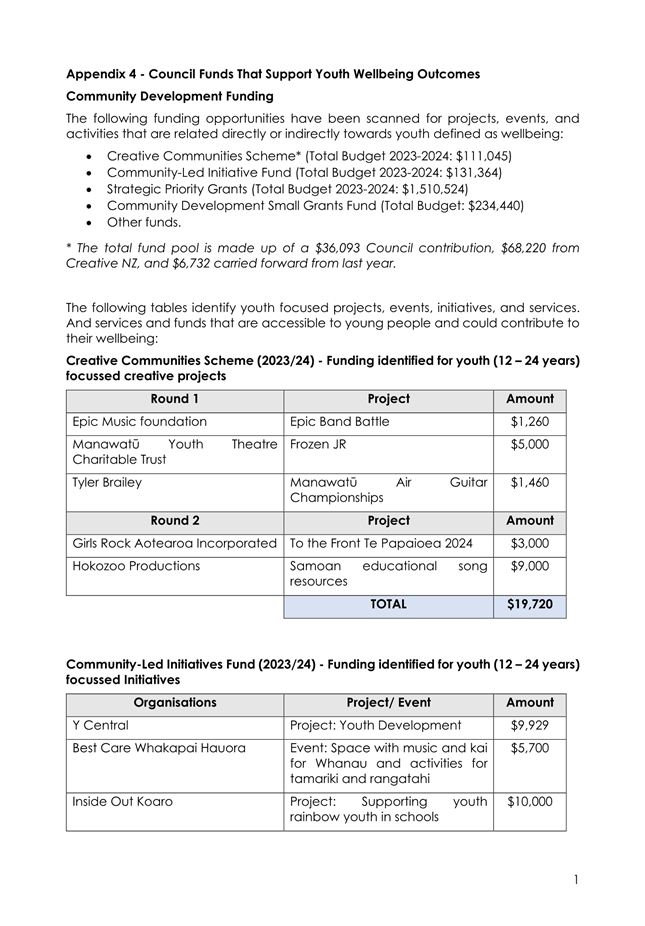
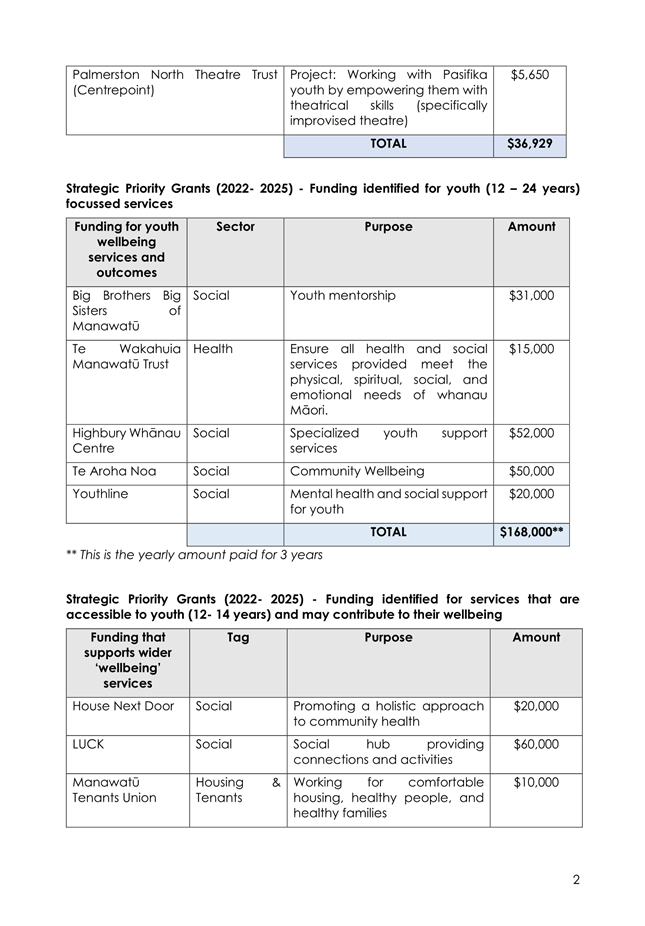
Funding (through Strategic Priority Grants, Community-Led Initiatives Fund,
Creative Communities Scheme, Community Development Small Grants, Youth Council
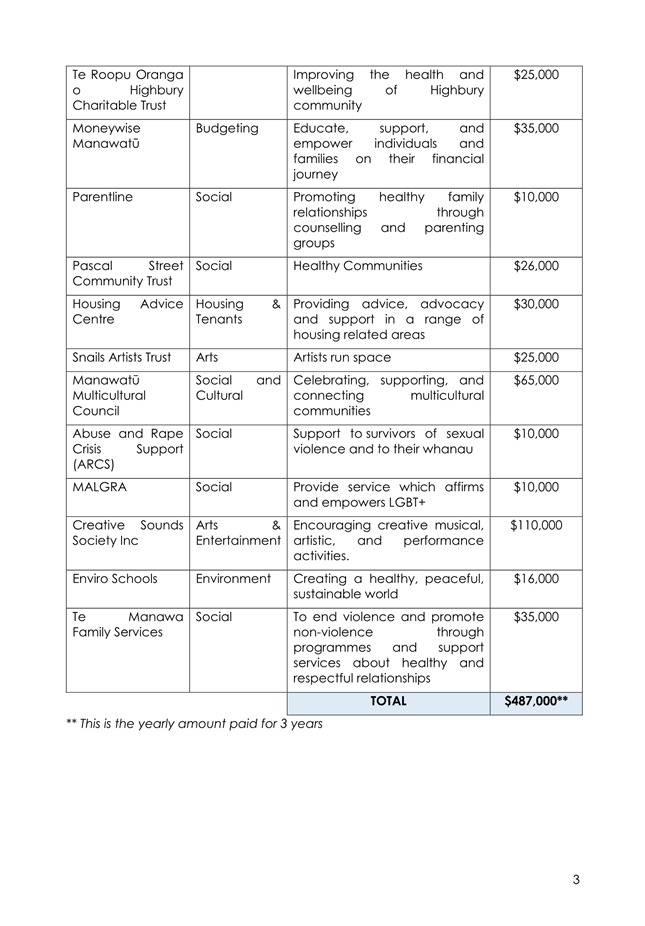
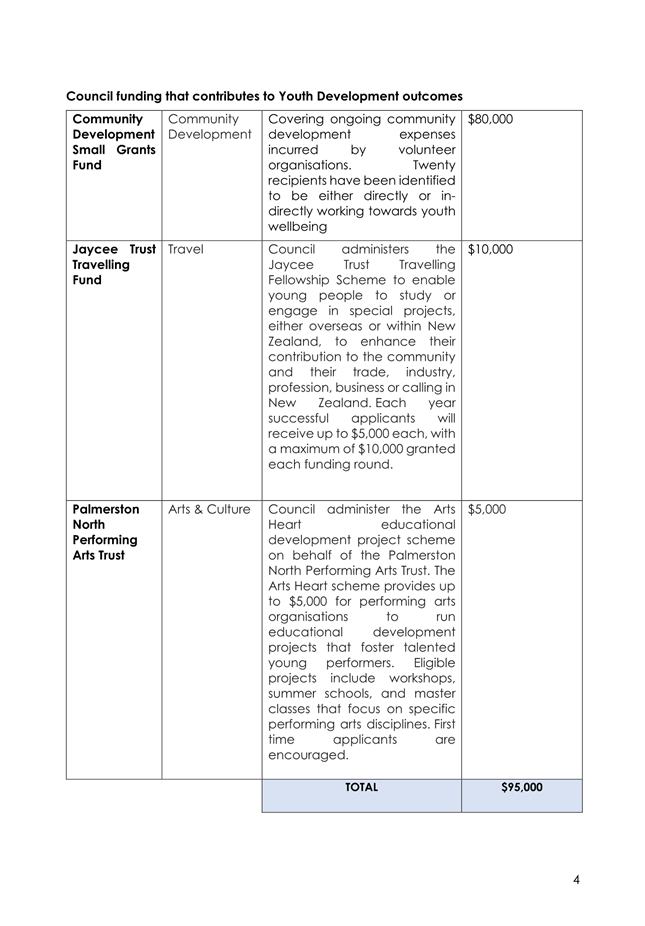
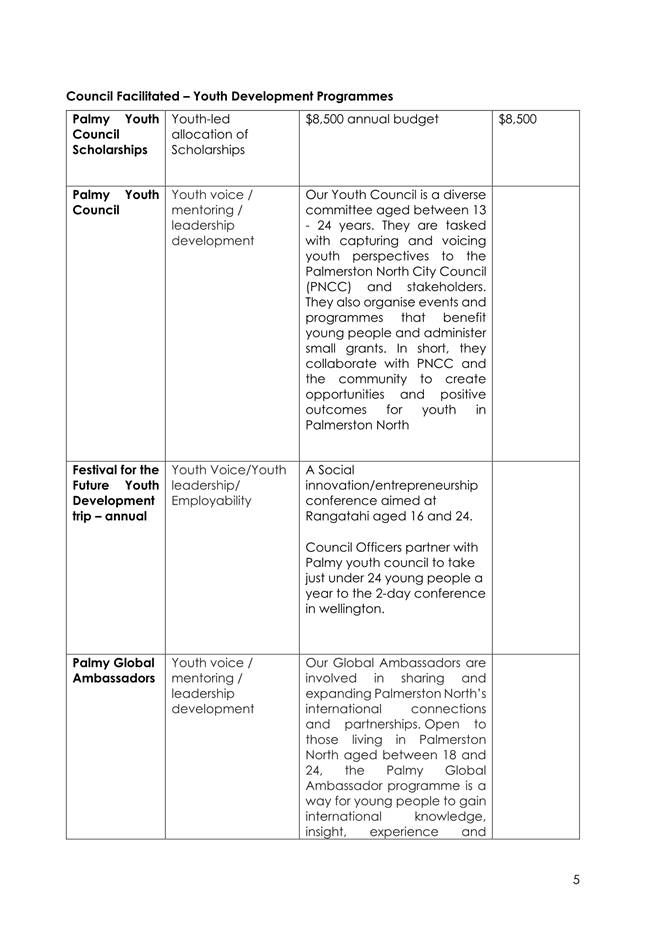
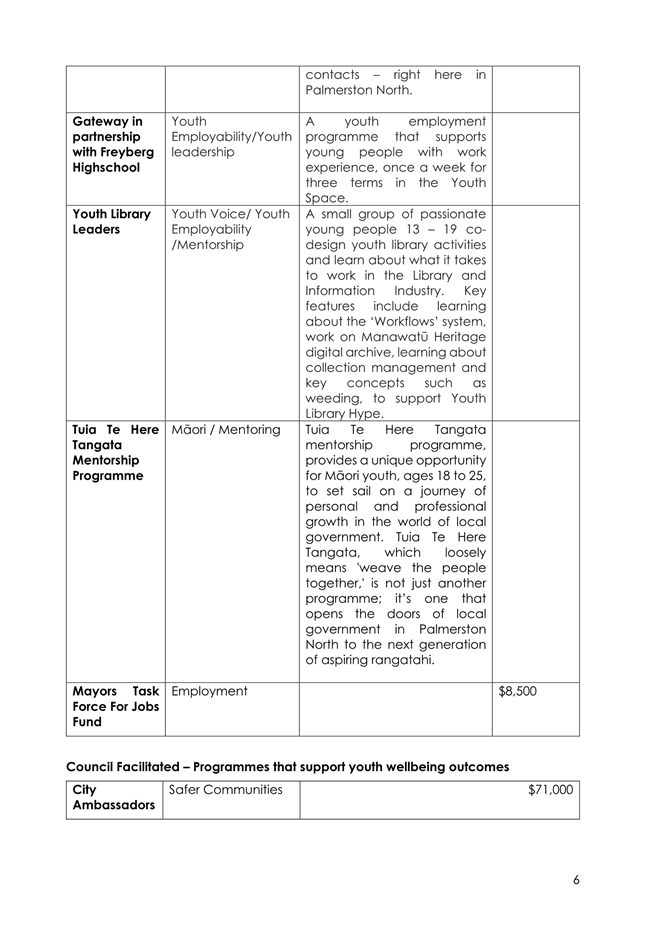
Scholarships and Grants). A breakdown of identified Council funding support is
provided in Attachment 4.
c. Strategic
relationships such as the Regional Inter-Agency Network (RIN) through the Group
Manager Community Services and the Regional Leadership Group (RLG) through the
Chief Executive.
d. Strategic
partnerships such as Whānau Ora Strategic Innovation and Development Group
(WOSIDG), and Ora Konnect.
e. The
City Ambassadors Programme.
f. Outdoor
amenities such as parks, sport fields, skateparks, hiking and biking trails and
basketball courts.
g. Community
facilities such as libraries, community centres, the Regent, Te Manawa, the
Globe, CET Arena, and community pools.
5.2 While,
the above represents identified support from Council, it is difficult to
extract specific demographic investment across all Council services.
5.3 Officer’s
recommend utilising current funding mechanisms as a practical way to respond to some
of the needs identified at the forum.
5.4 Existing
funding programmes could be accessed to provide support for the following:
a. Bi-annual
Youth Forum (Community-Led initiatives fund)
b. Collaborative
Youth Week events (Creative Communities Fund, Arts Event fund)
c. Palmerston
North Sector wide Youth Services directory (Discretionary funds)
d. Programming
for rainbow and takatāpui young people (Community-Led Initiatives
Fund)
e. Encourage
more youth organisations to apply for support through the Strategic Priority
Grants Round 2025- 2028. (Note: The Youth Sector is large enough to
warrant a potential youth focussed sector lead organisation.)
6. SUMMARY
6.1 Palmerston
North is fortunate to have many established organisations, networks and
services working towards the well-being of our city’s young people.
Well-being services are diverse, reflecting the varying access and support
needs of young people.
6.2 Should Council
wish to further progress a Youth Well-being Action Plan, resourcing will be
required to both strengthen the internal youth services provision and
strengthen support to the youth sector.
6.3 The strategic focus of a
Council-led Youth Well-being Action Plan could be centred around the three
following initial themes:
1.
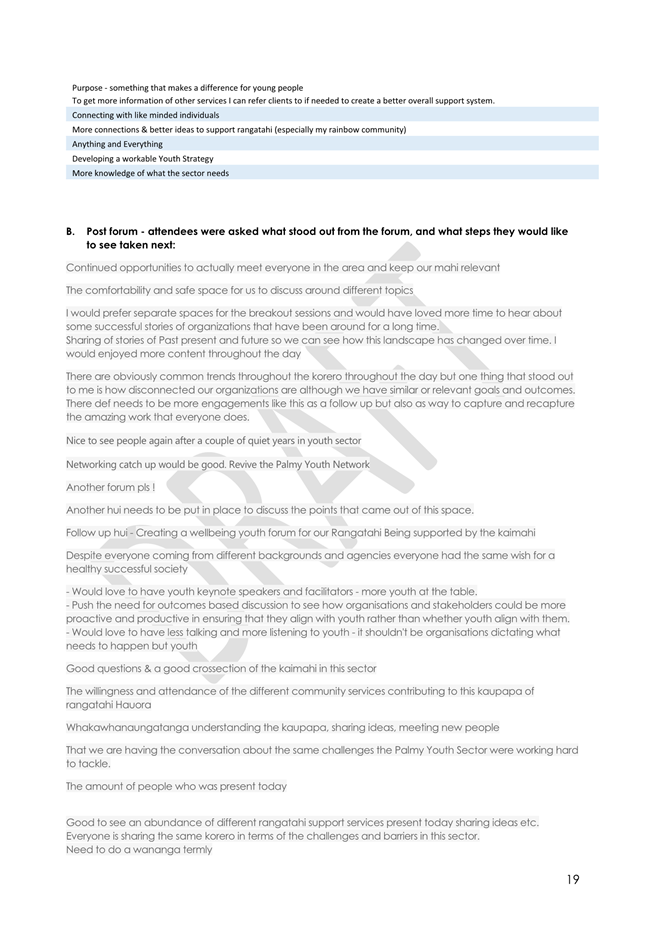
Connection – Improve ways for the Youth Sector to be more connected
to be able to share information, resources and knowledge.
2.
Collation – Collation of existing youth data at a local level to
provide better insights to youth well-being trends to help inform decision
making.
3.
Communication - Improve ways of communicating available youth services and
programmes to a wider audience to improve accessibility to these services and initiatives.
7. CONCLUSION
7.1 The Youth
Well-being Forum was invaluable for gaining direct insights from the youth
sector and there was strong feedback for six monthly youth forums to increase
collective impacts and positive outcomes for young people.
7.2 Council
provides a range of support and funding through existing mechanisms, directly
or indirectly to organisations and initiatives that deliver well-being outcomes
for young people.
7.3 Existing
Council funding mechanisms could be utilised to address specific sector needs,
such as outlined in section 5.4.
8. NEXT
STEPS
8.1 Officers
will actively communicate Council funding opportunities with the youth sector
and provide guidance to access these opportunities.
8.2 Officers
will investigate opportunities for a potential youth sector lead organisation.
8.3 Officers
will continue to work with Interagency networks, strategic partner networks and
Central Government agencies to strengthen support for the youth sector and
outcomes for young people.
9. Compliance
and administration
|
Does the Council have delegated
authority to decide?
|
Yes
|
|
Are the decisions significant?
|
No
|
|
If they are significant do they
affect land or a body of water?
|
No
|
|
Can this decision only be made
through a 10 Year Plan?
|
Yes
|
|
Does this decision require
consultation through the Special Consultative procedure?
|
No
|
|
Is there funding in the current
Annual Plan for these actions?
|
No
|
|
Are the recommendations
inconsistent with any of Council’s policies or plans?
|
No
|
|
The recommendations contribute
to Goal 3: A Connected and Safe Community
|
|
The recommendations contribute
to the achievement of action/actions in Connected
Communities
The action is: Support
Communities to achieve their aspirations. Be a city where people feel safe
and are safe.
|
|
Contribution to strategic
direction and to social, economic, environmental and cultural well-being
|
A Youth Well-being Action
Plan contributes to the social and cultural well-being strategic outcomes.
|
|
|
|
Attachments
|
1.
1
|
Youth Well-being Forum Report ⇩ 
|
|
|
2.
2
|
Sector Wide Youth Services Directory
2016 ⇩
|
|
|
3.
3
|
Sector Wide Scan - Programmes and
Initiatives ⇩ 
|
|
|
4.
4
|
Council Direct and Indirect Funding
support ⇩
|
|
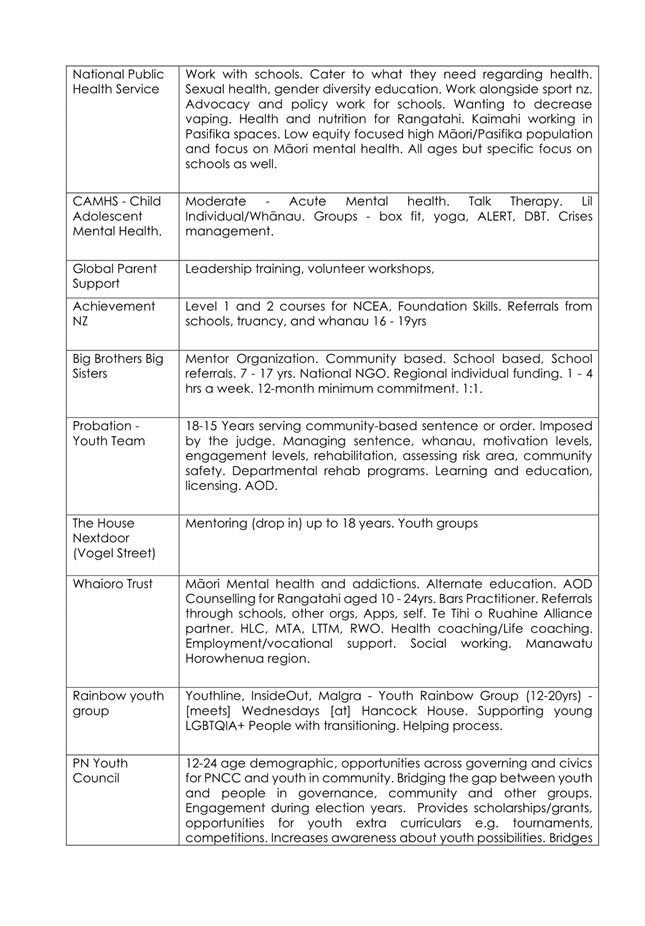
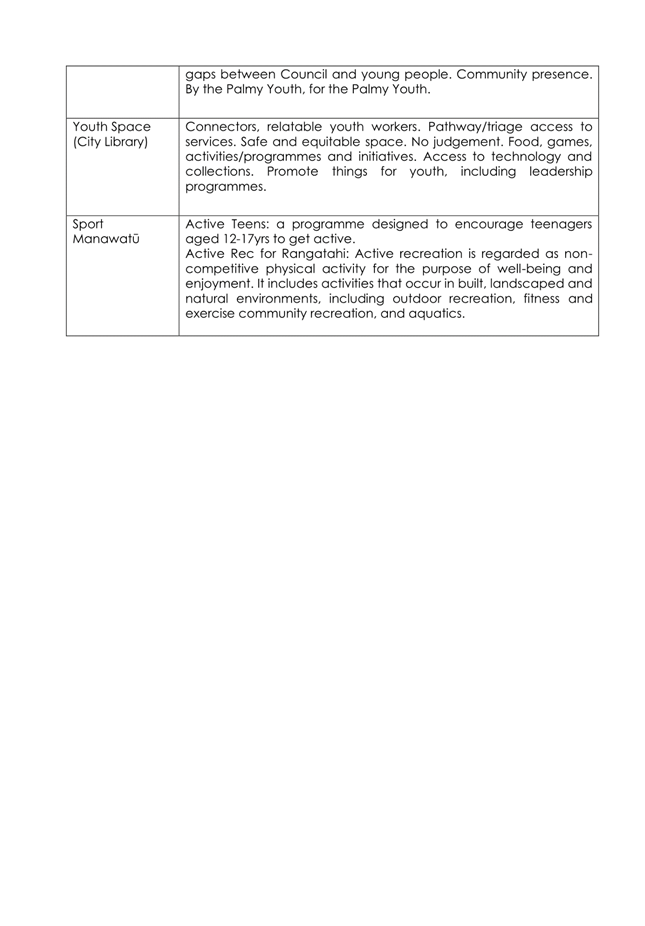
Memorandum
TO: Council
MEETING DATE: 1
May 2024
TITLE: Age
Friendly Progress Report
Presented By: Kerry
Hocquard, Community Development Advisor and Amy Viles, Acting Community
Development Manager
APPROVED BY: Kerry-Lee
Probert, Acting Chief Customer Officer
RECOMMENDATION TO Council
1. That Council receive the memorandum titled ‘Age Friendly Progress Report’,
dated 1 May 2024.
1. ISSUE
1.1 This
memorandum is a progress update on Council’s resolution on 31 May 2023 to
establish an Age Friendly Programme and to develop an Age Friendly
strategy/plan. Council resolved;
‘To establish an Age Friendly Programme to develop
an Age Friendly strategy/plan with a budget of $50K in 2023/24 and refer
ongoing costs of $30K annually to the Long-Term Plan deliberations.’
1.2 The
memorandum presents a summary of the activities to date including the community
engagement plan and community feedback following the engagement process.
1.3 A
final options report (including a complete analysis of feedback and data) and a
draft Palmerston North Age Friendly Action Plan and associated resourcing, will
be presented to the Community Committee in October 2024.
2. BACKGROUND
2.1 A
report titled ‘Age
Friendly Status and Funding’ was presented to the Community Committee
on 24 May 2023, in response to the Committee’s resolution of 15 March
2023 that the Chief Executive investigate what is required to apply for Age
Friendly status and funding. The Community Committee on 24 May 2023 resolved:
‘to refer a programme to develop an
Age Friendly strategy/plan to the Annual Budget deliberations.’
2.2 Subsequently,
on 31 May 2023, Council resolved:
‘to establish an Age Friendly Programme to develop
an Age Friendly strategy/plan with a budget of $50K in 2023/24 and refer
ongoing costs of $30K annually to the Long-Term Plan deliberations.’
2.3 Palmerston
North City Council successfully joined the Age Friendly Aotearoa New Zealand
(AFANZ) membership network in September 2023. According
to Age Friendly Aotearoa, to date, a total of 33 councils have joined the
Age-Friendly Aotearoa Network and are at various levels of progress in
achieving the criteria outlined by the network.
2.4 In
November 2023, Council was successful in receiving a grant of $5,000 from the
Office for Seniors, to run a series of co-design community workshops to support
the development of a Palmerston North Age Friendly Action Plan.
2.5 Achieving
Age Friendly status requires Council to both join the membership network and to
commit to a process of developing and implementing an Age Friendly Action Plan
in collaboration with community partners.
2.6 The
Age Friendly Framework, endorsed by Age Friendly Aotearoa New Zealand (part of
the Office for Seniors through the Ministry of Social Development) includes the
eight domains of the World Health Organisation (WHO) Age Friendly Framework,
which are:
1. Open
Spaces & Buildings
2. Housing
3. Transport
4. Civic
Participation & Employment
5. Social
Participation
6. Respect
& Inclusion
7. Communication
& Information
8. Health
& Community Support Services
(World Health
Organization. (2007). Source:
Global Age-Friendly
Cities: A Guide).
2.7 The
Office for Seniors suggest that the development of an Age Friendly Plan is
guided by the following steps (as outlined in the preceding report to the
Community Committee dated 24 May 2023 ’Age
Friendly Status and Funding’):
Step
1. Get started. Connect with others, set up a
steering group and check any funding that might be available.
Step
2. Assess how age friendly your community is.
Before you can develop an age friendly plan, you need to understand your
community’s current situation.
Step
3. Develop a plan for communities to work towards
becoming age friendly. The plan should focus on your own specific strengths,
cultures, and needs.
Step
4. Implement the plan. With the assessment and
planning done, you can now start to implement your age friendly actions.
Step
5. Evaluate your age friendly programme. Evaluating
the programme is key to understanding what is working well, what is not, and
what to focus on next.
2.8 Council’s
Age Friendly programme development is currently at Stage 2, where a community
stocktake has been completed and a full and complete assessment of the data is
still to be undertaken.
3. Community engagement Methodology
3.1 The
purpose of the community engagement plan was to develop a collective
understanding of the experiences of residents living in our City using an Age
Friendly lens. Outlined details of the community engagement methodology are
appended to this memorandum at Attachment 1.
3.2 Participants
in the engagement had opportunities to advise on specific features,
improvements, or proposed community actions, that will form the basis for the
development of a draft Palmerston North Age Friendly Action Plan. A mixed
methods approach was used to maximise participation by the community.
4. Early findings and emerging themes
4.1 Key findings have highlighted areas directly related to the work of
Council, areas Council may have influence to advocate and areas that are
outside of the work of Council. Workshop participants and survey respondents
recommended actions that centered on the need for an age-friendly and
disability-friendly lens (that is mana enhancing and culturally relevant) to be
applied to all of Council’s services and city planning.
4.2 Key themes that emerged from all workshops included concerns with
transport, housing, accessibility, social isolation, health, a need for
connected, inclusive communities and clear, accurate, user-friendly and
relevant information that was appropriate to an age-friendly audience.
4.3 Concerns
were raised in the Age-Friendly Community workshops of difficulties accessing
stairs and ramps into public buildings and that outdoor seating was not
suitable for older people when at an inadequate height and clearance space, and
missing backrests. Concerns about footpath safety were also expressed, where
regular Council footpath maintenance was needed to address broken footpaths and
tree roots impacting on the integrity of the footpath. Further feedback from
the workshops is appended to this memorandum at Attachment 2.
4.4 Population
projections signal an aging population which will have an impact on citywide
planning for this sector. The table below indicates that within the next decade
there will be more older people (aged 65+) than children in Palmerston North.
Age group projections as a proportion of the Palmerston North population
(June 2018-base)
|
Year
|
Total population
|
0-14 years
|
Percentage of pop. aged
0-14 years
|
65+
|
Percentage of pop. aged
65+
|
|
2023
|
94,400
|
18,180
|
19.3%
|
14,603
|
15.5%
|
|
2028
|
98,302
|
17,983
|
18.3%
|
17,285
|
17.6%
|
|
2033
|
103,021
|
18,085
|
17.6%
|
19,369
|
18.8%
|
|
2038
|
107,240
|
18,424
|
17.2%
|
21,761
|
20.3%
|
|
2043
|
111,070
|
18,608
|
16.8%
|
23,295
|
21.0%
|
|
2048
|
114,407
|
18,740
|
16.4%
|
24,714
|
21.6%
|
|
2053
|
117,202
|
18,896
|
16.1%
|
26,355
|
22.5%
|
Source: Palmerston North
City Council
4.5 The
Age Friendly Programme aligns with work currently being undertaken by Council
including the:
a. the Accessibility Audit and the future work of the
Accessibility Charter
b. endorsement of the Enabling Good Lives principles
c. commitment to the Urban Design Protocol.
4.6 The
Accessibility Audit of Council-owned buildings highlighted that some buildings
or part of the building are inaccessible or limitedly accessible. This is an
issue for both the aged community and for those living with disabilities.
4.7 In
the development of a draft Palmerston North Age Friendly Action Plan, Officers
will investigate opportunities to align the plan with these three areas.
5. NEXT STEPS
5.1 Council’s
Age Friendly programme development is currently sitting at Stage 2, where a
community stocktake has been completed, with early themes emerging.
5.2
Step 3 ‘Develop a plan’ will now be undertaken with an options
report to be presented for consideration in October 2024. Feedback from the
co-design community workshops and surveys will form the basis of a draft
Palmerston North Age Friendly Action Plan.
5.3 A staff working group will be established
to consider the community engagement feedback and to ascertain which areas can
be considered within the scope of existing budgets or those that may require
additional resourcing over time.
Age Friendly Funding Resourcing
5.4 If Council is to maintain membership to
Age Friendly Aotearoa (AFANZ) and support the Age Friendly programme and
subsequent Action Plan beyond October 2024, then funding the implementation of
the plan will be required.
As a requirement
of the AFANZ membership, Council is required to:
a. demonstrate that it is taking credible and
tangible steps towards developing an age friendly strategy or action plan for
their community.
b. be
leading the Age Friendly strategy or plan for their community.
5.5 Requirement ‘a’ is underway and demonstrated. Requirement ‘b’ would require ongoing resourcing by Council. Given
these membership requirements, it is likely that resourcing would be required
to drive any implementation and evaluation of the Action Plan, depending on the
content of the plan (steps 4 & 5 above).
5.6 The Office for Seniors has a fund
available for the initial work of becoming an Age Friendly City. The fund supports organisations with
grants between $5,000 to $15,000. The funds may be used for operational costs
related to the development of a strategy or plan, and/or the implementation of
new projects or initiatives in support of a strategy or plan.
5.7 Council was successful in receiving $5,000
of funding in November 2023 from this fund. Council will be eligible again in
2026 to apply to this fund for implementation and initiative costs. The fund
opens annually in August/September and officers will apply again when eligible
in 2026.
6. Summary
6.1 The stepped development process outlined
in the 24 May 2023 report ‘Age Friendly Status and Funding’
explained that the process of developing a Palmerston North Age Friendly Action
Plan was likely to take up to 12 months (Steps 1-3 above). Council’s
Age Friendly programme development is currently sitting at Stage 2 of 5 stages,
where a community stocktake has been completed, with early themes identified. The programme is currently on track to
meet that timeframe, noting that a full and complete assessment of the
data and findings is still to be undertaken.
6.2 A draft Palmerston North Age Friendly
Action Plan will be presented in October 2024 as an options report. Further
external data will also be sought at this time, including Census data (which
will start to become available from the end of May 2024) and will help inform
decision making.
6.3 The ongoing process to become Age Friendly
does not involve an end point achievement of a status or accreditation, rather it
includes a commitment to the ongoing process and membership.
7. Compliance and administration
|
Does the Council have delegated
authority to decide?
If Yes quote relevant clause(s)
from Delegations Manual
|
Yes
|
|
Are the decisions significant?
|
No
|
|
If they are significant do they
affect land or a body of water?
|
No
|
|
Can this decision only be made
through a 10 Year Plan?
|
Yes
|
|
Does this decision require
consultation through the Special Consultative procedure?
|
No
|
|
Is there funding in the current
Annual Plan for these actions?
|
No
|
|
Are the recommendations
inconsistent with any of Council’s policies or plans?
|
No
|
|
The recommendations contribute
to Goal 3: A Connected and Safe Community
|
|
The recommendations contribute
to the achievement of action/actions in Connected
Communities
The action is: Build and maintain relationships with
local communities of identity, interest and place to understand and support
their strengths and aspirations
|
|
Contribution to strategic
direction and to social, economic, environmental and cultural well-being
|
A continuing commitment to the Age Friendly process towards the achievement of the
eight age friendly outcome areas aligns strongly with Council’s goals of
being a connected and safe, and growing and innovative community, and will
have positive impacts for the social and economic wellbeing of older people
and the wider community.
|
|
|
|
Attachments
|
1.
|
Palmerston North Age Friendly Community Engagement
Methodology March 2024 ⇩
|
|
|
2.
|
Key Community Feedback from Age Friendly Workshops March
2024 ⇩ 
|
|
|
3.
|
Age Friendly Survey 2024 ⇩
|
|
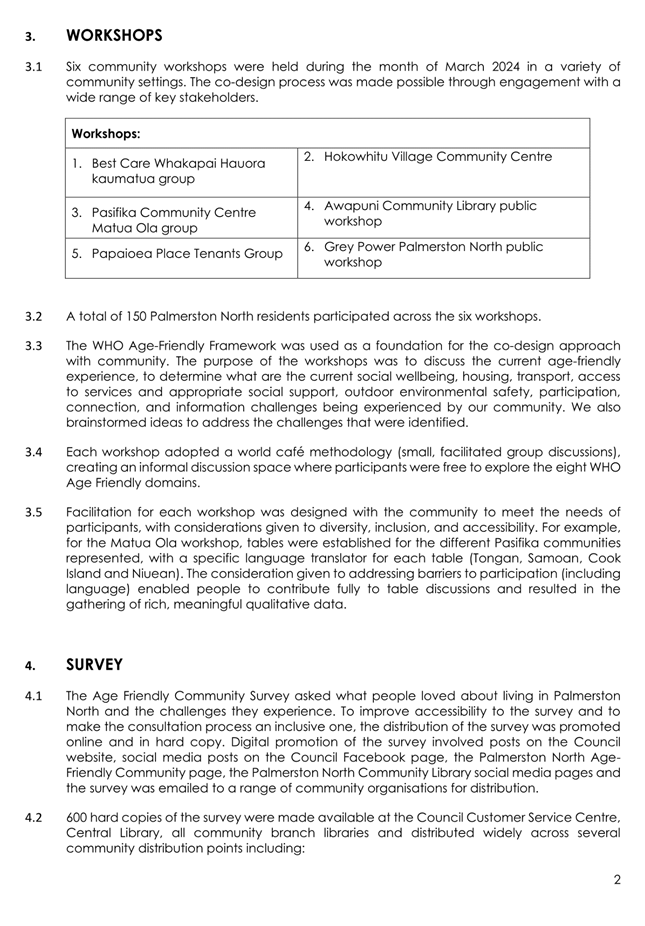
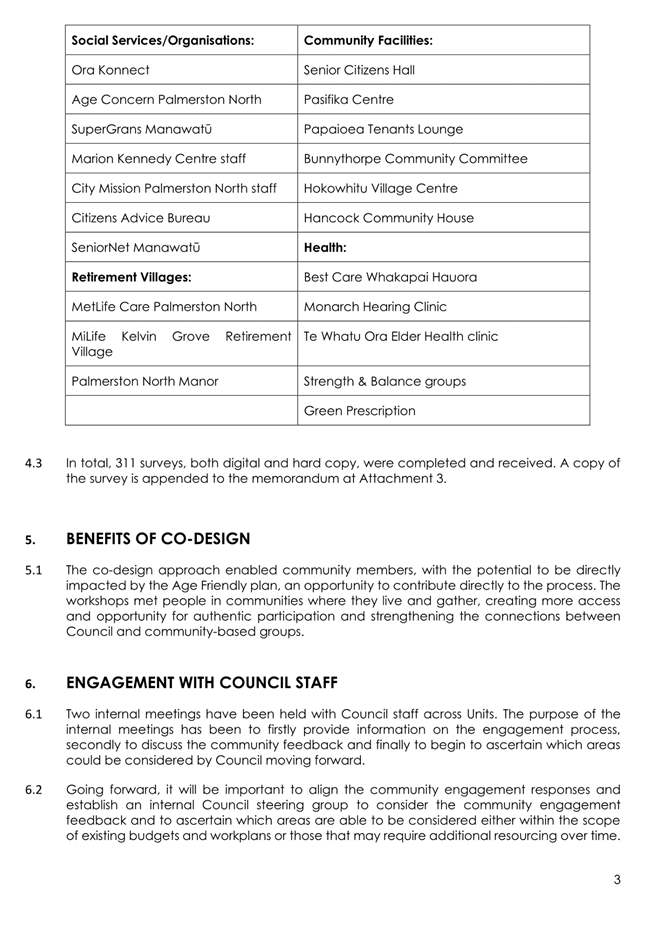
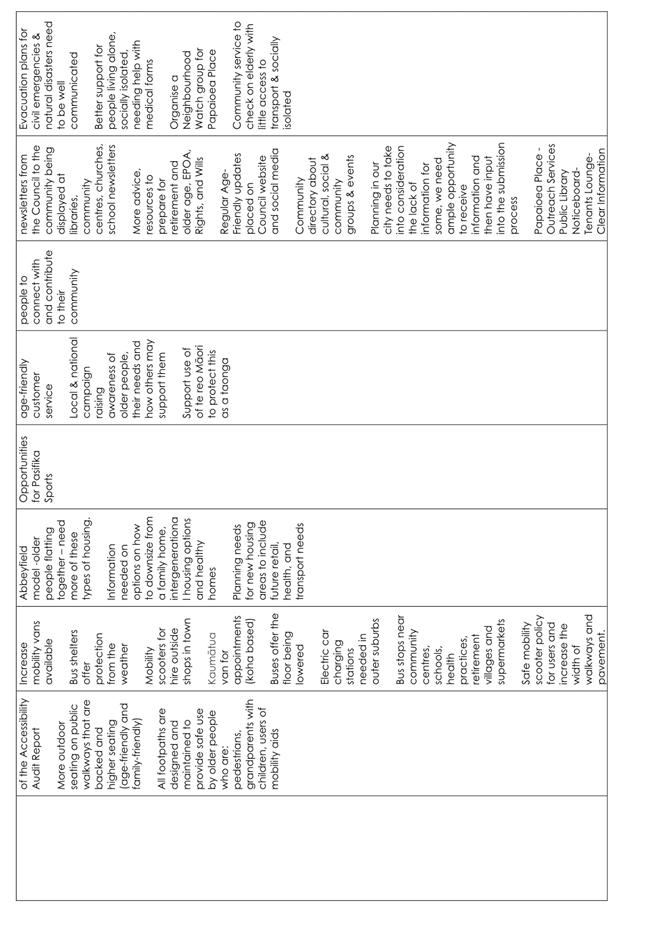
Memorandum
TO: Council
MEETING DATE: 1
May 2024
TITLE: Elected
Members' Meeting Attendance Statistics - 1 July 2023 to 31 December 2023
Presented By: Hannah
White - Democracy & Governance Manager
APPROVED BY: Donna
Baker, Acting Chief Executive Unit Manager
RECOMMENDATION TO Council
1. That Council
receive the memorandum titled ‘Elected Members’ Meeting Attendance
Statistics - 1 July 2023 to 31 December 2023’, dated 1 May 2024.
1. ISSUE
Elected Members’ meeting
attendance statistics are recorded and publicly reported on a six and
twelve-monthly basis.
The period covered is from 1
July 2023 to 31 December 2023.
2. BACKGROUND
Notes at the bottom of
Attachment 1 explain the guidelines for recording statistics.
It should be noted that in the
current term of Council (i.e. since October 2022) attendance is only recorded
for meetings of which an Elected Member is a member of the committee.
3. NEXT STEPS
Regular recording and reporting
will continue. The next memorandum will cover the period 1 January 2024 to 30
June 2024.
4. Compliance and administration
|
Does the Council have delegated
authority to decide?
|
Yes
|
|
Are the decisions significant?
|
No
|
|
If they are significant do they
affect land or a body of water?
|
No
|
|
Can this decision only be made
through a 10 Year Plan?
|
No
|
|
Does this decision require consultation
through the Special Consultative procedure?
|
No
|
|
Is there funding in the current
Annual Plan for these actions?
|
No
|
|
Are the recommendations
inconsistent with any of Council’s policies or plans?
|
Yes
|
|
The recommendations contribute
to Goal 5: A Driven & Enabling Council
|
|
The recommendations contribute
to the achievement of action/actions in Governance
and Active Citizenship
|
|
Contribution to strategic
direction and to social, economic, environmental and cultural well-being
|
It is Council practice
to record and report on elected member attendance for the purposes of
transparency, at the request of Elected Members.
|
|
|
|
Attachments
|
1.
|
Elected Members' Meeting Attendance Statistics 1 July 2023
to 31 December 2023 ⇩
|
|
TO: Council
MEETING DATE: 1
May 2024
TITLE: Summerhays
Street Redevelopment - Partnership Models
PRESENTED BY: Bryce
Hosking, Group Manager - Property and Resource Recovery, and Anna Saunders,
Capital Projects Officer
APPROVED BY: Chris
Dyhrberg, Chief Infrastructure Officer
RECOMMENDATION TO Council
1. That
Council facilitate the redevelopment of 17-19 Summerhays Street to achieve its
desired housing outcomes for the site through
EITHER:
a. Engaging a
construction partner through a standard design and build contract, whereby
Council would solely deliver and fund the development.
OR
b. Engaging
a partner to develop and finance the up-front cost of the project, with the
homes then being purchased by Council or sold to a third party
OR
c. Engaging a partner to provide an end-to-end solution whereby the
development, financing cost, and ongoing operation are undertaken by a partner,
not Council.
Summary of options
analysis for Summerhays Street Redevelopment Delivery Model
|
Problem
or Opportunity
|
Council
resolved to achieve medium-density social housing outcomes at 17-19
Summerhays Street, Palmerston North.
Council
has three broad partnership models which will deliver on its desired
outcomes. Council needs to determine their preferred model before
selecting a preferred partner.
This
report seeks direction from Council on the partnership model it wishes to
pursue to facilitate the redevelopment of the site.
|
|
Community
Views
|
· No specific
community engagement has been undertaken about seeking partners for the
redevelopment of 17-19 Summerhays Street, however, Council has previously
signalled its intention to repurpose the site for housing.
· In June and July
2021 Council consulted the community about Council’s proposal to
repurpose the site for housing. Analysis of those submissions was
provided to the Planning
and Strategy Committee 20 October 2021. Most people who
participated in the consultation favoured the site being repurposed for
housing, with a variety of views expressed about the type of housing which
could be developed.
· Neighbouring
residents may have a negative perception of social housing.
· There is a
general support for the creation of more housing.
· There has
historically been mixed views about Council selling land.
|
|
OPTION 1:
|
Engage
a construction partner through a standard design and build contract, whereby
Council would solely deliver and fund the development.
|
|
Benefits
|
· This
is the same model that Council has delivered its Papaioea Place Redevelopment
under. Council has a proven track record in delivery and achieving positive
housing outcomes, which reduces some of the uncertainties and project risk.
· Council
will have complete control of the outcomes achieved at the site, with a high
degree of influence over the design and methodology for what is delivered.
· The
outcomes of the development directly align with Council’s Goal 3
strategic direction to develop and support more social housing in the
city. At the time of writing this report, Council’s social
housing register waitlist sits at 286. A development of this size could
produce between 35 to 70 homes, which will help get people into homes and off
the waitlist.
· As
this would be a straightforward development partner engagement, no complex
partnership agreements will be required. The engagement would simply be
through a standard NZS3916:2023 design and build contract. This form of
contract reduces the overall project delivery risk through sharing risk in
the design between Council and the supplier, should any issues arise during
delivery.
|
|
Risks
|
· The
biggest trade-off for Option 1 is that Council will need to contribute the
entire cost of the development. This may create a financial risk in
respect to availability of funding and limiting Council’s ability to
use funds for other priorities. Adding to this risk is the uncertainty
regarding the Better off Funding. If this funding were no longer
available for the project, this would further impact the budget availability
for the project. This risk can be somewhat mitigated once the final
project cost is known as Council can ensure there is sufficient funding prior
to awarding the design and build contract or through potentially staging the
project to deliver what the current budget allows for.
· There
is a reputational risk where Council may be criticised for trying to
undertake the project itself when there are potentially financial
contributors willing to partner with Council for the project. This can
be somewhat mitigated through proactive public communication about why this
option was chosen.
· There
is a reputational risk where Council may be criticised by the potential
partners who responded to the EOI seeking other partnership models.
This risk could be somewhat mitigated through robust communication and
feedback back to the EOI respondents explaining why Council has chosen to
proceed with Option 1.
· There
is a delivery risk associated with any uncertainties arising during
construction, which either cause delays, increase the project cost, or
both. This risk can be mitigated through an appropriately scaled
project contingency, and through sharing the risk with the build partner
through the design outcomes of the design and build contract. Price
escalation could be managed through ordering of materials, value engineering
throughout the design phase, and prudent project management disciplines.
· There
is a risk that some design innovation could be missed that could have been
brought to the table from some of the end-to-end solution partners, which has
been obtained through their experience in similar past projects. This
risk cannot be mitigated.
|
|
Financial
|
· The cost to
Council for rezoning the recreational half of the site is circa $35K and
being funded through the better-off funding.
· The total cost
of development is estimated to be between $20 million – $30 million,
depending on the density and typology of housing built. This is higher
than the current budget provision for the project.
· A contribution
of $4.56M is currently available for the project through the Better-off
Funding.
· Council has a
$14M budget in the LTP for delivering additional social housing in the city,
with this budget tagged as our contribution to Summerhays. However,
this will likely not make up the full balance of the development cost.
· Council does
have some deliverability options it could consider, such as delivering the
development in stages. Noting that over the life of the project this
will likely cost more overall as costs of construction increase, however,
staging the development would allow Council to manage within its available
budgets.
· As this project
would be increasing the council-owned social housing portfolio, an additional
Tenancy Officer role would be required to maintain the current level of
service across the portfolio. Additionally, the larger social housing
portfolio would generate increased operational, maintenance, and renewal
costs over the life of the assets. Officers have provided some
high-level modelling on what Summerhays Street would cost across the next
10-year period in Appendix 1.
|
|
OPTION 2:
|
Engage
a partner to develop and finance the up-front cost of the project, with the
homes then being purchased by Council or sold to a third party.
|
|
Benefits
|
· The main benefit
of Option 2 is that Council will only contribute a heavily reduced, or even
no, up-front capital towards the project, whilst still achieving housing
outcomes on the site. This provides the opportunity for Council to
reprioritise available budgets to other projects.
· Having an
experienced partner in place will likely streamline and keep pace on delivery
of the development as well as allow for innovations in design and
construction that they may have used on similar projects. A partner will
also help mitigate or financially absorb any development risks.
· Council will
still have some input into the design of the project to ensure the desired
outcomes are achieved.
· As with Option
1, this option contributes towards Council’s Goal 3 strategic direction
through supporting more social housing in the city.
· Option 2
provides a linkage to the outcomes of the Finance Strategy, which
acknowledges that Council will actively seek partnering to help achieve its
outcomes and manage its constrained future debt position; that said, given
Council may end up purchasing the homes, this option would still impact debt
headroom for any unplanned items in the future.
|
|
Risks
|
· The trade-off
for Option 2 is that Council has less direct control over the development due
to the partner’s involvement. This creates a risk that
council’s aspirations for the site are not fully realised as they will
need to be balanced with the partner’s objectives. Equally, if
the partnership is not proceeding to Council’s satisfaction, this may
compromise the outcomes. This can be somewhat mitigated through a
robust and explicit partnership agreement and negotiations.
· As with Option
1, there is a financial risk around the continued availability of the Better
off Funding. Should this funding no longer be available and a financial
contribution is required to the partnership arrangement, this would need to
come from rate-funded budgets. This risk is mitigated as Council has
$14M in Programme 1459, which it previously resolved to use to cover any
financial contribution to the project.
· There is a
reputational risk of Council being criticised for selling the land to a
partner, even if it is for developing the site for housing as previously
signalled. This can be somewhat mitigated through exploring other
options such as long-term land leases which can be negotiated through in the
partnership arrangements.
· Depending on the
final arrangements of the partnership, there is a financial risk that Council
will not make a net financial return on its investment. Some
arrangement options could include Council purchasing some or all the houses
once built from the partner, which will likely negate any return from the
sale of the land. Another option could be that Council leases the houses
back from the partner, which, whilst avoids capital investment, will increase
the operating costs of council. This risk cannot be mitigated until
negotiations are completed with a partner.
|
|
Financial
|
· The rezoning
cost, possible overall development cost, and Council’s available
funding are all covered in the Financial section of Option 1 above.
These are unchanged for this option.
· The Summerhays
site is valued at $2.5M.
· The development
partner will be delivering and financing the up-front development costs
rather than Council.
· To make the
development commercially viable, the partner will likely be seeking to
on-sell or lease the house and land packages once built. This could be
to Council or to another entity. If Council were to purchase or lease
the finished product, it will be at a heightened cost as the land will be
developed and the partner will be seeking a financial return in this
opportunity. If purchase or lease is not guaranteed at the end of the
project from Council, the partner would need to seek alternatives, which may
detract from the attractiveness of the opportunity from their perspective.
· If Council were
to purchase the housing upon completion of the project, this will likely
again trigger the need for an additional Tenancy Officer. Equally as
with Option 1, the operational costs moving forward of increasing the housing
portfolio would be borne by Council.
|
|
OPTION 3:
|
Engage
a partner to provide an end-to-end solution, whereby the development,
financing cost, and ongoing operation are undertaken by a partner, not
Council.
|
|
Benefits
|
· All benefits of
Option 2 are also applicable for Option 3.
· The main
additional benefits are that Council will not have to pay any operational,
maintenance, or renewal costs associated with this development upon
completion and ongoing. Equally, no additional staff members will be
required for tenancy management as this will all be undertaken by the
development partner, who will either undertake these duties themselves or
will engage a Community Housing Provider (CHP). Essentially, Council
can achieve the desired outcomes for the site without incurring any
additional costs.
· Council could
receive an immediate cash injection through the sale of the land, which is
valued at $2.5M to the partner, or alternatively, a long-term financial gain
through a lease. Noting that a partner is most likely to want to
purchase the land as it provides them unencumbered control of the site moving
forward.
· Council
can have confidence that the site and tenants will be managed by a registered
CHP and maintained by an experienced partner.
· Council
would be able to reprioritise its existing capital budgets as these would not
be required to deliver the Summerhays project in this option.
· If
the Better off Funding is no longer available, this will be unlikely to have
an impact on the project being delivered as Council was not funding the
project.
· Option
3 provides a strong linkage to the outcomes of the Finance Strategy, which
acknowledges that Council will actively seek partnering to help achieve its
outcomes and manage its constrained future debt position. The opportunity
that an end-to-end soutlion in particular provides is achieving the outcome
without any, or very limited, further rates requirement and provides Council
debt headroom for any unplanned items in the future.
|
|
Risks
|
· As with Option
2, Council has less direct control over the development due to the
partner’s involvement. This creates a risk that council’s
aspirations for the site are not fully realised, as they will need to be
balanced with the partner’s objectives. Equally, if the
partnership is not proceeding to Council’s satisfaction, this may
compromise the outcomes. This can be somewhat mitigated through a
robust and explicit partnership agreement and negotiations.
· There is a
reputational risk of Council being criticised for selling the land to a
partner, even if it is for developing the site for housing as previously
signalled. This can be somewhat mitigated through exploring other
options such as long-term land leases, which can be negotiated through in the
partnership arrangements.
· There is a
reputational risk that Council is criticised for not utilising the Better off
Funding when it was available. If the funding remains available, this
risk can be mitigated through requesting to repurpose the available funding
to another project. If the Better off Funding is not available, then
this provides an explanation that can be communicated as to why it was not
used.
· A partner may
require a mixed tenancy model at the site to achieve adequate financial
return (through private sales or rentals) and meet the partner’s
outcomes of the site. There is risk that a mixed tenancy model might
not be attractive to the market, though this risk would be worn by the
partner financially and Council reputationally. This can be mitigated
through the partnership agreement to ensure it is viable for both Council and
the partner.
· A partner may
have a different target tenant to what Council currently have or would seek
to move into the development. This is a reputational risk to Council
but can be mitigated through including any such requirements in the
partnership agreement, noting that this may impact the attractiveness of the
deal to the partner if Council is too restrictive.
|
|
Financial
|
· The rezoning
cost, possible overall development cost, and Council’s available
funding are all covered in the Financial section of Option 1 above, these are
unchanged for this option.
· The Summerhays
site is valued at $2.5M.
· The development
partner will be delivering and financing the up-front development costs,
rather than Council.
· The
partner who is a registered community housing provider can access the rental
subsidy provided by the Ministry of Housing and Urban Development, making
this solution more financially viable than Option 2. Council cannot
currently access this subsidy as we are not a registered CHP and would
otherwise have to wear the ongoing operational cost of the development in
full.
|
Rationale for the recommendations
1. Overview of the problem or opportunity
1.1 Council
owns the 8,276m2 site at 17-19 Summerhays Street. This site
was formerly occupied by the Terrace End Bowling Club.
1.2 Council
decided to achieve medium-density social housing outcomes at the 17-19
Summerhays Street site and expressed that partnership opportunities should be
considered, noting that the design would require negotiation with any potential
partner.
1.3 To
understand the partnership opportunities, Officers released an Expressions of
Interest (EOI) on 6 December 2023, which closed on 31 January 2024. The
development expectations put forward through the EOI were derived from the
Council direction of the 4
October 2023 Council meeting.
1.4 To
maximise the partnership opportunities and to ensure as much of the potential
partner market was canvased as possible, partners were presented with three ways
to partner with Council for the project. Respondents could offer
solutions for one, two, or all three project components of:
1. Design
and Build.
2. Finance
and Own; and
3. Operate and Maintain.
Respondents were encouraged to work together with their
preferred suppliers to maximise their offerings through consortiums, etc.
As such, the options in this report reflect a combination of the above; Option
1 is a simple Design and Build; Option 2 is design, build, finance, and own;
and Option 3 is an end-to-end solution combining all three components.
1.5 This
report seeks direction from Council on the partnership model it wishes to
pursue to facilitate the redevelopment of the site. Noting that the feedback
from the EOI process is being presented in a separate confidential report
titled ‘Summerhays Street Redevelopment – Expressions of Interest
Feedback’to this same meeting.
2. Background and previous council decisions
Housing Outcomes for 17-19 Summerhays
Street
2.1 On
4 October 2023, Council resolved the following outcomes to be achieved at the
Summerhays Street site:
a. Social
housing outcomes for 17-19 Summerhays Street (Option 1); AND
b. Medium
density housing outcomes for 17-19 Summerhays Street; AND
c. Inclusion
of sustainable building practices in the development of future options for
17-19 Summerhays Street; AND
d. Inclusion
of best-practice urban design practices in the development of future options
for 17-19 Summerhays Street; AND
e. Design
options being developed for one-, two- and three-bedroom dwellings within 17-19
Summerhays Street; AND
f. The design
options include at least one option with a mix of subsidised and non-subsidised
social housing.
2.2 Council
expressed a desire to explore partnerships for the delivery of the development.
Subsequently, officers paused the design phase to first test the market for
partnership opportunities, so to avoid any rework should a partner come on
board.
Additional Social Housing Budget Update (Programme 1459)
2.3 On
18 December 2023 Council agreed (222-23) the 22 November 2023 Community
Committee recommendation to use Programme 1459 (Additional Social Housing
Units) to fund Council’s financial contribution to the Summerhays Street
redevelopment project, if any.
2.4 The
extent of how much of the budget in Programme 1459 would be required will not
be known until the design is progressed and the partnership opportunities are
explored/confirmed. It is unlikely that this programme budget will be
sufficient to deliver the entire development.
3. Description of options
3.1 Before
determining a preferred partnership model to best deliver on Council’s
desired outcomes, it is important to understand the partnership mechanics of
each model.
3.2 Each
model has benefits and risks, and can viably deliver the project and ensure
that the desired outcomes around delivering housing are delivered. The decision
around options comes down to how directly involved in the project delivery
Council wants to be.
3.3 The
trade-off to having more control in the delivery is that Council will also need
to contribute more or all capital upfront to deliver the project. This is
explored in more detail in Section 4 of this report.
3.4 A
further description of each of the options is given below:
Option 1: Engage a construction partner through a
standard design and build contract, whereby Council would solely deliver and
fund the development.
3.5 For
this option, Council would engage a partner to enter a design and build
contract to deliver the development. This is the same model of delivery
as Papaioea Place.
3.6 Council
would fund the project using Council capital budgets and the Better-Off Funding
provision.
3.7 The
property would be retained by Council, adding to our 442-unit social housing
portfolio.
3.8 Essentially,
Council would contribute the entire up-front capital cost of the project, along
with operating and maintaining the complex moving forward. It is
important to note that the development would be cost-negative in the long-term
as with the balance of the council-owned social housing portfolio.
Option 2: Engage a partner to develop and finance the
up-front cost of the project, with the homes then being purchased by Council or
sold to a third party.
3.9 Council
could sell or lease the land to a partner to deliver and fund the project.
3.10 Council’s
contribution to this delivery model would be the land and potentially some or
all the $4M better-off funding allocated for the project (if required).
3.11 In most
scenarios, the partner would be looking to on-sell or lease the housing units
back to Council to then operate and maintain, as it does with its current
portfolio. The partner would make their financial return through the sale
or lease of the house and land packages.
Option 3: Engage a partner to provide an end-to-end
solution, whereby the development, financing cost, and ongoing operation are
undertaken by a partner, not Council.
3.12 Council
could sell or lease the land to a partner to deliver, fund and then maintain
and operate the complex. Council’s financial contribution would be
like above Option 2, if any.
3.13 In this
option the development partner also includes a Community Housing Provider (CHP)
in the agreement.
3.14 Homes
provided by Registered Community Housing Providers (CHP) are typically
subsidised by the Income Related Rent subsidy. The tenant portion of the rent
will be 25% of the tenant’s income as determined by the Ministry of
Social Development (MSD).
3.15 This
differs from Council-owned social housing, as we are not eligible for the
balance to be payable from MSD. This essentially means the other 75% of the
‘market rent’ is simply foregone. This is a restriction with the
current social housing model Council operates and one of the reasons our social
housing portfolio is cost negative for the ratepayer.
3.16 Should the
end-to-end solution be preferred, Council should be aware that this will likely
involve the partner making a return through use of a mixed tenancy model that
includes some or all of, progressive home ownership, affordable market rentals,
and utilising the rental subsidy opportunities. This would be a key
consideration to ensure a financially viable solution is achieved.
3.17 For
affordable rental homes CHPs typically set rents at or below 80% of market
rental levels for the area and these are intended to be around a third of
household incomes. Each provider will have its own rent policy and eligibility
settings.
3.18 Noting
that in some scenarios this would mean that 100% of the site may not become
social housing as Council defines it. This could be a negotiation point with a
preferred partner.
3.19 A
Community Housing Provider also has the ability to apply to the Ministry of
Housing and Urban Development (MHUD) for funding to support the construction of
public housing units. When considering proposals from CHPs, MHUD looks for
public housing opportunities that meet specific criteria, with a major one
being land ownership or access to land for immediate development. They also
like to fund opportunities in locations where Kāinga Ora has limited
presence, or the need exceeds the availability of social housing.
3.20 MHUD’s
preference is for CHPs to retain ownership of completed housing units as this
strengthens their ability to ensure long-term public housing availability.
However, they do also consider build-to-rent situations on a case by case
basis.
3.21 As with
the Income Related Subsidy from MSD, the MHUD funding is not available to
Council in its current social housing model as it is only for registered CHPs
and Kāinga Ora.
4. Analysis of Partnership Model options
4.1 There
are many different partnership models that could be entered, and every
arrangement is different, however, Officers believe they can ultimately all be
aligned to one of the three options presented in this report. Equally, there
are several matters that will not be known until detailed discussions commence
with a preferred partner, such as financial modelling.
4.2 Each
partnership model can be summarised on a spectrum of how they relate to the
level of involvement (control on outcomes), risk, and cost as shown below:
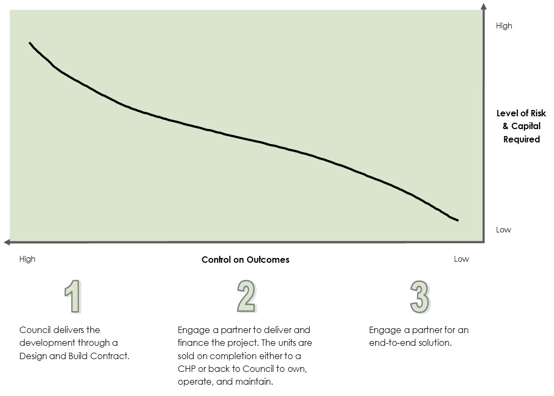
4.3 At
one end of the spectrum, Council would fund and deliver the project themselves
(Option 1). This presents the highest risk on balance, but Council has
direct control on the outcome. Council should also consider the
whole-of-life costs that this option entails, which is detailed in Appendix
1. It is also important to note that this option will not be cost
positive over its life, as with the balance of Council’s social housing
portfolio.
4.4 The
complete opposite delivery approach is where Council could sell or lease the
land to a partner for an end-to-end solution (Option 3). This is a lowest
risk option, with the trade-off being that Council would also have limited
direct control over the outcomes. Note, that the control on outcomes
could be enhanced by including a land covenant or development terms on the sale
or lease agreement of the land to the partner.
4.5 Option
2 sits in the middle of these.
4.6 The
below table provides a comparison between the three options through six critical
considerations:
1. Achievement
of housing outcomes.
2. Debt
and capital required.
3. Operational
expenditure.
4. Ownership
of the asset.
5. Control
and risk appetite; and
6. Achievement of social
outcomes.
|
|
Option
1
|
Option
2
|
Option
3
|
|
Housing Outcomes
|
Council’s desired
medium-density, social housing outcomes can be achieved as Council is
directly delivering the project.
|
Council’s desired medium-density, social housing outcomes can
be achieved through a partnership agreement.
|
Council’s desired medium-density, social housing outcomes can
be achieved through a partnership agreement.
|
|
Debt and Capital
|
The development is estimated to cost circa $20 - $30 million.
Council can use $4M from the better-off funding to contribute to this
project, though this may be retracted/redirected by Central Government.
Council has agreed that Programme 1459 can be used as a contribution
to this development.
There is likely to be a funding shortfall requiring additional
funding unless delivered in stages.
|
Council can use $4M from the better-off funding to contribute to this
project, should a capital contribution be required, though this may be
retracted/redirected by Central Government.
The partner will fund all or the remainder of the development.
Council could come out of the project cost-negative if Council were
required to purchase or lease units upon completion. This may be a
requirement for the development partner.
|
Council can use $4M from the better-off funding to contribute to this
project, should a capital contribution be required, though this may be
retracted/redirected by Central Government.
The partner will fund all or the remainder of the development.
|
|
Operational Expenditure
|
As this project would be increasing the Council-owned social housing
portfolio, an additional Tenancy Officer role would be required to maintain
the current level of service across the portfolio.
Additionally, the larger social housing portfolio would generate
increased operational, maintenance, and renewal costs over the life of the
assets. Officers have provided
some high-level modelling on what Summerhays Street would cost across the
next 10-year period in Appendix 1.
|
If Council were to purchase the housing upon completion of the
project, this will likely again trigger the need for an additional Tenancy
Officer who are currently at capacity.
Equally as with Option 1, the operational costs moving forward of
increasing the housing portfolio will be borne by Council. Again,
please refer to Appendix 1 for high-level financial modelling of Summerhays
Street.
|
No operational expenditure required as a partner will operate and
maintain the finished complex.
|
|
Ownership
|
Council would retain
ownership of the land and the newly built assets.
|
Council may share ownership of the land and the newly built
assets. A lease could be in place if ownership were not achieved.
|
A partner will own the finished complex.
|
|
Control/Risk
|
Council will have full control on design, timing, outcomes, and cost
of the development.
|
Council will have some control on the development, where Council
could provide input or requirements on the design, timing, outcomes, and
costs. Requirements could be put in place via an agreement/contract.
|
Council will have some control on the development, where Council
could provide input or requirements on the design, timing, outcomes, and
costs. Requirements could be put in place via an agreement/contract.
|
|
Social Outcomes
|
Council will be able to determine and execute agreed social outcomes
for the site.
|
Council may have to alter or compromise social outcomes for the
partner to achieve a financially viable project.
|
Council may have to alter or compromise social outcomes for the
partner to achieve a financially viable project.
|
5. Conclusion
5.1 All
three partnership options are considered valid and provide several benefits and
risks, and will deliver on Council’s aspirations and desired outcomes for
the site.
6. Next actions
6.1 Once
a partnership model is determined, a decision on how Council wishes to engage a
preferred partner will be explored i.e. proceed with a single preferred
partner, a shortlist of partners etc. This is discussed in the confidential
report titled ‘Summerhays Street Redevelopment- Expressions of Interest
Feedback’ to this 01 May 2024 meeting.
7. Outline of community engagement process
7.1 No
specific wider community engagement has been undertaken about seeking partners
for the redevelopment of 17-19 Summerhays Street, however, Council has
previously signalled its intention to repurpose the site for housing.
Compliance and administration
|
Does Council have delegated
authority to decide?
|
Yes
|
|
Are the decisions significant?
|
No
|
|
If they are significant do, they
affect land or a body of water?
|
No
|
|
Can this decision only be made
through a 10 Year Plan?
|
No
|
|
Does this decision require
consultation through the Special Consultative procedure?
|
No
|
|
Is there funding in the current
Annual Plan for these actions?
|
Yes
|
|
Are the recommendations
inconsistent with any of Council’s policies or plans?
|
No
|
|
The recommendations contribute
to Goal 1: An Innovative and Growing City
|
|
The recommendations contribute
to the achievement of action/actions in City Growth
The action is: Collaborate with
the development community and Kāinga Ora on delivery of new housing
developments and diverse forms of housing, such as duplexes, terrace housing,
apartments, and other multi-unit options.
|
|
Contribution to strategic
direction and to social, economic, environmental, and cultural well-being
|
Developing the Summerhays Street
site will contribute to housing outcomes (Goals 1 and 3).
|
|
|
|
Attachments
|
1.
|
Financial Modelling for Summerhays Street Redevelopment ⇩ 
|
|
Committee Work Schedule
TO: Council
MEETING DATE: 1
May 2024
TITLE: Council
Work Schedule
RECOMMENDATION TO Council
1. That Council
receive its Work Schedule dated 1 May 2024.
COUNCIL
WORK SCHEDULE 1 May 2024
|
#
|
Estimated Report Date
|
Subject
|
Officer Responsible
|
Current Position
|
Date of Instruction & Clause
|
|
|
1 May 2024
|
2023 Residents Survey - Action
Plan
|
Chief Planning Officer
|
|
6 Sept 2023
Clause 144-23
|
|
|
1 May 2024
|
Development of a
Youth Wellbeing Plan - sector wide scan to identify strategic or service gaps
|
Chief Customer Officer
|
|
Community
Committee
22 November 2023
Clause 41.2-23
|
|
|
1 May 2024
|
Nature Calls Steering Group - Adoption
of Terms of Reference
|
Chief Infrastructure Officer
|
|
1 November 2023
Clause 180-23
|
|
1
|
15 May
2024
|
Hearings for the Long Term Plan 2024-34 AND
· Rates
Review
· Development
Contributions Policy
· Revenue
and Financing Policy
· Rates
Relief and Postponement Policies
· Fees
and Charges - Trade Waste and Planning
· Waste Management and Minimisation Plan
|
Chief Executive
|
|
Terms of Reference
|
|
2
|
29 May
2024
|
Deliberations of
the Long Term Plan 2024-34
|
Chief Executive
|
|
Terms of Reference
|
|
3
|
29 May 2024
|
Deliberations on
the Rates Review
|
Chief Financial
Officer
|
|
Terms of Reference
|
|
4
|
29 May
2024
|
Deliberations on
the Fees and Charges - Trade Waste + Planning
|
Chief Financial
Officer
|
|
Terms of Reference
|
|
5
|
29 May
2024
|
Deliberations on
Revenue and Finance Policy + Rates Relief and Postponement Policies
|
Chief Financial
Officer
|
|
Terms of Reference
|
|
6
|
29 May
2024
|
Deliberations on
Waste Management and Minimisation Plan (WMMP)
|
Chief Planning
Officer
|
|
Sustainability Committee
13 March 2024
|
|
7
|
29 May 2024
|
Deliberations on
Development Contributions Policy
|
Chief Planning
Officer
|
|
Terms of Reference
|
|
8
|
5 June 2024
|
Appointment of Trustees on Council Controlled Organisations
|
CE Unit Manager
|
|
Terms of Reference
|
|
9
|
5 June 2024
|
Remits received from other Territorial Authorities
|
CE Unit Manager
|
|
Terms of Reference
|
|
10
|
26 June 2024
|
Adopt Long Term
Plan 2024-34
|
Chief Executive
|
|
Terms of Reference
|
|
11
|
26 June 2024
|
Adopt Future
Development (FDS) Strategy – Recs from Steering group.
|
Chief Executive
|
|
Council
28 June
2023
Clause
109-23
|
|
12
|
26 June 2024
|
Adopt Fees and
Charges - Trade Waste + Planning
|
Chief Financial Officer
|
|
Terms of Reference
|
|
13
|
26 June 2024
|
Adopt Rating
System.
+ Strike the
rates.
|
Chief Financial Officer
|
|
Terms of Reference
|
|
14
|
26 June 2024
|
Adopt Revenue and
Finance Policy and Rates Relief and Postponement Policies
|
Chief Financial Officer
|
|
Terms of Reference
|
|
15
|
26 June 2024
|
Adopt the
Development Contribution Policy
|
Chief Planning Officer
|
|
Terms of Reference
|
|
16
|
26 June 2024
|
Adopt the Waste
Management and Minimisation Plan (WMMP)
|
Chief Planning Officer
|
|
Sustainability Committee
13 March 2024
|
|
17
|
7 August 2024
|
Civic and Cultural Precinct Master Plan Steering Group -
6-monthly update
|
Chief Planning Officer
|
|
Terms of Reference of the CCMP Steering Group
|
|
18
|
4 Sept 2024
|
Annual Review of Delegations Manual
|
CE Unit Manager
|
|
6 September 2023
Clause 147-23
|
|
19
|
2 Oct 2024
|
Food HQ Innovation Limited - Director's company progress
report
|
Chief Infrastructure Officer
|
|
6 September
2023
Clause 143-23
|
|
20
|
2 Oct 2024
|
Appointment of members to the District Licensing Committee
List.
|
CE Unit Manager
|
|
1 November 2023
Clause 190-23
|
|
21
|
30 Oct 2024
|
Adopt Annual Report 2023-24
|
Chief Financial Officer
|
|
Terms of Reference
|
|
22
|
27 Nov 2024
|
Appointment of CEDA Directors
|
CE Unit Manger
|
|
6 March 2024
Clause 23 -24
|
|
23
|
27 Nov 2024
|
Annual Report 2023-2024 - Performing Arts Trust
|
CE Unit Manger
|
|
Terms of Reference
|
|
24
|
11 Dec 2024
|
Annual Budget 2025/26
|
Chief Financial Officer
|
|
Terms of Reference
|
|
25
|
11 Dec 2024
|
City Revaluation – impact on rates
|
Chief Financial Officer
|
|
Terms of Reference
|
|
26
|
TBC
|
Report back on Investment Options for PN Airport
|
Chief Financial Officer
|
|
6 December 2023
Clause 197-23
|
|
27
|
1 March 2025
|
Exemption of Manawatū
Whanganui Disaster Relief Fund from being a CCO
|
CE Unit Manger
|
|
Terms of Reference
|
|
28
|
30 May 2025
|
Exemption of
Palmerston North Performing Arts Trust
|
CE Unit Manager
|
|
Terms of Reference
|
Recommendations
from Committee
TO: Council
MEETING DATE: 1
May 2024
TITLE: Presentation
of the Part I Public Culture & Sport Committee Recommendations from its 27
March 2024 Meeting
Set out below are the recommendations only
from the Culture & Sport Committee meeting Part I Public held on 27 March
2024. The Council may resolve to adopt, amend, receive, note or not adopt any
such recommendations. (SO 2.18.1)
|
9-24
|
Annual Sector Lead
Report: Creative Sounds Society Incorporated (The Stomach)
Memorandum, presented by Abi
Symes, Manager and Harry Fraser, Convenor, Creative Sounds Society
Incorporated (The Stomach).
The COMMITTEE
RECOMMENDS
1. That Council
refer the increase to Creative Sounds Sector Lead Grant (of an additional
$68,000 for 2024/5, and inflation adjusted for future years) to the Long-Term
Plan 2024-34 deliberations.
|
Recommendations from Committee
TO: Council
MEETING DATE: 1
May 2024
TITLE: Presentation
of the Part I Public Economic Growth Committee Recommendations from its 24
April 2024 Meeting
Set out below are the recommendations only
from the Economic Growth Committee meeting Part I Public held on 24 April 2024.
The Council may resolve to adopt, amend, receive, note or not adopt any such
recommendations. (SO 2.18.1)
|
20-24
|
Amendment to the
Appointment of Directors and Trustees Policy 2022 - Remuneration for
Directors/Trustees of Council Controlled Organisations.
Memorandum, presented by
Sarah Claridge, Democracy and Governance Advisor.
RECOMMENDATION TO Council:
1. That
Council adopt the draft Remuneration section (Attachment 1) to replace Part 1
section 12 Remuneration section of the Appointment of Directors Policy 2022.
|
|
24-24
|
Vogel Street Safety Improvements - Consultation
Feedback
Memorandum, presented by Bryce Hosking, Acting Group
Manager - Transport and Development.
RECOMMENDATION
TO COUNCIL
2.
That Council install three raised pedestrian crossings in Vogel
Street, and right hand turn bay into Featherston Street in FY2024/25.
|
|
25-24
|
Bus Shelter Civil
Works
Memorandum, presented by
Bryce Hosking, Acting Group Manager - Transport and Development.
RECOMMENDATIONS TO Council:
1. That
Council note that the total value of the civil works engagement with Fulton
Hogan to support the Bus Shelter Improvements project is $1,495,500 excl.
GST.
2. That
Council note that the Bus Shelter Improvements works have been directly
awarded to Fulton Hogan through separate work packages to ensure successful
delivery of the overall project within the required timeframes as specified
through the Transport Choices Funding Agreement.
|